AI in Healthcare
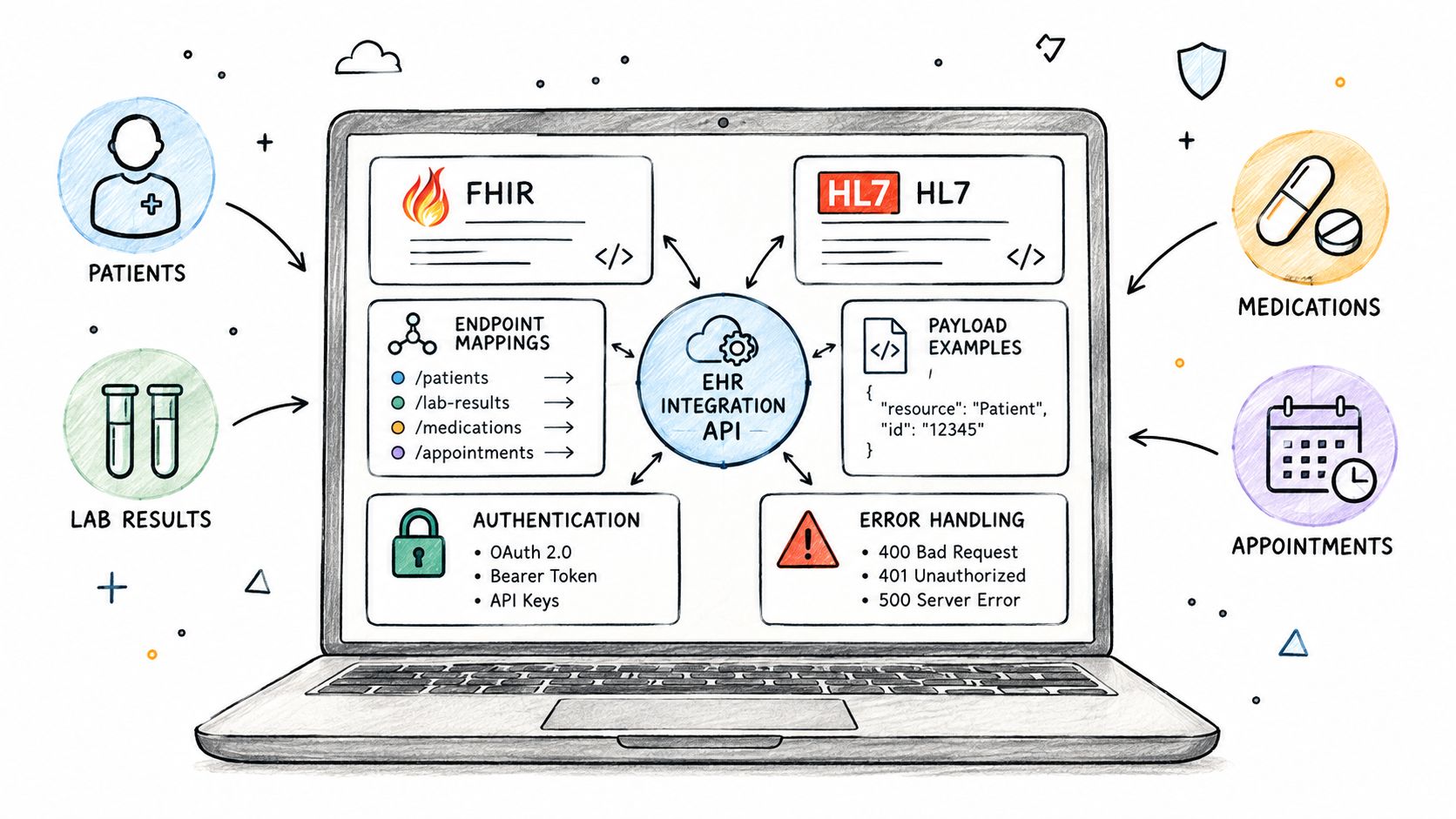
EHR Integration API: A Practical Reference Guide
A practical EHR integration API reference covering FHIR, HL7, endpoint mapping, auth, error handling, and best practices for healthcare teams.
October 06, 2026Read more
Discover how AI in healthcare operations transforms scheduling, revenue cycles, and workflows. Learn implementation strategies, ROI metrics, and governance.

The popular advice about AI in healthcare operations is to start with the most impressive model and find a workflow for it. That approach fails in hospitals because the difficult work starts after the demo. A model can summarize documents or predict demand, but it won't create an accountable process, resolve identity issues, connect safely to the EHR, or decide what happens when its output is uncertain.
The operational question is more practical: Can the organization embed AI into a reliable workflow without creating new clinical, financial, security, or compliance risks? Hospitals that answer that question well treat AI as an infrastructure capability, not an isolated data science experiment. They define ownership, measure workflow outcomes, and keep people involved where judgment matters.
High adoption doesn't automatically mean high maturity. In 2024, 71% of hospitals reported using predictive AI integrated with the electronic health record, up from 66% in 2023, according to the federal hospital predictive AI trends brief. That is a meaningful infrastructure shift, but it doesn't tell a CIO whether every deployment has clear ownership, dependable monitoring, or a safe escalation path.
The same brief found that 80% of hospitals using predictive AI relied on tools from their EHR developer, while 52% used third-party AI and 50% used self-developed AI. The pattern is revealing. EHR integration is becoming a practical requirement, yet hospitals still operate a mixed environment of vendor products, custom services, departmental tools, and manually coordinated processes.
Earlier survey research found that by 2022, 18.70% of U.S. hospitals, equal to 1,107 hospitals, had adopted at least one form of AI. Those deployments already included workflow optimization, routine task automation, patient demand prediction, staffing prediction, and staff scheduling, as documented in the Health Affairs Scholar adoption study. The trajectory shows how quickly operational use has expanded, but it also creates a measurement problem: a hospital may report AI use even when the technology remains narrow, poorly integrated, or dependent on manual workarounds.
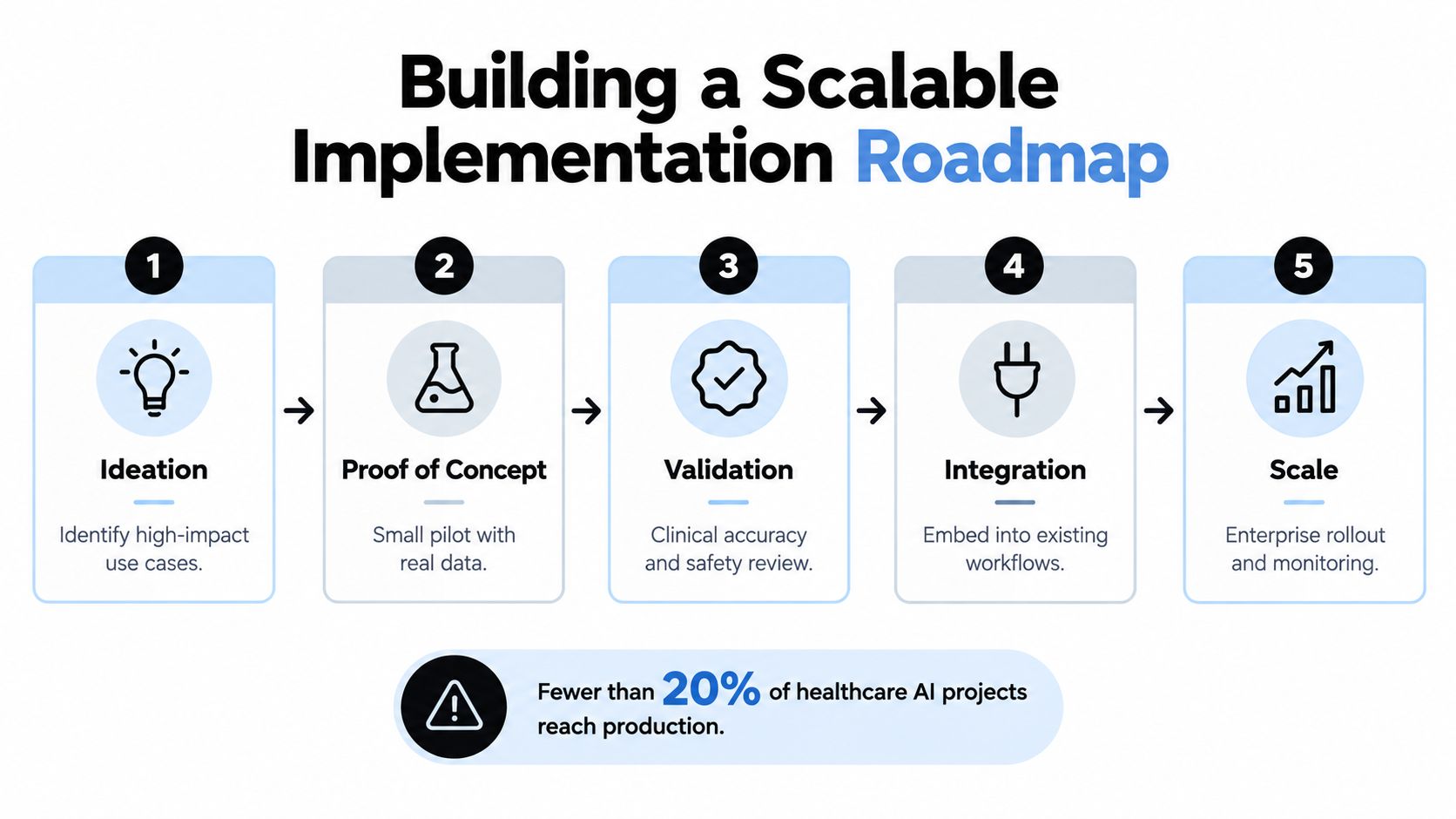
Bain's Healthcare AI Adoption Index makes the production gap explicit. Only 45% of AI applications in healthcare had moved beyond ideation or proof of concept, and only 30% of completed proof-of-concept projects had reached production. Experimentation is therefore not the scarce resource. Operational rollout is.
The governance risk becomes sharper with agentic tools. A 2026 survey reported that 72% of healthcare organizations had deployed agentic AI tools without formal IT approval, while 57% of leaders ranked security among their top three concerns and 50% cited compliance or regulatory violations as a concern, according to Healthcare IT Analytics reporting.
That creates a different class of operational failure. An employee may use an unsanctioned assistant to draft utilization-management correspondence, move protected data into an unapproved service, or trigger an action without an audit trail. The model may perform as expected, yet the workflow remains unsafe because nobody has defined permissions, retention, review, or accountability.
Practical rule: Treat every AI agent as a service identity with bounded permissions, logged actions, an accountable owner, and a documented fallback.
The bottleneck has moved from model availability to identity management, auditability, data quality, and organizational friction. A practical healthtech engineering partner can help connect those concerns, but the hospital still needs executive ownership. AI maturity means reliable operational control, not just a growing inventory of pilots.
High-value healthcare AI rarely starts with a general-purpose chatbot. It starts with a constrained bottleneck, clear performance criteria, and a workflow that can absorb a new decision point. Scheduling, revenue cycle work, demand planning, and administrative coordination fit that pattern because teams can measure delays, conflicts, rework, and handoffs before deployment.
Hospitals commonly apply predictive AI to patient trajectories and risk. Operational adoption is also growing around simplifying billing and facilitating scheduling, shifting AI from clinical decision support into the administrative core. The practical objective is narrower than replacing human judgment: reduce avoidable coordination work, then reserve review for exceptions and high-consequence decisions.
A filled roster can still leave a hospital short-staffed during demand peaks. Effective scheduling combines demand forecasts with constraints such as skills, availability, labor rules, coverage requirements, and patient acuity. It also needs a process for exceptions when forecasts are wrong or staff availability changes.
A 2026 hospital workforce-planning study reported LSTM forecasting with MAE 6.1 and R2 0.91, according to the study on hospital workforce planning. The study also reported a scheduling module that reduced conflicts by 41% and last-minute shift changes by 36%. Another scheduling result showed a 27% reduction in scheduling conflicts, 35% improvement in resource utilization, 18% decrease in patient wait times, and 31% reduction in administrative overhead, according to the same study.
Those figures support the case for structured workforce systems, not for copying a model into another hospital. Results depend on local data quality, constraint definitions, exception handling, and whether schedulers trust the recommendations enough to use them.
AI can assist with billing simplification, coding, document intake, claim preparation, and scheduling coordination. These workflows combine structured records with unstructured correspondence, so a hybrid design is usually safer. Deterministic rules execute approved actions, while AI extracts information, identifies missing evidence, or recommends the next step.
For a prior authorization workflow, the system can gather supporting records, flag missing documentation, prepare a draft, and route an exception to a reviewer. It should not approve or deny a complex case solely because a language model produced a confident response. Human review belongs at the points where context, policy interpretation, or financial risk can change the outcome.
| Operational Area | Traditional Metric | AI-Enhanced Outcome |
|---|---|---|
| Workforce scheduling | Conflicts, late changes, wait times | Forecast-led assignments, fewer conflicts, better utilization |
| Revenue cycle | Manual billing and documentation effort | Assisted billing workflows with reviewable recommendations |
| Patient flow | Queue length, delays, handoff time | Demand-aware coordination and exception routing |
| Administrative work | Routine task volume and overhead | Human-in-the-loop automation with auditable escalation |
| Quality and safety | Retrospective review and incident follow-up | Earlier signal detection, with human validation before action |
A real-world use cases library gives teams patterns to compare, but local workflow mapping still determines whether a design will work. Use workflow automation when a process has clear states, repeatable rules, and an accountable owner. If staff cannot describe the process consistently, automate the definition and ownership first.
EHR integration rarely fails because an API is unavailable. The difficult work is establishing identity, preserving clinical context, controlling write-back permissions, handling event timing, tracking data provenance, and managing recommendations when the source record changes.
Native EHR tools often have a practical advantage. 80% of hospitals using predictive AI relied on their EHR developer's tools, as reported in the 2024 federal predictive AI brief. Third-party and custom systems can still deliver value, but they must pass security review, define reliable data contracts, provide observability, support clinical validation, and remain maintainable after deployment.
A 2026 Microsoft survey found that 97% of respondents said data silos already affected their ability to deliver timely care, while 58% said they were ready to introduce AI agents into care coordination and administrative workflows, according to the RSM healthcare AI accountability report. That gap creates a predictable operational risk. Organizations can deploy agents before resolving the fragmented data, permissions, and ownership structures those agents require.
Shadow IT makes the problem harder. A department may adopt an external assistant to summarize referrals or retrieve records before enterprise security, privacy, and retention controls are in place. The resulting system can create duplicate work, expose sensitive data, or produce recommendations that no accountable team owns.
A safe integration layer should identify the authoritative system, define reconciliation rules, limit the fields an agent may read or write, and log every recommendation and action. It should expose uncertainty and preserve provenance. Staff need to see which records informed an output, when those records were current, and whether a human changed the result.
U.S. state regulation is expanding around transparency, human oversight, autonomous clinical decisions, insurer prior authorization, claims decisions, and disclosure when AI is used in care settings, as summarized in this 2026 legal update on state healthcare AI regulation. In the EU, the Chambers healthcare AI guide reports that requirements previously due in August 2026 have been deferred to December 2027 for stand-alone systems and August 2028 for AI embedded in regulated products, including medical devices.
Hospitals should establish operating controls before every rule is settled: a risk classification, approval gate, model and prompt inventory, access policy, review threshold, incident process, and monitoring plan. A regulatory compliance partner such as MedQair can support this work when operational software intersects with clinical risk or regulated product obligations.
For SaMD solutions, define intended use, validation evidence, change control, post-deployment monitoring, and the boundary between assistance and autonomous decision-making. Operational AI may not be classified as a medical device, yet it can still affect patient access, staffing, billing, and care coordination. Those effects belong in the risk assessment.
Production success depends less on selecting the most advanced model than on choosing a workflow the organization can own. Start with a narrow process, measure its current performance, and define permitted AI actions before building a prototype. The last mile is usually constrained by governance, shadow IT, and EHR integration, not model capability.
Select a constrained bottleneck. Choose a process with visible demand, repeatable states, accessible data, and a named operational owner. Scheduling exceptions, referral intake, documentation collection, and coding review are easier to control than an undefined goal such as “improve clinical efficiency.”
Map the current state. Record every handoff, queue, approval, system interaction, exception, and manual workaround. AI requirements analysis is useful at this stage. Teams must identify each input's source, the person acting on the output, and the EHR or operational system that carries the state. Use a structured AI delivery framework to guide the work from discovery through production.
Set operational KPIs. Time saved is only one measure. Track completion quality, rework, exception volume, wait time, staff adoption, patient impact, safety signals, and how often humans overturn recommendations. Faster processing is not an improvement if it creates downstream corrections.
Pilot with real constraints. Use representative data, edge cases, access controls, and failure handling. Keep the pilot small enough to observe, while exposing integration delays, permission gaps, and adoption problems. Block unapproved shadow tools from becoming the de facto workflow by giving staff a supported path for testing and escalation.
Long-horizon administrative work shows why autonomy is difficult. A recent benchmark examined provider prior authorization, payer utilization management, and care management workflows that require state tracking across policies, applications, evidence, roles, and handoffs. The best agent resolved only 28% of tasks at pass@1, while end-to-end prior authorization automation fell to 0%, according to the healthcare administrative agent benchmark.
That result supports partial automation. Build internal tooling that displays the agent's evidence, current state, pending action, confidence, and next responsible person. A reviewer should correct an output without restarting the process. The interface should also record the correction, so recurring failure patterns can inform workflow rules and future evaluation.
The safest automation does not hide the exception. It makes the exception easy to understand and quick to resolve.
Use an AI Product Development Workflow covering validation, security review, workflow training, staged rollout, and post-launch monitoring. Moving from pilot to production requires organizational change as well as technical deployment. The queue manager, reviewing clinician, and integration-support team each need defined responsibilities.
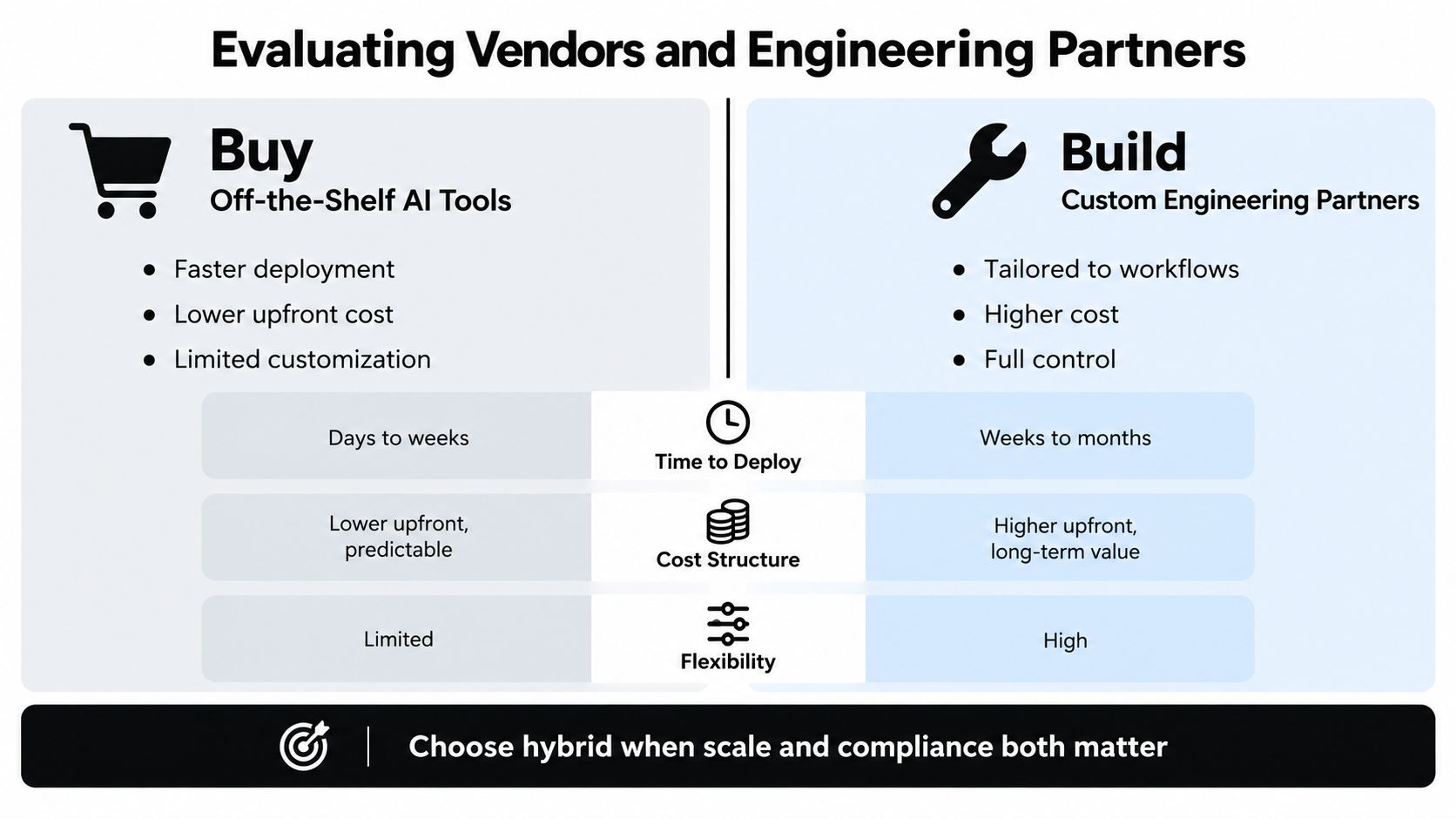
Buying an AI product is sensible when the workflow is standardized, the required integration already exists, and the hospital needs a controlled deployment quickly. Custom engineering is more defensible when the process depends on local EHR configuration, specialized rules, proprietary data, or audit requirements that generic software cannot support.
The decision is about control boundaries. Standardize repeatable capabilities, while retaining ownership of patient-data flows, permissions, exception handling, and operational evidence.

| Decision criterion | Off-the-shelf product | Custom engineering approach |
|---|---|---|
| Deployment | Faster when integrations and processes match | Slower because discovery and validation are deeper |
| Workflow fit | Strong for standardized use cases | Strong for local rules, exceptions, and complex handoffs |
| Control | Depends on vendor roadmap and configuration | Greater control over data flow, permissions, and behavior |
| Support | Product support and release cycle | Dedicated engineering and operational ownership |
| Commercial risk | Potential vendor dependence | Higher internal responsibility and maintenance burden |
AI tools for business can handle structured administrative tasks when the vendor documents data handling, access control, logging, and export options. An AI Automation as a Service model can support narrow automations without requiring the hospital to build every platform component. Intake, routing, and document-heavy work are practical starting points, provided ownership and escalation paths are defined.
Custom engineering fits hospitals that need deep EHR integration, a specialized rules engine, or workflows that must change with internal policy. Buyers exploring custom healthcare software development paths should establish who owns testing, monitoring, incident response, integration maintenance, and upgrades after launch. Otherwise, a technically successful pilot can become another unsupported system.
Also test the last mile before signing. Ask for a production-like integration exercise, clear handling of rejected or delayed EHR events, and evidence that audit records remain available during incidents. A vendor that demonstrates model accuracy but cannot explain queue ownership, rollback procedures, or data retention is not ready for hospital operations.
For deeper integration, an implementation support partner should be evaluated on engineering discipline as much as healthcare terminology. Healthcare AI Services need to fit the organization's data architecture and operating model, not merely present a polished interface.
Start with discovery rather than punishment. Ask departments which tools they use, what data they process, what outputs they create, and whether those outputs influence patient access, claims, scheduling, or care decisions. Then classify the workflows by risk and provide an approved path for low-risk experimentation.
Block unapproved transfers of sensitive data where necessary, but also give staff a safe alternative. Every approved agent should have an owner, identity, permission boundary, audit log, retention policy, review threshold, and shutdown procedure. Governance works when it is easier to use the approved route than to bypass it.
Prior authorization is a multi-step process, not a document classification task. The agent must track payer rules, evidence requirements, missing information, submissions, responses, deadlines, and handoffs. The administrative agent benchmark shows why full autonomy is premature, with the best system resolving 28% of tasks at pass@1 and end-to-end prior authorization automation reaching 0%.
Use AI to gather evidence, identify gaps, draft correspondence, and route cases. Keep a trained reviewer responsible for uncertain or consequential decisions, and measure the quality of escalations rather than treating every handoff as failure.
Measure the whole workflow. Pair productivity indicators with quality, service, safety, and financial measures.
A useful ROI model includes the cost of integration, monitoring, training, review, and failure recovery. If those costs remain invisible, the business case is overstated.
AI in healthcare operations has moved into real workflows, but adoption alone doesn't create value. The organizations that progress from pilots to dependable capability make three choices early: they connect AI to the EHR and surrounding systems, they assign ownership for every automated action, and they design human escalation into the process.
That is why AI strategy consulting should begin with operating-model questions rather than a model catalog. A Custom AI Strategy report can help prioritize use cases, define readiness requirements, map integration dependencies, and establish measurable implementation stages. Leaders should also assess whether they need internal tooling, workflow services, or a regulated product pathway before committing to a vendor.
Ekipa AI works with digital health teams on healthcare software, EHR integrations, clinical workflows, AI adoption, and compliance engineering. The work is most useful when it starts with a specific bottleneck and ends with an accountable production system. Review our expert team when you need a partner for the technical and operational decisions between pilot and scale.
Ekipa AI helps hospitals and healthtech companies define practical AI use cases, integrate them with existing healthcare systems, and build governed workflows with human oversight. Visit Ekipa AI to discuss your operational bottleneck and identify the next production-ready step.
A practical EHR integration API reference covering FHIR, HL7, endpoint mapping, auth, error handling, and best practices for healthcare teams.

Practical guide to ehr software development covering architecture, FHIR interoperability, HIPAA, security, testing, and team choices for healthtech leaders.
Master branch deep links for healthcare apps. Learn SDK setup, routing, deferred deep linking, and mobile/desktop behavior
Connect with our team to explore how AI expertise can transform your business.