AI in Healthcare
AI Transformation Healthcare Industry Explained
Learn what AI transformation healthcare industry means, from EHR integration to governance, ROI, and adoption roadmap for healthtech leaders.
September 23, 2026Read more
Explore proven strategies for AI powered innovation. Learn how industry leaders drive real business transformation with practical frameworks.
Imagine a factory where machines predict their own maintenance needs, or a retail app that suggests products you didn't even know you wanted. This is the new reality shaped by AI-powered innovation, but it’s vital to understand what makes it different from just installing new software. True AI innovation isn’t about small upgrades; it’s about completely rewiring how a business thinks, operates, and creates value.
Think of it this way: giving a cartographer a faster horse helps them map a known route quicker. Giving them a GPS, however, opens up entirely new possibilities for exploration. AI is the GPS. It doesn't just speed up old processes; it creates brand-new ones.
This is a step beyond simple automation. Traditional automation follows strict, pre-set rules (if X happens, then do Y). AI, on the other hand, learns and adapts. It's designed to spot patterns and make decisions in complex, unpredictable situations. The difference is like that between a basic calculator and a seasoned financial analyst. The calculator executes commands perfectly, but the analyst interprets data, identifies trends, and provides strategic advice. This distinction is crucial because adopting AI requires a completely different mindset.
This distinction is crucial because adopting AI requires a completely different mindset. AI strategy consulting firms like Ekipa ai are designed to empower businesses, helping them harness intelligent automation to drive transformation.
So, what makes AI-powered innovation genuinely different? It's not a single piece of technology but a combination of several key elements working together. These are the building blocks that let organisations move from basic automation to intelligent, adaptive operations. These core elements include:
Learning and Adaptation: Unlike static software, AI systems get better over time. They analyse new data to refine their performance, becoming more accurate and effective with each interaction.
Data-Driven Decisions: At its heart, AI runs on data. It moves decision-making from being based on human intuition alone to a blend of human expertise and data-backed insights. This often uncovers opportunities that would otherwise go unnoticed.
Predictive Capabilities: Instead of only reacting to past events, AI can forecast future outcomes. For example, Amazon uses a sophisticated AI model to predict regional product demand, making sure items like sunscreen are stocked in Brighton before a heatwave is even announced.
This new approach isn't a niche trend; it's a major economic force. The Generative AI market in the Netherlands alone is projected to reach approximately US$1.34 billion in 2025. This figure is a clear sign of its rapid adoption and financial impact. You can learn more about this growth in the latest market analysis.
This growth shows that AI-powered innovation is becoming a cornerstone of modern business strategy. To implement it well requires more than just technical skill; it needs a new way of thinking about problems and solutions. It's about building a system that doesn’t just follow instructions but actively adds to the business's intelligence and evolution, a topic we explore further in our AI adoption guide. Understanding this concept is the first step toward creating a successful AI strategy framework that delivers real results.

The true value of AI-powered innovation isn't about running isolated experiments; it’s about fundamentally changing how a business operates and competes. Think of it as a capability multiplier, creating tangible results that go far beyond basic cost savings from automation. The most successful organisations use AI to find new sources of revenue, build deeper customer connections, and secure a major operational advantage. This happens when businesses shift from making reactive decisions to building proactive, data-informed strategies.
For instance, companies are now analysing huge datasets of customer behaviour to spot subtle trends. This allows them to anticipate what customers will want next, creating highly personalised experiences that were once impossible to scale. Imagine a system that predicts customer needs before they are even expressed—that's the power of AI. It allows businesses to move from simply responding to market demands to actively shaping them.
Looking for inspiration for more AI-powered innovation ideas? Explore the AI use cases here or you can even plan your use case here.
The effects of AI are rarely limited to one department. Instead, they cascade throughout an organisation, creating a chain reaction of improvements. An efficiency gain in the supply chain can lead to more effective marketing and better customer service. It's this interconnectedness that generates the most significant value.
The Netherlands offers a compelling real-world example of this on a national scale. Its ecosystem of 6,100 innovative digital businesses, which employ around 150,000 people, are on average 90% more productive than other companies in the country. This remarkable productivity boost is directly linked to the strategic use of technologies like AI. You can find out more about the Dutch digital business landscape and its AI opportunity.
To see how this works in practice, let's compare traditional business methods with their AI-powered counterparts. The following table shows how AI is making a difference across several key functions.
|
Business Function |
Traditional Approach |
AI-Powered Innovation |
Productivity Gain |
|---|---|---|---|
|
Marketing |
Broad demographic targeting; manual A/B testing. |
Hyper-personalised campaigns based on predictive behaviour; automated optimisation. |
Up to 20% increase in campaign ROI |
|
Sales |
Manual lead scoring and gut-feel follow-ups. |
AI-driven lead prioritisation; accurate sales forecasting. |
10-15% uplift in sales conversions |
|
Customer Service |
Reactive support via call centres; long wait times. |
Proactive issue resolution with AI chatbots; real-time sentiment analysis. |
25% reduction in support ticket volume |
|
Operations |
Scheduled, calendar-based maintenance routines. |
Predictive maintenance alerts that prevent equipment failure before it happens. |
30% decrease in machine downtime |
This comparison highlights a clear shift from reactive, labour-intensive work to proactive, intelligent automation. The result is not just doing the same things faster, but doing entirely new things that create more value.
This fundamental change requires a new way of measuring success. While traditional Return on Investment (ROI) is still relevant, it often fails to capture the full picture of AI's contribution. Key Performance Indicators (KPIs) need to evolve to track metrics that reflect strategic growth, such as:
Customer Lifetime Value (CLV): How has AI-driven personalisation boosted long-term customer loyalty and spending?
Speed to Market: How much faster can new products be developed and launched using AI-generated insights?
Operational Resilience: By how much has predictive maintenance reduced costly, unplanned downtime?
By focusing on these strategic outcomes, organisations can appreciate the true, compounding value of their AI initiatives. This approach is key to building a successful strategy, which can be guided by platforms like an AI strategy consulting platform that helps identify these high-impact opportunities. The aim is not just small improvements but the creation of a durable competitive edge.
Jumping into AI powered innovation without a clear plan is like trying to build a performance race car without blueprints. You might end up with expensive parts that don’t fit together, leading to a spectacular failure. A successful rollout depends on a solid strategy that connects technology with real business needs. The most common mistake is starting with the technology—chasing the latest AI model—instead of starting with the business problem you need to solve. True breakthroughs happen when AI projects are directly tied to wider company goals, making sure every investment delivers clear results.
The first step in building a winning strategy is to honestly assess your organisation's readiness. This means looking beyond just technology and checking three critical areas:
Data Infrastructure: Is your data easy to access, clean, and relevant? AI models are only as good as the data they learn from. Without a solid data foundation, even the most powerful AI will stumble.
Talent and Skills: Do you have the right people to guide the project? This doesn’t just mean data scientists. It includes project managers, subject matter experts, and leaders who understand how to fit AI into existing workflows.
Organisational Culture: Is your company ready to embrace change? AI innovation often demands new processes and a willingness to experiment. A culture that resists change can stop an AI project before it even gets going.
An honest look at these areas will show you where you truly stand. It helps you find high-impact, low-complexity projects to build early momentum and show value, which is vital for getting long-term support from stakeholders. For a deeper look into building a cohesive plan, you can explore our detailed guide on creating an AI strategy framework.
Once you understand your readiness, the next step is to match potential AI projects with core business objectives. This ensures your efforts aren't just technical exercises but are actually helping the bottom line. A structured framework can help you prioritise projects based on their potential impact and how feasible they are.
The image below shows an example of a strategic framework used to connect AI capabilities to specific business outcomes.
This framework visually maps how foundational AI elements like data and infrastructure support specific use cases, which then drive key business results such as increased revenue or improved efficiency. By using a structured approach like this, organisations can avoid common issues like scope creep and ensure every AI project has a clear purpose and a defined path to value. This strategic alignment is the foundation of building a sustainable programme for AI powered innovation that grows with your business. It turns AI from a series of separate projects into a connected engine for continuous growth and adaptation. This methodical approach is essential for turning ambitious ideas into reality.
While strategies and theories are useful, nothing shows the true potential of AI powered innovation like seeing it work in the real world. Organisations are already using AI to solve difficult challenges, proving that these advancements are not just about technology but about fundamentally changing how businesses operate. These success stories offer a practical roadmap, showing what it takes to turn a big idea into a real operational advantage.
To help organisations see what’s possible, our platform provides a broad collection of vetted, real-world use cases. The image above gives you a peek into our use case library, where you can filter applications by industry and business function. This visual library makes it easy for leaders to find relevant examples that reflect their own operational hurdles and strategic ambitions.
By looking at these success stories, we can trace the journey from identifying a problem to launching a complete AI solution, including the adjustments and learning that happened along the way. These practical details about timelines, team structures, and managing change are often what makes an initiative successful instead of becoming an expensive, forgotten project.
Think about the global e-commerce company Amazon, which uses AI powered innovation to fine-tune almost every part of its massive logistics network. One of its most impressive achievements is an AI-driven demand forecasting model. In the past, planning inventory was mostly based on historical sales data. Amazon’s current system, however, does much more. It analyses complex factors like local weather, regional events, and holiday schedules to predict exactly what customers will want, where, and when.
This goes beyond just stocking more sunscreen in coastal areas during summer. The model delivers extremely accurate regional forecasts, resulting in a 20% improvement in predictions for millions of popular items. The immediate benefits are significant:
Faster Deliveries: Products are already stored closer to the customer, allowing for quicker shipping, sometimes even on the same day.
Increased Efficiency: Delivery partners travel shorter distances, which lowers fuel use and operational expenses.
Reduced Carbon Footprint: Well-planned routes and fewer unnecessary shipments help meet environmental sustainability targets.
This case shows how a single AI project can produce a chain reaction of benefits throughout an organisation, boosting customer satisfaction, operational efficiency, and corporate responsibility all at once. It’s a compelling example of moving from simple automation to intelligent, predictive operations.
The influence of AI is not just in logistics. In the world of digital content and gaming, NVIDIA is using AI to expand the limits of what is visually achievable. Their RTX Neural Shaders embed small, trained neural networks directly into the graphics pipeline. One such application, RTX Neural Texture Compression, uses AI to compress thousands of high-resolution textures with great efficiency.
The outcomes are substantial. Neurally compressed textures can save up to 7x more VRAM or system memory than traditional methods, while keeping the same visual quality. For game developers and digital artists, this is a major breakthrough. It lets them build richer, more detailed virtual worlds without the performance issues that previously held back their creativity. This demonstrates how AI can solve persistent technical problems, paving the way for new forms of creative expression.
These accounts from Amazon and NVIDIA are just two examples of how strategic thinking can turn technology into a competitive advantage. They underscore that successful AI powered innovation is about pinpointing a core business problem, whether it's delivery speed or graphics performance, and applying AI as a focused, effective solution. For guidance on your own journey, connecting with our expert team can provide the specialised knowledge needed to navigate these complex but rewarding transformations.
Bringing AI-powered innovation into your organisation isn't a single action but a sequence of well-planned steps. A clear roadmap is crucial for managing risks, building momentum, and making sure new technology delivers real business results. This process takes you from initial exploration to full-scale use, with a steady focus on solving specific business problems rather than just adopting technology for its own sake.
The journey starts with a solid base of preparation and discovery. This is where you lay the groundwork for everything that follows by asking the right questions before looking for answers.
Before any code is written, the first step is to figure out where AI can make the biggest difference. This isn't about technology first; it's about the business first. Begin by mapping out your main operational hurdles and long-term goals. Are you trying to improve customer loyalty, cut down on operational downtime, or speed up product creation?
Once you have a clear picture of your business aims, you can start pinpointing potential AI applications that directly support them. A helpful method is to use a prioritisation framework that balances potential business value against how technically possible it is. This approach ensures you begin with projects that are both impactful and achievable, creating early successes that build confidence and get support from key people in the organisation.
To help with this essential first step, you could look into organised sessions like an AI strategy workshop, which is set up to help your team find and prioritise these valuable opportunities. Putting together a team with members from different departments is also key at this stage. This team should include not just tech experts but also specialists from marketing, operations, and finance who truly understand the business context.
With a promising use case chosen, the next stage is to launch a pilot project. You can think of this as a small-scale, controlled experiment to test your idea. The objective here isn't perfection; it's learning. The pilot lets you confirm the solution's effectiveness, understand its real-world challenges, and collect initial data on its performance and return on investment.
This is the phase where the technical work really gets going, progressing through key stages of data management and model development. The infographic below shows the common technical workflow for an AI project.
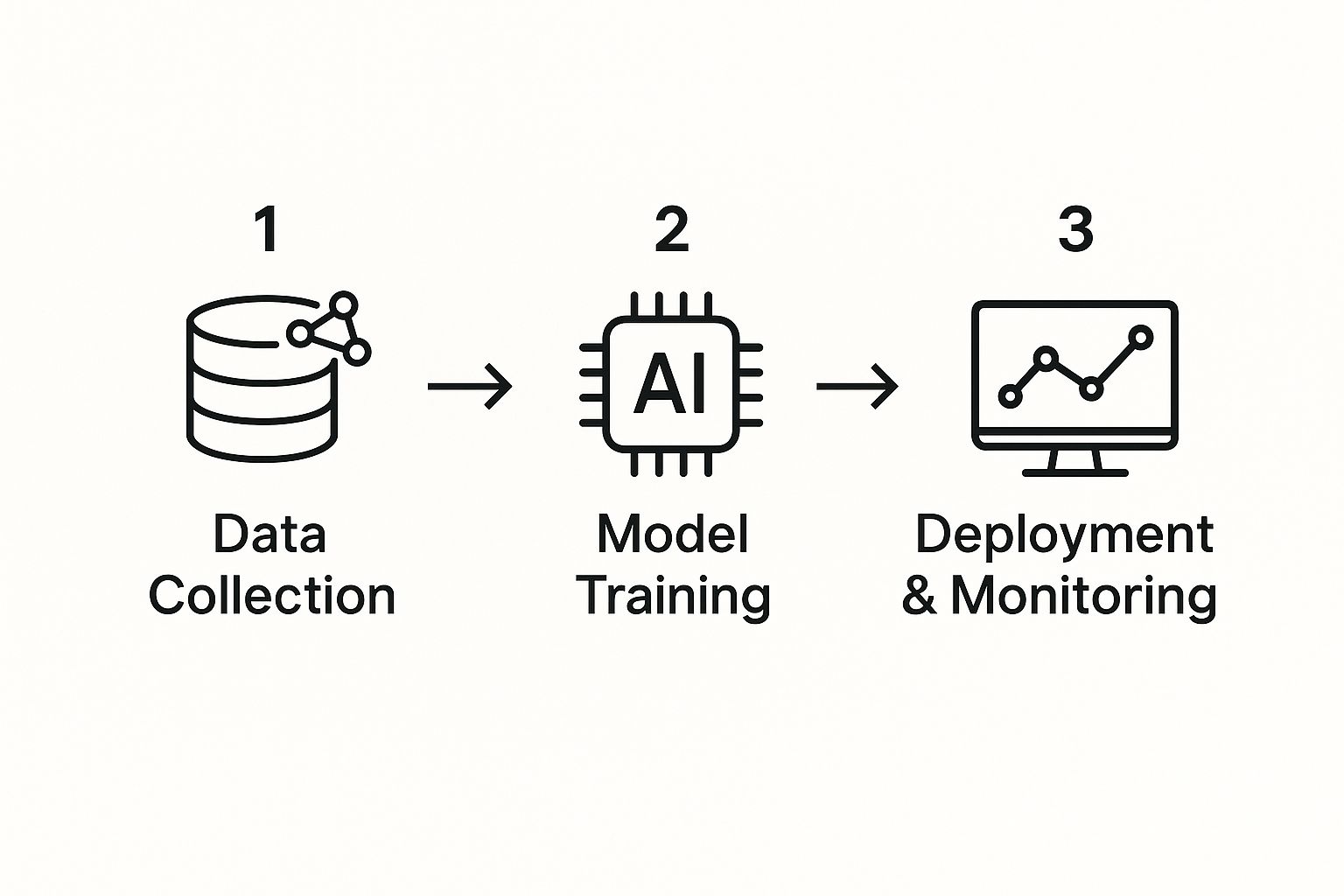
This visual illustrates the path from collecting raw data to training a working model and finally deploying it for real-world application. Ongoing monitoring is essential, as it creates the feedback loop needed to refine the model and make sure it adapts to new conditions over time. Success in the pilot phase is measured by clear metrics that were set during the discovery phase.
A well-structured plan is vital for navigating these phases smoothly. The table below outlines a typical timeline with key activities and goals for each stage of implementation.
|
Phase |
Duration |
Key Activities |
Success Metrics |
Resources Required |
|---|---|---|---|---|
|
1. Discovery & Strategy |
2-4 weeks |
Identify business challenges, brainstorm AI use cases, prioritise projects based on value vs. feasibility, form a cross-functional team. |
List of prioritised AI projects with clear business cases, stakeholder alignment, and defined success criteria. |
Business strategists, domain experts (e.g., from marketing, finance), AI/data specialists, workshop facilitators. |
|
2. Pilot Project |
2-4 months |
Data collection and preparation, model development and training, small-scale deployment, performance monitoring. |
Pilot achieves >80% of predefined success metrics, positive ROI is demonstrated, clear technical validation. |
Data scientists, machine learning engineers, data engineers, cloud computing platform, specific software tools. |
|
3. Scaling & Integration |
6-12+ months |
Full-scale deployment, integration with existing IT systems, develop governance and ethics policies, company-wide training. |
90% user adoption rate within the first year, measurable improvement in core business KPIs, established AI governance framework. |
Project managers, change management specialists, IT integration team, dedicated support staff, robust infrastructure. |
|
AI Implementation Timeline and Milestones |
|
|
|
|
|
Detailed breakdown of implementation phases with timelines and key deliverables |
|
|
|
|
This table highlights that AI implementation is a progressive journey, not an overnight switch. Each phase builds on the last, ensuring that the final solution is both technically sound and aligned with the organisation's strategic goals.
A successful pilot offers powerful evidence, but the true goal of AI-powered innovation is to create widespread, organisational change. The last phase involves expanding the proven solution across the whole company. This is often the most difficult step because it demands careful planning to maintain quality, manage change, and ensure smooth integration with current systems and daily operations.
To scale effectively, you need to establish strong governance structures to oversee the expanded programme. This means setting clear standards for data quality, model performance, and ethical use. It also involves creating a thorough training and change management plan to make sure employees have the skills and motivation to adopt the new AI-driven methods. Managing what stakeholders expect throughout this longer journey is vital, which requires open communication about progress, difficulties, and expected results. By following this phased approach, organisations can systematically turn ambitious AI ideas into real, scalable business benefits.

Starting a journey with AI powered innovation is exciting, but it's not a path without obstacles. Every organisation, no matter its size or industry, will encounter some bumps in the road. Being ready for these challenges ahead of time is often what makes the difference between a successful AI project and one that never quite gets off the ground. These hurdles can be technical, but just as often, they are human.
On the technical front, many issues come down to data and integration. You've likely heard the phrase 'garbage in, garbage out,' and it's a golden rule for AI. The quality of your AI's performance is directly tied to the quality of the data it learns from. Another common puzzle is getting a new AI system to work smoothly with your existing IT setup, which can require careful planning and skilled engineering.
Beyond the code and data, people are a huge part of the equation. Finding and keeping talent with the right AI skills is a well-known difficulty across many sectors. This skills gap means companies need to think creatively about training their current teams and fostering a culture that embraces ongoing learning.
Another significant barrier is resistance to change. Employees might worry that AI will make their jobs obsolete or disrupt familiar ways of working. The key to overcoming this is clear communication from leadership that shows how AI will support human roles, not replace them. When you involve employees in the process and show them how AI can automate tedious tasks, freeing them up for more interesting work, you can turn apprehension into advocacy.
The rules and regulations around AI are changing quickly, adding another layer of complexity. As governments around the world create new guidelines, it’s vital to build compliance into your AI strategy from day one. This isn't just about avoiding penalties; it's about earning the trust of your customers and partners.
Key areas to consider include:
Data Privacy: Making sure all data handling meets regulations like the GDPR.
Algorithmic Transparency: Being able to explain how an AI model makes its decisions is essential for fairness and accountability.
Ethical Principles: Creating a clear ethical framework to guide all AI-related decisions ensures your innovations are used responsibly.
In the Netherlands, the regulatory environment is shaped by the European Union's legal frameworks. The EU AI Act, which took effect on 1 August 2024, creates a clear set of rules for AI governance. This places the Netherlands at the forefront of promoting safe and responsible AI in Europe. You can find a detailed analysis of the Dutch approach to AI regulation.
By viewing these challenges not as roadblocks but as part of the process, you can build a strong foundation for your AI powered innovation and keep moving forward.
Launching an AI-powered innovation project is just the starting line. The real challenge is to accurately measure its impact and then successfully scale what works across your organisation. True success isn't defined by technical benchmarks like model accuracy, but by real, tangible business results. It means looking past surface-level metrics to focus on indicators that show long-term value and a lasting competitive edge. Without a solid measurement plan, a promising AI pilot can easily become a one-off success instead of a new capability for the entire business.
The first step is always to establish a clear baseline. Before you introduce a new AI solution, you need to understand your current performance inside and out. This "before" picture is the yardstick you'll use to measure all future progress, allowing you to quantify the "after" and prove the value of your investment. It helps you track improvements and catch any early signs of a project veering off course.
While technical performance is certainly important, the metrics that really matter to business leaders are tied to strategic goals. For example, instead of only tracking the accuracy of a predictive maintenance model, a more meaningful Key Performance Indicator (KPI) would be the reduction in unplanned machine downtime or the decrease in maintenance-related operational costs. These metrics link the AI’s function directly to business performance.
A practical way to measure this is through structured A/B testing designed for AI rollouts. You can implement the new AI-driven process for one business unit or customer group while another continues with the traditional method. This direct comparison delivers clear, quantifiable data on the AI’s real-world effects. Key areas to track include:
Operational Efficiency: Look for reductions in the time it takes to complete a process, lower error rates, or fewer resources needed for tasks.
Customer Experience: Monitor improvements in customer satisfaction (CSAT), Net Promoter Scores (NPS), or a drop in the volume of customer support tickets.
Revenue Generation: Track increases in conversion rates, customer lifetime value, or the emergence of entirely new sources of income.
This well-rounded approach to measurement ensures you capture the complete value your AI-powered innovation is creating.
Scaling a successful pilot project is one of the biggest hurdles in any AI journey. A solution that works perfectly for a small, dedicated team can be surprisingly difficult to reproduce across an entire enterprise. Success at this stage relies on a deliberate strategy for building internal skills, promoting a culture of continuous learning, and standardising processes.
A key part of scaling is creating internal centres of excellence. This means developing in-house expertise to lessen your long-term dependence on outside vendors. As your internal team's skills grow, they can champion AI adoption, share best practices, and make sure new projects align with the broader business strategy. This approach shifts AI from being a string of isolated projects to an integrated, self-powering engine for continuous improvement. It’s about moving from simply using AI tools to embedding an AI-first mindset into your organisation’s DNA.
Ready to turn your AI ideas into measurable, scalable impact? Ekipa’s AI strategy consulting platform provides the frameworks and expert guidance needed to navigate your AI transformation from initial use case to enterprise-wide success.
Learn what AI transformation healthcare industry means, from EHR integration to governance, ROI, and adoption roadmap for healthtech leaders.

Explore skilled nursing facility software in 2026. Covers core modules, compliance, KPIs, vendor evaluation, & AI integration for executives.

Unlock scalable impact with a practical healthcare AI transformation framework. This guide covers strategy, governance, ROI, and a phased roadmap for leaders.
Connect with our team to explore how AI expertise can transform your business.