AI in Healthcare
EHR Integration API: A Practical Reference Guide
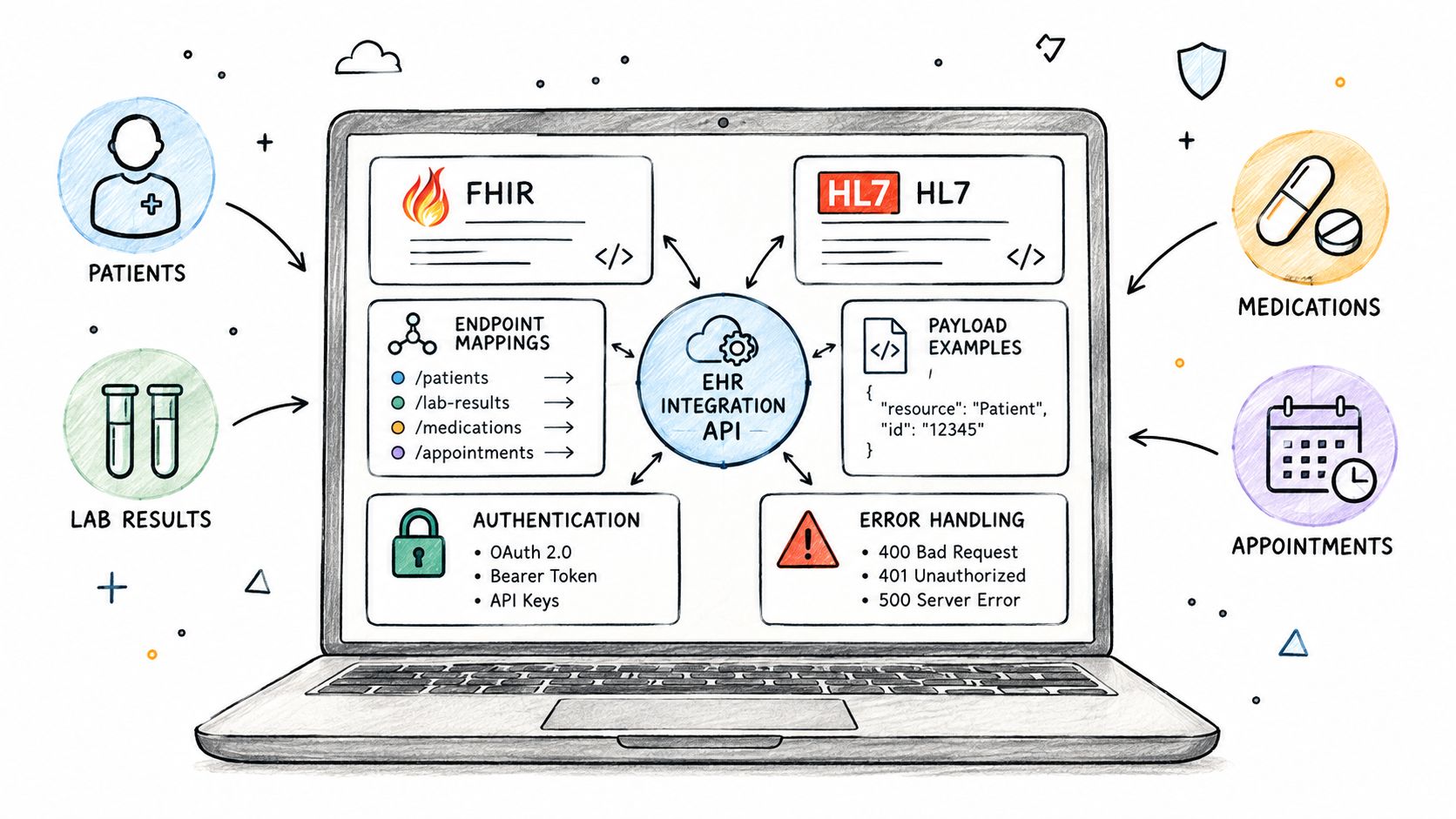
A practical EHR integration API reference covering FHIR, HL7, endpoint mapping, auth, error handling, and best practices for healthcare teams.
October 06, 2026Read more
A practical guide to healthcare data interoperability: FHIR, APIs, patient matching, governance, compliance, and an implementation roadmap with real trade-offs.
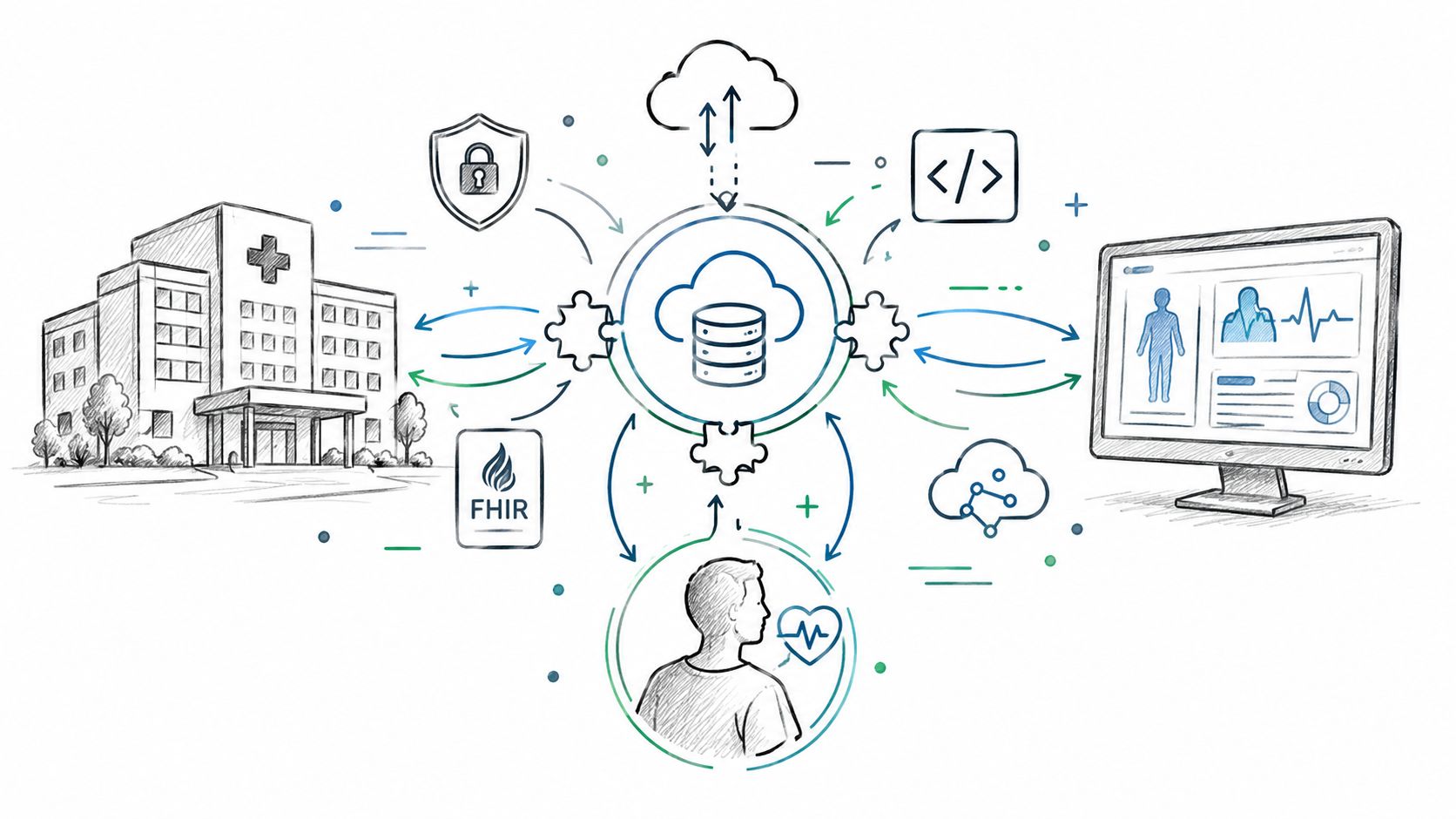
In the United States, the share of non-federal acute care hospitals engaging in all four core interoperability activities, sending, receiving, finding, and integrating patient information, rose from 23% in 2014 to 76% in 2025 (ONC hospital interoperability data). That looks like a standards success story. It is also an operational warning: health systems can exchange more data than their teams can clean, match, reconcile, and use.
Healthcare data interoperability has moved beyond the question of whether systems can connect. The harder question is whether an emergency department, payer, referral team, or clinical software product can turn incoming data into a trustworthy action. FHIR, HL7 v2, APIs, TEFCA, USCDI, terminology services, and patient matching all matter, but none of them fixes a workflow that presents clinicians with duplicate, incomplete, or context-free records.
A hospital leader in 2014 might have treated interoperability as a connectivity project. A CTO in 2026 is more likely to be accountable for a web of EHR integrations, payer APIs, health information networks, referral workflows, and patient-facing applications. The infrastructure has matured, but the operational burden has moved downstream.
Federal data shows the shift clearly. In 2023, 70% of hospitals engaged in all four interoperability domains at least sometimes, compared with 43% that routinely did so, up from 28% in 2018 (ONC's interoperability brief). In practice, that gap separates “the interface works” from “the care team can depend on the result.”
A referral platform may receive a clinical document, yet still fail if the medication list lands in the wrong field, the patient match remains uncertain, or the receiving clinician has to open another application to find the relevant lab result. The same pattern appears in payer integrations. An API can expose data without making the data clinically coherent or operationally useful.
Practical rule: Count the number of trusted decisions enabled by exchanged data, not the number of messages transported.
For leaders evaluating the future of Georgia healthcare technology, this distinction matters beyond one state or one EHR market. Regional providers, digital health vendors, and healthtech founders face the same constraints: limited engineering capacity, cautious compliance teams, and clinicians who won't tolerate another source of reconciliation work.
A capable Healthcare AI Services team can help map the data environment, design integration workflows, and identify where automation belongs. The useful work starts before implementation, with a clear account of what must arrive, what must be normalized, who reviews exceptions, and how the receiving system displays the result.
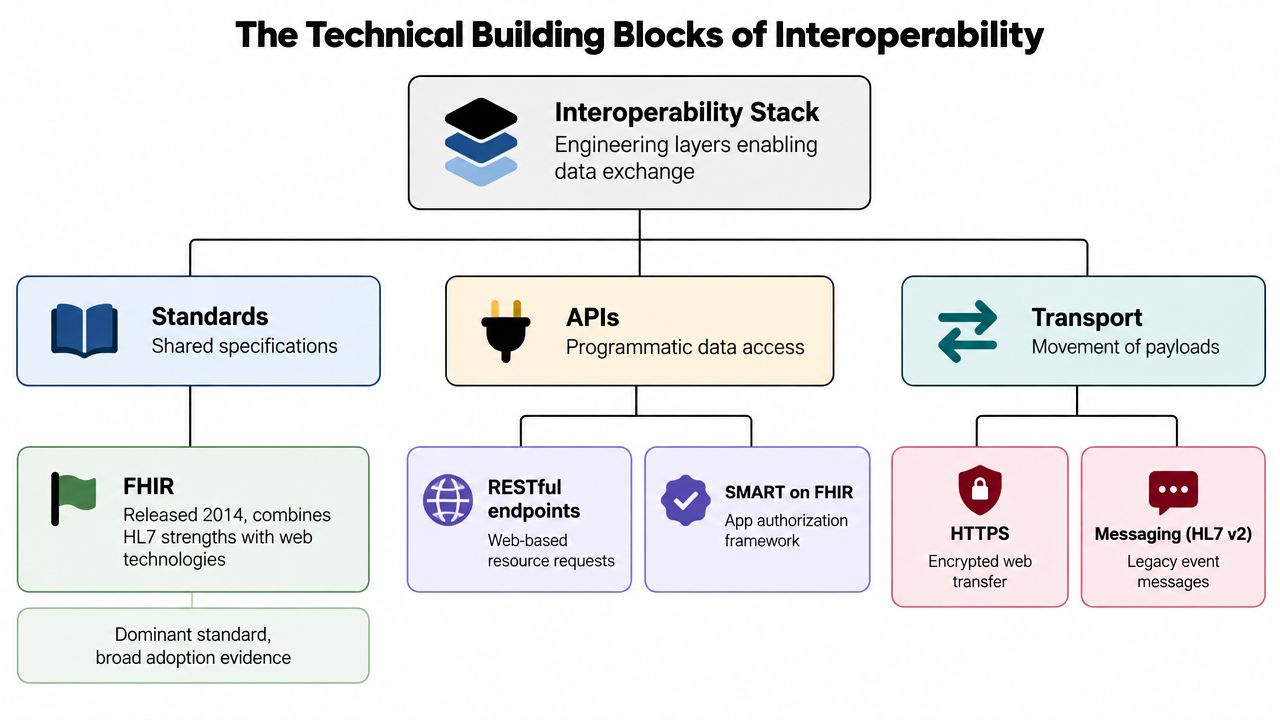
Interoperability needs two things at once: a shared language and a shared postal system. The shared language gives a blood pressure reading, allergy, medication, or diagnosis the same meaning in both systems. The postal system delivers that meaning to the right patient, endpoint, field, and workflow.
A system can have one without the other. An HL7 v2 message may travel reliably but contain local codes that the receiving application can't interpret. A FHIR API may expose well-structured resources while omitting the clinical context needed to decide whether a result is current, preliminary, or actionable.
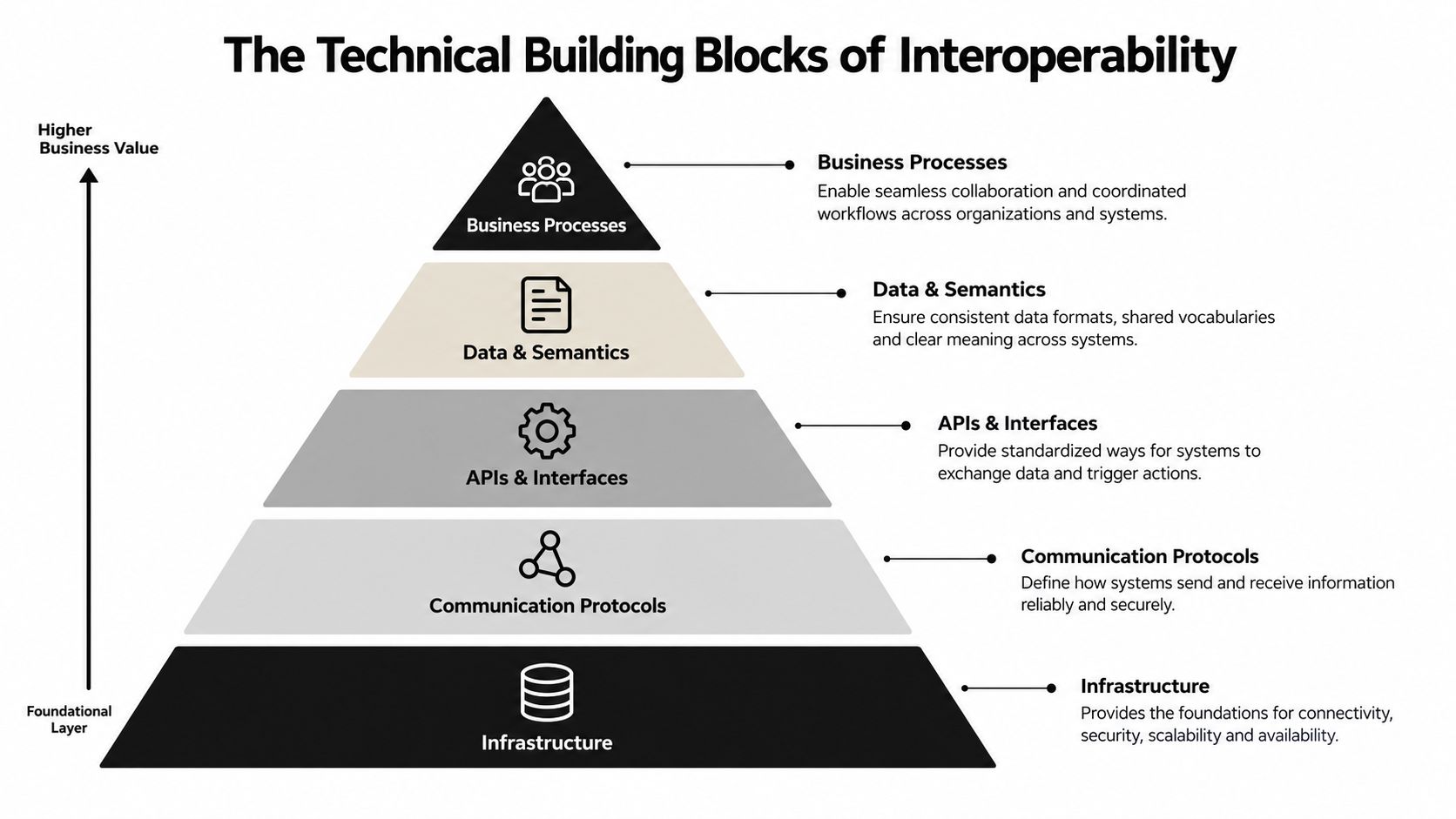
Foundational interoperability means systems can exchange data at all. A secure connection, message broker, or API provides the basic transport.
Structural interoperability means the receiving system understands the shape of the payload. A lab result has identifiable fields for the test, value, unit, reference range, status, and patient.
Semantic interoperability means both systems interpret the data consistently. A terminology service can map local laboratory codes to LOINC, medications to an agreed vocabulary, and clinical concepts to suitable SNOMED CT representations.
These levels create different failure modes. A transport error is visible. A semantic error can be harder to detect because the payload looks valid while the meaning is wrong or incomplete.
ONC measures interoperability across four operational domains: finding, sending, receiving, and integrating patient information (ONC's 2023 hospital exchange brief). The fourth domain is where many projects expose their real weakness.
A receiving EHR may accept a document without importing its medications into the reconciliation workflow. A care coordinator may locate a record but lack a usable view of the relevant history. A product may send observations successfully while dropping units, provenance, or status during transformation.
That changes the engineering definition of success. Interface monitoring should include successful ingestion, patient-match confidence, terminology conversion, chart reconciliation, clinician-visible availability, and exception handling. The most useful real-world use cases are therefore workflow-specific, such as closing a referral loop, presenting outside results during triage, or transferring a complete medication history during a care transition.
FHIR became central because it combined earlier HL7 standards with web technologies that support API-based exchange across EHRs, applications, and health information networks. HL7 released FHIR in 2014, and its resource model gave engineering teams a practical structure for representing patients, observations, medications, encounters, organizations, and other clinical concepts (HL7 adoption context from ONC).
FHIR is a modeling layer, not a finished architecture. Teams must define supported resources, applicable profiles, required elements, terminology bindings, and mappings from local data. An AI-powered data extraction engine can automate part of that mapping work, but engineers still need to validate extracted fields, provenance, confidence, and exception handling.
FHIR APIs provide programmatic access to resources instead of forcing every integration through document exchange. In 2022, more than two-thirds of hospitals used HL7 FHIR APIs for patient access, while four in five used APIs for applications that read from and write to the EHR (ONC API data).
Implementation details determine whether that exchange is useful. A resource is not merely a JSON container. Profiles, cardinalities, references, coding systems, and extensions determine whether another system can reuse the information without custom interpretation. Production integrations should keep canonical models and explicit transformation rules rather than spreading vendor-specific mappings through application code.
FHIR also has boundaries. In a JAMIA Open case study, converting the MIMIC-ED dataset to FHIR raised its FAIRness score from 60 to 82 out of 95, a 37% relative improvement, while the interoperability subscore rose from 5 to 19 out of 19 (JAMIA Open study). The study identified 14 implementation choices that influenced the result, including resource selection, field mapping, and profile design.
A separate finding from the same analysis showed that only about 51% of 814 distinct data elements across three clinical studies were directly available in FHIR. The remaining elements may require extensions or custom handling. That is an operational migration risk when standards versions or implementation guides change, including changes associated with USCDI v7. Teams need an inventory of local fields and a tested mapping strategy before adopting a new release.
Semantic interoperability fails when code conversion becomes a one-time lookup table. LOINC, SNOMED CT, medication vocabularies, local laboratory codes, units, qualifiers, and status values require maintained terminology services. A valid code is not enough if the mapping loses clinical context.
Patient matching creates another risk. A correctly modeled observation can attach to the wrong record or remain unusable when identity cannot be established. Matching rules should combine available demographic and organizational identifiers, apply confidence thresholds, route uncertain matches for review, and retain provenance for each automated decision.
Teams building healthcare software or regulated SaMD solutions should test these failure paths with deliberately messy records. Clean demo data conceals the operational cost of duplicates, missing identifiers, changed names, conflicting dates, and local terminology. Interoperability succeeds only when received data can be cleaned, matched, interpreted, and used in the target workflow.
An interoperability program needs an accountable operating model, not only an integration engine. Someone must own data definitions, extension approval, terminology updates, access decisions, audit review, and the response to an unsafe or ambiguous record.
CMS and ONC identify HL7 FHIR Release 4.0.1 as the foundational standard for secure API-based exchange in U.S. interoperability policy. CMS-regulated payers must use it for Patient Access APIs covering claims, encounters, cost information, and a defined subset of clinical data through third-party applications. Payer-to-payer exchange must support USCDI v1 when a patient requests it (CMS Patient Access fact sheet).
USCDI is a standardized set of health data classes and component elements. ONC says it isn't tied to one care setting, specialty, or exchange format, and it can work with C-CDA, FHIR, HL7 v2, and NCPDP SCRIPT (ONC and CMS standards resources).
| Requirement | Who It Applies To | Engineering Obligation |
|---|---|---|
| FHIR R4.0.1 for covered Patient Access APIs | CMS-regulated payers | Implement documented API endpoints, authorization, data scopes, error handling, and conformance testing |
| Payer-to-payer support for USCDI v1 | Impacted payers | Capture the patient request, retrieve the required data, validate identity, and preserve provenance |
| USCDI version change management | Certified health IT and affected exchange participants | Track element changes, update mappings, test backward compatibility, and document migration decisions |
| HIPAA security safeguards | Covered entities and business associates | Apply least-privilege access, encryption, audit trails, incident procedures, and documented data-use controls |
| Extension and terminology governance | Any organization operating shared clinical data models | Approve extensions, bind terminology, version mappings, and assign owners for ongoing maintenance |
USCDI v1 expired on January 1, 2026, while USCDI v3 is also available for use under the CMS final rule (CMS standards implementation FAQs). CMS permits impacted payers to use updated required standards only under defined conditions, including that the change isn't prohibited, has the relevant ONC approval, and doesn't disrupt end-user API access.
That makes compliance a product lifecycle concern. A team using AI strategy consulting to plan normalization or decision-support pipelines should include consent, access, auditability, retention, human review, and version migration in the architecture. A regulatory compliance partner can help translate obligations into controls, but engineering still owns whether those controls exist in the running system.
A workable roadmap begins with the workflow, not the vendor list. Pick one care or operating process where better data can change a decision, then trace the information from source system to receiving screen.
Inventory EHRs, laboratory systems, imaging platforms, payer endpoints, HIE connections, message feeds, identity stores, terminology tables, and manual workarounds. Record the data owner, transport method, format, refresh behavior, patient identifier, destination field, and exception path.
The first trade-off is buy versus build. An integration platform is usually sensible when many common connections and monitoring functions are needed quickly. In-house development becomes more defensible when the product depends on unusual clinical workflows, proprietary transformation logic, or control over a core data model.
Start with a narrow integration, such as importing outside laboratory results into a clinician-facing review flow. Define acceptance tests for all four domains, including whether users can find the source record, whether the payload arrives, whether the application receives it, and whether the information is integrated into the intended workflow.
Breadth and depth compete here. Connecting many partners with shallow document delivery can create impressive coverage and little clinical value. A deeper first integration should test terminology, provenance, patient matching, reconciliation, and user acceptance before the team expands.
Engineering judgment: A pragmatic extension that preserves meaning is safer than a superficially conformant mapping that silently discards it.
Add network exchange, payer APIs, patient access, and additional EHRs only after the first workflow has stable monitoring and exception ownership. Maintain a canonical model, but don't pretend every partner implements FHIR the same way. Version fragmentation across R4, R4B, and R5 creates compatibility work, while USCDI v7 changes add migration risk.
ONC's 2026 hospital API brief reports that about nine in ten hospitals enabled patient access through an API in 2024. Seven in ten hospitals, equal to four in five of those enabling API access, reported standards-based APIs such as HL7 FHIR. FHIR-based API implementation also rose from 84% of hospital referral regions in 2019 to 93% in 2024 (ONC 2026 API brief).
Use an AI Product Development Workflow to sequence discovery, mapping, validation, deployment, and monitoring. Teams can also develop internal tooling for mapping review, terminology QA, replayable test cases, and exception triage. Those tools reduce repeated manual analysis, but they don't remove the need for clinical and compliance ownership.
Connectivity produces ROI when received information changes a decision or removes work from a care team. A larger external data stream can increase operating costs if the organization cannot normalize, match, reconcile, and review it.
A 2025 healthcare data quality report found that 68% of respondents rated patient data quality as “mixed” or “poor,” while 70% cited limited time and resources as barriers to improvement (2025 healthcare data quality report). Every duplicate record that reaches a clinician's queue is a unit of reconciliation work competing with patient care. That is why exchange volume alone rarely appears on a P&L.
As TEFCA and other exchange channels expand, organizations need to account for the costs after transport. More records can improve coordination, but they can also increase identity resolution, terminology review, chart reconciliation, and clinician workload. The business case should show who absorbs those costs and which workflow improvement offsets them.
Measure the point where data becomes useful, then set a threshold before adding partners:
A referral product should prioritize closed-loop referrals over partner count. A payer application should prioritize complete, understandable patient access over raw API throughput. A clinical analytics product should prioritize normalized, traceable data over a larger volume of unreviewed feeds.
AI requirements analysis can help teams turn these outcomes into acceptance criteria. AI Automation as a Service can support normalization, classification, and exception routing when the workflow includes auditability and human review for uncertain cases. Automation should reduce repetitive work while leaving unresolved data-quality decisions visible.
Measure all four operational domains. Message counts can look healthy while integration into the receiving EHR fails. This prevents teams from confusing transport reliability with clinical usability.
Treat FHIR as a modeling layer. Resource selection, profiles, terminology binding, and governed extensions determine whether downstream systems can reuse the data. This prevents a nominally standard API from becoming another custom silo.
Make USCDI migration a roadmap item. Version changes affect mappings, test fixtures, profiles, and customer commitments. This prevents regulatory work from arriving as an emergency release.
Budget for stewardship beside connectivity. Matching, normalization, reconciliation, monitoring, and review are operating capabilities. This prevents exchange growth from creating information overload.
Sequence by workflow value. A deep integration that closes a referral or improves medication reconciliation is more useful than broad connectivity no clinician trusts.
Ekipa brings two decades of technology experience to healthtech delivery, including integration planning, clinical software, and AI-enabled workflows. If you need an expert team to assess an interoperability program, start with the workflow and the data decisions it must support.
No. HL7 v2 remains important for event-driven exchange, especially across established hospital systems. FHIR and HL7 v2 coexist because they solve different integration needs, and a practical architecture often transforms v2 messages into a governed canonical model or FHIR resources.
USCDI is a U.S. interoperability and certification framework, so global vendors shouldn't treat it as a universal international specification. They should isolate U.S.-specific requirements from the canonical model and maintain country-level implementation guides, terminology, consent, and compliance rules.
Organizations use combinations of demographic, administrative, and local identifiers, then apply deterministic or probabilistic rules with confidence thresholds. Uncertain matches need human review, because an incorrect merge can be more dangerous than a delayed match.
There isn't a responsible universal timeline. The work depends on the partner's implementation, the required resources, terminology, identity quality, authorization model, test access, and clinical validation, so estimate only after a source-to-workflow assessment.
Ekipa AI helps healthtech teams define interoperability requirements, build standards-based integrations, normalize clinical data, and operationalize workflows across EHRs, payers, and healthcare applications. Visit Ekipa AI to discuss your data environment and plan an integration that clinicians can use.
A practical EHR integration API reference covering FHIR, HL7, endpoint mapping, auth, error handling, and best practices for healthcare teams.

Practical guide to ehr software development covering architecture, FHIR interoperability, HIPAA, security, testing, and team choices for healthtech leaders.
Master branch deep links for healthcare apps. Learn SDK setup, routing, deferred deep linking, and mobile/desktop behavior
Connect with our team to explore how AI expertise can transform your business.