
AI Integration
Oracle Health Integration: A Practical Guide
Oracle Health integration guide: FHIR R4 APIs, HL7 v2 interfaces, SMART app types, sandbox testing and customer activation for HealthTech teams.
October 24, 2026Read more
Learn healthcare service orchestration patterns, FHIR architecture, ROI, and a roadmap to scale interoperable digital health operations with confidence.

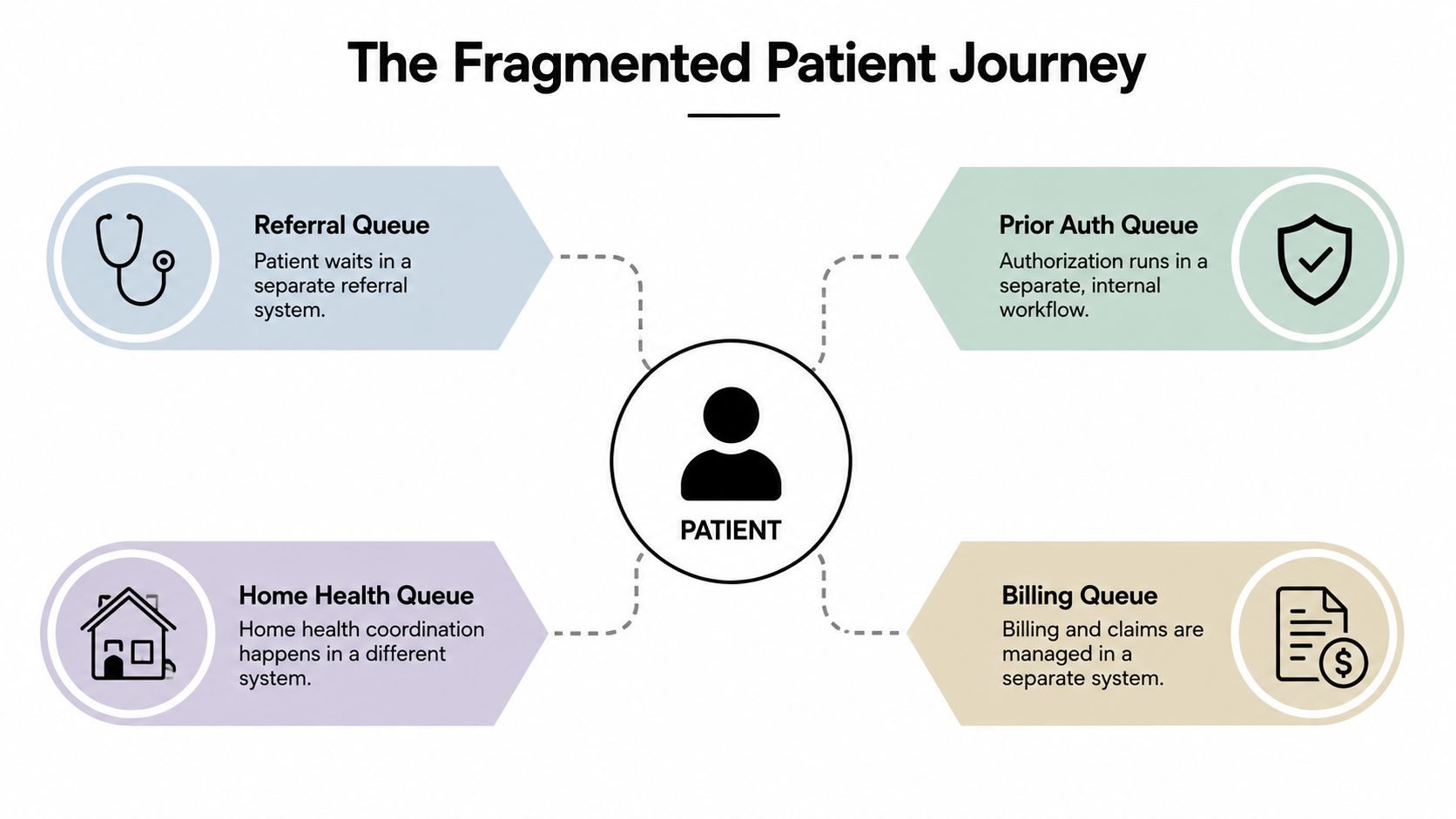
A discharge order can trigger a referral, prior authorization, home health scheduling, and a billing claim, all across different systems with different queues, identifiers, and failure rules. The patient experiences one journey. The health system experiences several disconnected workflows, with staff manually checking status, copying information, and deciding what happens next.
Healthcare service orchestration is the operating layer that coordinates those steps. It doesn't replace HL7 or FHIR, and it isn't another isolated automation script. It sequences calls, preserves workflow state, carries identity context, applies policy, retries safely, handles exceptions, and records what happened across clinical and operational systems.
That distinction matters for anyone building Healthcare AI Services. Data can move successfully and still fail to become useful. The harder production problems usually involve identity confidence, governance, semantic alignment, routing, and human fallback, not the wire format alone.
A discharge order can set off a referral, payer authorization, home health booking, and claim preparation. Each destination may require a different payload, patient identifier, and status model. Without a coordinating layer, teams reproduce handoff logic in separate integrations, leaving identity matching, routing, and failure handling inconsistent.
FHIR supplies resources and exchange mechanisms, while HL7 v2 supports widely used message integrations. Neither standard owns the business process. A FHIR API can return a referral resource, yet it does not determine whether authorization comes first, when scheduling may begin, how to handle a failed booking, or which human queue receives the exception.
Healthcare service orchestration is the post-transport operating layer. It coordinates those decisions and actions across clinical and operational systems. For teams building healthcare AI services, moving data is only the starting point. Production reliability depends on identity confidence, governance, semantic alignment, routing, and a workable human fallback.
Choreography of services: The platform selects the next service and passes the required context. A prior authorization workflow may call the EHR, payer, document service, and scheduling system in a controlled sequence.
Stateful execution: The workflow records whether a request is pending, approved, rejected, timed out, or awaiting human review. Staff can inspect the current state instead of reconstructing it from scattered logs and inboxes.
Policy enforcement: Authorization, consent, minimum-necessary access, escalation rules, and routing decisions should live in explicit policies, not hidden integration code.
Observability: Operators need one transaction view containing correlation identifiers, retries, downstream responses, and the final route to action.
The ONC definition of interoperability describes the ability to electronically send, receive, find, and use health information outside an organization. Orchestration must coordinate all four capabilities. A system can send data and still fail operationally if it cannot identify the patient, retrieve the right context, or activate the next task.
Practical rule: Treat every workflow as a state machine with an owner, a policy boundary, an audit trail, and a safe failure path.
Policy changes and exchange programs are pushing connectivity toward an operating layer rather than a collection of point tools. CMS work spanning the 2009 HITECH Act, Blue Button 2.0 in 2018, Promoting Interoperability in 2019, and the 2020 CMS and ONC interoperability rules connects automation with exchange, patient access, and prior-authorization modernization.
TEFCA adoption reinforces that direction. Reported exchange reached nearly 500 million health records by February 2026, up from 10 million in January 2025, and reached 600 million by March 2026, according to the cited program reporting. Orchestration determines whether that connectivity becomes a controlled workflow with accountable routing, rather than another stream of messages for staff to reconcile.
The choice between orchestration, choreography, and event-driven design changes how a team manages failure, evidence, and ownership. There isn't one universal answer. The right pattern depends on whether the workflow needs centralized control or broad, loosely coupled distribution.
| Pattern | Best Fit in Healthcare | Key Trade-off |
|---|---|---|
| Orchestration | Prior authorization, referrals, discharge coordination, and other regulated multi-step workflows | Central control improves traceability, but the coordinator can become a failure point or scaling constraint |
| Choreography | Device telemetry, ADT notifications, and high-volume event propagation | Services remain loosely coupled, but tracing business outcomes and preventing semantic drift becomes harder |
| Event-driven | Mixed workflows where brokers trigger durable processes and services react to state changes | Flexible and scalable, but teams must define ownership clearly across events, consumers, and workflow state |
A centralized orchestrator, often built with a workflow engine such as Camunda or Temporal, works well when a process has a known sequence and meaningful compensation rules. A prior authorization may require clinical documentation, payer submission, status polling, human review, and scheduling only after approval. Keeping that state in one durable workflow makes audit evidence easier to produce and gives operations staff a clear place to inspect the case.
The cost is concentration. A poorly designed coordinator can become a bottleneck, and a defect in its routing logic can affect many downstream workflows. It also tempts teams to place every business rule in one platform, creating an oversized control plane that's difficult to change.
Choreography distributes responsibility. A device platform can publish telemetry, an alerting service can react, and a billing service can consume a relevant event without the source calling each destination directly. This reduces direct coupling and can support high-throughput notification flows. It also makes traceability more difficult. A missing event, inconsistent terminology, or independently changed consumer can create a failure that spans teams.
Most health systems need a hybrid. Use centralized orchestration for regulated, multi-step, patient-specific workflows. Use choreography for telemetry, notifications, and broad event distribution. Let an event broker start a durable workflow when the process needs timers, approvals, retries, or compensation.
A practical workflow automation approach should make that boundary explicit. Don't force a care transition into a fire-and-forget event, and don't make a simple notification wait for a heavyweight workflow instance.
Production orchestration usually sits above the integration protocols. A gateway receives the request, a validation layer checks its structure and meaning, and a workflow engine coordinates downstream services. That separation keeps transport concerns from swallowing clinical workflow logic.
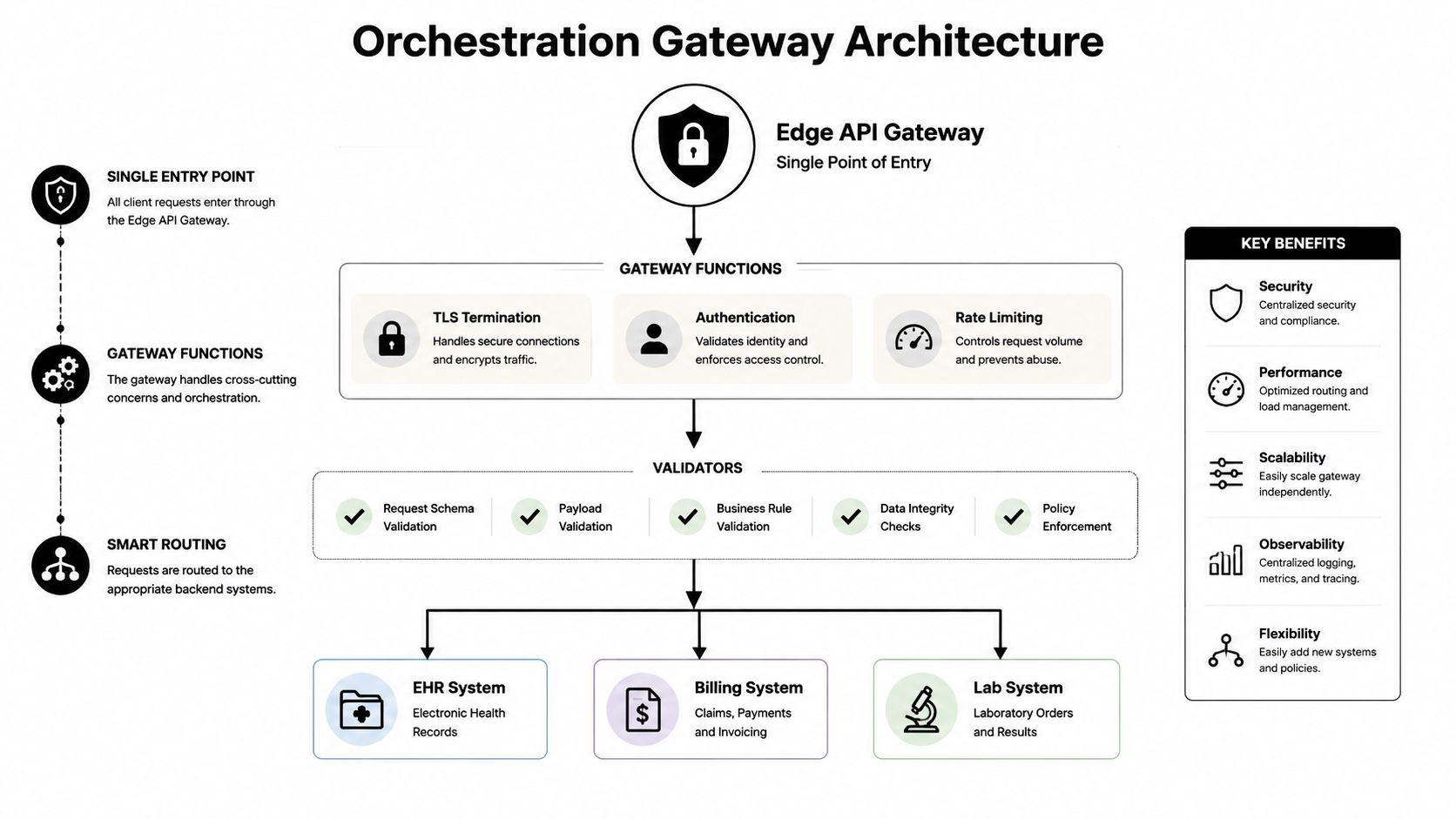
At the edge, an API gateway such as Kong or AWS API Gateway can terminate TLS, authenticate callers, apply rate limits, and route requests to a FHIR façade. The façade presents a stable interface to clients while shielding them from differences between EHR vendors and internal services.
Behind it, a validator and profiler enforce conformance to the profiles the workflow requires. Tools such as Inferno and Touchstone can support implementation validation, but the platform still needs local rules for required fields, terminology, patient matching, and business-level completeness.
The workflow engine then coordinates calls to:
FHIR is not only an API style. HL7's FHIR overview describes a content model based on resources and exchange through RESTful interfaces, messaging, and documents. The National Library of Medicine's FHIR explanation also highlights secure API exchange, XML, JSON, RDF, and semantic interoperability through existing terminology standards. Those layers affect how the orchestrator composes, validates, routes, and records each transaction.
SMART on FHIR tokens carry authorization context, but token validity doesn't guarantee correct patient correlation. Production systems need reliable mapping across MRN values, an enterprise MPI, and source-system identifiers. Consent under USCDI v2 and HIPAA minimum-necessary rules should be evaluated before release, not after data has already crossed a boundary.
Audit events should feed both operational investigation and compliance evidence, including environments aligned with HITRUST or SOC 2. Teams building agent-connected workflows can also use this guide to MCP agent tooling to understand how tool access and context exchange should be bounded before an agent can initiate healthcare actions.
The details that separate a demo from a dependable platform are often smaller than the architecture diagram suggests. Use idempotency keys, make retries idempotent, propagate distributed traces with OpenTelemetry across PHI boundaries, and version FHIR schemas so a breaking change doesn't damage downstream consumers. A gateway can route traffic. Only disciplined state and data contracts make the route safe.
Healthcare service orchestration earns investment when it improves an operating metric, not when it just adds another integration layer. A useful business case ties workflow control to denials, clinician time, referral completion, discharge throughput, or the cost of launching a service. The post-transport operating layer matters here: once data can move between systems, identity, ownership, policy, and routing determine whether that movement produces value.
Market projections indicate that workflow coordination is becoming a strategic infrastructure category, including in prior authorization. Treat those projections as signals of demand, not as a return-on-investment forecast. The actual case depends on a local baseline, a named process owner, and measurement that follows work through exceptions rather than stopping at API success.
Revenue cycle: Cleaner eligibility and authorization data can reduce avoidable rework and improve claim-submission timing. Finance teams should measure denial patterns by workflow stage, including missing documentation, identity mismatches, and delayed human review.
Clinical capacity: A coordinated discharge process can reduce waiting caused by handoffs among case management, transport, pharmacy, home health, and scheduling. The outcome to track is released capacity, not merely faster message delivery.
Referral conversion: Routing a referral with complete context and visible ownership makes leakage easier to detect. Operations leaders should follow referrals from creation through appointment completion, then separate payer, access, and clinical causes of failure.
Integration reuse: A shared orchestration layer lets teams register services once and reuse them across patient journeys. This reduces the need to hard-code every new connection, provided the platform maintains clear contracts and ownership.
Prior authorization makes the economics visible because it combines payer rules, EHR integration, clinical documentation, and human review queues. Software cannot complete every decision. Orchestration coordinates the work, preserves the required human judgment, and removes manual status chasing around it. That distinction also prevents teams from counting automated transport as completed care.
| Capability | Primary KPI | Typical Impact Range | Owner |
|---|---|---|---|
| Authorization coordination | Denial and rework rate | Measure locally, don't assume a universal range | Revenue cycle |
| Referral routing | Referral completion and leakage | Establish a baseline by service line | Access operations |
| Discharge coordination | Time from discharge order to completed handoff | Compare by unit and discharge type | Nursing and case management |
| Reusable integrations | Time to launch a new workflow | Track from approved requirements to production | CTO or platform engineering |
| Human review routing | Staff time spent on status checks | Segment by queue and exception type | Operations |
Calculate ROI across the full operating model. Include platform ownership, security review, monitoring, identity reconciliation, exception handling, and clinical change management. A low-cost connection that creates an opaque queue can shift expense from engineering to operations without reducing it.
Start with a baseline that shows where work stalls. Then compare automated, human, and failed paths separately. That makes the investment case defensible and exposes whether orchestration is improving the process or only moving its waiting time.
Avoid the big-bang rollout. A durable implementation starts with one painful workflow, proves that the organization can operate it, and expands only after the failure paths are visible.
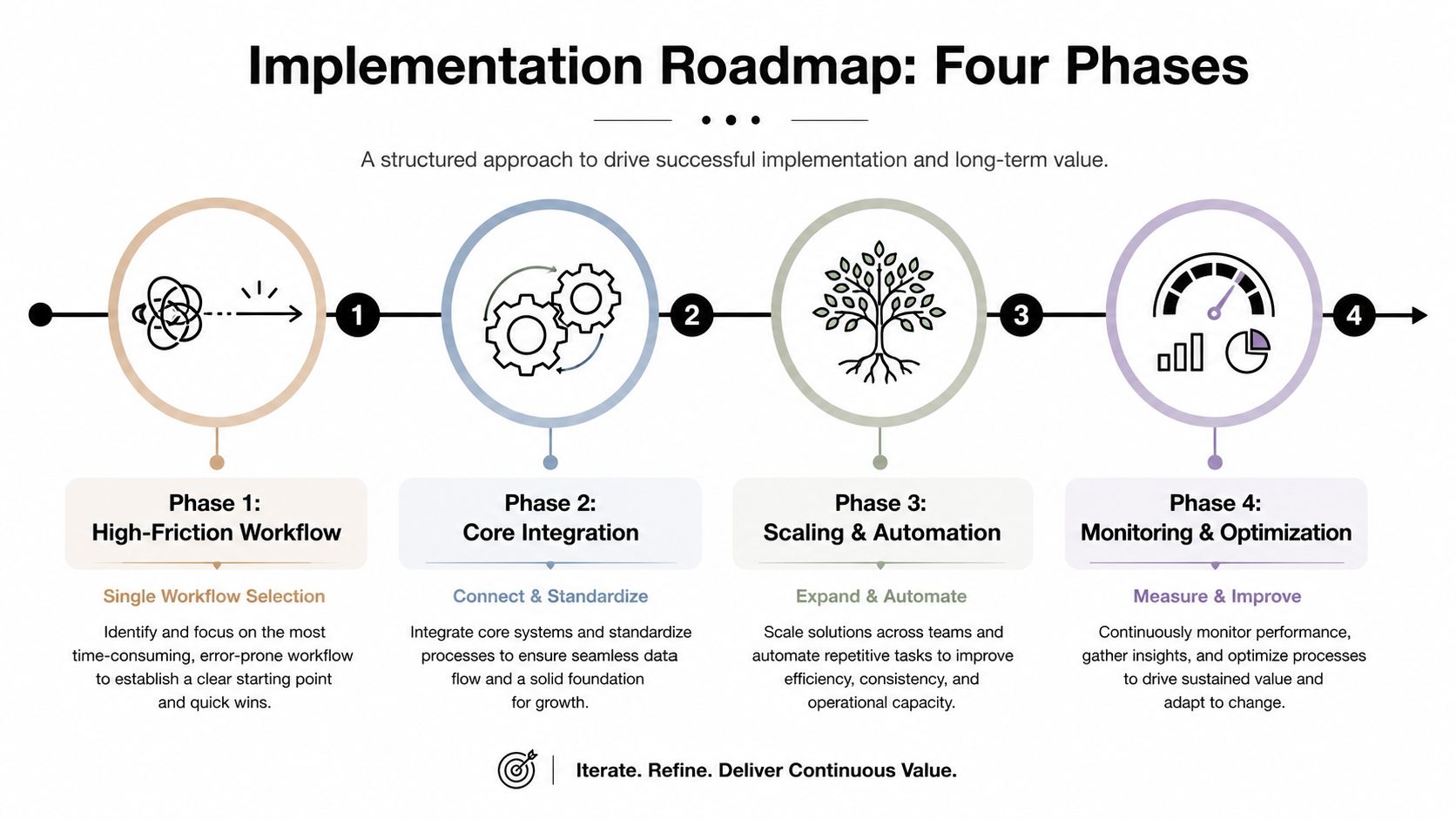
Choose a process with clear ownership and measurable friction, usually a prior authorization or referral handoff. Map every system, queue, human decision, timer, and fallback before writing orchestration code. A small team should include a clinical informatics lead, an integration engineer, and a security reviewer.
A thin prototype can be built over 6 to 8 weeks, but the exit gate isn't a demo. The workflow should complete a representative path, expose its state to operators, preserve an audit trail, and route failures to a named human queue.
Once the workflow proves valuable, define identity, audit logging, FHIR resource profiles, terminology mappings, and ownership of each decision. Don't expand the number of use cases until the team can explain which system is authoritative for every important field.
The phase-two gate is contract clarity. Test synthetic resources, validate authorization behavior, and document what happens when a payer, EHR, or scheduling service returns incomplete information.
Introduce durable workflow state, saga patterns for compensating transactions, retry policies, dead-letter handling, and production observability. A failed appointment booking may require cancellation of a provisional reservation or a human task, not an unbounded retry loop.
The engineering team should include platform ownership in addition to clinical and security participation. Move forward only when operators can detect failures, replay safe steps, and distinguish a downstream outage from a data-quality problem.
Horizontal scale brings multi-tenant routing, partner onboarding portals, service registration, environment separation, and a governance council. The council needs clinical representation, security authority, integration ownership, and a clear escalation path.
The final gate is operational independence. New partners should follow documented contracts, workflow changes should pass automated tests, and every release should identify its impact on consent, auditability, patient matching, and fallback operations.
Build the smallest workflow that proves operational control, not the largest platform that promises future flexibility.
Tool selection should follow the team's operating reality. A workflow engine gives strong control, but it requires engineers who can model state, operate workers, and maintain integrations. An iPaaS can shorten connectivity work, but transaction pricing and limited healthcare semantics may become constraints. A healthcare-native suite can package FHIR, terminology, and consent, though customization may be narrower.
| Category | Examples | Best Fit | Common Failure Mode |
|---|---|---|---|
| Workflow engines | Camunda, Temporal, AWS Step Functions | Teams building bespoke care journeys with strong engineering capacity | Business rules become embedded in code without clinical governance |
| iPaaS platforms | MuleSoft, Workato, Mirth Connect successors | Fast vendor connectivity and conventional data movement | Per-transaction cost and weak clinical semantics limit complex workflows |
| Healthcare-native platforms | FHIR, terminology, and consent suites | Organizations seeking packaged healthcare controls | Teams outgrow customization boundaries or create proprietary dependencies |
A regional health system, described here anonymously, consolidated more than 40 HL7 feeds into one orchestrator and reduced admission processing from 11 minutes to under 2 minutes. The result depended on standardizing message handling and operational ownership, not merely placing a broker in front of existing feeds. This kind of approach suits an organization with a large integration estate and enough platform capacity to own a shared control layer.
A digital health startup took a different route. It used Temporal-based orchestration to coordinate remote patient monitoring telemetry, clinician alerts, and billing events without maintaining a dedicated middleware team. That path fit a smaller product organization because durable workflow state and worker-based execution supported a complex journey without requiring a large integration platform group.
Ekipa AI's AI Product Development Workflow is one possible delivery model for teams that need help connecting product decisions, implementation, and operational controls. It should be evaluated alongside internal platform development, an iPaaS purchase, or a healthcare-native product.
Match the option to regulatory posture, EHR contracts, clinical semantics, staffing, and expected workflow variation. A platform that looks inexpensive during procurement can become expensive if every exception requires custom vendor work.
The most dangerous assumption is that successful transport means successful interoperability. A payer record can arrive through a valid API and still be unusable because the receiving system can't establish identity confidence, interpret provenance, detect missing fields, route the task, or activate the correct action.
Evidence points to this post-ingestion gap. Only 12% of organizations report emerging cross-functional workflows with visible governance and direct workflow activation, according to a payer-to-payer API reality-gap report. The operational question is simple: can the system safely act on the data after it arrives?
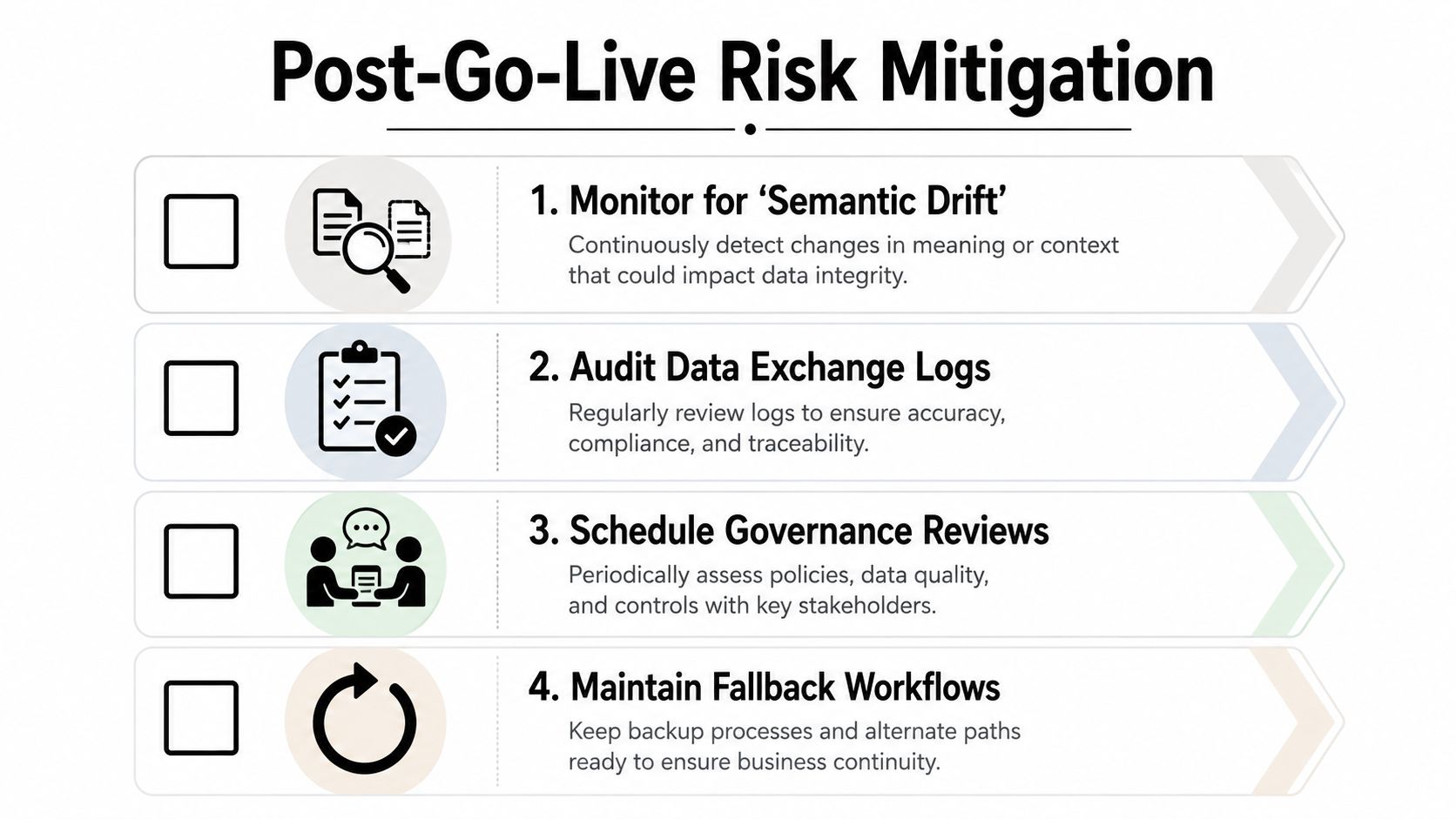
Semantic drift occurs when two systems continue exchanging valid structures but gradually disagree about meaning. A status such as “complete” may mean documentation received in one system and clinical review finished in another. Contract tests using synthetic FHIR resources, explicit terminology mappings, and semantic versioning reduce this risk.
Consent and break-glass gaps appear when an orchestration platform bypasses the EHR's native audit trail or applies a broader access rule than the source system. Keep dual-write audit pipelines, define emergency access policy, and make every exception visible to a responsible reviewer.
Vendor lock-in grows when a proprietary workflow language contains the only copy of the business process. Store canonical workflow definitions, resource contracts, and policy decisions in portable repositories. Treat the vendor engine as an execution environment, not the sole owner of institutional knowledge.
Observability blind spots turn a small downstream failure into a multi-day investigation. Propagate correlation IDs, capture state transitions, redact PHI from operational logs, and maintain fallback workflows that staff can execute when automation is unavailable.
Governance needs a living cadence. A board with clinician veto power should review workflow changes, exception trends, access policies, and semantic changes as part of release management. For software that influences clinical decisions, teams may also need SaMD solutions and a regulatory compliance partner, because workflow software can enter regulated product territory when it supports diagnosis, monitoring, prediction, prognosis, treatment, or alleviation of disease. EU high-risk AI obligations are expected to become fully applicable in August 2026, according to recent SaMD regulatory analysis.
A platform dashboard should answer whether the workflow is reliable for patients and manageable for staff. Track the full journey, not only API uptime.
| KPI | Why It Matters | Target Range |
|---|---|---|
| Integration cycle time | Shows how quickly a validated workflow reaches production | Set a baseline, then reduce it without weakening controls |
| Mean time to detect failure | Measures operational visibility before a patient or staff member reports a problem | Define an alert threshold for each critical workflow |
| Clinician minutes saved per encounter | Connects automation to workforce capacity | Establish a pre-launch observation baseline |
| Prior-authorization denial rate | Tests whether orchestration improves documentation and routing | Compare like-for-like workflows and payer groups |
| Workflow uptime SLA | Reflects whether a clinical process remains available | Set a separate SLA for each patient-critical journey |
How long does a first workflow take?
A narrow first workflow can reach production in 6 to 8 weeks, provided ownership, access, security review, and test data are available. The timeline expands when teams must negotiate new EHR contracts, resolve patient matching, or define clinical policy from scratch.
When should we build instead of buy?
Build when the workflow differentiates your product, requires unusual clinical semantics, or must coordinate systems your vendors don't support well. Buy or use iPaaS when the primary need is conventional connectivity and your team doesn't want to operate workflow infrastructure.
How should teams prepare for FHIR R5 migration?
Keep resource profiles versioned, isolate mappings at system boundaries, and test consumers against representative payloads before changing the canonical contract. Don't let one vendor's version decision force an unplanned rewrite across every workflow.
Which metrics belong in the first review?
Start with cycle time, failure detection, clinician effort, denial outcomes, and workflow availability. Add exception rates and human queue aging once the initial baseline is stable.
The next practical step is to select one patient journey, instrument it end to end, and document every identity, policy, and fallback decision. Teams that lack experience across multiple EHR environments should work with a healthtech engineering partner that has shipped integrations across at least three EHRs before expanding the orchestration surface.
Ekipa AI helps digital health teams shape and build EHR integrations, clinical software, AI adoption programs, and workflow automation around real operating constraints. Visit Ekipa AI to scope one healthcare journey, define its orchestration controls, and connect the implementation plan with our expert team.
Oracle Health integration guide: FHIR R4 APIs, HL7 v2 interfaces, SMART app types, sandbox testing and customer activation for HealthTech teams.

Epic FHIR API capabilities and limits for healthtech teams. Covers FHIR R4 resources, SMART on FHIR auth, sandbox testing, write access, and HL7 v2 gaps.
Our guide to AI for patient engagement: conversational assistants, intake, messaging, personalization, platforms and measurement.
Connect with our team to explore how AI expertise can transform your business.