AI in Healthcare
HIPAA-Compliant AI: How to Use LLMs With PHI Safely
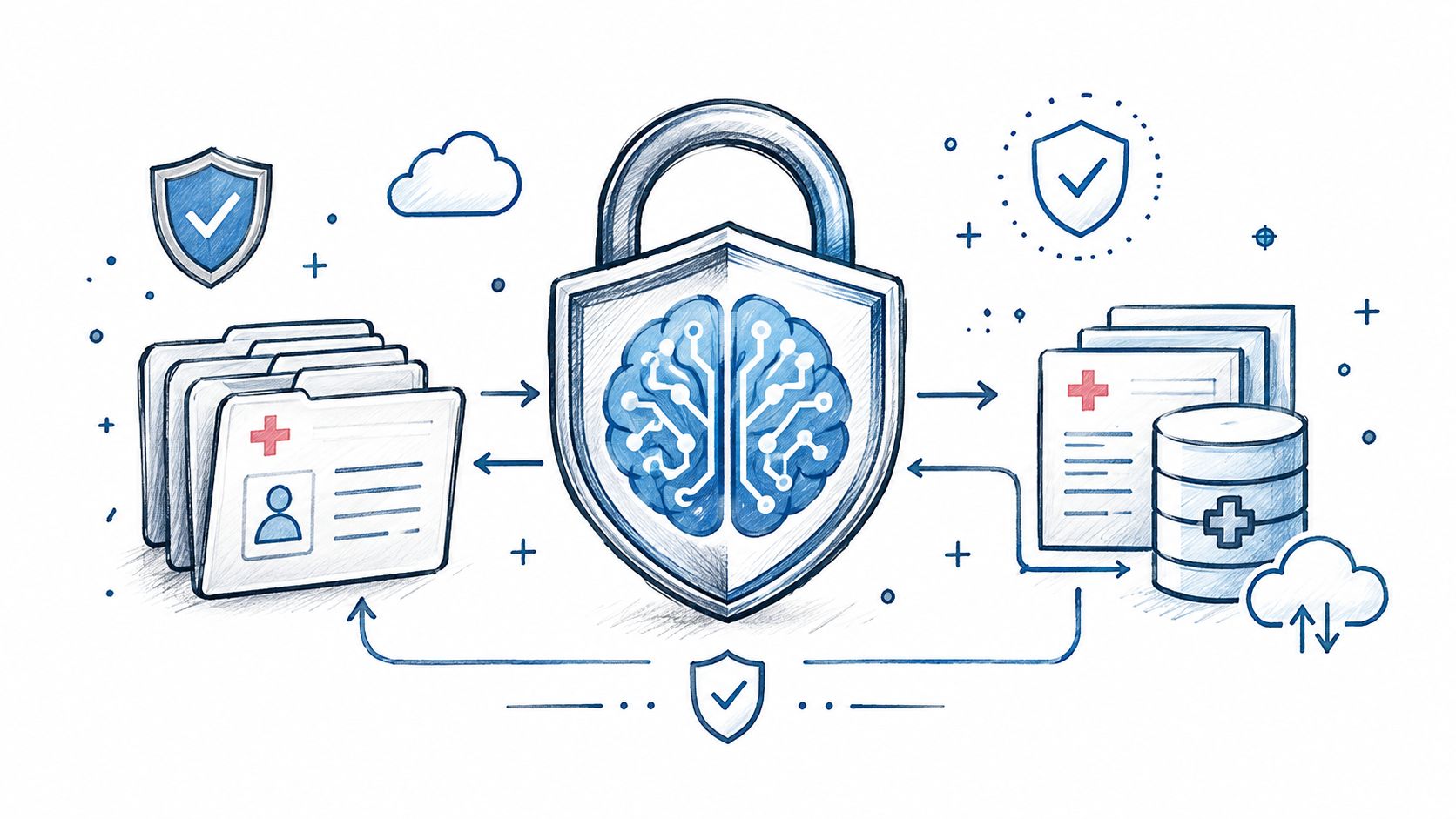
How to build HIPAA-compliant AI: when LLM providers need a BAA, data minimization, de-identification, audit controls and a reference architecture.
October 16, 2026Read more
Unlock value by measuring success of healthcare AI initiatives. Learn to define KPIs, prove ROI, and drive better patient outcomes with our practical guide.

Measuring the success of any healthcare AI initiative is about far more than just tracking technical performance. It demands a solid, strategic foundation built by getting the right people in a room to agree on well-defined business objectives.
Ultimately, success is a multi-layered concept. It covers everything from clinical improvements and operational efficiencies to the financial bottom line. All of this has to be hashed out before a single line of code is written.
It’s easy to get caught up in the excitement of a new AI project, but jumping straight to the tech is a recipe for a solution in search of a problem. The real work begins with strategy—aligning your ambitious AI goals with what your organization actually needs to accomplish.
Success truly hinges on getting everyone on the same page. I'm talking about clinicians on the front lines, administrators managing workflows, and executives in the boardroom. You need to facilitate frank discussions to define what a "win" looks like from each of their unique viewpoints. Without this shared understanding, you're just building on shaky ground.
Let's be honest: broad aspirations like "improving patient outcomes" or "boosting efficiency" are meaningless without specifics. The real task is to translate those fuzzy goals into something you can actually measure.
For instance, "improving efficiency" needs to become something tangible, like "reducing patient admission processing time by 15% within six months." That level of specificity is non-negotiable. It’s what separates a successful project from a science experiment.
This alignment process is often where things fall apart. Bringing in a structured approach, like an AI strategy workshop, can provide the framework needed for these critical conversations. Without it, you risk teams building technically brilliant solutions that solve the wrong problems entirely.
The flow is straightforward: your overall strategy informs your goals, and those goals give you what you need to build a project charter.

As you can see, a solid strategy and clear goals are the essential inputs for a powerful project charter.
The culmination of all this planning is the project charter. Think of it as your project's constitution—a living document that formally outlines the scope, objectives, and expected benefits. It’s your north star.
A well-crafted charter isn't just paperwork; it’s a critical tool. It should always include:
From my experience, when you connect adoption and usage directly to project results and ROI right from the start, you build an ironclad case for the resources you need. This isn't just about launching; it's about having the support to measure and prove your impact over time.
This upfront planning sets the stage for everything that follows. It ensures every initiative is a deliberate strategic move, not just a technological shot in the dark. With a solid charter in hand, you’ve transformed a good idea into a focused, results-driven plan, setting your project up for measurable success from day one.
Once you've aligned your team around a common goal, it's time to get specific. How will you actually know if your AI initiative is working? Success isn't a single number on a spreadsheet; it's a holistic picture that balances clinical wins, operational gains, financial returns, and rock-solid ethical standards.
A multi-dimensional measurement framework is non-negotiable. It ensures you capture the true, full-circle impact of your AI, from the balance sheet all the way to the bedside.

Without this balanced approach, you risk a classic pitfall: celebrating a financial victory that inadvertently hurts patient care or an operational shortcut that opens up new ethical risks. A comprehensive view, often hammered out during a robust AI strategy consulting process, is your best defense against these blind spots.
To create this complete picture, we need to look at performance through four distinct but interconnected lenses.
To give you a clearer idea of how this looks in practice, here is a framework that outlines essential KPIs across these key domains. It's designed to ensure a holistic and honest evaluation of your AI's impact.
| Metric Category | Example KPIs | Measurement Goal |
|---|---|---|
| Clinical & Patient-Centric | Reduction in mortality rates, decreased length of stay, lower readmission rates, improved diagnostic accuracy. | Quantify direct improvements in patient care quality, safety, and outcomes. |
| Operational Efficiency | Reduced patient wait times, increased equipment utilization, shorter documentation time for staff, faster appointment scheduling. | Measure how AI streamlines workflows, optimizes resources, and reduces administrative load. |
| Financial & ROI | Lower operational costs, reduced cost of care per patient, increased revenue from higher throughput, improved billing accuracy. | Demonstrate the direct financial benefit and return on investment for the organization. |
| Ethical & Governance | Algorithmic fairness audits (bias checks), patient/clinician trust scores, data privacy compliance rates (HIPAA). | Ensure the AI is trustworthy, fair, and compliant with regulatory and ethical standards. |
This table provides a starting point. Your specific KPIs will be unique to your project, but they should always cover these four foundational areas to tell the complete story.
The patient is at the heart of everything. Always. Clinical KPIs are where the rubber meets the road, directly measuring how your AI solution affects care quality, safety, and outcomes. For clinicians, these are the metrics that matter most, and they often provide the most compelling proof of your AI's value.
Let's imagine an AI model built to flag early signs of sepsis from electronic health records. We need to look beyond just the model's accuracy. A truly meaningful evaluation would measure:
Getting these clinical KPIs right means sitting down with your frontline medical staff. They live in the clinical trenches and can help you identify metrics that reflect genuine improvements in patient care, not just statistical noise.
Next, we look at workflow. Operational metrics show how AI makes the hospital or clinic run more smoothly. These are the numbers that get the attention of administrators and operations managers because they demonstrate how AI reduces friction, cuts down on administrative waste, and makes better use of expensive resources.
Many of these gains can be amplified through AI Automation as a Service, which is perfect for tackling those high-volume, repetitive tasks that drain staff time. For an AI tool that automates complex patient scheduling, you’d want to track:
Even seemingly small upgrades to internal tooling can have an outsized operational impact, improving everything from supply chain management to the billing cycle.
In the end, every project has to justify its existence financially. Financial KPIs are what connect those clinical and operational gains directly to the organization's bottom line. This is the language of the C-suite and is absolutely essential for securing the budget to scale successful pilots.
Financial metrics aren't always straightforward and can include both direct and indirect benefits:
When I help build a business case, I find that framing ROI in terms of the "cost of inaction" is incredibly powerful. What is the financial damage of not reducing your patient readmission rates by 10% over the next year? That question changes the conversation.
Finally, and especially in a field built on trust like healthcare, you absolutely cannot ignore the ethical dimension. These metrics ensure your AI is fair, transparent, and something clinicians and patients can rely on. They are vital for maintaining patient confidence and meeting strict regulatory demands, particularly for complex SaMD solutions.
Key ethical indicators you should be tracking include:
By defining and consistently tracking metrics across these four areas, you build a powerful, honest, and complete framework for measuring success. This is how you prove that your AI project is delivering real, responsible progress.
An AI model that performs brilliantly in a lab is one thing. Proving its worth—and its safety—in the controlled chaos of a real hospital is another thing entirely. This is where the rubber meets the road. To get undeniable proof that your AI is effective before a full-scale deployment, you have to design smart validation studies, A/B tests, and tightly focused pilot programs.
These studies aren't just about ticking a box for technical accuracy. They're about de-risking the entire project, building trust with clinicians, and crafting a rock-solid business case for a wider rollout. It's a foundational part of our AI Product Development Workflow, ensuring every solution we touch is battle-tested in the real world.

The first move is to pick the right environment for your pilot. I can't overstate how much this decision impacts the quality of your results. You need a clinical setting that truly represents where the AI will eventually live day-to-day.
When you're scouting for a pilot site, look for these key ingredients:
Get the setup right, and you're halfway to a successful pilot. A bad site or a disengaged team can sink your study before it even starts, no matter how brilliant the AI is.
Once you have your location locked down, it's time to map out the study protocol. Your objective is to isolate the AI's impact, which demands a structured and controlled approach. For most healthcare AI, this means using a control group.
A prospective A/B test is often the gold standard here. You’ll have one group of patients whose care is guided by the AI (the intervention group) and a parallel group that receives the normal standard of care (the control group). This head-to-head comparison is incredibly powerful for proving a direct link between your AI and the outcomes you’re hoping to improve.
Here’s a piece of hard-won advice: clearly define the success criteria for graduating from pilot to full deployment before the study even begins. Is it a 10% reduction in readmissions? A 15-minute drop in diagnostic time? Putting these hard numbers on paper eliminates any guesswork and stops the goalposts from moving later on.
Throughout the pilot, disciplined data collection is non-negotiable. You’re not just tracking the KPIs you defined earlier; you're also gathering qualitative feedback. This two-pronged approach gives you the "what" from the numbers and the crucial "why" from the user experience. You can see how this works in practice with tools like our diagnostic support platform, Diagnoo.
Your monitoring checklist should include:
Don't forget the regulatory side of things, which is especially critical for complex SaMD solutions. You have to ensure your study design and data practices are fully compliant to avoid hitting a brick wall. When done right, a successful pilot delivers the hard evidence you need to justify a broader, more impactful rollout.
Let's talk money. You've run a successful pilot, you have promising results, but now comes the real test: proving the project's worth in dollars and cents. Every healthcare AI initiative eventually has to justify its existence financially. This is the moment your project goes from an interesting experiment to an essential, scalable part of the organization.
Demonstrating a clear return on investment (ROI) isn't just about a simple cost-benefit analysis. It's about building a sophisticated business case that connects with executive leadership and answers their biggest question: "Why should we fund this?" Tying the clinical and operational gains you've measured directly to the organization's bottom line is how you get their attention and, more importantly, their buy-in for a full-scale rollout.
It’s easy to focus on direct cost reductions, but the real financial impact of AI in healthcare is much broader. A truly comprehensive ROI model captures a mix of direct savings, indirect financial gains, and long-term strategic value.
Here's how to think about it:
While healthcare has its unique challenges, many of the core principles for financial analysis are universal. It can be useful to look at guides on how to measure ROI and prove impact from other fields to get a fresh perspective.
With your pilot data in hand, it’s time to tell a story. Your goal is to construct a clear, data-backed narrative that connects your AI's performance to the hospital’s core financial health. Your business case needs to spell out the financial consequences of both acting and—just as importantly—not acting.
From my experience, framing the discussion around the "cost of inaction" is incredibly effective. For example, you could say: "Our pilot showed a 12% reduction in patient readmissions for this cohort. If we don't scale this solution, we are projected to lose approximately $1.5 million over the next year in penalties and unreimbursed care." Suddenly, it’s not an expense; it's a necessary investment to stop bleeding money.
To make your findings as clear as possible, present a unified view of the financial picture. A tool like a Financial Insights Dashboard can be invaluable here, translating complex data into digestible charts and graphs that even a non-technical executive can understand at a glance.
Finally, don't forget to zoom out and place your project within the larger industry context. The explosive growth of the market itself provides a powerful backdrop for your business case.
The AI in healthcare market was valued at over $20 billion in 2024 and is projected to skyrocket past $148 billion by 2029. That kind of blistering growth isn't happening in a vacuum; it’s being driven by real, tangible value. Some analyses suggest that AI applications could generate $150 billion in annual savings for the U.S. healthcare system by 2026, with certain predictive models showing the potential to cut hospital admissions in half.
For business leaders, these aren't just numbers—they're a signal of an undeniable market shift. Highlighting these statistics underscores the urgency and massive opportunity at stake, making it clear that investing in AI isn't just a good idea, it's a strategic imperative.
Getting your AI solution live isn't the finish line; it’s the starting gun. The real work—and the real value—begins now. This is where you embed continuous measurement and governance into your day-to-day, a crucial step that separates successful, long-term AI integrations from flashy but failed pilots.
Without a solid plan for ongoing oversight, even the most impressive model can drift off course, delivering diminishing returns or, worse, creating new risks. Think of this phase as building the operational backbone for sustained success and constant improvement. This is often where an experienced HealthTech engineering partner proves invaluable, ensuring your Healthcare AI Services are built not just to launch, but to last.
You can't manage what you can't see. The cornerstone of continuous measurement is a set of real-time performance dashboards. Forget static, month-end reports. We’re talking about live, dynamic views that show exactly how your AI is performing against those clinical, operational, and financial KPIs you worked so hard to define.
A great dashboard gives the right information to the right people, right now.
This immediate feedback loop is your early warning system. It helps you spot minor issues before they snowball into major problems, arming your team with the data needed for quick, confident decisions. These insights are what will spark your next wave of innovation, much like the examples in our library of real-world use cases.
A powerful AI model demands strong governance. You absolutely need an AI governance committee or a dedicated oversight body to monitor performance, ensure ethical standards are met, and manage risk over the long haul. This group is the guardian of your AI's health and integrity.
So, what does this committee actually do? Their key responsibilities fall into a few critical areas:
This structure creates accountability. It moves your AI from a one-off "project" to a managed, operational asset with clear ownership. For a system this dynamic, implementing comprehensive AI observability and monitoring is essential for effective, continuous governance.
The whole point of measuring is to take action. The data flowing from your dashboards and governance reviews must feed a nonstop cycle of improvement. When a KPI dips or a clinician reports a workflow snag, your incident response playbook should kick in immediately.
This improvement process looks something like this:
The rapid pace of AI adoption in healthcare shows just how urgent it is to get this right. One recent study found that 22% of healthcare organizations have already put domain-specific AI tools into practice—a massive leap from just 3% two years earlier. This isn't just hype; it's driven by real results, like generative AI saving some clinicians up to 2 hours per day.
For healthcare leaders, a strong governance framework isn't just bureaucracy. It’s the strategic engine that turns a promising pilot into this kind of enterprise-wide impact.
You can find more on these healthcare AI trends and their implications to see where the industry is headed.
When you get serious about measuring your healthcare AI initiatives, something interesting happens. It’s about more than just justifying a budget—it builds real, tangible momentum. A structured measurement framework isn't just about reporting; it creates a feedback loop for continuous improvement. Each win, backed by hard data, paves the way for the next project and helps cultivate a culture of innovation that's driven by evidence, not just enthusiasm.

This approach is what separates organizations that simply use AI tools for business from those that truly thrive with them. The end game is to deliver safer, more efficient patient care while also strengthening your financial health. You're shifting from isolated AI experiments to a cohesive, forward-thinking program.
As we explored in our AI adoption guide, getting buy-in is everything. The clear, quantifiable wins you can show—like a 15% reduction in diagnostic errors or a 20% boost in operational throughput—are what turn skeptics into your biggest supporters.
This process transforms measurement from a final report card into a living, strategic asset. The insights you gather don’t just close out one project; they become the foundational data for your next AI requirements analysis, fueling a continuous cycle of targeted innovation.
By operationalizing your measurement strategy, you make sure every initiative is a stepping stone to something bigger. This allows you to confidently scale what works and, just as importantly, pivot away from what doesn't. You're no longer guessing; you're making informed decisions.
Ready to apply these principles and turn your own measurement efforts into unstoppable momentum? Connect with our expert team today to see how a Custom AI Strategy report can provide the roadmap for your success.
When it comes to measuring the real-world impact of AI in healthcare, a lot of questions pop up. It’s a complex area, so let's tackle some of the most common ones I hear from healthcare leaders and strategists.
Before a single line of code is written, the most critical step is getting everyone to agree on what success actually looks like. This isn’t just an IT task. You need to get clinicians, hospital administrators, and your tech teams in the same room to hammer out a shared vision.
From that conversation, you can build a balanced set of key performance indicators (KPIs) that cover your clinical, operational, and financial goals. For example, instead of a fuzzy objective like "improve diagnoses," a much stronger KPI would be something like, "achieve a 15% reduction in false positives for mammogram screenings within six months." Getting this foundation right is everything, and often starts with a thorough AI requirements analysis.
Calculating the ROI for clinical AI is about more than just direct cost savings. To see the full picture, you have to measure both the obvious financial wins and the less tangible benefits.
A truly comprehensive ROI model will assign a financial value to all these outcomes. It takes some effort, but using an AI Strategy consulting tool can help model these complex scenarios and ensure you’re not leaving value on the table.
This is a huge concern, and it has a name: model drift. The solution is all about continuous monitoring and solid governance. Launching the model is the starting line, not the finish line. You absolutely must have a system in place to track the model's performance after it's deployed, because real-world data is always changing.
The key is to set up automated alerts that flag when a core metric, like accuracy, drops below a pre-defined threshold. A dedicated governance committee should be reviewing these performance dashboards regularly and have a clear playbook for when to retrain the model.
This kind of proactive monitoring is a cornerstone of our AI Automation as a Service, designed to ensure your AI tools remain reliable and deliver sustained value long after launch.
Think of governance as the operational backbone for your entire measurement strategy. It’s what turns your metrics from a report into a real tool for action.
A good governance committee doesn't just watch the numbers; it actively oversees ethical compliance, monitors for algorithmic bias, and manages the playbook for when performance dips. In a highly regulated field like healthcare, this structure is non-negotiable for building trustworthy AI tools for business. This also plays a key role in the custom healthcare software development lifecycle, ensuring long-term viability.
Ready to build a measurement framework that proves the value of your healthcare AI projects? The team at Ekipa AI specializes in turning complex AI strategies into measurable, scalable impact. Explore our Healthcare AI Services or connect with our team to see how we can help you define, track, and achieve success.
How to build HIPAA-compliant AI: when LLM providers need a BAA, data minimization, de-identification, audit controls and a reference architecture.
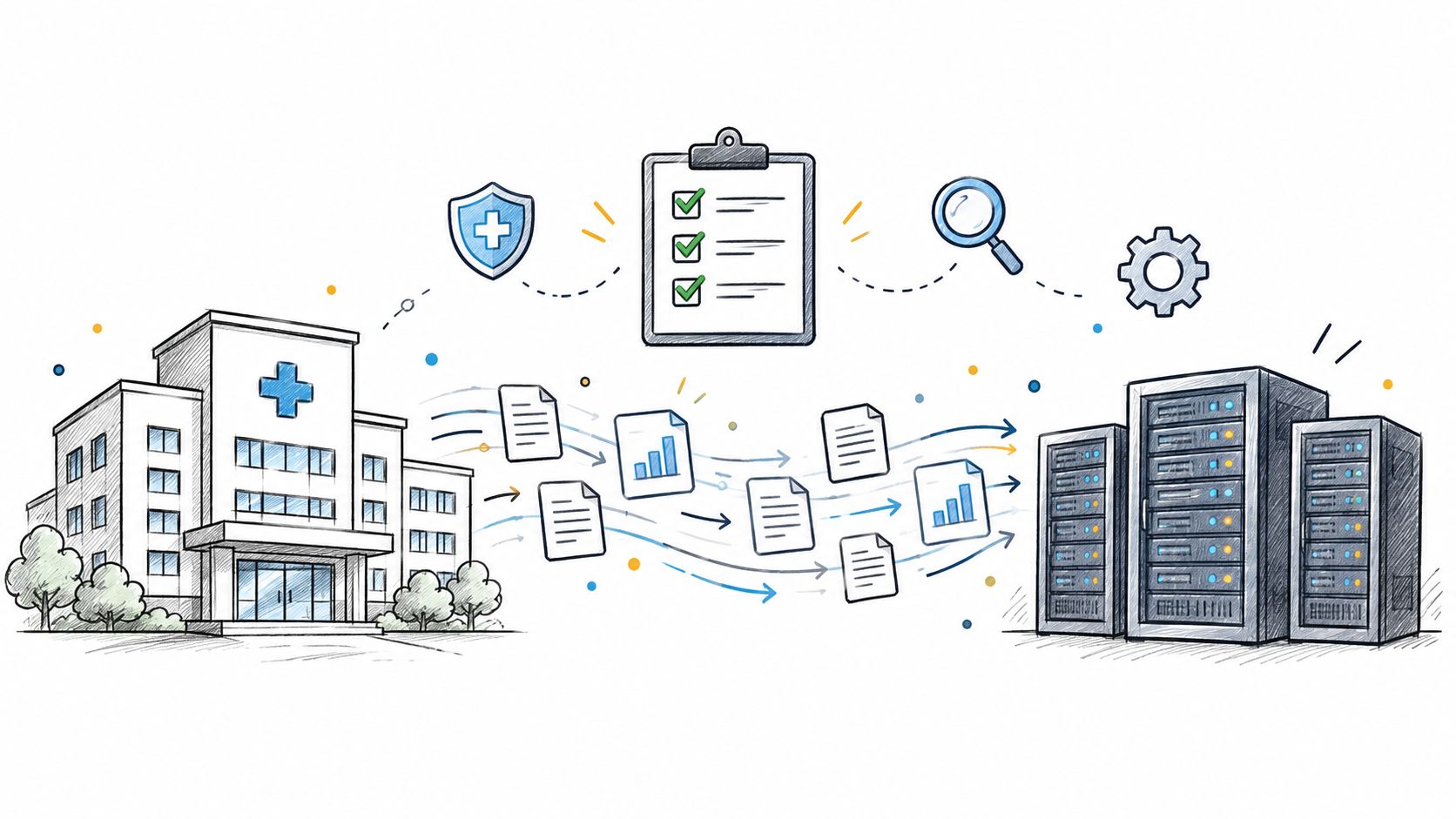
Practical data migration planning guide for healthcare teams. Scope, mapping, compliance, validation, cutover and rollback decisions explained end to end.

Smart on FHIR guide for healthtech engineers. Learn the OAuth 2.0 launch model, scope syntax, backend services, and US regulatory requirements.
Connect with our team to explore how AI expertise can transform your business.