Compliance
IEC 62304 Software Safety Classification Explained
IEC 62304 software safety classification explained: how Class A, B and C are assigned, what each class requires, and what Edition 2 changes.
November 06, 2026Read more
Compare PHI de-identification methods under HIPAA: Safe Harbor, Expert Determination, tokenization, free-text redaction and re-identification risk.
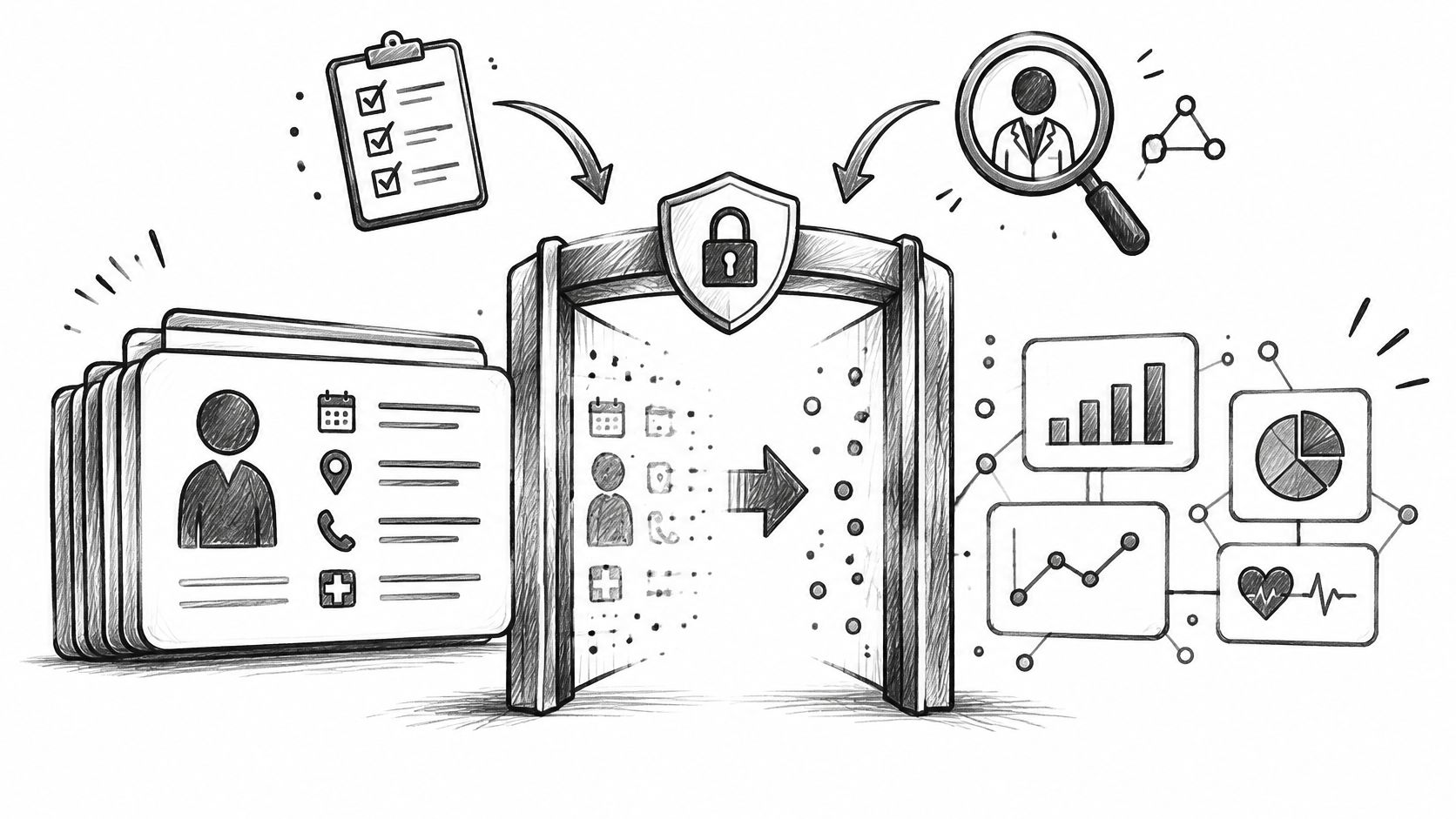
Removing obvious identifiers can still leave a dataset identifiable: HHS de-identification guidance makes Safe Harbor conditional on having no actual knowledge that the remaining information could identify someone. For data and AI teams, the engineering problem is proving that the released dataset, including its notes, metadata, and derived features, meets the chosen standard. This guide explains PHI de-identification methods, practical transformations, and the evidence needed before release.
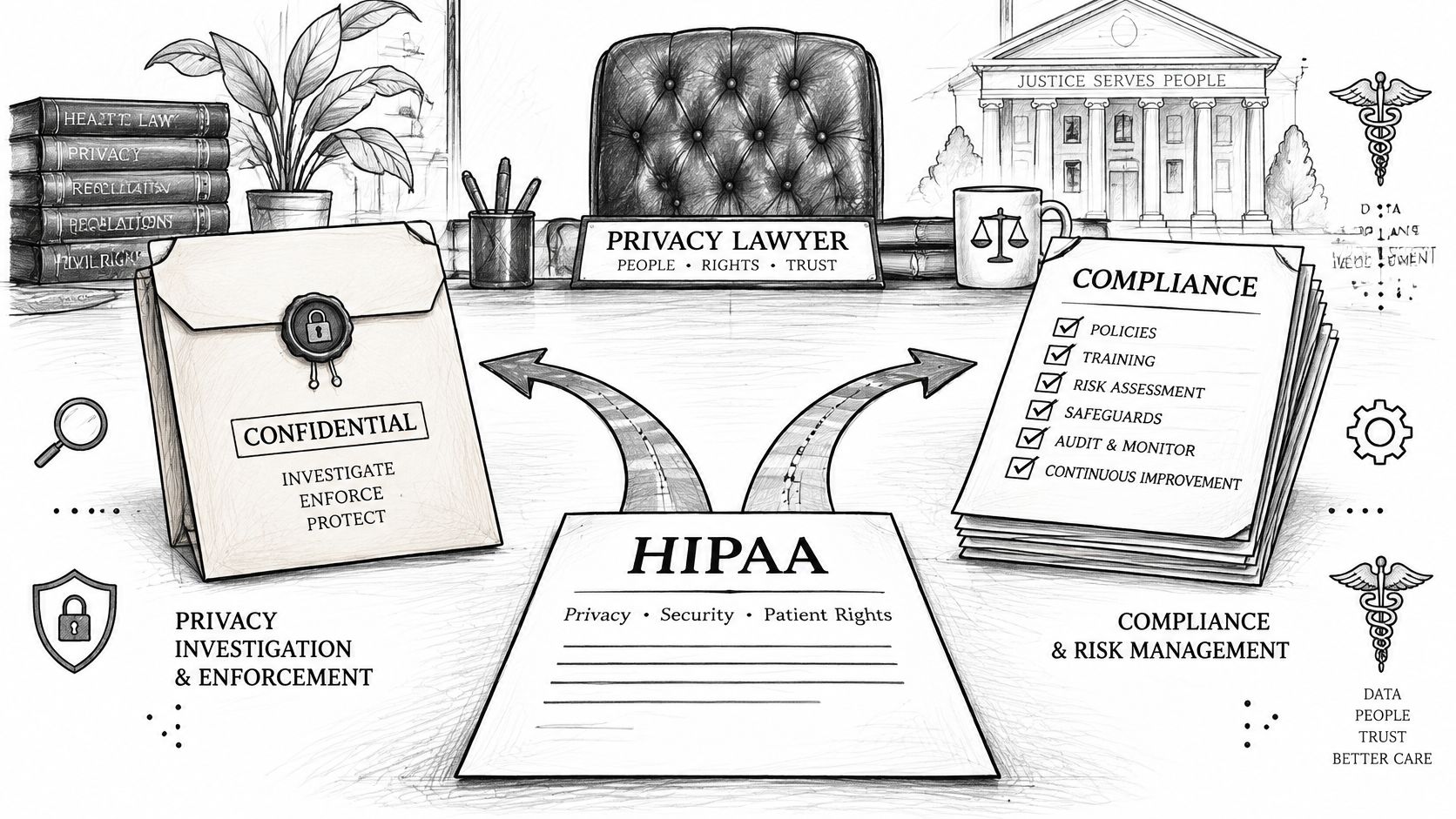
45 CFR 164.514(b) permits Safe Harbor and Expert Determination; under the latter, a qualified expert must document that identification risk is “very small,” considering reasonably available information and anticipated recipients.
Safe Harbor requires removing 18 identifier categories, including identifiers of relatives, employers, and household members, as described in the Defense Health Agency's de-identification fact sheet. These cover names; sub-state geography; individual-related dates; telephone and fax numbers; email; Social Security numbers; medical-record, health-plan, and account numbers; certificate or license numbers; vehicle and device identifiers; URLs; IP addresses; biometrics; full-face photographs; and other unique identifying characteristics or codes.
Safe Harbor and Expert Determination compared
| Method | Legal basis | What you do | Sign-off and evidence | Analytical cost | Best fit |
|---|---|---|---|---|---|
| Safe Harbor | §164.514(b)(2) | Remove required identifiers, apply geographic and age rules, satisfy actual-knowledge condition | Engineering and privacy review; field inventory and removal log | Loses granular dates and small geographies | Standard baseline for shared or non-care datasets |
| Expert Determination | §164.514(b)(1) | Retain detail only where a qualified expert finds identification risk very small | Qualified expert; written methods, assumptions, mitigations, and conclusion | Can preserve utility; requires maintaining assessment evidence | Analytics needing dates, locations, or detailed codes |
The choice belongs at the dataset-and-recipient level. A software-testing export and a longitudinal training dataset can warrant different treatments, even when they originate in the same EHR.
For healthcare data engineering, we recommend recording that choice before implementing transformations.
Masking replaces content with a placeholder. Replacing an entire medical-record number with [MRN] removes its visible value; displaying its trailing characters merely obscures part of it and shouldn't be treated as complete removal.
Generalization reduces precision. The HHS implementation guidance allows the first three ZIP digits only when their combined geographic area contains more than 20,000 people, otherwise requiring 000; it also requires individual-related dates to lose elements other than year and ages over 89 to enter a 90-or-older category.
Tokenization substitutes a stable surrogate. A token vault can preserve joins without exposing source identifiers. Keyed HMAC can support controlled pseudonymization, but don't assume a value derived from an identifier qualifies as a Safe Harbor re-identification code. Unsalted hashes of guessable identifiers are unsuitable because an attacker can enumerate candidate inputs.
Date shifting applies a patient-specific offset to event dates, preserving intervals. Retaining shifted month and day doesn't automatically satisfy Safe Harbor. Treat this as an Expert Determination or controlled-access design requiring assessment.
Consider an expert-assessed export containing patients, encounters, and laboratory results:
Assign each patient a random vault token and replace the MRN consistently across every table.
Derive an age category from birth date, then remove birth date and prevent exact older ages from surviving.
Resolve geographic treatment through a documented population lookup.
Apply the same patient-specific date offset to encounters and laboratory timestamps.
Retain lab values subject to clinical-utility and disclosure-risk review.
The token must resolve consistently across the tables. A different key or token namespace in the laboratory pipeline can break joins.
Treatment of each identifier by technique
| Identifier | Technique | Output | Failure mode |
|---|---|---|---|
| Medical-record number | Token vault or assessed keyed HMAC | Stable surrogate | Unsalted hash guessed; incompatible token namespaces |
| Date of birth | Age generalization | Age category, with older-age grouping | Exact age survives in an export |
| ZIP code | Population-aware generalization | Permitted prefix or 000 |
Format check substitutes for population lookup |
| Admission date | Patient-specific date shifting | Shifted date | Offset exposed or inconsistently applied |
| Name, phone, or email in text | Typed masking | [PATIENT_NAME] or equivalent |
Entity detector misses a span |
The release method still determines whether a particular transformation is acceptable.
Clinical narratives require NLP-based detection plus human QA. Discharge summaries, radiology reports, progress notes, and nursing notes can contain names, contacts, dates, locations, and identifying narrative details. An unusual occupation or publicly reported event deserves review even when conventional identifiers have disappeared.
Start by normalizing encoding and document structure without destroying offsets needed for traceability. Combine pattern rules for identifier formats, dictionaries for facility names, and named entity recognition for people, locations, dates, and narrative context.
Replace detected spans with typed placeholders. If an assessed release retains shifted dates, use the same patient offset in text and structured records. Otherwise, a note can contradict its encounter record or expose the original date.
Use a review process that makes errors visible:
Sample across note types and facilities rather than reviewing only the easiest documents.
Have independent reviewers annotate samples and resolve disagreements.
Measure recall and precision by entity type, then set acceptance thresholds with privacy reviewers.
Record misses and update rules, dictionaries, or model training examples.
A high overall score can conceal poor name detection. Reviewers should examine missed identifiers separately from excessive redaction, because the consequences differ.
For the release itself, retain annotation decisions, model and rule versions, QA results, and unresolved exceptions.
Automated redaction needs an evidence trail showing what was tested and which residual risks reviewers accepted.
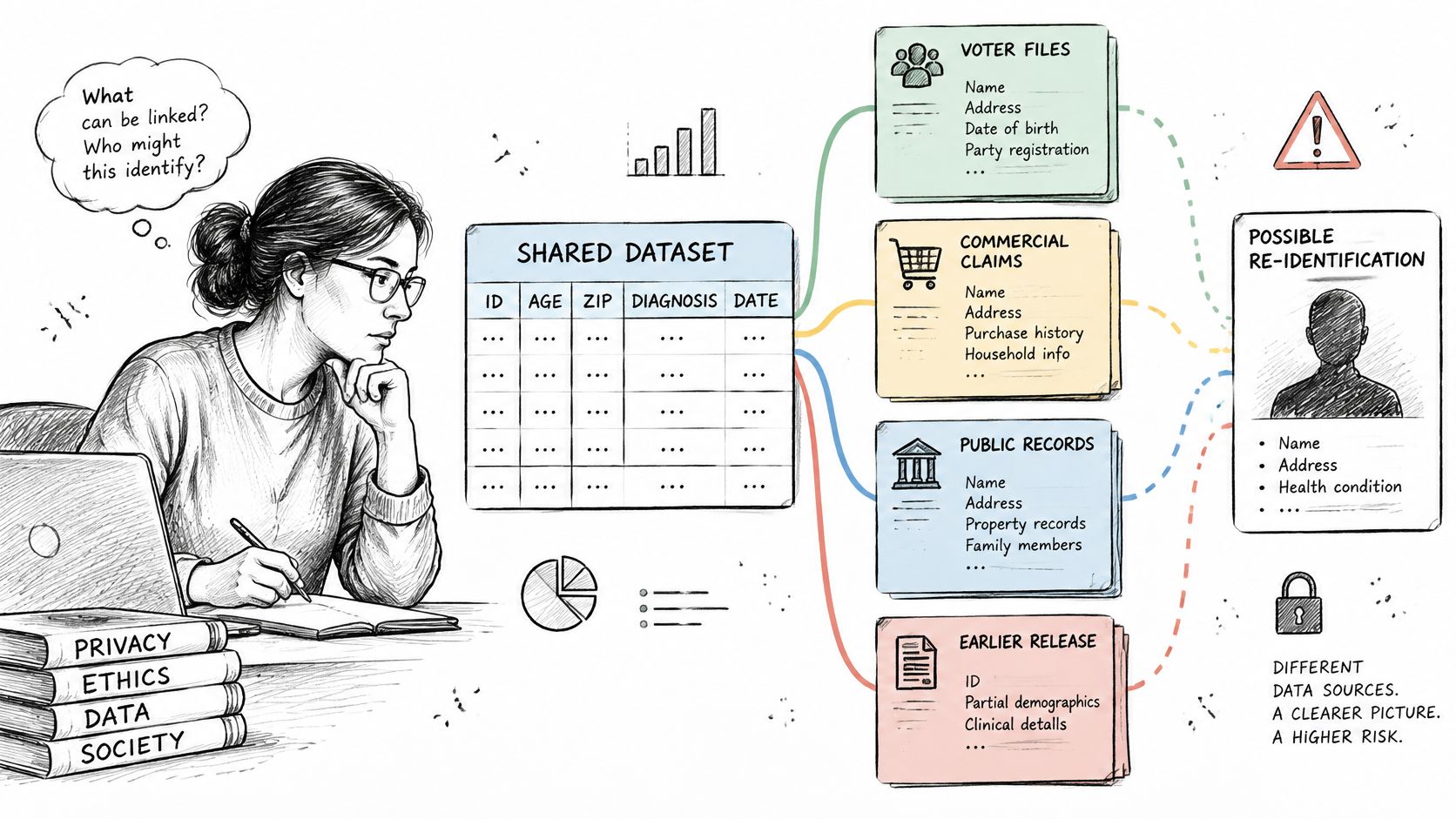
Define the attacker before choosing a metric. Identify the recipient, their access permissions, and outside information they could plausibly join, such as public records, commercial datasets, or earlier releases. Then identify quasi-identifiers, including combinations of age, geography, diagnosis group, and event timing.
HHS guidance on de-identification methods explains why the anticipated recipient and reasonably available information matter. A release assessment should document those assumptions rather than treating de-identification as permanent.
| Measure | What it tests | Limitation to address |
|---|---|---|
| k-anonymity | Whether each quasi-identifier combination occurs in a group of at least k records | Group members can still share the same sensitive attribute |
| l-diversity | Whether groups contain sufficiently diverse sensitive values | Distinct values can remain semantically similar or reveal disproportionate information |
| t-closeness | Whether group-level sensitive-value distributions stay sufficiently close to the overall distribution | Results depend on distribution and distance choices |
| Differential privacy | A formal bound on output changes between neighboring datasets | Requires a defined neighboring relationship, mechanism, and privacy accounting |
These are analytical tools, not interchangeable HIPAA approvals. The expert should justify chosen parameters and explain which attacks the assessment does and doesn't address.
For differential privacy, epsilon expresses part of the privacy guarantee. Tighter privacy settings generally require accepting more noise or another utility cost; teams must account for cumulative privacy loss across related releases.
Retain a risk report containing the attacker model, quasi-identifier inventory, uniqueness counts before and after transformation, chosen thresholds, linkage tests, and results. Name the owner who must reopen it when recipients, schemas, auxiliary datasets, or intended uses change.
Teams sometimes assume generated records are automatically private. A generator fitted to patient data can reproduce rare examples or reveal information about training-set membership, so synthetic data still needs a release assessment.
Synthetic records aim to reproduce useful patterns without reproducing individual records. Test for near-duplicates and membership inference against the source, and examine whether rare combinations survive in identifying form.
A behavioral-health synthetic-data study in JAMIA Open reported adequate predictive utility at epsilon 5 while mitigating privacy risk. That result concerns the study's task and population; it doesn't establish a universal parameter for healthcare releases.
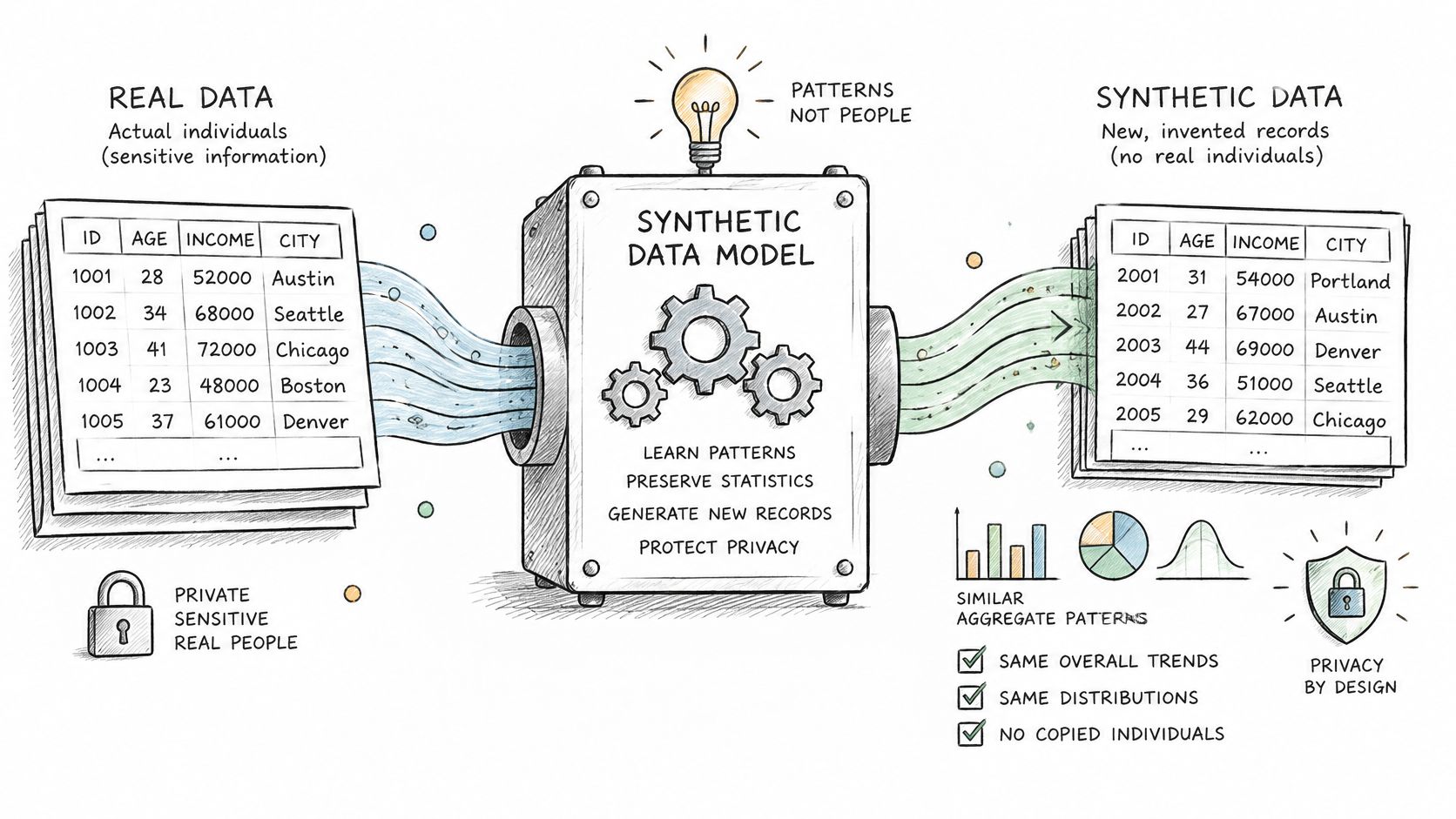
Evaluate subgroup calibration, rare-event performance, and temporal validity when the intended use involves prediction. For software testing, check relationships, constraints, missingness, and interface behavior rather than judging realism by visual inspection.
Appropriate applications include pipeline development, interface testing, and model prototyping; generated records shouldn't substitute for final clinical validation on appropriate real-world evidence.
Use synthetic data for questions about pipeline behavior; use controlled access or Expert Determination when the question depends on real patients.
Evaluate any managed de-identification service or in-house library against an explicit coverage contract. Require tests for structured fields, narrative text, images, metadata, and references between records. A successful transformation response doesn't establish that the entire release is safe.
For FHIR exports, inventory identifiers and references across resources rather than relying on a patient-name field alone. For DICOM, separately evaluate headers and text embedded in pixels. Require consistent token namespaces, restricted key access, and audit records that don't repeat source values.
Production failure points, owners, and controls
| Failure point | Owner | Control to verify |
|---|---|---|
| Error traces and logs echo raw fields | Engineering | Tests fail when raw fixture values appear |
| Export filenames and object metadata | Engineering | Naming rules and pre-release metadata scan |
| DICOM headers and burned-in text | Engineering with data owner | Header coverage tests and pixel review |
| Backups and restored copies | Data owner | Defined backup scope; restored copies rescanned |
| Development clones | Engineering | Clone workflow applies approved transformations |
| Derived features recreate unique patterns | Data owner | Uniqueness and linkage tests on derived features |
| Token keys stored beside released data | Data owner | Managed key storage, access logs, and rotation procedure |
Compliance should own applicable Business Associate Agreement review and the assessment record. Engineering owns implementation evidence; the data owner authorizes release and key custody arrangements.
For workflows such as a clinical AI assistant, include retrieval stores, prompt traces, and exported responses in the inventory. Don't stop at the source database.
Define the recipient, purpose, permitted environment, and retention period.
Choose the legal method. Where detailed dates or geography are necessary, budget for expert assessment or retain controlled access.
Inventory identifiers across tables, notes, images, logs, exports, and backups.
Transform data inside the protected boundary before promoting an export into its destination.
Run disclosure-risk and task-specific utility tests. Record versions, results, and exceptions.
Obtain privacy approval and, where applicable, the qualified expert's written determination.
Assign reassessment triggers for new recipients, auxiliary datasets, model retraining, and schema changes.
De-identification is one control within a wider HIPAA program. For the rest, see our guides to HIPAA compliance for software development, the HIPAA compliant app development checklist, business associate agreements for software vendors, and HIPAA compliant AI.
De-identification is a release decision backed by evidence. Engineering must demonstrate transformation coverage, privacy reviewers must evaluate residual risk, and data owners must authorize a defined use.
Ekipa works as an extension of internal developers, product managers, and regulatory stakeholders, following client development processes with SaMD-aligned documentation, validation readiness, and traceability. To build HIPAA-ready data pipelines and release workflows, explore our HealthTech engineering services or book a consultation.
This article is general information, not legal or regulatory advice.
Tokenization alone doesn't establish that a dataset meets a HIPAA method. Review the token design, remaining attributes, and recipient context before approving release.
Don't assume shifted calendar dates satisfy Safe Harbor. If the intended analysis requires detailed timelines, obtain an appropriate expert assessment or keep the workload under controlled access.
Validate against human-reviewed samples stratified by document source and note type. Measure entity-specific misses and excessive redaction, and retain adjudication records.
Synthetic records can support development and testing, but they shouldn't replace appropriate real-patient evidence for final clinical validation. Their suitability depends on the question being tested.
The data owner should authorize release with privacy or compliance review. Engineering supplies test evidence, and Expert Determination also requires the qualified expert's documented assessment.
IEC 62304 software safety classification explained: how Class A, B and C are assigned, what each class requires, and what Edition 2 changes.

HITRUST vs SOC 2 for healthtech: assurance model, HITRUST e1, i1 and r2 levels, hospital buyer demands and the order to pursue them.

A practical roadmap to SOC 2 for HealthTech startups: Type I vs Type II, Trust Services Criteria, HIPAA overlap, and the steps to a Type II report.
Connect with our team to explore how AI expertise can transform your business.