
AI in Healthcare
HIPAA-Compliant AI: How to Use LLMs With PHI Safely
How to build HIPAA-compliant AI: when LLM providers need a BAA, data minimization, de-identification, audit controls and a reference architecture.
October 16, 2026Read more
AI-driven healthcare analytics helps organizations turn complex data into actionable insights. It supports smarter decisions, improves operational efficiency, and enhances patient outcomes.
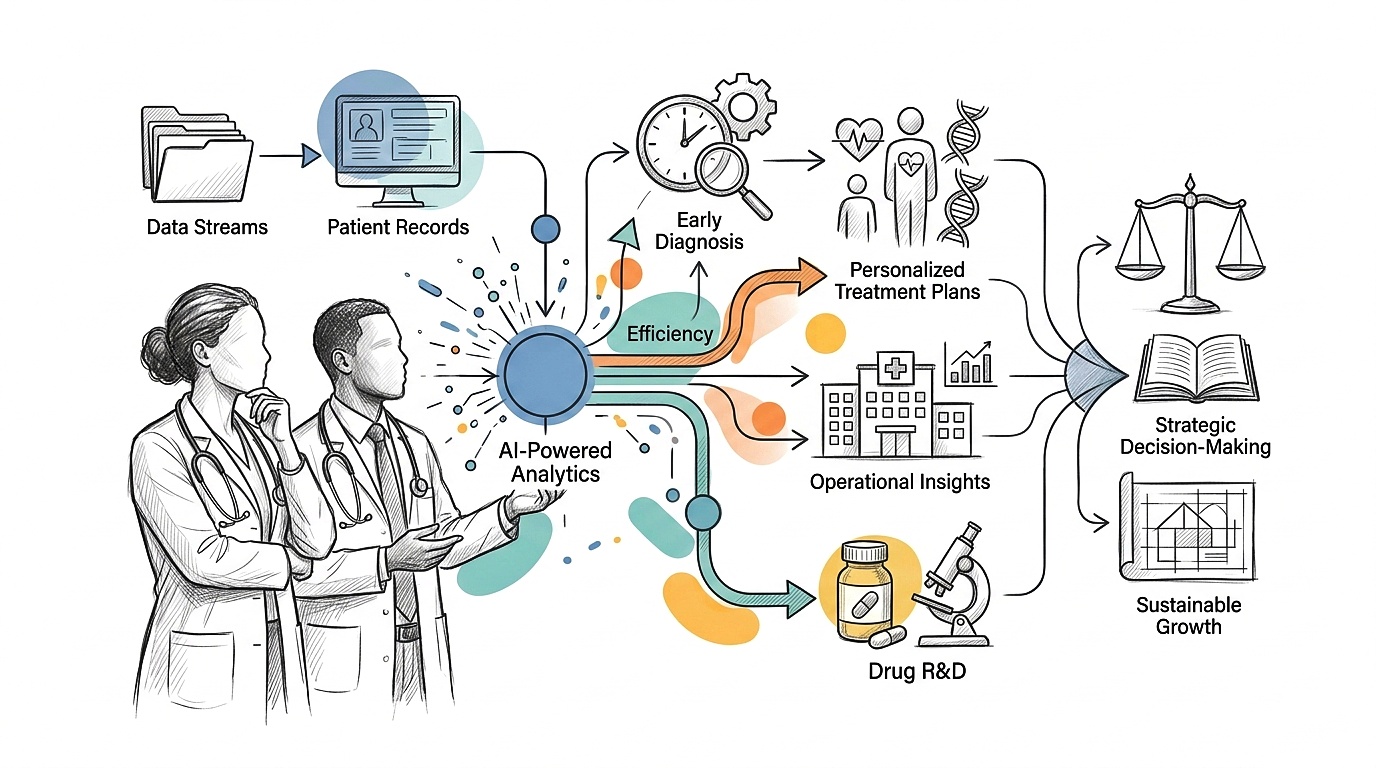
Healthcare leaders face a constant stream of data that influences every decision. The challenge lies in turning this information into clear insights that guide action. AI-driven healthcare analytics brings order to complex records, treatment patterns, operational data, and financial inputs, transforming them into knowledge that supports smarter choices across the organization.
At the same time, leaders must balance improving patient care, controlling costs, and preparing for future demands. Traditional models depend on past reports and manual interpretation, which often slow progress. AI-powered analytics changes this approach by delivering timely and precise insights that strengthen long-term planning and support sustainable growth, improved outcomes, and efficient resource use.
AI-driven healthcare analytics means using intelligent systems to study medical and operational data. These tools work with large amounts of both structured and unstructured information, including patient records, diagnostic reports, and hospital operations. A skilled healthtech engineering partner brings the technical know-how to connect analytics systems with real clinical workflows and organizational goals.
The approach involves three main types of analysis. Descriptive analytics looks at what has already taken place. Predictive analytics studies patterns and forecasts what might happen next. Prescriptive analytics suggests possible actions based on the data available. Together, these methods give healthcare teams a clear way to make informed decisions.
AI reviews subtle changes in patient data and spots risks before symptoms appear. Detecting issues early improves treatment planning and lowers the chance of complications. Predictive models also estimate admissions and identify high-risk cases, giving hospitals time to prepare.
AI studies medical history, genetic details, and lifestyle patterns to design treatment plans tailored to each patient. Continuous data from monitoring devices keeps care aligned with patient progress, improving both safety and accuracy.
Hospitals produce huge amounts of data every day. AI organizes this information to improve patient flow, reduce waiting times, and guide staff allocation. This creates smoother workflows and raises efficiency across departments.
AI examines large datasets to find possible drug combinations and predict patient responses. This shortens research timelines and increases accuracy in clinical trials, speeding up the development process.
Virtual assistants and automated systems help patients with scheduling, medication reminders, and basic guidance. These tools reduce administrative tasks and give healthcare professionals more time to focus on patient care.
Strategic decisions need a clear view of trends, risks, and opportunities. AI systems look at past and current data to help guide future planning. This reduces guesswork and sharpens accuracy. Many organizations turn to advanced healthcare AI services to make sense of complex datasets and turn them into practical strategies for growth and efficiency.
Older decision models leaned on manual reporting and insights that came too late. AI-driven analytics offers faster analysis, which helps with planning around capacity, disease patterns, and budgets. This shift brings more clarity to long-term decisions.

Predictive analytics studies patterns in patient data to spot potential health risks. It can help forecast disease outbreaks, estimate how many patients may need admission, and identify high-risk cases. A detailed custom AI strategy report can guide healthcare leaders in picking predictive models that fit their clinical and operational priorities.
AI systems assist doctors by looking at symptoms, medical history, and diagnostic data. They offer recommendations that help with accuracy in diagnosis and treatment planning. In advanced clinical settings, SaMD solutions connect analytics with medical devices to bring greater precision and reliability to clinical decisions.
Real-time analytics processes data as it comes in. This matters in emergency care, where quick decisions can shape patient outcomes. Organizations use AI automation services to keep data moving and deliver insights instantly across departments, helping teams respond faster in critical moments.
Hospitals manage many moving parts, including staff schedules, patient flow, and equipment. AI-powered analytics identifies where operations fall short and suggests ways to improve. A structured AI implementation support approach guides healthcare teams through system setup, integration, and performance monitoring over time.
When operations run more efficiently, wait times go down, service improves, and both patients and staff have a better experience. That brings consistent, reliable performance across the organization.
Healthcare costs continue to rise due to increased demand and limited resources. AI analytics examines financial data to identify unnecessary spending and support better budget planning.
A thorough AI readiness assessment evaluates current systems, data quality, and organizational readiness before bringing in analytics tools. Accurate financial insights guide resource allocation, reduce waste, and support long-term financial stability. This strengthens decision-making at the executive level.
Patient care improves when decisions are based on accurate data. AI analytics studies individual patient profiles to suggest personalized treatment plans. A well-structured AI adoption roadmap defines the steps to integrate analytics systems across departments and support better care delivery. Personalized care keeps patients more engaged and leads to higher recovery rates. It also builds trust between patients and providers through consistent, data-informed decisions.
AI analytics is being used in practical ways across healthcare. Hospitals apply predictive models to estimate disease spread and prepare resources in advance.
Organizations explore various AI use cases to improve operations, patient care, and long-term planning across departments. ICU resource management becomes more efficient with real-time data analysis. Remote monitoring helps track patients outside hospital walls. Workflow automation reduces manual tasks and improves daily operations. These examples show how analytics helps reshape routine processes and supports strategic planning.
Despite its strengths, AI-powered analytics comes with a few challenges. Data privacy is a major concern because medical information is highly sensitive. Organizations must follow strict practices to protect it. System integration can be difficult, especially in environments with older systems. It takes time, planning, and technical skill to make it work. Cost can also be a barrier, especially for smaller providers. Skilled professionals are needed to manage and make sense of analytics systems. Training and building a skilled workforce are key to successful adoption.
AI analytics continues to grow as more healthcare organizations adopt advanced tools. Future systems will offer deeper insights, sharper accuracy, and faster processing. Predictive models will become more precise, helping spot diseases earlier and improve planning. As data quality improves and systems become more advanced, decision-making will grow more accurate. AI-driven healthcare analytics will shape the future of care by guiding decisions around quality, efficiency, and long-term sustainability.
AI-driven healthcare analytics brings clarity to complex data and supports better decisions across clinical and operational areas. It strengthens long-term planning, improves patient care, and helps manage resources more effectively. Healthcare organizations that take this approach gain a clear edge in decision-making and performance. AI-driven healthcare analytics is central to building a structured, data-informed strategy for the future.
As technology moves forward, the role of analytics in healthcare will only grow, opening new doors for precision and efficiency. Contact us to explore how data-driven strategies can reshape healthcare decision-making.
AI-driven healthcare analytics uses intelligent systems to analyze clinical and operational data, helping organizations make faster and more accurate decisions.
Healthcare AI services process large datasets, enable predictive insights, and support key AI use cases for better planning and patient care.
A healthtech engineering partner helps build scalable systems, align analytics with workflows, and provide AI implementation support for smooth integration.
They start with an AI readiness assessment, followed by a custom AI strategy report and a clear AI adoption roadmap to guide implementation.
AI automation services and regulated SaMD solutions enable real-time insights, improve workflows, and strengthen data-driven decision-making in healthcare.
How to build HIPAA-compliant AI: when LLM providers need a BAA, data minimization, de-identification, audit controls and a reference architecture.

Practical data migration planning guide for healthcare teams. Scope, mapping, compliance, validation, cutover and rollback decisions explained end to end.

Smart on FHIR guide for healthtech engineers. Learn the OAuth 2.0 launch model, scope syntax, backend services, and US regulatory requirements.
Connect with our team to explore how AI expertise can transform your business.