AI in Healthcare
HIPAA-Compliant AI: How to Use LLMs With PHI Safely
How to build HIPAA-compliant AI: when LLM providers need a BAA, data minimization, de-identification, audit controls and a reference architecture.
October 16, 2026Read more
Discover how AI-driven healthcare platforms are transforming patient care, diagnostics, and operations. Get practical implementation and strategy insights.

The healthcare industry is moving away from its old, familiar methods and stepping into a new reality powered by intelligent technology. Leading this charge are AI-driven healthcare platforms. These aren't just futuristic ideas; they are integrated systems already at work, making sense of vast amounts of health data to help clinicians make smarter decisions and hospitals run more smoothly.
This move toward intelligent systems is changing the game for patient care and hospital management. For anyone leading a healthcare organization, the appeal is obvious: a chance to operate more efficiently while delivering better outcomes for patients. These platforms are quickly becoming the digital backbone for today's hospitals and clinics.

Think of these platforms as the central nervous system for a healthcare organization. They don't just store data; they connect and interpret information from all corners of the system—electronic health records (EHRs), medical scans, lab results, and even data from wearable devices—into one clear, coherent picture.
The growth here is staggering for a reason. The global AI in healthcare market, valued at around $11 billion in 2021, is on track to hit a projected $187 billion by 2030. That’s a compound annual growth rate (CAGR) of 37%.
This boom is happening because these platforms are proving their worth by crunching massive datasets to give providers insights in real-time. Investors are clearly taking notice, pouring 54% of all digital health VC funding into AI startups last year. For hospital administrators and operations leads, the payoff is an estimated $150 billion in annual savings by 2026, primarily from optimizing workflows and cutting down on preventable errors.
Such rapid growth highlights a serious need for a well-thought-out strategy. It’s not enough to just buy the latest tech; organizations need a cohesive plan to make it work.
An AI-driven healthcare platform isn't just another piece of software. It’s a fundamental change in how care is delivered—one that turns fragmented data into a powerful asset for improving both patient health and the bottom line.
Bringing these advanced systems into an organization successfully takes a clear vision and some expert planning. The path from a great idea to a scalable, real-world solution is full of complexities, and this is where having strategic guidance becomes essential.
Expert AI strategy consulting helps organizations navigate this tricky terrain by:
With specialized guidance, healthcare providers can adopt these powerful technologies with confidence. Our dedicated Healthcare AI Services are designed to help organizations turn these complex opportunities into tangible results. Having our expert team in your corner can make all the difference in ensuring your transformation is a success and keeps you at the forefront of medical innovation.
So, what exactly is an AI-driven healthcare platform? The best way to think about it is as the digital nervous system for a hospital or healthcare system. It’s designed to pull together all the disconnected streams of information—from Electronic Health Records (EHRs) and lab results to medical scans and data from patient wearables—and make sense of them collectively.

This is a huge step up from standalone AI tools for business that might only solve one specific problem. A true platform integrates these capabilities to create a single, unified view of a patient's health journey and the hospital's operational status. This is what makes it one of the most critical healthcare software solutions available today.
Imagine having an expert medical team that works 24/7, tirelessly analyzing new data as it comes in. That’s what a platform does—it flags risks, suggests diagnoses, and helps fine-tune clinical workflows, all in real-time.
Let's look under the hood. A handful of powerful AI technologies do the heavy lifting, each playing a specific role in turning raw data into actionable insights. A thorough AI requirements analysis is the first step to figuring out which ones your organization needs most.
Here is a breakdown of the key technologies you’ll find at the heart of these platforms:
| AI Technology | Primary Function | Example Application |
|---|---|---|
| Machine Learning (ML) | Predictive Analytics: Identifies patterns in historical data to forecast future events or risks. | Predicting patient sepsis risk or flagging individuals at high risk for a cardiac event based on their health data. |
| Natural Language Processing (NLP) | Text Interpretation: Reads, understands, and extracts meaningful information from unstructured text. | Analyzing doctors' clinical notes or patient reports to pull out key symptoms, diagnoses, and medication mentions. |
| Computer Vision | Image Analysis: Interprets and analyzes medical images like X-rays, CT scans, and MRIs. | Detecting subtle tumors or anomalies in a radiograph that might be missed by the human eye. |
These technologies aren't just working in isolation; their real power comes from how they work together. For instance, an NLP model might pull a symptom from a doctor's note, which an ML model then uses to instantly update that patient's risk score. This interconnectedness is what makes the system truly intelligent.
An AI-driven healthcare platform is more than the sum of its parts. It’s the seamless integration of machine learning, NLP, and computer vision that transforms a collection of data points into a dynamic, intelligent system for better care delivery.
Many organizations begin their AI journey by adopting point solutions—maybe for improving their internal tooling for billing or scheduling. While these individual tools are helpful, they often just create new data silos.
A true platform, on the other hand, is built from the ground up for interoperability. It’s designed to connect every system and serve as the single source of truth for both clinical and operational teams. This is where the big wins are found—not just in making one task a bit more efficient, but in making the entire healthcare ecosystem smarter.
This approach is the cornerstone of any effective AI Strategy consulting tool. As we've seen time and again, a unified platform delivers far greater long-term value than a patchwork of disconnected solutions ever could.
While the technology is impressive, the true test of any AI-driven healthcare platform is how it actually helps patients and providers in the real world. Let's move past the theory. These systems are already being used in hospitals and clinics to solve very real problems, showing that their value isn't just in the code, but in how they empower clinicians and improve people's lives.

We’re seeing major strides in a few key areas. These aren't futuristic ideas; this is what’s happening on the ground today.
One of the most powerful applications for AI is in diagnostics. When an AI model is trained on millions of medical images, it learns to spot diseases like cancer with incredible accuracy. It can often pick up on subtle patterns that even a trained human eye might overlook.
Think of it as a super-powered second opinion. Computer vision models are now analyzing mammograms, CT scans, and retinal images to flag potential issues, from tumors to signs of diabetic retinopathy. It gives radiologists and pathologists an invaluable safety net. This is a fast-growing field, with AI even being tested for cardiac analysis, as seen with tools like ChatGPT's ECG Reader.
Another major win is using predictive analytics to get ahead of disease. By looking at all the data in a patient's electronic health record, lab results, and even information from wearable devices, AI platforms can pinpoint individuals at high risk for serious health events.
AI platforms can analyze thousands of data points to predict a sepsis event up to 12 hours before a patient shows clear symptoms. This early warning gives clinical teams a critical window to intervene, drastically improving survival rates and reducing the length of hospital stays.
This fundamentally changes the healthcare model from reactive treatment to proactive care. It means providers can step in before a crisis hits, which is always better for the patient and far more efficient for the healthcare system.
AI is also proving to be a powerful tool for improving how hospitals run, which directly tackles one of the biggest crises in healthcare today: clinician burnout. Administrative work eats up so much of a provider's day. AI-driven platforms can automate a lot of that grunt work.
By taking over these routine tasks, AI gives clinicians precious time back to focus on what truly matters: caring for their patients.
Finally, AI is the engine making personalized medicine a reality. By analyzing a patient's unique genetic code, lifestyle, and health history, AI can help specialists design incredibly specific treatment plans. For an oncologist, this means moving away from a one-size-fits-all approach and toward therapies that are more effective and have fewer side effects.
These are just a few of the many real-world use cases where AI is already making a tangible difference.
Bringing an AI-driven platform into a healthcare setting isn't like installing new software. It’s a major operational shift that demands a thoughtful, well-structured plan connecting the technology directly to your business goals. For CTOs and operations leaders, creating this roadmap is the single most important step to ensure the project actually delivers value.
The journey doesn't start with choosing a technology; it starts with a problem. A deep AI requirements analysis is the first, most critical step. You need to get specific about the organizational headaches AI is truly suited to solve. This isn’t about chasing the latest trend. It’s about finding tangible pain points—like frustratingly long waits for diagnostic results, bloated administrative costs, or gaps in patient monitoring—where AI can make a measurable difference. Without this groundwork, even the most powerful platform is likely to fall flat.
Once you’ve locked onto a high-value problem, the next move is to launch a targeted pilot project. Trying to go big with an enterprise-wide rollout from the start is a classic recipe for blown budgets and burned-out stakeholders. A focused pilot acts as your proof-of-concept, giving you a safe, controlled space to test the technology.
Pick a project with a clear, measurable finish line. For example, you could pilot an AI model to automate billing codes in a single department or to predict patient no-shows for one specific clinic. A win here creates critical momentum. It also gives you the hard data you need to get buy-in from leadership and clinical staff for a wider rollout.
A successful pilot project does more than just prove the technology works; it demonstrates tangible value quickly. This early win is essential for building the organizational confidence and support needed to justify further investment and scale the initiative.
With a successful pilot in your back pocket, you can start mapping out a phased implementation. This strategy breaks the overwhelming process into manageable stages, which minimizes disruption and gives your team room to adapt along the way. A structured AI Product Development Workflow is essential for keeping this lifecycle on track from start to finish. We’ve found that a well-defined process, like the one we detail in our guide to the AI Product Development Workflow, is what separates a smooth rollout from a chaotic one.
Your phased roadmap should account for these key stages:
Trying to navigate this complex process alone can be daunting. Many healthcare organizations discover that bringing in an expert partner can speed up the timeline and help them sidestep common pitfalls. A Custom AI Strategy report gives you a clear, actionable plan built from the ground up for your organization’s unique challenges and goals.
This document becomes your definitive guide, mapping out everything from prioritizing use cases to designing the technical architecture and projecting your ROI. With expert guidance, you can move from planning to execution with much more speed and confidence.
Bringing AI-driven healthcare platforms to life isn't just a technical exercise; it’s a mission that requires careful planning and a serious commitment to responsible innovation. While the potential is incredible, the path is filled with critical hurdles. Success means navigating the complexities of data privacy, regulatory compliance, and ethics.
At the end of the day, building trust with patients and clinicians is just as important as building the technology itself.
The biggest challenge, without a doubt, is protecting patient data. In healthcare, this means unwavering adherence to regulations like HIPAA. Every piece of data has to be secured, anonymized whenever possible, and managed with the highest degree of care. This isn't an afterthought—it demands a solid data governance framework from the very beginning.
Another major hurdle is what we call the "black box" problem. Many powerful AI models work in ways that are hard for people to decipher. In a clinical setting, where every single decision must be transparent and justifiable, that's a non-starter.
There’s a clear and growing demand for explainable AI, especially for tools that guide clinical decisions. A doctor needs to understand why an AI model is suggesting a certain diagnosis or treatment plan before they can confidently act on it.
This need for transparency isn't just clinical; it extends to investors and payers, too. Funding for AI-driven healthcare platforms is surging—AI startups are projected to capture 54% of digital health venture capital in 2025, a significant jump from 37% in 2024. This investment wave shows the industry is betting big on AI, but long-term success will absolutely depend on mastering the tricky landscape of compliance and data security.
An AI system is only as good as the data it’s trained on. If that data is poor quality, incomplete, or biased, the AI's output will be unreliable and could even be harmful. This is why data quality and interoperability are the bedrock of any successful AI initiative in healthcare.
To start shaping your strategic plan, a practical AI adoption playbook can give you the framework and guidance needed to get it right.
These challenges might seem daunting, but they aren't roadblocks. Think of them as the cornerstones for building a sustainable AI strategy. Facing them head-on is the only way forward. It all begins with a clear roadmap, like the one illustrated in the process flow below, which breaks the journey down into manageable stages.

As the infographic shows, a successful rollout moves logically from a deep analysis of needs and opportunities to a focused pilot project and, finally, to full-scale integration. Managing this change also means training your clinical staff so they can trust and effectively use the new tools. When you empower your team, you turn potential skepticism into genuine enthusiasm.
Trying to adopt AI-driven healthcare platforms on your own is a tough road. It’s often slow, surprisingly expensive, and full of hidden risks that can derail even the most promising projects. The sheer complexity of integrating new technology, wrangling data, and staying on the right side of regulations is enough to overwhelm any team.
This is exactly where bringing in an experienced partner changes the game. A good partner helps you sidestep the common pitfalls and dramatically shortens the time it takes to see real results. Instead of trying to master everything at once, you get instant access to people who have done this before, along with their proven methods. As we explored in our AI adoption guide, a clear strategy from day one makes all the difference.
It’s one thing to have an ambitious idea; it’s another to build a fully functional AI solution that actually scales. This leap requires more than just code—it demands a deep understanding of what’s practical, what’s impactful, and what will work within the unique constraints of healthcare.
Our approach is built around turning your goals into concrete results. We start by working with you to quickly identify and refine the best use cases for your organization, a key part of our AI strategy consulting services. From there, we offer hands-on support to bring your vision to life. This might look like:
Each service is laser-focused on delivering clear business outcomes, whether that’s cutting operational costs, enhancing patient care, or simply giving your clinical staff more time to focus on their patients.
We don’t just build technology and walk away. We see ourselves as a dedicated partner, invested in your success for the long haul. Our job is to help you navigate the complexities of AI with confidence, from the initial strategy sessions to the final rollout and beyond. We’re in the trenches with you, providing guidance at every turn.
A true strategic partner doesn’t just deliver technology; they help build organizational capability. They empower your team to not only use AI but to understand its potential, ensuring your investment continues to deliver value long after the initial rollout.
When you work with our expert team, you’re getting more than just technical skill. You’re gaining a partner who genuinely understands the challenges and immense opportunities in healthcare today. We’re here to help you put AI to work, improve your operations, and secure your place as a leader in a changing industry.
Ready to get started? Explore the many real-world use cases we’ve brought to life for organizations just like yours. A Custom AI Strategy report can provide the clear, actionable roadmap you need. Let's build the future of healthcare, together.
As you start to explore what AI-driven healthcare platforms can do, some common questions naturally come up. Let's walk through some straightforward answers based on our experience in the field.
It helps to think of it like this: a standalone AI tool is a specialist. It’s built to do one thing exceptionally well, like analyzing a CT scan or transcribing a physician's notes. It solves a single, specific problem.
An AI-driven healthcare platform, on the other hand, is more like an integrated command center for the entire organization. It pulls together disparate data sources—EHRs, wearables, lab results, and more—and uses a suite of AI tools for business to create a unified, intelligent view of both patient journeys and operational workflows.
A platform is what allows you to move beyond isolated wins and achieve system-wide intelligence, which is why it’s a foundational piece of modern healthcare software solutions.
Protecting patient data isn't just a best practice; it's a fundamental requirement. This demands a layered security strategy. It starts with strict compliance with regulations like HIPAA, but it also involves advanced data anonymization and robust cybersecurity defenses to guard against breaches. Strong data governance policies have to be baked in from the very beginning, not bolted on as an afterthought.
The surest way to get this right is by working with a partner who lives and breathes secure, compliant custom healthcare software development. Managing these risks properly is essential for building trust with both your patients and your providers.
The best advice is always to start small and prove the concept. Instead of trying to boil the ocean, identify a high-impact but well-defined problem within your organization and launch a focused pilot project. A great first step is a thorough AI requirements analysis to pinpoint the perfect starting point. Maybe it’s improving diagnostic accuracy for a single condition or simply optimizing patient scheduling in one department.
This approach lets you demonstrate real value quickly, which builds momentum and gets people excited. You also gain crucial, real-world experience before you commit to a full-scale rollout.
The timeline for a return on investment really hinges on what you’re trying to achieve. If your focus is on operational efficiency—think automating administrative tasks with AI Automation as a Service—you can often see significant cost savings and a positive ROI in a matter of months.
For clinical improvements, like developing better diagnostic models, the ROI is a longer game. The value here is measured in better patient outcomes, fewer complications, and lower long-term care costs. A well-designed Custom AI Strategy report will help you map out these financial and clinical milestones right from the start.
To learn more about how we can help you build and execute your vision, connect with our expert team today.
How to build HIPAA-compliant AI: when LLM providers need a BAA, data minimization, de-identification, audit controls and a reference architecture.
Practical data migration planning guide for healthcare teams. Scope, mapping, compliance, validation, cutover and rollback decisions explained end to end.
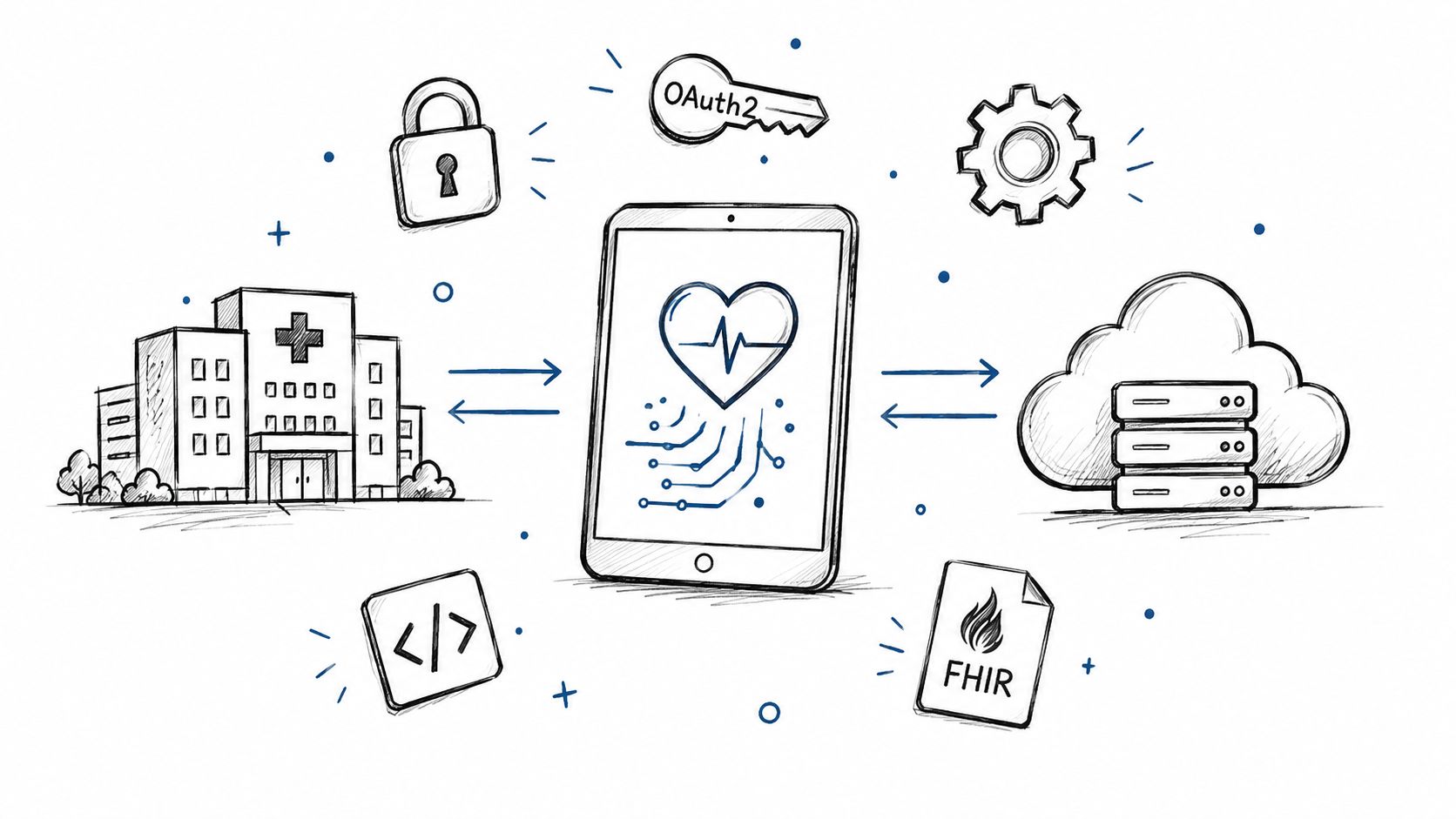
Smart on FHIR guide for healthtech engineers. Learn the OAuth 2.0 launch model, scope syntax, backend services, and US regulatory requirements.
Connect with our team to explore how AI expertise can transform your business.