
AI in Healthcare
HIPAA-Compliant AI: How to Use LLMs With PHI Safely
How to build HIPAA-compliant AI: when LLM providers need a BAA, data minimization, de-identification, audit controls and a reference architecture.
October 16, 2026Read more
Discover how AI for detecting rare diseases and anomalies is shortening diagnostic timelines, overcoming data challenges, and transforming patient outcomes.
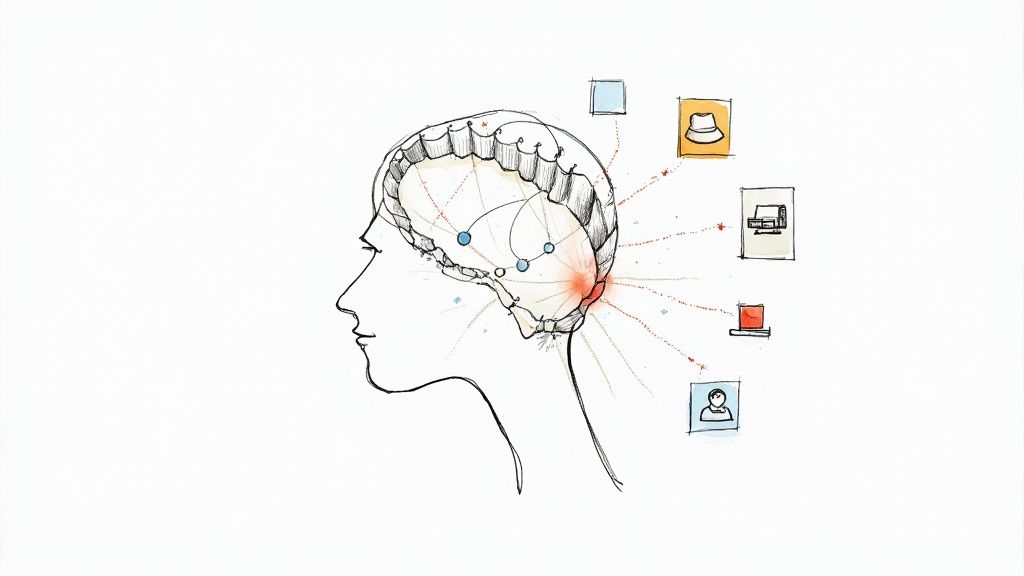
For far too many people, getting a rare disease diagnosis is a crushing, decade-long ordeal. They bounce from specialist to specialist, enduring endless tests and misdiagnoses, all while their condition remains a mystery. The problem isn't a lack of expertise; it's that the symptoms often look just like more common illnesses, sending doctors down the wrong path.
This is where AI for detecting rare diseases and anomalies comes in—not as a replacement for clinicians, but as a brilliant analytical partner.
The journey to a diagnosis for a rare disease can feel incredibly lonely and draining. While these conditions affect a staggering 300 million people worldwide, the path to an answer for any single person can stretch on for 10 to 15 years.
This long wait isn't just an inconvenience. It’s a critical window where a disease can progress, effective treatments become less viable, and the financial and emotional burden on families grows immense. The core issue is that connecting the dots requires sifting through mountains of complex data—from genomic sequences to nearly invisible clues in medical scans.
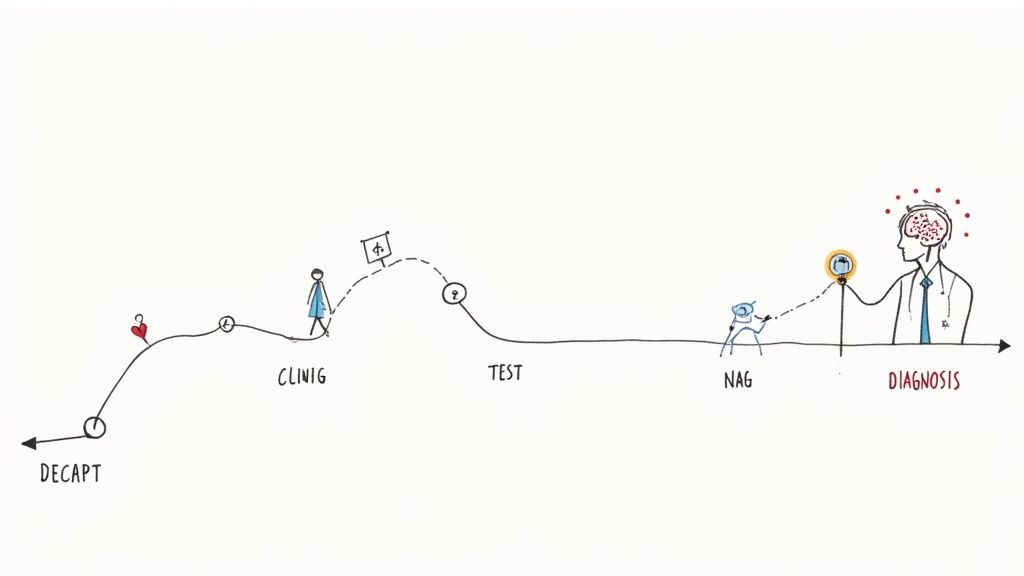
This is exactly the kind of challenge our advanced AI solutions were built to solve. AI algorithms have an uncanny ability to spot faint, complex patterns across massive datasets that are simply invisible to the human eye.
In minutes, they can analyze a patient's complete medical history, genetic profile, and imaging results, cross-referencing them with global medical knowledge to surface connections that point directly to a rare condition.
Let's look at how this plays out in the real world. The traditional diagnostic process is often a slow, reactive one. With AI, that entire dynamic shifts.
| Traditional Diagnostic Challenge | AI-Powered Solution | Key Patient Benefit |
|---|---|---|
| Symptom Overlap: Symptoms mimic common illnesses, leading to years of misdiagnosis. | Pattern Recognition: AI analyzes vast datasets to find subtle, unique patterns that differentiate rare diseases from common ones. | Faster, Accurate Answers: Patients get the right diagnosis sooner, ending the cycle of uncertainty. |
| Information Overload: Clinicians can't possibly keep up with the data on 7,000+ rare diseases. | Knowledge Synthesis: AI rapidly cross-references a patient's data against the entire body of medical literature and case studies. | Informed Clinical Decisions: Doctors are equipped with comprehensive insights, even for diseases they've never seen. |
| Diagnostic Delays: The average diagnostic journey takes 10-15 years, allowing the disease to progress. | Early-Stage Detection: AI can flag at-risk patients by identifying subtle anomalies long before symptoms become severe. | Earlier Intervention: Treatment can begin sooner, often leading to better long-term outcomes. |
| Data Scarcity: It's hard to train models with limited patient data for each rare disease. | Advanced AI Models: Techniques like few-shot learning allow models to learn from very few examples. | Solutions for the Rarest Cases: Even patients with extremely rare conditions can benefit from AI analysis. |
AI-driven tools fundamentally change the diagnostic process from reactive to predictive. Instead of waiting for a disease to become obvious, AI models can flag at-risk patients early on, suggesting possibilities a physician might not have considered on their own.
This is made possible by new approaches like the RetiZero vision-language foundation model, which has shown incredible promise in "few-shot learning" situations. This is a game-changer because it directly addresses the data scarcity problem that has always plagued rare disease research. You can read the full research about these AI model findings to see how it works.
The practical advantages are clear and compelling:
Accelerated Timelines: The diagnostic odyssey can be cut from years down to months, or sometimes even weeks.
Enhanced Accuracy: By offering data-driven hypotheses, AI significantly reduces the chance of misdiagnosis.
Reduced Costs: It helps avoid a cascade of unnecessary tests and specialist visits, easing the financial strain on both patients and the healthcare system.
Ultimately, AI gives clinicians the ability to turn a flood of data into clear, actionable intelligence. It offers real hope to patients who have been searching for answers for years and gives healthcare providers the tools to tackle some of the most difficult challenges in medicine. For organizations looking to implement these systems, working with a team that offers expert AI strategy consulting can make all the difference in navigating this complex but incredibly rewarding field.
To really get a handle on how AI for detecting rare diseases and anomalies works, you have to peek behind the curtain at the different models doing the heavy lifting. These aren't mysterious black boxes; they're specific algorithms that learn from data in different ways, each tailored to a particular diagnostic puzzle. And the good news? You don’t need a PhD in data science to understand the core ideas.
Think of these models as different kinds of students. Each one has a unique learning style for figuring out what’s normal and what’s not. This flexibility is essential because the data challenges in healthcare are almost never one-size-fits-all. Exploring these techniques shows just how sophisticated our Healthcare AI Services have become.
The most straightforward approach is supervised learning. It’s a lot like a medical student cramming with flashcards. On one side of the card, you have a medical image—say, a chest X-ray—and on the other, you have the correct label: "pneumonia" or "normal."
After going through thousands of these labeled examples, the student—or in our case, the AI—learns to connect specific visual patterns with a diagnosis. This method is incredibly effective when you have a massive, well-labeled dataset. It’s the engine behind many diagnostic AI tools for business that classify common, well-documented conditions.
But what about when you don't know exactly what you're looking for? With rare diseases, you rarely have thousands of labeled examples to train a model. This is where unsupervised learning comes into its own.
Imagine a detective sifting through a huge database of "normal" patient data—heart rates, lab results, genomic markers, the works. The AI’s job is simply to learn the fundamental signature of a healthy patient. When a new patient's data comes in, the model scans it for anything that breaks from that established baseline.
This approach is powerful because it doesn't need labeled anomalies to function. It just flags any data point that doesn't fit the expected pattern, making it a critical tool for discovering new or exceptionally rare conditions that have never been documented before.
The unique hurdles of rare diseases mean that standard models often aren't enough. The biggest problem is almost always a lack of data. Thankfully, newer, more advanced techniques have been developed to work around these limitations, and they are now a core part of any serious AI strategy consulting tool effort in healthcare.
Few-Shot Learning: This model is built to learn from an incredibly small number of examples, sometimes just a handful. Think of a seasoned clinician who can spot a rare syndrome after seeing it just once or twice. That's the goal here, making it indispensable when patient data is nearly impossible to find.
Transfer Learning: This is a clever shortcut that repurposes knowledge from one medical task to kickstart another. For example, an AI trained to find anomalies in lung scans already has a foundational "understanding" of medical imaging. You can transfer that knowledge to help it detect abnormalities in liver scans, even with much less training data.
Federated Learning: This model tackles the massive challenge of data privacy head-on. It allows multiple hospitals to train a single, robust AI model together without ever having to share their sensitive patient data. Each hospital trains a local copy of the model on its own data, and only the anonymous insights—not the data itself—are combined centrally. This protects patient privacy while building a much smarter diagnostic tool.
These models aren't just academic theories; they're the practical tools that make modern diagnostic systems possible. They are the backbone of a solid AI Product Development Workflow, capable of turning complex data problems into real-world, life-saving solutions. Understanding how they work is the first step toward building powerful AI solutions that can finally bring an end to the diagnostic odyssey for millions.
Think of AI models as brilliant students. To excel, they need excellent study materials. But when you’re trying to teach an AI to spot rare diseases, the "textbooks"—the available patient data—are often incomplete, scattered across different systems, or even written in different "languages." This data puzzle is the single biggest hurdle in building effective diagnostic tools. After all, the very definition of a rare disease means you don't have a lot of examples to learn from.
Solving this isn't just about writing clever code; it’s about having a sophisticated data strategy. A solid data foundation is absolutely non-negotiable for any AI project to succeed. This is precisely why organizations often turn to expert guidance to navigate the murky waters of scarce, imbalanced, and fragmented medical information. Without a clear plan, even the most powerful AI model is dead in the water.
The most glaring problem is the simple lack of examples. How can an AI possibly learn to recognize a condition that affects only a handful of people in a million? One of the most promising answers is synthetic data generation. This isn’t science fiction; it’s a technique where we create realistic, artificial patient data that mirrors the key characteristics of real patients, all without touching private information.
By generating these synthetic profiles—complete with plausible medical histories, lab results, and genomic markers—we can amplify a tiny dataset into a much larger, more useful one. It gives the AI model enough material to finally learn the subtle patterns of the disease, effectively sidestepping the scarcity problem and boosting its diagnostic accuracy.
The diagram below shows how different AI approaches—like supervised, unsupervised, and federated learning—can be brought to bear on this anomaly detection challenge, even when the data is far from perfect.
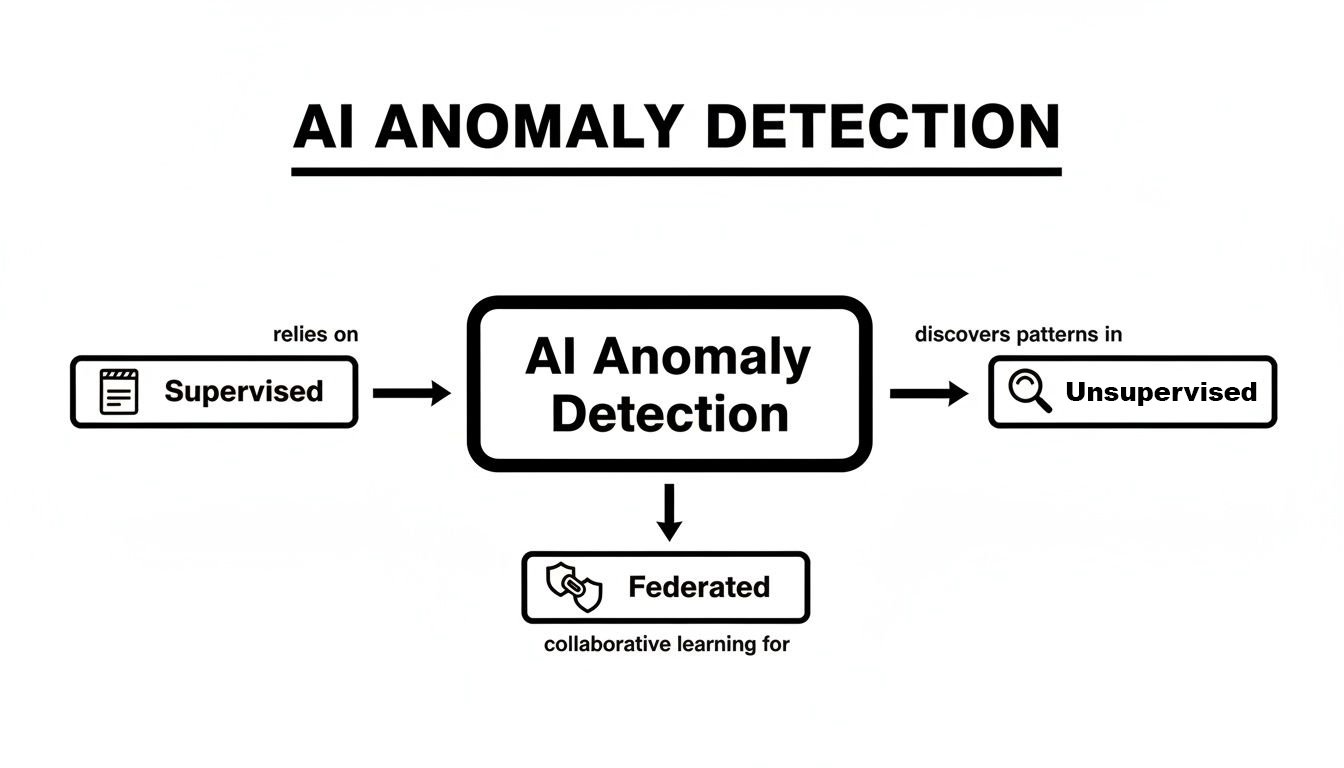
As you can see, each technique offers a different way to tackle the problem. Some use labeled examples, while others are designed to find hidden patterns on their own. It’s this adaptability that makes AI so powerful.
Another major headache is dataset imbalance. In any random sample of health records, the "normal" cases will overwhelmingly outnumber the rare anomalies. If you're not careful, an AI model will quickly learn a lazy but effective trick: just classify every case as normal. Technically, it would be right over 99% of the time, but it would be completely useless for finding the one patient who needs help.
To get around this, we use special techniques that essentially tell the model that finding the one rare case is a thousand times more important than correctly identifying the thousands of normal ones. This forces it to pay close attention to the outliers.
The challenge gets even tougher when you realize that critical diagnostic data is often multimodal—it comes in all sorts of formats. A complete patient picture requires us to connect the dots between genomic data, unstructured text from a doctor’s notes (EHRs), and visual information from medical images like MRIs or X-rays.
Pulling all these different pieces together into a coherent story is a serious data engineering challenge. It typically involves a few key steps:
Data Integration: We have to create a single, unified view of the patient by linking all these different data types.
Feature Extraction: Next, we need to pull the most important signals from each source. This could be a specific gene mutation from a lab report or a key phrase buried in a clinician's notes. Tools like an AI-powered data extraction engine are built specifically to pull this kind of structured insight from messy, unstructured text.
Model Fusion: Finally, we build AI models that can process and learn from all these data types at the same time, giving them a much richer context to make an accurate prediction.
While AI is poised to change diagnostics, it’s also important to remember the ongoing work in the field, like advances in gene testing for diagnosis, that continues to unravel complex biological puzzles. Ultimately, solving the data puzzle is the first and most critical step. It’s what transforms raw, messy information into the fuel that powers life-saving AI systems.
All the theory is great, but seeing AI for detecting rare diseases and anomalies out in the wild is where its real power comes to light. This is where the algorithms stop being abstract concepts and start producing tangible, often life-changing, results for patients. In one specialty after another, AI is quickly becoming an essential partner for clinicians, helping them spot clues that were once hidden in plain sight.
These aren't far-off ideas from a sci-fi movie; they are compelling, real-world use cases happening right now. From ophthalmology to genetics, AI-powered tools are slashing diagnostic wait times, boosting accuracy, and completely changing how we solve complex medical puzzles. You can even see its impact in specialized tools like advanced point-of-care wound imaging devices for bacterial detection that rely on sophisticated analysis to guide treatment.
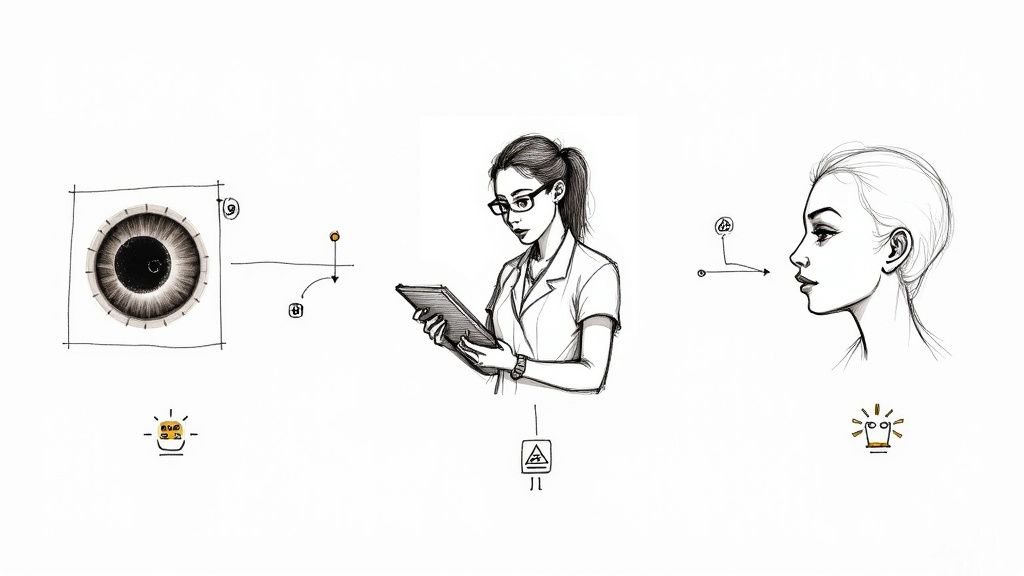
Medical imaging is one area where AI has made some of its most impressive leaps. Algorithms can now analyze retinal scans with a precision that was unthinkable a decade ago, spotting the faintest, earliest signs of rare eye diseases long before a patient notices any change in their vision. By picking up on minuscule shifts in blood vessels or retinal layers, these systems give ophthalmologists a crucial head start.
In a similar vein, computer vision is making huge strides in genetics. Some tools can analyze facial photographs to identify dysmorphic features—subtle structural differences in the face that often point to specific genetic syndromes. The AI then suggests potential conditions, handing geneticists a data-driven starting point that dramatically narrows down the list of diagnostic possibilities.
So much of a patient's story is locked away in unstructured clinical notes, buried deep within their electronic health record (EHR). This is where Natural Language Processing (NLP) models come in, acting like tireless researchers that can sift through years of doctors' notes, lab reports, and consultation summaries to pull out critical information.
These NLP tools are trained to connect the dots, identifying seemingly unrelated symptoms mentioned across dozens of documents to flag a patient who might have an undiagnosed rare disease. This proactive approach transforms the EHR from a static archive into a dynamic diagnostic partner. Automating this detective work also lifts a massive burden from clinicians, letting them focus on the patients who need them most. Our own platform, https://www.ekipa.ai/products/diagnoo, is designed to do just that.
By transforming unstructured text into structured insights, AI can surface patterns of symptoms and medical history that might take a human clinician months or even years to piece together. This capability is central to ending the long diagnostic odyssey.
The real future, though, lies in integrated systems that pull together multiple data sources for a complete, 360-degree patient view. One pioneering example is an AI model that plugs directly into EHRs to flag high-risk cases and suggest diseases that may have been overlooked. In clinical trials, this type of AI contributed to a correct diagnosis in 70% of the patients it flagged, proving just how much it can shrink the diagnostic timeline.
This push toward integration highlights a key trend: even general-purpose AI tools are being adapted for medical use, helping to pull critical insights from records and spot at-risk individuals faster than ever before. These aren't just technical wins; they're the product of combining deep AI expertise with practical medical knowledge.
These examples really drive home the tangible impact AI is having in medicine today. They show how thoughtfully designed AI can turn raw data into life-changing diagnoses, finally giving answers and hope to patients who have been searching for years.
An advanced AI model for detecting rare diseases is a powerful thing, but it’s only valuable if it can safely make the leap from the lab to a real-world clinic. This isn't a single step; it's a carefully planned journey. Without a clear path, even the most brilliant algorithm remains a theoretical exercise, never reaching the patients who need it most.
Making that transition from a promising prototype to a trusted diagnostic tool requires a structured, de-risked approach. A well-defined AI Product Development Workflow ensures that every stage, from initial testing to final deployment, is handled with the precision and care that patient safety demands.
Before any AI tool can get near a patient, it must go through exhaustive clinical validation. This is a non-negotiable step designed to prove one thing: that the model is both accurate and reliable in a real-world environment. It's not enough for an AI to perform well on clean, curated datasets; it has to deliver consistent results with the messy, complex data of actual patients.
This validation process means testing the model against a "gold standard," which is often the consensus of expert human clinicians. The AI's predictions are systematically compared to their diagnoses across hundreds or even thousands of cases to measure its sensitivity, specificity, and overall accuracy.
This process is all about building trust. Clinicians need irrefutable evidence that the AI is a dependable co-pilot, not an unpredictable black box. A robust Custom AI Strategy report is essential for outlining these validation protocols right from the start.
Once an AI model has proven its clinical utility, the next major hurdle is the complex web of healthcare regulations. In the United States, this primarily means securing clearance or approval from the Food and Drug Administration (FDA), which classifies this kind of AI as a medical device. On top of that, any system handling patient data must be fully compliant with the Health Insurance Portability and Accountability Act (HIPAA) to protect patient privacy.
Meeting these standards is a serious undertaking. It involves:
Rigorous Documentation: Every single aspect of the model’s development, training, and validation has to be meticulously documented.
Risk Management: You must provide a thorough analysis of all potential risks and a clear plan for how they are mitigated.
Data Security: Implementing robust safeguards to keep patient data confidential and secure isn't just a good idea—it's mandatory.
This regulatory phase is often the most time-consuming and resource-intensive part of the journey, and it calls for deep expertise to get it right.
The final, and perhaps most crucial, step is operational integration. For an AI tool to actually make a difference, it must fit seamlessly into a clinician's existing workflow. If a tool is clunky, slow, or requires doctors to jump through extra hoops, it will be abandoned, no matter how accurate it is.
Successful integration means embedding the AI directly into the systems clinicians already use every day, like Electronic Health Records (EHRs). The goal is to deliver AI-driven insights at the point of care, presenting them in a way that is intuitive and immediately actionable.
The potential here is enormous. Researchers at Vanderbilt University Medical Center recently showed how AI tools can dramatically speed up rare disease diagnosis. One of their models achieved 77.8% accuracy in identifying rare diseases just from clinical notes, demonstrating how AI can make advanced phenotyping accessible to nearly any healthcare facility. You can discover more about these findings on Vanderbilt Health.
To bring this all together, here is a practical roadmap for taking an AI model from concept to clinic.
| Phase | Key Activities | Primary Goal |
|---|---|---|
| Phase 1: Discovery & Scoping | Identify specific clinical need, define success metrics, assess data readiness, build a cross-functional team. | To establish a clear business case and ensure the project is feasible and aligned with clinical needs. |
| Phase 2: Data & Model Development | Aggregate and anonymize data, develop and train the initial AI model, perform preliminary testing. | To build a functional and accurate prototype that addresses the defined clinical problem. |
| Phase 3: Clinical Validation | Design and execute a validation study against a "gold standard" (e.g., expert clinicians). Analyze performance. | To rigorously prove the model's accuracy, reliability, and safety in a simulated clinical environment. |
| Phase 4: Regulatory & Compliance | Prepare and submit documentation to regulatory bodies (e.g., FDA), ensure HIPAA compliance. | To achieve the necessary legal and ethical approvals for use with real patient data. |
| Phase 5: Integration & Deployment | Integrate the model with clinical systems (EHRs), design user interface, and conduct pilot testing with a small user group. | To embed the AI tool seamlessly into the clinical workflow with minimal disruption. |
| Phase 6: Launch & Monitoring | Roll out the AI tool to all intended users, provide training, and implement continuous monitoring for performance. | To achieve full operational use while ensuring ongoing safety, accuracy, and clinical value. |
This structured approach helps de-risk the entire process, turning a powerful algorithm into a life-changing clinical reality.
The future of rare disease diagnostics isn't just about building smarter algorithms; it’s about smart collaboration. Bringing AI into the world of rare disease and anomaly detection isn't an incremental step—it's a massive leap forward, giving us a real shot at solving some of medicine's most stubborn puzzles. But this journey, from years of diagnostic uncertainty to a clear answer, is too big for any one organization to take on by itself.
To really move the needle, we need healthcare providers, biotech innovators, and research institutions to pool their strengths. This kind of progress demands dedicated partnership every step of the way, from the initial AI requirements analysis that sets the project's foundation to building the sophisticated internal tooling that puts critical insights directly into clinicians' hands.
Success here is born from a simple formula: deep clinical wisdom plus advanced technical skill. A partnership that truly works is built on a few key pillars:
A Shared Vision: Everyone agrees on the core mission—to drastically shorten the diagnostic odyssey for patients.
Data Collaboration: Finding ethical and secure ways to share knowledge is essential for training AI models that are both robust and accurate.
Integrated Solutions: The goal is to create custom healthcare software development that doesn't disrupt, but instead slides seamlessly into the way clinicians already work.
This kind of teamwork is the fastest way to turn incredible AI potential into real-world patient benefits. By combining our expertise, we can get these life-changing technologies adopted faster and create better outcomes for everyone. The promise of our Healthcare AI Services is powerful on its own, but it becomes truly transformative when amplified through strong partnerships.
The real endgame is a healthcare system where AI-driven insights are a standard tool in the diagnostic kit, ensuring no patient has to spend years searching for an answer. This isn't some far-off dream; it's an achievable goal, but only if we work together.
Overhauling diagnostic capabilities isn't something you can do overnight. It takes a strategic partner who gets both the technology and the mission. Whether you’re just starting to map out your AI strategy, need to develop highly specific models, or want to integrate powerful new diagnostic tools, having the right expertise in your corner makes all the difference.
If your organization is ready to help lead this change, we'd welcome a conversation with our expert team. Let’s talk about how we can revolutionize your diagnostic capabilities and build a healthier future, one patient at a time.
When you're exploring how AI can help spot rare diseases and anomalies, a lot of questions come up. Let's tackle some of the most common ones we hear from healthcare leaders.
Think of it as a highly advanced pattern-spotter. AI anomaly detection uses algorithms to sift through mountains of patient data—lab results, imaging scans, genomic information—and flag anything that doesn't fit the norm.
In a clinical setting, this means it can pick up on faint, unusual signals that might point to a rare disease or a brewing health problem. These are the kinds of subtle clues that are incredibly difficult, if not impossible, for a person to catch on their own.
That’s the million-dollar question, isn't it? Rare diseases, by definition, don't give us a lot of data to work with. This is where modern AI techniques really shine. We don't just throw a standard algorithm at the problem; we use specialized approaches:
Few-Shot Learning: This is like teaching a model to be a quick study. It learns to make reliable predictions from just a handful of examples, which is perfect for rare conditions.
Transfer Learning: We take a model that's already an expert on common diseases and transfer its knowledge. It applies what it already knows about medical data to the new, rarer patterns.
Synthetic Data Generation: When we just don't have enough real-world data, we can create artificial—but highly realistic—patient profiles. This gives the model more material to train on without compromising patient privacy.
These methods are specifically designed to work around the data scarcity problem. In fact, our own AI solutions are built from the ground up using these very techniques to solve real-world healthcare challenges.
Not a chance. The goal is to empower clinicians, not replace them. Think of AI as an incredibly sharp and tireless assistant.
It does the heavy lifting of data analysis, flagging potential issues and bringing them to a doctor's attention with supporting evidence. This allows your clinical teams to spend less time digging through data and more time with patients, thinking through complex cases, and making the final call. The physician is always in charge.
Getting started is less about a massive tech overhaul and more about a focused, strategic plan. It begins with pinpointing a specific clinical area where you want to make an impact and taking a hard look at your data infrastructure.
From there, finding the right partner can help you navigate everything from model development and clinical validation to integrating the tool smoothly into your daily operations. A dedicated AI strategy consulting engagement can provide a clear roadmap. Feel free to connect with our expert team to talk through how we can help you use AI to truly elevate patient care.
At Ekipa AI, our focus is on making complex AI opportunities a practical reality. We guide organizations from the initial idea all the way to a fully implemented, scalable solution that delivers real impact. Discover how our AI strategy platform can accelerate your transformation.
How to build HIPAA-compliant AI: when LLM providers need a BAA, data minimization, de-identification, audit controls and a reference architecture.

Practical data migration planning guide for healthcare teams. Scope, mapping, compliance, validation, cutover and rollback decisions explained end to end.

Smart on FHIR guide for healthtech engineers. Learn the OAuth 2.0 launch model, scope syntax, backend services, and US regulatory requirements.
Connect with our team to explore how AI expertise can transform your business.