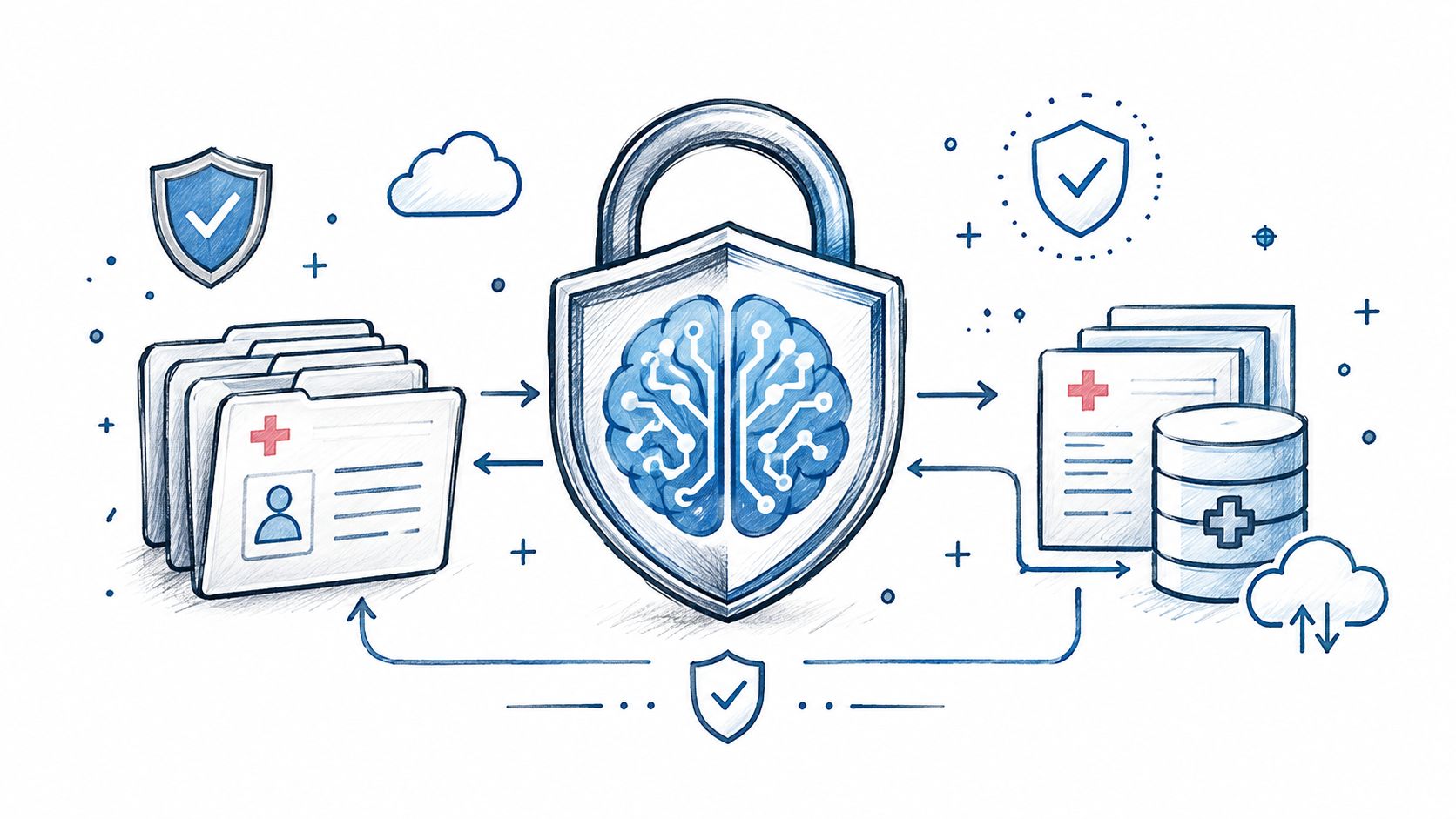
AI in Healthcare
HIPAA-Compliant AI: How to Use LLMs With PHI Safely
How to build HIPAA-compliant AI: when LLM providers need a BAA, data minimization, de-identification, audit controls and a reference architecture.
October 16, 2026Read more
A guide on AI for healthcare fraud detection. Learn about ML techniques, implementation, ROI, and how to build a proactive prevention strategy.

Healthcare fraud isn't a back-office nuisance. It's a capital allocation problem. AI-assisted detection programs were pivotal in the U.S. Department of Justice and HHS recovering a record $42 billion in 2023, and organizations using pre-payment AI risk scoring reported a 62% reduction in improper payments according to this healthcare fraud detection analysis. That should change how every healthcare executive thinks about fraud.
The old model was simple: pay first, investigate later, recover what you can. It was slow, expensive, and structurally weak. AI for healthcare fraud detection changes the economics. It shifts the operating model from post-payment cleanup to pre-payment prevention, where the primary value sits.
If you're leading a payer, provider network, TPA, or digital health operation, the strategic question isn't whether AI belongs in fraud programs. It's where to apply it first, how to build a credible business case, and how to avoid turning a promising pilot into another stalled analytics initiative.
Most fraud programs still behave like collections teams. Money goes out. Analysts investigate after the fact. Legal and audit teams chase evidence. Recovery takes time, and a lot of the leakage never comes back.
That approach no longer makes sense. Healthcare organizations already hold the signals they need across claims, provider behavior, prior authorizations, encounter data, and clinical documentation. The problem isn't lack of data. It's that traditional controls can't process it fast enough to stop suspicious activity before payment.
A reactionary model creates three business problems:
Healthcare executives should treat fraud prevention as an operational design issue, not just a compliance issue. That's why governance matters. A practical resource like Everglow Prosperity's risk guide is useful because it frames risk as a managed system with controls, escalation paths, and ownership, not as an isolated audit exercise.
Practical rule: If your fraud program starts after payment, you're already accepting avoidable loss.
The strongest argument for AI isn't technical sophistication. It's timing. Pre-payment risk scoring turns fraud control into a front-end decision layer. That means suspicious claims can be held, routed, or reviewed before funds are disbursed.
That's the shift leaders should fund. Not “more analytics.” Prevention infrastructure.
A capable healthtech engineering partner helps organizations redesign that flow so fraud models sit inside operational decisions, not in a disconnected dashboard no one uses.
Healthcare fraud isn't one problem. It's a cluster of behaviors with different signals, actors, and operational consequences. Executives who treat it as a single category usually end up buying a generic platform and wondering why results are mixed.
Here's the situation at a glance.

This is often the highest-value category because providers control coding, documentation, and billing workflows.
These patterns usually show up in coding behavior, utilization intensity, and provider-level billing habits. That's why provider fraud is often the best starting point for AI deployment.
Patient-side fraud tends to look smaller claim by claim, but it adds operational drag and downstream clinical risk.
Examples include:
The signals here are fragmented. Identity, claims, scheduling, and pharmacy data often need to be joined before the pattern becomes visible.
Pharmacy fraud often centers on false prescriptions, altered scripts, refill abuse, or kickback-driven dispensing patterns. Insurer-side misconduct can involve misrepresentation of benefits or manipulation of coverage terms.
These aren't always the first categories organizations target with AI, but they matter when a fraud program matures. They also highlight why cross-functional data matters. Claims data alone won't tell the whole story.
A useful executive lens is simple. Ask which fraud categories are most costly, which are most frequent, and which are most preventable before payment.
For organizations shaping broader digital health operations, focused Healthcare AI Services become particularly useful. Different fraud categories need different data products, workflows, and model choices.
Most executives don't need a machine learning lecture. They need to know which technique finds which kind of fraud, and why it outperforms manual review.
This is the practical stack behind AI for healthcare fraud detection.

Think of anomaly detection as the system that spots billing behavior that doesn't fit the normal pattern.
It's useful when you don't already know the exact fraud scheme. Maybe a provider suddenly bills an unusual combination of codes. Maybe a clinic's claim volume shifts sharply without a corresponding operational reason. Rule-based systems may miss it because no one wrote a rule for that exact scenario.
Anomaly detection is best for:
Its limitation is context. Not every anomaly is fraud. Some are legitimate operational changes. That's why anomaly models should feed review queues, not act as stand-alone judges.
Predictive models learn from known fraud patterns and assign a risk score to new claims, providers, or transactions, making supervised machine learning commercially useful.
One strong example is LightGBM. Advanced AI models using LightGBM architecture achieve a detection rate of over 98% for targeted suspicious claims, and the same source notes that financial details and provider billing habits are among the strongest predictive indicators in these pipelines, as described in this healthcare AI whitepaper.
That matters because executives don't need abstract accuracy. They need ranked worklists and better intervention timing.
A large share of fraud signals sits in unstructured text. Clinical notes, referral narratives, and supporting documentation often tell a different story than the submitted code set.
Natural Language Processing reads that narrative layer. It helps detect mismatches between diagnoses, procedures, and billing codes that manual audit teams can't review at scale.
Use NLP when you need to detect:
The fastest way to miss fraud is to analyze only structured claims fields and ignore the note that contradicts them.
Some fraud isn't visible in a single claim. It only appears when you map relationships among providers, patients, facilities, pharmacies, and referrals.
Network analysis exposes these connected patterns. If several providers share suspiciously overlapping patient groups, referral paths, or billing behavior, the graph often reveals what row-by-row analysis misses.
Many organizations underinvest. They buy fraud software that scores isolated claims but never models the relationships behind coordinated abuse.
A modern fraud program should combine all four methods. Not because it sounds advanced, but because each one addresses a different failure mode in traditional oversight.
Fraud prevention programs break down long before model performance becomes the issue. They break down because the organization cannot assemble a trusted, usable fraud dataset fast enough to support pre-payment decisions, provider monitoring, and investigator action.
That is a business problem first. If your data arrives late, conflicts across systems, or lacks review outcomes, your AI program will stay trapped in retrospective recovery. You will score risk after the money is gone.
Executives should insist on a prevention-ready data foundation, not another reporting mart built for hindsight. That foundation should combine:
Speed matters here. Manual extracts and spreadsheet reconciliation create delay, version confusion, and audit risk. A structured intake layer such as an AI-powered data extraction engine helps standardize inputs early so your team can move from fragmented review to consistent scoring and triage.
Poor data does more than weaken accuracy. It distorts the business case. Leadership sees noisy alerts, investigators lose trust, and the pilot gets labeled as an AI problem when the underlying failure sits in identity resolution, missing notes, or inconsistent case labels.
Set a hard standard for data readiness before you fund broader deployment. Review completeness, consistency, timeliness, and label quality with the same discipline you apply to financial controls. This guide on data quality for AI and robotics is a useful checklist because it pushes teams to inspect the training data issues that gradually erode model value.
Bad data does not produce a mediocre pilot. It produces the wrong operating decisions.
The wrong question is whether to buy a fraud platform or build a model. The right question is where your organization needs control to prevent fraud earlier, reduce false positives, and improve investigator throughput.
For many payers and healthcare organizations, the differentiators are not the base algorithms. The differentiators are the pieces that connect risk scoring to action:
Buy what is commoditized. Build or configure what reflects your policies, workflows, and fraud priorities. For some teams, that means pairing commercial model components with internal tooling and case workflows. For others, it means using a partner for custom healthcare software development so source systems, PHI controls, and investigator processes work as one operating system instead of a patchwork.
The executive goal is simple. Create a foundation that supports prevention, not just detection. Once that foundation is in place, a rapid AI strategy platform can evaluate use cases, expose data gaps early, and reduce the cost of getting from idea to operational proof.
Healthcare fraud drains billions from the system each year. The organizations that keep treating it as a recovery problem will keep paying the recovery tax.
Executives need a prevention plan with clear decision points, accountable owners, and hard business targets. That is how you shift from chasing bad payments after the fact to stopping avoidable losses before they hit the books.

Start with money, not models.
Pick two or three fraud problems that create the biggest combined impact on payment loss, investigator effort, and provider abrasion. A broad mandate slows execution and weakens the business case. A focused scope gives you a faster path to proof and a cleaner funding argument.
Set direction around four decisions:
Governance belongs here, early. If leaders do not agree on who can hold a claim, escalate a provider, or override a model recommendation, the program stalls in committee and never reaches prevention.
A proof of concept should prove one thing. Your data can identify risk early enough to support action.
Keep the test narrow and commercially relevant. Choose one line of business, one claims stream, or one provider cohort with enough volume to matter. Compare AI outputs against known cases, current rules, and investigator judgments. Then decide whether the signal is strong enough to justify workflow change.
The deliverables should be operational, not academic:
Use a focused tool for this phase. A verification and risk-scoring platform for early fraud validation helps teams test value quickly without turning a proof of concept into a full platform rebuild.
The pilot is where the business case either gets stronger or falls apart.
Run AI recommendations inside live operations with guardrails. Keep current controls in place. Let investigators review AI-prioritized cases, record override reasons, and document where the model improves speed or cuts wasted review time. That gives you evidence an executive team can fund.
Track pilot performance in business terms:
Speed matters because prevention economics are different from recovery economics. Earlier detection improves recoverability, reduces administrative waste, and lets payment integrity teams intervene before bad behavior spreads.
Scale only after the pilot proves three things. The model finds meaningful risk. Operations can act on the output. Governance can support intervention at volume.
At this stage, executives should treat fraud AI as an operating capability, not a one-time analytics project. That means setting threshold policies, funding model monitoring, and tying case routing to business priorities such as claim value, provider history, and suspected typology.
Focus enterprise rollout on:
If you want faster adoption with less waste, use a rapid AI strategy platform at the start of the program, not after architecture decisions are locked. That approach exposes data gaps, clarifies ROI assumptions, and reduces the odds of funding another pilot that never reaches production.
Most fraud leaders worry about false positives, model explainability, and HIPAA. They should. But the biggest blind spot is often elsewhere. Many systems are still designed to detect suspicious records, not suspicious networks.
That's a serious limitation because some of the most damaging schemes are collaborative.

Rule-based controls are good at catching isolated anomalies. They are weak at spotting coordinated behavior across providers, patients, and intermediaries.
A key pitfall is the collusive fraud blind spot, where rule-based systems miss fraud emerging from network interactions. Graph neural networks are specifically designed to model these relationships, a strategy that has helped CMS prevent $2.1 billion in improper payments but remains an underutilized technique, as discussed in this review of AI and graph methods in healthcare fraud.
If your fraud stack only scores single claims, you're leaving a major class of abuse under-detected.
A model that can't be explained will create internal resistance fast. SIU teams won't trust it. Compliance will slow it down. Provider relations will object when legitimate behavior gets flagged without clear rationale.
That doesn't mean every model must be simplistic. It means outputs need case-level reasons people can act on.
Use explainability in practical terms:
HIPAA, auditability, access controls, and data minimization can't be retrofitted after model deployment. They need to shape ingestion, permissions, logging, and case review from the start.
That's why it helps to involve a regulatory compliance partner before the workflow goes live. Fraud prevention touches PHI, payment decisions, and provider-facing actions. All three carry scrutiny.
The same design discipline applies in adjacent regulated products such as SaMD solutions, where model behavior, validation, and traceability must hold up under review.
If compliance joins after the pilot, the pilot usually gets rewritten.
Fraud programs waste money fast when success is measured by queue volume instead of dollars protected. Executive teams should judge AI fraud initiatives by avoided loss, faster intervention, and lower review cost.
A useful ROI model starts with one question. Did the program shift fraud management upstream, from recovery to prevention?
Use a short scorecard tied to financial and operational outcomes:
Track these metrics at the use-case level, not just at the enterprise dashboard level. A pre-payment prior authorization abuse model and a post-payment upcoding model will have different economics, different staffing impact, and different adoption curves.
For documentation-heavy fraud, text analysis often changes the business case. Reviewing notes, orders, and supporting documentation at scale helps teams catch mismatches between clinical evidence and billed services earlier, which improves pre-payment prevention and reduces wasted manual audit effort. That matters more than producing another long list of suspicious claims.
Executives do not need a long pilot with vague learning goals. They need a fast decision process that answers four questions clearly: where to start, what data is missing, how the workflow changes, and how value will be measured.
Start with a 90-day path:
Strategy work should reduce uncertainty, not create more slideware. A focused AI strategy process can turn broad interest in AI into a prioritized fraud-prevention business case with data dependencies, workflow changes, and investment needs spelled out clearly. If delivery capacity is the constraint, targeted automation support and proven implementation patterns can shorten time to value. For leaders comparing options, a library of real-world use cases is useful because it ties AI decisions to operating models instead of vendor promises.
The organizations that get ROI from healthcare AI are not the ones experimenting the longest. They are the ones that choose a narrow prevention use case, tie it to a measurable operational change, and expand only after the first model proves financial value.
Executives usually ask the same practical questions once the strategy conversation gets real. Here's the short version.
| Question | Answer |
|---|---|
| Where should a healthcare organization start with AI for healthcare fraud detection? | Start with one fraud typology where the data is available and the workflow impact is clear. Provider billing anomalies and documentation mismatch are common entry points because they create measurable review value quickly. |
| Does AI replace fraud investigators? | No. It changes what they spend time on. AI handles pattern detection and prioritization. Investigators handle context, judgment, escalation, and case development. The goal is better allocation of human expertise. |
| Should we focus on pre-payment or post-payment use cases first? | If your operations can support intervention before funds go out, pre-payment use cases usually create the strongest business case. If governance is immature, start with post-payment prioritization and move upstream once teams trust the outputs. |
| What data do we need first? | Claims, payment history, provider reference data, and any available clinical documentation form the core. Add external exclusion lists and investigator outcomes as the program matures. |
| How do we avoid a failed pilot? | Keep scope tight. Pick one use case, define one intervention path, and agree on success criteria before model work starts. Most failed pilots try to solve too many fraud categories at once. |
| What's the biggest technical mistake? | Building a model before resolving data fragmentation. If identities, notes, and claims can't be joined reliably, the system will produce noisy outputs and users will lose trust. |
| How should smaller organizations approach this? | Don't imitate enterprise architecture. Start with a narrow workflow, focused automation, and selective model support. A compact operating model beats a broad but underused platform. |
| How do we handle internal adoption? | Bring compliance, operations, and investigators in early. Show them how the system explains risk, how overrides work, and how outcomes will be measured. Adoption improves when the model supports their judgment instead of trying to replace it. |
A final operational point matters. Before publishing content or launching a public-facing initiative around this space, teams should keep SEO hygiene in order and avoid duplicate slugs. Clean, descriptive URLs reduce confusion for both users and search engines. The same discipline helps internal program documentation too.
For deeper planning, organizations often benefit from mapping fraud priorities against workflow, data readiness, and governance requirements before selecting tools. That kind of early structure prevents expensive rework later.
If you're evaluating AI for healthcare fraud detection and want a grounded path from strategy to implementation, Ekipa AI can help you shape the use case, assess readiness, and build a practical roadmap. Explore their capabilities in AI requirements analysis, review adjacent healthcare offerings, and meet our expert team to see who would support the work.
How to build HIPAA-compliant AI: when LLM providers need a BAA, data minimization, de-identification, audit controls and a reference architecture.

Practical data migration planning guide for healthcare teams. Scope, mapping, compliance, validation, cutover and rollback decisions explained end to end.

Smart on FHIR guide for healthtech engineers. Learn the OAuth 2.0 launch model, scope syntax, backend services, and US regulatory requirements.
Connect with our team to explore how AI expertise can transform your business.