
AI in Healthcare
HIPAA-Compliant AI: How to Use LLMs With PHI Safely
How to build HIPAA-compliant AI: when LLM providers need a BAA, data minimization, de-identification, audit controls and a reference architecture.
October 16, 2026Read more
Discover how ai for hospital workflow optimization transforms operations. Learn to pilot AI solutions that boost efficiency and improve patient care.

Hospital administrators are constantly battling operational friction. We see it everywhere—patient admission gridlock, resources stretched thin, and a clinical staff teetering on the edge of burnout. The only way forward is a serious operational overhaul, and that’s where AI for hospital workflow optimization comes in. This guide is your playbook for making it happen, showing you how to pinpoint, build, and scale AI-driven improvements that actually work.
In any hospital today, operational friction isn't just a minor headache; it's a direct threat to patient care, a driver of runaway costs, and the reason for a high-stress, draining work environment.
These inefficiencies show up as delayed discharges, chaotic operating room schedules, and an administrative load that crushes clinicians who should be focused on patients. The manual, paper-shuffling processes that hospitals have clung to for decades just can't keep up anymore. They're broken.

This is precisely where intelligent automation can step in, turning chaotic, manual routines into smooth, data-driven operations.
The real goal here is to give you the blueprint for an AI strategy that sticks. It's about turning today's biggest operational pains into tomorrow's competitive strengths. By bringing in the right AI solutions, hospitals can finally:
Slash the administrative tasks that steal so much time from clinical staff.
Predict patient flow with enough accuracy to get ahead of resource crunches.
Optimize staff schedules to prevent burnout while ensuring every shift is covered.
This isn't just about tech for tech's sake. It’s a strategic shift that leads to better outcomes for everyone involved, from the patient in the bed to the nurse on the floor. This push for modernization is happening everywhere; seeing how different regions are approaching AI workflows and digital transformation strategies makes it clear that adopting smart workflows is essential for delivering top-tier care.
By focusing on targeted workflow improvements, hospitals can see a direct impact on their bottom line and, more importantly, on the quality of patient care. Our specialized Healthcare AI Services are designed to guide organizations through this critical transformation, ensuring technology serves the ultimate mission of healing.
Before you even think about algorithms or data models, your first move in bringing AI into a hospital has nothing to do with technology. It's about people and the processes they live with every day. You absolutely have to start with a deep discovery phase—no shortcuts. This means getting out on the floor and seeing how things really work, not just how they’re supposed to work on paper.
The whole point is to map out the existing workflows to find the snags. Where are the bottlenecks that consistently eat up time, burn out staff, and drain resources? You're looking for the patterns, the recurring frustrations that everyone complains about but no one has had the time or tools to fix.
Honestly, the best intel always comes straight from your frontline staff. Sit down with clinicians, nurses, lab techs, and the administrative teams. Have real conversations—don't just send out a survey. You need to hear their stories and understand the daily pain points that make their jobs harder than they need to be.
To pinpoint where AI can actually make a difference, you have to ask the right questions. These chats are where you'll uncover the hidden inefficiencies that are dragging down the entire operation.
Think about these common friction points:
Patient Discharge: What’s the real reason for discharge delays? Is it always waiting on final paperwork? A communication breakdown between the pharmacy and the floor? Or is it the wait for a physician's final sign-off?
Operating Room Scheduling: Why does the OR schedule feel like a constant firefight? Are unpredictable procedure times throwing everything off? Or is it a struggle to get the right equipment and staff lined up efficiently?
Administrative Overload: How much of a nurse's shift is spent clicking boxes in the EHR instead of being with patients? Where are the most frequent data entry errors cropping up?
Getting candid answers to these questions is the first step in a thorough AI requirements analysis. This groundwork is what builds your business case. It gives you the evidence you need to get buy-in from stakeholders who, understandably, need to see a clear problem before they'll fund a solution.
Once you have a list of these real-world challenges, you can start matching them to potential AI solutions. A great way to get started is by looking through a library of real-world use cases to see how other hospitals have tackled similar problems.
But here’s the critical part: not every opportunity is a good one to start with. You need a system for deciding where to place your bets first. This is all about smart prioritization.
I’ve seen it happen too many times: a hospital gets excited about the flashiest AI tech instead of focusing on the project that solves the most urgent operational problem. Real value comes from aligning the technology with your strategic goals to deliver measurable wins, whether that’s better patient care or a healthier bottom line.
To prioritize effectively, you need to evaluate each potential project against a consistent set of criteria. This framework stops you from chasing shiny objects and helps you invest your limited resources where they’ll have the biggest impact.
Run your list of potential AI initiatives through this scoring matrix. It’s a simple but powerful way to bring clarity to a complex decision.
| Criterion | Key Question to Ask | Why It Matters |
|---|---|---|
| Clinical Impact | How significantly will this improve patient outcomes or safety? | This keeps the hospital's core mission front and center. |
| Operational Efficiency | Will this free up staff time, reduce costs, or speed up a critical process? | This addresses the constant financial and logistical pressures every hospital faces. |
| Technical Feasibility | Do we have the data, infrastructure, and expertise to actually build this? | This is a reality check. It prevents you from launching projects that are doomed from the start. |
| Strategic Alignment | Does this project directly support our hospital's long-term goals? | This ensures your AI work isn't just a series of one-off experiments but a cohesive part of your overall strategy. |
This kind of structured approach turns a messy list of ideas into a clear, focused action plan. A Custom AI Strategy report can provide exactly this kind of framework, making sure you’re laser-focused on solving the right problems. By methodically finding and prioritizing these high-impact opportunities first, you lay the foundation for an AI initiative that can actually scale and succeed. It’s the single most important step you’ll take.
You've pinpointed a high-impact workflow ripe for improvement. Now comes the exciting part: turning that idea into a real, working solution. The key here is to start small and think iteratively. A focused pilot project is your best friend—it keeps risks low, controls costs, and most importantly, delivers tangible results you can show to build momentum for your AI for hospital workflow optimization initiative.
Before a single line of code is written, you need to define what success actually looks like. This means setting clear, measurable Key Performance Indicators (KPIs). For example, if you're tackling the patient scheduling headache, your success metrics might be a 15% reduction in patient wait times or a 10% drop in no-show rates. You could even aim for a specific jump in staff satisfaction scores tied to scheduling tasks.
Think of your first pilot as a controlled experiment. You need a solid game plan to guide you from the initial model selection all the way through integration. This isn't something you do in a vacuum; it demands a tight-knit collaboration between your clinical teams and technical experts, whether they're on your payroll or a trusted external partner.
Getting the technology right is critical. The AI models you choose have to play nicely with your existing infrastructure, especially the Electronic Health Record (EHR). This often means building custom connections to sync data or smooth over any software hiccups. For many hospitals, bringing in an experienced partner is the quickest way to get this done right.
The discovery process that gets you to this point usually involves mapping out your current state, finding the real bottlenecks, and then picking the opportunity with the biggest potential payoff.
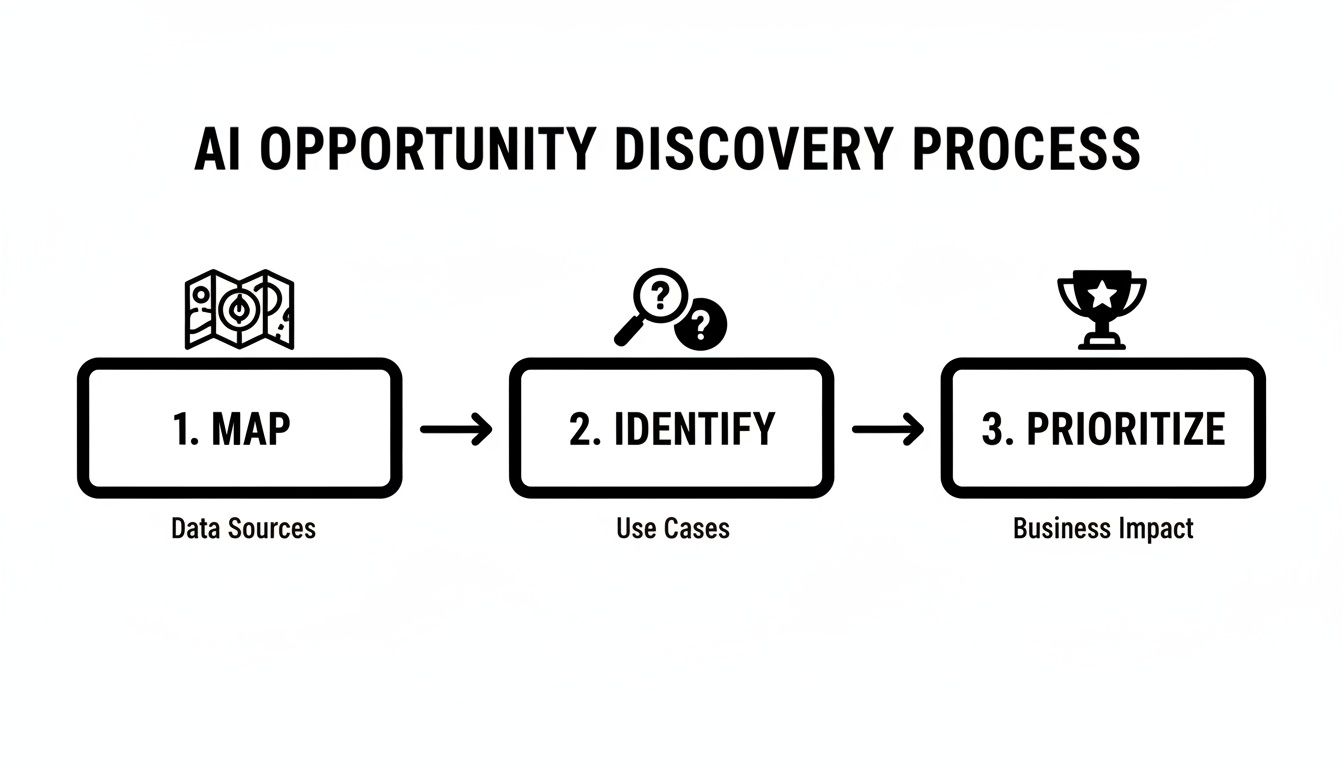
Resist the urge to boil the ocean. A successful pilot is deliberately small. Pick a single department or even just one clinical team to test the new AI-powered workflow. This creates a focused environment where you can collect honest feedback and make quick adjustments. Even looking at simpler applications, like implementing an AI receptionist for automating front-desk operations, can offer valuable lessons on automation and user interaction.
This iterative, hands-on approach is about more than just proving the tech works. It’s about building trust. When your nurses, doctors, and administrators see a new tool making their day genuinely easier—even in a limited capacity—they become its biggest advocates.
A successful pilot isn't one that's perfect from day one. It's one that demonstrates a clear path to value and effectively engages end-users in the process of refinement. The feedback loop is your most valuable asset during this phase.
By keeping the pilot contained, you can iron out the wrinkles and prove the concept with real data. You can explore the broader principles of process improvement in more detail in our guide to AI workflow automation. This methodical approach ensures that when you're ready to scale, you’re not just hoping it will work—you're expanding a solution that's already a proven success with the full support of your staff.
Let's be blunt: any AI project in a hospital lives or dies by its data, how well it plugs into existing systems, and whether it meets strict regulations. Hospitals are drowning in data, but it's often locked away in different silos—EHRs, lab systems, pharmacy databases, you name it. This mess is the single biggest technical roadblock you'll face.
The only way through is to build a solid, unified data pipeline. This isn't just an IT project; it’s a core strategic move. Modern standards like FHIR (Fast Healthcare Interoperability Resources) are a huge help here, as they're designed specifically to get these disparate systems talking the same language. Without a clean, accessible stream of data, your AI model is flying blind, and that's a risk you can't afford in healthcare.
Here’s another reality check: clinicians are swamped. If you hand them a new tool that complicates their life or slows them down, it’s dead on arrival. The integration has to feel seamless, like it was always meant to be there. It needs to genuinely make their job easier.
This is where smart AI strategy consulting can make all the difference. You're not just installing an algorithm; you're rethinking the workflow itself. The aim is to enhance your team's skills, not replace them. Take AI-powered scheduling, for instance. It’s no longer a novelty. Adoption for these tools shot up from around 60% to over 75% in just one year. Why? Because hospitals that use them are seeing up to 25% less understaffing and slashing overtime costs, all by using ML to predict patient census and staff needs. It's about turning operational chaos into a well-oiled machine. You can discover more insights about AI adoption trends in hospitals and see how this is playing out across the industry.
Finally, and this is non-negotiable, you have to nail compliance. Healthcare is one of the most regulated fields on the planet for a very good reason. Every byte of patient data is governed by laws like the Health Insurance Portability and Accountability Act (HIPAA). Any AI solution you implement, whether for bed management or clinical predictions, must be bulletproof from a compliance standpoint.
I can't stress this enough: if you don't build your AI strategy on a foundation of compliance, you're courting disaster. A data breach means crippling fines, lawsuits, and a complete erosion of patient trust. Security and privacy can't be an afterthought.
This means putting ironclad security protocols in place across the entire AI lifecycle—from how you collect and store data to how you train and deploy your models. It’s critical to work with partners who live and breathe this stuff. Look for teams with proven expertise in custom healthcare software development, because they understand the stakes and know how to build solutions that are not only powerful but also secure and compliant from the ground up.
Tackling these data, integration, and regulatory challenges head-on is the only path forward. Get this right from the start, and you'll avoid painful delays, minimize risks, and build an AI program that people can actually trust.
So, you’ve run a successful pilot. That's a huge win, but it's really just the first step. The true power of AI in a hospital setting isn't in isolated wins; it's realized when you scale those proven solutions across the entire organization. This leap from a single-department success to an enterprise-wide standard requires a thoughtful roadmap, one that places your people right at the center.
Scaling is less about technology and more about change management. Let’s be clear: communication is everything. You have to translate the benefits into terms that matter to your staff. How does this AI tool make their shift less chaotic? How does it give them back precious minutes to spend with patients? Answering these questions upfront and addressing concerns head-on is the only way to build the trust you need for widespread adoption.

A broader rollout needs more than just an IT helpdesk ticket system. I've seen organizations get the best results by creating a dedicated Center of Excellence (CoE) or an AI governance team. This group becomes the central nervous system for your AI strategy, overseeing new implementations, handling ongoing support, and making sure the models are constantly learning from fresh data.
Think of this team as the guardians of your AI ecosystem. Their core responsibilities should include:
Standardizing Best Practices: Making sure every department uses the same proven playbook for implementation.
Managing Vendor Relationships: Serving as the single point of contact for tech partners and service providers.
Monitoring Performance: Keeping a close eye on KPIs across all deployments to measure impact and spot areas for improvement.
Facilitating Training: Building and delivering solid training programs that make everyone comfortable and proficient with the new tools.
For many hospitals, the day-to-day work of scaling and long-term maintenance is just too much to handle internally. This is often where partnering with an AI implementation specialist makes sense. It lets your clinical teams stay focused on what they do best—caring for patients—while the experts manage the technical heavy lifting.
A common mistake is treating scaling as a simple copy-and-paste of the pilot. Every department has its unique quirks and workflows. A phased, department-by-department rollout allows you to adapt and learn, ensuring each new implementation is as successful as the first.
Forget the "big bang" launch. It's disruptive and risky. A phased approach is almost always the smarter path, giving your teams time to adapt and providing you with crucial feedback along the way.
Imagine you've had a great pilot in the Emergency Department. The next logical step might be the surgical unit, then radiology, and so on. Each phase becomes a learning opportunity, refining your process and building momentum. This creates a snowball effect of success and boosts confidence across the hospital.
This methodical expansion hinges on having a clear plan. This is where a well-defined AI Product Development Workflow becomes your playbook. It ensures you can repeat the success of the pilot consistently while still customizing the approach for each new department's specific needs.
Ultimately, scaling is about weaving AI into the very fabric of your hospital's operations. You're moving from a single, isolated success story to a new, more intelligent standard of care for everyone. By focusing on your people, providing great training, and adopting a smart, phased rollout, you'll see a much greater return on your investment and truly change how your organization works.
To keep your AI initiatives funded and expanding, you have to prove they’re actually working. This isn't about bragging about algorithm accuracy or server uptime. It's about demonstrating real-world wins—the kind of business and clinical results that make executives and frontline staff sit up and take notice.
Think of it as telling a story with data. Every number should point back to a clear return on the hospital's investment. The key performance indicators (KPIs) you set back in the pilot phase are your main characters; now it's time to show how they've developed.
The metrics you track have to tie directly back to the problem you originally aimed to solve. If the goal was to fix patient flow bottlenecks, you need the hard numbers to prove you did it.
Quantitative Metrics: This is the undeniable proof. You're looking for things like a 12% reduction in average patient wait times, a 15% faster bed turnover rate, or a 20% decrease in administrative costs for a specific department. These figures are the foundation of any report you send to the C-suite.
Qualitative Feedback: Numbers alone don't tell the whole story. You need to talk to the people on the ground. How do clinicians feel about the new workflow? Are patients less frustrated? Surveys, quick interviews, and focus groups provide the context that makes the data meaningful.
When you combine hard data with human experience, you create a narrative that’s impossible to ignore. A good AI Strategy consulting tool can be a huge help here, giving you a way to visualize performance and show how these wins align with the hospital's bigger picture goals.
An AI project isn't something you set and forget. It’s a constant cycle of improvement. The real strategic advantage comes from regularly digging into the performance data, celebrating what's working, and always hunting for the next workflow to optimize.
The data you're gathering isn't just for justifying budgets. It’s your map for what comes next. By analyzing performance trends, you can quickly see which AI tools for business are hitting home runs and where the next big optimization opportunity might be hiding. This is how you make sure your AI initiatives deliver value that grows and compounds over time.
This constant loop—measure, learn, refine—is what separates a mature AI strategy from a series of one-off tech projects. It’s how a hospital stops just using technology and starts becoming a truly intelligent, adaptive organization. If you need a hand building this kind of value cycle, our expert team has spent years in the trenches of both healthcare and technology, and we know what it takes to get it right.
Diving into AI for hospital workflow optimization is a big step, and it naturally brings up a lot of questions. Let's tackle some of the most common ones I hear from hospital leaders who are ready to explore what's possible.
My advice is always to start small and aim for a clear win. Look for the high-volume, repetitive, and rule-based administrative tasks that drain your team's time. Think patient scheduling, medical billing and coding, or even managing supply inventory.
These areas are perfect starting points. Why? Because they're often riddled with manual errors and bottlenecks that AI is exceptionally good at fixing, delivering a return on investment that’s easy to see and measure.
A great way to find these opportunities is to simply talk to your frontline staff. Host a few workshops and ask them: "What are the biggest headaches in your day?" Their answers will point you directly to the highest-impact projects and, just as importantly, make them feel valued and part of the solution from day one. These conversations are the foundation of a solid AI requirements analysis.
From my experience, it almost always boils down to two things: data and people.
First, the data. You’re going to run into siloed systems, inconsistent data quality, and a frustrating lack of interoperability. These are the classic roadblocks that can stop an AI model in its tracks. You absolutely need a strong data governance strategy in place before you even think about building a model.
The other major challenge is change management. Your staff might be skeptical or even fearful of new technology, worried it’s coming for their jobs. The only way through this is to bring them into the process early. Involve clinicians from the get-go, provide fantastic training, and be transparent about your goals. You have to frame AI as a tool that gets rid of their tedious work so they can focus on what matters—not as a replacement.
The most successful AI initiatives I've seen are those that treat technology as a collaborator, not a replacement. When staff see AI as a tool that helps them provide better patient care, adoption happens naturally.
To get the real picture, you need to look beyond just the bottom line. A true ROI calculation tracks a mix of financial, operational, and clinical metrics.
Financial ROI: This is the most straightforward. Look for direct cost savings from things like reduced staff overtime, lower administrative costs, and fewer billing errors.
Operational ROI: Here, you're measuring efficiency gains. Think shorter patient wait times, faster bed turnover, or getting lab results processed quicker.
Clinical ROI: This is about patient impact. Are you seeing fewer medical errors because of better processes? Are patient satisfaction scores going up?
The key is to establish a clear baseline for these metrics before the project kicks off. Without that starting point, you’ll have no way to prove the incredible impact of your AI solutions.
Not right out of the gate. Many hospitals get started by working with a specialized partner that offers Healthcare AI Services. These teams live and breathe this stuff, and they can handle everything from developing the model to integrating it with your systems and keeping it running smoothly.
Going this route lets you tap into the benefits of AI without the massive upfront investment in building an in-house data science team from the ground up. Down the road, as your organization gets more comfortable with AI, you can decide if it makes sense to bring that expertise in-house.
No. The goal of AI in healthcare is not to replace clinical staff but to augment their capabilities. AI handles repetitive, data-intensive tasks like scheduling, administrative work, and preliminary data analysis. This frees up doctors and nurses to focus on complex patient care, critical thinking, and the human side of medicine that technology cannot replicate.
Effective AI models require large volumes of clean, structured, and relevant data. This typically includes historical data from Electronic Health Records (EHRs), patient admission/discharge/transfer (ADT) records, operating room schedules, staffing logs, and supply chain information. Data quality and accessibility are critical success factors.
AI can enhance patient safety by reducing the risk of human error. For example, AI algorithms can predict which patients are at a higher risk for falls or infections, allowing staff to intervene proactively. It can also optimize operating room schedules to prevent staff fatigue and ensure the right equipment is always available, reducing procedural risks.
The cost can vary significantly depending on the scale and complexity of the project. While there is an initial investment in technology, integration, and training, the long-term ROI is often substantial. By starting with a small, high-impact pilot project, hospitals can prove the value and secure buy-in for larger initiatives. Many providers also offer AI Automation as a Service, which can lower the upfront cost.
Results can often be seen within the pilot phase, which might last a few months. For a pilot focused on optimizing patient scheduling, for instance, you could see measurable improvements in wait times and no-show rates in 3-6 months. Broader, enterprise-wide results will take longer as the solution is scaled across different departments.
Ready to move beyond questions and start building a smarter hospital workflow? The team at Ekipa AI provides the strategic guidance and technical expertise to turn your optimization goals into reality. Explore our AI strategy consulting services and book a call with our experts today.
How to build HIPAA-compliant AI: when LLM providers need a BAA, data minimization, de-identification, audit controls and a reference architecture.

Practical data migration planning guide for healthcare teams. Scope, mapping, compliance, validation, cutover and rollback decisions explained end to end.

Smart on FHIR guide for healthtech engineers. Learn the OAuth 2.0 launch model, scope syntax, backend services, and US regulatory requirements.
Connect with our team to explore how AI expertise can transform your business.