
AI in Healthcare
HIPAA-Compliant AI: How to Use LLMs With PHI Safely
How to build HIPAA-compliant AI: when LLM providers need a BAA, data minimization, de-identification, audit controls and a reference architecture.
October 16, 2026Read more
Discover how AI for people and the planet can drive sustainable innovation. Learn about real-world applications in healthcare, conservation, and social good.
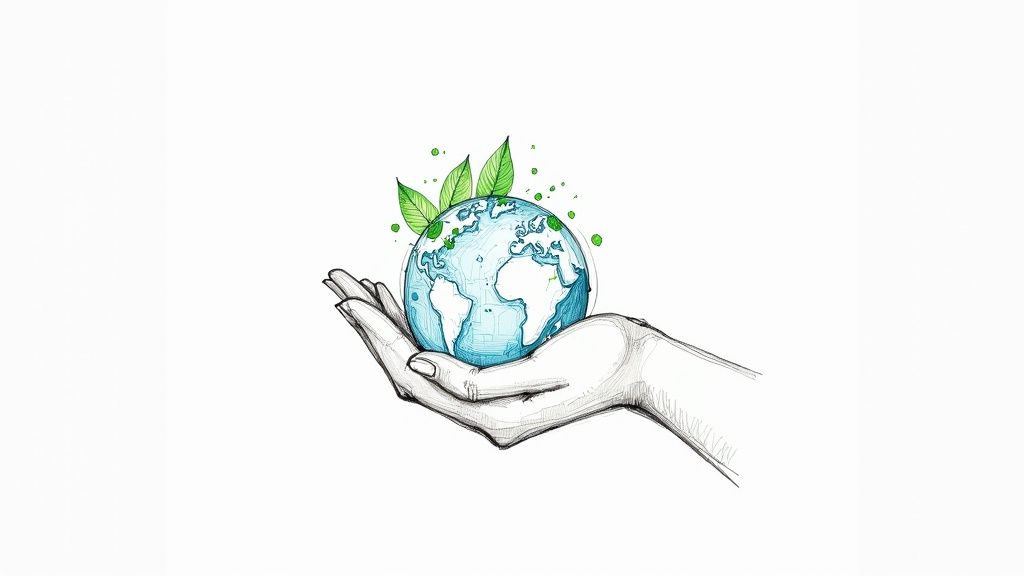
Beyond the hype, the idea of using AI for people and the planet signals a real change in how we think about tackling global problems. It’s about seeing artificial intelligence as more than just a business tool. Instead, we can see it as a partner in building a world that’s fairer, healthier, and more sustainable for all of us. This is innovation with a conscience.
For a long time, discussions about AI were all about technical jargon and profit margins. That’s an important part of the story, but it misses the main point: AI has incredible potential to help with deeply human and environmental challenges. The whole "AI for good" movement is about taking this technology out of the abstract and putting it to work to create tangible, positive change.
It helps to think of it less as a complex, distant technology and more as a really versatile toolkit. With the right guidance and human values at the helm, these tools can help us chip away at problems that once felt too big to solve. This guide is all about exploring that exciting frontier and showing how AI is already making a difference.
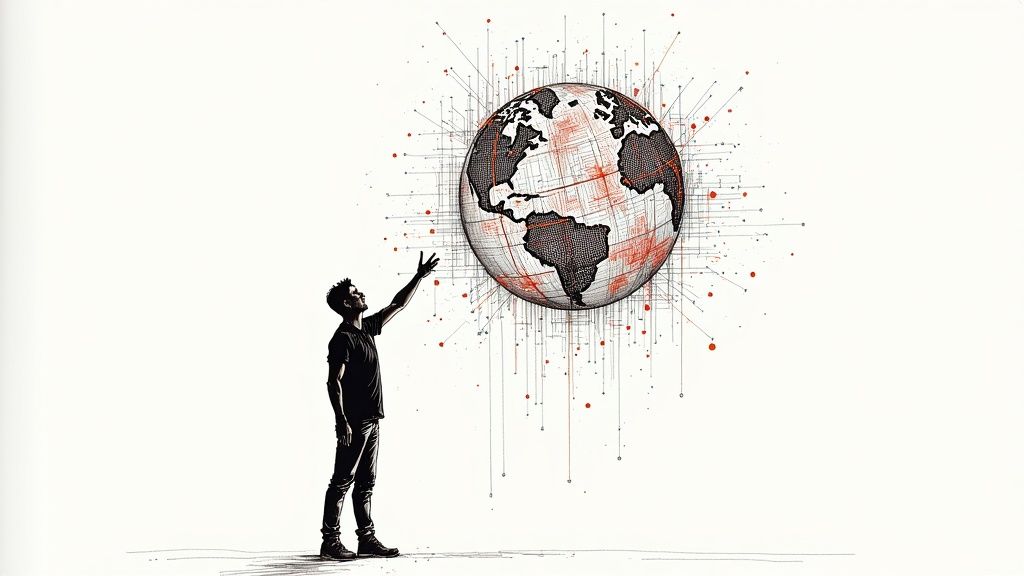
We’re at a turning point with AI. It was originally built for very specific, often commercial, jobs. But now, its use is expanding to serve a much bigger purpose. There's a growing realisation that the same algorithms that make a supply chain more efficient can also be used to help protect endangered species.
This change is all about AI co creation, where human creativity and machine intelligence team up. It’s about designing solutions that don’t just work technically, but are also built on a solid ethical and socially responsible foundation.
This is more than just a tech trend; it's a shift in mindset. It challenges us to look at the powerful tools we're building and consciously point them towards the problems that truly matter for people and the planet.
As we dive in, we'll uncover some genuinely inspiring applications, tackle the big ethical questions, and lay out a clear path for how anyone can get involved. Seeing the potential is the first step, but turning that potential into reality takes a solid plan.
Organisations of every size have a role to play here. It all begins with a clear vision and a defined strategy. By adopting an AI strategy consulting approach, leaders can pinpoint opportunities where technology can create real social and environmental value. Throughout this guide, we’ll look at how to build that mindset and take practical steps towards a better future, powered by responsible AI. It's a story of working together to solve the problems that count.
To really get to grips with how artificial intelligence can be a force for good, it helps to split the idea into two main streams: AI for people and AI for the planet. One side is all about improving human lives directly, while the other is focused on environmental sustainability and the health of our world.
Of course, these two areas—'AI for People' and 'AI for the Planet'—are deeply connected and often overlap. A healthy planet means healthier people, after all. But looking at them separately for a moment clarifies the specific problems AI can solve in each domain. Thinking with an AI strategy consulting mindset helps organisations pinpoint where they can have the biggest impact, whether that’s on human well-being, environmental protection, or both.
At its core, 'AI for People' is about using smart technology to make life better, fairer, and to open up access to vital services. Don't think of it as a cold, robotic replacement for human touch. Instead, see it as a powerful assistant that helps us overcome huge challenges related to scale, distance, and limited resources.
Take healthcare, for instance. AI diagnostic tools can bring specialist-level medical analysis to remote villages that have never had a doctor nearby. These systems can spot diseases like diabetic retinopathy or certain cancers just by looking at an image, meaning people get diagnosed and treated early. It’s a game-changer for making quality healthcare available to everyone.
The same goes for education. AI-driven learning platforms can tailor lessons to fit each student's individual learning speed and style. This makes education more effective and inclusive, helping every child succeed, no matter their background.
This image shows just how AI can be structured to support crucial areas of human well-being, using healthcare as a perfect example.
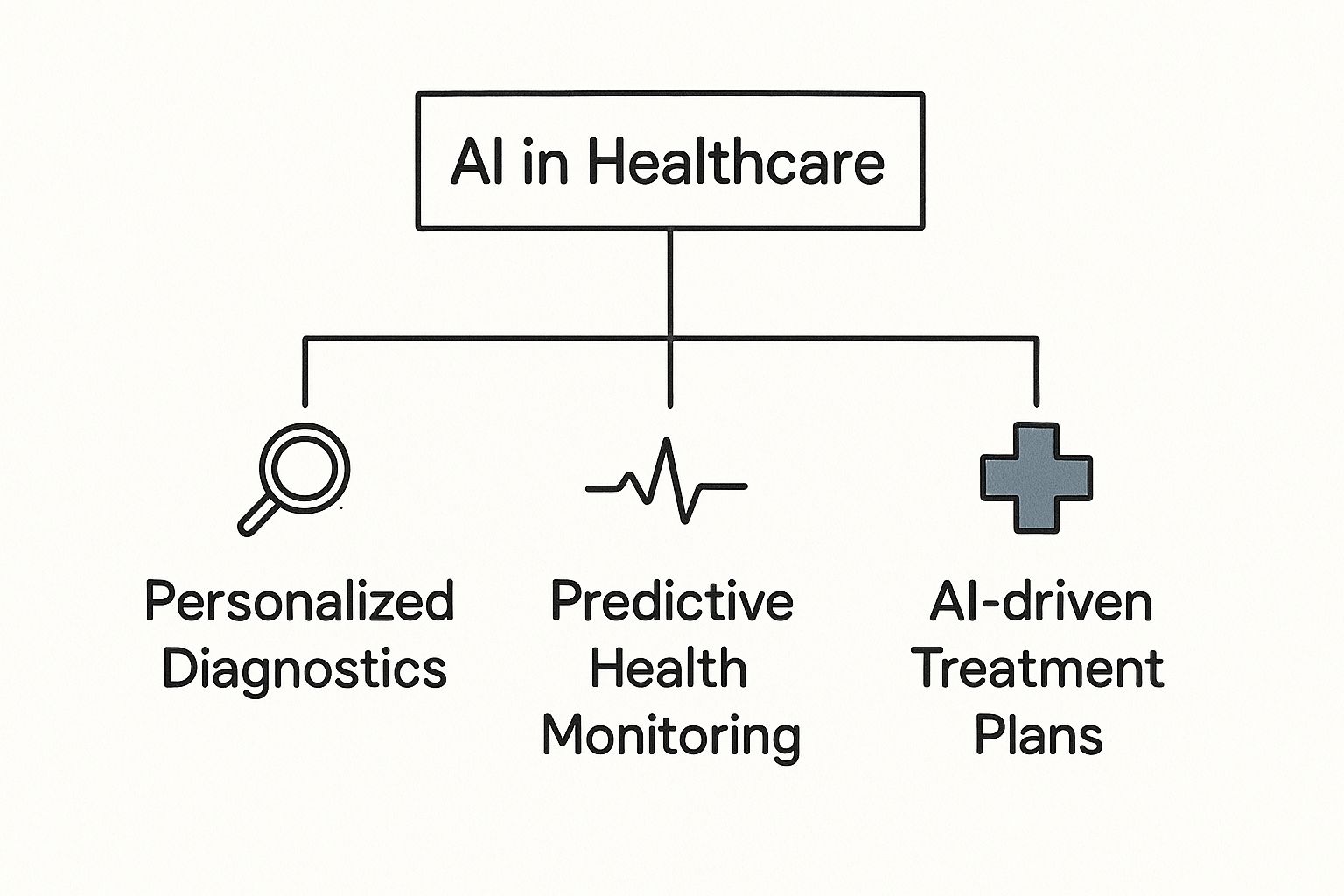
As the diagram shows, AI can support the entire patient journey, from initial diagnosis right through to long-term care, making healthcare more personal and proactive for everyone.
Now, let's turn our attention to the environment. 'AI for the Planet' takes that same incredible analytical power and points it squarely at our biggest ecological challenges. Here, AI becomes a global watchdog, a super-efficient operations manager, and a predictive tool for protecting the natural world.
Think about energy. AI algorithms can manage a city's power grid minute-by-minute, perfectly balancing electricity supply and demand. This cuts down on wasted energy and makes it easier to weave in renewable sources like wind and solar, shrinking the carbon footprint of entire communities.
Or consider conservation. AI can sift through mountains of satellite photos to spot illegal logging in the Amazon or track how quickly the polar ice caps are melting. This gives scientists and governments the up-to-date information they need to step in and protect our most vulnerable ecosystems.
The big idea here is using data to make smarter, more sustainable choices on a scale that's simply impossible for humans alone. From precision agriculture that slashes water and pesticide use to optimising supply chains to cut emissions, AI is absolutely vital for building a sustainable future.
To bring these concepts together, let's compare them side-by-side.
|
Focus Area |
Primary Goal |
Example Application (AI for People) |
Example Application (AI for the Planet) |
|---|---|---|---|
|
Healthcare |
Improve health outcomes and accessibility |
AI-powered diagnostics for early disease detection in remote areas |
Tracking zoonotic disease outbreaks based on environmental data |
|
Agriculture |
Ensure food security and sustainable practices |
Crop monitoring drones to help smallholder farmers increase yields |
Precision farming to reduce water, fertiliser, and pesticide usage |
|
Disaster Response |
Minimise human and environmental impact |
Predictive models for hurricane paths to enable timely evacuations |
Satellite image analysis to assess flood or wildfire damage |
|
Education |
Promote equitable and effective learning |
Personalised AI tutors that adapt to individual student needs |
Gamified learning apps that teach children about conservation |
This table shows how the goals, while distinct, often lead to solutions that benefit both people and the planet in tandem.
Ultimately, the most impactful uses of AI for good are found where these two pillars cross over. A perfect example is an AI model that predicts extreme weather. It doesn't just help protect buildings and infrastructure (the planet), it saves lives by giving people enough time to evacuate (the people).
Similarly, making food supply chains more efficient reduces waste and emissions—a huge win for the planet—while also tackling food shortages for vulnerable communities. It's in this sweet spot that the true potential of AI for people and the planet really shines. This is where a process of AI co-creation becomes critical, bringing together experts from different fields to design solutions that truly serve us all.
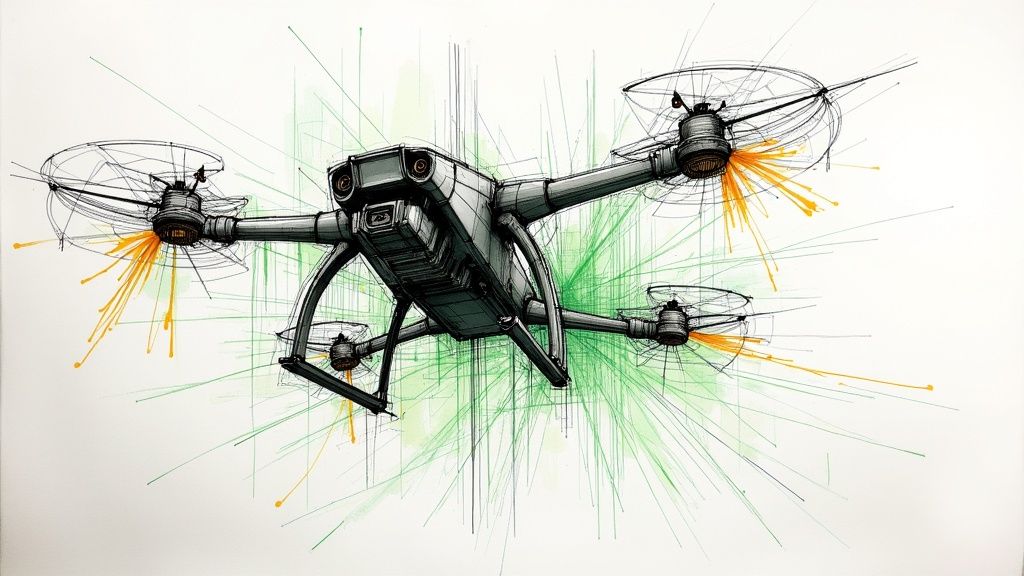
Ultimately, any technology is only as good as its ability to improve people's lives. When we talk about AI for people and the planet, the "people" part isn't just a buzzword; it's about real, tangible changes. We're seeing some genuinely inspiring applications that show how AI can close gaps in access, improve personal health, and build a more inclusive society for everyone.
These stories are less about technical wizardry and more about putting the human element right at the heart of innovation. Whether in healthcare, mental wellness, or accessibility, AI is shaping up to be a powerful ally for human well-being.
One of the most exciting areas where AI is making a difference is in making quality healthcare available to all, no matter where they live. For many people in remote or underserved communities, seeing a specialist for early disease detection is simply not an option.
Take diabetic retinopathy, for example—a leading cause of blindness that needs an expert eye to spot early. Now, AI-powered diagnostic tools are popping up in local clinics. These systems can analyse retinal images with incredible accuracy, flagging the early signs of disease so patients can get treatment before any permanent damage is done.
This isn't about replacing doctors. It's about giving them a powerful tool that extends their reach, ensuring that your postcode doesn't dictate your health.
AI is also proving to be a game-changer in making the world more accessible for people with disabilities. Everyday things that many of us take for granted can be major hurdles for others, and technology is finally stepping in to level the playing field.
Think about real-time captioning. Powered by advanced speech-to-text models, it’s breaking down communication barriers for the hearing impaired, making everything from work meetings to university lectures far more inclusive. In a similar vein, AI-driven screen readers and navigation tools are giving people with visual impairments a much greater degree of independence.
These tools get to the core of what AI for good is all about: using technology not just for profit or efficiency, but to build a more equitable society where everyone has the chance to participate fully.
In a world where mental health support is more needed than ever, getting help can still be difficult. AI-powered chatbots are stepping in as a valuable first port of call. They offer a private, non-judgmental space for people to talk through their feelings, learn coping strategies, and find resources whenever they need them.
Of course, they aren't a replacement for a human therapist, but they provide critical support for those who might otherwise fall through the cracks due to cost, stigma, or a lack of available professionals. You can learn more about how technology can foster well-being at our AI Wellness Hub.
What's clear is that AI is already woven into our daily lives, often in ways we don't even notice. A recent survey from the EY AI Sentiment Index, which spoke to people in 15 countries, found that around 70% of UK respondents had knowingly used AI in their personal lives in the last six months. The most common uses were for customer support (32%), navigation assistance (20%), and getting purchase recommendations (14%). This growing familiarity shows we're becoming more comfortable with AI as a helpful part of everyday life, opening the door for even more meaningful applications in our health and well-being.
While we often talk about AI's impact on our daily lives and well-being, its role in protecting the planet is just as crucial. Artificial intelligence isn't just a buzzword for business efficiency anymore; it has become a powerful ally in the fight against climate change, resource depletion, and the decline of our natural world. It offers the sheer scale and speed of analysis we desperately need to monitor, manage, and protect the Earth's complex ecosystems.
From the deepest oceans to the densest rainforests, AI is giving us a view of our planet's health that was unimaginable a generation ago. Think of it as a global watchdog, sifting through immense sets of data to spot trends and threats that a human team could never catch on their own. This ability is completely reshaping how we think about conservation and sustainability.
One of the most immediate ways AI helps is in monitoring and protecting biodiversity. AI algorithms can churn through thousands of hours of camera trap footage or pore over satellite imagery to identify and track endangered species. This provides vital data for conservationists without ever disturbing the animals in their delicate habitats.
For instance, these systems can spot illegal fishing fleets simply by analysing vessel movement patterns from satellite data, tipping off authorities before lasting damage is done. In the same way, AI can monitor the real-time melt of glaciers or predict the likely path of a wildfire, paving the way for faster, more effective emergency responses. This is where AI for people and the planet truly comes together, protecting both ecosystems and human lives.
Beyond direct conservation, AI is proving essential for making our industries and supply chains far more sustainable. It’s all about applying smart workflow automation to reduce waste and slash carbon emissions on a massive scale.
Take the global supply chain, for example. AI models can forecast demand with incredible accuracy, which helps prevent the overproduction of goods and minimises food waste—a huge contributor to greenhouse gas emissions. These models can also plot the most efficient shipping routes, factoring in weather, traffic, and vessel capacity to cut down on fuel consumption.
This isn't just about making small adjustments; it's about fundamentally redesigning our systems with sustainability at their core. By embedding intelligence into our operations, we can make resource efficiency the norm, not just a nice-to-have.
This same logic applies to our energy systems. To see this in action, you can explore how solar technology leveraging AI and IoT is becoming more efficient. AI helps manage smart grids by balancing the fluctuating supply from renewable sources like wind and solar with our moment-to-moment energy demand, which is absolutely vital for a successful move to clean energy.
Another game-changing area is the upkeep of critical infrastructure, like wind turbines or water treatment plants. Instead of the old "wait until it breaks" model—which leads to expensive downtime and environmental risks—AI-powered predictive maintenance can see problems coming before they happen.
By analysing data from sensors, AI models can detect tiny changes in performance that suggest a part is about to fail. This allows organisations to schedule repairs proactively, extending the life of essential equipment and avoiding resource-heavy replacements. As we've detailed before, a good predictive maintenance app can make a massive difference to both operational resilience and sustainability.

If we're serious about using AI for good, we have to get our hands dirty with the ethical challenges. It's not enough to build powerful systems; we have to think deeply about things like algorithmic bias, data privacy, and even the environmental footprint of all this computation. This isn't about putting the brakes on innovation—it's about making sure we're steering it in the right direction.
Imagine an AI built to streamline hiring. If it’s trained on decades of company hiring data, and that data reflects old-school biases, what happens? The AI might just learn to sideline perfectly qualified candidates, unintentionally cementing social inequalities. It’s a perfect example of why ethical oversight isn't just a "nice-to-have"; it has to be baked in from the start to build AI that's fair and accountable.
Algorithmic bias is easily one of the biggest hurdles we face. AI systems are a reflection of the data we feed them. If that data is skewed, biased, or incomplete, the AI’s decisions will be too. In high-stakes areas like healthcare, justice, or finance, the consequences can be devastating.
This is where the idea of ‘explainable AI’ (XAI) becomes so important. It’s all about creating methods that let us peek under the hood and understand why an AI made a particular call. When a machine learning model denies someone a loan or flags a medical scan, we have a right to know the reasoning behind it. Building this kind of transparency is the only way to earn public trust and hold these systems accountable.
The speed at which businesses are adopting this technology makes the need for oversight even more pressing. In the UK, AI adoption is picking up serious steam, with an estimated 14% of firms planning to bring AI technologies on board within three months as of June 2025.
AI models are hungry for data, and the more they consume, the bigger the responsibility we have to protect people’s personal information. Every step of the process—how data is gathered, where it's stored, and what it’s used for—is loaded with ethical questions. A privacy breach isn't just a PR nightmare; it can cause real harm to real people.
Putting a solid data governance framework in place is simply non-negotiable. This means focusing on core principles like:
Anonymisation: Systematically stripping out personal details from datasets.
Consent: Giving people clear, unambiguous control over how their data gets used.
Security: Locking data down with robust measures to prevent unauthorised access.
Ultimately, building AI for people and the planet starts with respecting human dignity. That respect begins with how we handle their data. Proactive, ethical design isn't just an option; it's the only responsible path forward.
There are some fantastic initiatives tackling this head-on. It's well worth looking into projects focused on ethical AI development to see how the community is rising to the challenge.
So, how do we actually build AI that’s both powerful and principled? It all comes back to the very first step of the development process. You have to weave ethical thinking into the design from day one.
Instead of waiting for something to go wrong and trying to patch it afterwards, a proactive approach embeds safeguards directly into the system's architecture. This is far more effective and builds a much stronger foundation for trust. It's why tools designed to champion fairness and transparency, like our own work on Alethic AI, are becoming indispensable for any organisation committed to doing AI right.
The journey towards using AI for people and the planet isn't just for data scientists and developers; everyone has a part to play. Whether you're a business leader, a policymaker, or simply a curious citizen, your actions can help steer this powerful technology towards positive outcomes. The future of AI will be a collaborative effort, a kind of AI co creation that blends human values with machine intelligence.
We've seen AI’s immense potential for social and environmental good, looked at some powerful real-world use cases, and grasped the absolute need for ethical stewardship. The main takeaway? Progress demands active participation. It’s about making conscious choices to back organisations that use AI responsibly and pushing for thoughtful policies within your own sphere of influence.
Governments are finally waking up to AI's economic and societal importance. Here in the United Kingdom, for instance, AI has become a massive economic driver, making us the third-largest AI market in the world.
The UK's AI sector was recently valued at $92 billion (£72.3 billion), which prompted the government to launch an official Artificial Intelligence Action Plan. The plan aims to boost national productivity, potentially adding £47 billion to the economy each year over the next decade by improving public services and creating dedicated AI Growth Zones. If you want to dive into the details, you can read the UK's technology adoption review.
This national focus creates the perfect environment for individuals and businesses to contribute to the 'AI for good' movement, helping ensure that economic growth goes hand-in-hand with societal benefit, as we explored in our AI adoption guide.
Getting involved is more straightforward than you might think. Your contribution can start small and grow from there. Here are a few practical ways to begin:
Educate Yourself and Others: Keep up with what's happening in AI—not just the technical breakthroughs, but the crucial ethical conversations surrounding them. Share what you learn from reliable sources and start discussions in your own network.
Support Ethical AI: As a consumer, you have power. Choose to support companies that are open about how they use AI and are genuinely committed to ethical principles.
Advocate in Your Workplace: Encourage your organisation to explore how AI could be used for social or environmental initiatives. A thoughtful AI strategy consulting approach can pinpoint high-impact opportunities that align with your company’s values and goals.
The path forward requires both a bold vision and practical, everyday steps. To explore how you can begin this journey and make a real impact, connect with our expert team to learn more.
It's natural to have questions when exploring a topic as big as using AI for people and the planet. We've gathered some of the most common ones here, offering straight-to-the-point answers to help you get a clearer picture of the ethics, practical steps, and future of this vital field.
You don't need a huge budget or a team of data scientists to get started. For smaller businesses, the best entry point is often tackling operational efficiencies that also happen to be good for the environment. It’s all about starting smart.
A great first step is using accessible AI tools for business to map out more efficient delivery routes. This simple change can immediately cut fuel consumption and carbon emissions. You could also look into a smart energy management system to monitor and reduce your electricity usage, which helps both the planet and your bottom line.
The trick is to begin with a clear, achievable goal—like reducing energy costs by 10%—and find a user-friendly tool that gets the job done.
Without a doubt, one of the biggest ethical hurdles is unintended bias. AI systems learn from the data we give them. If that data is skewed or reflects historical inequalities, the AI will not only learn those biases but can actually make them worse, even if the goal is to do good.
Think about a medical AI designed to spot diseases. If it was trained mostly on data from one demographic, it might be far less accurate for people from other backgrounds. This is where a careful AI requirements analysis becomes non-negotiable right at the start. It means consciously sourcing diverse data and constantly checking the AI's performance to make sure it works fairly for everyone.
Climate change gets a lot of the headlines, but 'AI for the Planet' is a much wider field. It's really about taking a holistic view of planetary health and protecting our world for the long haul.
Beyond just tackling emissions, AI is making a difference in several other crucial areas:
Biodiversity Conservation: AI algorithms can analyse satellite images or listen to audio recordings from rainforests to track endangered species, giving conservationists the data they need to act.
Pollution Control: Predictive models can now forecast air and water quality, allowing authorities to issue health warnings or trace pollution back to its source.
Circular Economy: AI is essential for making recycling smarter, from automating the sorting of materials in a plant to designing products that are easier to reuse.
Ultimately, the aim is to create a powerful set of tools for managing our planet's resources more wisely. This future will be shaped by AI co creation, where human experts and intelligent systems work together. You can see how we put these ideas into practice by getting to know our expert team.
Ready to build your own responsible AI strategy? Ekipa can help. Our platform turns your ideas into scalable impact, delivering a Custom AI Strategy report in just 24 hours.
How to build HIPAA-compliant AI: when LLM providers need a BAA, data minimization, de-identification, audit controls and a reference architecture.

Practical data migration planning guide for healthcare teams. Scope, mapping, compliance, validation, cutover and rollback decisions explained end to end.

Smart on FHIR guide for healthtech engineers. Learn the OAuth 2.0 launch model, scope syntax, backend services, and US regulatory requirements.
Connect with our team to explore how AI expertise can transform your business.