
AI in Healthcare
HIPAA-Compliant AI: How to Use LLMs With PHI Safely
How to build HIPAA-compliant AI: when LLM providers need a BAA, data minimization, de-identification, audit controls and a reference architecture.
October 16, 2026Read more
AI is transforming population health management by analyzing large datasets to identify trends, predict risks, and improve care outcomes. It enables data-driven decisions that enhance efficiency and support better community health.
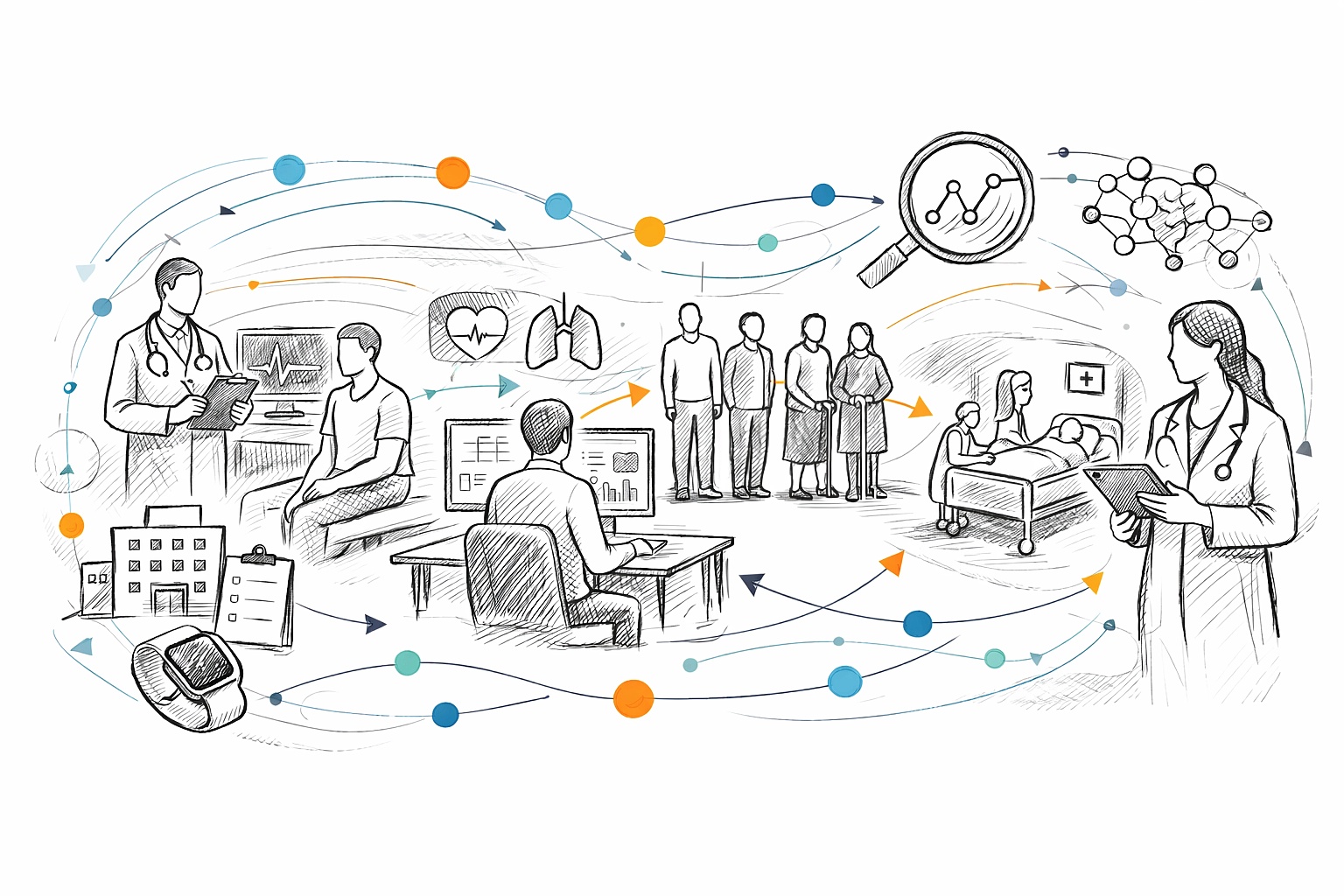
Patient information often gets scattered across different places. One hospital holds one record, a clinic holds another, and lab results sit somewhere else entirely. Chronic diseases are increasing, and care at the population level frequently lacks a clear picture. The result? Delayed diagnoses, gaps in treatment, and rising costs for both providers and patients.
A data-driven approach powered by AI offers a better way forward. With AI population health analytics, healthcare providers can connect the dots between data sources, uncover meaningful insights, and plan care for entire populations with real clarity and purpose. This method moves away from reactive care and toward well-planned, informed action.
Population Health Management means working to improve health outcomes for a whole group of people. That group could be patients in a hospital network, residents of a city, or individuals living with the same medical condition. The aim is to spot health trends, lower risks, and raise overall well-being across that group.
Take diabetes as an example. A healthcare provider may track diabetes patients across a whole region, often with the help of a healthtech engineering partner to integrate and manage the data. By studying their combined data, the provider can find common risk factors and plan early care. Another example involves hospital readmissions. When patients come back repeatedly, the system can detect gaps in care and suggest changes that bring down those repeat visits.
AI improves population health management by converting scattered healthcare data into clear and useful insights. Healthcare systems gather huge amounts of information from clinical records, lab reports, wearable devices, and patient conversations. Going through such large data sets by hand takes too long and often misses important patterns. AI steps in to process that data at scale and spot trends across entire populations. Predictive analytics looks at past and current data to catch early warning signs of illnesses like diabetes or heart disease. This early detection allows care teams to act before conditions become severe. That leads to better patient outcomes and lower costs over time.
Another big job for AI is risk stratification and making workflows run better. Patients fall into groups based on their health risk levels, such as high risk, moderate risk, or low risk. This grouping helps healthcare providers focus more attention on patients who need care right away. AI population health analytics strengthens this process by offering precise insights for each group. That leads to more targeted actions.
Many healthcare AI services now support this work by providing ready-to-use tools for risk analysis and patient segmentation. At the same time, automation simplifies routine tasks like data entry, alerts, and follow-ups. This reduces the load on healthcare staff and creates smoother operations across the system, leading to more efficient and organised care at the population level.

AI population health analytics means using artificial intelligence to study, organise, and interpret healthcare data across large groups of people. It pulls together information from many places, such as electronic health records, insurance claims, wearable devices, and social factors. Once the data comes together, AI applies advanced analytical methods to examine patterns, links, and trends that are hard to spot by hand. AI population health analytics turns raw data into structured insights, giving healthcare providers a full and connected picture of population health.
This approach goes further than basic reporting. It focuses on finding patterns, predicting risks, and forecasting outcomes. For example, AI can identify which patient groups face a higher chance of developing chronic conditions based on lifestyle, medical history, and clinical data. It can also predict future healthcare demand, which helps with better planning of resources and services. Clinical teams receive data-backed insights that guide decisions like early action, care prioritisation, and treatment planning. With AI automation services handling routine data processing and analysis, care teams can focus more on acting upon those insights. AI population health analytics plays a key part in moving healthcare from reactive treatment to planned, proactive care across entire populations.
Electronic Health Records hold detailed patient information like medical history, diagnoses, treatments, and clinical notes. These records provide a complete view of a patient's health journey across various care settings. When looking at a whole population, they help identify common health patterns and track how diseases move through groups over time.
Claims data shows which healthcare services people used, what treatments cost, and billing details. It reveals how often patients seek care and which services get the most use. This data also reveals cost trends and supports financial planning within population health programmes.
Wearable devices and connected health tools collect real-time data such as heart rate, physical activity, and sleep patterns. This steady stream of data gives a deeper look at daily health behaviour. It also helps detect health changes early, even when patients are not in a clinical setting.
Social and environmental factors like income, lifestyle, education, and housing conditions all affect health outcomes. These factors add context to clinical data and explain why certain populations face higher health risks. Including this data leads to more accurate and fair health analysis. A custom AI strategy report can help organisations decide which social factors matter most for their specific population.
Data integration brings all these sources together into one system. This creates a single, complete view of population health. It fills information gaps and raises the quality of analysis. This results in stronger decision-making. Data integration connects every source into a unified system, offering a complete view of each population group.
Data comes in from hospitals, clinics, wearable devices, and outside systems. This step lays the groundwork for all future analysis and insights.
Information gathered from different systems gets combined into one platform. This step connects scattered pieces of data and builds a consistent, reliable dataset.
AI works through the integrated data to find patterns, trends, and hidden insights. It examines large amounts of information quickly and with precision. Many SaMD solutions now power this analysis, offering validated clinical intelligence directly within the system.
Patients are grouped according to their health risks. This helps care teams focus their efforts on high-risk groups and plan targeted interventions.
The system produces insights that guide clinical decisions. These insights help shape treatments, improve care strategies, and manage population health in a more effective way.
AI tracks long-term conditions like diabetes and heart disease across patient groups. It finds patterns and helps deliver timely care to slow disease progression and lift quality of life.
AI studies patient history and treatment patterns to spot those at risk of coming back to the hospital. Early action lowers readmission rates and supports better recovery.
AI reviews patient data to create care plans tailored to individual health needs. This approach raises treatment accuracy and keeps patients more engaged in their own care.
Connected devices track patient health outside hospital walls. AI analyses this data to detect changes and alert care teams when a patient needs attention. With AI workflow automation, these alerts and follow-up tasks move forward without manual effort, saving time for clinical staff.
AI finds early signs of disease and risk factors across entire populations. This supports preventive care, which prevents future health problems. These AI use cases demonstrate how proactive health management can reduce the overall burden on healthcare systems.
Early detection and timely care lead to better health results across patient groups. Patients receive care at the right moment based on real data insights.
Fewer hospital visits and smarter use of resources bring down overall healthcare expenses. Cost control becomes more structured and easier to predict.
Data-driven insights give healthcare teams a steady direction for planning and treatment. Decisions stand on facts and analysis, not on guesswork.
Well-organised workflows cut down delays and improve teamwork across departments. This leads to smoother daily operations within healthcare systems. Organisations that invest in AI implementation support often see faster adoption and fewer disruptions during this transition.
Finding risks early shifts the focus from treatment to prevention. This improves long-term health outcomes for entire populations.
What lies ahead? Care will become more personal, guided by data that streams in as events happen. Advanced analytics will point the way toward faster clinical choices. AI-powered systems will work alongside digital health platforms to offer steady, ongoing care insights. Healthcare providers will see deeper into the health of entire populations and plan treatments with far greater accuracy.
AI and data work together to offer a clear path forward for population health management. From bringing data together to uncovering predictive insights, every step builds a more informed healthcare system. AI population health analytics strengthens decision-making and lifts outcomes across large groups of people. Contact us to explore how a data-driven approach can reshape population health strategies.
AI population health analytics uses data-driven AI use cases to identify trends, predict risks, and improve health outcomes across populations.
Healthcare AI services use AI workflow automation and AI automation services to streamline data analysis and improve population health management.
A healthtech engineering partner provides AI implementation support and ensures SaMD solutions are effectively integrated into healthcare systems.
A custom AI strategy report identifies key AI use cases and guides the adoption of AI population health analytics for better outcomes.
AI workflow automation reduces manual work, enhances efficiency, and strengthens AI population health analytics with faster insights.
How to build HIPAA-compliant AI: when LLM providers need a BAA, data minimization, de-identification, audit controls and a reference architecture.

Practical data migration planning guide for healthcare teams. Scope, mapping, compliance, validation, cutover and rollback decisions explained end to end.

Smart on FHIR guide for healthtech engineers. Learn the OAuth 2.0 launch model, scope syntax, backend services, and US regulatory requirements.
Connect with our team to explore how AI expertise can transform your business.