
AI in Healthcare
HIPAA-Compliant AI: How to Use LLMs With PHI Safely
How to build HIPAA-compliant AI: when LLM providers need a BAA, data minimization, de-identification, audit controls and a reference architecture.
October 16, 2026Read more
Learn how AI for small business can enhance growth and efficiency with practical tips, simple steps, and affordable tools. Start today!
Let’s be honest, for most small business owners, “artificial intelligence” sounds like something reserved for tech giants with massive budgets. But the reality is much more grounded. Think of AI as an incredibly efficient digital team member, one that works 24/7 to handle routine tasks, dig up customer insights, and help you make smarter decisions.
Getting started with AI can feel like a huge step, and that's a common feeling. The trick is to ignore the hype and focus on what it can actually do for your business. AI is leveling the playing field, giving smaller companies the kind of power that was once completely out of reach. It lets you punch above your weight by making your operations sharper and your customer experiences better.
This isn't about replacing people; it's about making your team even better. Imagine your marketing guru spending less time scheduling social media posts and more time brainstorming brilliant campaign ideas. Or picture your sales team zeroing in on genuinely hot leads because an AI has already sorted through the noise. That’s the real magic of using AI for small business—it frees up your people to do the creative, strategic work that truly grows the company.
We're seeing a massive shift in how small businesses view AI. It's quickly moving from a "nice-to-have" novelty to a core business tool. The numbers don't lie. A recent report from the U.S. Chamber of Commerce found that 58% of small businesses are now using generative AI. That's a huge jump from just 40% the year before.
And what about jobs? The fear that AI will replace everyone is proving to be unfounded. In fact, 82% of small businesses using AI actually increased their employee count. You can see more details in the U.S. Chamber of Commerce report on technology's impact.
This isn't just a trend; it's a response to real, tangible benefits. Businesses are seeing major improvements in a few key areas:
If you want to get specific, this article on 5 ways AI can help you sell smarter is a great read.
The real power of AI is how it turns everyday operational costs into a genuine competitive edge. When you streamline workflows and cut down on manual work, you see a direct impact on your bottom line. It takes tasks that were once just expenses and transforms them into opportunities for growth.
By strategically using AI, small businesses can automate the necessary but time-consuming grunt work. This frees up money, time, and talent for things that really matter—like building customer relationships and developing new products. That’s how you build a business that lasts.
The first step is knowing what you want to achieve, which is where something like AI strategy consulting can make a world of difference. Once you identify your biggest headaches, you can figure out exactly where AI will give you the most bang for your buck. From there, you can find the right tools and build a simple roadmap that grows with you, turning abstract ideas like "cost savings" into real, measurable results. To get started, you can always connect with our expert team to hash out a plan that fits your business perfectly.

Feeling lost in a sea of technical jargon? Let's cut through the noise. Getting a handle on AI for small business isn't about becoming a data scientist overnight. It’s about learning to spot new ways to grow your company and work smarter. The trick is to translate the buzzwords into practical business terms you can actually use.
Think of it like this: you don't need to understand the inner workings of an engine to drive a car. In the same way, you don’t need to code an algorithm to get real value from AI. You just need to know what these tools do and how they can solve your everyday business problems.
Let's break down the big ideas using simple analogies, skipping the dry textbook definitions. We'll focus on what these technologies can actually do for you.
Machine Learning (ML) is a bit like training a new hire by showing them years of your best work. Imagine you want to pinpoint your hottest sales leads. You'd feed an ML model thousands of examples of past leads—the ones that converted and the ones that didn't. Over time, it learns the patterns and can predict which new leads are most likely to close, letting your sales team focus their energy where it matters most.
Natural Language Processing (NLP) is all about giving your software the ability to read, understand, and even write emails like a seasoned professional. It’s the magic behind chatbots that can answer customer questions in a heartbeat or tools that can summarize a long thread of support emails into a few key bullet points. This can save your team from spending hours on manual reading and writing.
The real goal isn't just to plug in new technology; it's to create a partnership between your team's expertise and AI's capabilities. This collaborative approach of AI co creation is where genuine innovation sparks, blending human intuition with machine-like efficiency.
Beyond these core concepts, a few specific types of AI offer immediate value for small businesses. These aren't some far-off, futuristic ideas—they're accessible tools you can put to work right now to solve common challenges.
Generative AI: Think of this as your creative engine. It can produce brand-new content, from marketing copy and social media posts to product descriptions and even outlines for a business plan. It’s like having a junior copywriter on call 24/7, ready to brainstorm ideas or whip up a first draft.
Predictive Analytics: This is your business crystal ball. It sifts through your historical data to forecast what’s likely to happen next. For a small retailer, it might predict inventory needs to avoid running out of stock during a busy season. For a service business, it could forecast which customers are at risk of leaving, giving you a chance to step in before you lose them.
Getting a feel for these concepts is the first step. The next is figuring out how to apply them to your unique challenges, which an AI strategy consulting process can help clarify.
Once you grasp these ideas, AI stops being an abstract buzzword and becomes a toolkit full of practical solutions for your business. When you understand what Machine Learning or Generative AI does in simple terms, you'll start seeing opportunities everywhere.
You'll quickly see how that tedious job of sorting through customer feedback can be automated. You'll realize you can predict your cash flow with much better accuracy. This clarity is the foundation for building a realistic and effective plan.
Ultimately, the power of AI for small business is in its ability to amplify your team's skills, not replace them. It’s about giving your people tools that can take over repetitive tasks, uncover insights hidden in your data, and open up new paths for growth. Seeing AI through this practical lens helps you move forward with confidence, ready to make smart decisions that deliver real results. A great way to formalize this is with a Custom AI Strategy report designed specifically for your business goals.
It’s one thing to talk about AI in the abstract, but the real magic happens when you see it solve actual business problems. This is where the theory hits the road. We're going to walk through some tangible ways AI can work for you across your business, showing the clear "before and after" that makes it a practical tool, not just a buzzword.
The best part? You don't need a huge budget or a team of data scientists to get going. Many of today’s most powerful AI tools are built with small businesses in mind, ready to take on the tasks that eat up your time and money. The trick is to start small and aim for high-impact areas first.
Marketing is usually the first stop for small businesses dipping their toes into AI, and for good reason. It’s an area filled with repetitive tasks and a constant hunger for fresh ideas. Think of AI as a powerful assistant, freeing up your team to think bigger about strategy and connect with customers.
Take social media content creation, a classic time-sink.
The same logic applies to your sales process. Instead of guessing, AI can sift through your customer data to find patterns that signal which leads are actually ready to buy. This lets your sales team stop chasing cold leads and focus their energy where it counts—on prospects with real potential. This kind of targeted efficiency is a cornerstone of our AI Automation as a Service, where we help businesses put these systems in place.
To give you a clearer picture, here’s a quick breakdown of how AI can plug into different parts of your business, turning daily challenges into growth opportunities.
| Business Function | AI Application Example | Primary Benefit |
|---|---|---|
| Marketing | AI-powered content creation (e.g., blog posts, social media) | Saves time and overcomes creative blocks |
| Sales | Predictive lead scoring to identify high-value prospects | Increases conversion rates and sales efficiency |
| Customer Service | 24/7 AI chatbots for instant query resolution | Improves customer satisfaction and reduces support load |
| Operations | Inventory forecasting to prevent stockouts/overstocking | Optimizes cash flow and prevents lost sales |
| Finance | Automated invoice processing and expense tracking | Reduces manual errors and frees up administrative time |
| HR | Resume screening to identify top candidates quickly | Speeds up the hiring process and improves quality of hire |
These examples are just the beginning. The goal is to identify the most repetitive, time-consuming tasks in your workflow and see where an AI tool can step in to help.
Great customer service can set a small business apart, but it demands a lot of time and attention. AI-powered chatbots and virtual assistants can handle the bulk of common questions, offering instant answers around the clock.
Think about a customer who has a simple question about your return policy at 10 PM.
This frees up your human support agents to focus on the more complex or sensitive issues where empathy and a personal touch really matter. The end result is a faster, more effective support system and happier, more loyal customers.
The numbers back this up. A 2025 survey showed a massive jump in AI adoption among small businesses, from just 39% in 2024 to 55% in 2025. Even more telling, a whopping 58% of these businesses reported saving over 20 hours per week, with marketing and customer service being the top areas for these gains.
Beyond the customer-facing stuff, AI for small business can be a game-changer for your internal operations. From managing inventory to handling admin work, AI brings a new level of smart efficiency. For example, AI-powered predictive analytics can forecast demand for your products by looking at past sales, seasonal trends, and even what’s happening in the broader market.
This means you can keep just the right amount of inventory on hand, avoiding costly stockouts on popular items while not tying up cash in products that aren't moving. AI can also automate invoicing, process expense reports, and schedule appointments, wiping hours of tedious manual data entry off your plate.
For a deeper dive, check out our library of real-world use cases. These stories show how a smart plan, often developed with an AI strategy consulting partner, can turn operational headaches into a real competitive edge. Working with our expert team can help pinpoint the best automation opportunities hiding in your unique workflow.
Jumping into AI doesn't have to be a giant leap into the unknown. Think of it as a series of small, intentional steps. For a small business, adopting AI is all about finding a specific problem you're facing and applying a targeted solution. This simple approach cuts through the hype, making the process feel manageable and focused on getting real results from day one.
The trick is to not get bogged down by the endless list of AI tools out there. Instead, start by getting crystal clear on your business's biggest headaches. This mindset shifts AI from a confusing buzzword into a practical tool for growth. For a deeper dive into this structured way of thinking, check out our AI Product Development Workflow.
This graphic breaks down a simple, three-stage process for bringing AI into your business, starting with finding your pain points.
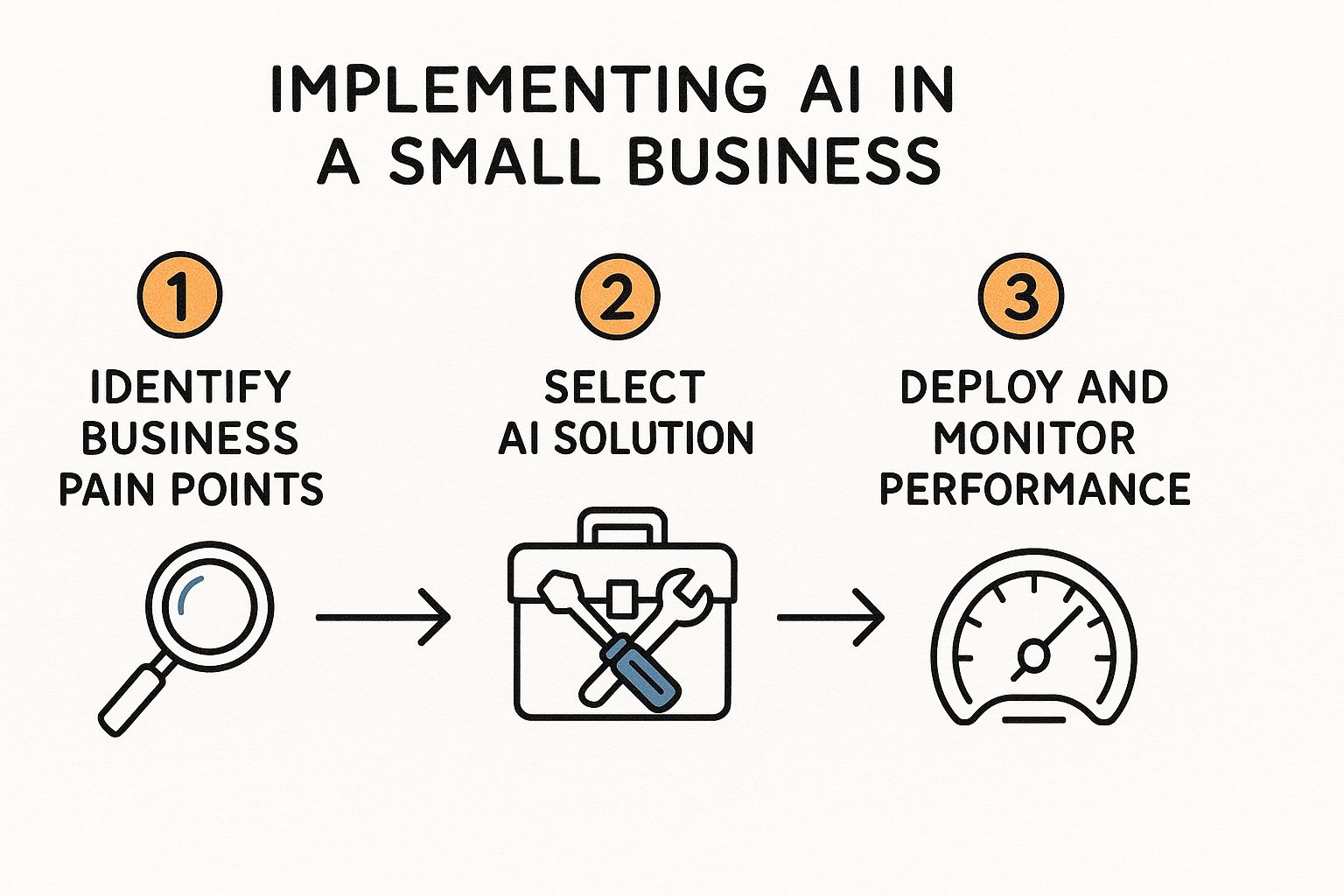
As you can see, successful AI adoption isn't a one-and-done deal. It’s a cycle of identifying what you need, picking the right tools, and keeping an eye on how they’re performing.
Before you can even think about a solution, you have to know exactly what problem you're trying to solve. Take a hard look at your daily operations. Ask your team: "What tasks eat up the most time for the least reward?"
Is it tedious, manual data entry? Or maybe it's answering the same five customer questions over and over again. These repetitive, low-impact tasks are the perfect candidates for AI. Think about where things are slow or where mistakes happen most often. These bottlenecks aren't just minor annoyances; they're hidden costs draining your time and money.
The goal here is clarity. Nailing down one or two major pain points gives you a clear target. It turns a vague idea like "we should use AI" into a specific mission, like "let's automate invoice processing to save 10 hours a week."
Once you've zeroed in on a bottleneck, fight the urge to go for a massive, all-in-one platform. Instead, start with a single, straightforward tool designed to solve that one specific problem. The market is full of user-friendly AI for small business options that deliver immediate value without a steep learning curve or a hefty price tag.
Here are a few ideas to get you started:
The aim is to score a quick win. This not only fixes a real problem but also builds your team's confidence in AI and shows a clear, immediate return on your investment.
A shiny new tool is useless if nobody uses it. Bringing AI into your business is really about people, so you have to set aside time for training and support. Don't just show them how to use the tool; explain why you're bringing it in. Emphasize how it's going to make their jobs easier, not replace them.
Start with the people most affected by the bottleneck you identified. Run hands-on training sessions and create some simple guides they can look back on. Most importantly, ask for their feedback and be ready to listen to their concerns. When your team feels like part of the process, they take ownership, and the technology actually becomes a helpful part of their daily routine.
How do you know if your new AI tool is actually working? You have to measure its impact. Before you even start, decide what success looks like by setting a few simple, measurable Key Performance Indicators (KPIs).
For example, you could track:
The data shows just how common this is becoming. An incredible 99% of US small businesses are already using at least one AI tool for things like accounting or content. Globally, 78% of all companies use AI in their operations, with small businesses closing the gap with big corporations faster than ever.
Once you’ve seen a positive ROI on that first tool, you can use that success to make the case for bringing AI into other parts of the business. This methodical, measure-then-scale approach ensures every new tool you bring in is a smart, data-backed investment in your company’s future.
Let's get straight to the biggest question on every small business owner's mind: cost. It’s no secret that the fear of a massive price tag is a major hurdle. In fact, 55% of small business owners cite cost as the main reason they haven't jumped into AI yet.
The good news? The world of AI for small business isn't just for the big players with deep pockets. It's an incredibly diverse marketplace with powerful options that fit almost any budget. You don't need a huge upfront investment to start seeing real results.
If you're just dipping your toes into AI, the "freemium" world is your best friend. These tools offer core features at no cost, giving you a chance to experiment with AI's capabilities and see the impact for yourself. It’s a completely risk-free way to get started.
Think of it as a no-obligation test drive. You can use free AI generators to draft social media posts or try out a simple chatbot to answer common questions on your website. Many platforms you already use—like email marketing or project management software—are now baking basic AI features right into their free plans.
A great way to see what's out there is to check out a list of AI content creation tools. This helps you compare features and understand what’s possible before spending a dime.
Once you've found a clear use for AI, stepping up to an affordable subscription is the logical next move. These tools, usually priced per user per month, unlock more advanced features, higher usage limits, and better customer support. This is where most small businesses find their perfect balance of cost and capability.
You’ll find tons of great options in this category:
These subscriptions are a predictable monthly expense that, when chosen wisely, delivers a return that far outweighs the cost.
To help you figure out where to start, here’s a simple breakdown of the different tiers of AI tools available.
| Investment Level | Typical Cost | Best For | Example Tools |
|---|---|---|---|
| Freemium | $0/month | Experimenting with AI, basic tasks, and trying before you buy. | ChatGPT (Free Version), Canva Magic Write, Grammarly (Free) |
| Affordable Subscription | $10 - $100/month | Core business functions like marketing, sales, and customer service. | Jasper, SurferSEO, Zendesk AI, QuickBooks |
| Custom Solution | $5,000+ (Project-based) | Solving unique, complex business problems that off-the-shelf tools can't handle. | Custom-trained chatbots, predictive inventory models, proprietary data analysis |
This table shows there’s an entry point for everyone. Start where you're comfortable and scale up as you see the value.
For businesses with truly unique challenges, an off-the-shelf tool might not cut it. This is where a custom solution becomes a powerful strategic investment. It doesn't always mean building an AI from scratch; often, it involves fine-tuning an existing AI model with your specific company data.
Think about it: a custom AI could optimize a niche manufacturing process or create a one-of-a-kind recommendation engine for your e-commerce site. This isn't just an expense—it's a calculated move to build a competitive advantage that no one else can copy.
The key is to shift your mindset from "How much does AI cost?" to "What is the return on this investment?" An AI tool that saves your team 10 hours a week pays for itself almost instantly.
You've made it through the essentials, from understanding what AI really is to sketching out a game plan. Now, let’s be clear: integrating AI into your small business isn’t about chasing the latest shiny object. Real, lasting success comes from finding the right tool for the right problem—turning your biggest operational headaches into your best growth opportunities.
The magic really happens when you combine your team's unique expertise with smart automation. This partnership is what lets you supercharge what your people do best, while offloading the tedious, repetitive work to technology. It’s less of a tech revolution and more of a smart evolution for your business.
The businesses that thrive from here on out will be the ones that master this collaboration. The goal isn't just to use new tools; it's to create a smarter way of working, where your team and AI work together to do incredible things.
So, are you ready to take that next step? Real progress begins with a clear, intentional plan. Following a process of AI co-creation is the best way to ensure the solutions you build are actually aligned with what you want to achieve, as we explored in our AI adoption guide.
If you're looking to build a roadmap that truly fits your vision, let's talk. Connect with our expert team, and we can help you turn these ideas into an action plan that delivers real, measurable results and gets your business ready for whatever comes next.
Diving into AI for your small business can feel like opening a can of worms. You've probably got questions about the cost, the learning curve, and what it means for your data. Those are all smart concerns, so let's break down some of the most common questions we hear from business owners just like you.
Not anymore. It's a common misconception that AI comes with a massive enterprise-level price tag. The truth is, the market is full of powerful AI tools that are either free or very affordable, built specifically for small teams.
You can get your feet wet with free versions of AI writing tools or chatbot builders without spending a dime. Plus, a lot of the software you already pay for—think accounting platforms or CRMs—are now rolling out AI features as part of their standard plans. The trick is to start small by targeting one specific business problem and finding a tool that solves it without breaking the bank.
Absolutely not. You don't need a degree in computer science to make AI work for you. Most AI tools designed for small businesses are made to be incredibly user-friendly.
If you can use a program like Microsoft Word or manage a Facebook page, you have all the skills you need. These tools are all about simple dashboards and drag-and-drop interfaces. They let you focus on running your business while the AI does the heavy lifting in the background.
This is a big one, and it's something you should take seriously. Protecting your company's information starts with choosing the right AI partners. Always go with well-known vendors who are transparent about their privacy policies and use security measures like data encryption.
Before you sign up for anything, spend a few minutes reading the terms of service. You need to know exactly how they plan to use and protect your data. A good rule of thumb is to only share the information that's absolutely necessary for the tool to do its job.
The best way to start is by looking for a bottleneck. Pinpoint one repetitive, mind-numbing task that eats up your time every week. Is it writing social media captions? Answering the same customer questions over and over? Juggling your calendar?
Once you have that one pain point in mind, find an AI tool built specifically to fix it. Starting with a single, focused solution helps you understand how AI works, see real results fast, and build the confidence to explore more. For a deeper dive into other questions, check out our comprehensive FAQ page.
Ready to stop wondering about AI and start seeing it deliver real growth for your business? At Ekipa AI, we create practical AI roadmaps that fit your specific goals. Let's find your best opportunities and get started.
How to build HIPAA-compliant AI: when LLM providers need a BAA, data minimization, de-identification, audit controls and a reference architecture.

Practical data migration planning guide for healthcare teams. Scope, mapping, compliance, validation, cutover and rollback decisions explained end to end.

Smart on FHIR guide for healthtech engineers. Learn the OAuth 2.0 launch model, scope syntax, backend services, and US regulatory requirements.
Connect with our team to explore how AI expertise can transform your business.