AI in Healthcare
HIPAA-Compliant AI: How to Use LLMs With PHI Safely
How to build HIPAA-compliant AI: when LLM providers need a BAA, data minimization, de-identification, audit controls and a reference architecture.
October 16, 2026Read more
Learn how a comprehensive AI gap analysis can identify high-impact opportunities, assess your readiness, and create a practical roadmap for business growth.
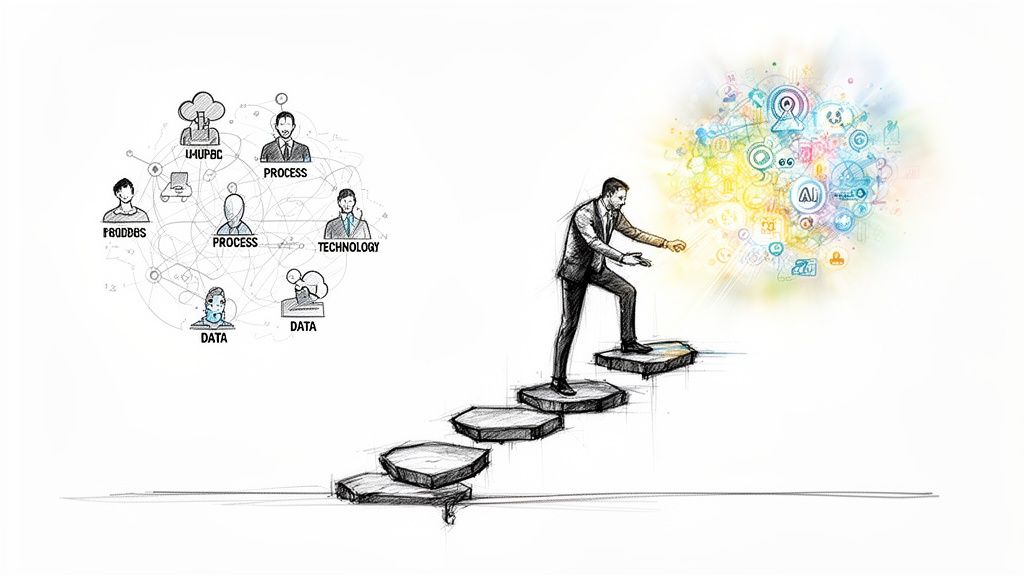
An AI gap analysis is really just a structured way to figure out where your company stands today versus where you need it to be to compete with AI. It’s a diagnostic that looks at everything—your people, your internal processes, the tech you use, and the data you have—and compares it against your vision for an AI-powered future. Think of it as the step that moves you from simply talking about AI to creating a concrete, actionable plan.
An AI gap analysis isn't some abstract technical audit. It’s a vital business exercise that shows you exactly where you are in a world being fundamentally changed by artificial intelligence. If you're new to this, understanding the broader concept of gap analysis can be a helpful starting point before focusing specifically on AI.
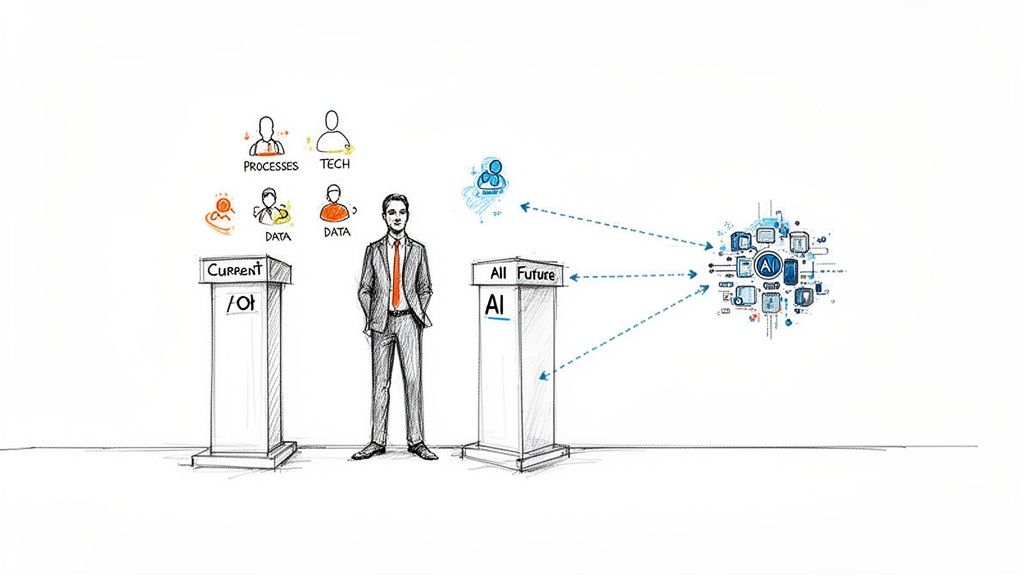
The whole point is to map the distance between your current operations and your desired future. It's about systematically uncovering the hidden risks you're facing, pinpointing the opportunities that will give you the biggest bang for your buck, and building a compelling business case for the investments you need to make. This isn't something you can put off; the pace of AI development means the gap between the leaders and everyone else is getting wider every day.
The gap between AI "leaders" and "laggards" is no longer a gut feeling—it's backed by data, showing massive differences in investment and capability scores. For instance, the 2023 Government AI Readiness Index found that high-income countries are outperforming others by 13–17 points in areas like innovation and human capital.
For a business leader, that’s a critical insight. A well-executed AI gap analysis does the same thing for your company. It tells you where you stand against the competition, which specific capabilities are holding you back, and how targeted investments can close what might be a 10- to 40-point disadvantage.
Putting this off means you're not just standing still; you're actively falling behind. A proactive AI gap analysis lets you make deliberate, strategic moves instead of constantly reacting to whatever your competitors are doing. It's the difference between building a bridge to your future and finding yourself on the edge of a canyon that's getting wider by the minute.
This process forces you to answer the three fundamental questions every leader needs to address:
By working through these questions, you build a strategy that connects your technology investments directly to real business outcomes. It ensures that every dollar you put into AI is aimed at something that delivers measurable value and gives you a genuine competitive advantage.
A solid AI gap analysis comes down to an honest, thorough audit of your organization's core capabilities. This isn't about ticking boxes on a generic checklist. It's about asking pointed, practical questions across four distinct areas that give you a complete picture of where you stand.
This structured approach grounds your AI ambitions in reality. It forces you to look at everything—from your team’s actual skills to the state of your data—ensuring your strategy is built on a solid foundation.
Let's be clear: AI implementation is a human challenge, not just a technical one. You can have the best technology in the world, but without the right people and a culture that’s open to change, it will fall flat. Auditing your people means looking beyond job titles to see what your team can really do and whether your company's mindset is ready.
Start by mapping out your current talent. Do you have data analysts, engineers, or project managers who have actually worked on data-heavy projects before? An honest AI requirements analysis shows you not just who you have, but more importantly, who you're missing. With studies showing a huge chunk of the workforce will need reskilling for an AI-driven world, getting this right is urgent.
Skills are only half the battle, though. Culture is the invisible current that can either carry your initiatives forward or pull them under.
A culture of experimentation—where teams are encouraged to try new things and learn from what doesn’t work—is a far greater asset than having a single AI genius on staff. It's the collective curiosity and willingness to adapt that fuels real progress.
Ask your team and your leaders:
For example, a company looking at Ecommerce AI Solutions might find its marketing team is excited about personalization but doesn't have the data literacy to understand the results. That’s a clear and actionable training gap.
Next, you have to put your day-to-day business processes under the microscope. The goal here is to hunt down the bottlenecks, inefficiencies, and tedious manual tasks that are perfect candidates for automation. This is where you'll find the low-hanging fruit—the quick wins that show immediate value.
Think of your core workflows like the arteries of your business. Where is the flow getting clogged? A simple process map often reveals shocking inefficiencies. I once saw a customer service team spending 40% of its time just manually sorting and tagging support tickets. That’s a perfect use case for a natural language processing model that could do it instantly.
This part of the analysis isn't about replacing people. It's about freeing them up. By automating the soul-crushing, repetitive work, you empower your team to focus on strategic thinking, creative problem-solving, and other high-value work that actually grows the business.
Here's what to look for:
A business exploring Manufacturing AI Solutions might realize its manual quality control checks are a huge bottleneck. An AI-powered computer vision system could spot defects on the assembly line in real-time, boosting both speed and accuracy.
Your current technology stack is the foundation you’ll build all your AI projects on. If that foundation is shaky, you're setting yourself up for failure. This pillar demands a brutally honest look at your hardware, software, and cloud capabilities.
Modern AI, especially the generative kind, is hungry for computing power. Can your servers handle it, or will you need to lean on cloud services like AWS or Google Cloud? Your ability to scale up or down is non-negotiable.
Beyond raw power, integration is everything. Your new AI tools for business need to talk to your existing systems—your CRM, your ERP, your databases. If they can't connect, you end up with data silos that starve your AI models of the broad, clean information they need to be effective.
To see how you can build this connective tissue, our interactive AI Readiness Workshop provides hands-on guidance from our experts.
Your tech audit checklist should include:
Data is the fuel for AI. Without a steady supply of high-quality, accessible, and well-managed data, the most advanced algorithm is completely useless. This final pillar is often the toughest to tackle, but it’s arguably the most critical.
Start with data quality. Is your data accurate, complete, and consistent? A model trained on garbage data will give you garbage results—and those results could be dangerously misleading. For anyone in a regulated industry, this is a deal-breaker. A company providing Healthcare AI Services, for example, must guarantee its data practices are compliant with privacy laws, which often means working with specialists in custom healthcare software development.
Data governance provides the essential rules of the road. Who owns the data? Who is allowed to see it? How is it protected? A clear governance framework ensures your AI work is not only effective but also ethical, secure, and legally sound.
Key data questions to answer:
To help structure this audit, here is a simple framework that ties these pillars together.
This table breaks down the core investigation for each of the four pillars, giving you guiding questions and a clear picture of what a successful "future state" looks like.
| Pillar | Key Questions to Ask | What Success Looks Like (Future State) |
|---|---|---|
| People & Culture | Do we have the right skills in-house? Is leadership bought in? Are employees open to change? How well do our teams collaborate? | A skilled, cross-functional team led by supportive leadership. The entire organization embraces experimentation and views AI as an enabler, not a threat. |
| Processes & Workflows | Where are our biggest bottlenecks? Which manual, repetitive tasks are slowing us down? Where is friction in our customer journey? | Core workflows are streamlined and augmented by AI. Employees are freed from low-value tasks to focus on strategic, creative, and customer-facing work. |
| Technology & Infrastructure | Can our current tech stack scale? Are our systems integrated? Is our data architecture modern and accessible? How strong is our security? | A scalable, secure, and integrated technology infrastructure that allows for the seamless deployment and operation of AI tools. Data flows freely between systems. |
| Data & Governance | Is our data high-quality, complete, and accessible? Do we have the right data for our goals? Are our data governance and privacy policies clear and enforced? | High-quality, reliable data is readily and securely accessible to authorized teams. A robust governance framework ensures all AI initiatives are ethical, compliant, and secure. |
By working through these four pillars methodically, you move beyond the buzzwords. You turn the abstract idea of an "AI gap analysis" into a powerful diagnostic tool that shows you exactly where to invest your time, money, and energy for a successful transformation.
You've done the hard work of the audit. You have a crystal-clear picture of your company's capabilities across people, processes, technology, and data. But that snapshot is just a starting point. Now comes the exciting part: connecting the dots and turning that raw information into a strategic map of AI opportunities.
This is where you bridge the gap between "what we have" and "what we could achieve." It’s less about making a wish list of cool AI projects and more about methodically linking the weaknesses and strengths you uncovered to real, tangible business problems that AI can solve.
The four pillars you just audited don't exist in a vacuum. They're completely interconnected.
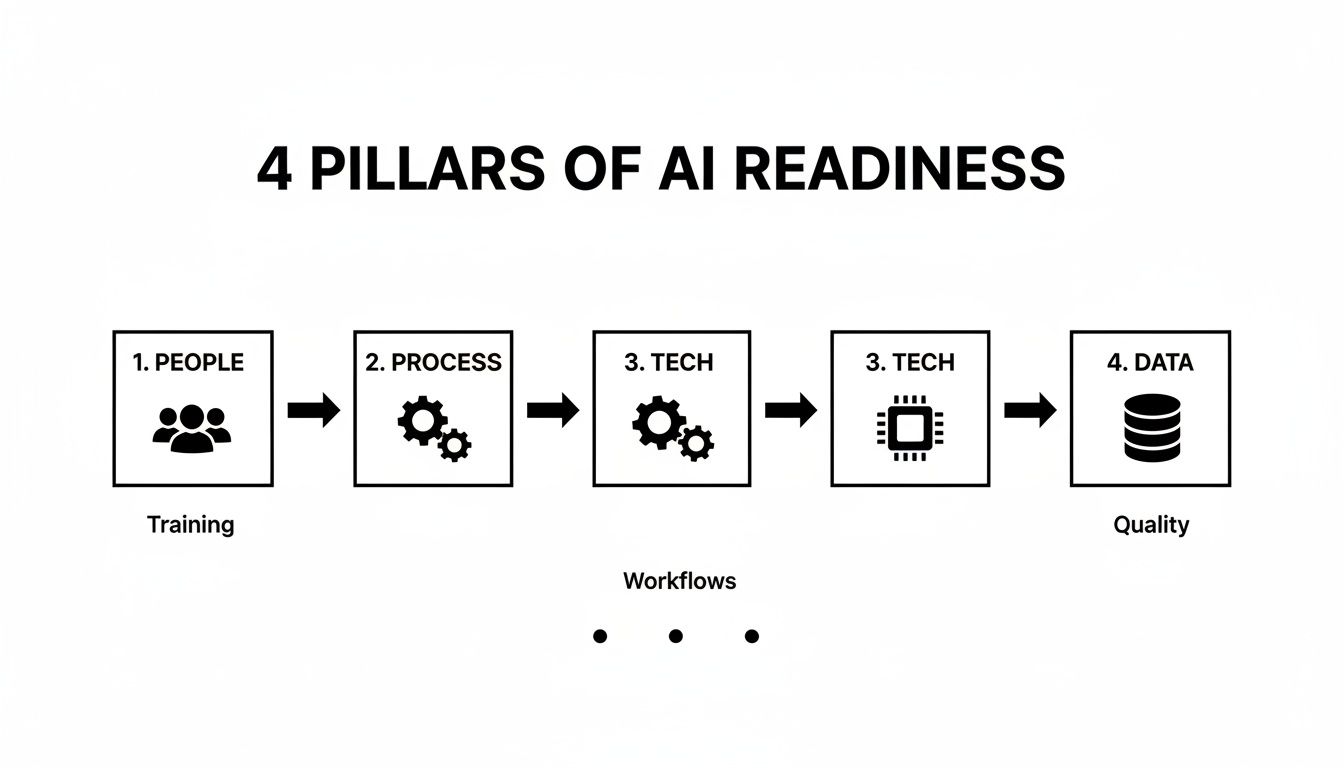
As you can see, a weakness in one area—say, poor data quality—will absolutely hamstring your ability to implement new tech or get the most out of your people. This is why a holistic view is non-negotiable.
Your audit probably produced a long list of observations. A sloppy data governance policy here, a painfully manual approval workflow there, maybe a glaring lack of data skills on the marketing team. These are your gaps. The trick is to reframe them as starting points for action.
Think of it this way:
By translating every finding into a potential project, you'll quickly build a backlog of initiatives. But let's be realistic—you can't do everything at once. You need a simple, effective way to separate the quick wins from the long-term moonshots.
To bring order to the chaos, you need a scoring framework. This doesn't have to be some overly complex algorithm; it’s about having a straightforward, consistent way to evaluate each potential project against the things that actually matter to your business.
I’ve seen this work countless times. A solid scoring model really just needs to balance three key factors:
Just by adding up these three scores (Impact + Complexity + Alignment), you get a total priority number for each initiative. This simple math helps you step back from the "shiny new toy" syndrome and focus on what's going to deliver genuine, measurable value.
Let's make this tangible. Imagine an e-commerce company just finished its AI gap analysis and surfaced two big opportunities:
Here’s how we’d run them through the scoring framework:
| Criteria | Opportunity A: AI Chatbot | Opportunity B: Predictive Inventory |
|---|---|---|
| Potential Impact | 7/10 (Boosts customer satisfaction, reduces agent burnout) | 10/10 (Directly grows revenue and cuts carrying costs) |
| Implementation Complexity | 8/10 (Fairly easy; many off-the-shelf AI solutions are available) | 4/10 (Much tougher; needs clean historical data and custom modeling) |
| Strategic Alignment | 6/10 (Supports a secondary goal of improving customer experience) | 9/10 (Tied directly to core goals of increasing profitability and market share) |
| Total Priority Score | 21 | 23 |
In this case, the predictive inventory system, despite being more complex, emerges as the top priority because its strategic and financial impact is just so much greater. The chatbot, however, is a fantastic quick-win candidate to tackle right after.
This is the real power of a structured AI gap analysis: it turns subjective arguments into clear, objective business decisions. For teams ready to take the next step, our AI Product Development Workflow outlines the path from this scoring phase to a successful launch. And if you need a hand, our expert team can help you tailor this process to your specific business needs.
You've done the hard work of analyzing your opportunities. Now, how do you turn that prioritized list into a real plan? This is where you build your strategic AI roadmap, the playbook that translates your findings into action. It's the critical document that shifts your AI gap analysis from a theoretical exercise to a genuine driver of business growth.
A good roadmap is more than just a timeline of projects. It tells a story. It clearly shows stakeholders how you’ll deliver value right away while methodically building the capabilities you need to win in the long run. This is absolutely essential for keeping everyone engaged and ensuring you get the continued support you need from leadership.
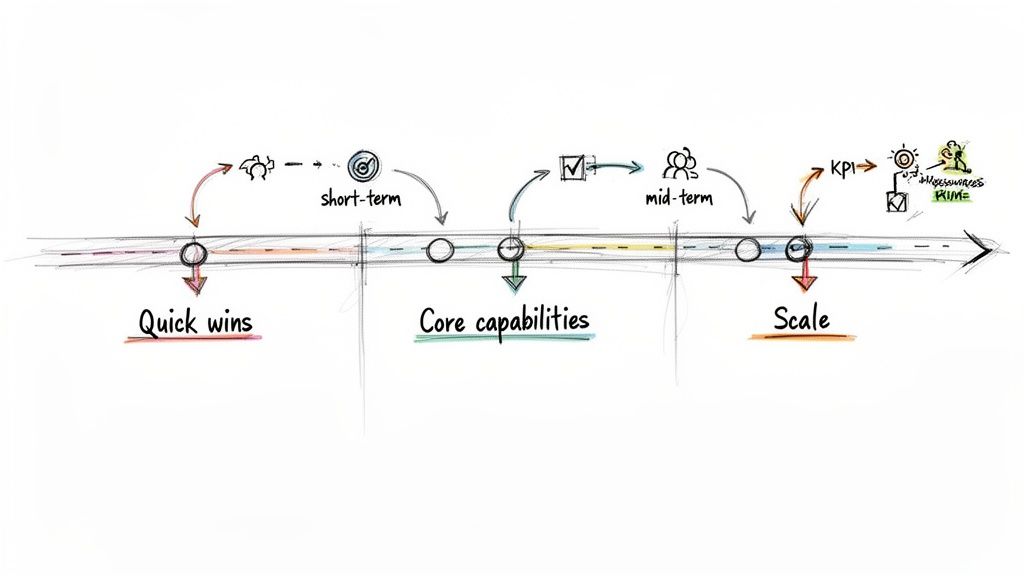
From my experience, the best roadmaps start small to win big. You have to sequence your initiatives to show visible results fast. This is where "quick wins" are your best friend—high-impact, low-complexity projects you can roll out in the next 3-6 months.
A perfect example is a marketing team using an AI tool to generate email subject lines. It's a fairly straightforward project that uses existing AI tools for business and can produce a measurable jump in open rates almost instantly.
Quick wins aren't just easy projects; they're political capital. A successful early initiative silences the skeptics, fires up your team, and builds the organizational trust you'll need to ask for bigger investments down the line.
These early victories create a flywheel of positive momentum, making it much easier to get the resources for the more ambitious projects that will truly move the needle.
Once you have some momentum, your roadmap should pivot toward medium-term projects—think 6-18 months out. These initiatives are all about building your core AI capabilities and tackling the bigger gaps you found in your audit.
These are the bridge projects. They get you from those initial quick wins to your long-term vision, systematically strengthening your organization's ability to scale its AI efforts. A solid AI gap analysis is often the first step in creating a much broader digital transformation roadmap, making sure your AI bets align with the company's bigger goals.
For this plan to be effective, it needs more than a list of project names. Each initiative on your roadmap should have some key details attached.
Remember, this roadmap is a living document, not something you create and forget. You’ll learn as you go. Plan to review and tweak it quarterly to reflect your progress, new technology, and any shifts in business priorities.
Building a comprehensive roadmap can feel like a massive project in itself. To fast-track this crucial step, services like a Custom AI Strategy report can deliver a professionally structured, data-driven plan. This can accelerate the entire process, giving you a clear, actionable roadmap you can confidently present to your leadership team.
An AI roadmap on paper is one thing; bringing it to life in the messy reality of a business is another entirely. I've seen beautifully crafted strategies, born from a thorough gap analysis, completely stall the moment they hit the real world.
The key is to know what's coming. If you can anticipate the common roadblocks, they stop being showstoppers and become manageable bumps in the road. Success here isn't just about the tech—it's about having the foresight to navigate the very human and operational challenges that inevitably pop up.
Let's be honest: the biggest hurdle is rarely the algorithm. It's the people. Resistance to AI often comes from a very real place—fear of job loss, confusion about how it works, or just plain skepticism that it will deliver on its promises. Forcing a new tool on your team without laying the proper groundwork is a guaranteed way to fail.
Your best tool here is radical transparency. Pull together an "AI council" with people from across the company—IT, marketing, operations, HR, you name it. When people feel like they're part of the process, they take ownership. The other secret? Get those quick wins you identified in your roadmap up and running fast. Nothing silences a skeptic faster than seeing a tangible, positive result with their own eyes.
Your gap analysis probably uncovered some uncomfortable truths about your team's current AI capabilities. A major talent shortage can bring your entire initiative to a grinding halt. But the answer isn't always to rush out and hire a small army of expensive data scientists.
Think of it as a "build, buy, or borrow" decision:
An AI model is only as smart as the data it learns from. If that data is a mess—locked away in different systems, full of errors, or inconsistent—your AI projects are dead in the water. This is one of the most common, and most frustrating, discoveries teams make during their initial audit.
There's no shortcut here; you have to put in the work to establish solid data governance. The first step is often creating a central place—a data lake or warehouse—where all this information can live together and be cleaned. Then, assign "data stewards" in different departments who are responsible for the quality of their data. It isn't glamorous work, but it's the absolute bedrock of any successful AI program.
Don't forget, the point of AI isn't just to make things faster, it's to make them smarter. The intelligence of your systems is a direct reflection of the quality of your data. Garbage in, garbage out—it’s a cliché for a reason.
Finally, rolling out AI brings a new set of ethical headaches and risks to the table. You can't treat things like data privacy, algorithmic bias, and compliance with new regulations as an afterthought. Getting this right from the start is fundamental to building trust with customers and your own team.
Create a clear set of ethical principles for how your company will use AI. For every new project, especially those touching sensitive customer data, run a formal risk assessment. These issues are complex, and getting them wrong can have serious consequences.
If you're looking for hands-on guidance through this phase, our expert team at Ekipa can help. We’ve been in the trenches with countless businesses, helping them navigate these complexities to ensure their AI journey is both successful and responsible.
Let's tackle some of the common questions leaders ask when they're first thinking about an AI gap analysis. These are the practical, real-world concerns that pop up, and having clear answers can help you move forward with confidence.
An AI gap analysis is a strategic business process that assesses the difference between your company's current capabilities and its desired future state with artificial intelligence. It examines four key pillars—People & Culture, Processes & Workflows, Technology & Infrastructure, and Data & Governance—to identify strengths, weaknesses, and high-value opportunities for AI implementation.
This really boils down to the size and complexity of your company. For a focused analysis in a small or mid-sized business, you’re often looking at a 2-4 week timeline. But for a sprawling enterprise with multiple departments, a truly thorough audit could take 2-3 months.
At Ekipa, we've built our own proprietary AI Strategy consulting tool to cut down on that time significantly. Our whole approach is designed to get you a Custom AI Strategy report much faster, so you can stop analyzing and start acting.
By far, the most common and expensive mistake is chasing a shiny new technology without first having a clear business problem to solve. We see it all the time: a company gets excited about a new AI tool and tries to shoehorn it into their workflow, only to find the ROI is terrible.
A successful AI journey always starts with the gap analysis to find a real, painful business challenge. Only after you’ve identified that need should you start looking for the right AI solutions to fix it. This "problem first" mindset, as we explored in our AI adoption guide, is non-negotiable.
Not for the initial stages, no. The AI gap analysis itself is fundamentally a business strategy exercise. It should be led by a cross-functional group of leaders from operations, IT, finance, and strategy.
A successful gap analysis relies more on sharp business acumen and strategic insight than on deep technical expertise. The goal is to identify business opportunities, not to build machine learning models from scratch.
You'll definitely need the data scientists when it comes time to build and implement. But the initial audit and opportunity mapping? That's where business context is king. Our AI strategy consulting services are built to bring that strategic expertise to the table from day one.
You start measuring the ROI of an AI project long before you write a single line of code—it happens during the gap analysis. For every potential opportunity you uncover, you have to define the Key Performance Indicators (KPIs) that tie directly back to business value. You can find many real-world use cases that illustrate this.
For instance:
Setting these benchmarks up front is the only way you'll ever be able to prove the value of your AI investments and justify future projects.
Ready to bridge your AI gap and build a clear path to value? At Ekipa AI, we turn your business goals into a concrete, actionable AI strategy. Our expert team uses advanced tools to deliver a comprehensive roadmap, helping you find those high-impact opportunities and execute them with confidence. Start your AI transformation journey with Ekipa today.
How to build HIPAA-compliant AI: when LLM providers need a BAA, data minimization, de-identification, audit controls and a reference architecture.

Practical data migration planning guide for healthcare teams. Scope, mapping, compliance, validation, cutover and rollback decisions explained end to end.

Smart on FHIR guide for healthtech engineers. Learn the OAuth 2.0 launch model, scope syntax, backend services, and US regulatory requirements.
Connect with our team to explore how AI expertise can transform your business.