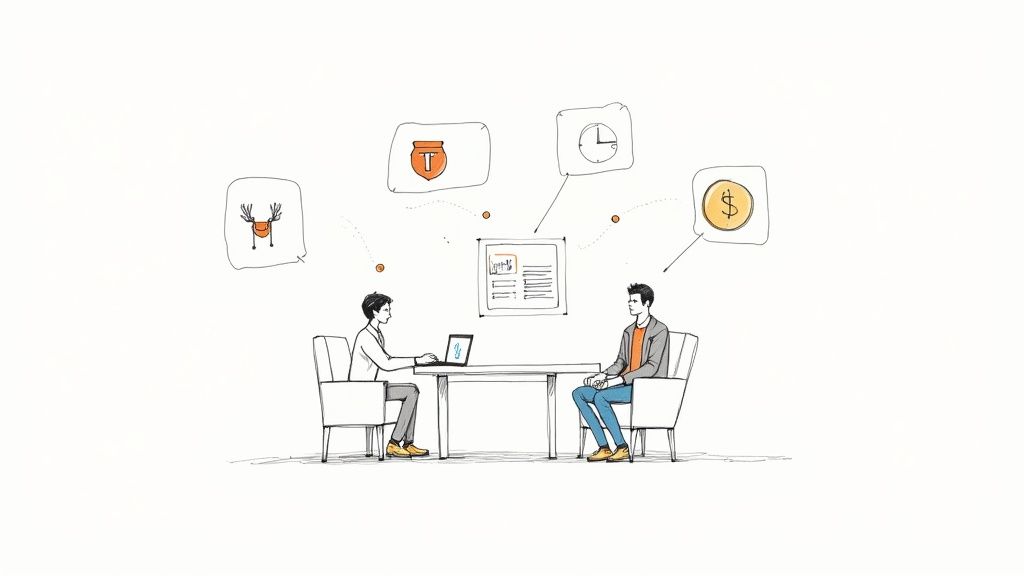
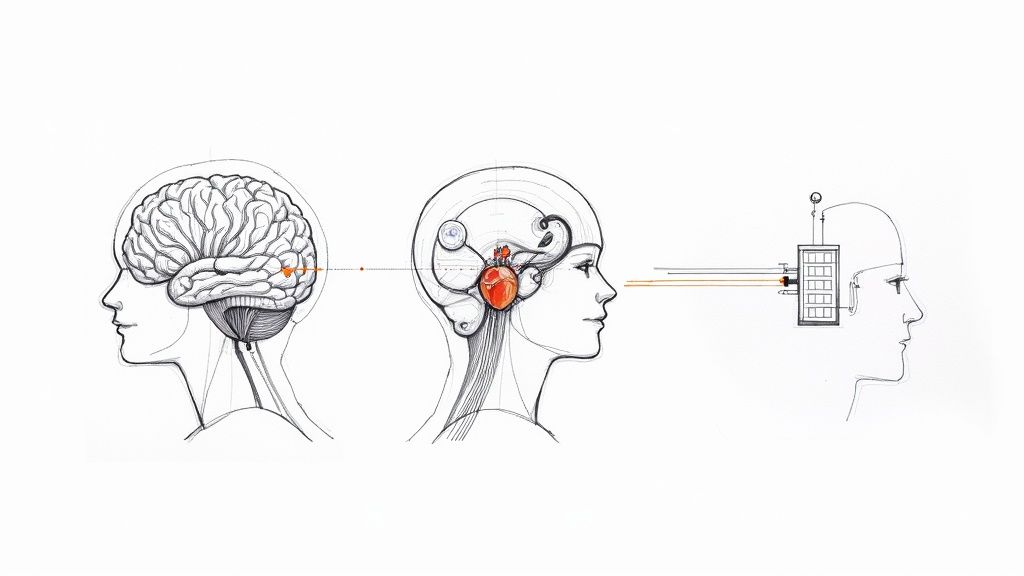
The most useful way to think about senior care digital transformation is this: it's not an IT modernization project. It's an operating model response to a market that is getting larger, more home-centered, and harder to serve with manual processes.
A 2025 elderly care market forecast valued the global market at $53.29 billion, projected $57.78 billion in 2026, and projected $114.57 billion by 2034. The same forecast says home care service will account for 59.05% of the market in 2026. That should change how executive teams allocate capital today. If care is shifting outward, data, monitoring, coordination, and automation have to move with it.
Families feel this shift too. If your organization is designing services that extend into the home, resources like this practical guide for elder care help clarify what day-to-day support looks like from the family side.
The Inevitable Shift in Senior Care
Senior care digital transformation means redesigning how care is delivered, documented, monitored, and coordinated. It's not about buying one new platform and calling it innovation. It's about replacing fragmented workflows with connected systems that let staff act faster, spend less time on low-value tasks, and support residents more consistently across settings.
For senior care operators, the pressure is immediate. Staffing remains tight. Resident acuity is rising. Families expect better visibility. Referral partners expect cleaner handoffs. Margins don't tolerate wasted labor.
That's why digital transformation belongs on the same agenda as occupancy, quality, labor management, and payer strategy. The organizations that treat it as a side initiative usually end up with disconnected tools, frustrated staff, and weak returns.
What leaders should actually mean by transformation
A credible transformation program in senior care usually includes a mix of the following:
- Connected care data: Shared records, accessible workflows, and fewer information silos.
- Event-driven monitoring: Sensors, wearables, alerts, and escalation logic tied to resident risk.
- Workflow automation: Less manual documentation, fewer repetitive admin tasks, and better task routing.
- Cross-setting coordination: Better transitions between hospital, SNF, home care, clinicians, and families.
- Decision support: Analytics that help teams prioritize interventions instead of reacting late.
If your digital roadmap doesn't improve care delivery and labor productivity at the same time, it's incomplete.
Many providers also need a partner that understands how AI, software, compliance, and care operations fit together. That's where broader Healthcare AI Services become relevant, especially when executive teams need to connect strategy to delivery.
Senior care digital transformation is no longer optional infrastructure. It's how providers stay operationally credible in a higher-demand, more distributed care market.
The Strategic Case Beyond Technology
The business case is stronger than most executives realize. Digital transformation in senior care isn't just about resident experience. It has direct implications for enterprise value, workforce capacity, and resilience.
A peer-reviewed study found that for every one-unit increase in an eldercare organization's digitalization index, the value of the care industry increased by an estimated 2.99 units through both direct and indirect effects, including capital allocation efficiency, new product development, and enterprise digitalization, as reported in this peer-reviewed research on digitalization in older-adults care.
That matters because many leadership teams still evaluate digital spending like a cost-control exercise. That's too narrow. The better lens is value creation.
Why inaction is expensive
The biggest risk isn't failed experimentation. It's standing still while complexity rises.
Without digital infrastructure, organizations typically force staff to bridge process gaps manually. Nurses and caregivers chase updates across paper notes, phone calls, disconnected systems, and family messages. Administrators spend time reconciling records instead of improving throughput and quality. Leaders lose visibility into where care friction sits.
Here's what that means in practice:
- Labor gets wasted: Staff perform routine checks and duplicate documentation instead of focused interventions.
- Clinical response slows down: Teams often act after deterioration becomes obvious rather than when early signals appear.
- Expansion gets harder: Multi-site consistency breaks down when workflows live in people's habits instead of systems.
- Differentiation weakens: Referral partners and families increasingly notice who can coordinate care cleanly and who can't.
What executives should fund first
Don't approve a shopping list of tools. Fund a business thesis.
A useful board-level framing looks like this:
| Strategic pressure |
Weak response |
Strong response |
| Staffing strain |
Add more manual oversight |
Automate low-value work and improve triage |
| Rising acuity |
Increase routine checks |
Use monitoring and alerts to target risk |
| Family expectations |
More call volume |
Shared visibility and coordinated updates |
| Growth goals |
Add standalone software |
Build interoperable systems and scalable workflows |
The work of a Custom AI Strategy report proves valuable. Leadership teams need a clear map of where AI and automation can improve economics, not a generic innovation deck.
Practical rule: If a proposed initiative can't be tied to labor efficiency, care quality, or coordination speed, it probably belongs lower on the roadmap.
AI and Data Innovations Remaking Care Delivery
The most important change in care delivery is the move from fixed-time checks to event-driven response. That sounds technical. Operationally, it's simple. Staff stop spending large portions of the day checking everyone on a schedule and start responding when resident data indicates actual risk.
That changes labor allocation fast.
Facilities implementing sensor-based digital care rounds and predictive alerts have seen fall reductions between 40% and 60%, with some achieving over an 80% reduction, according to this industry reporting on digital elder care rounds. The value isn't just fewer falls. It's that teams can shift time away from repetitive rounds and toward targeted prevention.

What high-impact use cases look like on the floor
Start with a common scenario. A resident's movement pattern changes overnight. In a manual environment, staff may not detect that shift until the next round, or after an incident. In a digitally enabled environment, sensors and analytics flag the change early, route an alert, and prompt intervention before a fall happens.
That's the template that matters. Data detects variation. Workflow routes action. Staff intervene sooner.
The same pattern applies across multiple use cases:
- Fall prevention: Sensor input and predictive alerts help teams act on mobility changes early.
- Wander management: Location-aware systems support residents at risk of unsafe movement.
- Readmission risk support: Care teams can prioritize follow-up when discharge patterns or status changes suggest instability.
- Documentation support: Voice and workflow tools reduce manual entry burden and improve record completeness.
Where AI earns its place
AI should sit inside workflow, not beside it. If staff have to leave their normal process to use an “AI tool,” adoption usually drops.
The strongest implementations use AI for narrow, useful jobs:
- Signal detection: Surface patterns in vitals, movement, and behavior that merit attention.
- Prioritization: Rank residents or tasks based on urgency.
- Workflow execution: Trigger alerts, assign actions, and log follow-up.
- Administrative relief: Reduce repetitive tasks that consume caregiver time.
For providers evaluating resident-facing and staff-facing capabilities, purpose-built AI tools for business are most useful when they sit close to operational reality, not when they promise abstract intelligence.
The right question isn't “Where can we use AI?” It's “Where do staff repeatedly lose time, miss signals, or work around fragmented information?”
Your Phased Roadmap to Digital Maturity
Organizations that digitize in the wrong order waste budget, frustrate staff, and lock in weak processes. In senior care, that mistake is expensive because staffing shortages, higher resident acuity, and margin pressure leave little room for failed rollouts.

Phase 1 Assess and strategize
Start with operating risk. Do not start with vendor demos.
Executive teams need a hard view of where labor hours disappear, where care teams work around missing information, and where delays increase clinical or financial exposure. That includes the overlooked last mile interoperability problem. Data may technically exist across EHRs, nurse call systems, pharmacy platforms, billing tools, and point solutions, but if it does not arrive in the right workflow at the right moment, it has little operating value.
Answer these questions first:
- Which workflows create the highest cost of delay
- Where does fragmented data force staff to re-enter, reconcile, or chase information
- Which resident risks worsen because signals are late, incomplete, or buried
- Which pilot can show measurable value within one operating cycle
Set clear requirements for workflow fit, integration, reporting, and accountability before selecting tools. If those requirements are vague, the project will drift.
Phase 2 Pilot and implement core systems
Run one pilot that matters. Choose a workflow with visible operational pain and clear executive ownership, such as documentation lag, medication coordination, incident response, or transitions of care.
Keep the pilot narrow, but build it on real operating conditions. Include frontline staff, unit leadership, IT, compliance, and finance. If one of those groups is missing, the pilot usually looks better in meetings than it does on the floor.
Focus on three things:
- Workflow clarity: Define the current process, the future process, and who owns each step
- Data readiness: Fix access gaps, inconsistent fields, and handoff failures before adding more automation
- Training execution: Measure whether staff can use the system correctly during live work, not just after classroom sessions. Strong teams use training impact measurement to confirm that adoption changes behavior, not just attendance
Phase 3 Optimize and expand integration
After the pilot proves value, scale the operating model. That means updating SOPs, manager reviews, escalation paths, staffing assumptions, and reporting cadence across units or sites.
Many providers often stall here. They buy software for one use case, then discover the surrounding systems still do not exchange usable information. Last mile interoperability decides whether expansion lowers labor friction or adds another screen, another alert, and another manual reconciliation task.
A disciplined expansion review looks like this:
| Expansion question |
What strong teams do |
| Is the workflow repeatable? |
Standardize procedures, exceptions, and ownership across sites |
| Does information arrive where work happens? |
Fix last mile interoperability between systems, roles, and handoffs |
| Is adoption stable? |
Coach managers, retrain weak teams, and remove extra steps |
| Is financial value visible? |
Review labor, quality, and risk metrics on a set schedule |
Phase 4 Innovate and continuously evolve
Advanced capabilities come last because they only produce value on top of clean workflows and usable integrations. Once the foundation is stable, providers can expand remote monitoring, strengthen family communication, automate more back-office coordination, and build targeted internal tools that reduce administrative drag.
The order matters because the risk of inaction is no longer theoretical. Providers that delay digital maturity will carry higher labor costs, slower decisions, weaker visibility into resident risk, and more difficulty scaling quality across communities.
Build the roadmap like an operator. Fix the workflow. Connect the last mile. Prove value. Then expand.
Measuring Success and Ensuring Compliance
A digital program that cannot prove labor savings, risk reduction, or care improvement is not a transformation. It is overhead. In senior care, that mistake gets expensive fast because staffing shortages, tighter margins, and higher resident acuity leave little room for systems that add work without producing measurable operational value.

Executives should measure transformation the same way they evaluate any major operating investment. Start with business outcomes. Then test whether the workflow, data flow, and governance model can sustain those outcomes across communities. Analysts cited by LeadingAge on digital transformation in aging services point to workflow fit, user co-design, communication, and economic analysis as recurring drivers of adoption. That is the right standard. ROI comes from operational fit and repeatable execution, not feature volume.
What to measure
Track a small set of metrics that tie directly to margin, care quality, and risk exposure. If a dashboard cannot show whether a tool reduces manual work, improves response times, or tightens compliance performance, it is reporting activity instead of value.
Useful executive metrics include:
- Labor efficiency: Reduction in duplicate documentation, manual follow-up, and reconciliation work
- Response performance: Faster identification, escalation, and resolution of resident risk events
- Care coordination reliability: Fewer missed handoffs, clearer task ownership, and better visibility across shifts
- Adoption in live operations: Consistent use during real care delivery, not just after training
- Resident and family confidence: Clearer communication, fewer avoidable delays, and stronger trust in the care experience
- Interoperability performance: Whether information reaches the point of care without re-entry, workarounds, or side-channel communication
That last metric gets ignored too often. It should not. Last mile interoperability determines whether your investment lowers workload or moves it from one team to another.
If training is part of the rollout, evaluate it against observable behavior change and operational results. This guide to training impact measurement is a useful reference for connecting education to frontline performance.
Compliance needs an operating model
Compliance should sit inside the implementation plan, budget, and KPI review from day one. Senior care systems handle protected health information, medication workflows, incident documentation, and decision support. Every one of those areas creates financial, legal, and reputational exposure if governance is weak.
Focus governance on four controls:
- Data handling: Map where sensitive information enters, moves, and is stored. Eliminate unnecessary transfers.
- Access control: Use role-based permissions that match real job responsibilities and supervisory lines.
- Audit readiness: Log access, edits, escalations, and exceptions in a way leadership and compliance teams can review.
- Clinical accountability: Define where automation ends and human judgment begins, especially when a tool influences care actions.
Vendor selection matters here, but leaders often evaluate the wrong thing. A polished demo tells you very little about implementation risk. Press harder on integration ownership, data mapping, security obligations, support response times, and post-launch issue resolution. If a vendor cannot explain how data will move into the last mile of actual care delivery, expect higher labor costs, weak adoption, and compliance friction after go-live.
Good governance protects margin. It prevents rework, limits avoidable risk, and gives leadership confidence to scale what works.
Leading the Change and Overcoming Resistance
Most digital transformation programs don't stall because the software is impossible. They stall because leaders underestimate behavior change.
Frontline teams won't adopt tools that add clicks, interrupt care flow, or solve the wrong problem. Residents and families won't trust digital systems if the experience feels confusing or impersonal. Executive sponsors won't stay engaged if implementation becomes a technical side project with no operational owner.

Resistance usually signals a design problem
When staff push back, leaders often label it cultural resistance. Sometimes that's true. More often, the workflow is poorly designed, training is abstract, or managers haven't explained why the change matters.
Better change leadership looks like this:
- Involve frontline staff early: Let caregivers, nurses, and administrators shape workflow decisions before rollout.
- Train in context: Show how the tool works during actual tasks, handoffs, and shift patterns.
- Explain the tradeoff: Be explicit about what work should disappear, not just what system is arriving.
- Equip supervisors: Unit and department leaders determine whether adoption sticks.
The last mile problem leaders keep missing
One of the most overlooked issues in senior care digital transformation is poor data exchange across care settings. A review of health IT in skilled nursing and post-acute care found that progress depends on integrated exchange of electronic health information across settings, improved data standards, and implementation support, while fragmented data systems and weak real-time communication are linked to adverse events and readmissions, according to this review on interoperability in SNFs and post-acute care.
That's the last mile problem. Many organizations can digitize internal tasks. Far fewer can maintain reliable information flow between hospitals, SNFs, home care, specialists, and families.
Leadership teams should challenge every vendor and internal project owner with three questions:
| Leadership question |
Why it matters |
| Can this system exchange usable data across settings? |
Internal optimization is not enough |
| Who owns the handoff workflow? |
Interoperability fails without process ownership |
| What happens when external data is late or incomplete? |
Teams need fallback procedures, not assumptions |
If your organization serves post-acute or transitional populations, interoperability isn't a technical nice-to-have. It's a care quality issue and a reputational issue.
As we explored in our real-world use cases, the strongest AI programs usually succeed because teams solve operational friction first and only then layer in more advanced capabilities.
Your Next Step in a Transformed Industry
Staffing pressure is rising. Resident needs are getting more complex. Operators that treat digital transformation as a delayed IT project will absorb the cost through overtime, avoidable handoff failures, slower response times, and weaker margins.
This is a strategic operating decision.
The strongest senior care organizations are building digital capability for one reason: it protects care quality while improving labor efficiency. That means reducing documentation drag, tightening coordination, giving frontline teams faster visibility into resident risk, and fixing the last mile interoperability gaps that break performance across settings.
Inaction has a price. If your systems still depend on manual follow-up, disconnected records, and workarounds between teams, you are paying for it already in staff burnout, missed signals, and unstable operations. As noted earlier, internal digitization alone does not solve the handoff problem. Real value comes when information moves reliably between people, departments, and external partners.
Your next step should be concrete. Identify the workflow where delay, duplication, or poor data exchange is causing the biggest financial and clinical loss. Assign an executive owner. Set a narrow pilot with hard success measures tied to labor savings, response time, occupancy protection, readmission risk, or documentation throughput. Then scale only what proves it can improve operations and care at the same time.
Do not buy more software than your organization can absorb. Build a system your staff will utilize, your managers can measure, and your partners can connect to. That is how digital transformation becomes a competitive advantage instead of another stalled initiative.
Frequently Asked Questions
What should a senior care provider digitize first
Start with the workflow causing the most operational pain. In many organizations, that's monitoring and response, documentation burden, or care coordination across teams. Don't start with the flashiest tool. Start where staff time is being wasted or resident risk is rising.
How can smaller providers approach digital transformation without overspending
Use a phased model. Begin with one measurable pilot and a clear success definition. Avoid buying multiple disconnected tools at once. A focused rollout usually teaches more than a broad deployment.
What's the most common implementation mistake
Treating digital transformation like software installation. The hard part is workflow redesign, training, accountability, and integration with existing care practices.
How should leaders think about AI in senior care
Use AI for specific operational jobs such as prioritization, signal detection, documentation support, and coordination. Keep human review in the loop for care decisions.
What makes adoption stick
Staff need to see that the system removes friction from their day. If it adds complexity without obvious benefit, adoption fades quickly.
How do you reduce compliance risk during rollout
Set governance early. Define data access, review vendor obligations carefully, document decision pathways, and involve compliance and clinical leadership before launch.
If you're planning senior care digital transformation and want a practical path from use case selection to execution, Ekipa AI can help you evaluate opportunities, shape the roadmap, and move faster with the right mix of strategy and delivery. Explore AI strategy consulting tool, review an AI Automation as a Service model for workflow improvement, or connect with our expert team to discuss your priorities.