AI in Healthcare
HIPAA-Compliant AI: How to Use LLMs With PHI Safely
How to build HIPAA-compliant AI: when LLM providers need a BAA, data minimization, de-identification, audit controls and a reference architecture.
October 16, 2026Read more
Discover a practical healthcare digital transformation strategy that blends AI, data architecture, and proven change management into a clear actionable roadmap.

A healthcare digital transformation strategy isn't some futuristic nice-to-have anymore. It's a matter of survival. It means taking a hard look at how your health system actually runs and rebuilding it with smart technology to make patient care better, workflows smoother, and costs lower. This isn't just about new software; it's a direct response to creaking legacy systems, patients who expect more, and a workforce on the brink of burnout.
For too long, the healthcare industry has lived a double life. We've seen incredible medical breakthroughs happen in the same buildings that still rely on fax machines and paper charts. That contradiction just isn't sustainable. People are used to managing their banking, shopping, and travel with a few taps on their phone, and they're starting to wonder why their healthcare experience feels stuck in the past.
The pressure isn't just coming from patients, either. Internally, health systems are getting crushed by rising operational costs and scary levels of clinician burnout. When doctors and nurses spend hours on repetitive administrative work, they're not spending that time with patients. It’s a massive drain on both the budget and morale.
Leaders across the industry see the writing on the wall. Digital initiatives are now the top priority for health systems worldwide, and it’s easy to see why. About 90% of C-suite executives believe the push for digital tech will only speed up in 2025.
The urgency is real because healthcare has been playing catch-up for years. To get a handle on the foundational tech needed for modern care delivery, this IT Services Healthcare Transformation Guide is an excellent primer. It's no wonder that around 70% of leaders are saying that investing in digital platforms is essential for their organization’s survival. This isn't just about updating servers; it's about redesigning the entire business to be more resilient, efficient, and focused on the patient.
A solid digital strategy is built on several core components that work together. From enhancing patient engagement to optimizing back-end operations, each pillar plays a critical role.
| Pillar | Objective | Key Technologies |
|---|---|---|
| Patient Engagement | Empower patients with self-service tools and personalized communication. | Patient Portals, Telehealth, Mobile Apps, Wearables |
| Clinical Workflow | Free up clinicians from administrative tasks to focus on high-value patient care. | EHR/EMR Optimization, AI Scribes, Clinical AI |
| Operational Efficency | Automate repetitive back-office processes to reduce costs and errors. | Robotic Process Automation (RPA), AI-powered Billing |
| Data & Analytics | Turn raw data into actionable insights for better decision-making. | Cloud Data Warehouses, BI Dashboards, Predictive AI |
| Interoperability | Ensure seamless and secure data exchange between different systems. | APIs, FHIR Standards, Health Information Exchanges |
Ultimately, a truly effective strategy integrates these pillars into a cohesive whole, creating a system that's more than the sum of its parts.
At its heart, a smart digital transformation strategy is about one thing: automating the low-value, repetitive work so your highly skilled people can focus on the high-value, human work. Labor is almost always the biggest line item on a hospital's budget, which makes fixing inefficient workflows the biggest opportunity.
With intelligent automation, health systems can:
Key Takeaway: Stop thinking of digital transformation as an IT project. It’s a core business strategy to overhaul operations, empower your staff, and meet the expectations of today’s patients. It's what will keep your organization viable for the long haul.
By bringing in technologies that solve these very real, everyday problems, you can start making meaningful change. Specialized Healthcare AI Services are a huge part of this, offering powerful ways to automate complex tasks and surface insights you could never see before. This is how technology stops being a cost center and starts driving better, more sustainable healthcare.
A solid digital transformation strategy in healthcare starts with a brutally honest look at where to focus your efforts. Vague goals like "improving efficiency" are useless. You need to zero in on specific, high-impact opportunities that deliver real results and build momentum for the long haul. That means getting your hands dirty and digging into your current processes to find the real pain points.
Kick things off with a deep dive into your clinical and operational workflows. I mean, map out everything—from the moment a patient first calls for an appointment to the final bill and follow-up. This exercise will shine a bright light on the bottlenecks: the chaotic scheduling systems, the mind-numbing billing cycles, the endless manual data entry. These aren't just minor headaches; they're huge drains on your resources and your team's morale.
The shift from these old, creaky systems to a new strategic approach is often driven by intense pressure, as this visual shows.
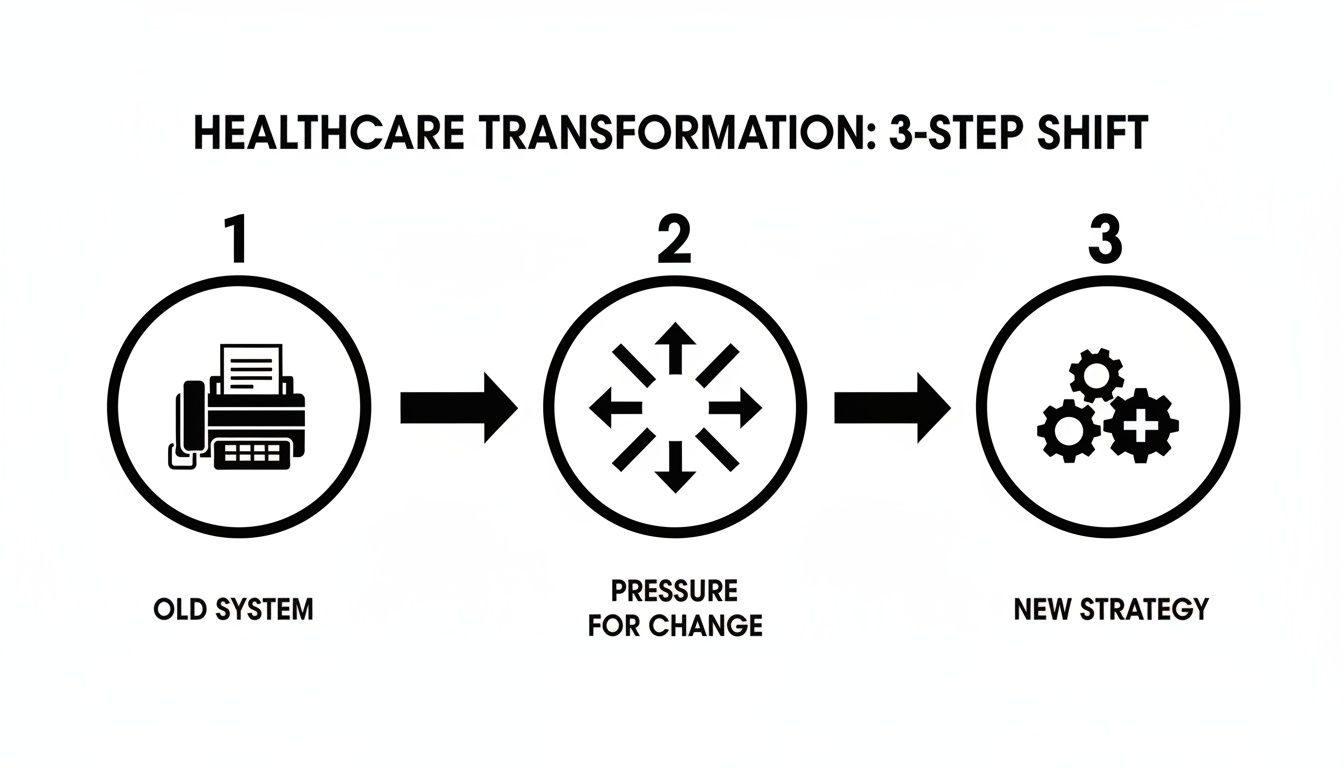
This diagram really gets to the heart of it. External pressures and internal breakdowns force a move away from legacy systems. To survive and grow, you have to adopt a structured, tech-forward strategy.
Once you've got a list of potential projects, you have to decide what to tackle first. Not all opportunities are created equal. A simple portal update might be an easy win, but will it have the same game-changing impact as an AI tool that helps slash diagnostic errors? You need a structured way to weigh each initiative to make smart decisions.
A prioritization matrix is perfect for this. It’s a simple but powerful tool that helps you score potential projects against what really matters to the business, ensuring you put your money and people where they’ll make the biggest difference.
Here are the kinds of criteria you should be evaluating each initiative against:
This methodical approach stops you from getting distracted by low-impact "quick wins" and keeps the focus on advancements that truly move the needle.
Real-World Scenario: A hospital is weighing two projects: a cosmetic update to its patient portal versus implementing an AI-powered diagnostic tool for radiologists. The portal update is straightforward, but the AI tool scores off the charts on clinical impact and long-term ROI by helping spot early-stage cancers. The matrix makes the strategic choice obvious.
With this framework in place, you can build a roadmap that's both ambitious and actually achievable. The goal is to sequence your projects to deliver tangible value fast. This proves the concept, silences the skeptics, and builds the buy-in you need from key stakeholders.
This is exactly where a well-defined strategy can be a game-changer, offering targeted solutions for your most pressing challenges. Instead of grabbing off-the-shelf software, you can pinpoint the exact features that will solve your unique problems—whether that’s automating prior authorizations or finally optimizing operating room schedules.
Your healthcare digital transformation strategy can't just be a document that gathers dust. It needs to be a living, practical blueprint for success.
Artificial intelligence isn't some far-off concept for healthcare anymore; it’s the engine powering the most significant advancements happening today. When we talk about placing AI at the center of your healthcare digital transformation strategy, we’re not just talking about software updates. We’re talking about fundamentally rethinking how care is delivered—using smart technology to make everything from clinical diagnoses to back-office tasks faster, more accurate, and deeply interconnected.
AI, particularly generative AI, is changing the game on both sides of the healthcare coin. Administratively, it's about crushing the repetitive work that drains your staff's time, like sifting through billing codes or juggling appointment schedules. On the clinical side, it’s about giving doctors and nurses intelligent tools that serve up evidence-based insights right when they need them, helping them make quicker, more confident decisions at the point of care.
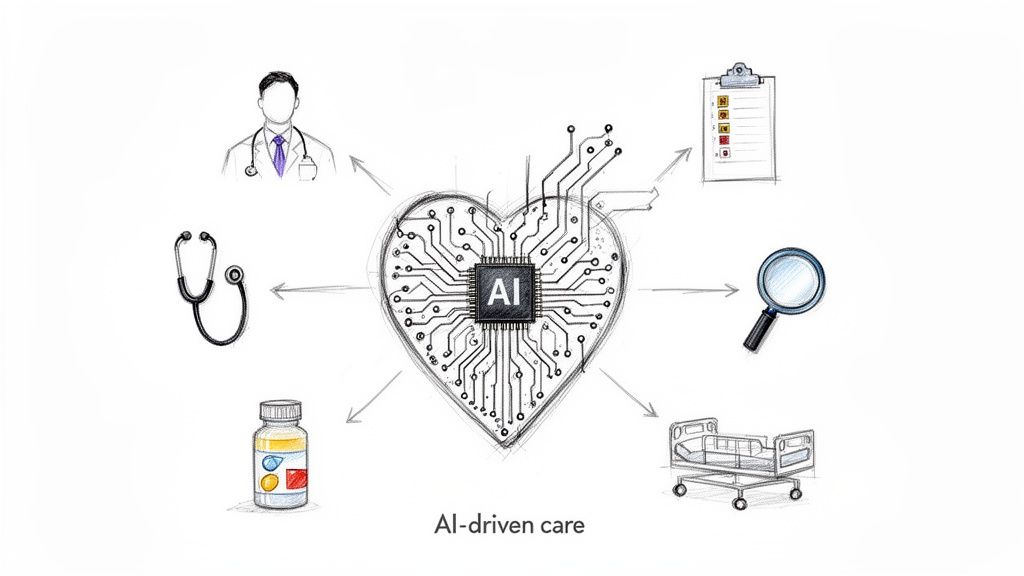
This shift is more than just an upgrade; it's a necessary evolution. AI is now a core component of healthcare's digital future, and generative AI is proving to be an especially powerful force. I've seen organizations move from simply automating isolated tasks to integrating AI across their entire ecosystem. The potential impact is staggering, with some projections showing up to a 40% improvement in healthcare outcomes from these kinds of interventions. And it's not just about patient care—AI is reshaping everything from how clinical trials are run to the way regulatory submissions are handled in pharma.
The real magic of AI in healthcare happens when it connects disconnected processes and begins to orchestrate the entire patient journey. It’s no longer about using a single tool to fix a single problem. It's about building an intelligent, interconnected web that supports both patients and clinicians at every single touchpoint.
Just look at what’s already happening out in the field:
Key Insight: Let's be clear: the goal isn't to replace clinicians. It's to augment their expertise. AI does the heavy lifting with data, freeing up your human experts to focus on what they do best: complex decision-making, patient communication, and delivering compassionate care.
Bringing AI into your organization doesn't have to be a massive, intimidating overhaul. The key is to start small by targeting specific, high-value problems and building momentum from there. The first step is to demystify the technology and show its practical power in solving real-world challenges. For healthcare leaders putting AI front and center, understanding how AI-powered software development can speed up the delivery of these new tools is a critical piece of the puzzle.
This is exactly where a model like AI Automation as a Service proves its worth. It gives you access to sophisticated AI capabilities without having to build a massive in-house data science team from the ground up. By zeroing in on practical applications that deliver immediate value—whether that’s reducing medical errors or fine-tuning supply chains—you start building the foundation for a smarter, more patient-centric system.
Your digital transformation strategy is only as good as the technology it runs on. You can have the most brilliant AI initiatives planned, but they will fall flat without a modern, scalable, and secure architecture underneath. The real goal here is to build a tech and data ecosystem that doesn't just solve today's problems but is flexible enough to handle whatever comes next.
One of the biggest hurdles I see holding health systems back is the mess of data silos. Over decades, we've bolted on countless systems—EMRs, lab software, billing platforms, and now data from wearables. This has created a fragmented nightmare where critical information is locked away, making it impossible to see a full patient journey or get any real value from analytics and AI solutions.
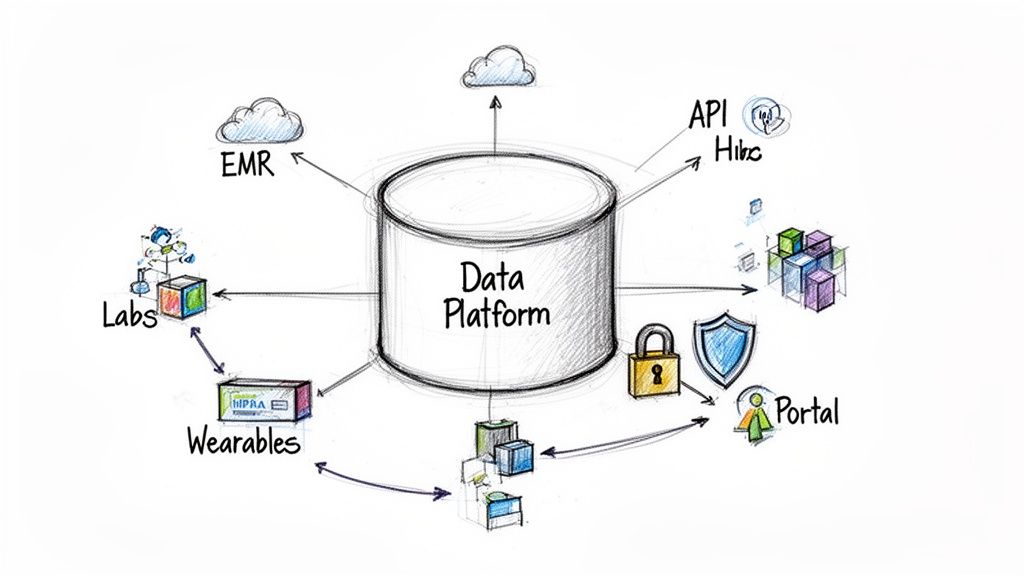
The only way forward is to create a unified data platform. Think of it as the central hub, the single source of truth that pulls all those different data streams together. This unified view is the absolute bedrock for the powerful analytics and AI applications you want to build.
You don’t want to build something that becomes another legacy headache in five years. To avoid that, you have to bake modern architectural principles into the very foundation of your strategy.
A well-designed, API-first architecture turns your health system from a closed-off fortress into an open platform for innovation. It's how you future-proof your technology investments, period.
For some, this means building from the ground up with custom healthcare software development. For others who need to move faster, an AI Automation as a Service partner can bring the right infrastructure and expertise to the table quickly.
A key decision is how you'll structure your data platform. The two main schools of thought are centralized (like a data warehouse) and decentralized (like a data mesh). Each has its trade-offs, and the right choice depends entirely on your organization's scale, culture, and long-term goals.
Here’s a quick rundown to help you weigh the options:
| Architecture Model | Pros | Cons | Best For |
|---|---|---|---|
| Centralized (e.g., Data Warehouse) | High data consistency; Simplified governance; Stronger security controls | Can create bottlenecks; Slower to adapt to new data sources; Can be complex to scale | Organizations with standardized data needs and a strong central IT team that can manage a single source of truth. |
| Decentralized (e.g., Data Mesh) | Highly scalable; Greater team autonomy and speed; Fosters domain-specific expertise | More complex governance; Potential for data duplication; Requires a significant cultural shift | Large, complex organizations with diverse data domains where agility and team ownership are critical for innovation. |
Ultimately, there's no single "right" answer. A centralized model offers control, which can be ideal for smaller systems or those just starting to unify their data. A decentralized mesh, on the other hand, provides the agility large, innovative systems need to move fast.
In healthcare, we’re not just dealing with data; we’re stewards of highly sensitive, personal, and regulated information. Robust governance and security can't be an afterthought—they have to be designed in from day one. It’s foundational to earning patient trust and staying compliant.
Your governance framework needs to have ironclad policies for:
A strong governance policy is the rulebook that keeps everyone safe and ensures your data is a reliable asset. We bake this thinking directly into our AI Product Development Workflow so that compliance is a given, not a scramble at the end.
Let's be honest: the most brilliant technology in the world is useless if your people don't use it. You can have a state-of-the-art AI platform and a perfectly designed data architecture, but if your clinicians and staff see it as just another hurdle, it will fail. This is the part of the journey where change management becomes your most important tool—it’s all about the people.
Real transformation doesn't happen when technology is forced upon a team. It happens when they feel it's a tool that works for them, not something being done to them. To get to that point, you have to earn genuine buy-in. That starts with a vision that answers the one question everyone is thinking: "What's in this for me?"
A vision statement filled with buzzwords about ROI and operational efficiency isn't going to inspire the nurse on the night shift. Your messaging has to connect directly to the realities of their work and their core mission of caring for patients. The entire goal is to show them, in no uncertain terms, how these new tools will make their lives better.
Frame the changes around benefits they'll feel personally:
When the "why" is crystal clear, you'll find that resistance starts to fade. People are far more willing to climb a learning curve when they believe it leads to a less frustrating, more fulfilling workday. This is something we focus on heavily in our AI strategy consulting—making sure the technology serves the human from day one.
Once you've shared the vision, you can't just go silent. You need a rock-solid, transparent communication plan to keep everyone in the loop. Nobody likes surprises, especially when their job is on the line. Consistent updates, town halls, and open Q&A sessions build trust and stop the rumor mill from churning.
Training is just as crucial, and I don't mean a one-off webinar. Effective training builds confidence, not just competence. A program that actually works needs to be:
My Two Cents: Don't confuse "implementation" with "adoption." Implementation is just flipping the switch. Adoption is when the new technology becomes so ingrained in the daily workflow that your team can't imagine going back. You only get there by putting people first.
One of the most effective things you can do is find your internal "digital champions." These are the people on the front lines who are naturally curious about technology and respected by their peers. They aren't just power users; they're the informal leaders everyone turns to for advice.
Give these champions a seat at the table. Involve them in the AI requirements analysis and beta testing. Equip them with the knowledge to answer questions, calm fears, and share early wins. A simple "Hey, this new tool just saved me 20 minutes" from a trusted colleague is worth more than a dozen emails from management.
This approach turns pockets of resistance into a groundswell of support. It ensures your new tools aren't just installed, but woven into the very fabric of how your organization operates. Navigating this human element is what our expert team does best, because we know that true success is always a partnership between great people and great technology.
To keep the C-suite bought in and the funding flowing for your healthcare digital transformation strategy, you have to prove it’s working. And I don’t mean with vanity metrics. We're talking about showing clear, undeniable value through key performance indicators (KPIs) that map directly to better clinical, operational, and financial results. This isn't just a box you check at the end of a project; it's how you continuously validate the investment and make smarter decisions down the road.
The entire goal is to draw a straight line from every digital initiative to a tangible outcome. Don't just report on system uptime. Instead, show how your new tools are cutting patient readmission rates, boosting diagnostic accuracy with better AI tools for business, or shaving minutes off the average patient wait time. These are the numbers that make executives sit up and listen because they represent real-world impact.
You need a balanced view. If you only focus on financial returns, you'll miss the bigger picture of clinical quality and patient satisfaction. A balanced scorecard approach is perfect for this, giving you a holistic look at how your strategy is performing across the board.
Your scorecard should be a mix of metrics like these:
This comprehensive view is what tells the full, compelling story of your transformation.
The best healthcare organizations don't just use data to track what happened—they use it to constantly refine what they do next. Look at a leader like Novant Health. They achieved a Level 9 out of 10 in the 2025 Digital Health Most Wired Survey, putting them in the top 1% of 50,000 healthcare organizations globally. That's not just a fancy award; it's a reflection of their proven excellence in clinical quality, analytics, patient engagement, and innovation. You can read more about their healthcare technology leadership on NovantHealth.org.
This kind of achievement isn't an accident. It’s proof that a well-designed and flawlessly executed strategy delivers validated, impressive outcomes that benefit both patients and the clinicians who care for them.
Getting this right requires a clear plan and the right expertise. By defining the right KPIs from the get-go and consistently measuring your progress against them, you can build an airtight case for the ROI of your digital initiatives. This data-driven approach doesn't just justify past investments; it builds the confidence you need to secure resources for the next wave of innovation. Let our expert team help you build a strategy that delivers results you can measure.
It’s tempting to try and fix everything at once, but that's a recipe for disaster. The smartest move is to find the most acute pain point in your organization and start there. Look at your existing clinical or administrative workflows—where are the biggest bottlenecks?
Maybe it's the patient intake process, which is notoriously manual, or perhaps it's the revenue cycle management, where delays directly hit your bottom line. Pick one high-impact area where technology can deliver a clear, measurable win. This gives you a quick victory that builds momentum and gets people on board for bigger changes down the road. A thorough AI requirements analysis can really help you zero in on that perfect first project.
This is the million-dollar question, isn't it? The key is to stop pushing technology on them and start pulling them into the process. Adoption lives and dies by clinician involvement.
Bring them into the conversation from day one. Let them help choose and design the tools. If a new system doesn't solve a real problem they face every day—like cutting down on charting time or giving them faster access to patient histories—they simply won't use it. You have to frame the benefits in their language: less admin work, better information, and ultimately, better outcomes for their patients. When you co-create the solution with them, as we explored in our AI adoption guide, you turn your biggest skeptics into your most powerful advocates.
Thinking of it as just an IT project. That’s the classic pitfall.
A successful digital transformation is a fundamental business strategy, not a tech upgrade. It requires rock-solid leadership, a compelling vision that everyone understands, and a relentless focus on managing the human side of change. If you don't address the ingrained habits, fears, and daily workflows of your staff, you can have the best technology in the world, and it will still fall flat. It’s this kind of strategic blind spot that our AI strategy consulting is specifically designed to help organizations avoid.
Absolutely, and that’s one of its biggest advantages. AI is incredibly versatile. It can streamline back-office headaches like billing and coding just as effectively as it can provide clinical decision support at the bedside. A truly effective strategy tackles both sides of the house to maximize efficiency and elevate care quality across the entire organization.
It's about more than just cost savings. A true ROI calculation quantifies the "soft" benefits, too. Think about the long-term cost reduction from improved patient outcomes, the value of increased staff productivity, and the financial impact of higher patient retention. A solid analysis puts a dollar value on all of it, showcasing the comprehensive value of real-world use cases.
Ready to build a future-proof healthcare strategy? Ekipa AI delivers a Custom AI Strategy report in 24 hours, turning your transformation goals into a clear, actionable roadmap. Our approach is backed by our expert team dedicated to navigating the complexities of healthcare innovation.
How to build HIPAA-compliant AI: when LLM providers need a BAA, data minimization, de-identification, audit controls and a reference architecture.
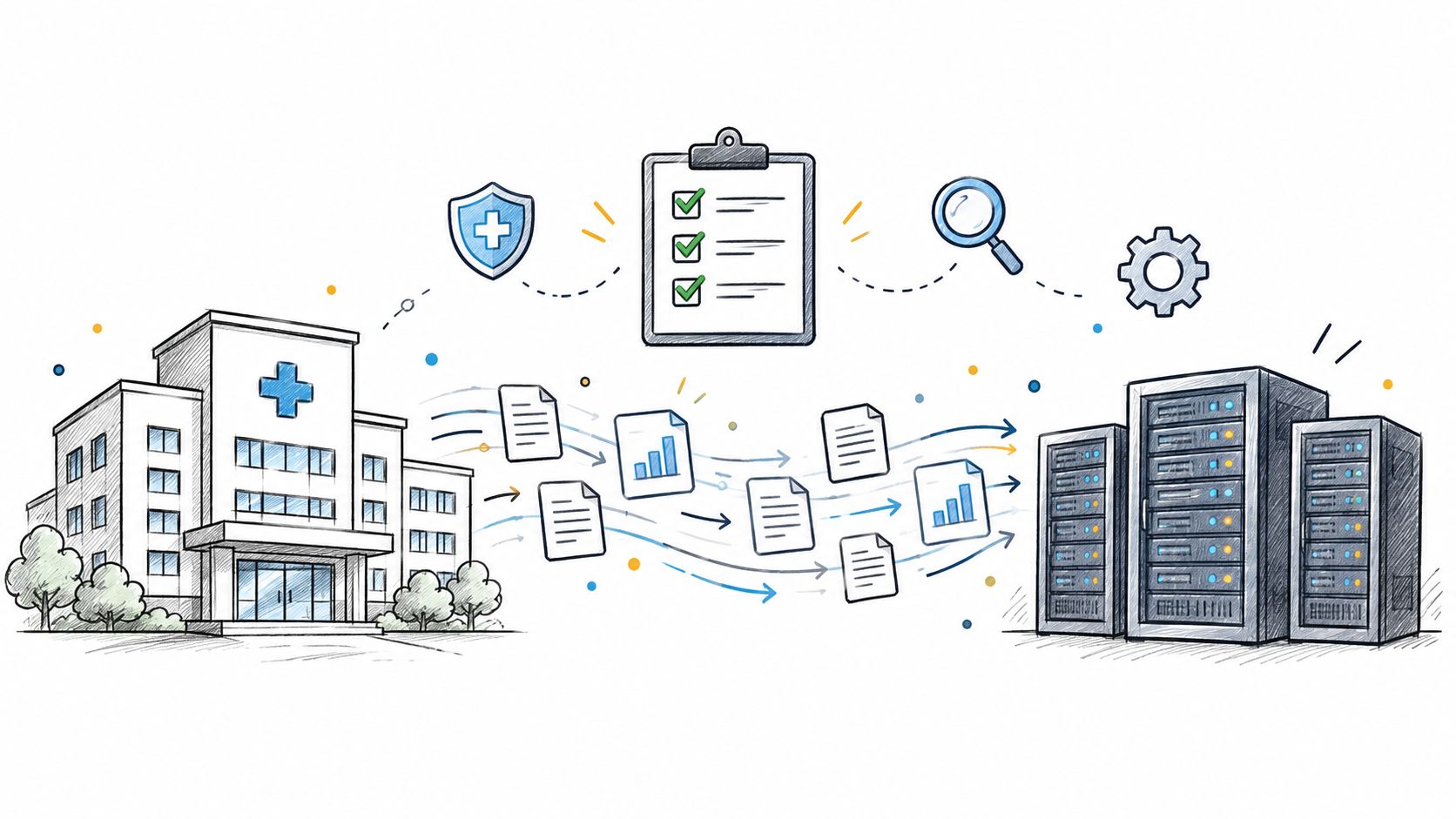
Practical data migration planning guide for healthcare teams. Scope, mapping, compliance, validation, cutover and rollback decisions explained end to end.

Smart on FHIR guide for healthtech engineers. Learn the OAuth 2.0 launch model, scope syntax, backend services, and US regulatory requirements.
Connect with our team to explore how AI expertise can transform your business.