AI in Healthcare
HIPAA-Compliant AI: How to Use LLMs With PHI Safely
How to build HIPAA-compliant AI: when LLM providers need a BAA, data minimization, de-identification, audit controls and a reference architecture.
October 16, 2026Read more
Explore Med Palm 2, a foundational AI model for healthcare. Learn its capabilities, safety benchmarks, and strategic impact for enterprise AI.

Let's clarify one point immediately: Med-PaLM 2 is not off-the-shelf software you can install and run. It is a highly specialized, medically tuned reasoning engine developed by Google. Think of it as an infrastructure-level capability: a powerful foundational layer designed to support clinical experts, not replace them.
For healthcare leaders and strategists, this distinction is critical. The true potential of Med-PaLM 2 lies in its integration into existing clinical workflows and systems. The objective is to build custom AI solutions that tackle your specific challenges, whether that is reducing administrative overhead or helping to identify diagnostic indicators earlier.
Success is not measured by the model's impressive benchmarks alone. It requires a strategic approach from the outset, prioritizing clinical safety, seamless system integration, and robust governance. Our AI strategy consulting services are designed to establish this foundation.
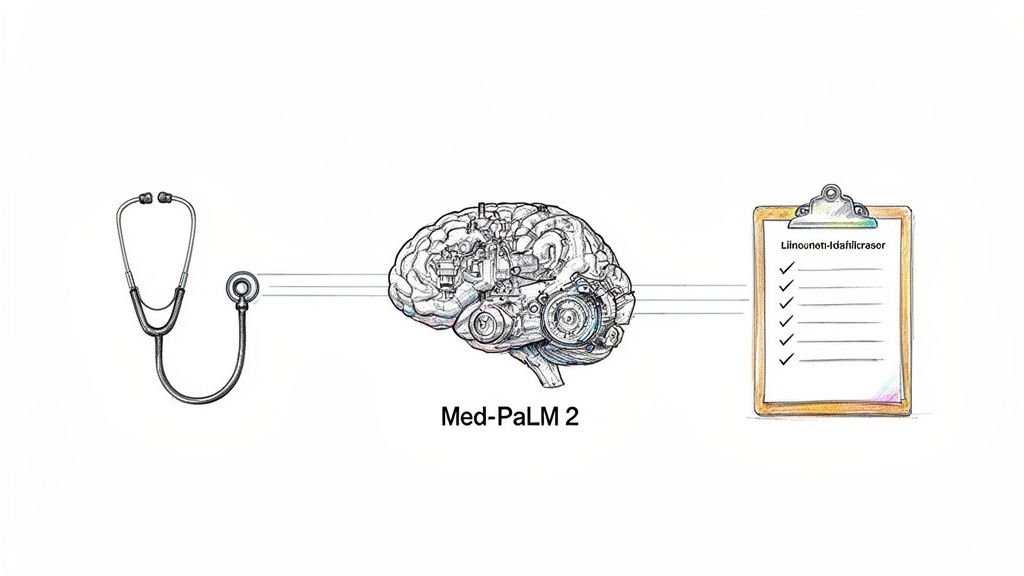
To make this tangible, let's break down its core attributes. The following table frames Med-PaLM 2 as an infrastructure-level capability, providing a clear summary for strategic planning.
| Attribute | Description for Strategists |
|---|---|
| Model Type | Foundational, medically-tuned LLM |
| Core Function | Advanced clinical reasoning and data synthesis |
| Deployment Model | Integration via APIs into existing clinical systems and workflows |
| Primary Goal | Augment human expertise, not replace it |
| Implementation | Requires custom development and a clear governance framework |
This table helps shift the conversation from a generic "what does AI do?" to a much more focused "what can we build with this specific capability?"
The credibility of a medical AI rests on the depth of its knowledge and the quality of its reasoning. This is where Med-PaLM 2 stands out from more general-purpose AI models.
At Google's 2023 Check Up event, it scored 86.5% accuracy on a set of USMLE-style questions. This represented a significant leap: a full 19% improvement over its predecessor, and the first time an AI model performed at this "expert" level.
This is more than a number for a research paper. For leaders shaping their Healthcare AI Services strategy, it signals a new phase of technical possibility.
By framing Med-PaLM 2 as a core component, organizations can move beyond hype and focus on building targeted, effective, and safe AI tools. The conversation shifts from "what can this AI do?" to "what can we build with this capability?"
This strategic mindset is crucial. It directs focus away from a single piece of technology and toward a broader vision for how advanced AI can be safely and effectively embedded in the healthcare ecosystem. Understanding this foundational layer is the first step toward building intelligent internal tooling and patient-facing applications. With that in mind, let's explore some practical use cases.
Med-PaLM 2 is not a general-purpose AI with a medical vocabulary. It was engineered to handle the specific, high-stakes reasoning required in clinical settings. Consider it less a finished product and more a powerful engine for medical analysis and synthesis, ready to drive a new class of intelligent healthcare tools.
For any leader in this space, understanding what this engine actually does is the first step to identifying where it can create tangible value in your organization. It’s about moving past hype to see practical functions.
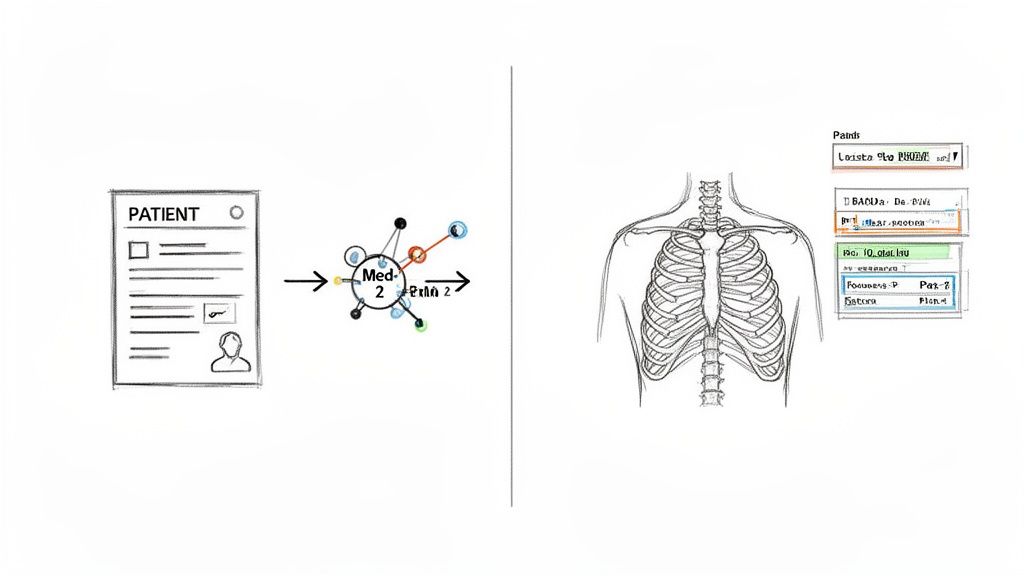
One of the most immediate and powerful functions of Med-PaLM 2 is its ability to process the massive amounts of unstructured data that define modern healthcare—from sprawling clinical notes and dense lab reports to long discharge summaries. The model can parse, synthesize, and extract the most important information, reorganizing it into a clean, coherent format.
For example, it can take a dense, multi-page patient history and, in seconds, produce a concise summary listing key diagnoses, current medications, and known allergies. This capability alone can significantly reduce administrative drag and make patient handoffs safer and more efficient.
Beyond simple summarization, Med-PaLM 2 excels at advanced question answering. This is not a simple search function. It can take a complex clinical question like, "What are the differential diagnoses for a patient presenting with these specific symptoms and lab values?", and synthesize an answer by drawing from multiple sources in its knowledge base, grounding its response in established medical literature.
A key capability of Med-PaLM 2 is its ability to synthesize information from disparate formats—text, charts, and even medical images—to form a single, unified clinical picture. This is a significant step forward for any clinical decision support tool.
Perhaps its most notable capability is its multimodality: the power to interpret and reason across different types of data simultaneously. This is where Med-PaLM 2 begins to function as a true clinical support tool, as it can analyze a text-based query alongside medical imagery.
This unlocks powerful applications for clinical decision support. For instance:
Smarter Radiology Workflows: An application could analyze a chest X-ray and the radiologist’s written report simultaneously, flagging potential discrepancies or suggesting follow-up actions based on the combined data.
Dermatology Triage: A system could review a photo of a skin lesion while also considering the patient’s documented medical history, helping to prioritize which cases need urgent specialist review.
Nuanced Pathology Analysis: The model could process a digital slide of a tissue sample and cross-reference its findings with genomic data and the patient's clinical notes to help identify complex disease patterns.
Putting these capabilities to work is not as simple as just plugging the model in. The quality of the output is directly tied to the quality of the input. To truly get the most out of Med-PaLM 2, it's critical to frame queries effectively.
High scores on standardized tests are impressive, but for healthcare leaders, the only metric that truly matters is the one that leads to better, safer patient outcomes. When evaluating a foundational model like Med-PaLM 2, it is essential to look past the percentages and understand what they mean in a real-world clinical context.
The model’s performance on medical exams is a useful starting point. Scoring between 85.4% and 86.5% on USMLE-style questions is a significant milestone. This demonstrates a massive, validated knowledge base that can serve as a solid foundation for clinical tools. That performance represents an 18-19% jump over previous models and made Med-PaLM 2 the first AI to pass challenging international exams like India's MedMCQA.
A high exam score does not mean an AI is ready for patient interaction. Google developed a robust evaluation framework that goes much deeper, checking the model’s answers against criteria that directly impact patient care. This gives leaders a practical way to gauge if this technology is ready for operational deployment.
Key areas of focus include:
Alignment with Scientific Consensus: Is the model's advice in line with current, accepted medical knowledge, or does it deviate into unproven theories?
Precision and Accuracy: Are the facts correct? This means double-checking everything from drug dosages to diagnostic steps for even the smallest errors.
Potential for Harm: The framework actively looks for any response that could lead to poor medical advice, a delay in treatment, or any other negative outcome for a patient.
This type of structured evaluation is crucial for making large language models safe for healthcare. It shifts the conversation from "what can it do?" to "how can we trust it?" For any organization looking to build its own AI tools, establishing similar validation processes is an absolute necessity. That is where platforms like our own VeriFAI come in, helping to build those critical safety guardrails from the ground up.
To understand how a model like Med-PaLM 2 is vetted, it helps to break down the evaluation criteria. The table below summarizes the key dimensions used to assess its outputs, giving leaders a clear view of what "safe and effective" looks like in this context.
| Evaluation Axis | Description | Strategic Implication |
|---|---|---|
| Alignment with Consensus | Measures if the model's answers align with established medical guidelines and scientific evidence. | Ensures AI-driven recommendations are grounded in proven science, not experimental or fringe theories, building clinical trust. |
| Accuracy and Precision | Assesses the factual correctness of the information, checking for errors in data, figures, or procedural details. | Directly impacts patient safety by minimizing the risk of errors in dosages, diagnoses, or treatment plans. |
| Completeness | Evaluates whether the model provides a comprehensive answer, covering all relevant aspects of a clinical query. | Prevents critical omissions that could lead to incomplete or flawed clinical decision-making. |
| Likelihood of Harm | Actively screens for any information that could lead to negative health outcomes, from incorrect advice to delayed care. | This is the ultimate safety check, prioritizing the "do no harm" principle above all other performance metrics. |
| Bias and Fairness | Examines responses for embedded biases related to demographics like race, gender, or socioeconomic status. | Mitigates the risk of perpetuating health inequities, ensuring the AI provides fair and equitable support for all patient populations. |
This multi-faceted approach moves beyond simple right-or-wrong scoring. It provides a holistic view of the model's behavior, which is essential for any organization planning a serious, responsible deployment in a clinical setting.
No AI model is perfect, and a sound strategy must account for Med-PaLM 2's inherent limitations. Two significant risks demand constant attention and planning:
Information Inaccuracy ('Hallucinations'): Like other LLMs, Med-PaLM 2 can sometimes generate information that sounds plausible but is factually incorrect. This risk makes it absolutely clear: a qualified human clinician must always be in the loop to verify every output before it impacts patient care.
Embedded Data Bias: The model learns from decades of medical literature and clinical notes. If those source documents contain biases related to race, gender, or income, the model can learn and even amplify them.
These are not reasons to abandon the technology; they are design constraints that must be managed. A successful AI strategy does not pretend the model is flawless. Instead, it builds strong governance, continuous monitoring, and mandatory human oversight into the workflow to mitigate these risks from day one.
Ultimately, performance benchmarks are just one piece of the puzzle. They show that the model has the foundational knowledge, but real clinical value comes when that knowledge is applied within a system designed for safety, accountability, and constant human validation. This balanced perspective helps leaders see both the potential and the necessary safeguards.
We've seen the impressive benchmarks, but what does a model like Med-PaLM 2 actually do? Its real value is not in a lab score but in solving the persistent, costly problems that affect healthcare operations. Think of it less as a new tool and more as a foundational capability, like adding a new wing to a hospital. It is the infrastructure that enables a new class of solutions.
The key is to move past hype and focus on specifics. This is not about buying a one-size-fits-all product. It's about building targeted solutions that augment existing workflows and, most importantly, your people. The goal is to enhance the skills of clinical and administrative teams, not replace them. Success starts with pinpointing specific areas of friction where smarter data synthesis and clinical reasoning can deliver a clear return.
Let's start with a common pain point: the administrative work that contributes to clinician burnout. Physicians spend a significant portion of their day on data entry rather than patient interaction. This is where Med-PaLM 2's core technology can make an immediate, tangible difference.
Imagine a system that listens to a patient visit and, in real-time, generates a structured, accurate clinical note. This is more than simple transcription. The model is capable of extracting key clinical details—symptoms, diagnoses, medications, next steps—and organizing them into the appropriate sections of an EHR.
What it fixes: Slashes the time clinicians spend on manual data entry, freeing up time for patient care.
The payoff: Increased physician productivity, better job satisfaction, and more accurate, timely records for billing and care continuity.
Prior authorizations are a notorious bottleneck, delaying patient care and creating significant paperwork for staff. The process often involves manually searching a patient’s chart to find the specific clinical evidence a payer requires. This is an ideal task for an advanced language model.
An intelligent system can be built to instantly scan a patient's entire medical record—notes, lab results, and more, and compile a concise summary that directly addresses the payer's questions. This turns a slow, human-powered task into a fast, automated workflow.
The key here is the model's ability to comprehend and summarize complex medical narratives. It acts as an assistant, finding and packaging the justification for a procedure or medication in a fraction of the time it would take a person.
This is not just theoretical. The model has demonstrated its ability to interpret clinical data with high accuracy. In a blind test with 246 retrospective chest X-rays, clinicians preferred the reports generated by Med-PaLM 2 over those written by radiologists 40.5% of the time. That finding, which you can discover in the full research about its clinical edge, shows its capability in producing high-quality, clinically useful summaries.
Medical research is often slowed by the painstaking process of finding eligible patients for clinical trials. The eligibility criteria can be incredibly complex, with dozens of specific rules that must be checked against each patient's history.
An application built on this technology can sift through thousands of patient records in seconds. It can process unstructured notes, structured lab data, and billing codes to create a short list of potential candidates for trial coordinators to review, dramatically accelerating the pace of research.
A significant number of medical errors occur due to communication breakdowns during shift changes. A clear, concise, and relevant summary of a patient's current status is vital for safe handoffs. AI can assist here as well.
A smart tool can analyze a patient's chart and recent activity to generate a focused summary for the incoming nurse or doctor. It can highlight critical changes, flag pending tests, and point out key care priorities, reducing the risk that important information is missed during a hectic shift change. To see how this works in a real-world context, explore our HCP Engagement Co-pilot, which applies similar principles to support healthcare professionals.
Each of these real-world use cases demonstrates the proper way to approach this technology—applying powerful AI to solve a specific, high-value problem without expecting a universal solution.
Bringing a powerful model like Med-PaLM 2 into a live clinical environment requires more than a simple API call. For CTOs, product owners, and tech teams, the real challenge is integrating this advanced capability into existing, often complex, healthcare ecosystems—without disrupting patient care or compromising data security. It demands a thoughtful, strategy-first approach.
Med-PaLM 2 is available through Google Cloud's Vertex AI platform as part of the MedLM family, but that is just the starting point. To implement it correctly, you must treat it as a foundational piece of infrastructure, not a pre-packaged app. The heavy lifting is in closing the gap between the model's capabilities and your organization's specific operational needs.
Getting there means navigating critical technical and regulatory requirements. You will need robust API management to govern access and monitor usage. Ironclad data security is non-negotiable. As you map out your integration plan, ensuring GDPR compliant AI integration is essential, alongside rigid adherence to HIPAA standards to safeguard sensitive patient data.
Jumping straight to a full-scale rollout is a recipe for failure. The path to enterprise-wide adoption must begin with small, focused pilot projects. These serve as your proving ground—a controlled space to confirm clinical value, identify workflow friction, and spot potential risks before they escalate.
A pragmatic, phased approach typically looks like this:
Pinpoint the Right Use Case: Don't try to solve every problem at once. Start with a high-impact, low-risk workflow. Summarizing clinical documentation is a popular first step because it delivers clear efficiency gains with less immediate risk than diagnostic assistance.
Scope the Pilot Project: Define success in concrete terms. Are you aiming for a 20% reduction in documentation time? Or a measurable improvement in the quality of patient handoff notes?
Validate Rigorously: Before any clinician uses the tool, its output must be thoroughly checked by human experts. This "human-in-the-loop" oversight is not just a temporary step for the pilot; it is a permanent fixture of responsible AI deployment in healthcare.
This diagram illustrates how Med-PaLM 2 can fit into common workflows, from administrative tasks to research.
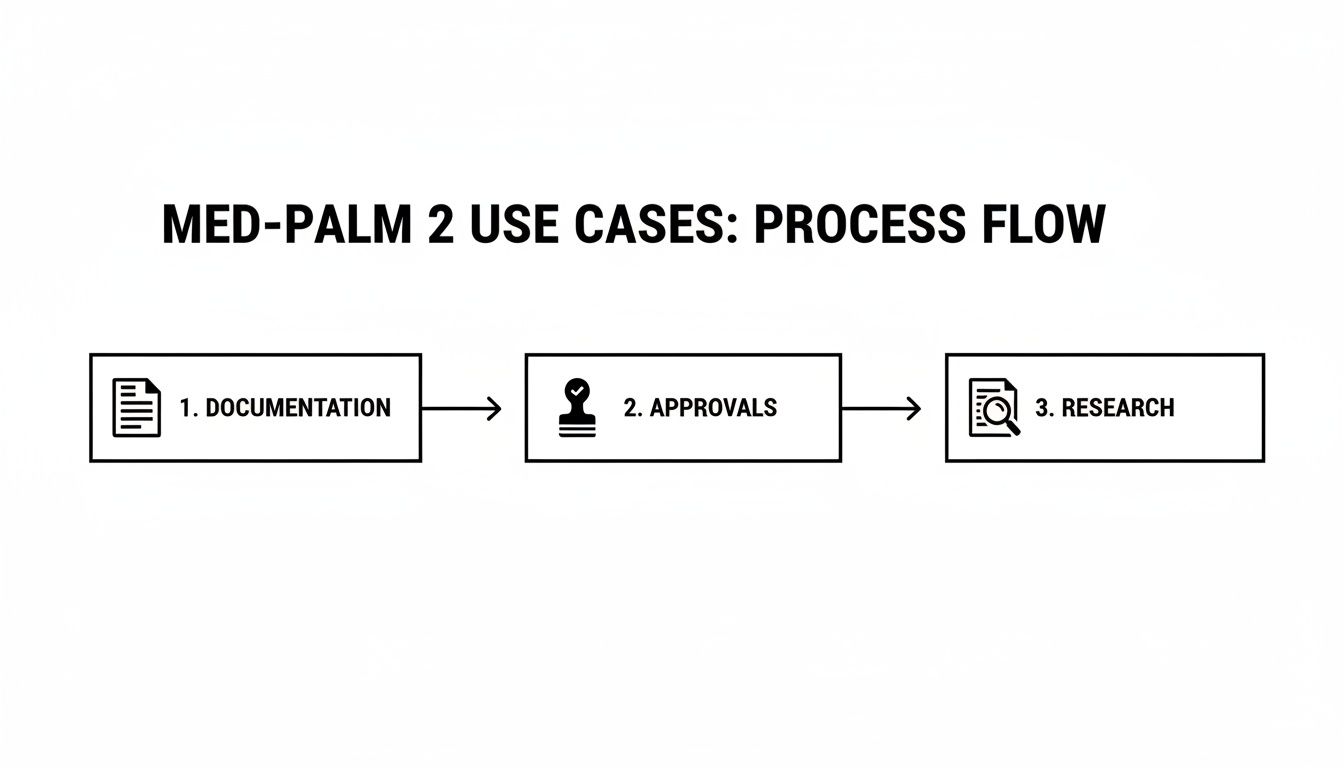
As the visual lays out, the model's abilities can be layered to first streamline administrative and research tasks, which in turn builds a solid foundation for more complex clinical applications down the line.
The biggest technical hurdle is almost always integration with existing systems, especially Electronic Health Records (EHRs). The goal is to enhance the tools clinicians already rely on, not force them to adopt something entirely new. This requires deep expertise in healthcare IT and a careful approach to user interface design, making sure new features feel like a natural part of the existing workflow.
The most sophisticated AI model will fail if it disrupts clinical flow or adds complexity for the end-user. The success of a Med-PaLM 2 integration is measured not by its technical elegance, but by its seamless adoption and tangible value to clinicians.
Alongside the technology, user training is vital. Clinicians and staff need to know how to use the new tools and, just as importantly, understand the model's limitations. Training must stress the importance of verifying AI-generated information and establish clear protocols for when and how to use the system safely.
Navigating these interconnected technical and human elements is precisely what our AI Product Development Workflow is designed to handle. It provides a structured path to turn a complex model into a reliable, user-friendly solution, helping you de-risk implementation and achieve real value faster.
Understanding what a model like Med-PaLM 2 can do is one thing; building a real-world strategy around it is another. For healthcare leaders, this is where theory must meet the hard realities of budgets, workflows, and patient care.
The biggest mistake is treating this technology like an off-the-shelf product. Instead, think of it as a powerful new engine. You still have to build the car around it: a car designed to solve your organization's specific problems. Waiting for a perfect, one-size-fits-all AI system is not a viable strategy. The prudent move is to start now, pick a high-value target, and build incrementally.
A winning game plan does not start with the technology. It starts with your most persistent problems. Instead of asking, "What can we do with Med-PaLM 2?" ask, "Where are our biggest clinical and administrative headaches?" Starting there allows you to pinpoint exactly where a sophisticated AI tool can deliver real value.
To get from idea to implementation, you need a structured game plan. A solid framework ensures your AI initiatives are tied to real operational needs and, most importantly, clinical safety.
Here’s a practical approach:
Identify High-Impact Challenges: First, find the specific bottlenecks. Is it physician burnout from paperwork? Diagnostic delays? Patient scheduling complexities? Pinpoint where better, faster information could create the most value.
Assess Tech and Data Readiness: Be honest about your current state. Evaluate your data governance, EHR system capabilities, and cloud infrastructure. You need to identify gaps before you can integrate an advanced model.
Assemble a Cross-Functional Team: This is non-negotiable. Involve clinical champions, IT specialists, data scientists, and compliance officers from day one. All these perspectives are needed to avoid building something that fails in practice.
Plan for Governance and Responsibility: Responsible AI, patient safety, and regulatory compliance cannot be afterthoughts. These principles must be integrated into your strategy from the very beginning.
Putting this framework into action requires a unique mix of deep healthcare domain knowledge and serious technical skill. Our AI strategy consulting services are designed for this exact challenge, guiding you from an initial AI requirements analysis to a custom roadmap.
Med-PaLM 2 and the MedLM models are catalysts, not cure-alls. Their true potential is unlocked only when thoughtfully integrated into a broader strategy that solves real-world healthcare problems safely and effectively.
Adopting this mindset is what separates a flashy pilot project from a program that delivers sustainable value. With the right plan and the right partner, you can turn knowledge into meaningful action. Connect with our expert team to start building a future where advanced AI tools for business truly support your goals for clinical excellence and operational efficiency.
For healthcare leaders and tech decision-makers, questions about what Med-PaLM 2 means for your organization are common. This section addresses the most frequent inquiries, covering everything from clinical roles and model access to the real-world challenges of implementation.
No. Med-PaLM 2 is designed as an advanced decision-support tool to augment clinician expertise, not replace it. Think of it as an incredibly capable assistant.
Its value lies in handling data-intensive tasks - synthesizing patient histories, summarizing complex information, and automating time-consuming administrative work. This frees up clinicians to focus on direct patient care, complex diagnoses, and the human aspects of medicine that algorithms cannot replicate. It is crucial to remember that any information generated by Med-PaLM 2 must be reviewed and validated by a qualified medical professional to ensure accuracy and patient safety.
Med-PaLM 2 is not a product you can buy and install. It is available to enterprise clients through Google Cloud's Vertex AI platform, where it is offered commercially under the name MedLM.
Access involves partnering with Google Cloud and implementation specialists to build custom, secure applications tailored to your specific needs. These applications connect to the model's API and are designed to integrate directly into your existing infrastructure, such as Electronic Health Records (EHRs), to improve specific clinical or administrative workflows. This tailored approach is at the core of services like custom healthcare software development.
When integrating a powerful model into a clinical setting, the primary risks fall into three categories: clinical safety, data privacy, and operational complexity. Like any large language model, it can occasionally generate incorrect information ("hallucinate"), which makes rigorous human oversight a non-negotiable requirement.
Protecting sensitive patient data and ensuring HIPAA compliance is the absolute top priority. Integrating any cloud-based AI requires a deep understanding of both healthcare regulations and the technical nuances of data security.
Finally, do not underestimate the operational lift. Integrating a foundational model into complex, often legacy, healthcare systems is a major undertaking. It demands a clear, phased roadmap—from small pilot projects to full-scale deployment—guided by a well-defined AI Product Development Workflow.
The distinction is simple: think of Med-PaLM 2 as the powerful research "engine" and MedLM as the commercial "product line" available for use.
Med-PaLM 2: This is the specific, highly advanced model from Google Research that gained attention for its performance on medical licensing exams.
MedLM: This is the commercial brand for the family of medically-tuned models that Google offers to healthcare organizations. These models are built on the same underlying technology as Med-PaLM 2 and are made available through the secure Vertex AI platform for building real-world applications.
So, when your organization builds an application, it uses the MedLM product family to access the capabilities first demonstrated by the Med-PaLM 2 research model.
Ready to move from theory to a concrete plan? The experts at Ekipa AI can turn advanced capabilities like Med-PaLM 2 into strategic assets. Get your Custom AI Strategy report to start building a smarter, more efficient healthcare future. For a deeper dive into how to choose the right projects, explore our guide on AI use case selection, as we explored in our AI adoption guide. To learn more about the minds behind our strategic approach, meet our expert team.
How to build HIPAA-compliant AI: when LLM providers need a BAA, data minimization, de-identification, audit controls and a reference architecture.
Practical data migration planning guide for healthcare teams. Scope, mapping, compliance, validation, cutover and rollback decisions explained end to end.
Smart on FHIR guide for healthtech engineers. Learn the OAuth 2.0 launch model, scope syntax, backend services, and US regulatory requirements.
Connect with our team to explore how AI expertise can transform your business.