AI Healthcare Consulting: A Guide to Transforming Patient Care
November 09, 202522 min read
ai healthcare consulting: practical implementation, real-world use cases, and tips for choosing the right partner to transform patient care.
What if you could virtually eliminate diagnostic errors? Or automate the endless administrative tasks that pull clinicians away from patients? This isn't a far-off dream. It's what's happening right now, thanks to AI healthcare consulting.
Think of it this way: AI is an incredibly powerful tool, but like any specialized instrument, you need an expert to wield it effectively. This guide explains how strategic AI partners act as that expert, translating complex technology into practical, life-saving applications.
The New Frontier of AI in Healthcare
Healthcare is standing at a crossroads. The pressure is on to deliver better patient outcomes while somehow getting a handle on skyrocketing costs. AI isn't just a buzzword anymore; for many, it's becoming a core part of the solution.
But here's the catch: successfully bringing AI into a hospital or clinic is a lot more complicated than just installing new software. It demands a real-world understanding of clinical workflows, patient data systems, and the maze of healthcare regulations. This is exactly why AI healthcare consulting has become so critical.
A good consultant is a navigator. They help healthcare organizations cut through the noise and find the best places to apply AI for maximum impact. They provide the strategic roadmap to get from an idea on a whiteboard to a tool that doctors and nurses use every day, ensuring that every dollar spent on tech actually pays off.
Why AI Consulting Matters Now
The push to adopt AI in healthcare is hitting a fever pitch, driven by both market momentum and sheer operational necessity. Yet, many organizations get stuck. An experienced consulting partner helps them break through the common barriers.
Finding the Quick Wins: They sift through dozens of potential projects to pinpoint the few AI applications that will deliver the biggest and fastest return on investment.
Navigating the Rules: Consultants are experts in the complex web of regulations like HIPAA, ensuring that any new system protects patient data and is fully compliant from the start.
Creating a Plan for Growth: They help build a sensible, phased plan that starts with a manageable pilot project and scales up successfully across the entire organization.
Filling the Expertise Gap: Most in-house IT teams don't have deep AI and machine learning experience. Consultants bring that specialized knowledge, dramatically speeding up the process.
The market numbers tell the story. Valued at roughly USD 14.92 billion in 2024, the global AI in healthcare market is expected to explode to USD 110.61 billion by 2030. That kind of growth sends a clear message: the industry sees AI as fundamental to the future of medicine.
For today's healthcare leaders, the question isn't if they should adopt AI, but how to do it smartly. A great consulting partner is the answer to 'how,' turning ambitious goals into real results.
By working with experts, organizations can deploy powerful AI solutions that sharpen diagnostics, cut down on paperwork, and ultimately, improve patient care. To see how this applies directly to your work, take a look at our specific insights on AI for the healthcare industry.
What AI Healthcare Consultants Really Do
So, what does an AI healthcare consultant actually do all day? It's a lot more than just talking tech. Think of them as the strategic architects for your entire AI journey, making sure every new tool or algorithm is firmly planted in the real world of clinical needs and operational realities.
Their job is to connect the dots between what sophisticated AI can do and the practical challenges you face in patient care and hospital administration. They take your goals—like cutting down patient wait times or making diagnoses more accurate—and turn them into a concrete, step-by-step technology plan.
This whole process kicks off with a deep dive. A good consultant doesn't show up with a one-size-fits-all solution. Instead, they embed themselves in your workflows to figure out where AI can have the biggest, most meaningful impact.
A consultant’s work typically breaks down into a few core services, each designed to build on the last and ensure a successful outcome.
Core AI Healthcare Consulting Services
Here's a closer look at the key services that form the backbone of a typical AI consulting engagement.
Service Area
Description
Key Outcome
Use-Case Discovery
In-depth analysis of clinical & operational workflows to find high-impact AI opportunities.
A prioritized list of projects with clear ROI and strategic alignment.
Clinical Impact Analysis
Evaluating how an AI solution will change day-to-day work for doctors, nurses, and staff.
A change management plan that promotes adoption and minimizes disruption.
Data Readiness Assessment
Auditing data sources (EHR, PACS, etc.) to check quality, accessibility, and structure.
A clear picture of data assets and a plan to address any gaps before development.
Regulatory & Privacy
Ensuring any proposed solution is compliant with HIPAA and other healthcare regulations.
A compliant, secure-by-design AI framework that protects patient data and trust.
Pilot-to-Scale Roadmap
Creating a detailed plan for a small-scale pilot and its eventual expansion.
A step-by-step blueprint for implementation, from initial proof-of-concept to enterprise-wide rollout.
These services provide a structured path from an initial idea to a fully integrated and valuable AI tool. Let's dig into a few of these key stages.
Uncovering High-Impact Opportunities
The first—and arguably most important—job is use-case discovery. Consultants sift through your clinical and operational processes to find the pain points that are perfect candidates for AI. This isn't about chasing shiny objects; it’s about identifying opportunities with the highest potential return on investment, as we explored in our AI adoption guide.
They'll ask the tough questions: Where are the biggest logjams in patient flow? Which administrative tasks are eating up valuable clinical time? Could an AI model screen lab results faster to flag anomalies for immediate review? This rigorous AI requirements analysis is what separates a successful project from a costly experiment.
This strategic groundwork is crucial. It stops organizations from pouring money into flashy tech that doesn't solve a real problem—a common pitfall we see all the time. The aim is to build a portfolio of AI projects that produce real, measurable improvements in efficiency, costs, and, most importantly, patient outcomes.
Building a Foundation of Data and Compliance
Once you've zeroed in on a high-value use case, the focus shifts to the two pillars of any healthcare AI project: data and regulations. An AI model is only as smart as the data it learns from, which makes a data readiness assessment an absolute must.
Consultants will audit your data sources, from EHRs to imaging archives, to gauge their quality, accessibility, and structure. They’ll figure out if your current data setup can even support an AI application and map out exactly what you need to do to fix any issues.
At the same time, they navigate the tricky legal landscape, especially HIPAA. Every single solution must be built on a foundation of total compliance and patient trust. This proactive approach to security is a central part of how we turn our AI strategy consulting into secure, real-world results.
An experienced AI healthcare consultant ensures that compliance isn’t an afterthought but a core design principle from day one, preventing costly regulatory missteps down the road.
Creating the Implementation Roadmap
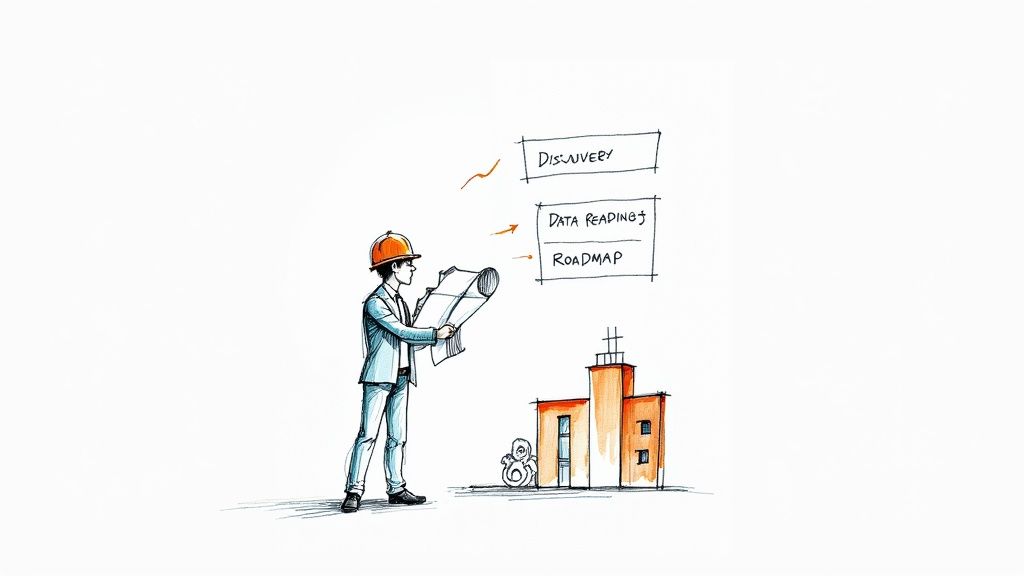
With a clear goal and a solid data foundation, the final piece of the puzzle is the implementation roadmap. This is the master plan that guides the entire project, from a small-scale pilot to a full-blown, system-wide rollout.
A key part of this is often a Custom AI Strategy report, which lays out everything from technology choices to change management. This document becomes your blueprint, detailing things like:
Pilot Project Design: Scoping out a small, manageable first project to prove the concept and show value fast.
Technology Stack: Recommending the right AI tools for business and platforms for your specific needs.
Integration Plan: A strategy to make sure the new AI solution plugs seamlessly into your existing systems, such as internal tooling.
Scaling Strategy: A phased plan for expanding the solution across other departments or facilities once it's proven successful.
This structured process, much like our own AI Product Development Workflow, takes the guesswork out of adopting AI. It gives you a clear, step-by-step guide that gets everyone on the same page, manages expectations, and dramatically increases the odds of a successful deployment.
All the theory and potential in the world don't mean much until a technology proves itself in the field. And that's exactly what's happening with AI in healthcare right now. This isn't some far-off concept anymore; it's a practical tool delivering real, measurable results every single day.
From the diagnostic lab all the way to the front office, AI is being put to work to improve patient outcomes, make operations run smoother, and, perhaps surprisingly, bring back more of the human side of medicine.
The applications are incredibly diverse, but they all circle back to one core idea: using smart automation to solve the stubborn problems that have plagued healthcare for decades. By sifting through massive amounts of data faster and more accurately than any human ever could, AI is creating tangible value at every step of the patient journey. You can explore a variety of real-world use cases to see this in action.
Boosting Diagnostic Accuracy and Speed
Medical imaging is where AI is really flexing its muscles. Think about it: machine learning algorithms can be trained on millions of scans, teaching them to spot subtle patterns that are often invisible to the human eye. This is a game-changer for early disease detection.
We're seeing AI models analyze mammograms, CT scans, and retinal images with incredible precision. In fact, some studies show AI can help improve breast cancer detection rates by as much as 20%. This isn't about replacing radiologists. It’s about giving them a powerful co-pilot, an extra set of eyes that helps them catch potential problems earlier and with a lot more confidence.
The real ROI here isn't just about dollars and cents—it's measured in lives. Finding something earlier can dramatically improve a patient's prognosis, often reducing the need for more aggressive treatments and cutting down on long-term care costs.
Streamlining Clinic and Hospital Operations
Outside of the exam room, AI is completely overhauling the administrative side of healthcare. The mountains of paperwork, the scheduling nightmares, and the billing headaches don't just drive up costs; they're a massive contributor to staff burnout.
AI is stepping in to automate a whole host of these operational headaches:
Intelligent Scheduling: Smart algorithms can look at a clinic's entire calendar and optimize it on the fly, cutting down patient wait times and making sure expensive equipment and rooms are being used efficiently.
Automated Claims Processing: Instead of having staff manually review every insurance claim, machine learning can do the first pass, flagging errors and reducing denial rates. This means cash flow improves and staff can focus on more complex cases.
Voice-to-Text Transcription: Ambient AI tools can now listen in on a doctor-patient conversation and automatically create the clinical notes. This frees up physicians from hours of tedious data entry. Products like our Clinic AI Assistant are built to handle these exact workflows.
Even something as simple as improving patient adherence gets a boost. For example, a well-implemented system of automated text message reminders can make a huge dent in no-show rates, which is a straightforward win for any practice's bottom line.
Personalizing Patient Treatment Plans
The future of medicine isn't one-size-fits-all. It's personal. AI is finally making it possible to design care plans that are specifically tuned to an individual's genetic makeup, lifestyle, and environment.
For instance, AI models can now chew through complex genomic data to predict how a patient might respond to a certain drug. This helps an oncologist choose the most effective chemotherapy with the fewest side effects right from the start. You're not just improving outcomes; you're avoiding the huge financial and emotional cost of treatments that were never going to work.
This kind of personalization isn't just for complex diseases, either. AI can analyze data from wearables and patient records to create customized wellness plans, helping people manage chronic conditions like diabetes or hypertension far more effectively day-to-day.
Your Strategic AI Implementation Roadmap
A successful AI project doesn’t just happen. It’s built on a clear, well-thought-out roadmap that guides your organization from an abstract idea to a concrete, value-generating reality. Without a solid plan, you're just experimenting; with one, you’re making a strategic investment.
This journey starts not with code, but with conversation. The initial discovery phase is all about a deep AI requirements analysis. We dig into your clinical and operational workflows to pinpoint the exact problems and bottlenecks where AI can make the biggest impact. This groundwork ensures that whatever we build is aimed squarely at your most pressing needs from the get-go.
Kicking Off with a Pilot Project
Before you go all-in on a massive deployment, it’s almost always smarter to start small. A well-defined pilot project is your best friend here. Think of it as a test flight—a controlled experiment designed to prove the concept's value on a manageable scale before committing the big bucks. This step is critical for building momentum and getting your key stakeholders excited.
A good pilot does a few things really well:
Demonstrates ROI: It gives you hard data on efficiency gains, cost savings, or better patient outcomes. This is the proof you need to make the case for a bigger investment.
Identifies Challenges: You’ll uncover technical glitches, workflow snags, and training gaps in a low-risk setting. It’s better to find these things out early.
Builds Champions: When clinicians and staff see the benefits for themselves, they become your biggest advocates. This makes the broader rollout so much smoother.
This is exactly where a foundational Custom AI Strategy report proves its worth. It lays out the pilot’s scope, what success looks like, and the timeline, giving you a clear path forward for this crucial first step.
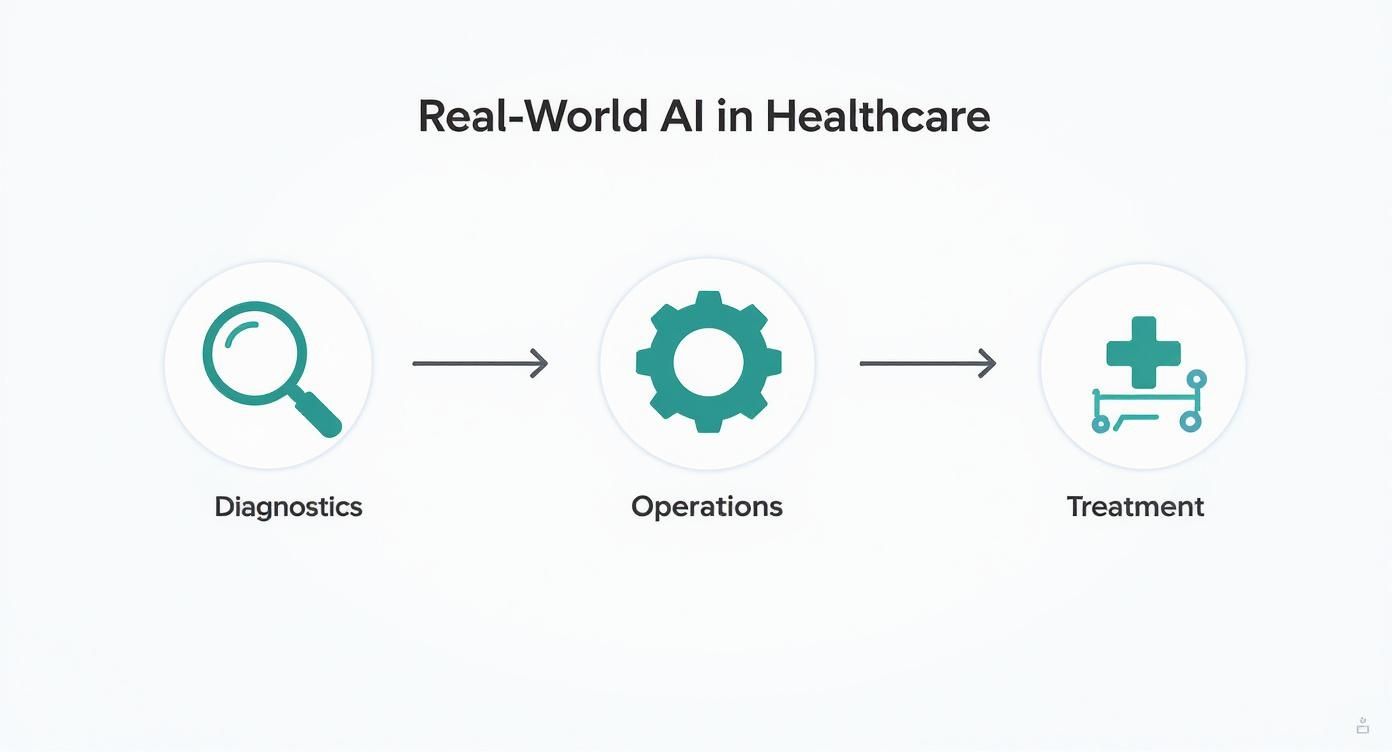
The infographic below shows some of the core areas where AI can deliver real value across the entire patient journey.
As you can see, AI isn't a single magic bullet. It's a collection of connected solutions that can fine-tune different stages of how care is delivered.
Scaling Success Across the Organization
Once your pilot has proven its mettle, the real work begins: scaling that success. Taking a tool that worked wonders in one department and rolling it out across the entire organization is where many initiatives stall. This is the move from a promising project to a true enterprise transformation, and it requires a structured framework.
Getting this right is becoming more important every day. The global AI consulting services market is projected to explode from USD 11.07 billion in 2025 to an eye-watering USD 90.99 billion by 2035—a CAGR of 26.2%. This isn't just hype; it reflects a massive shift in how industries like healthcare operate. Learn more about the AI consulting market growth.
To scale effectively, you have to tackle a few common hurdles head-on:
EHR Integration: Making sure the new AI tool plays nicely with your existing Electronic Health Record system is a non-negotiable technical priority.
Staff Training: You can’t just drop new tech on people and hope for the best. A solid training program is essential to build competence and confidence.
Change Management: People are often resistant to change. You need clear communication and strong leadership to bring everyone along on the journey.
A structured rollout plan is the difference between a successful enterprise AI strategy and a collection of isolated, underutilized tools. It ensures consistency, maximizes adoption, and delivers on the full promise of the technology.
This disciplined approach is at the heart of our AI Product Development Workflow. We've built a process that anticipates these challenges, helping you navigate the complexities of scaling from a pilot to a full-blown rollout that truly changes patient care and operations for the better.
Building Your AI Team In-House vs. Consulting
So, you're ready to get serious about AI. One of the first major hurdles you'll face is deciding who will actually do the work. Do you build a dedicated AI team from the ground up, or do you bring in an AI healthcare consulting firm? There’s no single right answer—it really boils down to your organization's resources, timeline, and what you hope to achieve in the long run.
Going the in-house route has its perks. An internal team has a home-field advantage; they live and breathe your organization’s unique culture, clinical quirks, and workflows. This deep institutional knowledge can lead to incredibly specific and well-integrated solutions.
But let's be realistic: this path is often a steep, expensive climb. Finding and hiring top-tier AI talent is a battle in itself, and even then, there's a significant learning curve to applying that expertise to the messy, regulated world of healthcare. That delay can mean a slower path to seeing any real results.
The Case for Consulting Expertise
This is where bringing in an AI healthcare consulting firm can be a game-changer. You get immediate access to a team of specialists who have been there and done that. They bring a wealth of experience from working with various healthcare systems, so they know what works—and, just as importantly, what doesn't. This experience can shave months, or even years, off your timeline.
That speed is a massive advantage in a market that's absolutely exploding. The U.S. AI healthcare market, valued at USD 8.41 billion in 2024, is expected to skyrocket to USD 195.01 billion by 2034. This growth is fueled by a perfect storm of a strong tech ecosystem and the desperate need to make sense of overwhelming patient data. A consultant helps you ride that wave instead of getting caught in the undertow of building a team from scratch. You can dig into the numbers in this AI in healthcare market analysis.
Partnering with a consultant is often the most direct route to deploying effective, compliant, and impactful AI solutions, turning a complex technological challenge into a manageable strategic initiative.
Of course, consulting comes with its own set of trade-offs, like upfront costs and making sure their knowledge actually gets passed on to your permanent staff. For many organizations, though, it’s a much more nimble and budget-friendly way to get into the AI game. For a deeper look at different external engagement styles, it's helpful to understand the nuances between staff augmentation vs. consulting models.
Comparing In-House AI Teams and Consulting Firms
To help you weigh the options, here’s a side-by-side comparison. This table breaks down the key factors to consider when deciding between building your own team and hiring outside experts.
Factor
In-House AI Team
AI Healthcare Consulting Firm
Speed to Impact
Slower. Requires hiring, training, and a learning curve.
Faster. Immediate access to a skilled team and proven methods.
Upfront Cost
High. Recruiting fees, salaries, benefits, and tool costs.
Lower initial outlay. Project-based or retainer fees.
Expertise
Narrows over time. Deep knowledge of your specific organization.
Broad. Diverse experience across many healthcare settings.
Risk
Higher. Success depends on a few key hires. High turnover is a major threat.
Lower. Risk is shared with a firm that has a track record.
Flexibility
Less flexible. Fixed overhead and a static skillset.
Highly flexible. Scale team up or down based on project needs.
Long-Term Control
Full control over IP, strategy, and team direction.
Less direct control; requires strong project management.
Ultimately, both paths have clear pros and cons. The best choice depends on whether you're optimizing for speed and specialized knowledge or for long-term control and deep institutional integration.
Finding the Right Balance
For many healthcare organizations, this isn't an "either/or" decision. A hybrid approach often works best. You could bring in a consultant to map out your initial strategy and get a pilot project off the ground, all while they help train and upskill your own people.
A flexible model like our AI Automation as a Service is built to bridge this very gap. It gives you the expert horsepower to launch high-impact projects quickly, but it’s designed to empower your internal teams to eventually take the wheel. You get the speed of a consultant with the lasting benefit of building your own in-house muscle.
The end goal is to create a sustainable AI program that keeps delivering value. By taking a hard look at your organization's needs, you can choose the right path—in-house, consulting, or a smart blend of both—to move your organization forward.
Ready to Put AI to Work in Your Clinic?
We’ve walked through the entire landscape of AI in healthcare, from spotting the most promising opportunities to untangling the knots of a real-world rollout. It’s a lot to take in, and frankly, it can feel overwhelming. That's where Ekipa AI comes in. We skip the high-level fluff and get straight to practical, results-driven AI healthcare consulting that actually improves your bottom line.
What makes us different is our focus on speed to value. Forget about endless, costly discovery projects that go nowhere. We use a proprietary AI Strategy consulting tool to quickly zero in on the initiatives that will make the biggest difference for your organization. This gets you moving from a concept to a concrete plan, building confidence and showing a return on your investment almost immediately.
We're Here to Build Your In-House Muscle, Not Just a Project
We see ourselves as partners, not just vendors. Our job isn't finished when a project is "done." The real goal is to work shoulder-to-shoulder with your team, sharing what we know so you can build a lasting AI capability from the inside out. We blend high-level strategy with get-your-hands-dirty execution, making sure the solutions we build are woven directly into how your team already works. It’s about empowering your staff, not just giving them another new tool to learn.
Real change happens when you equip your own people with the right know-how and a clear plan. We're the spark that gets you started and the guide that sees you through to long-term success.
Our team has been in the trenches across the entire AI project lifecycle. Whether you just need a starting point with our AI strategy consulting or you’re ready for deep-dive work like custom healthcare software development, we’ve got the experience to make it happen. We’re here to help you sidestep the common pitfalls of digital innovation and build a smarter, more effective system for delivering patient care.
The road to a more intelligent healthcare practice is clearer than you think, and it starts with a simple conversation. Feel free to reach out and talk with our expert team about the specific hurdles you're facing. Let's figure out how to reach your goals and start building the future of your organization together.
Frequently Asked Questions
Jumping into AI for healthcare brings up a lot of practical questions. We get it. Here are some straightforward answers to the things healthcare leaders ask us most often.
What Is the First Step to Starting with AI in My Hospital?
Before you even think about technology, think about the problems you need to solve. The best first step is always a strategic assessment, not a software demo.
Start by pinpointing a specific, high-pain clinical or operational challenge. Is it patient no-shows? Administrative backlogs? Diagnostic bottlenecks? An AI requirements analysis workshop helps you focus on the highest-value opportunities first, making sure your initial investment goes toward something with a clear, measurable impact.
How Do We Ensure Patient Data Privacy and HIPAA Compliance with AI?
This is the big one, and it's absolutely non-negotiable. Any consultant worth their salt will build privacy and security into the DNA of an AI solution from day one. It’s not an afterthought.
This means using de-identified data for model training whenever possible, setting up rock-solid access controls, and using end-to-end encryption. It also involves regular, tough security audits that specifically address the unique ways HIPAA applies to machine learning.
A "security-by-design" mindset is the only way to go. You can't just bolt on compliance at the end. An experienced partner makes it a core piece of the AI Product Development Workflow, which saves you from major headaches, risks, and costs down the road.
How Long Does It Take to See a Return on Investment?
It really depends on the project's scope. If you're automating administrative tasks with a solution like our AI Automation as a Service, you could start seeing real efficiency gains in as little as 3-6 months.
For more complex clinical tools, the ROI cycle is naturally longer—think 12-18 months. But the payback is often exponentially greater, showing up as better patient outcomes or significant reductions in long-term care costs. The key is starting with a well-defined pilot to prove the value quickly and build momentum for bigger projects.
Can AI Integrate with Our Existing EHR and Legacy Systems?
Absolutely, but it demands careful planning. A huge part of AI consulting in healthcare is making sure new tools play nicely with your existing world, especially your Electronic Health Record (EHR) system.
This usually involves building custom APIs and data pipelines that let the systems talk to each other without a hitch. A good consultant starts with a deep technical dive to map out an integration strategy, heading off compatibility issues before a single line of code is written. This way, the AI tool actually helps your workflows instead of creating new data silos.
Ready to see what AI can really do for your organization? It all starts with a conversation. Ekipa AI has the hands-on expertise to guide you from a rough idea to a fully executed strategy. Connect with our expert team today, and let's build a practical roadmap for the future of your patient care.
healthcare ai strategymedical aidigital healthai healthcare consulting
How to choose an AI medical scribe: features to compare, EHR integration options, consent and BAA requirements, accuracy checks and questions to ask vendors.
Artificial general intelligence in healthcare: how AGI differs from the AI in use today, what current models can and cannot do, and where to focus now.
AI in medical imaging: detection, triage and measurement uses, how FDA clearance works and how to check it, PACS and DICOM integration, and local validation.