
AI in Healthcare
HIPAA-Compliant AI: How to Use LLMs With PHI Safely
How to build HIPAA-compliant AI: when LLM providers need a BAA, data minimization, de-identification, audit controls and a reference architecture.
October 16, 2026Read more
Explore AI in patient data management and security. This guide covers how AI enhances privacy, ensures compliance, and creates safer healthcare systems.

Artificial Intelligence isn't just another tool for healthcare; it's becoming the central nervous system for managing and protecting patient data. Think of it less as a digital filing cabinet and more as a proactive guardian. AI algorithms can sift through millions of records, organizing them with incredible accuracy, smoothing out clinical workflows, and standing guard against increasingly clever cyber threats. This move away from clunky, manual systems toward a smarter, unified approach is no longer a luxury—it's essential.
The healthcare world is in the middle of a massive operational makeover, and AI is calling the shots. For decades, managing patient data was a manual, painstaking task, riddled with human error and wide open to security risks. Information was trapped in separate, disconnected systems, making a complete patient picture nearly impossible to assemble.
Today, that's all changing. Advanced AI solutions are systematically dismantling those old barriers.
Imagine a system that doesn't just store patient files but actually understands the information within them. That's the core idea here. We're building an intelligent, connected data environment where critical information is both instantly available to the right people and locked down tight. Getting this balance right is a key focus of any modern AI strategy consulting effort in the medical field.

AI's job goes way beyond simple automation. The goal is to fundamentally rewire how healthcare organizations handle their most critical asset: patient data. The main objectives are clear:
The table below breaks down the practical shift from old-school methods to what's possible with AI.
| Function | Traditional Method (Manual/Legacy) | AI-Powered Method (Automated/Intelligent) |
|---|---|---|
| Data Entry & Capture | Manual input from paper forms or direct typing; high risk of typos and errors. | Automated data extraction from scanned documents, voice notes, and digital forms using NLP and OCR. |
| Data Cleaning & Integrity | Periodic manual audits; often inconsistent and time-consuming. | Real-time, continuous scanning to detect duplicates, correct errors, and standardize formats automatically. |
| Information Retrieval | Keyword-based searches; often returns irrelevant or incomplete results. | Context-aware, semantic search that understands clinical intent to pull the most relevant patient data. |
| Security & Threat Detection | Rule-based firewalls and antivirus; reactive to known threats. | Proactive anomaly detection that identifies and isolates suspicious user behavior or network patterns in real-time. |
| Workflow Automation | Staff manually routes files, schedules appointments, and handles billing codes. | Intelligent automation that triages tasks, predicts scheduling needs, and suggests accurate medical codes. |
This evolution shows a clear move toward systems that don't just store data but actively work with it to improve efficiency and security.
The rapid adoption of these technologies speaks volumes. By early 2025, an estimated 85% of healthcare organizations will have adopted or be exploring generative AI, a significant climb from 72% in early 2024. This isn't just hype; it's driven by real results, with 82% of organizations now seeing moderate to high ROI from their AI projects. You can explore more on the statistical impact of AI on healthcare operations.
AI is no longer just a technological advantage; it's a strategic necessity. For healthcare providers, integrating AI into data management is the most effective way to enhance patient outcomes, improve operational efficiency, and maintain the highest standards of security and trust.
Ultimately, the aim is to create a seamless and secure data ecosystem. As we'll see, getting there requires a smart strategy and a solid grasp of the unique challenges in healthcare. By using AI correctly, organizations can turn their data from a complex burden into their most powerful asset for driving better health outcomes—a journey we specialize in through our AI for healthcare services.
When you move past the buzzwords, what does AI actually do for healthcare data? It delivers tangible results that impact both clinicians and their patients. This isn't just theory; it's about putting AI to work across four key areas to create meaningful change. We see this firsthand when we help organizations turn strategy into reality through services like our AI Automation as a Service.
First off, there’s the massive boost in operational efficiency. Healthcare professionals are drowning in administrative work. Think about the hours spent on manual data entry, processing claims, and managing billing. AI can automate a huge chunk of these repetitive tasks with incredible accuracy.
This frees up doctors, nurses, and staff to do what they were trained to do: care for patients. It’s not about replacing people; it’s about letting them focus on the human side of medicine, which improves morale and the quality of every patient interaction.

The second pillar is achieving a level of data accuracy that humans simply can't match at scale. In medicine, a tiny error—a misplaced decimal, a wrong diagnosis code—can have huge consequences for a patient's health.
AI algorithms can scan millions of records in an instant, flagging inconsistencies, correcting errors, and standardizing data across different systems. This constant verification minimizes the risk of mistakes caused by bad data, ensuring every clinical decision is based on information you can trust. Building these reliable systems often requires specialized skills in areas like custom healthcare software development.
Third, AI allows healthcare to shift from being reactive to proactive. Instead of just treating sickness, what if you could predict it? AI models can analyze a patient's entire history—labs, genetics, lifestyle data—to spot patterns and forecast future health risks.
This gives clinicians the power to intervene before a condition becomes a crisis. An algorithm might flag a patient as high-risk for heart disease, prompting a personalized prevention plan. This predictive approach is already being applied in countless real-world use cases, changing the very nature of patient care.
By forecasting health trajectories, AI gives clinicians the foresight to act preemptively. This evolution from treatment to prevention is one of the most significant impacts of AI in patient data management and security.
Finally, the fourth pillar is fortified data security. With more data going digital, healthcare has become a massive target for cyberattacks. Traditional security tools just can’t keep up with the sophistication of modern threats.
AI-driven security systems, on the other hand, are always on, always learning. They establish a baseline of normal network activity and can instantly detect any strange behavior that might signal a breach. These systems can identify and neutralize threats faster than any human team could, creating a much stronger defense for sensitive patient data. As we explored in our AI adoption guide, building security in from day one is essential for earning patient trust.
Bringing all these pieces together—efficiency, accuracy, prediction, and security—is what a strong AI strategy is all about, and it's what our expert team helps organizations achieve.
While the promise of AI in healthcare is enormous—think hyper-efficient systems and predictive insights—getting there isn't as simple as flipping a switch. It comes with a heavy dose of responsibility. Bringing AI into patient data management and security means you have to tackle a tangled web of regulations, ethical dilemmas, and technical hurdles right from the start.
First and foremost are the massive data privacy concerns. AI models are data-hungry; they need huge volumes of patient information to learn effectively. This immediately creates a natural tension between driving innovation and protecting a person's fundamental right to privacy. The risk isn't just about fending off hackers; it’s about how that data is handled, stored, and secured every single day.
One of the biggest ethical tripwires you'll encounter is algorithmic bias. Here’s the hard truth: an AI model is only as good—and as fair—as the data it's trained on. If the historical data you feed it is skewed by existing societal or demographic biases (like certain groups being underrepresented in clinical trials), the AI will not only learn those biases, it will amplify them.
This isn't a theoretical problem. It can lead to a diagnostic tool that’s less accurate for people of a certain ethnicity or a risk model that unfairly flags patients from specific neighborhoods. Fighting this requires a deliberate, proactive effort to curate diverse datasets and constantly audit your algorithms to ensure they're performing fairly for everyone.
Beyond bias, there’s a more technical but equally dangerous risk called model leakage. This is a tricky one. It happens when a powerful AI model unintentionally memorizes bits and pieces of the sensitive training data it was built on.
Think of it like a backdoor data breach. A clever attacker could probe the model with specific queries, effectively tricking it into revealing fragments of individual patient records it was never supposed to share. This threat means you have to secure not just your databases, but the AI models themselves.
The global push for AI is clear. A staggering 92% of healthcare leaders view AI automation as a critical answer to staffing shortages, which is driving a huge wave of investment into startups building secure data platforms.
Let's be clear: compliance is not optional. When you’re dealing with patient data, a few key regulations are the law of the land.
These regulations aren't just bureaucratic hoops to jump through. They force you to establish strong governance, transparent processes, and clear lines of accountability. Sticking to these standards is essential for building and keeping the trust of your patients. Our own commitment to these principles is outlined in our privacy policy.
To help organizations navigate these complexities, we've developed a checklist to guide your risk assessment process.
This checklist is designed to help you proactively identify and address the most common risks when implementing AI for patient data management, ensuring you build a system that is both effective and trustworthy.
| Risk Category | Key Challenge | Mitigation Strategy |
|---|---|---|
| Data Privacy | Protecting PHI from unauthorized access or breaches. | Implement end-to-end encryption, strict access controls, and data de-identification techniques before training models. |
| Algorithmic Bias | AI models perpetuating or amplifying existing societal biases. | Curate diverse and representative training datasets. Regularly audit models for fairness across demographic groups. |
| Model Security | Preventing model leakage or adversarial attacks. | Use techniques like differential privacy and federated learning. Implement robust monitoring to detect anomalous queries. |
| Regulatory Compliance | Adhering to complex laws like HIPAA and GDPR. | Conduct a thorough Data Protection Impact Assessment (DPIA). Ensure all data processors are compliant and have a clear audit trail. |
| Lack of Transparency | "Black box" models where decisions are hard to explain. | Prioritize explainable AI (XAI) models where possible. Document the logic and data used for all AI-driven decisions. |
By systematically working through these areas, you can build a more resilient and ethically sound AI framework from the ground up.
Remember, data security extends beyond digital systems to the physical world. The process of safeguarding patient privacy during medical equipment disposal is another critical piece of the compliance puzzle. Truly understanding these challenges is the essential first step toward building an AI strategy that works.
Putting a strategy on paper is one thing; building a secure, functional architecture is where the real challenge begins. This isn't about just plugging in new software. It's about designing a multi-layered defense system that protects sensitive patient data at every single step, from creation to analysis to storage. This architecture becomes the technical backbone of your entire AI initiative.
The whole structure rests on a set of fundamental security controls. These are the absolute non-negotiables, the bedrock of data protection.
Before we even think about sophisticated AI models, the basics have to be rock-solid. You can think of these controls as the digital version of a hospital's locked doors, security cameras, and ID badges. They’re essential for day-to-day safety, and two stand out as critical:
Once these foundational pieces are firmly in place, we can start layering on more advanced AI techniques designed specifically to preserve privacy.
While basic controls shield data from outside attacks, advanced techniques are needed to protect patient privacy during the AI training process. This is the key to not only meeting strict compliance standards but also earning and keeping patient trust. Two of the most powerful approaches here are Federated Learning and Differential Privacy.
Federated Learning completely flips the old AI training model on its head. Traditionally, you’d have to pull massive amounts of sensitive patient data into one central server to train a model. Instead, Federated Learning sends the model out to learn from the data right where it lives—say, within a single hospital’s secure server.
With Federated Learning, the raw patient data never leaves the premises. The AI model learns locally, and only the anonymized insights or model updates are sent back to be aggregated with learnings from other locations. This drastically reduces the risk of a large-scale data breach during the training phase.
This decentralized method makes it possible for multiple institutions to collaborate on building a powerful, shared model without any of them ever having to expose their sensitive patient data to one another.
Differential Privacy is a fascinating mathematical technique that adds a carefully measured amount of "noise" to a dataset. The genius of this approach is that it makes it mathematically impossible to pick out any single individual from the data, even if an attacker somehow gets their hands on the entire set.
Imagine you have a database of patient ages. Differential Privacy might tweak each age slightly—adding or subtracting a small, random number—before any analysis is done. The individual data points are no longer exact, but the big-picture statistical properties, like the average age, remain accurate and incredibly useful. It lets researchers find valuable patterns in large populations without ever compromising one person's privacy.
Bringing these sophisticated systems to life is no small task. It usually involves custom healthcare software development, guided by a structured AI Product Development Workflow to ensure security and scalability are baked into the solution from the very beginning. By combining foundational security with these advanced privacy techniques, healthcare organizations can finally build an AI framework that is both powerful and worthy of trust.
Knowing the architecture is one thing; actually deploying it is another. Getting AI right in the high-stakes world of patient data management and security demands a clear, methodical plan—not a blind leap of faith. The best approach breaks down your ambitious goals into a series of manageable, value-driven steps. This way, each phase builds on the last, cutting down on risk and dramatically increasing your odds of a successful, scalable solution.
A disciplined, phased approach is what separates the successful projects from the expensive failures. It prevents you from getting bogged down in the tech before you’ve even defined the problem. As we’ve seen time and again, a well-defined plan is the single most important factor for success.
This first phase is all about deep listening and sharp planning. Forget about code for a moment. The real first step is to nail down the specific, high-value problem you're trying to solve. This begins with a thorough analysis of your existing workflows, data infrastructure, and security protocols.
Your goal here is to pinpoint the exact pain points where AI can make the biggest difference. You also need to define what a "win" looks like right from the start. What are your success metrics? This phase typically wraps up with a detailed blueprint—a custom strategy that aligns the technology with your clinical and business objectives, giving everyone a clear path forward.
With a solid strategy in hand, it's time to start small and prove the concept. A pilot program is a controlled, limited-scope project designed to validate the AI technology and show it can deliver a real return on investment (ROI). It’s your chance to test your assumptions in a low-risk environment.
Think of the pilot as a crucial reality check. It lets you gather priceless feedback from clinicians, iron out the kinks, and build a powerful business case for a wider rollout—one based on actual results, not just projections.
This is how you build momentum and get key stakeholders on board. A successful pilot speaks louder than any presentation ever could.
The diagram below breaks down the core components of the secure AI framework that needs to be at the heart of any implementation.
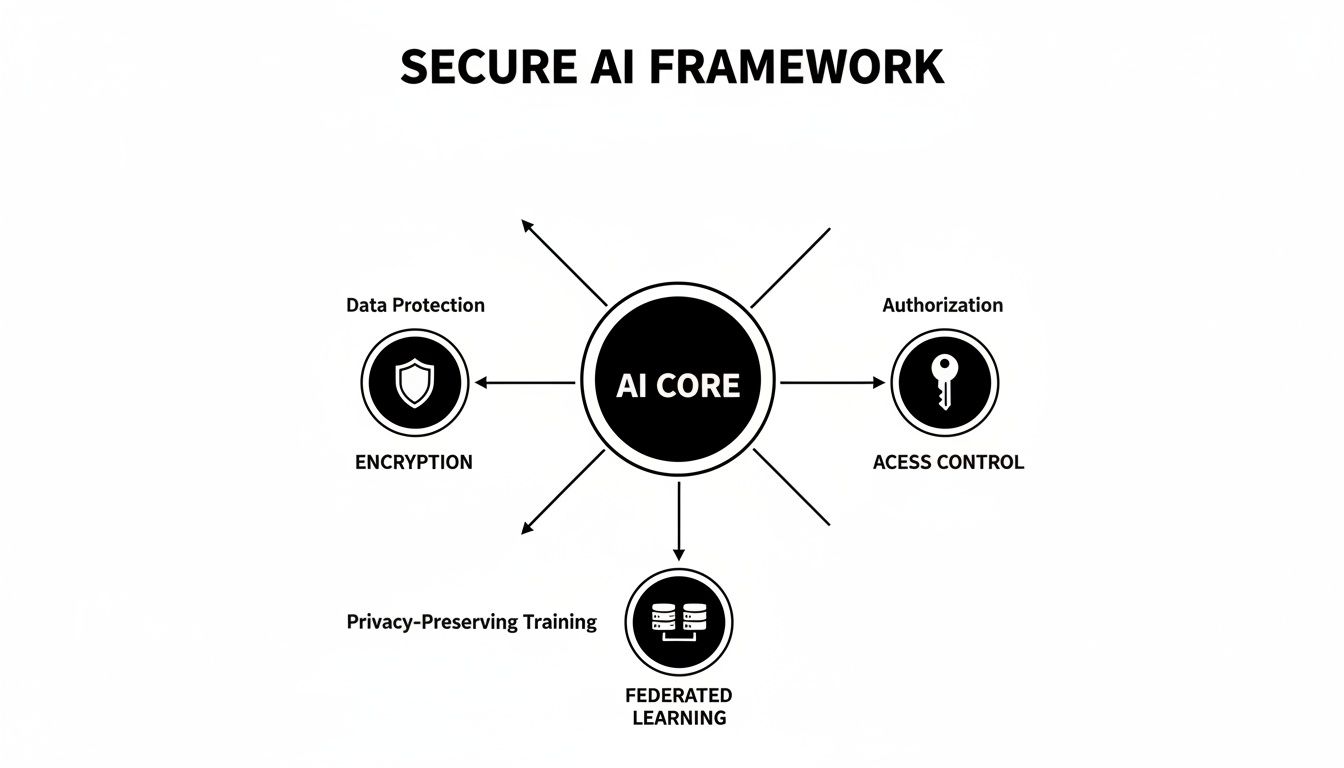
As you can see, things like encryption, access control, and privacy-preserving techniques like Federated Learning all work together to create a multi-layered defense for sensitive patient data.
Once your pilot has proven its worth, it's time to go big. This is where you face the very real technical challenge of integrating the new AI solution with your existing systems, especially the Electronic Health Records (EHRs). If this integration isn't seamless, you risk creating frustrating data silos or disrupting critical clinical workflows.
This stage often means building custom tools to help manage the AI models and make sure they can talk to your legacy infrastructure. Following a structured AI Product Development Workflow becomes essential here to navigate the complexities of building a secure, scalable, and interoperable system.
Here's a critical truth: AI implementation is not a one-and-done project. Your AI system is a living thing, and it needs ongoing attention to keep delivering value. This final, perpetual phase is all about monitoring, model retraining, and governance.
Following this structured, four-phase approach turns the daunting task of implementing AI into a practical, reliable plan for genuine innovation.
Bringing AI into patient data management and security is a massive undertaking. It’s about more than just plugging in new technology; it’s about having a partner who genuinely understands the high-stakes world of healthcare. The road from a great idea to a secure, compliant, and genuinely useful AI system is full of pitfalls, from navigating regulatory minefields to untangling complex technical integrations. That’s where we come in.
We get the immense pressure you're under. You need to innovate, but you absolutely cannot compromise the security of your most sensitive asset—patient data. The old way of doing things, with traditional consultants, is often slow, incredibly expensive, and leaves you with a theoretical plan that’s a nightmare to actually put into practice. We decided to do things differently, focusing on speed and real-world results.
We’re built to speed up the whole process, starting with our distinct take on AI strategy consulting. Forget about months of back-and-forth. We can help you build a clear, actionable plan in a fraction of the time. This first step often results in a detailed Custom AI Strategy report, giving you the clarity and confidence to move forward.
But our job doesn't stop once the plan is on paper. We're here to help you bring that vision to life, covering every single stage of the project:
Ekipa exists to close the gap between a great strategy and a successful implementation. We have the deep expertise to not only map out your AI roadmap but also to build the secure, scalable, and compliant solutions that deliver real value to your clinicians and patients.
This entire journey is guided by our expert team—a group of specialists who live and breathe this stuff every day. We’ll walk you through our proven AI Product Development Workflow, making sure every decision aligns with security and efficiency best practices. As we’ve talked about before, a structured approach is the only way to minimize risk and get the best return on your investment.
Whether your goal is to lock down data security, make clinical workflows more efficient with our AI Automation as a Service, or develop groundbreaking predictive care models, Ekipa has the strategic insight and the technical muscle to make it happen. We turn big ideas into secure, working AI solutions that will shape the future of your organization.
Without a doubt, the most significant risk is a data privacy breach. We often think of cyberattacks as the main culprit, but with AI, there's a more subtle threat called a "model inference" attack.
This is where a clever attacker can essentially work backward from the AI's results to figure out the private patient data it was trained on. It’s like guessing the ingredients of a cake just by tasting it. Defending against this requires more than just a firewall; it demands a layered security strategy combining strong encryption, tight access controls, and advanced privacy techniques like federated learning.
Think of AI as a vigilant, always-on security guard for HIPAA compliance. It can automate critical security tasks that are difficult for humans to manage at scale. For example, it can constantly monitor who is accessing what data, flagging suspicious activity in real-time before it becomes a major incident.
AI is also fantastic for creating detailed audit trails for compliance reporting. Even better, it can automatically de-identify Protected Health Information (PHI) before that data is used for research or analytics. This allows you to gain valuable insights while keeping patient privacy locked down, a core tenet of HIPAA. These systems often require specialized custom healthcare software development to get right.
Don't jump straight to the technology. The most crucial first step is to conduct a thorough AI readiness assessment and map out a clear strategy. Start by pinpointing a specific, high-value problem you want to solve—something like reducing patient readmission rates or spotting diagnostic errors earlier.
Before you even think about vendors or algorithms, you need a complete AI requirements analysis to honestly evaluate your data quality, current infrastructure, and the potential return on investment. Kicking off with a Custom AI Strategy report ensures your project is aligned with your organization's goals and built on a solid foundation for success.
Absolutely. In fact, it must. A successful AI implementation isn't about ripping and replacing your current systems; it's about integrating smoothly with them, especially your EHR.
Modern AI solutions are built for this kind of interoperability. They use APIs and data integration platforms to securely connect to and enrich your existing healthcare IT stack. As we explored in our AI adoption guide, this seamless connection is what creates efficient new workflows instead of frustrating data silos. For more complex projects, having a clear AI Product Development Workflow is non-negotiable.
Ready to build a secure, intelligent data strategy for your healthcare organization? At Ekipa AI, our expert team specializes in turning complex challenges into actionable plans and effective solutions.
How to build HIPAA-compliant AI: when LLM providers need a BAA, data minimization, de-identification, audit controls and a reference architecture.

Practical data migration planning guide for healthcare teams. Scope, mapping, compliance, validation, cutover and rollback decisions explained end to end.

Smart on FHIR guide for healthtech engineers. Learn the OAuth 2.0 launch model, scope syntax, backend services, and US regulatory requirements.
Connect with our team to explore how AI expertise can transform your business.