
AI in Healthcare
HIPAA-Compliant AI: How to Use LLMs With PHI Safely
How to build HIPAA-compliant AI: when LLM providers need a BAA, data minimization, de-identification, audit controls and a reference architecture.
October 16, 2026Read more
Discover how AI in regulatory compliance helps businesses automate tasks and manage risk. Learn practical strategies for successful implementation.
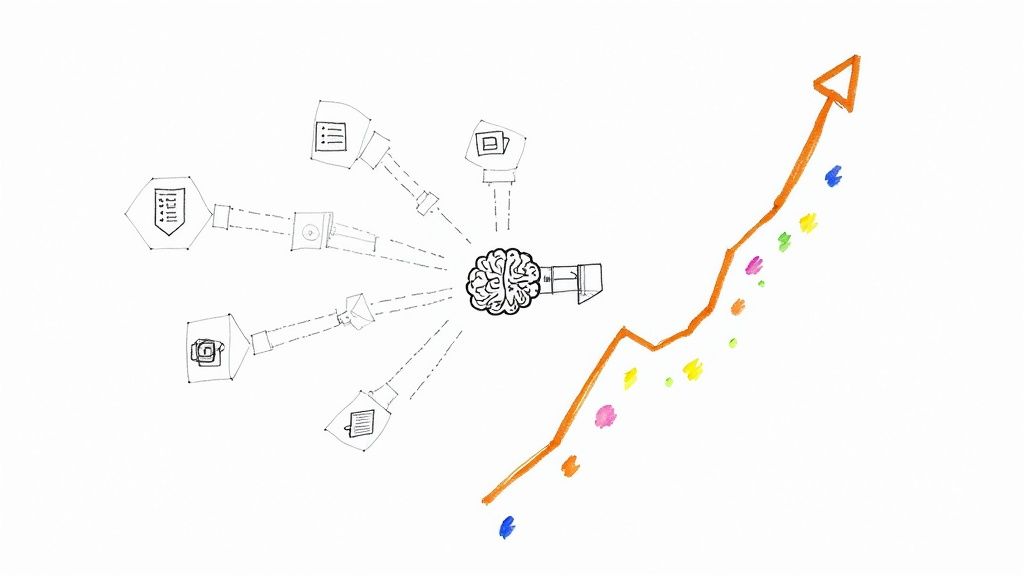
Gone are the days when regulatory compliance meant ticking boxes on a manual checklist and scrambling to fix problems after they occurred. The game has changed. Today, staying compliant requires a smart, forward-thinking strategy, and AI is at the heart of it. Working with partners through a collaborative AI co creation process can give a company a serious advantage in this complex legal environment.
To get a real sense of this shift, picture traditional compliance as a lone librarian meticulously searching a massive library for a single, updated legal clause. It's slow, exhausting, and prone to human error. Now, imagine AI as a super-intelligent digital assistant. It doesn't just find that new rule in a split second; it also instantly grasps how that change ripples through every single one of your company's internal policies. This isn't a futuristic luxury anymore—it's an operational necessity.
The sheer volume and ever-increasing complexity of modern regulations have made manual oversight practically impossible. This is where technologies like machine learning and natural language processing (NLP) really shine. They are perfectly built to handle this data overload, turning compliance from a dreaded cost center into a genuine strategic asset.
This image really drives home the difference between the old way and the new.
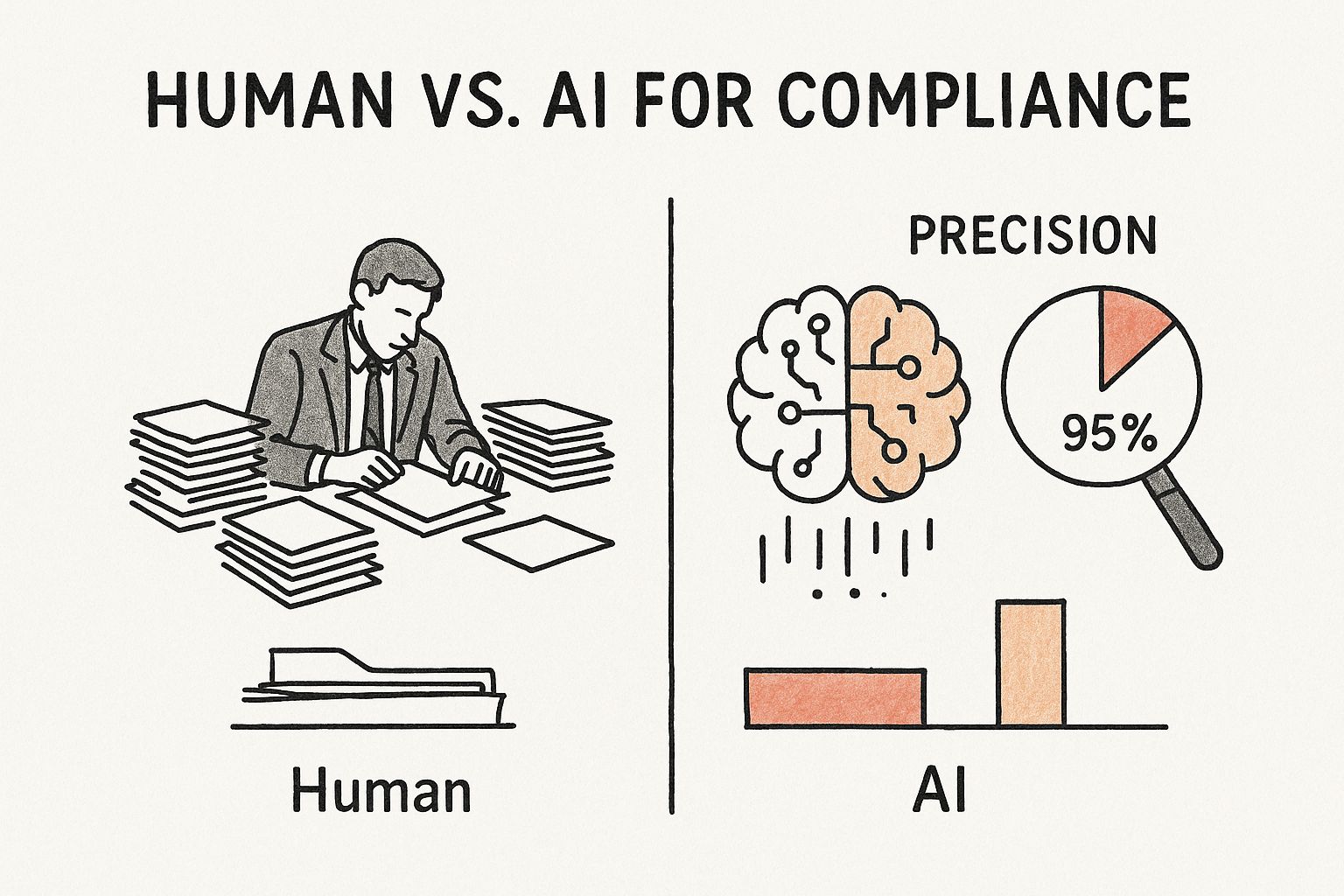
It perfectly contrasts the slow, paper-choked past with the speed and pinpoint accuracy of an intelligent, automated future.
To better understand this evolution, let's compare the two approaches side-by-side.
| Compliance Activity | Traditional Approach (Manual) | AI-Powered Approach (Automated) |
|---|---|---|
| Regulatory Monitoring | Teams manually track news and government websites. | AI continuously scans global sources for changes in real-time. |
| Policy Management | Policies are updated by hand, a slow and error-prone process. | AI identifies impacted policies and suggests updates instantly. |
| Risk Assessment | Relies on periodic audits and subjective human analysis. | AI provides continuous, data-driven risk scoring and prediction. |
| Reporting & Audits | Compiling reports is a time-consuming, manual effort. | AI generates comprehensive reports and audit trails on demand. |
This table shows a clear pattern: AI doesn't just speed things up; it introduces a level of precision and proactivity that manual methods simply can't match.
The push towards AI in regulatory compliance isn't just about chasing efficiency; it's being driven by both new opportunities and stark realities. On one side, AI brings incredible accuracy and speed. On the other, the regulatory world itself is becoming more technologically sophisticated and demanding, making AI adoption less of a choice and more of a critical priority.
For instance, the upcoming EU AI Act—often called "GDPR on steroids"—is slated to take effect in February 2025. This groundbreaking legislation will impose staggering fines of up to €35 million for certain violations. When you consider that 71% of organizations already use generative AI in at least one business function, it becomes clear that AI compliance is a core operational issue for any company with a global footprint. You can read more about the evolving AI compliance landscape on Scrut.io to get a deeper dive.
AI isn't just about doing the old compliance tasks faster. It’s about creating an intelligent, predictive, and resilient compliance framework that can anticipate and adapt to regulatory changes before they become a problem.
This proactive mindset is what truly separates the market leaders from the companies constantly playing catch-up. Building this kind of resilience starts with a clear, forward-looking plan, like one detailed in a Custom AI Strategy report, which helps turn compliance from a liability into a real competitive edge.
Here is the rewritten section, designed to sound human-written and natural.
Let's move past the theory. How is AI actually changing the day-to-day grind for compliance teams? The reality is that it’s already here, taking over the manual, error-prone tasks that used to eat up countless hours. This isn’t about replacing people; it’s about freeing them up to think strategically instead of just reacting to the next fire.
Think about it this way: you have an AI system that's always on, scanning thousands of regulatory updates from around the globe—official government sites, legal updates, you name it. When it finds something that affects your business, it doesn't just forward a link. It gives you the gist of the change, points out exactly which of your internal policies are now out of date, and can even draft the new language for you. This is what modern regulatory change management looks like.
The impact goes way beyond just keeping an eye on new rules. AI is fundamentally changing how companies get ahead of risk and keep their own house in order. These real-world use cases aren't hypotheticals; they show how AI delivers real value by improving both speed and precision. As we explored in our AI adoption guide, starting with these focused tasks is a great way to build momentum for bigger changes down the road.
Here are a few areas where AI is making a huge difference right now:
The real magic of AI in compliance isn’t just about working faster. It's about seeing the bigger picture and connecting dots a human team, no matter how dedicated, could easily miss in the flood of information.
This shift lets your most skilled people focus on what they do best: strategy. Instead of spending weeks pulling documents for an audit, a compliance officer can now use AI to gather everything in minutes. That frees them up to analyze the findings and give solid advice to leadership.
This elevation of the compliance role is essential for any company trying to navigate today’s tangled web of regulations. The best way to start is with a clear roadmap, often detailed in a Custom AI Strategy report, that pinpoints exactly where AI can make the biggest splash first.
Bringing AI into your compliance workflow is a game-changer, but it's not a magic fix. You have to approach it with a clear-eyed view of both the incredible potential and the serious risks involved. Getting this balance right is everything, and often requires a solid plan, sometimes with guidance from an AI strategy consulting partner.
On one hand, the benefits are huge. AI can supercharge efficiency and offer predictive insights that let compliance teams get ahead of the curve. Instead of being buried in tedious, manual tasks, your people can focus on what really matters: strategic risk management, complex analysis, and making high-level judgment calls. It's about automating the noise so your experts can apply their wisdom.
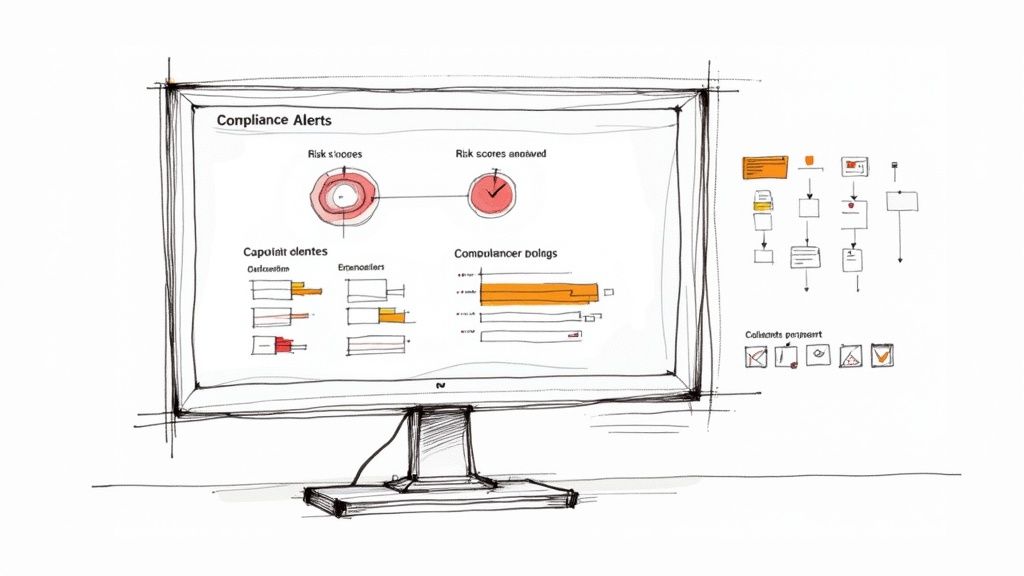
But we have to be honest about the other side of the scale. The risks are just as real and demand proactive management from day one.
Every organization stepping into this space needs to face these potential downsides head-on to build an AI framework that’s truly trustworthy.
Here are the most common challenges you'll encounter:
This dual nature of AI is a hot topic for a reason. Professionals in governance, risk, and compliance (GRC) see AI as both their biggest opportunity and one of their most significant challenges.
Recent survey data backs this up perfectly. A 2025 poll found that 46.85% of GRC leaders view AI adoption as a key opportunity and a top challenge at the same time. While they love how AI can spot anomalies and speed up workflows, there are deep-seated concerns about trust and accountability. In that same survey, 43.24% of leaders cited regulatory uncertainty as a major roadblock, which underscores the urgent need for clear rules around AI ethics and explainability. You can discover more insights about these GRC trends on MetricStream.com.
Ultimately, success isn't just about chasing the benefits; it's about aggressively managing the risks. This means building a rock-solid governance framework to ensure your AI tools are not only powerful but also fair, transparent, and reliable.
Everyone sees the potential of AI in compliance, but let's be honest—getting it right is tough. The path from a great idea to a working, regulator-approved system is often littered with obstacles. Many companies get stuck trying to figure out how to source clean data for training, explain their AI models to skeptical auditors, or deal with the very real legal risks of algorithmic bias.
It's one thing to talk about AI's promise; it's another thing entirely to make it work in the real world. Success comes from a practical, grounded approach that sidesteps the common traps and builds a system that’s not just powerful, but also trustworthy.
Turning a promising AI concept into a reliable compliance tool means facing a few key challenges head-on from the very beginning. These aren't just tech problems; they're deeply connected to how you manage data, run your operations, and build trust across the organization.
Here’s how to get started:
The need for better AI governance isn't just a talking point. Stanford's 2025 AI Index Report found a staggering 56.4% jump in reported AI incidents in a single year. That’s a huge red flag showing a major gap between knowing the risks and actually managing them.
This spike in incidents is a serious wake-up call. The report highlights that even with growing awareness, many developers are still not doing enough when it comes to transparency and safety testing—two things that are absolutely critical for passing a regulatory audit. You can read more about these findings and the push for responsible AI at Kiteworks.com.
Implementing AI isn't a one-and-done project. The world changes, and so does the data that feeds your models. Over time, an AI's performance can degrade as new patterns emerge—a problem known as model drift.
Without constant monitoring, a system that was once pinpoint accurate can slowly become unreliable or even biased, creating major compliance headaches down the road. This is why continuous oversight is completely non-negotiable. For any organization looking to get this right, dedicated AI implementation support can provide the expert guidance needed to build and maintain a system that stands the test of time.
Bringing AI into your compliance workflow can feel like a massive undertaking, but it doesn't have to be. The key is to treat it not as a single, giant leap but as a series of deliberate, well-planned steps. A phased approach is your best friend here, allowing you to build momentum, demonstrate value, and keep risks in check.
It all starts with a solid plan. You can't build a reliable AI compliance system if you don't know what you're trying to fix. This initial stage is all about pinpointing your biggest compliance headaches and figuring out where AI can make the most meaningful difference.
Before you start looking at fancy software, you need to get your strategy and your people aligned. This foundational work ensures everyone is rowing in the same direction.
With a strategy and a team, it's time to shift from planning to doing. The trick is to start small, prove the concept works, and get some quick, tangible results. This is how you build confidence and get the buy-in you'll need to expand later.
The goal of a pilot isn't to solve every compliance problem at once. It's to demonstrate success in a controlled, low-risk environment, proving the technology works and delivering a clear return on investment.
This phase is all about picking the right tools and running a focused trial.
Once your pilot is a proven success, it’s time to expand. This is where AI stops being a "project" and starts becoming a core part of how you manage compliance every day.
This final phase involves rolling out the solution more broadly with strong governance and a commitment to ongoing refinement. After all, implementing AI isn’t a one-and-done task; it’s a continuous process of learning and adapting.
When it comes to using AI in regulatory compliance, long-term success boils down to one critical ingredient: trust. Bringing intelligent systems into your workflow isn't just about plugging in a new piece of software. It’s about building a deep-seated culture of responsible AI that informs every decision you make.
This means you have to see AI for what it is—a powerful partner designed to enhance human judgment, not replace it.

That’s why human oversight is absolutely non-negotiable. It’s the final safety net that guarantees accountability. Your most experienced compliance officers bring something to the table that even the smartest algorithms can't: nuanced, ethical judgment. They are crucial for interpreting what the AI is telling them, handling the inevitable exceptions, and making the final strategic calls that keep the organization safe.
To build that essential trust, you need to commit to three core pillars from the moment you start developing your AI until it's fully operational.
Ultimately, you need to stop thinking of AI as just a fix for today’s compliance headaches. Think of it as a core strategic asset that will prepare you for whatever regulations come next.
When you frame it that way, AI shifts from being a reactive tool to a proactive engine for building resilience. Constructing an ethical and robust AI framework that can stand the test of time is a serious undertaking. Partnering with our expert team can give you the deep, real-world expertise needed to get it right.
It's natural to have questions when you're exploring how AI can fit into regulatory compliance. We get it. Below, we've tackled some of the most common ones we hear from leaders just like you. The goal is to give you clear, straightforward answers to help you move forward.
For a deeper dive, feel free to explore our complete AI FAQ page.
The biggest mistake is trying to boil the ocean. Don't attempt to solve every compliance issue at once. The smartest starting point is a simple readiness assessment. Take a hard look at your current processes and pinpoint the biggest compliance headaches—the repetitive, time-consuming tasks that are bogging your team down.
From there, pick one high-impact area for a pilot project. A great example is automating regulatory change monitoring. By focusing on a single, specific problem, you can demonstrate a clear return on investment, learn valuable lessons, and build the internal momentum needed to expand your efforts later. A Custom AI Strategy report can help you zero in on the perfect project to get started.
This is a critical question, and the answer is that preventing bias isn't a one-and-done task—it’s an ongoing commitment.
It all starts with the data. You need diverse, high-quality, and representative data to train your models. Before you even think about going live, you have to put your models through rigorous testing to sniff out and correct any fairness issues.
But the work doesn't stop there. Once a model is deployed, you need to monitor it constantly to catch what's known as "model drift," where performance degrades or new biases creep in. Full transparency is also non-negotiable; you must be able to explain why your model made a certain decision to regulators and auditors. Frameworks like the NIST AI Risk Management Framework provide a solid, structured approach for managing these risks from day one.
Absolutely not. Think of AI as a powerful partner for your compliance team, not a replacement. It’s a tool that takes the grunt work off their plates, freeing them up to focus on the high-value tasks that truly require human intelligence. This is the core idea behind our AI co creation philosophy.
AI is fantastic at sifting through mountains of data and automating repetitive tasks with incredible speed. What it can't do is exercise nuanced judgment, make ethical calls, or understand the subtle context of a complex situation. That’s where your seasoned professionals shine. The best setup is a true partnership: AI handles the data-heavy lifting, while your team focuses on strategic analysis, complex investigations, and stakeholder communication.
Ready to turn your AI strategy into a reality? At Ekipa AI, we specialize in transforming ambitious ideas into scalable impact. Our next-generation platform helps you discover and execute AI opportunities without the high cost of traditional consultants. Get in touch with our expert team today to learn more.
How to build HIPAA-compliant AI: when LLM providers need a BAA, data minimization, de-identification, audit controls and a reference architecture.

Practical data migration planning guide for healthcare teams. Scope, mapping, compliance, validation, cutover and rollback decisions explained end to end.

Smart on FHIR guide for healthtech engineers. Learn the OAuth 2.0 launch model, scope syntax, backend services, and US regulatory requirements.
Connect with our team to explore how AI expertise can transform your business.