AI in Healthcare
HIPAA-Compliant AI: How to Use LLMs With PHI Safely
How to build HIPAA-compliant AI: when LLM providers need a BAA, data minimization, de-identification, audit controls and a reference architecture.
October 16, 2026Read more
Explore how ai in the medical field is transforming patient care, diagnostics, and efficiency with practical applications and a strategic roadmap.
The age of AI in the medical field isn’t some far-off concept—it's here, and it's already changing how healthcare works. For any executive steering a healthcare organization, getting a firm grasp on this shift isn't just important; it's essential for survival and growth. AI offers a real, practical answer to some of our biggest headaches, from crippling staff shortages to the ever-growing demand for truly personalized patient care.
Artificial intelligence is quickly graduating from a buzzword in a research paper to a workhorse tool in hospitals and clinics around the globe. It’s becoming a trusted partner for clinicians, empowering them to make smarter decisions faster and, most importantly, freeing them up to spend more quality time with their patients. This is all possible because AI can chew through massive amounts of data in ways no human ever could.
Don't think of AI as a replacement for doctors or nurses. Instead, picture it as an incredibly powerful assistant that enhances their expertise. It can spot tiny, almost invisible patterns in an MRI scan that a person might miss, flag a patient's risk of sepsis hours before symptoms appear, or untangle the knot of hospital logistics. This fusion of human skill and machine intelligence is creating a new benchmark for what’s possible in both patient care and operational performance.
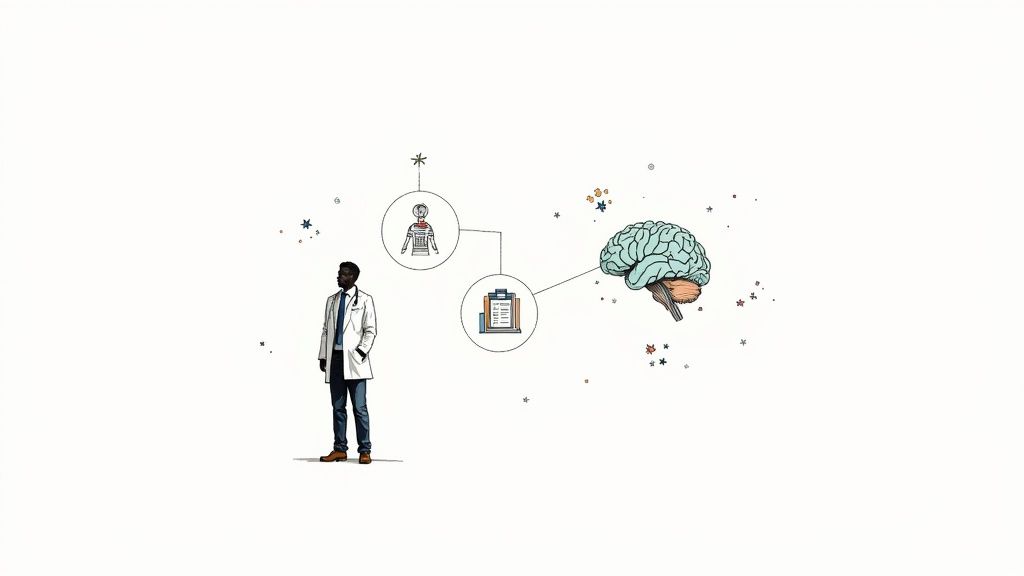
AI’s influence is making its mark across three key areas of the medical field. Each one presents a different set of opportunities for real, measurable improvement.
The real magic of AI in medicine is its ability to turn mountains of raw data into clear, actionable insights. It’s what allows us to shift from simply reacting to illness to proactively predicting it, which is better for both patient outcomes and the bottom line.
As we go deeper, it becomes clear that putting AI to work successfully demands a solid vision. Understanding where it can be applied is the first step. The focus has to be on tangible results, whether that’s boosting diagnostic accuracy or just making the back office run more smoothly. The role of technology is also being explored in other areas, such as using virtual reality for medical training to improve clinical skills.
This guide will lay out a practical roadmap, exploring real-world applications and how to bring these critical tools into your organization effectively. For a closer look at industry-specific applications, check out our overview of AI in the healthcare industry.
When we talk about the promise of AI in healthcare, what we're really talking about is its direct impact on patient care and outcomes. This isn't science fiction anymore. We’ve moved past theory and into a reality where AI in the medical field is giving our best clinicians a new level of analytical power. The goal isn't to replace doctors and nurses, but to supercharge their expertise.
At its core, AI is incredibly good at recognizing patterns—far beyond what the human eye can catch. Think about fields like radiology and pathology, where this is a complete game-changer. AI models can be trained on millions of medical images to spot faint anomalies in X-rays, MRIs, or tissue samples that signal the earliest signs of diseases like cancer.
This capability is pushing medicine from a reactive stance to a much more preventive one. A fascinating 2023 study, for example, demonstrated an AI model that could predict a patient's risk of pancreatic cancer just by analyzing disease codes from health records. It often flagged high-risk people long before any obvious symptoms appeared. Finding a disease that early can completely change a patient's prognosis.
Predictive analytics is where clinical AI truly shines. By continuously sifting through huge streams of patient data—everything from real-time ICU vitals to years of health records—AI can pinpoint individuals at high risk for events like sepsis, cardiac arrest, or a costly hospital readmission.
By identifying high-risk patients hours or even days before a crisis, AI gives clinical teams a crucial window to intervene. This proactive approach prevents complications, shortens hospital stays, and ultimately saves lives.
This kind of foresight is invaluable. Imagine a post-operative patient whose vital signs are subtly shifting in a way that signals a high chance of infection. A predictive model can flag this instantly, allowing the care team to step in with preventive measures before it becomes a serious, expensive complication. You can see just how tangible these benefits are by exploring these real-world use cases.
The old "one-size-fits-all" approach to medicine is on its way out, and AI is speeding up the shift toward truly personalized treatments. Every person has a unique genetic makeup, lifestyle, and medical history. AI is what lets us make sense of that complexity and predict how someone will actually respond to a specific therapy.
We can now start tailoring a cancer treatment plan not just to the type of tumor, but to its precise genomic profile. AI models can dig through massive genomic datasets to find the most effective drug combinations for one person, which helps minimize side effects while boosting the chances of success. This was a distant dream not long ago, but it's happening in clinics today.
This same analytical muscle is also transforming drug discovery. AI can:
All of this dramatically shortens the R&D timeline, which means life-saving drugs get to patients faster. Getting these advanced tools into daily practice often requires sophisticated systems, which is where custom healthcare software development comes in. For hospitals and clinics ready to take the next step, a platform like the Clinic AI Assistant can be a great starting point for improving patient interactions and making better use of data. It’s all about building a smarter, more connected healthcare system that’s built around the needs of each individual patient.
While the clinical breakthroughs in AI grab most of the headlines, the impact on a healthcare organization's operational and financial health is just as significant. For any executive, the story of AI in the medical field is really a story about powerful, measurable ROI. These intelligent systems are perfectly suited to tackle the thorny logistical puzzles that drain hospital resources, ultimately creating a leaner, more resilient organization.
This isn't just about tweaking a few processes here and there. It's about fundamentally redesigning workflows for peak efficiency. AI can untangle the logistical knots in patient scheduling, making sure facilities and clinician time are used to their fullest potential. It can also predict patient admissions to proactively manage bed capacity, which cuts down on wait times and dramatically improves patient flow.

As you can see, AI’s role spans the entire care journey. It creates value at each step, contributing to better patient outcomes and real operational gains.
One of the quickest financial wins comes from intelligent automation. Healthcare is famous for its administrative overhead—endless tasks that eat up the valuable time of highly skilled professionals. AI is the perfect tool to step in and handle these repetitive, rule-based processes with incredible speed and accuracy.
Just think about these applications:
The numbers speak for themselves. The operational and financial impact of AI in healthcare is not just substantial; it's growing fast. By 2025, around 63% of healthcare organizations worldwide will be actively using AI, with another 31% already exploring or piloting projects.
The financial upside is clear: 81% of organizations report a boost in revenue after bringing AI on board, and 73% see a drop in operational costs. What’s really compelling for leaders, though, is how quickly this happens. Nearly half of these organizations see a return on their investment in under a year. You can dig deeper into these healthcare AI trends on rsisecurity.com.
This rapid ROI is exactly why adoption is accelerating. The key is to start with well-defined projects that target specific, nagging pain points. Getting those early wins on the board is the best way to demonstrate value, build momentum, and secure the buy-in you need for larger, enterprise-wide initiatives.
The real financial win with AI isn't just about cutting costs. It’s about freeing up your most valuable resource—your people—to focus on the work that requires human empathy, critical thinking, and complex decision-making.
For leaders who want to track these gains, a sophisticated monitoring system is a must. A dedicated Financial Insights Dashboard provides real-time visibility, connecting operational improvements directly to bottom-line financial metrics. This data-driven approach is the bedrock of scaling AI successfully. In the end, a smart AI strategy doesn’t just make operations smoother; it builds a more financially sound and competitive organization ready for whatever comes next.
While the potential of AI in the medical field is enormous, the road to getting it right is paved with challenges unique to healthcare. This isn't just about plugging in new software; it's a careful orchestration of data, security, and people. For any leader, seeing these roadblocks ahead of time is the first step to navigating around them.
It all starts with data. Healthcare information is notoriously scattered across different systems—electronic health records, lab reports, imaging archives—that rarely talk to each other. The first real challenge is pulling all of that into a clean, unified dataset. Without that foundation, you can't build a reliable AI model.
In healthcare, data is more than just numbers and text. It’s deeply personal information protected by strict rules like HIPAA. This makes robust privacy and security an absolute must. Every AI project has to be built on a foundation of airtight compliance to protect patient information at every turn.
That goes far beyond simple data encryption. It means setting up clear governance rules for who can access data, how it can be used, and how everything is tracked. Building these guardrails isn't just about staying on the right side of the law; it’s fundamental to earning and keeping the trust of patients and clinicians alike.
A single data breach can destroy trust that took years to build. Privacy isn't an add-on for your AI strategy—it has to be the starting point.
For organizations trying to map out this complex territory, our AI strategy consulting services can offer the expert guidance needed to ensure your projects are both effective and compliant from the very beginning.
Beyond the technical snags, the human element is often the biggest barrier. Clinicians are, quite rightly, cautious about any new technology that affects patient care. Getting doctors, nurses, and other staff to trust and use AI tools is absolutely critical for success.
This is where thoughtful change management comes in. The key is to bring clinicians into the process early and often, making them partners in designing and testing new AI tools for business. The goal should always be to build tools that enhance their expertise and slide smoothly into how they already work, not get in the way. Clear training and honest communication about what an AI model can and can't do are essential for getting people on board.
The good news? The tide is turning fast. Physician use of AI tools in the United States jumped from 38% to 66% between 2023 and 2024—a massive 78% increase in a single year. This shows that when AI is implemented the right way, clinicians are ready and willing to embrace tools that help them deliver better care. You can dive deeper into these trends and see how AI adoption is rapidly growing in US hospitals.
Finally, any AI model used in a clinical setting has to be rigorously tested to prove it's accurate, dependable, and free from bias. A faulty algorithm could have devastating consequences. This isn't a one-and-done check, either. Models need constant monitoring and retraining as new data comes in to make sure they stay sharp.
Tackling these challenges head-on requires a clear, strategic approach. The table below outlines some of the most common obstacles and practical solutions for leadership to consider.
| Challenge Area | Description | Strategic Solution |
|---|---|---|
| Data Integration | Data is fragmented across various legacy systems, making it difficult to create a unified view for AI analysis. | Invest in modern data warehousing and interoperability standards (like FHIR) to create a single source of truth. |
| Regulatory Compliance | Navigating complex regulations like HIPAA while innovating with patient data can be a tightrope walk. | Establish a dedicated AI governance committee to oversee compliance, ethics, and data privacy protocols from the start. |
| Clinician Buy-In | Staff may be resistant to new technologies, fearing they will disrupt workflows or replace human judgment. | Implement a co-design process where clinicians are involved in developing and validating AI tools to ensure usability and build trust. |
Ultimately, overcoming these hurdles is a mix of smart technical planning, strong governance, and a genuine understanding of the people who will be using these tools every day.
Knowing what AI in the medical field can do is one thing. Making it a reality in your organization is another challenge entirely, and it calls for a clear, deliberate plan. A successful AI initiative doesn’t just happen; it’s the result of a structured approach that ties the technology directly to your core business goals. The journey starts not with the tech, but with a deep-dive AI requirements analysis to pinpoint exactly where AI can make the biggest difference.
This initial analysis is your foundation. It's where you find the most frustrating operational bottlenecks, the biggest clinical inefficiencies, or the administrative headaches that are perfect candidates for intelligent automation. Think of it as creating a map before you start driving—it ensures you're heading toward a valuable destination instead of just wandering.

No AI project can succeed in a silo. Your first real move is to bring together a cross-functional team with diverse perspectives from across the organization. This group becomes the engine driving your AI strategy forward.
Your core team should include:
Getting this mix right is crucial for buy-in. When clinicians, IT staff, and administrators all have a seat at the table, the AI solutions you build are far more likely to be welcomed and used.
It’s tempting to go big and launch a massive, enterprise-wide AI overhaul. The smarter path? Start with a focused pilot project. A pilot is simply a controlled experiment designed to prove value quickly and with minimal risk. It’s your chance to test a specific use case, measure the results, and build undeniable momentum.
A successful pilot project is your most powerful tool for building organizational buy-in. It turns AI from an abstract idea into a tangible solution with measurable benefits, making it much easier to get funding and support for a wider rollout.
Choosing the right pilot is key. Look for a problem that is both significant and solvable—a real pain point. Good candidates often involve automating high-volume, repetitive tasks or improving a specific diagnostic workflow. As we explored in our AI adoption guide, these early wins are what prove the ROI and pave the way for more ambitious projects down the road.
Once your pilot proves successful, you have a powerful story to tell. Use the data and outcomes to build a solid business case for scaling your efforts. The lessons you learn—what worked, what didn't—will inform your broader AI strategy consulting, helping you refine your approach as you tackle bigger challenges.
By 2025, AI is an entrenched, critical technology in healthcare, with roughly 80% of hospitals worldwide using AI systems to improve care and efficiency. This isn't on the fringe; it's mainstream, covering everything from real-time imaging analysis to automated patient intake. For instance, many hospitals now use AI to monitor chronic diseases like COPD and diabetes through wearables, which helps reduce preventable hospitalizations. What’s more, about 92% of healthcare leaders now see AI-powered automation as a key solution to critical staffing shortages. Discover more insights on AI's role in healthcare on litslink.com.
This methodical roadmap—from analysis and team-building to a strategic pilot and measured scaling—is the most reliable way to integrate AI successfully. For organizations looking for a personalized plan, a Custom AI Strategy report can provide a detailed blueprint, while a structured AI Product Development Workflow ensures your vision is executed flawlessly.
Bringing AI into the medical field is so much more than a technology project. It's a fundamental shift in how you deliver care. Getting it right—from better patient outcomes to smoother operations—really hinges on finding a strategic partner who gets it. The future of medicine is collaborative and AI-powered, and the right people in your corner can help you cut through the complexity and get from a plan on paper to real-world results, faster.
Choosing a partner isn't just about finding someone who can write code. You need a team that lives and breathes the unique regulatory and clinical world of healthcare. They have to be able to turn messy, complex data into clear insights and build AI solutions that your clinicians will actually trust and use because they fit right into their existing workflows.
When you're vetting potential partners, look for a team that thinks about the whole picture. A true partner does more than just hand over a finished product; they’re with you for the entire journey.
Here's what that looks like in practice:
The right partnership is an accelerator. It helps you sidestep common mistakes and scale your wins much more quickly. It turns the daunting idea of adopting AI into a clear, manageable journey with a return you can actually measure.
Ultimately, you’re looking for a team that feels like an extension of your own. They should be just as invested in your long-term success as you are, helping you build an advantage that lasts.
We invite you to connect with our expert team to see how powerful AI tools for business can be when they're built specifically for healthcare's unique demands. Your journey into the future of medicine starts with the right guide by your side.
The key is to focus on high-impact, low-cost solutions. Instead of a major overhaul, start with a pilot project targeting a specific administrative pain point, like automating patient scheduling or billing. Utilizing SaaS platforms for internal tooling can provide a quick ROI by improving efficiency without a large upfront investment.
Without a doubt, it's clinician buy-in. The most advanced AI tool will fail if doctors and nurses don't trust it or find it disruptive to their workflow. The best solutions are developed in collaboration with clinical staff, ensuring they enhance expertise and integrate seamlessly into daily practice. A strong change management plan is crucial.
This requires a proactive and continuous governance strategy. It begins with using diverse and representative datasets for training to avoid embedding historical biases into the algorithm. After deployment, models must be constantly monitored to detect and correct any emerging biases. Establishing a clear accountability framework is essential for maintaining ethical standards and patient trust.
Ready to move from AI strategy to real-world results? Ekipa AI provides a focused AI Strategy consulting tool to pinpoint your highest-impact opportunities and offers the end-to-end execution to make them a reality. Get in touch with our team to learn more.
How to build HIPAA-compliant AI: when LLM providers need a BAA, data minimization, de-identification, audit controls and a reference architecture.
Practical data migration planning guide for healthcare teams. Scope, mapping, compliance, validation, cutover and rollback decisions explained end to end.
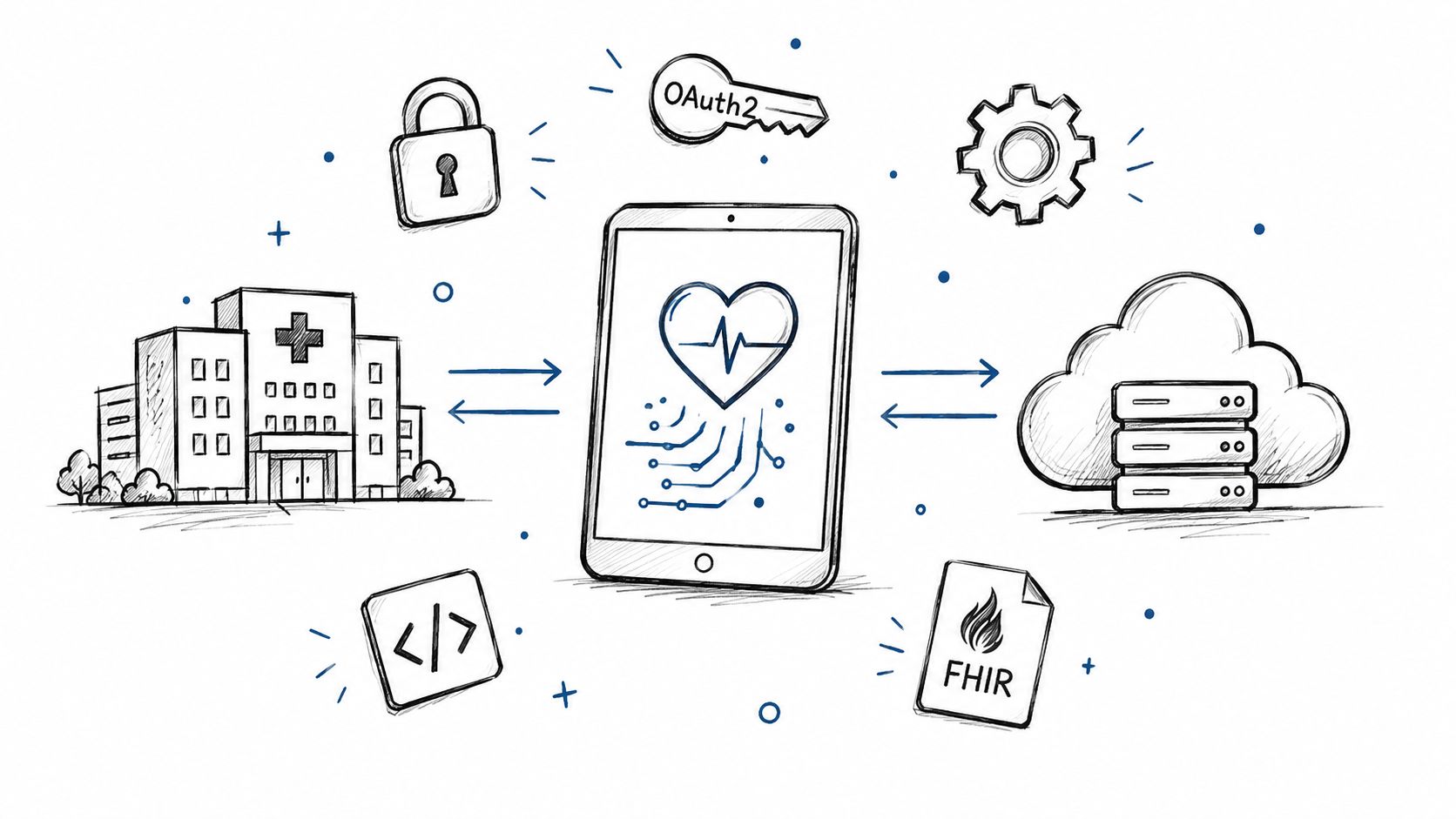
Smart on FHIR guide for healthtech engineers. Learn the OAuth 2.0 launch model, scope syntax, backend services, and US regulatory requirements.
Connect with our team to explore how AI expertise can transform your business.