
AI in Healthcare
HIPAA-Compliant AI: How to Use LLMs With PHI Safely
How to build HIPAA-compliant AI: when LLM providers need a BAA, data minimization, de-identification, audit controls and a reference architecture.
October 16, 2026Read more
Discover how AI-led healthcare innovation drives ROI. Our guide covers use cases, a strategic framework, and implementation steps to transform your business.
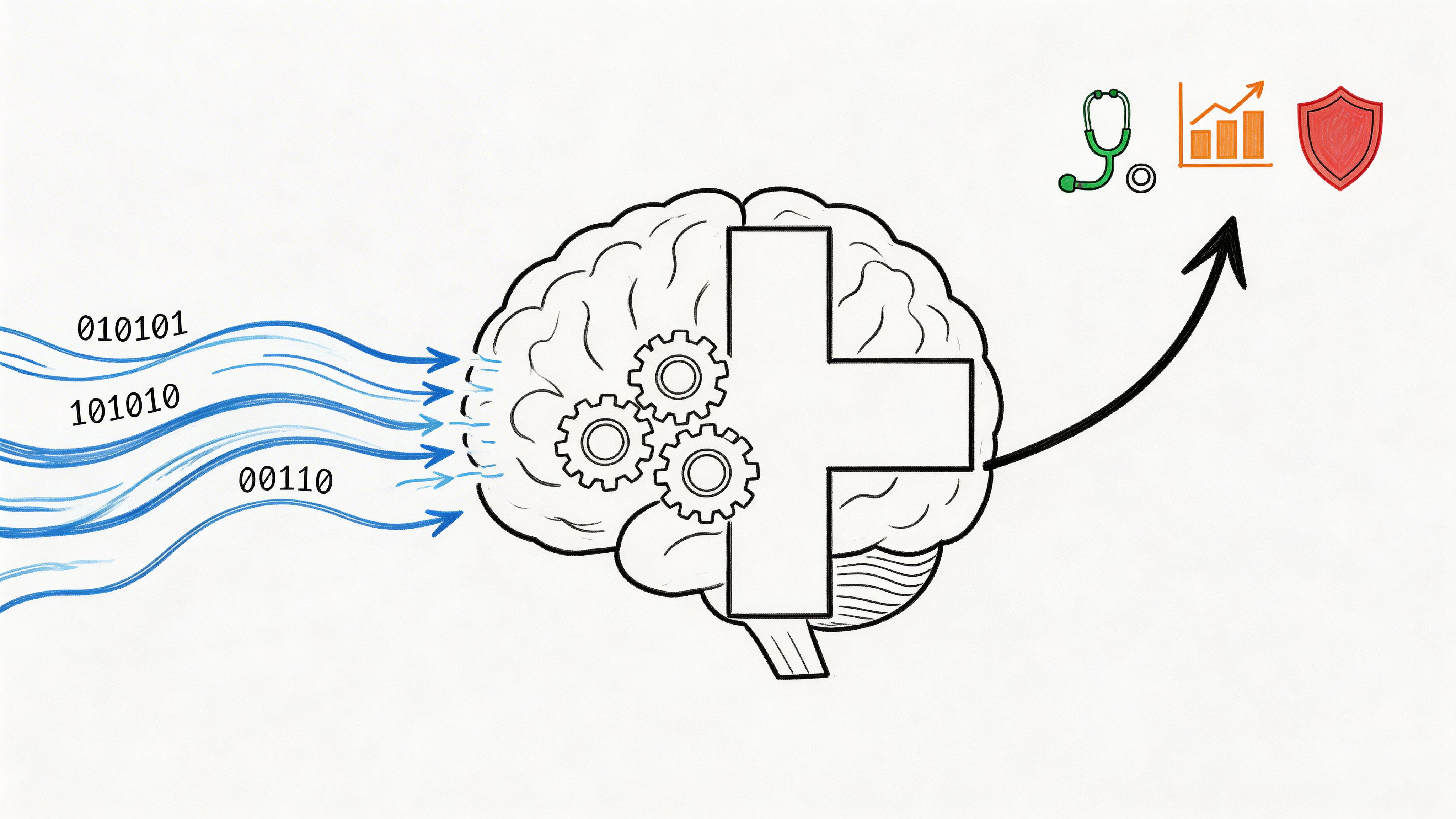
Healthcare moved from AI experimentation to AI deployment. In 2025, 22% of healthcare organizations implemented domain-specific AI tools, a 7x increase from 2024 and 10x from 2023, surpassing the broader economy by 2.2x according to Menlo Ventures.
That changes the executive conversation. AI-led healthcare innovation isn't about adding another dashboard or automating a single workflow. It's about redesigning clinical operations, care delivery, documentation, revenue capture, and product strategy so the organization can move faster with lower friction and better decisions.
Most health systems don't need more AI ideas. They need fewer, better bets. They need a way to choose use cases with a clear path to ROI, handle compliance early, and avoid building disconnected pilots that never reach production. Such situations demand disciplined execution far more than hype.
A $4.9 trillion industry is finally acting like a software market.
Healthcare is no longer treating AI as a side experiment. Health systems, outpatient groups, and payers are putting it into production because the economics now justify the effort. Documentation is getting automated. Revenue cycle workflows are getting tighter. Clinical support tools are getting embedded into daily operations instead of sitting in pilot mode.
That shift matters because healthcare has carried avoidable friction for years. Manual charting, disconnected systems, coding gaps, slow prior authorization, referral leakage, and weak patient communication all drain margin and staff capacity. AI improves those pressure points when leaders apply it to a specific workflow, connect it to the system of record, and hold teams accountable for measurable results.
AI-led healthcare innovation is not one product category. It is a portfolio of capabilities, including generative AI, machine learning, computer vision, and workflow automation, applied to operational and clinical bottlenecks. The return comes from choosing use cases that fit service-line economics, compliance requirements, and data readiness. That is why disciplined operators are pulling ahead.
Start there.
A practical program begins with three decisions. Pick a high-frequency workflow with visible cost or revenue impact. Confirm the data, integration path, and clinical ownership before procurement. Set success metrics that finance, operations, and compliance all accept. Teams that need execution support should start with focused Healthcare AI Services, not another generic innovation sprint.
AI creates value in healthcare when it removes friction from an expensive process and ties the improvement to a hard operating metric.
The winners will not be the organizations with the most pilots. They will be the ones that standardize evaluation, deploy into real workflows, and scale what works across adjacent functions. That is why ambient documentation, imaging support, and revenue cycle automation are advancing quickly. The workflow is repeatable. The stakeholder group is clear. The financial impact shows up fast.
The same operating discipline is shaping adjacent sectors. Unleashing AI and CRISPR in biotechnology shows how technical capability turns into commercial advantage only after organizations integrate it into products, processes, and governance. Healthcare is now at that stage. The question for executives is no longer whether AI matters. The question is where to apply it first for the fastest, cleanest return.
USD 505.59 billion by 2033. That is where the AI in healthcare market is headed, with projected annual growth of 38.90%. The same analysis estimates AI could remove 4 to 10% of U.S. hospital costs, or roughly $60 to $120 billion a year, according to Grand View Research.
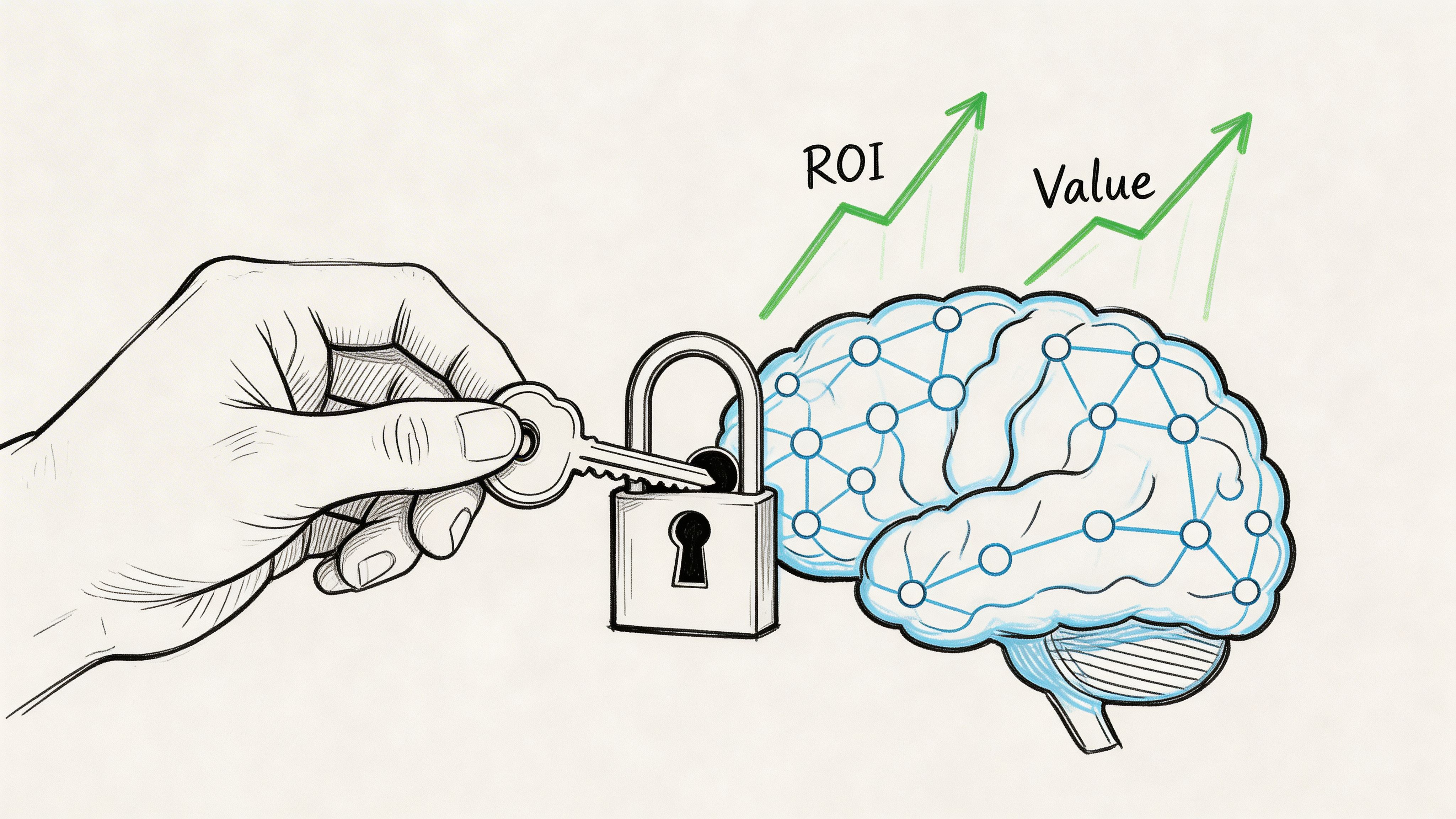
That headline number is useful, but it does not build a business case. Executives need a tighter standard. Fund AI where it improves a defined workflow, produces a measurable financial result, and can survive clinical, IT, and compliance review without slowing deployment to a crawl.
Healthcare AI pays off through three routes: lower operating cost, higher throughput, and stronger revenue capture.
Use all three in the model. A business case built on labor savings alone is incomplete and usually undervalues the investment.
The strongest near-term returns usually come from software embedded inside existing operations. That matches where spending is already concentrating across the market, especially in decision support, workflow execution, and coordination tools rather than standalone novelty products.
For provider organizations, four categories deserve immediate scrutiny:
| ROI lever | Where it shows up | Executive implication |
|---|---|---|
| Documentation efficiency | Clinical notes, ambient capture, coding support | Reduce clinician friction and improve downstream data quality |
| Revenue cycle performance | Prior auth, denials, coding workflows, claim prep | Protect margin without adding headcount |
| Diagnostic acceleration | Imaging support, risk scoring, triage | Improve time-sensitive decisions and care coordination |
| Internal operations | Staffing workflows, audit prep, reporting, knowledge access | Improve speed on repetitive internal work |
Ambient documentation is a good example because the economics are easy to verify. If your organization is evaluating a clinical AI assistant for ambient documentation and workflow support, measure it against time saved per encounter, chart closure speed, coding completeness, and clinician retention risk. Those are operating metrics a CFO and COO can act on.
Practical rule: If a use case does not improve cost, capacity, revenue, or risk inside a named workflow, it does not deserve board-level sponsorship.
Model sophistication is secondary. Workflow economics come first.
A CFO cares about denied claims, labor cost per encounter, and days in A/R. A COO cares about cycle time, staffing pressure, and service-line capacity. A CMO cares about clinician adoption, documentation burden, and patient safety. If the proposal cannot tie the AI system to those outcomes, it is still a technical experiment.
That is the standard Ekipa AI helps organizations apply. Map the use case to a hard financial lever, confirm the integration path and governance requirements early, then deploy where the return is visible within one budget cycle. That is how healthcare AI moves from pilot theater to enterprise value.
Stroke treatment loses value by the minute, and rare disease diagnosis often drags on for years. That is why the best healthcare AI use cases are easy to spot. They remove delay from expensive clinical decisions.
This category deserves board attention because the ROI is visible. You can tie it to faster treatment, higher throughput, stronger service-line performance, lower specialist burden, or better trial matching. If a use case cannot show one of those outcomes in a defined workflow, it belongs in R&D, not in the operating plan.
Researchers from Harvard Medical School and the Centre for Genomic Regulation developed PopEVE, a generative AI model for classifying genetic variants. A cited industry summary reports that it reached 92% accuracy, outperformed prior tools by up to 20%, and could reduce rare disease diagnostic timelines from 5 to 7 years to months (Alation).
For executives, the point is straightforward. Variant interpretation is a specialist bottleneck. A tool that improves speed and confidence in that step can reduce review burden, speed patient stratification, and make genomics programs more financially viable.
This is how strong healthcare AI creates value. It improves one costly decision inside a workflow that already matters.
RapidAI's Lumina 3D targets a different constraint. It converts CT angiography into near real-time 3D views for stroke intervention, improving detection of medium vessel occlusions and cutting time to treatment, according to the same cited summary.
That matters operationally as much as clinically.
In stroke care, faster imaging interpretation supports faster handoffs across radiology, neurology, intervention teams, and transfer coordination. That can improve throughput, protect reimbursement, and strengthen the competitiveness of a stroke program. CEOs should view this as service-line economics, not just technical progress.
High-value AI use cases reduce delay or uncertainty inside an existing care pathway.
These examples also show that not all clinical AI sits in the same risk category.
A genomics interpretation model or imaging decision-support tool can influence diagnosis or treatment. That raises the bar for validation, monitoring, quality documentation, and regulatory review. A workflow assistant sits in a lighter deployment category if it does not make clinical decisions and if escalation rules are clear.
That distinction affects budget, timeline, ownership, and compliance work. Get it wrong, and the pilot turns into expensive rework.
A practical example is a clinical AI assistant for ambient documentation and workflow support. It usually delivers faster ROI because it improves note completion, routing, and staff workload without sitting as close to direct clinical decision-making. That does not remove governance requirements. It changes the implementation path.
| AI Use Case | Primary Impact Area | Potential ROI | Implementation Complexity |
|---|---|---|---|
| Genomic variant interpretation such as PopEVE | Rare disease diagnosis and precision medicine workflows | Faster diagnosis, better patient stratification, stronger research and trial workflows | High, due to data integration, specialist validation, and clinical workflow fit |
| Stroke imaging support such as RapidAI Lumina 3D | Acute intervention and imaging-led care coordination | Faster intervention decisions, stronger stroke pathway efficiency, better service-line performance | High, due to imaging integration, clinical trust, and regulated deployment |
| Ambient clinical documentation | Documentation burden and note quality | Faster note completion, less clinician friction, improved downstream billing support | Moderate, with integration and adoption as the main constraints |
| AI-guided patient communication | Access, scheduling, follow-up, intake | Lower call burden, better patient routing, smoother front-door operations | Moderate, especially where workflow ownership is clear |
The strategic takeaway is simple. Prioritize use cases where the clinical gain and the business gain show up in the same workflow. That is where healthcare AI moves fastest from pilot to scaled value.
Most AI programs fail for a boring reason. The organization starts with tools instead of decisions.
A workable strategy has four pillars. Not because frameworks are fashionable, but because healthcare AI collapses without alignment across business priorities, data quality, delivery capability, and governance.
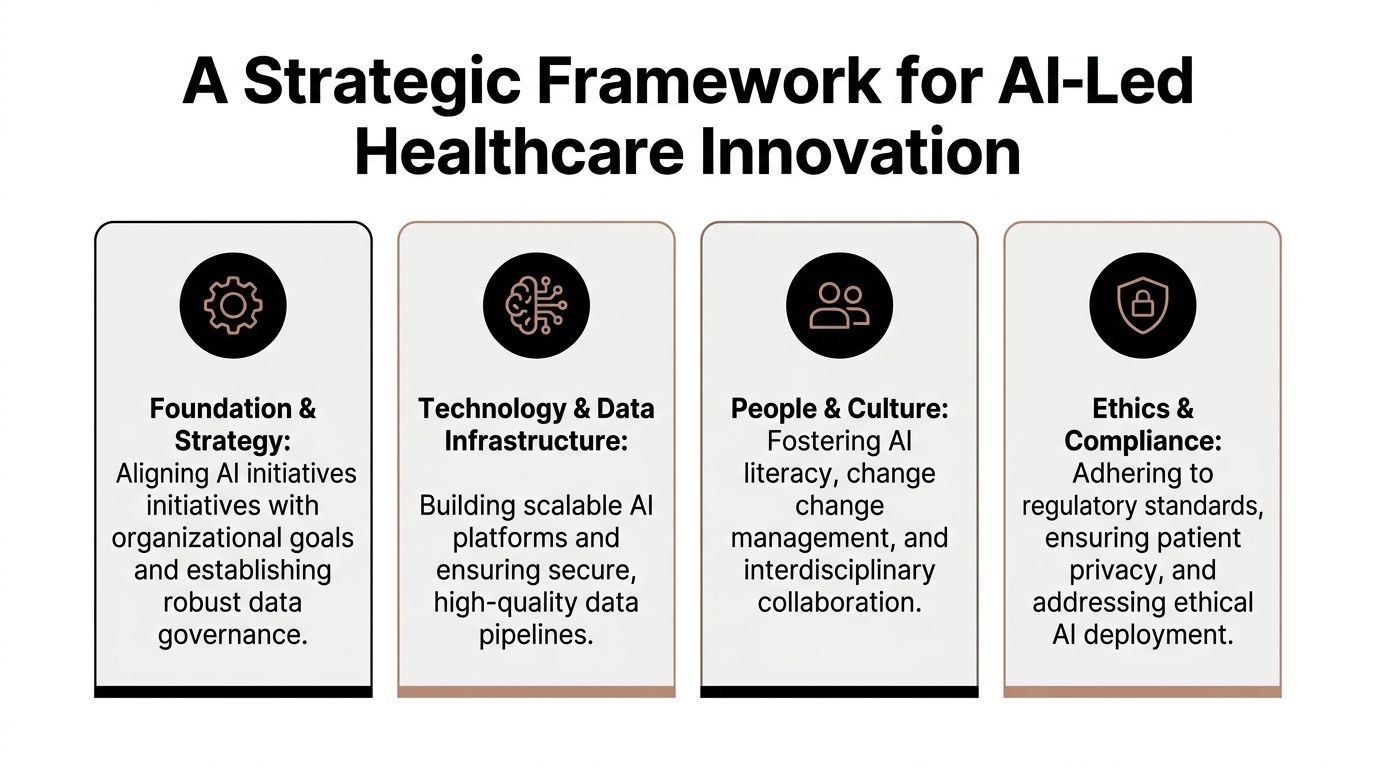
Start with pain, not possibility.
The right question isn't "Where can we use AI?" It's "Which workflow creates enough operational drag, clinical risk, or margin leakage that fixing it changes business performance?"
Good candidates have four traits:
A structured scoping exercise proves its value in this situation. Teams benefit from a Custom AI Strategy report when they need to prioritize use cases against feasibility, compliance demands, and expected business value.
Healthcare leaders underestimate this pillar.
You don't need perfect data. You do need governed data, accessible data, and enough data integrity to support a reliable workflow. Many AI initiatives stall because the source systems are fragmented, labels are inconsistent, and no one has mapped how information moves from the EHR to the operational process the model is supposed to support.
Focus on these questions early:
If your data governance is weak, the AI project won't fail because of the model. It will fail because no one trusts the output enough to act on it.
Build versus buy isn't a philosophical question. It's an economics question.
Buy when the workflow is common, the integration path is straightforward, and the product category is mature. Build when your differentiation comes from proprietary workflow design, domain-specific data, or a product experience that off-the-shelf software can't support.
At this stage, organizations assess AI tools for business, vendor models, APIs, orchestration layers, cloud controls, observability, and security architecture. The technical stack should match the risk level of the use case. An internal summarization tool doesn't need the same validation path as an imaging product that influences treatment decisions.
Many strategies fail at this point.
People need to know who owns the workflow, what the AI is allowed to do, when humans override it, how issues get escalated, and how outcomes are reviewed. Without that clarity, staff either ignore the system or trust it too much.
Organizational alignment usually requires:
One practical option in this stage is a platform like Ekipa AI, which provides structured discovery, strategy support, and execution planning across AI transformation initiatives. The key point isn't the platform itself. It's the discipline of moving from idea to scoped implementation without losing business focus.
Healthcare AI doesn't fail only because of weak models. It fails because leaders ignore the operating environment.
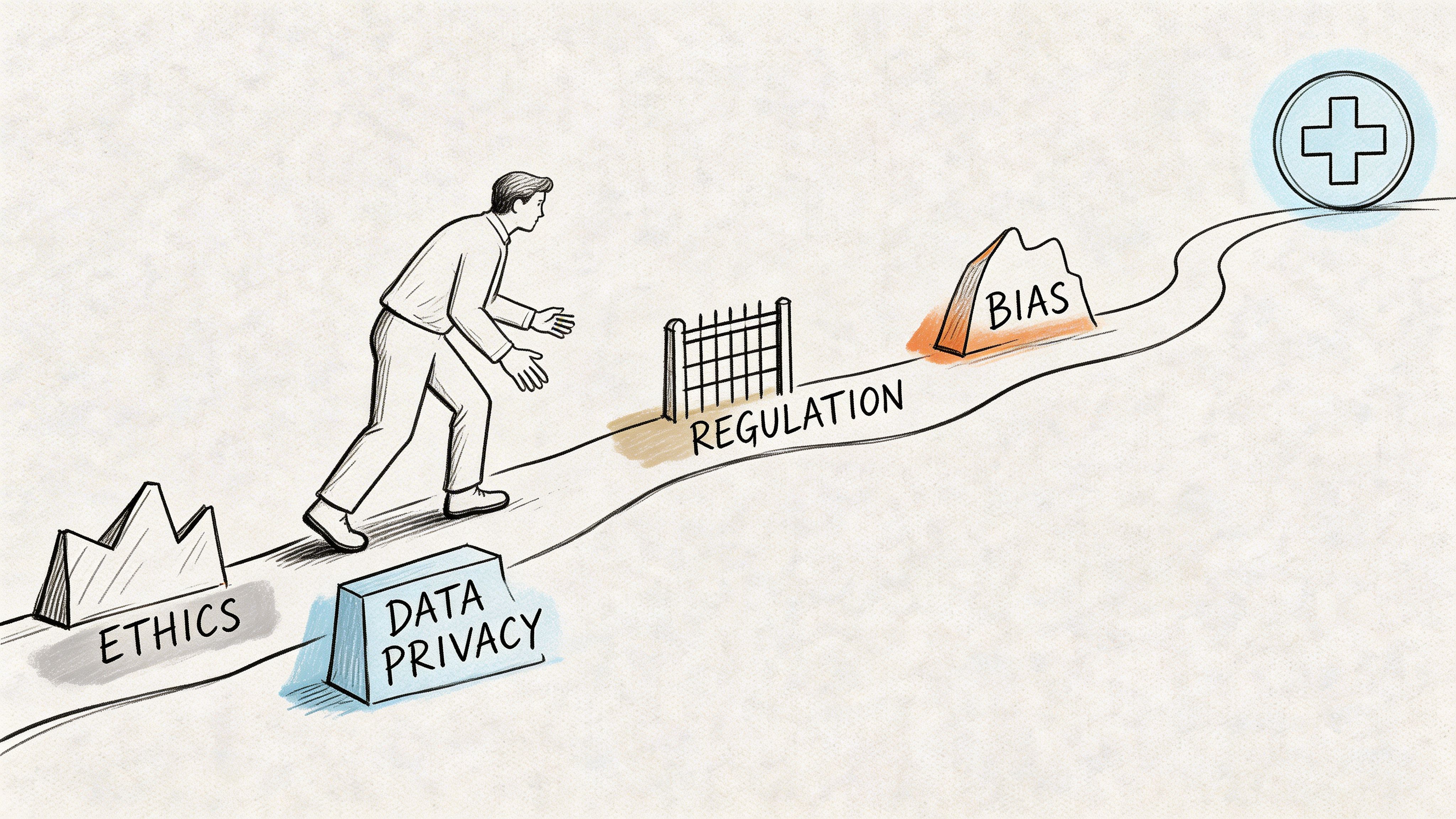
Every serious deployment has to answer the same questions.
Can the system handle protected health information appropriately? Can you explain how outputs are used inside a decision workflow? Is the tool merely supporting operations, or is it influencing diagnosis or treatment? Are the data used to train and validate the system representative enough for the patient populations you serve?
Those questions aren't legal footnotes. They determine architecture, vendor selection, review processes, and whether the product belongs in a regulated category.
For software that may function as a medical device, teams should design with validation, traceability, change control, and post-deployment monitoring in mind. Retrofitting these later is expensive and disruptive.
A lot of AI strategy decks stop at data quality. That's not enough.
Infrastructure barriers beyond data are underexplored. Seventy-seven million Americans live in areas with provider shortages that often overlap with digital and energy infrastructure deficits, and without targeted investments in training and IT, AI can widen inequities instead of narrowing them according to Philips.
That should change how executives think about deployment.
If your model assumes stable broadband, modern endpoints, trained staff, and smooth interoperability, then your rollout plan may exclude the sites that need support most. The issue isn't only fairness. It's execution risk.
A strong AI roadmap includes site reality, not just system architecture.
Healthcare has always required procedural discipline. AI doesn't replace that. It raises the standard.
For example, operational leaders know that clinical safety depends on consistent handling of risk-heavy processes, whether that's medication workflow, sterile processing, or lab operations. A practical safety operations reference outside AI is this guide on handling hazardous drugs. The lesson carries over. High-risk environments need explicit protocols, training, and accountability. AI deployment is no different.
As we explored in our AI adoption guide, the best time to address risk is before procurement, not after rollout.
AI programs fail in execution, not in slide decks. Ekipa AI helps healthcare leaders turn a shortlist of use cases into deployed workflows with clear owners, measurable outcomes, and the controls needed to operate safely.
Start with operating decisions. Define the workflow, name the executive owner, set the target metric, and document the constraints before anyone debates models or vendors. Ekipa AI supports that work with structured discovery, decision support, and implementation planning that prevent teams from funding the wrong build.
Different healthcare priorities need different delivery approaches. Treating every initiative like a platform build slows time to value and inflates risk.
Ekipa AI is useful when leadership wants to move from AI interest to operating results without creating another disconnected pilot. The value is not generic AI capability. The value is disciplined execution across strategy, workflow design, technical delivery, and adoption.
A strong partner should help you answer four questions fast.
| What to evaluate | What a strong partner should clarify |
|---|---|
| Use-case selection | Which workflows should be prioritized first, and what ROI logic supports that choice |
| Technical design | What should be bought, built, or integrated based on data quality, system constraints, and timeline |
| Compliance planning | Which controls, documentation, approvals, and review steps are required before deployment |
| Adoption path | How clinicians, operators, and managers will use the system in day-to-day work |
That is the standard C-suite teams should use.
If a partner cannot tie a use case to workflow ownership, implementation effort, compliance obligations, and measurable financial impact, the engagement is too vague to fund.
Healthcare AI fails financially when leaders fund broad ambition instead of a defined workflow.
Start with one operating problem. Map the current process, identify where labor time is wasted, where errors trigger rework, where revenue is delayed or lost, and where slow handoffs create downstream cost. Then set one target outcome the AI system must improve, such as documentation turnaround, referral routing speed, claim quality, or staff time spent on repetitive tasks.
If no one owns the workflow and no operating metric is attached to it, the business case is still incomplete.
They treat model selection as strategy.
That is backward. The right order is business problem, workflow design, data readiness, risk controls, then tooling. Teams that skip those steps usually end up with pilots that look promising in demos and disappear in production.
Choose the pain point first. Choose the model later.
No.
Smaller provider groups often have an execution advantage because decision-making is faster and workflows are narrower. That makes it easier to test a use case, prove value, and expand with discipline.
The best starting points are usually operational. Front-desk coordination, patient messaging, clinical documentation, and internal staff support tend to have clear friction, visible labor cost, and straightforward success metrics.
Buy when the workflow is common and the vendor category is already proven.
Build when the workflow is part of your differentiation, your internal data creates strategic value, or integration requirements are too specific for an off-the-shelf product. In practice, many healthcare organizations should use a hybrid model. Buy the commodity layer. Build the workflow logic, system integrations, and user experience that drive adoption and margin improvement.
That approach usually produces faster time to value without giving up long-term control.
Ask a simple question. Does the system materially influence diagnosis, treatment, triage, patient risk classification, or another clinical decision?
If the answer is yes, treat regulatory review as a design requirement from day one. Bring in legal, compliance, quality, security, and clinical leadership before the architecture is fixed. That reduces rework and lowers the chance of building something the organization cannot approve or safely deploy.
Set direction fast and keep the scope tight.
Strong leadership teams do not spread AI across ten initiatives at once. They fund the use case that can prove value quickly, survive compliance review, and fit into day-to-day operations.
If you want a practical starting point, review our expert team and use the same standard described earlier in this article. Tie every AI decision to workflow ownership, implementation effort, compliance obligations, and measurable ROI.
If you're evaluating AI-led healthcare innovation, start with a narrow business problem and a realistic execution plan. Ekipa AI helps teams identify viable use cases, shape strategy, and move toward implementation with fewer false starts.
How to build HIPAA-compliant AI: when LLM providers need a BAA, data minimization, de-identification, audit controls and a reference architecture.

Practical data migration planning guide for healthcare teams. Scope, mapping, compliance, validation, cutover and rollback decisions explained end to end.

Smart on FHIR guide for healthtech engineers. Learn the OAuth 2.0 launch model, scope syntax, backend services, and US regulatory requirements.
Connect with our team to explore how AI expertise can transform your business.