AI in Healthcare
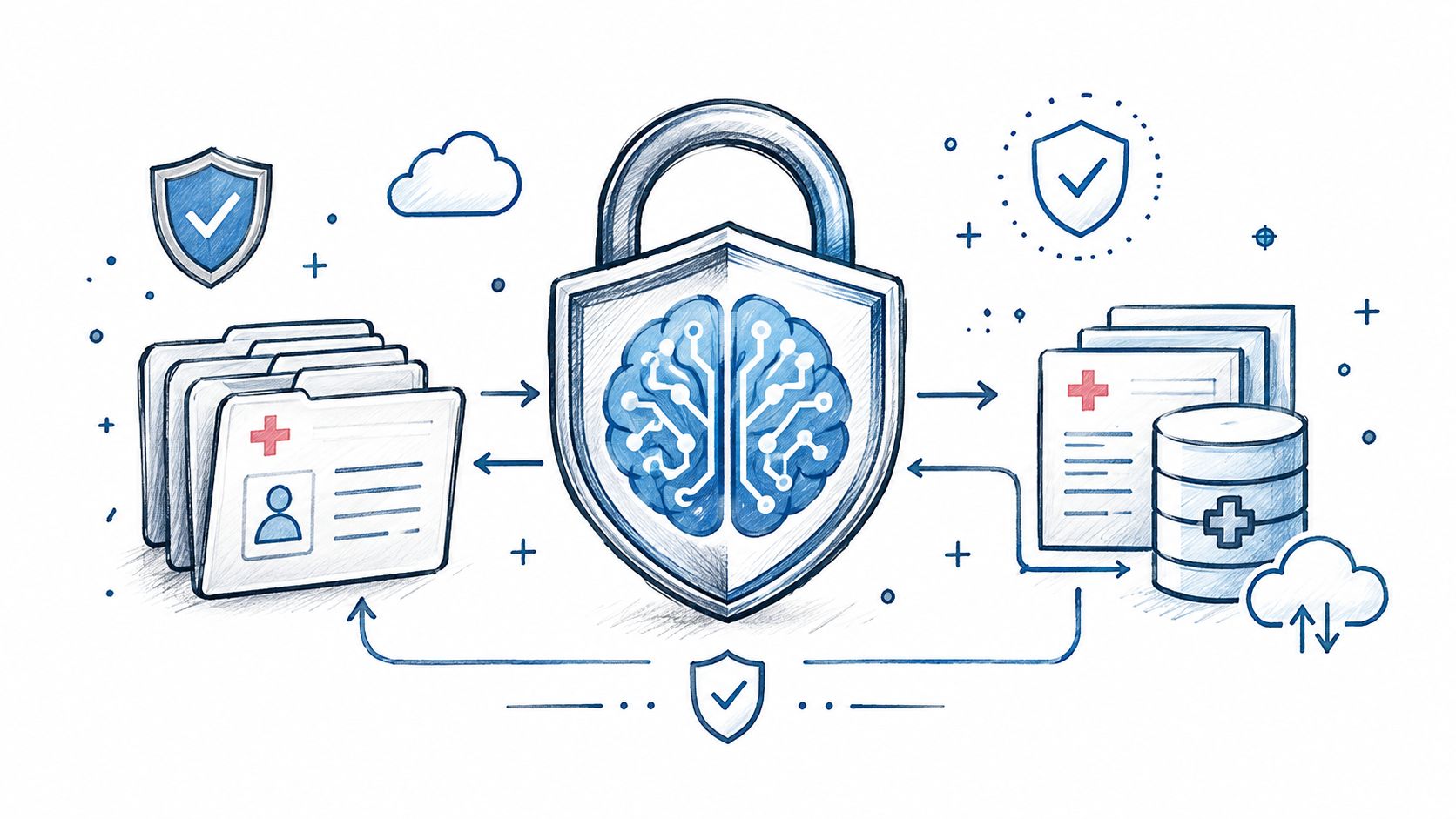
HIPAA-Compliant AI: How to Use LLMs With PHI Safely
How to build HIPAA-compliant AI: when LLM providers need a BAA, data minimization, de-identification, audit controls and a reference architecture.
October 16, 2026Read more
Transform your organization with AI-powered clinical operations. Discover key use cases, ROI, & an implementation roadmap for healthcare leaders in 2026.

For healthcare leaders, the idea of AI-powered clinical operations has rapidly shifted from a future-forward concept to a pressing strategic need. Faced with a perfect storm of soaring operational costs, chronic staff shortages, and shrinking reimbursements, the current financial model is simply unsustainable. AI presents a clear, actionable path toward building a more resilient, efficient, and financially sound healthcare system.

The pressure on healthcare executives has never been greater. The financial math just doesn't work anymore, pushing entire systems toward a breaking point where "doing more with less" is no longer a goal—it's a survival tactic. This is precisely where the strategic use of artificial intelligence becomes indispensable.
Let's look at the hard numbers. The American Hospital Association paints a stark picture: by 2025, labor costs are on track to eat up a staggering 56% of all hospital operating expenses. This is happening at the same time as severe staffing shortages across nursing, care management, and revenue cycle teams.
To make matters worse, reimbursements aren't keeping pace. While inflation jumped 14.1% between 2022 and 2024, Medicare inpatient rates only crept up by 5.1%. Caught in this economic vise, healthcare organizations are turning to AI not as a luxury, but as a lifeline.
The table below breaks down exactly how AI addresses the most significant operational hurdles, turning systemic weaknesses into measurable business strengths. It's a clear illustration of the direct ROI available to organizations that make this shift.
| Operational Challenge | Traditional Approach | AI-Powered Solution | Business Impact |
|---|---|---|---|
| Administrative Overload & Burnout | Manual data entry, paper-based workflows, hiring more staff. | Automates repetitive tasks like documentation, scheduling, and prior authorizations. | Reduces clinician burnout by freeing them for patient care; improves staff retention. |
| Rising Labor Costs | Increased hiring, overtime pay, reliance on expensive contract staff. | Optimizes staffing levels based on predictive patient demand; automates administrative roles. | Lowers labor expenses and dependency on temporary staff; improves operational budget stability. |
| Revenue Leakage & Denials | Manual claims review, reactive denial management, lengthy appeals. | Proactively identifies coding errors and manages claims before submission; automates denial appeals. | Accelerates revenue cycle, reduces denial rates by over 30%, and captures lost revenue. |
| Operational Inefficiencies | Siloed data, inefficient patient scheduling, and poor resource allocation. | Provides real-time visibility into operations, optimizing patient flow and resource use. | Increases patient throughput and asset utilization; shortens wait times and improves satisfaction. |
By moving from manual, reactive processes to intelligent, automated ones, healthcare systems can finally get ahead of the financial and operational pressures that have defined the last decade.
One of the biggest misunderstandings about AI is that it’s here to replace skilled clinicians. The truth is much more practical and powerful: AI is about augmentation. It acts as a force multiplier for your teams, taking over the repetitive, low-value administrative work that bogs down a clinician’s day.
AI-powered clinical operations empower leaner teams to handle increasing demands by automating tedious administrative work. This frees clinicians to focus on what truly matters: complex decision-making and high-value patient care.
This strategic pivot allows healthcare organizations to refocus their most valuable resource—their people—on activities that directly improve patient outcomes and satisfaction. It’s about creating a system where technology manages the clerical burden, letting humans drive the compassionate, expert care that technology can't replicate. The numerous benefits of AI in the healthcare industry make it clear that this isn't just a good idea; it's essential for a sustainable future.
By 2026, we expect to see a massive expansion of AI-driven administrative automation focused on the biggest pain points. These are the areas where efficiency gains can deliver the most immediate and significant impact:
Prior Authorization Triage: Automating the initial review and submission to accelerate approvals.
Clinical Note Summarization: Generating instant, accurate summaries from long patient records.
Claims Editing and Management: Catching and correcting errors before submission to cut denial rates.
Quality Measure Abstraction: Pulling data automatically for compliance and reporting.
Adopting AI has moved beyond an IT project—it's now a core business strategy for survival and growth. For any organization aiming to build a more resilient and efficient future, exploring what's possible with our Healthcare AI Services is the first step in turning today's operational headaches into tomorrow's strategic advantages.

Let's get practical. The real promise of AI-powered clinical operations isn't some far-off, futuristic vision. It’s about solving the stubborn, everyday problems that bog down your clinics and frustrate your staff. The most successful approaches I’ve seen don't involve ripping out your existing systems; they surgically target the highest-friction points with smart automation.
By zeroing in on these specific bottlenecks, you can create a clear "before-and-after" story that makes the business case for AI almost self-evident. When integrated properly with your core healthcare software solutions, these tools don't just fix a problem—they turn a daily headache into a competitive edge.
Patient flow is a constant juggling act. Overbook and you get crowded waiting rooms and angry patients. Underbook and you have idle staff and wasted resources. We've been trying to solve this with manual block scheduling for decades, and it's never quite worked.
AI offers a much smarter way. By crunching the numbers on your historical appointment data, no-show patterns, and even local events or seasonal flu trends, these algorithms can predict patient demand with uncanny accuracy. This means your scheduling can become dynamic, smoothing out the patient load throughout the day and dramatically cutting wait times. It’s about creating a calmer, more efficient clinic for everyone.
Before AI: Rigid, block-based scheduling that creates bottlenecks and can't keep up with the reality of a busy day.
After AI: Predictive, flexible scheduling that anticipates patient demand, optimizes every provider's day, and can slash clinic wait times by an average of 20-30%.
Let's be blunt: physician burnout is a crisis, and the crushing weight of administrative work is a huge part of it. Clinicians often spend nearly half their day tethered to a keyboard, clicking through EHR fields. This is where ambient AI scribes are a game-changer.
Imagine a tool that listens quietly to the natural conversation between a doctor and patient, then automatically drafts the complete, structured clinical note. That’s exactly what these scribes do. They translate the dialogue into compliant documentation that's ready for a quick review and sign-off.
This one piece of technology can give clinicians back hours every single week. It lets them look their patients in the eye instead of at a screen. It's a perfect example of how thoughtfully designed internal tooling can have a profound impact on the well-being of your staff.
By taking over the thankless job of clinical note-taking, ambient AI scribes can cut documentation time by up to 70%. This is a direct assault on burnout and a massive step toward a more human-centered and sustainable way of practicing medicine.
The effect goes beyond just saving time. It addresses one of the most hated parts of a clinician’s job, freeing them to do what they were actually trained to do: care for patients.
Running a hospital or a large clinic is a massive logistical puzzle. How do you make sure you have enough nurses, open operating rooms, and available imaging equipment without being wasteful? AI-powered forecasting gives managers the cheat codes.
By pulling real-time data from your EHR, scheduling systems, and admissions logs, these models can see what's coming. For example, the system can spot a rising patient acuity trend and predict an upcoming need for more ICU beds. Or, it can look at the OR schedule and flag a potential shortage of a specific surgical kit.
This gives your managers the foresight to adjust staffing, order supplies, and prep equipment before a crisis hits. This proactive approach prevents expensive delays and, most importantly, ensures that patient care is never held up by a simple logistical failure. You can see how this works in practice by exploring a library of real-world use cases with proven results.
These high-impact applications are ready today. By starting with a clear strategy, as we explored in our AI adoption guide, any healthcare leader can start using these proven AI tools for business to build a more resilient and efficient operational foundation.
Anyone in clinical research knows the story all too well: trials are expensive, painstakingly slow, and fraught with risk. For decades, this has been the accepted reality of medical discovery. Now, AI-powered clinical operations are starting to change that narrative.
The high cost and even higher failure rate of traditional trials have been a massive drag on innovation. AI offers a way out—not by replacing scientists, but by arming them with tools to make smarter decisions right from the start. We're finally moving away from educated guesses and toward data-backed predictions.
One of the biggest game-changers is using AI to simulate how a trial might play out before enrolling a single patient. By feeding massive amounts of clinical and real-world data into these models, research teams can predict how different patient groups will respond or how a specific trial design will perform.
This gives you a chance to spot critical flaws and make adjustments early on, heading off those costly late-stage failures that can burn through millions and delay research by years. It’s like having a data-driven crystal ball that shows you the most likely paths to success and failure. A Custom AI Strategy report is a great first step to pinpoint where these R&D opportunities exist in your own pipeline.
This isn't just a future concept. We expect 2026 to be the year AI shifts from a talking point to a core component of trial operations. With better data integration, AI simulations will start to have a real impact, leading to concrete wins like faster patient recruitment and more accurate outcome predictions. You can explore more on this trend by reading the full report on Clinical Trials Arena.
Finding the right patients is almost always the biggest bottleneck in a clinical trial. It can drag on for months, sometimes even years. AI completely changes the speed of this process. Algorithms can now comb through millions of electronic health records in minutes, identifying eligible participants who fit complex criteria.
The Old Way: Relying on manual chart reviews and individual site investigators, which is slow and often misses qualified candidates.
The New Way: Using automated screening to build accurate patient cohorts from huge datasets in a fraction of the time.
The Difference: We're seeing recruitment timelines cut by 50% or more, which gets crucial treatments into the world that much faster.
This speed doesn't just get the trial running sooner. It also helps build a more diverse and representative patient group, which ultimately leads to better, more applicable research findings.
The ability to find the right patients from massive datasets in minutes instead of months is a monumental leap forward for clinical research. It directly translates into reduced costs and a faster path to regulatory approval.
Another fascinating application gaining traction is the synthetic control arm. Instead of recruiting a whole separate group of patients for a placebo, AI models can build a "digital twin" control group. This is done by using historical and real-world data from similar patients who weren't in the trial.
The benefits here are huge, especially for rare disease research where finding enough patients for a traditional control arm can be next to impossible.
Key Advantages of Synthetic Control Arms:
Smaller Trials: You simply don't need to recruit as many people, which cuts down on costs and logistical headaches.
Faster Timelines: With no need to manage a full control arm, trials can get started and finished more quickly.
Ethical Upside: Every patient who enrolls gets to receive the investigational treatment, which is a major ethical win.
By adopting these kinds of advanced AI applications, research organizations are seeing a massive return on investment. The ability to shorten trial timelines and slash budgets provides the hard evidence that CTOs and AI strategists need to champion further investment in our Healthcare AI Services.
Bringing AI into your clinical operations isn't a flip-of-the-switch project; it's a carefully planned journey. To get from a promising idea to real, scalable impact without disrupting patient care, you need a solid blueprint. We've seen firsthand what works, and it boils down to a phased approach that mirrors our own AI Product Development Workflow.
This step-by-step process turns what could be an overwhelming transformation into a series of manageable, achievable milestones. By breaking it down, you minimize risk, build crucial buy-in from your teams, and start seeing a return on your investment much sooner.
First things first: you have to know where you stand. This initial phase is all about discovery. Before you can solve any problems with AI, you need to identify exactly what and where those problems are.
Start by mapping your current clinical workflows to find the real bottlenecks. Is patient scheduling a constant headache? Does clinical documentation steal too much time from your physicians? Get specific and quantify the pain. How many hours are lost? How much do errors cost? This hard data will clearly show where AI can deliver the biggest, fastest wins. This process, often part of an AI strategy consulting engagement, sets the foundation for a successful rollout.
Once you’ve zeroed in on a high-impact use case, it’s time to test the waters. The goal here isn't a massive, system-wide overhaul. Instead, you run a pilot program—a small-scale, controlled experiment to prove the concept works in your specific environment. This is your chance to work out the kinks and gather concrete data before you go all-in.
Pick one well-defined problem and set a clear, measurable goal. For example, you might pilot an ambient AI scribe in a single department to see if you can hit a target of reducing physician documentation time by 40%. When a pilot succeeds, it does more than just validate the tech; it creates enthusiastic champions on your staff who can vouch for its value.
This targeted approach is also transforming clinical trials, where AI can streamline notoriously complex processes from start to finish.

As you can see, AI systematically improves each stage, helping optimize trial design, find and recruit the right patients faster, and make sense of complex data—all of which lead to more efficient and effective research.
With a successful pilot under your belt, you have the proof you need to scale up. This next phase is about weaving the AI solution into the fabric of your daily operations. A key piece of the puzzle is making sure the new tools talk seamlessly with your Electronic Health Record (EHR) and other internal tooling.
The best integrations are the ones your team barely notices. For instance, an AI-powered coding tool shouldn't be a clunky, separate app. It should pop up as a helpful suggestion right inside the EHR. Getting this right requires careful technical planning, and it often means working with specialists in custom healthcare software development who know how to make data flow securely and efficiently.
The technology is only half the battle. The other, more important half involves your people. This final phase is dedicated to the human side of adopting AI, which hinges on solid governance and thoughtful change management. Governance means creating clear rules for how AI is used, monitored, and audited, with a heavy emphasis on ethics and patient privacy.
Change management is fundamentally about building trust. It’s more than just training sessions; it’s about explaining the ‘why’ behind the new tools and showing your staff how it makes their work better.
When you communicate openly and bring clinicians into the process from the beginning, you turn skepticism into advocacy. This human-first approach ensures that AI-powered clinical operations aren't just installed—they're truly embraced. That's how you achieve lasting improvements in both efficiency and the quality of patient care.

For a long time, the idea of AI in healthcare meant background automation—something running silently behind the scenes. That’s changing. Now, we're seeing the emergence of the AI copilot, a new breed of tool powered by generative AI that sits right alongside doctors and nurses, woven directly into their daily work.
These copilots aren’t here to make diagnoses or clinical decisions on their own. Think of them more like incredibly capable assistants, ready to lift the heavy administrative burden so clinicians can focus entirely on their patients. This isn't some far-off concept anymore; it's happening in clinics right now.
Until recently, AI's role in the clinic was pretty limited, often handling things like back-office billing or trying to optimize schedules. Generative AI brings that intelligence out of the server room and into the exam room, creating a genuinely collaborative partnership. Integrating practical AI Assistant tools is already showing us what this new way of working looks like.
This new class of AI tools for business is built to assist with complex tasks, but always with a human expert firmly in control. Some of the most immediate applications include:
Scribing on Autopilot: Listening to a patient visit and instantly drafting accurate clinical notes.
Instant Patient Summaries: Turning a decade of medical records into a clear, concise summary in just a few seconds.
Spotting Care Gaps: Automatically scanning a patient's history to flag overdue screenings or potential drug interactions.
Drafting Communications: Quickly generating first drafts of patient follow-up instructions or referral letters for the clinician to review.
This shift is accelerating as the digital health market continues to expand, with projections showing it will exceed $300 billion by 2026. This growth is fueled by tools that fundamentally improve how clinical work gets done. Within this trend, generative AI copilots are becoming indispensable for handling documentation and synthesizing information at scale, all under strict professional oversight.
With all the power AI copilots bring, patient safety remains the absolute priority. That’s why the "clinician-in-the-loop" model isn't just a best practice—it's an absolute requirement. Every single output from an AI, whether it's a draft note, a patient summary, or a care suggestion, must be reviewed, edited, and signed off on by a qualified medical professional.
The AI copilot makes suggestions; the clinician makes the decisions. This fundamental principle ensures that technology serves as a powerful support tool, never a replacement for professional medical judgment.
This model demands that the AI systems themselves are rigorously tested and that clear ethical guidelines are in place to govern their use. The end goal is to build deep, deserved trust in these tools. When implemented correctly, the result is a massive reduction in the cognitive load that drives so much physician burnout. By freeing clinicians from the drudgery of paperwork, these copilots don't just make the practice more efficient—they improve job satisfaction and help retain top talent. You can learn more about how these copilots work in practice with our HCP Engagement Co-pilot.
Making AI-powered clinical operations a reality isn’t something you can do alone. The technology itself is just a tool; the real results come from choosing the right people to build with. Your partner needs to bring more than just technical chops—they must have a deep, practical understanding of healthcare's complex operational and regulatory environment.
This is the single most important decision you'll make. It’s not about just buying a piece of software. It’s about building a core strategic capability for your organization. I’ve seen firsthand how the wrong partnership leads to stalled projects, burned budgets, and clunky solutions that nobody wants to use. The right one, however, acts as a force multiplier, turning your vision into a practical, scalable reality.
The old way of doing things—endless months of analysis followed by a massive consulting bill—is simply too slow to solve today's problems. You need a partner who helps you move fast, right from day one. It all starts with a quick but comprehensive assessment of where you'll get the most value.
This is precisely what our AI Strategy consulting tool was built for. Instead of waiting months for a report, you can pinpoint the highest-impact AI opportunities across your operations in a fraction of the time. This lets you skip the "analysis paralysis" that so often sinks ambitious projects before they even start.
The goal is to get from a high-level idea to a concrete, actionable plan in days, not months. A great partnership is measured by its speed, precision, and a relentless focus on delivering real operational value from the get-go.
A successful AI implementation is a team sport, requiring a mix of very different skills. You don't just need AI coders. You need people who genuinely understand clinical workflows, data security, and the nuances of healthcare compliance.
This is why a blended partnership model is so powerful. It should bring together:
Deep AI Acumen: The technical skill to develop and deploy sophisticated models that solve your specific challenges.
Healthcare Domain Knowledge: A true insider's understanding of clinical processes, regulatory hurdles, and EHR integrations.
Software Development Excellence: The ability to build robust, user-friendly solutions that integrate smoothly with your existing systems.
This combination ensures your AI initiatives are not just technically brilliant but also clinically relevant and operationally sound. Our Healthcare AI Services are founded on this exact principle, blending elite AI talent with proven custom healthcare software development expertise.
To win in this new era of healthcare, leaders have to be decisive. The path to building a more efficient and resilient operation is clear, and it starts with a partner who can guide you at every step. Connect with our expert team today, and let's start building your custom roadmap.
Making the move to AI-powered clinical operations is a big decision, and it’s natural for healthcare leaders to have questions. Let's tackle some of the most common ones we hear, clearing up the practical steps and real-world benefits of getting your AI strategy right.
This is the big one, and the answer is simpler than you might think: AI should fit into your workflow, not the other way around. The goal is always integration, never disruption.
We start by looking closely at your existing processes. The best AI tools are the ones that quietly enhance what your clinicians already do. Think of an ambient AI scribe that listens during a patient visit—it doesn't add a new task for the doctor; it removes the burden of manual note-taking.
The secret is to start small. We always advise a phased approach, beginning with a focused pilot program. This gives you a chance to see how the technology works with your EHR and, more importantly, to get honest feedback from your clinical team before even thinking about a wider rollout.
Another question that always comes up is money. The return on investment really depends on where you apply the AI, but it's measured in both hard cost savings and massive efficiency boosts.
For administrative tasks like handling prior authorizations or cleaning up billing, the ROI is straightforward. You can calculate it directly based on fewer labor hours and a sharp drop in costly errors. Most organizations see a positive return within 12-18 months.
For clinical applications, the impact can be even bigger. In trial recruitment, for example, AI can slash timelines and cut R&D spending, potentially saving millions on a single trial.
The first step is always a thorough AI requirements analysis to pinpoint the use cases that will deliver the fastest and highest return for your specific situation.
When it comes to patient data, privacy isn't just a priority; it's non-negotiable. A responsible AI strategy is built from the ground up on a foundation of HIPAA compliance and airtight data governance.
This means only working with AI platforms designed for healthcare that include end-to-end data encryption, sophisticated data anonymization, and strict, role-based access controls.
Any partner you consider must have a deep and proven track record with sensitive healthcare data. We also build in a critical safety layer with a "clinician-in-the-loop" model, which means a human expert always validates AI-generated insights before any action is taken.
It's a valid concern. Your IT team is likely already stretched thin, and the last thing they need is another massive project. This is precisely why your partnership model is so critical.
Instead of trying to build complex AI systems from scratch, you can offload the heavy lifting. A partner providing AI Automation as a Service or custom healthcare software development can handle it all.
A good partner takes care of the model development, the tricky integration work, and all the ongoing maintenance. This frees up your internal IT team to focus on strategy and oversight instead of getting bogged down in coding and infrastructure. It's the fastest way to see a return.
Connect with our expert team to see how we make implementation feel seamless.
How to build HIPAA-compliant AI: when LLM providers need a BAA, data minimization, de-identification, audit controls and a reference architecture.
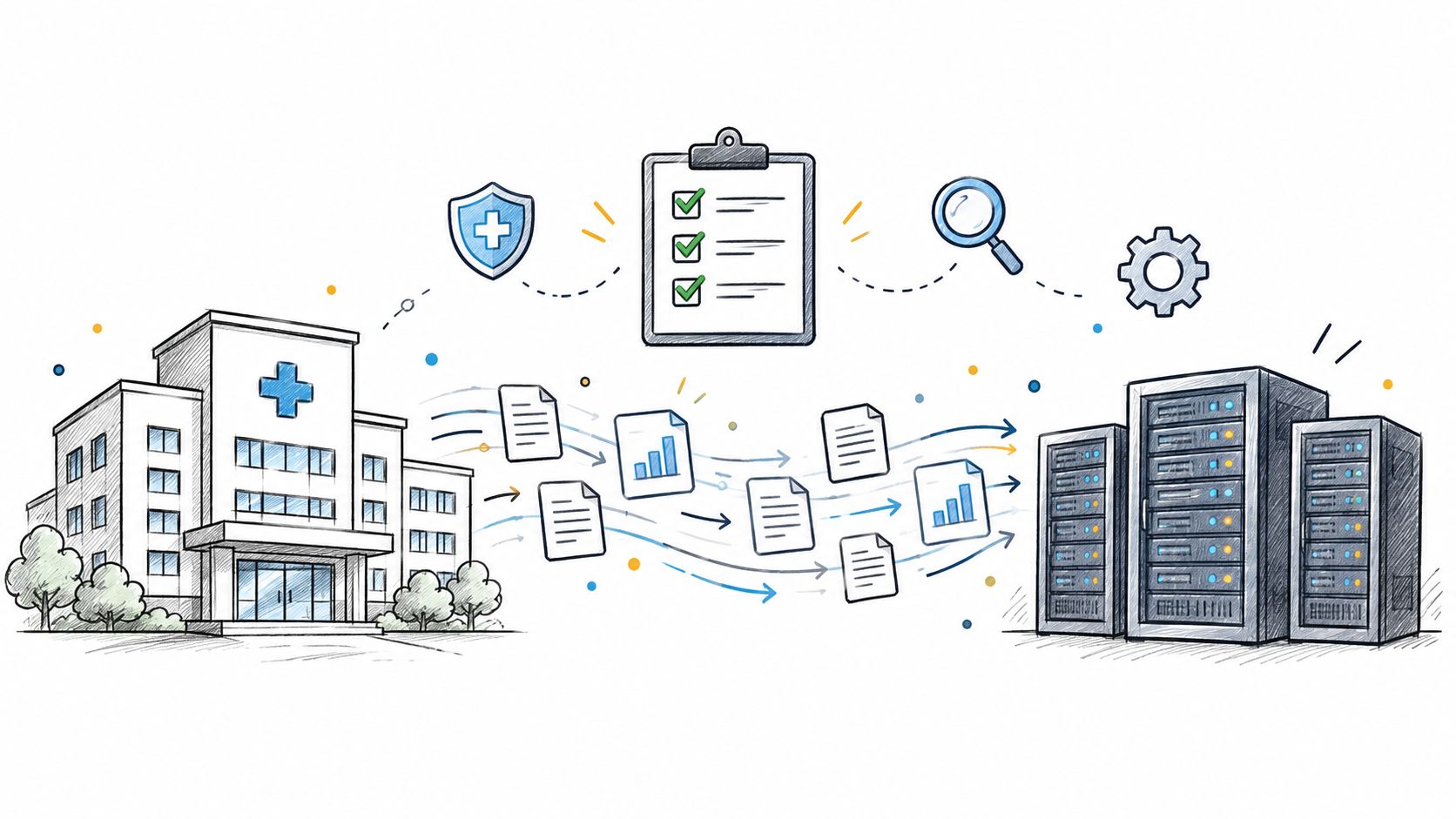
Practical data migration planning guide for healthcare teams. Scope, mapping, compliance, validation, cutover and rollback decisions explained end to end.
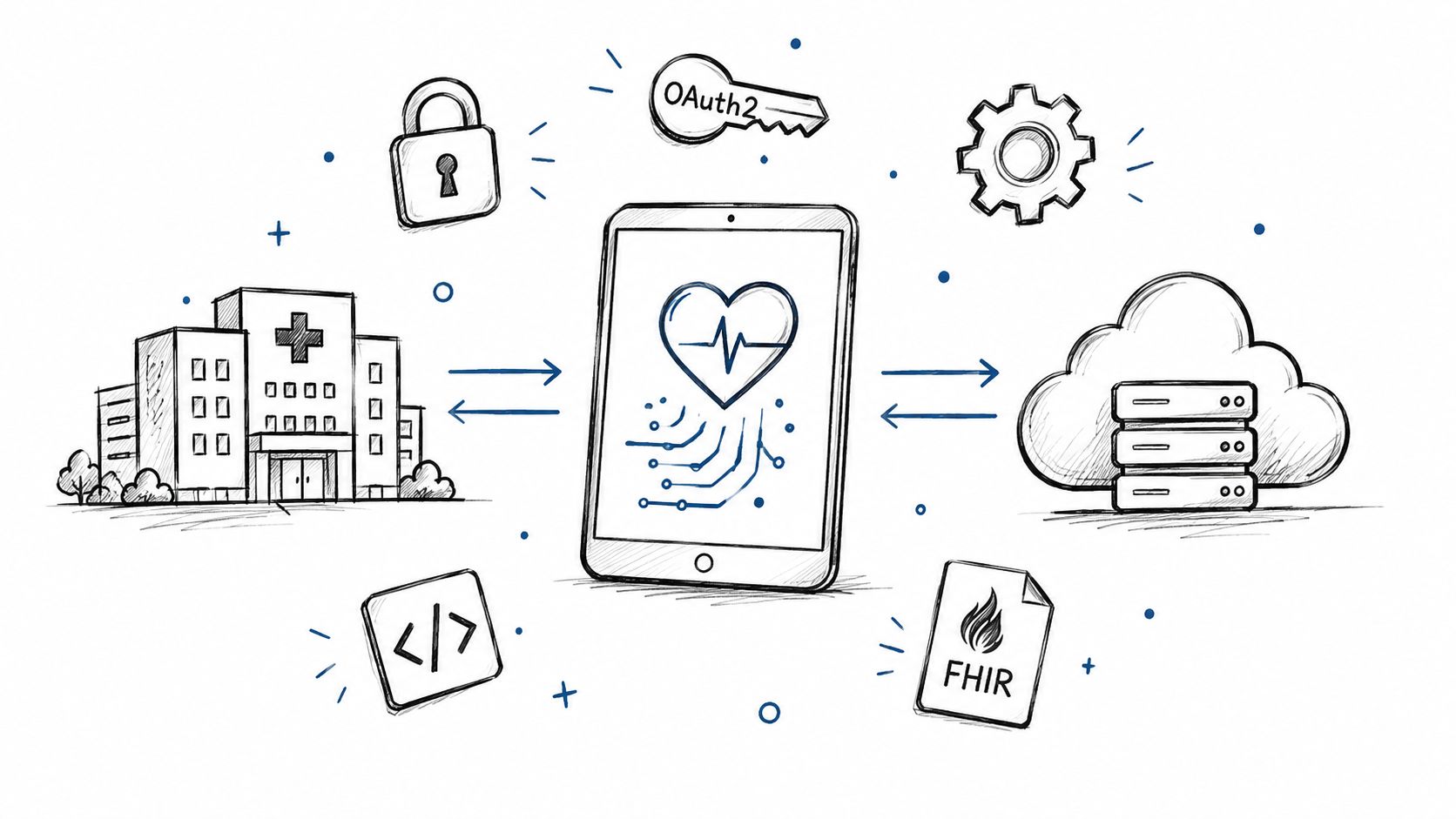
Smart on FHIR guide for healthtech engineers. Learn the OAuth 2.0 launch model, scope syntax, backend services, and US regulatory requirements.
Connect with our team to explore how AI expertise can transform your business.