AI in Healthcare
HIPAA-Compliant AI: How to Use LLMs With PHI Safely
How to build HIPAA-compliant AI: when LLM providers need a BAA, data minimization, de-identification, audit controls and a reference architecture.
October 16, 2026Read more
Explore how an AI-powered medical scribe can reduce physician burnout, enhance documentation, and boost operational efficiency in modern healthcare practices.
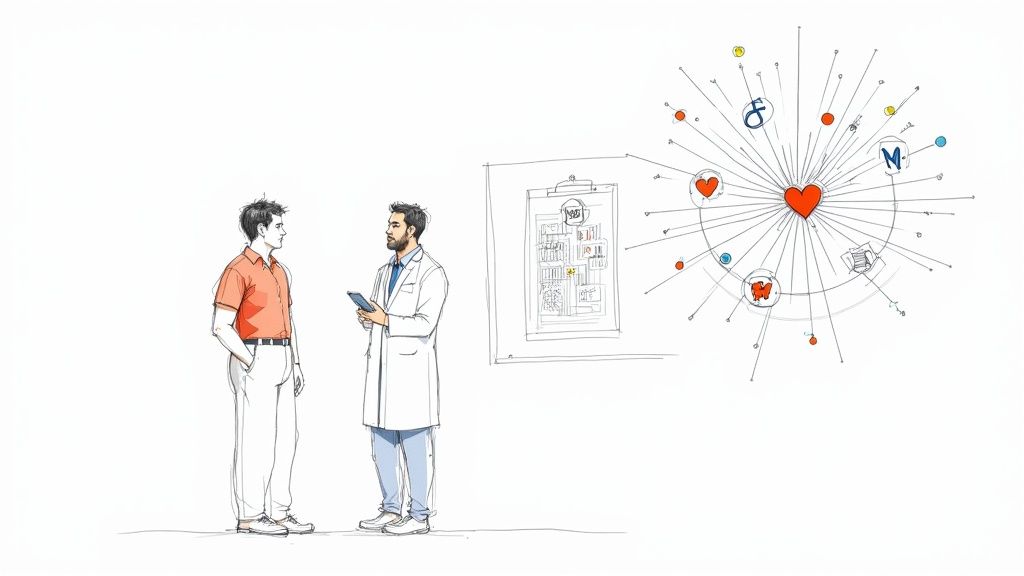
An AI-powered medical scribe is a smart software tool that listens to the natural conversation between a doctor and a patient and automatically turns it into a structured clinical note. Think of it as a digital assistant that handles the tedious task of note-taking, so the clinician can focus completely on the patient in front of them.
Doctors today are drowning in administrative work. The demands of clinical documentation have exploded, and many physicians now spend almost as much time typing into electronic health records (EHRs) as they do actually talking to patients. This constant data entry is a major cause of professional burnout and pulls them away from what they're meant to be doing: providing compassionate, focused care.
The result is easy to see. Clinicians are chained to their keyboards, patients feel ignored as their doctor types, and the entire interaction feels impersonal. This is where an AI-powered medical scribe isn't just another piece of tech—it's a way to bring balance back to the practice of medicine.
Picture a medical assistant who never gets tired, understands complex medical jargon perfectly, and can instantly organize a detailed conversation into a flawless clinical note. That's essentially what an AI scribe does. It works quietly in the background, using advanced listening technology to capture the dialogue between a clinician and a patient.
This automation frees physicians from the endless clicking and typing needed to fill out EHRs, and the benefits go way beyond convenience.
To really get how AI scribes make such a difference, it's useful to look at the bigger picture of AI automation for business. The core idea is the same: automate repetitive work to let human experts focus on what matters. Applying this to healthcare is yielding incredible results. We cover similar ideas in our guide on workflow automation.
To put it into perspective, here's a quick look at how the old way of doing things stacks up against the new.
| Feature | Manual Documentation | AI-Powered Medical Scribe |
|---|---|---|
| Data Entry | Manual typing by the clinician during or after the visit | Automated transcription and data entry in real-time |
| Clinician Focus | Divided between the patient and the computer screen | Fully on the patient, enabling better eye contact |
| Documentation Time | Significant time spent during and after hours | Minimal to no "pajama time"; notes are ready faster |
| Note Accuracy | Prone to human error, typos, and omissions | Highly accurate and consistent, reducing errors |
| Patient Interaction | Often feels rushed and impersonal | More natural, conversational, and engaging |
| Cost | "Free" in terms of dollars, but high cost in burnout | Subscription-based, but with high ROI from time savings |
As the table shows, the shift is about more than just technology; it's about fundamentally changing the dynamic of a clinical encounter for the better.
An AI scribe doesn't just transcribe; it comprehends. It can tell the difference between speakers, pull out clinically important details—like symptoms, medications, and treatment plans—and place that information correctly into the patient's record.
The American Medical Association has noted that AI medical scribes are becoming more common in healthcare, saving thousands of clinician hours each year and helping restore the human element of medicine. This change is vital for keeping the healthcare profession sustainable. By letting smart systems handle the administrative grunt work, we empower our healthcare professionals to do what they trained for—caring for people.
So, how does an AI medical scribe actually work? It might seem like magic, but what's happening behind the scenes is a carefully choreographed sequence of technologies designed to turn a normal conversation into a structured clinical note. The whole point is for it to operate invisibly in the background, letting the doctor focus completely on the patient, not the computer.
It all starts with something called ambient listening technology. Imagine a smart microphone system that can capture everything said during a visit. It’s sophisticated enough to distinguish between the doctor, the patient, and anyone else in the room, without anyone needing to wear a special device or speak into a microphone. This is a critical first step in our AI Product Development Workflow, because the tech needs to adapt to the clinical environment, not the other way around.
Once the audio from the visit is captured, the system gets to work translating it. Powerful Speech-to-Text (STT) engines convert the spoken words into a raw text transcript. These aren't just off-the-shelf voice recognition tools; they've been trained on thousands of hours of medical dialogue, so they understand complex terminology, various accents, and the back-and-forth rhythm of a real patient encounter.
Of course, a simple transcript is a long way from a useful clinical note. This is where Natural Language Processing (NLP) steps in. Think of NLP as the "brain" that reads the transcript and actually understands it. It figures out the context, identifies key medical terms, and makes sense of the unstructured conversation. It’s the difference between hearing words and grasping their meaning, a core function in many modern AI tools for business that becomes absolutely critical in a healthcare setting.
The infographic below really brings to life how this technology can break the cycle of paperwork and physician burnout.
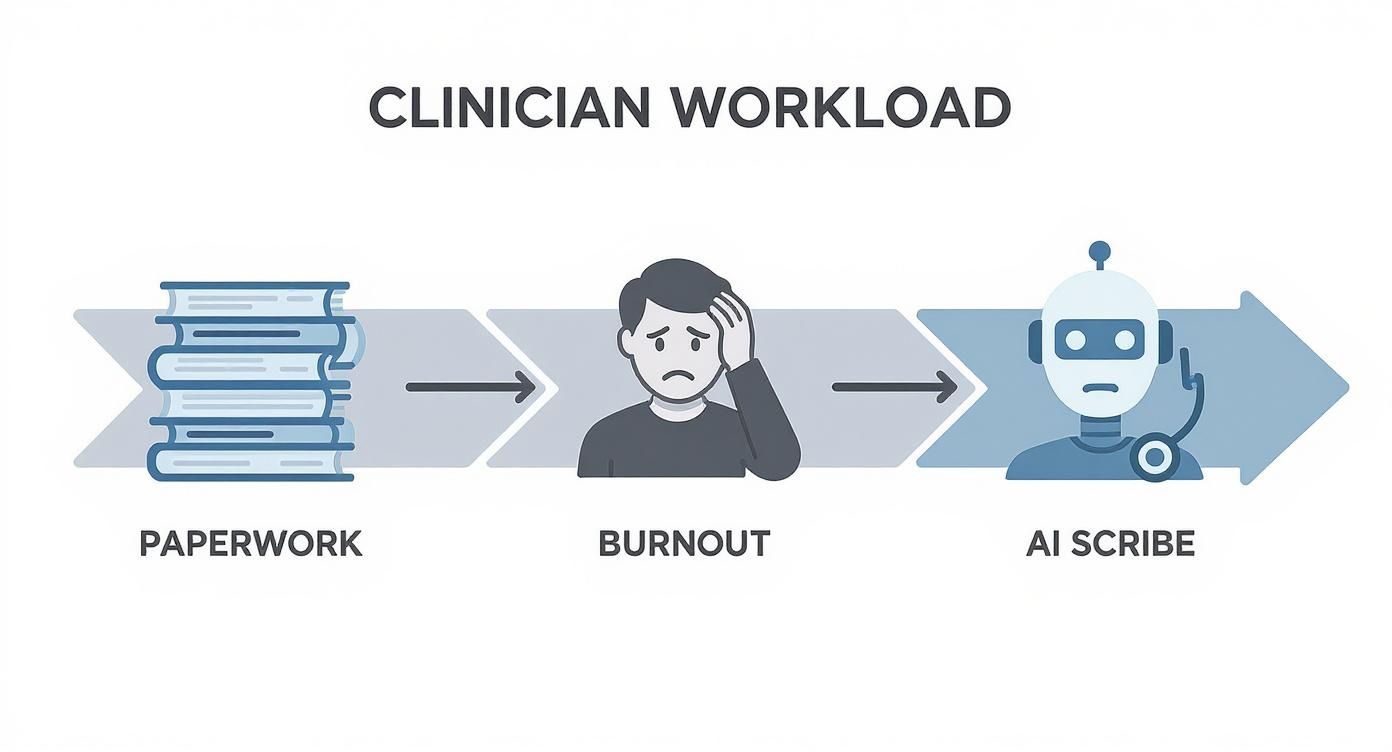
As you can see, AI scribes offer a direct solution to one of the biggest administrative headaches in medicine, turning a major source of frustration into a much more efficient workflow.
The final step is the most important one: structured data extraction. The AI doesn't just create a summary. It intelligently pulls out specific pieces of clinical information and categorizes them correctly. This is where well-designed AI solutions truly prove their worth.
For instance, the AI will sift through the conversation and organize the details into a standard SOAP note format:
This neatly organized information is then formatted to fit directly into the fields of the clinic's Electronic Health Record (EHR) system. The clinician is left with a pre-populated, clinically relevant note that just needs a quick review and a signature.
This ability to turn a messy, real-world conversation into clean, actionable data is what an AI scribe is all about. Building this kind of smart internal tooling requires a deep understanding of both technology and clinical workflows, which is the focus of our AI strategy consulting. You can explore similar real-world use cases to see how these principles are applied across different industries.
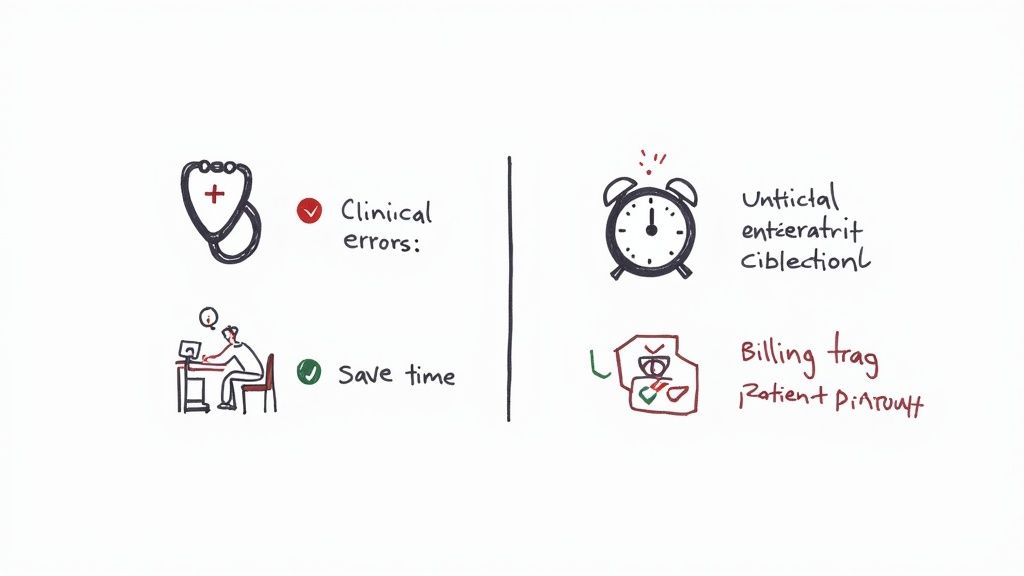
Bringing an AI-powered medical scribe into your practice is about so much more than just saving a few minutes on paperwork. The ripple effects are felt across the entire healthcare organization, delivering real-world wins for both clinical care and day-to-day operations. Think of it less as a simple productivity tool and more as a strategic investment that strengthens the very core of your practice.
The most immediate change happens in the exam room. When physicians are finally untethered from their keyboards, they can give their full attention to the person right in front of them. This shift—from data-entry clerk back to engaged caregiver—is nothing short of profound.
One of the biggest clinical victories is the sharp reduction in human error. An AI scribe captures the nuances of a conversation and structures the data with incredible fidelity, slashing the risk of typos, omissions, or misremembered details that often creep in when notes are written hours later.
This leads to a cascade of improvements:
By taking over the tedious work of documentation, an AI scribe lets clinicians practice at the top of their license. Their mental energy is spent on critical thinking and patient care, not administrative busywork.
Nailing down these clinical goals is a vital first step when building a Custom AI Strategy report, as it ensures the technology serves patient-centric outcomes.
On the operational side, the benefits are just as compelling. AI scribes tackle some of the biggest headaches in modern healthcare management, from financial performance all the way to staff retention.
The single most powerful operational benefit is its direct assault on physician burnout. The administrative load is a well-known driver of burnout, and by automating documentation, AI scribes can give clinicians back up to two hours every single day. That reclaimed time translates directly into better work-life balance and higher job satisfaction.
But the advantages spread throughout the entire practice:
This move toward automation isn't going unnoticed. The AI medical scribe market is heating up, with new tools launching from major EHR players like Epic. This signals a highly competitive environment as health systems hunt for smarter documentation solutions. You can read more about the evolving AI scribe market to get a sense of these trends. These operational gains are precisely why integrating AI Automation as a Service is climbing the priority list for healthcare leaders.
Ultimately, the combination of clinical and operational benefits builds a powerful case for change. An AI-powered medical scribe isn't just another piece of software; it's a catalyst for a more efficient, profitable, and humane way of practicing medicine. If you're ready to see how these systems are built, our expert team can walk you through the world of custom healthcare software development.
In healthcare, nothing is more important than patient trust. So, when we talk about bringing an AI-powered medical scribe into the mix, the conversation has to start and end with data privacy and security. Healthcare leaders need ironclad assurance that patient data is safe, and any technology partner has to show a deep, demonstrable commitment to the rigorous standards of the Health Insurance Portability and Accountability Act (HIPAA).
This isn't just a box to check; it’s the entire foundation. The best AI scribe solutions are built with compliance at their core. Security isn't an add-on—the entire system is engineered around protecting sensitive information, making sure every detail is handled with the utmost care.
To be truly HIPAA compliant, AI scribe vendors have to implement a security strategy with multiple layers. Think of it like a fortress. These technical measures work in concert to create a secure environment where Protected Health Information (PHI) is shielded from unauthorized eyes at every single step.
Here are the non-negotiables:
These safeguards are mission-critical. When you're looking at different AI scribe tools, it's crucial to understand the value of thorough data security and compliance pentests, as they provide third-party validation of a vendor's security claims.
Of course, technology alone can't guarantee compliance. There's a vital legal piece to this puzzle: the Business Associate Agreement (BAA). This is a binding contract between a healthcare provider (the Covered Entity) and the AI scribe company (the Business Associate).
A Business Associate Agreement isn't just a piece of paper. It's a legal promise. The vendor is formally agreeing to protect all PHI it handles on your behalf, making them directly liable for any breaches.
This agreement lays out the vendor's responsibilities under HIPAA in black and white, creating clear accountability. No healthcare organization should ever work with a vendor that touches PHI without a signed BAA. It's the only way to ensure both sides are legally and ethically aligned. You can see our own commitment to data protection in our detailed privacy policy.
Ultimately, bringing an AI-powered scribe into your practice can be a completely secure process. By focusing on vendors who design for compliance from day one, insisting on a BAA, and demanding transparency about their security practices, you can integrate these powerful tools with confidence. The goal is to improve patient care with technology, never to compromise the privacy patients rightly expect.
Not all AI-powered medical scribe solutions are built the same. As this technology moves from a niche tool to a clinical standard, the market is quickly getting crowded. For healthcare leaders, this isn't just another software purchase; it's a critical decision that directly impacts clinical workflows, data security, and the quality of patient care. Picking the right partner requires a methodical approach.
The first step, before you ever see a demo, is to look inward. A thorough AI requirements analysis is essential. You need a crystal-clear picture of what your practice actually needs to achieve. This internal audit grounds your evaluation in your own operational goals, preventing you from being swayed by a vendor’s slick presentation. Knowing exactly what you’re solving for helps you weed out the wrong tools from the get-go.
When you start comparing platforms, a few key factors should immediately jump to the top of your list. These go far beyond simple transcription and get to the heart of how the tool will actually work within your daily operations.
A great piece of software is only half the battle. The vendor you choose becomes a partner, and that relationship is just as important as the technology itself. The best AI solutions are always backed by a strong commitment to service and a clear vision for the future.
Choosing an AI scribe is about more than just technology; it's about selecting a long-term partner. The quality of customer support and the vendor's commitment to future development are just as critical as the software itself.
Think about how the vendor will grow with you. Can their system support a five-person private practice and scale up to a multi-state hospital network? What does their training and onboarding process feel like? A detailed implementation roadmap and responsive support are hallmarks of a vendor that's serious about your success, a principle central to our AI Product Development Workflow.
To help structure this crucial decision-making process, we've developed a checklist. Use it to guide your conversations with potential vendors and ensure you're covering all the essential bases.
| Evaluation Criterion | Question to Ask | Importance (High/Medium/Low) |
|---|---|---|
| EHR Integration | Can you demonstrate a live, bi-directional integration with our specific EHR version? | High |
| Clinical Accuracy | What are your documented accuracy rates for our specialties? Can we run a pilot? | High |
| Data Security & HIPAA | Where is our data stored, and what are your specific encryption and security protocols? | High |
| Specialty Customization | How do you train the AI on our specialty-specific terminology and templates? | High |
| Clinician Workflow | How does the tool fit into the natural flow of a patient visit? Is it obtrusive? | High |
| Implementation & Training | What does your standard onboarding process look like, and who manages it? | Medium |
| Customer Support | What are your support SLAs? Do we get a dedicated account manager? | Medium |
| Scalability & Cost | How does your pricing model scale as we add more providers or locations? | Medium |
| Product Roadmap | What new features or improvements are planned for the next 12-18 months? | Low |
| Vendor Reputation | Can you provide references from organizations similar to ours? | Low |
Ultimately, you're looking for a provider who understands the bigger picture of healthcare technology. A vendor who can act as a true advisor, offering insights similar to AI strategy consulting, will be far more valuable than one who just sells you a license. With the right partner, an AI scribe becomes more than just a tool—it becomes a cornerstone of a more efficient, sustainable, and patient-first practice.
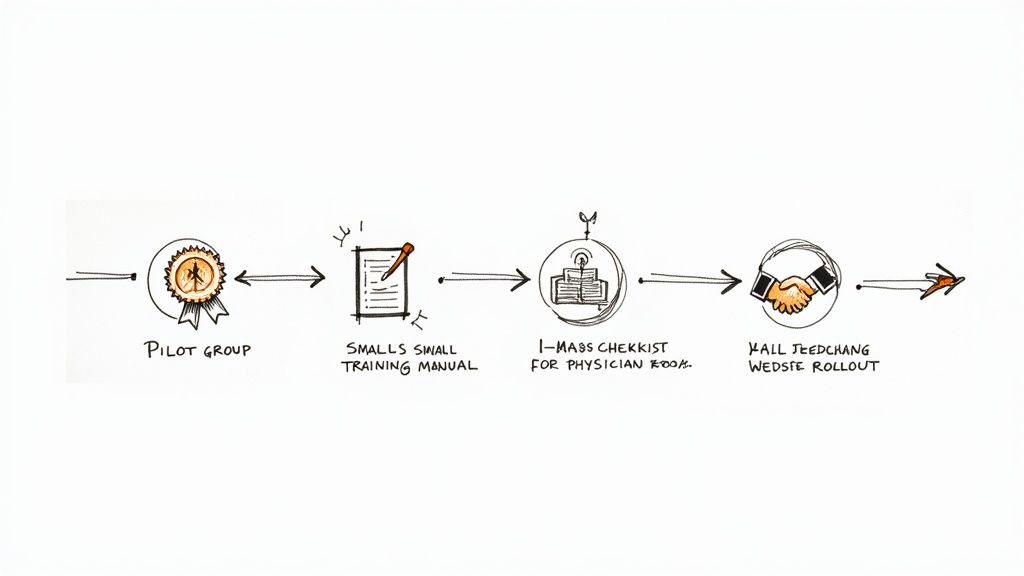
Getting an AI-powered medical scribe up and running successfully has surprisingly little to do with the software itself. It’s all about the strategy. A well-thought-out plan is the difference between a frustrating tech rollout and a smooth adoption that clinicians actually welcome. The real goal is to weave this new tool into the human practice of medicine with as little friction—and as much benefit—as possible.
The whole process needs a clear roadmap from day one. Instead of a top-down mandate, the best approach is to start small, work collaboratively, and build momentum. This ensures the technology bends to fit your clinical world, not the other way around.
The smartest way to begin is with a focused pilot program. Handpick a small, diverse group of clinicians to test the AI scribe in a real-world but controlled environment. You’ll want a mix of tech enthusiasts and healthy skeptics from various specialties. This phase is absolutely essential for getting honest feedback and spotting workflow hiccups before you even think about a full-scale deployment.
Here’s what you need to accomplish during the pilot:
The data you gather here is gold. It will help you build a solid business case for expanding the program and will show you exactly how to refine your training.
Once you have insights from your pilot, you can build out a proper training program. Good training is more than a "click here, then here" tutorial. It needs to build trust in the technology and drive home its core value: less time on paperwork means more time with patients.
Physician buy-in is, without a doubt, the single most important part of managing this change. When you address concerns head-on, prove the time-saving benefits, and make clinicians feel like partners in the process, you turn skeptics into your biggest champions.
Establishing clear workflows for how clinicians should review and sign off on AI-generated notes is also key. This keeps them in the driver's seat, reinforcing that the AI is a highly capable assistant, not a replacement. For a deeper look at managing these kinds of integrations, you can explore our detailed implementation support process.
The market trends are certainly pointing in this direction. The global market for AI in medical writing, which includes these scribes, was valued at around $869 million and is on track to reach $1.76 billion by 2030. This incredible growth, which you can read more about in these market growth findings, shows just how committed the industry is to solving the documentation burden.
In the end, a successful implementation puts people first. By listening to your clinicians, offering solid support, and focusing on the real, tangible benefits to their daily work, you can make sure your AI scribe initiative delivers on its promise to bring the focus back to patient care.
As organizations start to look into AI medical scribes, some very practical questions always come up. It's only natural. Getting straight answers to these common concerns is the best way to understand how this technology actually works in the real world and build confidence in what it can do.
Here are the answers to the questions we hear most often from both clinicians and administrators.
This is usually the first question on everyone's mind. The best AI scribes can hit over 95% accuracy under good conditions—think clear audio and minimal background noise.
But here’s the most important part: no professional system is ever meant to be a "one and done" solution. Every single one is designed for a clinician to give the note a quick final review and make any necessary edits. This "human-in-the-loop" step is critical, ensuring the final record that goes into the chart is 100% accurate and clinically sound.
Yes, and it absolutely has to. The ability to fit right into your existing workflow is non-negotiable. Top-tier AI scribe platforms are built to integrate seamlessly with major EHR systems like Epic, Cerner, and Athenahealth.
The goal is for the AI to push the drafted note directly into the correct fields in the patient’s chart, all behind the scenes. This gets rid of the copy-paste nightmare and makes the tool feel like a natural part of the clinical process. If you have unique needs, looking into custom healthcare software development can help create even deeper, more tailored integrations.
Absolutely, and it's a responsibility every credible vendor takes seriously. Any AI scribe provider you consider must be HIPAA compliant. This involves a whole host of security measures, from end-to-end encryption of all audio and text to storing data in secure, access-controlled cloud environments.
Before you sign any contract, make sure the vendor will sign a Business Associate Agreement (BAA). This is the legally binding document that holds them accountable for protecting patient data to the same standards you do. It's a deal-breaker if they won't.
Figuring out how to adopt this kind of technology is a big piece of any modern healthcare strategy, as we explored in our AI adoption guide. At Ekipa AI, our team specializes in helping organizations build a clear AI roadmap, from the first conversation all the way through a successful rollout.
Ready to see how AI can give your clinicians back their time? Explore our AI solutions to learn how we help turn complex documentation challenges into real, scalable results. Meet our expert team to discover the people behind our technology.
How to build HIPAA-compliant AI: when LLM providers need a BAA, data minimization, de-identification, audit controls and a reference architecture.

Practical data migration planning guide for healthcare teams. Scope, mapping, compliance, validation, cutover and rollback decisions explained end to end.
Smart on FHIR guide for healthtech engineers. Learn the OAuth 2.0 launch model, scope syntax, backend services, and US regulatory requirements.
Connect with our team to explore how AI expertise can transform your business.