AI in Healthcare
HIPAA-Compliant AI: How to Use LLMs With PHI Safely
How to build HIPAA-compliant AI: when LLM providers need a BAA, data minimization, de-identification, audit controls and a reference architecture.
October 16, 2026Read more
Discover a practical AI risk management framework for healthcare. Learn to build governance, define risks, and ensure patient safety for reliable AI adoption.
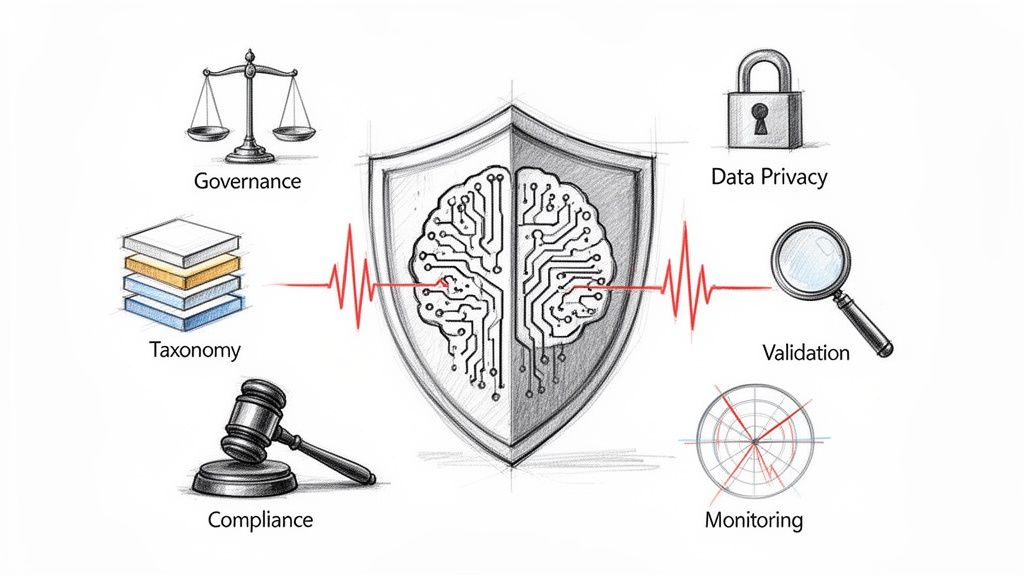
An AI risk management framework in healthcare is essentially a structured game plan. It combines governance, strict data and model controls, and ongoing oversight to make sure artificial intelligence is rolled out safely, ethically, and effectively. This isn't just about ticking boxes; it's about turning a powerful technology from a potential liability into a trusted clinical tool by getting ahead of risks to patient safety, privacy, and compliance.
Artificial intelligence has moved beyond the lab and is now actively shaping everything from patient diagnoses and treatment personalization to the nuts and bolts of hospital operations. But as AI becomes more embedded in clinical workflows, the stakes get higher. Once you look past the buzz, it becomes clear why having a formal system for managing AI risks is no longer a "nice-to-have"—it's a clinical imperative.
Without a structured approach, jumping into AI implementation can expose a healthcare organization to some serious blind spots. You could easily run into:
This isn't just theory. Top industry safety organizations are sounding the alarm. In a telling sign of the times, ECRI—a global patient safety organization—recently placed artificial intelligence at the very top of its annual list of the most significant health technology hazards.
They're not saying AI is bad; they're warning that deploying it without rigorous testing and oversight introduces profound, often hidden, risks to patients.
This flowchart maps it out perfectly: you implement AI, new risks naturally emerge, and a management framework becomes the essential bridge to ensuring the technology is both safe and effective.
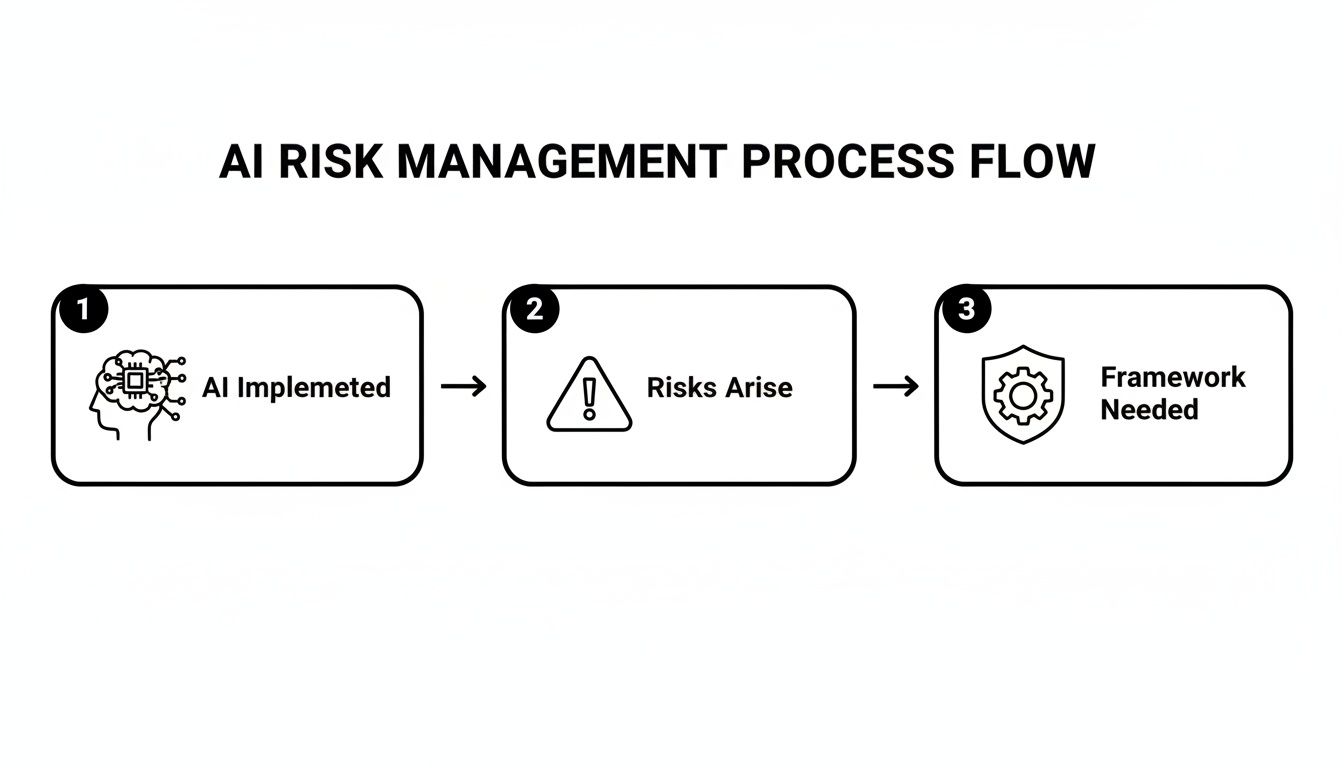
What this shows is that risk isn't just a possibility; it's an inherent part of AI adoption. That's why building a protective framework from day one is non-negotiable.
Let's make this tangible. Picture an AI tool designed to screen retinal images for early signs of diabetic retinopathy. If that algorithm was primarily trained on data from one demographic, it might be far less accurate when analyzing images from patients of other ethnic backgrounds.
This could lead to a wave of missed diagnoses and delayed treatments for an entire population. Without a solid risk management framework, this dangerous bias might not be discovered until after patients have already been harmed.
An effective framework would have mandated a fairness audit during development. It would require continuous performance monitoring across all patient demographics post-deployment and establish a clear, simple protocol for clinicians to flag suspected inaccuracies. It turns a potential crisis into a manageable, controlled process.
Building a robust framework starts with a solid foundation. A comprehensive Responsible AI guide provides the principles, and our specialized team at Healthcare AI Services can help you put those principles into practice, ensuring your AI initiatives are both innovative and incredibly safe.
Let's get straight to the point: you can't manage AI risk without clear accountability. It’s the bedrock of any serious AI risk management framework for healthcare. Without a defined structure for who owns what, even the most brilliant AI initiatives can drift into dangerous territory, leaving your patients and your organization exposed.
This isn't about adding layers of red tape. It’s about building responsibility directly into your organization's culture. The aim is to create a clear line of sight for every single AI system, from the moment it's just an idea on a whiteboard to the day it's retired. This is the kind of proactive thinking that separates successful AI adoption from a string of failed, risky experiments.
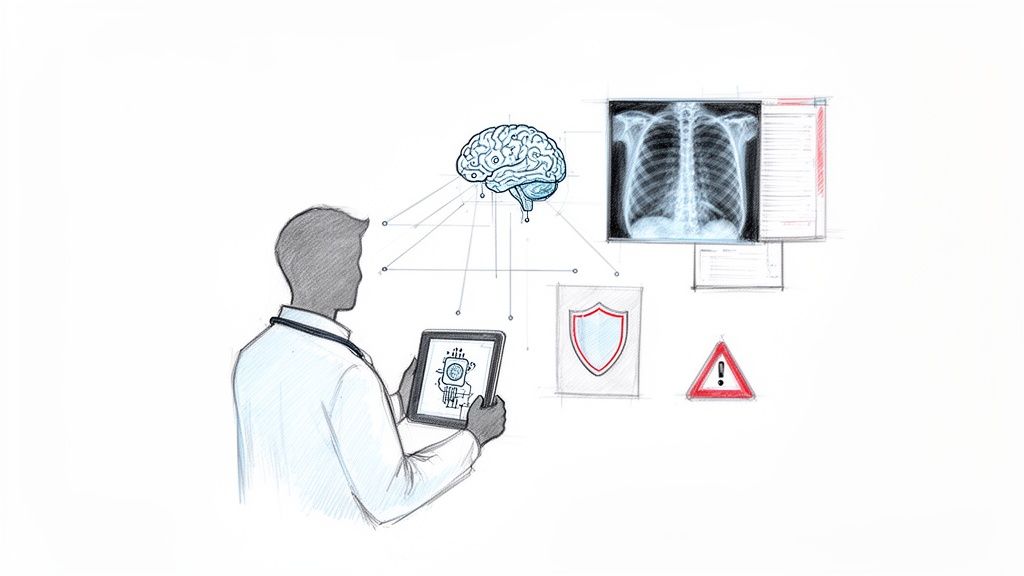
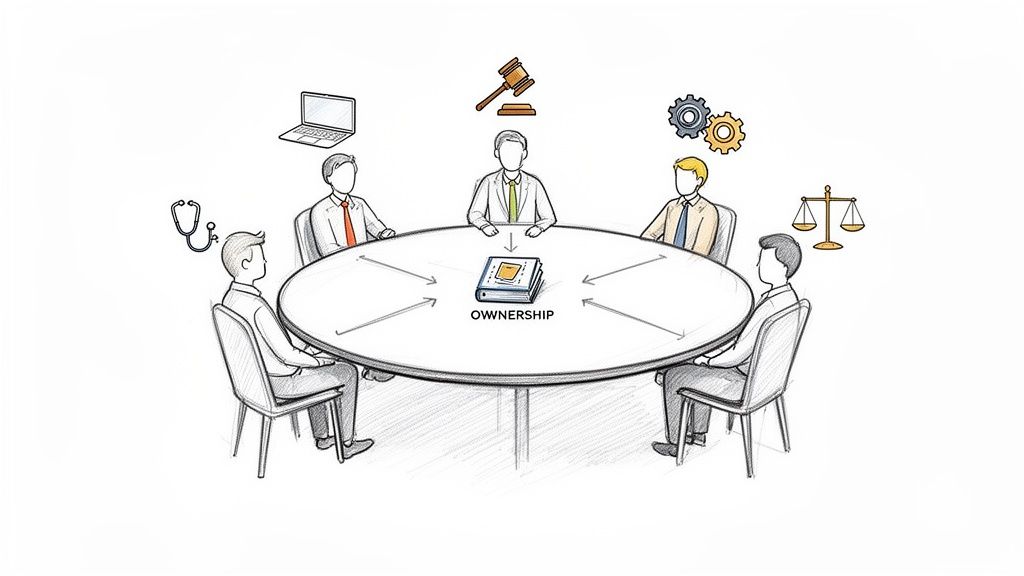
Your first practical step is to put together a cross-functional AI governance committee. Think of this group as the central command for all things AI. They provide the necessary guidance, make the tough calls, and ensure you’re not making decisions in a vacuum. Honestly, one of the biggest threats I see in healthcare AI is siloed decision-making, and a diverse committee is your best shield against it.
Who should be in the room? You need a mix of experts who can see the puzzle from different angles:
This committee isn't ceremonial. Their job is to draft, approve, and, most importantly, champion the organization's AI risk policies.
While the committee handles high-level oversight, real-world safety comes down to individual accountability. For every single AI tool you put into play, you need to assign unambiguous ownership. This prevents the all-too-common scenario where a problem pops up and everyone points fingers, assuming someone else is on it.
Here are the key roles to define for each AI system:
A clear ownership model means that when a doctor questions an AI-generated insight, they know exactly who to call. This creates a tight feedback loop, which is absolutely critical for quick incident response and making the tool better over time.
Finally, good governance relies on good documentation. You need a transparent, auditable record of how and why critical decisions were made. Every major milestone—from choosing a vendor to approving a new clinical use case—should be formally documented by the governance committee.
Just as crucial is having a well-defined escalation path. What happens when a nurse on the night shift notices something strange, a potential bias or a safety concern? There must be a clear, no-blame process for them to flag it. That report needs to go straight to the System Owner and, if it’s serious enough, up to the governance committee for a swift resolution. Building this structure is a core part of our implementation support, because it ensures risks are caught and handled early, not after something has gone wrong.
You can't manage what you can't define. That’s a fundamental truth in any complex field, but it’s especially critical when implementing AI in healthcare. Simply talking about "AI risk" is too broad to be useful. To get a real handle on potential problems, you need to build a detailed risk taxonomy—a shared vocabulary that allows everyone from clinicians to data scientists to pinpoint, discuss, and ultimately mitigate potential harm with precision.
Without this common language, "risk" just stays a vague, scary concept. A well-structured taxonomy, on the other hand, transforms abstract fears into concrete, actionable items. Think of it as the output of a thorough AI requirements analysis; it’s about mapping out the potential pitfalls long before a new tool ever touches a patient workflow.
This process isn't just an academic exercise. It's about breaking down risks into categories that make sense in a clinical environment. While every organization’s taxonomy will have its own nuances, most risks fall into four key domains.
This is, without a doubt, the most critical category. These are the risks that directly impact patient outcomes. When an AI model gets it wrong here, the consequences can range from diagnostic delays and incorrect treatments to serious adverse events.
Here are a few real-world examples I've seen play out:
Not all AI risks are clinical. Some can completely cripple a hospital's day-to-day functions. These operational risks create workflow bottlenecks, frustrate staff, and can quietly degrade the quality of care over time. They often come from a poor understanding of how a new tool actually fits into existing processes.
A classic mistake is deploying sophisticated AI tools for business without fully mapping their impact on human workflows. The most advanced AI is a failure if it makes a clinician's job harder, not easier.
Consider these scenarios:
Patient data is the lifeblood of healthcare, and it's protected by ironclad regulations like HIPAA. Risks in this bucket involve everything from unauthorized access and data corruption to privacy breaches that can shatter patient trust and lead to crippling legal penalties. The sophisticated data pipelines required for AI can introduce entirely new vulnerabilities if you're not careful, a core focus of any professional custom healthcare software development.
These risks can show up in a few nasty ways:
Finally, we get to the complex challenges of fairness, equity, and transparency. Ethical failures don't just feel wrong; they cause tangible reputational damage, undermine the trust of the communities you serve, and can lead to discriminatory care—even if the AI is technically "accurate" for the majority of the population.
Here are two of the most common ethical tripwires:
The following table provides a structured view of these risk categories, linking specific examples to their potential fallout for both patients and the healthcare organization.
| Healthcare AI Risk Taxonomy and Potential Impact |
|---|
| This table outlines common AI risk categories in healthcare, providing specific examples and mapping them to their potential impact across different stakeholder groups. |
| Risk Category |
| Clinical Safety |
| Diagnostic error (e.g., missed cancerous lesion in a scan) |
| Misdiagnosis, delayed treatment, adverse health outcomes |
| Malpractice lawsuits, loss of accreditation, damage to clinical reputation |
| Operational Disruption |
| Poor EHR integration causing data entry delays |
| Delayed care coordination, frustrating patient experience |
| Decreased staff productivity, increased operational costs, staff burnout |
| Data Integrity & Security |
| Inadvertent PHI leak from a model's output |
| Loss of privacy, potential for identity theft or fraud |
| Severe HIPAA fines, legal liability, erosion of patient trust |
| Ethical & Reputational |
| Biased algorithm unfairly flags a demographic for high-risk behavior |
| Systemic denial of care, discriminatory treatment, health inequities |
| Public backlash, loss of community trust, regulatory scrutiny |
By categorizing risks in this way, you move from a reactive, "what if" posture to a proactive stance. You can start assigning ownership, developing specific controls, and measuring the effectiveness of your mitigation strategies for each type of risk. This structured approach is the bedrock of a resilient AI governance program.
The performance of any AI system comes down to two things: the quality of its data and how thoroughly it's been tested. When we talk about a real-world AI risk management framework for healthcare, the technical controls you build around your data and models are the foundation. These are the practical guardrails that keep patient data safe, prevent biased algorithms from making unfair recommendations, and ultimately, make sure a clinician can actually trust what the AI is telling them.
These aren't just one-time checks you tick off a list. These controls have to be an integral part of the AI's entire lifecycle, from the moment you collect the first piece of data, through training and validation, and long after it’s been deployed. It's a constant state of diligence.
The healthcare industry has jumped into AI with both feet, and for good reason—85% of organizations are seeing a decent return on their investment. But that excitement is matched by some very real concerns. A recent survey highlighted that data quality (62%), getting the workforce ready (47%), and navigating regulations (42%) are still the biggest hurdles. These numbers make it crystal clear: strong controls aren’t just a nice-to-have, they're essential for any kind of lasting success.
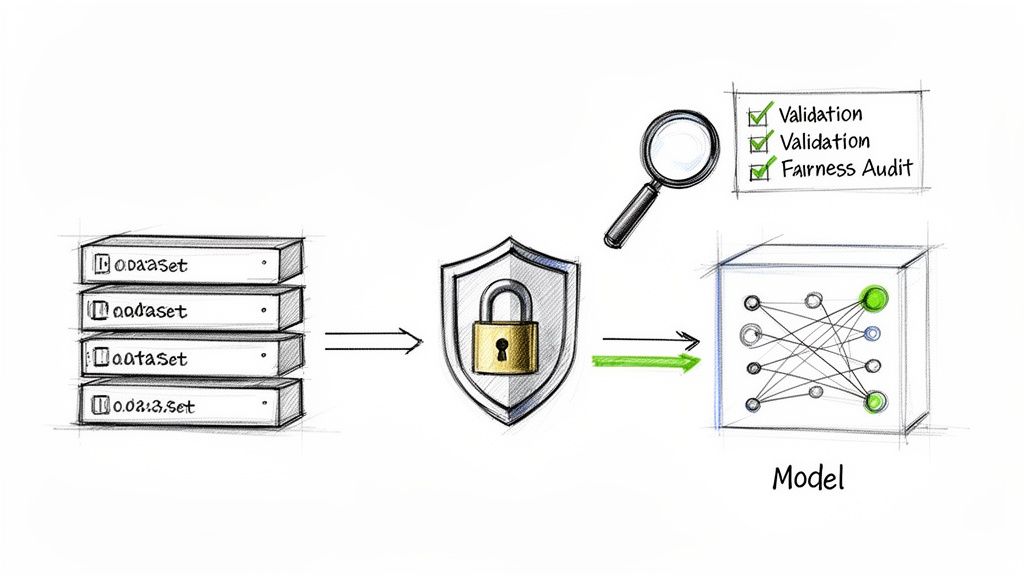
First things first: protecting patient data. This is about more than just basic HIPAA compliance; it means having a data governance plan built specifically for the unique pressures of AI development.
Your framework needs to enforce strict rules for:
Think of your patient data as the most valuable—and most vulnerable—asset you have. Building a fortress around it isn't optional; it's the price of entry for doing AI in healthcare responsibly.
Algorithmic bias is one of the most dangerous risks in healthcare AI. A model that works perfectly for one group of people but fails another isn't just a technical problem—it's a tool that actively creates health inequity.
You have to get ahead of this, and that means a multi-pronged attack:
This relentless focus on fairness is a core part of how we approach building AI—the goal is always to create tools that are not only accurate but also equitable.
A "black box" AI has no business being in a clinical setting. Period. For any clinician to trust a recommendation from an algorithm, they need to understand how it reached its conclusion. This is where Explainable AI (XAI) comes in.
XAI techniques peel back the layers and show which data points were most influential in a model's prediction. That kind of transparency is absolutely essential for building trust with clinicians and for doing a proper root cause analysis when something goes wrong.
As healthcare models grow more complex, the code they run on becomes a potential point of failure. That's why addressing issues in AI-generated code is now a crucial part of model control.
Finally, every single AI model needs to go through rigorous clinical safety validation. This is completely separate from technical validation. It means putting the model into a simulated clinical environment and letting the actual end-users—doctors, nurses, radiologists—put it through its paces with realistic scenarios. This step is the ultimate safety check for catching risks before the tool ever touches a real patient. For teams building out their validation capabilities, platforms like our own VeriFAI can provide the structure needed to make this critical process repeatable and reliable.
Healthcare AI doesn't operate in a vacuum. It lives within a dense, tangled web of regulations that you absolutely have to navigate with care. A solid AI risk management framework for healthcare must have compliance baked in from the very beginning, ensuring every new tool meets strict legal and ethical standards. Get this wrong, and you're not just facing a technical problem—you're risking patient safety, data security, and your organization's legal standing.
This landscape isn't standing still, either. The push for AI regulation is gaining serious momentum. Just look at the numbers: forty-seven US states have introduced over 250 AI-related bills affecting healthcare, and 33 have already passed into law. These laws are increasingly focused on risk management frameworks to find that sweet spot between life-saving innovation and essential patient safety. That's a critical balance to strike, especially when you consider that 86% of health systems are already using AI. You can dig deeper into these legislative trends over at the National Association of Counties.
To make sense of this complex environment, I find it helps to focus on two foundational pillars of U.S. healthcare regulation that have a huge impact on AI. Mapping your framework's controls to these requirements isn't optional; it's how you stay compliant day in and day out.
FDA and Software as a Medical Device (SaMD): If your AI tool is designed to diagnose, treat, or prevent a disease, the U.S. Food and Drug Administration (FDA) is almost certainly going to classify it as Software as a Medical Device. This classification puts the tool under a microscope, demanding rigorous validation, quality management systems, and post-market surveillance. The FDA’s guidance for AI/ML-based SaMD is especially crucial. It recognizes that these models can learn and evolve, so you'll need a "predetermined change control plan" to manage updates safely.
HIPAA and Patient Data Protection: The Health Insurance Portability and Accountability Act (HIPAA) is the law of the land for Protected Health Information (PHI). Any AI system that touches patient data—whether it's processing, storing, or transmitting it—has to follow its strict privacy and security rules. That means things like robust access controls, encryption, and clear audit trails are non-negotiable.
The biggest mistake I see teams make is treating compliance like a final checkbox. You can't do that. You have to weave regulatory requirements directly into your AI Product Development Workflow. Your data privacy controls need to be designed with HIPAA in mind from day one, and your model validation process has to generate the evidence you might need for an FDA submission down the road.
The regulatory environment is always in flux, with new state-level AI laws adding even more layers to an already complex system. You have to be proactive, not reactive. This is particularly true as you begin to scale your internal tooling and explore new real-world use cases.
Here are a few practical steps I recommend to stay on top of things:
When you build these legal guideposts into your framework, compliance stops feeling like an obstacle and becomes a natural outcome of doing good, responsible work. If you need a hand building this capability, feel free to connect with our expert team.
An AI risk management framework isn't a one-and-done document you file away. It's a living, breathing system. The moment an AI tool goes live in a clinical setting, your focus has to shift to constant vigilance and having a rock-solid plan for when things inevitably go sideways. This is where the rubber meets the road.
Good monitoring is so much more than just a system-is-up-or-down check. You need to be tracking the right key performance indicators (KPIs) that act as your canary in the coal mine. You’re not just looking for catastrophic failures; you’re hunting for the subtle drifts and shifts that whisper a problem is on the horizon.
To keep your AI tools safe and effective, your team needs to have its eyes on a few critical areas. This isn’t a task to be checked off a list; it's an ongoing process of observation and analysis.
We've found that setting up real-time dashboards to track these metrics is non-negotiable. This kind of proactive oversight is a core part of our AI Automation as a Service, because it's the only way to ensure AI tools stay trustworthy long after the go-live party.
When an alert fires or a doctor reports a problem, you can't afford to scramble. A generic IT incident plan just won't work here; you need a playbook built specifically for the unique quirks of AI.
Your response plan has to be designed for speed and clarity. The absolute priority is to immediately contain any potential patient harm, figure out what went wrong, and communicate clearly with everyone involved—from the doctors on the floor to the governance committee.
A solid AI incident response plan must clearly define:
Building these monitoring and response protocols is what makes an AI risk management framework for healthcare truly resilient. If you need some help implementing these critical safeguards, feel free to connect with our expert team.
As you start to weave AI into your clinical operations, a lot of important questions are going to come up. It's only natural. Here are some of the most common ones we hear from healthcare leaders and technical teams, along with some straightforward answers.
It’s easy to get bogged down, so start small and focused. The first real step is pulling together a dedicated governance committee. You'll want a mix of people in the room: clinicians, IT folks, your legal counsel, and key administrators. Their first job? To hash out and agree on your organization's guiding principles for using AI responsibly.
Once you have those principles, don't try to boil the ocean. Pick one high-value, but manageable, pilot project. This gives you a real-world testing ground to build and refine your risk framework before you even think about rolling it out more widely. Getting some early guidance from an AI strategy consulting partner can help you nail this first project and avoid common pitfalls.
This is a big one, and there's no magic bullet. Tackling bias is a continuous commitment, not a one-and-done task.
It all starts with your data. You absolutely must ensure the data you train your models on is a true reflection of your patient community. If it isn't, bias is almost guaranteed. As you build the model, you have to actively check for it using fairness metrics to spot any performance dips across different patient groups (like age, ethnicity, or gender).
But the work doesn’t stop at launch. You need to have systems in place to constantly monitor for any new biases that crop up over time. Pairing this with explainability tools that show why a model made a certain decision is a critical part of any responsible AI solutions.
The regulatory landscape depends entirely on what the AI tool actually does. If it's helping with diagnosis or suggesting treatments, you're almost certainly looking at the FDA's Software as a Medical Device (SaMD) rules. And, of course, any tool that touches patient information has to be rock-solid on HIPAA compliance.
On top of that, more and more states are rolling out their own AI-specific laws around transparency and accountability. This is not an area to guess. Getting your legal and compliance experts involved from day one is non-negotiable.
Trust isn't something you can mandate; you have to earn it. The key ingredients are transparency, reliability, and most importantly, inclusion.
Bring clinicians into the conversation from the very beginning—when you're still just evaluating or designing the tool. They need to be part of the process, not have it dictated to them.
Provide crystal-clear training on what a specific AI tool does well and, just as crucially, what its limitations are. This isn't a black box. Use explainability (XAI) features that allow a doctor to see the reasoning behind an AI-generated insight. Finally, create an easy, no-fuss way for them to give feedback or flag problems. When they feel like partners in ensuring patient safety, adoption happens naturally. If you need help structuring this, it's often a good idea to connect with an expert team.
Think of AI governance as the overall rulebook and AI risk management as the specific game plan for enforcing those rules. Governance sets the high-level principles, policies, and ownership structure. Risk management is the hands-on process of identifying, assessing, and mitigating specific threats within that governance structure. You can't have effective risk management without strong governance.
Your AI risk framework should be a living document, not something that collects dust. A good practice is to conduct a formal review at least once a year. However, you should also trigger a review anytime there's a significant change, such as deploying a major new AI system, a change in regulations, or after a serious incident.
You can absolutely use third-party AI tools, but it doesn't absolve you of responsibility. Your risk management framework must include a rigorous vendor assessment process. You need to scrutinize their data security, model validation processes, and how they handle bias. Make sure your contract clearly defines liability and grants you the right to audit their systems. As we explored in our AI adoption guide, choosing whether to buy or build is a critical strategic decision. If you decide to buy, you can always generate a Custom AI Strategy report to evaluate vendors.
How to build HIPAA-compliant AI: when LLM providers need a BAA, data minimization, de-identification, audit controls and a reference architecture.
Practical data migration planning guide for healthcare teams. Scope, mapping, compliance, validation, cutover and rollback decisions explained end to end.

Smart on FHIR guide for healthtech engineers. Learn the OAuth 2.0 launch model, scope syntax, backend services, and US regulatory requirements.
Connect with our team to explore how AI expertise can transform your business.