
AI in Healthcare
HIPAA-Compliant AI: How to Use LLMs With PHI Safely
How to build HIPAA-compliant AI: when LLM providers need a BAA, data minimization, de-identification, audit controls and a reference architecture.
October 16, 2026Read more
Discover how AI strategy consulting for healthcare builds a practical roadmap to transform patient care, ensure compliance, and drive measurable outcomes.

When we talk about AI strategy consulting for healthcare, we're not just talking about buying the latest flashy software. We're talking about creating a master plan—a cohesive framework that thoughtfully weaves together your operations, diagnostic processes, and patient care with smart technology. It’s about making sure every AI initiative is genuinely effective, fully compliant, and perfectly aligned with your core mission.
Picture a hospital where every single department—radiology, the ER, patient administration, even surgical planning—is seamlessly connected by an intelligent technological layer. This is what a real AI strategy delivers. It turns a patchwork of isolated systems into a responsive, unified "digital nervous system." The goal isn't just to make one department smarter; it's about elevating the intelligence of the entire organization.

Without a clear plan, it's all too easy for a hospital to end up with a random collection of tools that don't talk to each other. This digital Tower of Babel leads to wasted money, frustrated staff, and missed opportunities to improve care.
This is where expert AI strategy consulting comes in. It provides the architectural blueprint you need to avoid that chaos. It ensures every dollar invested in AI serves a bigger purpose, contributing to a more efficient and effective model of healthcare delivery. In a field where patient outcomes and data security are everything, this kind of strategic thinking isn't a luxury; it's a necessity.
A durable AI strategy rests on a few core pillars that work in harmony. This structure is absolutely essential for navigating the complexities of healthcare while making sure the technology actually helps people.
The market growth alone tells the story. The global AI in healthcare market is expected to rocket from USD 28.07 billion in 2025 to an incredible USD 543.83 billion by 2035. That's a compound annual growth rate of over 34.5%. This explosive growth highlights just how urgent it is for organizations to get expert guidance to properly tap into AI's potential.
To build a strategy that lasts, it's crucial to focus on the fundamental components. The table below outlines the core pillars that every successful healthcare AI strategy is built upon.
| Pillar | Description | Key Objective |
|---|---|---|
| Clinical and Operational Alignment | Connecting AI initiatives directly to specific clinical challenges or operational inefficiencies. | Ensure every project solves a real-world problem, like reducing patient wait times or improving diagnostic accuracy. |
| Data Governance and Interoperability | Establishing clear protocols for data quality, security, and the ability of different systems to share information. | Create a single source of truth for reliable data, enabling AI models to function effectively and safely. |
| Ethical and Regulatory Compliance | Building a framework that adheres to regulations like HIPAA and addresses potential algorithmic bias. | Maintain patient trust and avoid legal penalties by prioritizing data privacy and equitable outcomes. |
| Scalable Technology Infrastructure | Implementing flexible and robust technology platforms that can support AI models from pilot to full-scale deployment. | Ensure that successful AI proofs-of-concept can be rolled out across the organization without major technical hurdles. |
Getting these pillars right is the first step toward creating a system that doesn't just adopt new technology but truly integrates it into the fabric of patient care. As we explore our comprehensive approach for the healthcare industry, you'll see just how critical these components are for achieving long-term success.
Diving into AI in healthcare without a clear plan is a bit like performing surgery without a diagnosis—it's unpredictable, incredibly risky, and you're more likely to cause harm than good. When individual departments start buying their own separate tools, you end up with a mess of wasted resources, frustrated clinicians, and virtually no real impact on patient care. A formal strategy isn't just a nice-to-have; it's the only way to make sure your AI initiatives are secure, compliant, and actually work.
This kind of deliberate planning turns AI from a collection of expensive, disconnected experiments into a coordinated, powerful effort. It gives you the framework you need to navigate the very real risks while systematically unlocking the benefits. In an industry where lives are on the line, the alternative is just too dangerous.
Without an expert guiding the way, it's dangerously easy for healthcare organizations to stumble. The risks aren't just about money; they touch every part of patient care and your organization's integrity. Rushing to implement AI without a solid foundation opens you up to all sorts of preventable disasters that a good strategy would have helped you avoid.
Here are some of the most critical risks to consider:
On the flip side, a thoughtfully built AI strategy, often developed with expert AI strategy consulting, allows organizations to tap into AI's full potential safely and effectively. The focus shifts from just buying cool tech to achieving specific, measurable goals that improve everything about the care you provide.
By aligning every AI initiative with core clinical and operational goals, a strategic approach ensures that technology serves the mission of better patient outcomes, not the other way around. This is the fundamental difference between successful and failed AI transformations in healthcare.
This methodical approach unlocks some game-changing advantages. For example, you can develop hyper-personalized treatment plans by analyzing a patient's unique data against vast clinical datasets, leading to far better results. Diagnostic accuracy also gets a huge boost, with AI algorithms helping radiologists and pathologists spot subtle patterns the human eye might miss.
Beyond the clinical side, you can drastically improve operational efficiency with smart automation. Solutions like AI Automation as a Service can handle the repetitive administrative work, freeing up your clinical staff to focus on what they do best: caring for patients. A formal plan gives you the roadmap to find and prioritize these high-impact opportunities, making sure your resources go where they’ll make the biggest difference. You can see how this planning comes to life by exploring our approach to creating a Custom AI Strategy report.
Jumping into AI without a plan is a recipe for stalled projects and wasted resources. To truly make a difference in healthcare, you need a structured, deliberate approach—not just a collection of disconnected experiments. A solid framework is your roadmap, guiding you from initial curiosity to a full-scale, compliant rollout that actually improves patient care and makes operations smoother.
The alternative? Chaos. Ad-hoc adoption is unpredictable and risky. A strategic approach, on the other hand, turns that risk into measurable results.
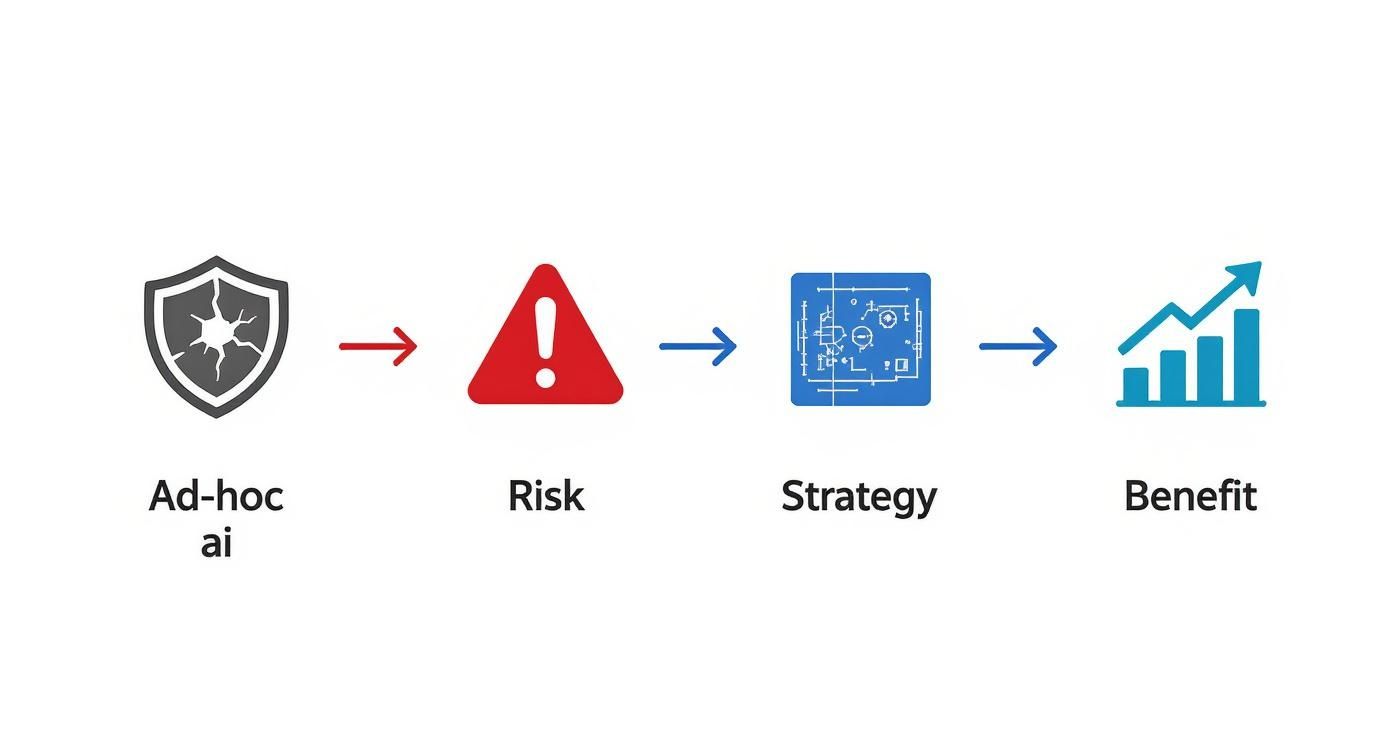
As you can see, moving from isolated experiments to a formal blueprint is the core goal of expert AI strategy consulting. We break this journey down into four proven stages, each designed to build momentum while keeping complexity in check.
Before you even think about technology, you have to find the right problems to solve. This discovery phase is all about deep collaboration. We bring clinical staff, IT teams, and administrative leaders to the table to pinpoint the most pressing challenges and opportunities where AI can deliver a real impact.
The goal here is to get specific. We move past vague ideas and perform a thorough AI requirements analysis to understand what data you have, how a solution could fit into your existing workflow, and what the potential return on investment looks like. It’s all about finding that sweet spot where a project is both technically possible and clinically meaningful.
This step is absolutely critical. The healthcare industry generated over 2.3 zettabytes of data in 2020, a figure expected to balloon past 10 zettabytes by 2025. An experienced consultant helps you cut through that noise to find high-value real-world use cases that can genuinely reduce clinician burnout, improve diagnostic accuracy, or boost patient engagement. You can dig deeper into these data trends by exploring these insights on AI in HealthTech.
Once you’ve zeroed in on a promising idea, it’s time to test it on a small, controlled scale. A pilot or Proof-of-Concept (PoC) is your low-risk way to validate your assumptions before you go all-in. This isn’t just about making sure the tech works; it’s about seeing how it behaves in the real world with your actual clinicians.
During this phase, we get answers to crucial questions:
A successful pilot gives you the hard data and—just as importantly—the clinician buy-in you need to justify a bigger investment. It’s the proof that turns a good idea into a viable solution.
Our structured AI Product Development Workflow is built to guide organizations through this exact process, setting up pilots for success right from the start.
With a successful pilot under your belt, the focus shifts to rolling the solution out across the organization. This means moving from a limited test environment to full integration within daily operations. Getting this right requires careful planning around IT infrastructure, staff training, and change management.
Key activities in this stage include:
Finally, lasting success depends on strong governance and compliance. This isn't a one-time setup; it's an ongoing process of oversight to ensure your AI solutions stay effective, ethical, and secure.
This means creating clear policies for everything from data management and model maintenance to regulatory adherence (like HIPAA). We recommend establishing a governance committee to oversee all AI initiatives, track performance, and ensure every tool continues to serve your organization's core mission. This final stage is what solidifies your AI transformation, turning individual project wins into a sustainable, long-term advantage.
It's one thing to talk about frameworks and another to see AI making a real-world difference. Let's move past the theory and look at concrete examples where AI is already improving patient outcomes and smoothing out clinical operations. These aren't far-off dreams; they are applications delivering measurable results today.

From spotting diseases faster than the human eye to freeing clinicians from a mountain of paperwork, AI is solving real, tangible problems. Each of these use cases shows how a smart strategy turns powerful technology into a life-saving tool.
Medical imaging is where AI first made its mark in healthcare, and for good reason. Radiologists and pathologists spend their days scrutinizing countless images—X-rays, CT scans, MRIs—where a tiny, almost invisible anomaly can change a patient's entire life. AI algorithms, trained on vast libraries of annotated images, act as a tireless second set of eyes, catching patterns that a person might miss after a long shift.
For instance, AI models can pinpoint cancerous nodules on lung scans with incredible accuracy, often flagging them at earlier, more treatable stages. In ophthalmology, similar tools analyze retinal scans to spot early signs of diabetic retinopathy, a leading cause of blindness, giving doctors a chance to intervene. This isn't about replacing clinicians. It’s about arming them with better tools to make quicker, more confident decisions.
These diagnostic tools represent a fundamental shift away from purely reactive care. By helping clinicians identify risks sooner, AI nudges the entire healthcare system toward a more proactive, preventative model—one that ultimately saves lives and lowers long-term treatment costs.
Another game-changer is using predictive analytics to flag patients at high risk for chronic conditions or acute events like sepsis or hospital readmission. By sifting through enormous datasets from Electronic Health Records (EHRs)—lab results, vital signs, patient history—AI models can spot subtle trends that signal trouble ahead.
Imagine a system that alerts a care team when a patient's combined biometrics point to a high probability of a cardiac event in the next 72 hours. This critical warning gives clinicians a window to adjust medications, schedule a follow-up, or provide targeted patient education. This is absolutely essential for managing population health and succeeding in value-based care, where preventing illness is just as important as treating it. Breakthroughs like these are often fueled by grants for collaborative research in computational neuroscience.
Clinician burnout is a genuine crisis, and a huge part of the problem is the crushing administrative workload. AI-powered Natural Language Processing (NLP) is tackling this problem by automating documentation and data entry. Some ambient clinical intelligence tools can now listen to a doctor-patient conversation and generate accurate clinical notes on the fly, allowing the physician to focus completely on the person in front of them.
This automation extends to the back office, too. It can be used to streamline billing, coding, and insurance claims, which reduces errors and speeds up revenue cycles. By offloading these repetitive tasks, AI not only boosts efficiency but, more importantly, improves the work-life balance for the healthcare professionals we all depend on. These operational wins are a great way to build momentum for bigger changes across an organization, including developing powerful internal tooling.
Launching an AI initiative without clear success metrics is like prescribing a treatment and never checking on the patient. You have to know if it's working. For AI in healthcare, success isn't just about financial ROI; it’s measured in human impact. A well-defined strategy, often hammered out with the help of AI strategy consulting for healthcare, looks past simple cost savings to focus on what really matters.
This means tracking concrete improvements in clinical outcomes—things like lower diagnostic error rates or faster patient recovery times. It also means keeping an eye on patient satisfaction scores and, just as importantly, watching for a drop in clinician burnout rates. These are the metrics that paint a full picture of an AI tool's true value on the ground.
To know if you're succeeding, you need to set clear, quantifiable Key Performance Indicators (KPIs) before you roll out any AI solution. These KPIs can't be generic; they must connect directly to the specific problems you're trying to solve.
A successful AI strategy is one that shows real, measurable movement on these kinds of specific, meaningful goals.
While the potential is huge, the road to implementing AI is littered with pitfalls that can sink even the most promising projects. Thinking ahead is the only way to navigate them. The U.S. AI in healthcare market is projected to skyrocket from USD 13.26 billion in 2024 to USD 221 billion by 2030, which highlights the opportunity but also the pressure to get it right. You can read the full research about these market projections here.
One of the biggest mistakes we see is failing to get genuine clinical buy-in. If your clinicians see a new AI tool as just another box to check or a system that doesn't trust their judgment, they won't use it. It's that simple.
Here are a few of the most common challenges and how to get ahead of them:
Thinking through these challenges upfront is what separates a successful AI investment from a failed one, as we explored in our AI adoption guide. By planning for these issues, you can ensure your investment leads to real improvements in care. You can explore our portfolio of AI tools for business to see how we help organizations build these kinds of effective systems.
Bringing AI into a healthcare setting isn't just about plugging in new software. It takes a clear, deliberate plan and a partner who genuinely gets the nuances of the industry. The only way to successfully adopt AI—while managing risk and staying compliant—is to move in phases. This is where having a team with the right experience and tools becomes invaluable.
Trying to navigate this journey solo is a huge gamble. Instead, we can help you get there faster and more safely. Our AI Strategy consulting tool is built to pinpoint high-impact opportunities quickly, and our team provides the hands-on guidance to make them happen. We help you bridge the gap between a great idea and a real-world solution.
The real goal here is to create a sustainable, forward-thinking foundation for your organization. That all begins with a solid plan. We provide the structure to get you there efficiently.
Our structured AI Product Development Workflow keeps your projects on track from start to finish, ensuring they deliver the results you expect. To successfully navigate your AI execution roadmap, consider exploring specialized AI enablement services that can guide your organization through implementation.
Technology is a powerful enabler, but true transformation is driven by people. The right expertise ensures your AI strategy is not just technically sound, but also clinically relevant and operationally practical.
Embarking on an AI journey is a major step, but you don’t have to go it alone. The right partner can make all the difference, bringing the tools, framework, and deep industry knowledge needed to turn your vision into a reality.
Ready to build a future where AI leads to better patient outcomes and more efficient operations? It all starts with a conversation. Connect with our expert team today to start building your custom AI roadmap and take the first step toward a more intelligent healthcare future.
The absolute first step has nothing to do with technology. It’s all about a deep discovery and prioritization phase. You need to get clinical leaders, IT folks, and administrators in the same room to identify the most pressing problems you’re trying to solve. This isn't just brainstorming; it’s a focused AI requirements analysis to pinpoint the specific operational bottlenecks or clinical challenges where AI could make a real difference. This groundwork ensures you don't waste time and money on a solution that doesn't fix a core issue.
A solid AI strategy doesn't just bolt on compliance at the end—it's built in from the very beginning. You have to establish a strict data governance framework that dictates exactly how patient data is handled at every stage: from collection and storage to anonymization and use in AI models. This means putting technical safeguards like end-to-end encryption and tight access controls in place, backed by clear administrative policies. Expert AI strategy consulting ensures these privacy measures are part of the fundamental architecture of your AI solutions, not just a checkbox.
That really depends on the scope of the project. For something focused like an AI Automation as a Service project to speed up administrative tasks, you could see a positive return in as little as 3 to 6 months from cutting operational costs. But for more complex clinical tools, like an AI model that assists with diagnostics, it might take 12 to 24 months to see the full value. The ROI there is measured not just in dollars, but in better patient outcomes and long-term efficiencies.
The single biggest mistake is failing to achieve genuine clinical buy-in. If your doctors, nurses, and technicians see a new AI tool as just another administrative burden or something that undermines their expertise, they won't adopt it. To avoid this, involve clinical staff from the very beginning of the process—from identifying the problem to testing the pilot solution. Their input is crucial for ensuring the technology seamlessly integrates into their existing workflows and actually makes their jobs easier.
Not necessarily. While a dedicated team is a great long-term goal, you can start by partnering with an experienced AI consulting firm. They bring the necessary expertise in data science, engineering, and project management to get your initial projects off the ground. This partnership allows you to validate the potential of AI and build early successes while you develop a plan for building your own internal capabilities over time.
Ready to build a clear, actionable AI roadmap for your healthcare organization? Ekipa AI delivers tailored AI strategies and provides the end-to-end support to turn your vision into scalable impact. Meet the people who bring these strategies to life on our expert team. Start your AI transformation with us today.
How to build HIPAA-compliant AI: when LLM providers need a BAA, data minimization, de-identification, audit controls and a reference architecture.

Practical data migration planning guide for healthcare teams. Scope, mapping, compliance, validation, cutover and rollback decisions explained end to end.

Smart on FHIR guide for healthtech engineers. Learn the OAuth 2.0 launch model, scope syntax, backend services, and US regulatory requirements.
Connect with our team to explore how AI expertise can transform your business.