AI in Healthcare
HIPAA-Compliant AI: How to Use LLMs With PHI Safely
How to build HIPAA-compliant AI: when LLM providers need a BAA, data minimization, de-identification, audit controls and a reference architecture.
October 16, 2026Read more
Discover how AI strategy consulting for healthcare companies helps align teams, prepare data, and scale AI solutions for real-world impact and growth.

Jumping into AI without a clear strategy is a recipe for disaster. I've seen it happen too many times: promising pilot projects stall out, budgets get burned, and the whole initiative grinds to a halt. In healthcare, where the stakes are incredibly high, a formal AI strategy isn't just a good idea—it's non-negotiable. You need a practical roadmap to turn ambitious ideas into scalable solutions that actually improve patient outcomes and streamline your operations.
Healthcare isn't just dipping its toes in artificial intelligence anymore. We're well past the "experimentation" phase. Smart health systems are actively weaving AI solutions into their core workflows, and for good reason. AI has massive potential to fix problems that have plagued the industry for decades, from frustrating diagnostic delays to the soul-crushing administrative burden.
But here's the catch: implementing AI in a clinical setting is a minefield of unique challenges. You're dealing with ironclad data privacy laws like HIPAA, the absolute necessity of rigorous clinical validation, and the very human challenge of getting busy doctors and nurses to adopt new technology.
Without a coherent strategy, organizations often wind up with a patchwork of disconnected pilot projects. They look impressive on a slide deck but fail to deliver any real, scalable value. A strategic approach, on the other hand, ensures every AI initiative is chosen for a reason, properly funded, and directly tied to what matters most to your organization. It's about navigating risk intelligently and getting the most out of every dollar you invest in technology.
Just look at the numbers. The global AI in healthcare market was valued at USD 36.96 billion in 2025. By 2034, it's expected to rocket to roughly USD 613.81 billion. That’s a staggering compound annual growth rate of 36.83%. This isn't just hype; it's a clear signal that healthcare leaders need to get serious about building a unified, forward-thinking plan right now.
Think of your AI strategy as a compass. It guides your organization through the complexities of digital modernization, turning AI from a collection of shiny new toys into a core engine for clinical excellence and operational efficiency.
Any successful journey starts with a solid foundation. In my experience, a truly effective AI strategy is built on several key pillars that address both the technical and, crucially, the human side of the equation. We’ve explored in-depth how AI transforms the healthcare industry, and these pillars are the bedrock of that transformation.
Before diving into specific use cases, it's essential to understand these foundational components. They provide the structure needed for a comprehensive and sustainable AI program.
Table: Core Pillars of a Healthcare AI Strategy
| Pillar | Objective | Key Considerations |
|---|---|---|
| Clinical & Operational Alignment | Ensure AI projects solve real, high-impact problems for clinicians and administrators. | Stakeholder interviews, workflow analysis, direct alignment with organizational goals (e.g., reducing readmissions, improving patient throughput). |
| Data Governance & Readiness | Build a secure, high-quality, and compliant data foundation for reliable AI models. | Data quality assessments, de-identification protocols, robust HIPAA compliance checks, clear data ownership rules. |
| Technology & Infrastructure | Evaluate and build the necessary tech stack to support AI development and deployment at scale. | Cloud vs. on-premise decisions, integration with existing EHRs, selecting the right MLOps platforms. |
| Workforce Enablement | Prepare clinicians and staff to adopt and trust new AI-powered tools through training and support. | Change management plans, user training programs, establishing clinical champions, transparent communication. |
| Ethical & Regulatory Framework | Proactively manage the ethical implications of AI and ensure full compliance with all regulations. | Bias detection and mitigation strategies, clear model explainability standards, staying ahead of FDA and other regulatory guidance. |
By methodically building out each of these pillars, you create a durable framework for success. This isn't just about technology; it's about building a smarter, more efficient healthcare system from the ground up.
Before you ever think about deploying an algorithm, the real work starts with your people and your data. From my experience guiding healthcare organizations, the most successful ai strategy consulting for healthcare companies isn't about fancy tech—it's about building a rock-solid foundation first. If you skip this, your initiatives are almost guaranteed to stumble.
The single biggest hurdle isn't the technology; it's getting everyone on the same page.
Trying to align clinical, administrative, and IT teams can feel like herding cats. Each group speaks its own language, chases different metrics, and has unique priorities. That’s why the first practical step I always recommend is creating a cross-functional AI council or steering committee.
This isn't just another weekly meeting to add to the calendar. Think of it as the command center for your entire AI initiative. It’s where you’ll hash out shared goals that actually mean something to everyone, from the doctors on the floor to the executives in the boardroom. Getting buy-in and a clear sponsorship from this group is absolutely essential if you want your projects to ever move beyond the pilot phase.
This council’s job is to translate vague corporate goals into concrete, AI-solvable problems. For instance, "improve efficiency" is a nice sentiment, but it's not actionable. A better, shared objective would be: "reduce patient wait times in the emergency department by 15% using predictive scheduling tools."
Suddenly, everyone has a clear target. The IT team knows what to build, and the nurses understand why they’re being asked to use a new tool. This collaborative groundwork prevents the all-too-common scenario where IT builds a masterpiece that clinicians ignore because it disrupts their workflow.
This infographic really drives home how you get from raw data to real-world healthcare outcomes, a journey that has to start with this kind of foundational alignment.
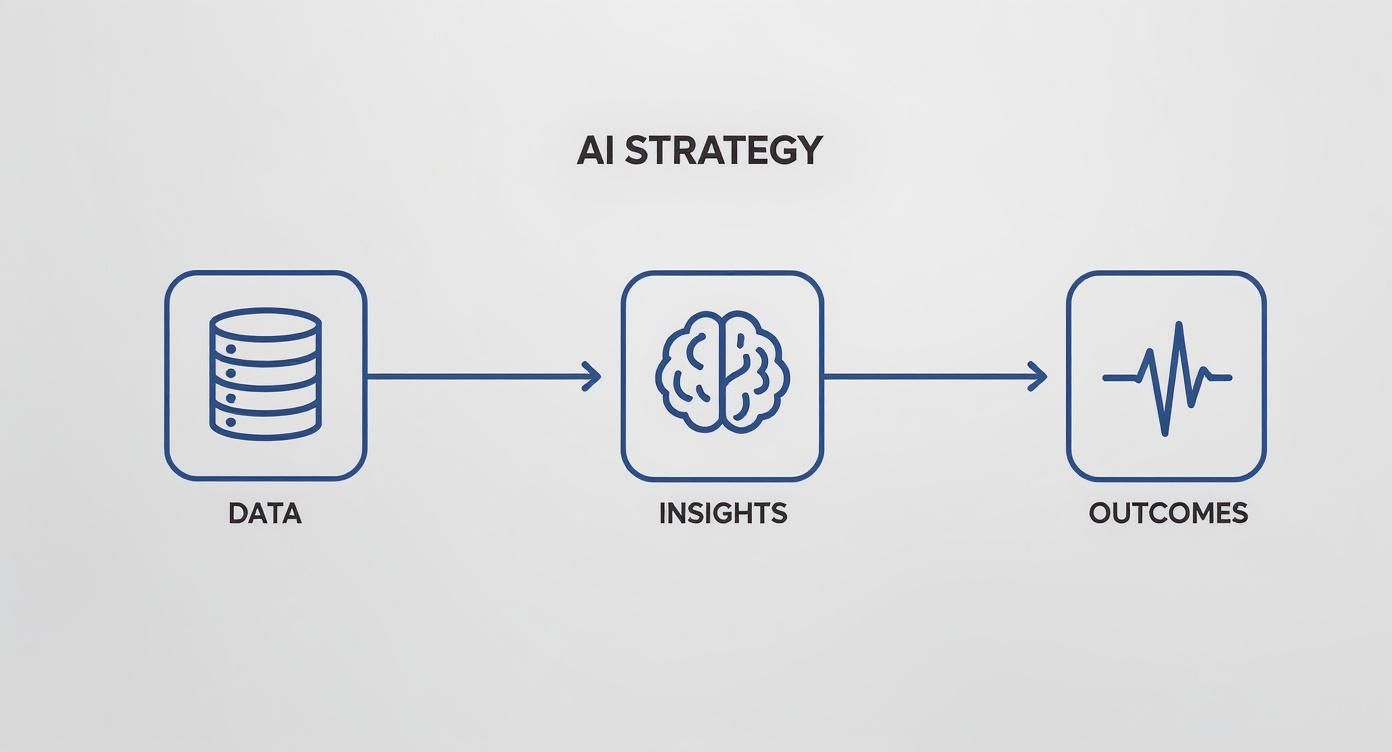
As you can see, those valuable insights and better outcomes are impossible without clean, high-quality data—the technical bedrock of your entire strategy.
Once you have your teams aligned, the spotlight shifts to your data. In healthcare, data is simultaneously your greatest asset and your biggest liability. Any AI model is only as good as the data it’s trained on, which makes getting your data house in order a non-negotiable step. This means you have to get brutally honest about your data's quality, completeness, and accessibility.
A strong AI strategy is completely dependent on reliable data. This makes it critical to understand and implement data quality best practices. You have to go beyond simple data cleaning and establish firm governance protocols for how data is collected, stored, and used—all while maintaining ironclad HIPAA compliance.
Key Takeaway: I've seen countless promising AI projects in healthcare get completely derailed by data silos. Different departments run their own systems, making it nearly impossible to get a full picture of a patient's journey or an operational process. A primary goal of a good AI strategy is to systematically break down these walls.
To get your organization's technical foundation ready, here are a few things you need to do right away:
This foundational work—from aligning your people to preparing your data—is the most important part of this whole process. Getting it all down in a formal document, like a Custom AI Strategy report, gives you a clear and actionable blueprint for everything that comes next.
Okay, you’ve got your team aligned and a handle on your data. Now for the exciting part: figuring out where AI can actually move the needle for your organization. It's incredibly tempting to chase every shiny new idea, but that's a surefire way to spread your resources thin and end up with a lot of half-finished projects.
The real key here is discipline. We're not just making a wish list; we're building a strategic shortlist of initiatives that will deliver the biggest bang for your buck, both clinically and operationally. This starts by getting that cross-functional team you assembled back in a room for some structured brainstorming.
Think of this phase as creating an "opportunity map" of your entire organization. You're looking for pain points, inefficiencies, and areas where data-driven insights could fundamentally change outcomes.
On the clinical side, we often see promising applications pop up in areas like:
Don't forget the operational side—it's often where you find the quickest wins:
For many of these big operational challenges, working with an AI Automation as a Service provider can be a smart move. It gets you to the solution faster without needing a massive in-house build. Similarly, looking at well-established applications like AI-powered clinical decision support tools gives you a proven blueprint for success.
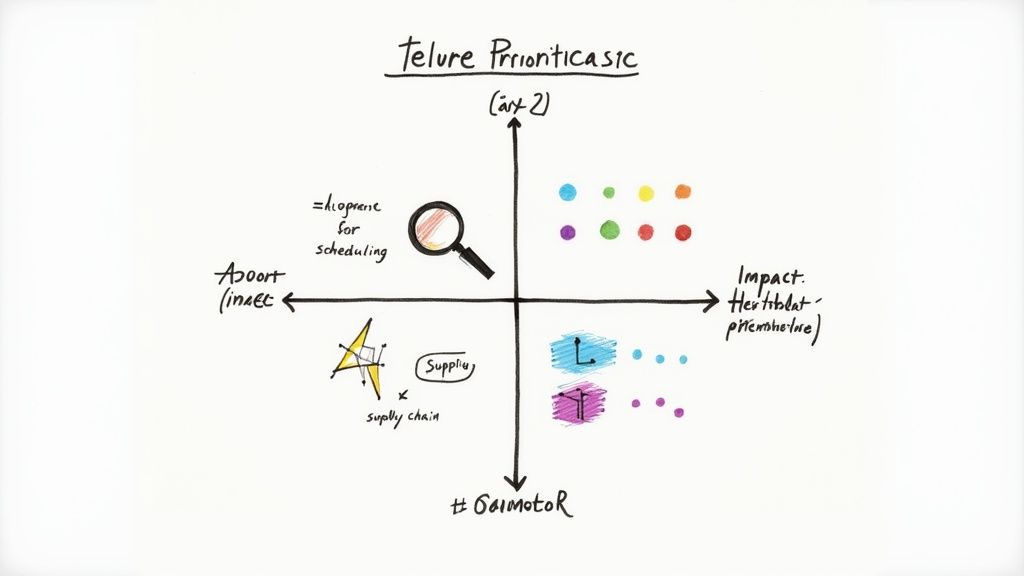
Once you have a big list of potential projects, you need a way to separate the contenders from the pretenders. A simple but incredibly effective tool I always use is a prioritization matrix. You score each idea against two critical dimensions: Potential Impact and Practical Feasibility.
My two cents: Don't get bogged down trying to create a perfect mathematical model here. A simple 1-5 scale for each axis is all you need. The real value is in the structured conversation it forces your team to have.
This simple exercise shifts the decision-making process from being about who has the loudest voice to a more objective, data-informed discussion. It ensures your first few AI projects are the ones with the best chance of delivering a win.
Here’s what that might look like in practice:
| Use Case | Potential Impact (1-5) | Feasibility (1-5) | Total Score | Priority |
|---|---|---|---|---|
| Predictive Sepsis Alerts | 5 (Saves lives) | 3 (Tough data integration) | 8 | High |
| Automated Appointment Reminders | 3 (Reduces no-shows) | 5 (Off-the-shelf tech) | 8 | High |
| Smart Supply Chain Forecasting | 4 (Major cost savings) | 4 (Clean data available) | 8 | High |
| AI-Powered Surgical Robots | 5 (Huge clinical potential) | 1 (Massive cost & complexity) | 6 | Low |
This kind of methodical selection is more important than ever. The broader healthcare consulting market shows a massive trend toward strategic tech investments, with technology consulting grabbing a 31.7% market share in 2024. That sector, valued at USD 26.7 billion this year, is all-in on digital health and AI analytics.
A disciplined approach ensures your resources are directed toward projects that will deliver tangible improvements—whether that's in patient care or your bottom line.
An idea is only as good as its execution. You've done the hard work of identifying high-impact AI opportunities, and now it's time to move that prioritized concept from a strategy document into the real world. This is where we design a tangible, well-managed pilot program—and where success hinges on meticulous planning and picking the right people to work with.
Think of a pilot not as just a small-scale test, but as a focused experiment. It’s designed to deliver clear, measurable results that either prove the business case for a full rollout or give you invaluable lessons on why it won't work. Jumping into a pilot without clear success metrics is like starting a clinical trial without an endpoint. You'll gather a lot of data, but you won't actually know if you've succeeded.
Before a single line of code is written or a new process is tested, your AI council needs to agree on what a "win" looks like. These key performance indicators (KPIs) have to be specific, measurable, and tied directly back to the clinical or operational goals you set earlier.
Let's say your pilot is an AI tool designed to predict patient no-shows. Vague goals won't cut it. You need something concrete:
This level of clarity gets rid of any ambiguity and gives everyone a clear benchmark for judging the pilot's performance. It also helps you choose the right place for the initial test—you want a department or patient group that’s representative of the larger organization but small enough to manage risk and collect clean data.
With your pilot defined, you'll hit a fork in the road: should you build this solution in-house or bring in external experts? There's no single correct answer here. The best path really depends on your organization's long-term goals, internal skills, and how quickly you need to move.
Building In-House: This route makes sense when you're developing proprietary internal tooling that could give you a unique competitive edge. It builds deep institutional knowledge and gives you complete control. The catch? It requires a major, long-term investment in specialized talent—data scientists, ML engineers, project managers—which can be a slow and expensive process.
Partnering Externally: Working with outside experts can dramatically accelerate your timeline. You get immediate access to a seasoned team and proven methods, which is incredibly valuable for your first few AI projects. This is where AI strategy consulting becomes so important, not just for planning but for actually getting it done.
Many health systems find a hybrid model works best. They might bring in consultants to lead the initial AI requirements analysis and pilot development, using the project as a live training ground for their own up-and-coming team. A structured AI strategy consulting workshop can offer a ton of clarity on how this collaboration can work in practice.
Picking a partner is one of the most important decisions you'll make in this entire process. Technical skill is just the price of entry. In healthcare, it’s the deep domain knowledge that separates successful projects from expensive failures. A vendor who doesn't understand clinical workflows or the nuances of HIPAA can easily create more problems than they solve.
When you're evaluating partners, don't just ask them what they can do with AI. Ask them to show you what they have already done in a healthcare setting similar to yours. Their portfolio of real-world use cases is far more telling than any sales pitch.
Use a structured evaluation process to compare potential partners, whether they're AI vendors, firms offering custom healthcare software development, or specialized consultants. Your checklist should get straight to the point:
A well-designed pilot, supported by the right partner, is what turns your AI strategy from an ambitious plan into a real success story. It builds the momentum you need to drive adoption across the entire enterprise.
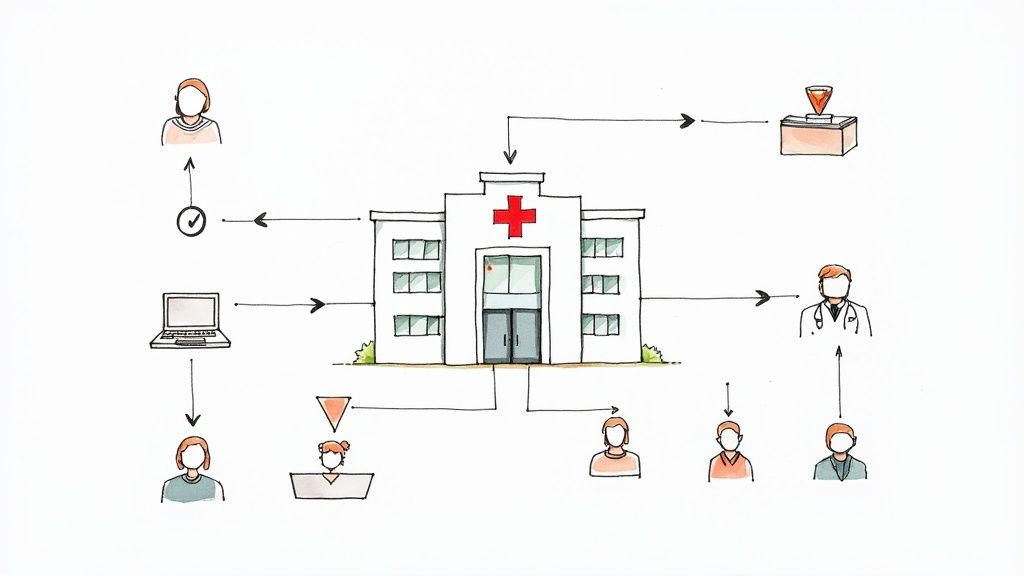
Getting a pilot program to show promise is a huge win, but it’s just the beginning. The real, lasting value of any AI initiative comes from taking it enterprise-wide, and that’s often where the wheels can fall off. Moving from a controlled experiment to full-scale adoption demands a deep focus on the human side of the equation.
In healthcare, this means making new AI solutions feel like a natural part of established clinical workflows. This is far more than a technology rollout; it’s a change management challenge. You absolutely have to win over busy, often skeptical, clinicians and staff. A tool with a clunky interface or one that adds steps to an already packed day will be dead on arrival, no matter how brilliant its algorithm is.
This is the make-or-break phase where having our expert team guide the process can be the difference between a small-scale success and a true enterprise asset.
I've seen it time and again: effective change management in a clinical setting stands on three pillars—clear communication, hands-on training, and showing real, tangible value. You must be able to articulate the "why" behind any new tool. Will it cut down on diagnostic errors? Will it automate mind-numbing paperwork and give nurses more time at the bedside?
This message has to be consistent and delivered through channels people actually trust. One of the most effective things you can do is appoint clinical champions—respected physicians or nurses who truly believe in the project. They can translate the tech benefits into terms their peers understand and respect, serving as an essential bridge between the IT team and the front lines.
And please, don't make training a one-off webinar. It needs to be hands-on, specific to each role, and woven directly into the daily workflow. Offer ongoing support and create simple feedback loops so users feel heard and problems get fixed fast. This approach turns potential critics into your biggest advocates.
As you start to scale, the C-suite will inevitably—and rightly—ask about the return on investment. But in healthcare, a purely financial calculation doesn't tell the whole story. To capture the full impact, your ROI framework has to track both the hard numbers and the softer, but equally important, qualitative metrics.
The true measure of an AI tool's success in healthcare isn't just about cost savings. It's about its impact on the quality of care, the efficiency of clinicians, and the overall patient experience.
Think of your ROI tracking as a balanced scorecard:
The drive for AI-led productivity isn't unique to healthcare. By looking at how other industries deploy AI tools for business, we can borrow proven models for success. Many large enterprises are already seeing incredible gains from AI.
The AI consulting market reflects this reality, with large organizations expected to fuel growth at a CAGR of 27.9% between 2025 and 2035. These companies are using AI for everything from predictive analytics to automating customer service, with some projections showing AI-led productivity boosts hitting 45% in large companies by 2035. As we explored in our AI adoption guide, these lessons are highly transferable to the challenges we face in healthcare. Find out more about these AI market trends.
Ultimately, scaling AI solutions is the final, crucial step in any ai strategy consulting for healthcare companies. It’s the moment a well-laid plan finally becomes a source of sustainable, long-term value for your patients, your clinicians, and your entire organization.
Stepping into the world of AI in healthcare can feel like navigating a maze. It’s only natural to have a lot of questions. Based on countless conversations with hospital executives and clinical leaders, here are straight answers to the most common queries.
Before you even think about algorithms or vendors, your first move is to get the right people in the same room. Pull together a small, focused steering committee with leaders from your clinical teams, IT, administration, and compliance. The single goal of that first meeting is to define why you're pursuing AI. Is the main driver to slash operational costs, give clinicians a leg up in diagnostic accuracy, or create a better patient experience? Answering this provides a north star for every decision that follows. Using an AI Strategy consulting tool can ensure these initial workshops are productive.
This is a big one, and the answer is simple: you bake HIPAA compliance into your AI strategy from the very beginning. It can't be an afterthought. This means starting with a deep dive into your data governance, establishing rock-solid de-identification protocols before any data is used for training an AI model. Any vendor or partner you bring on must sign a Business Associate Agreement (BAA)—no exceptions. Your strategy should also require routine security audits for any AI system you deploy.
The classic "build vs. buy" debate depends on your organization's long-term ambitions, current resources, and how quickly you need to see results. Building an in-house team is a fantastic long-term goal, but it’s a massive investment in time and expensive talent. Partnering with a specialized firm like Ekipa AI gives you instant access to expertise and field-tested methods, dramatically speeding up your timeline. Many health systems use a hybrid model: they bring in consultants to map the initial strategy and run pilot projects while simultaneously training their internal team to manage and scale the solutions long-term.
Measuring the return on investment for clinical AI goes beyond just looking at cost savings. You need a broader perspective that captures the true clinical value, which almost always leads back to financial benefits. Track a mix of hard and soft metrics, including improved diagnostic accuracy, faster time-to-diagnosis, better patient outcomes (e.g., lower readmission rates), and clinician efficiency gains. Don't forget to measure clinician and patient satisfaction. The most successful ai strategy consulting for healthcare companies delivers clear wins across all these areas.
Ready to stop talking about AI and start making it happen? At Ekipa AI, our team helps healthcare organizations like yours get from strategy to execution, every step of the way. Our AI Product Development Workflow and expert consultants are ready to build your roadmap to success. Learn more about our expert team and how we can help.
How to build HIPAA-compliant AI: when LLM providers need a BAA, data minimization, de-identification, audit controls and a reference architecture.
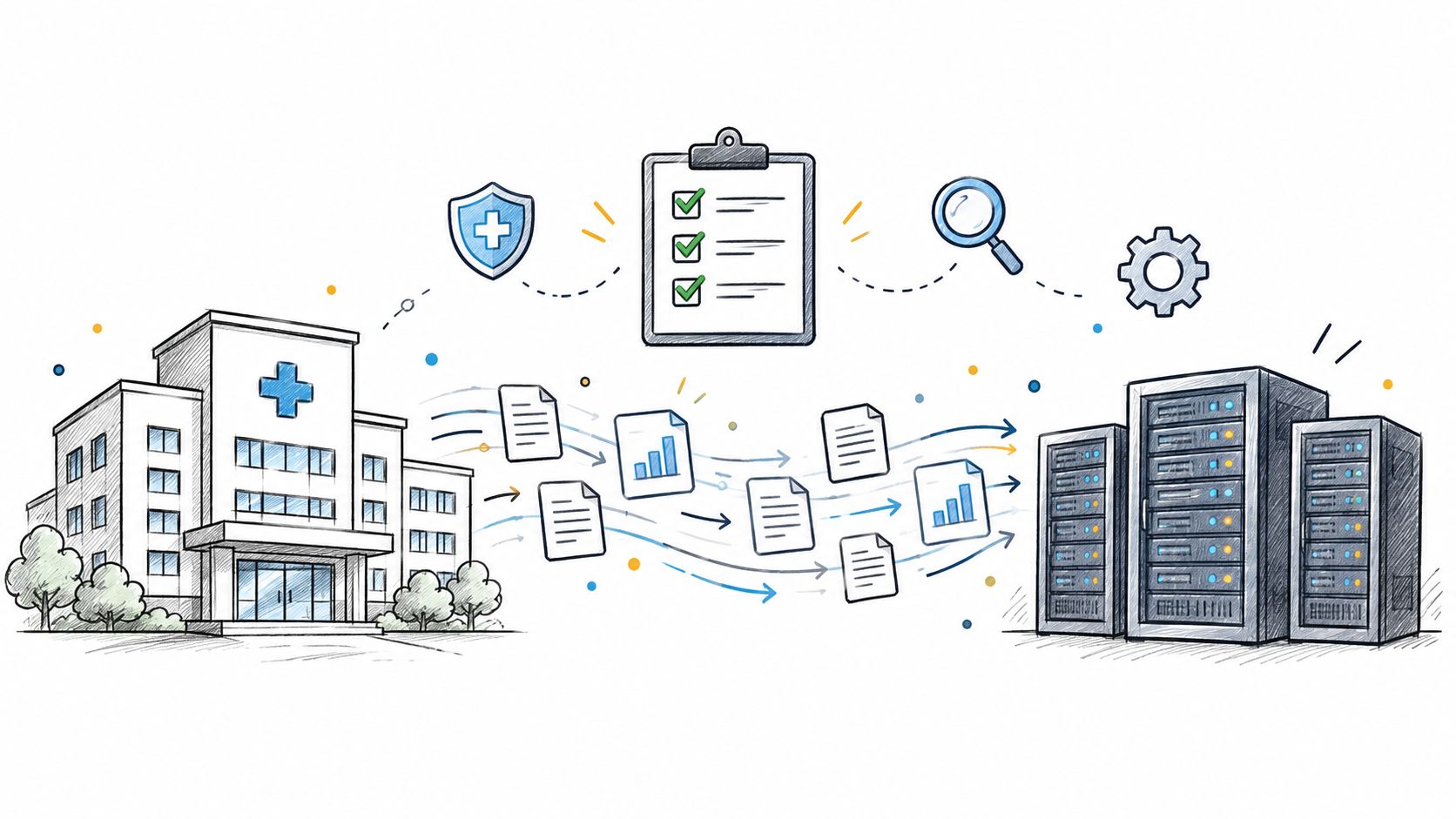
Practical data migration planning guide for healthcare teams. Scope, mapping, compliance, validation, cutover and rollback decisions explained end to end.

Smart on FHIR guide for healthtech engineers. Learn the OAuth 2.0 launch model, scope syntax, backend services, and US regulatory requirements.
Connect with our team to explore how AI expertise can transform your business.