AI in Healthcare
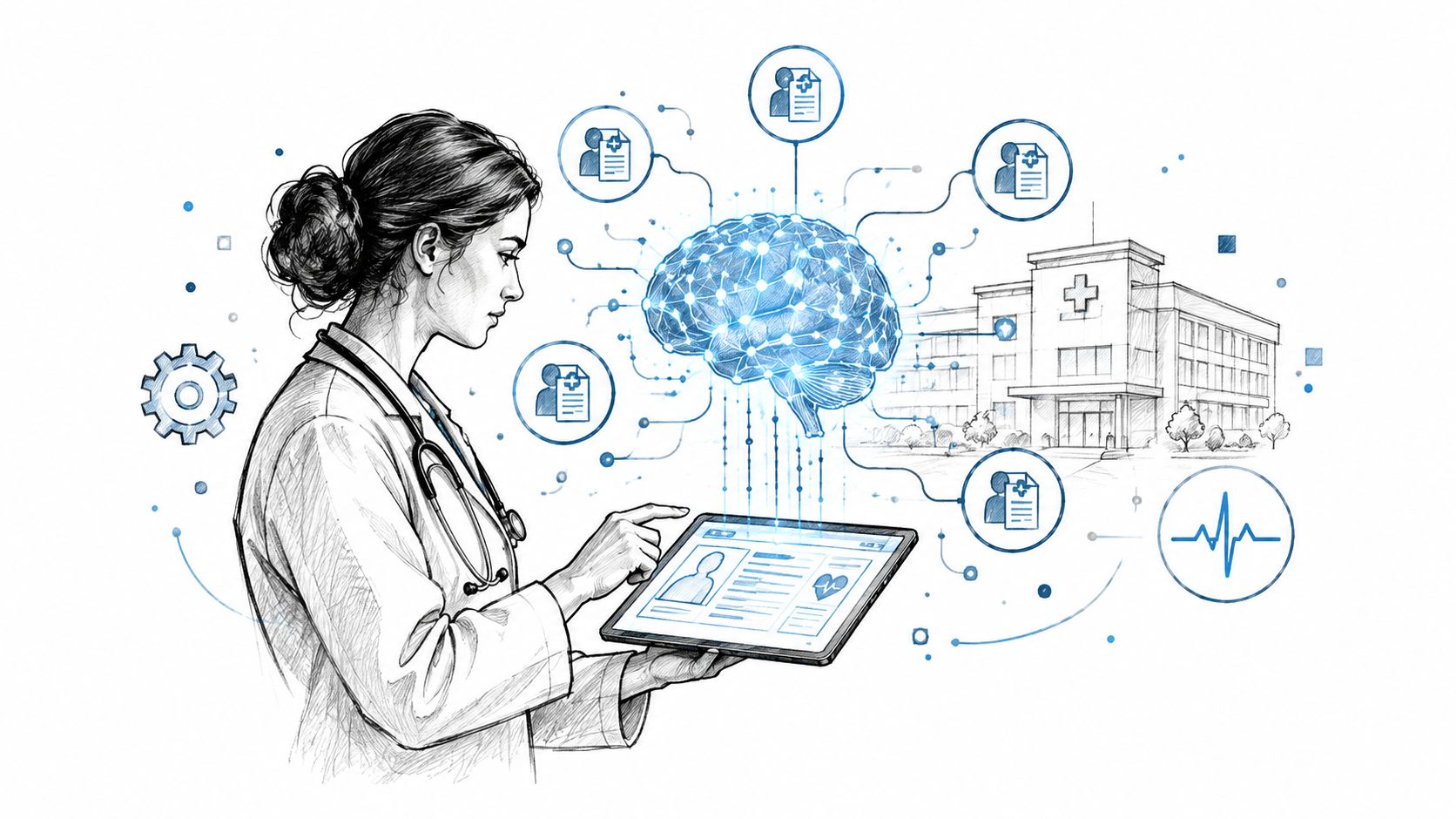
AI Transformation Healthcare Industry Explained
Learn what AI transformation healthcare industry means, from EHR integration to governance, ROI, and adoption roadmap for healthtech leaders.
September 23, 2026Read more
Discover the top 10 applications of AI in business transforming industries. Learn how to leverage AI for growth, from customer service to supply chains.
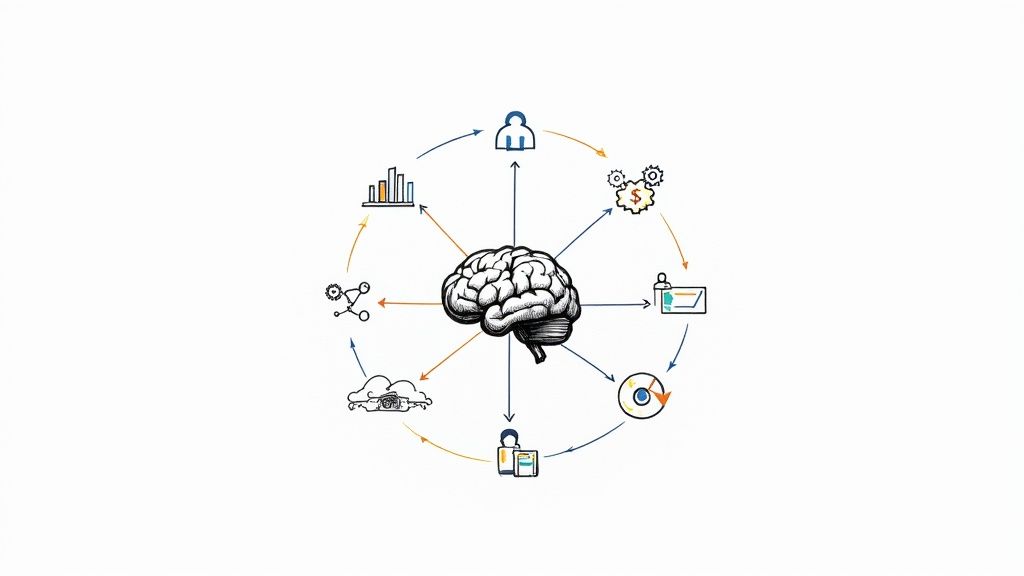
Artificial intelligence is no longer a futuristic concept; it's a practical tool actively reshaping core business functions. While discussions often focus on high-level potential, business leaders need concrete examples to inform their strategy. Understanding the specific applications of AI in business is the first step toward moving from theory to tangible ROI. This article cuts through the noise to provide a detailed breakdown of proven AI use cases across critical departments, from marketing and operations to finance and HR.
We will move beyond surface-level descriptions and dive deep into the strategic mechanics behind each application. You will find actionable takeaways, tactical insights, and replicable methods that you can adapt for your own organization. This is not just a list of what's possible; it's a playbook for implementation. By exploring these diverse, real-world use cases, you will gain the clarity needed to identify high-impact opportunities and build a robust AI roadmap. As businesses look ahead, having a practical grasp of these tools is essential, a sentiment echoed in expert predictions for AI and data in 2025. Our goal is to equip you with the knowledge to make informed decisions, whether you're considering AI Automation as a Service or developing a comprehensive AI strategy consulting plan.
One of the most widespread applications of AI in business is the deployment of AI-powered chatbots and virtual assistants for customer service. These intelligent systems leverage natural language processing (NLP) to understand, interpret, and respond to human language. They manage customer inquiries, provide 24/7 support, and guide users through complex processes, significantly reducing operational costs and improving response times.
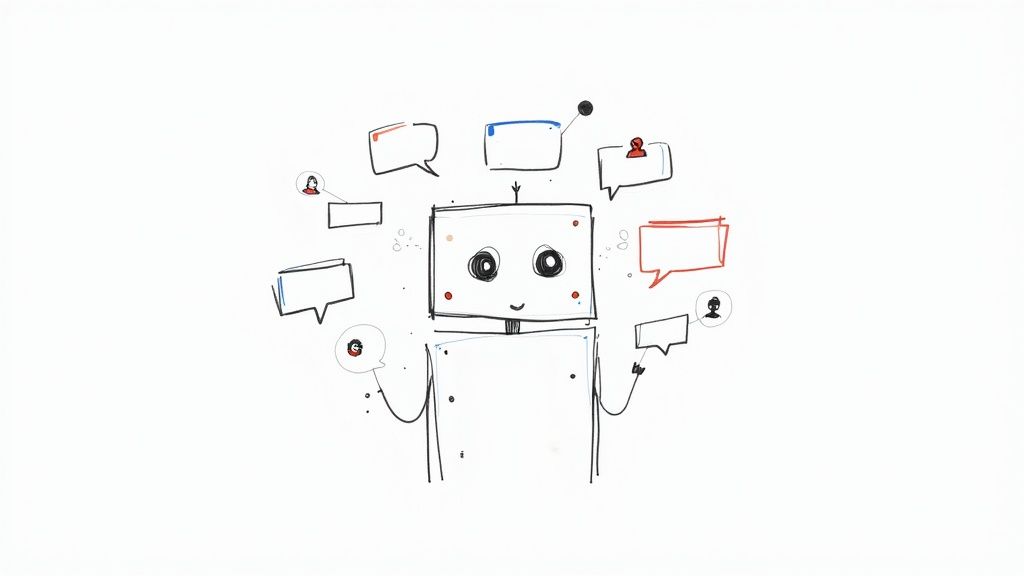
Unlike basic rules-based bots, modern AI chatbots learn from each interaction, continuously improving their accuracy and contextual understanding. For companies looking to scale their support without a proportional increase in headcount, this technology is a game-changer. For those interested in developing their own intelligent assistants, you can learn more about custom ChatGPT solutions and how they can be tailored to specific business needs.
Leading companies use chatbots as strategic assets, not just cost-saving tools. Bank of America's virtual assistant, Erica, has handled over one billion client requests, demonstrating massive scalability. Sephora's chatbot doesn't just answer questions; it provides personalized beauty advice and product recommendations, acting as a digital sales associate that boosts engagement and drives revenue. The key is moving from reactive support to proactive, personalized interaction.
One of the most transformative applications of AI in business involves predictive analytics and business intelligence. This technology utilizes historical data, sophisticated machine learning algorithms, and statistical models to forecast future trends, customer behaviors, and market shifts. By doing so, it empowers organizations to move from reactive to proactive decision-making, optimizing operations, identifying growth opportunities, and mitigating risks before they arise.
This bar chart visualizes the significant returns businesses can expect from implementing predictive analytics.
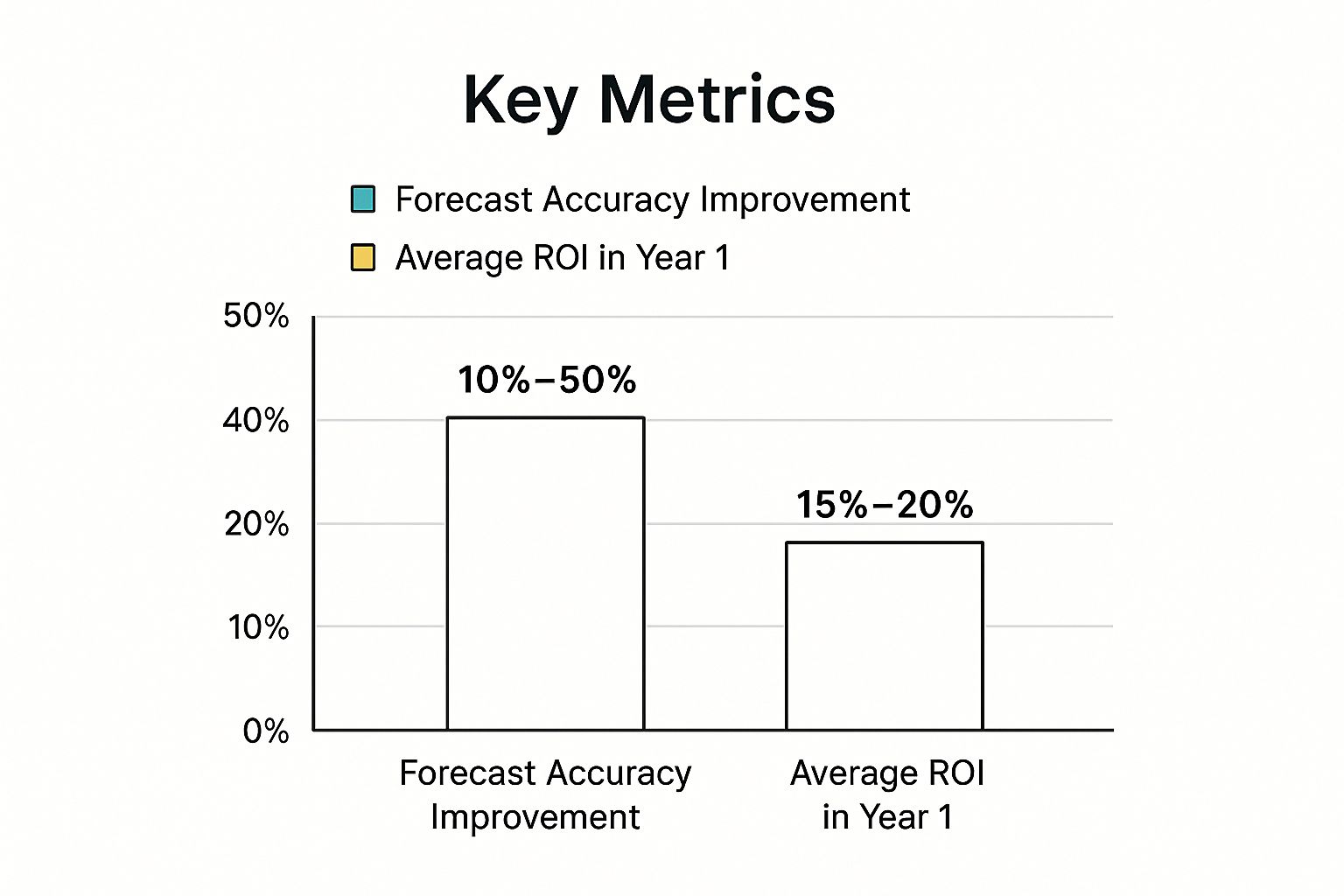
The data clearly indicates that while forecast accuracy can improve by up to 50%, a substantial ROI is often realized within the first year of deployment.
Unlike traditional business intelligence which reports on past events, AI-driven predictive analytics answers the question, "What is likely to happen next?" For companies aiming to gain a competitive edge, this foresight is invaluable. Businesses interested in harnessing this power can explore tools like a financial insights dashboard to see how predictive models can be applied to financial data.
Industry leaders use predictive analytics not just to forecast but to fundamentally reshape their operations. For example, Netflix analyzes viewing data to predict which original content will succeed, making multi-million dollar investment decisions with reduced risk. Similarly, UPS uses its ORION system to optimize millions of delivery routes daily, saving immense fuel costs. The strategic value lies in embedding these predictions directly into core business processes to drive efficiency and innovation.
One of the most impactful applications of AI in business is creating hyper-personalized customer experiences. AI-powered systems analyze vast amounts of customer data, including browsing history, purchase patterns, and demographic information, to deliver tailored marketing messages, product recommendations, and unique content. These engines use techniques like collaborative filtering and deep learning to predict user interest, significantly boosting engagement, loyalty, and sales.
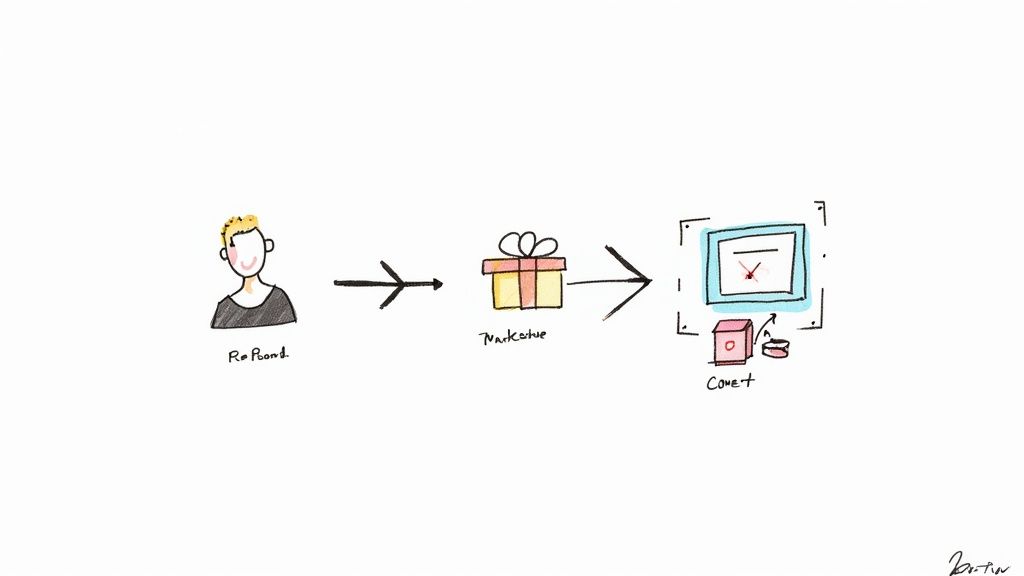
This technology moves marketing from a one-to-many to a one-to-one conversation at scale. For businesses aiming to increase customer lifetime value, a well-defined personalization strategy is crucial. Developing this requires expert guidance, often starting with AI strategy consulting to align technology with business goals and ensure a strong return on investment.
Leading companies use personalization to create deeply integrated brand experiences. Amazon’s recommendation engine is legendary, reportedly driving up to 35% of its total revenue by showing customers products they are highly likely to purchase. Similarly, Spotify’s Discover Weekly playlist, powered by a sophisticated AI model, has become a core feature that keeps over 40 million users engaged by introducing them to new music tailored to their specific tastes. The strategic shift is from broad market segmentation to true one-to-one individualization, making each customer feel uniquely understood.
Another critical application of AI in business involves enhancing security through advanced fraud detection and risk management. AI systems leverage machine learning and anomaly detection to analyze vast datasets in real time, identifying patterns and outliers indicative of fraudulent activity. This proactive approach allows financial institutions and e-commerce platforms to stop illicit transactions before they cause significant damage, protecting both revenue and customer trust.
Unlike static, rules-based systems that are easily circumvented, AI models continuously learn from new data, adapting to the sophisticated and evolving tactics of fraudsters. This capability is essential for businesses operating at scale, where manual review is impossible. Solutions like FICO's Falcon Fraud Manager are now industry standard, demonstrating how AI can provide robust security. For businesses looking to build similar bespoke security measures, an expert AI requirements analysis is the first step toward a resilient system.
Leading organizations use AI not just to block fraud but to holistically manage risk while improving the customer journey. Mastercard's Decision Intelligence system, for example, analyzes thousands of data points to approve legitimate transactions with greater accuracy, reducing false declines by up to 50%. This prevents the frustration and potential customer loss caused by incorrectly flagged purchases. Similarly, PayPal's system reviews millions of transactions daily, learning user behavior to distinguish between genuine and suspicious activity with remarkable precision, thereby securing its global platform.
AI transforms supply chain management through demand forecasting, inventory optimization, route planning and warehouse automation. These systems analyze data from suppliers, weather patterns, market conditions and historical trends to optimize the entire ecosystem. Companies leveraging AI co creation and AI strategy consulting achieve sharper cost reduction and faster delivery.
Unlike manual planning, modern AI platforms learn continuously from sensor feeds and order flows. DHL’s predictive maintenance cuts aircraft downtime by 25%, Maersk’s AI routing saves $150 million annually, Zara’s algorithmic design-to-shelf cycle is just two weeks, and Amazon’s fulfillment robots boost efficiency by 20%. For a deeper dive, check our Custom AI Strategy report.
“Visibility across every node of the supply chain is critical to spotting disruptions before they cascade.”
Integrated platforms from Oracle SCM, SAP Integrated Business Planning or Blue Yonder unify data streams in real time. This lets operations leads detect demand spikes, reroute shipments and rebalance stock instantly. The strategic advantage is turning reactive firefighting into proactive optimization.
Explore more real-world use cases to scale your supply chain with AI, or connect with our expert team to begin.
AI is revolutionizing human resources by automating and optimizing processes from recruitment to employee retention. These intelligent systems analyze vast amounts of data to screen resumes, predict employee turnover, and identify high-potential candidates for leadership roles. By handling repetitive tasks, AI frees HR professionals to focus on strategic initiatives, making the entire department more efficient and data-driven. This is a critical application of AI in business for building a stronger, more agile workforce.
Unlike traditional HR software, AI-powered platforms like Workday HCM or HireVue use machine learning to uncover insights hidden in employee and candidate data. For instance, Unilever reduced its hiring time by 75% using AI-powered assessments that analyze candidate submissions for key traits. Companies seeking to implement similar efficiencies can benefit from an AI Automation as a Service model to streamline these complex workflows.
Leading organizations leverage HR AI not just for administrative efficiency but for predictive talent management. IBM's Watson Talent can identify at-risk employees with 95% accuracy, allowing managers to intervene proactively and reduce turnover. Similarly, L'Oréal’s AI tool screens over 1.5 million applications annually, identifying top talent far faster than manual methods could. The strategic shift is from a reactive, administrative function to a proactive, predictive one that directly impacts business outcomes.
AI is fundamentally reshaping the financial industry, powering sophisticated services like algorithmic trading, automated credit scoring, and dynamic risk assessment. These systems process vast market datasets in real-time, identifying complex patterns and trading opportunities that are impossible for humans to detect. They also automate regulatory compliance, reducing errors and ensuring adherence to complex financial rules.
This application of AI in business extends far beyond just trading. The application of AI-driven financial analytics is transforming how institutions approach everything from lending decisions to asset management. By analyzing non-traditional data sources, AI models can generate more accurate credit scores and risk profiles, opening up financial products to previously underserved populations.
Leading financial institutions use AI not just for speed, but for strategic depth. JPMorgan's LOXM algorithm, for instance, executes large equity trades by learning from historical data to minimize market impact. Similarly, BlackRock's Aladdin platform isn't just a trading tool; it's a comprehensive risk management system that provides a holistic view of a firm's entire portfolio, managing trillions in assets by predicting potential market shocks. The strategy is to leverage AI for predictive intelligence, not just reactive execution.
AI is revolutionizing the factory floor, transforming manufacturing through predictive maintenance, automated quality control, and production optimization. This application of AI in business uses computer vision to inspect products for defects with superhuman accuracy and machine learning algorithms to predict equipment failures before they happen. This shift towards smart factory operations maximizes efficiency, minimizes waste, and dramatically improves output quality.
AI-driven systems analyze vast streams of data from sensors and machinery to identify patterns that precede breakdowns, allowing for proactive maintenance. This not only prevents costly downtime but also extends the lifespan of critical equipment. For businesses looking to implement such systems, it's beneficial to explore solutions like a custom predictive maintenance app to see how they can be tailored to specific operational needs.
Leading manufacturers use AI as a core competitive advantage, not just a simple inspection tool. Siemens' digital factory in Amberg, Germany, has achieved a stunning 99.99885% quality rate by integrating AI across its entire production line. Similarly, BMW uses AI-powered computer vision to detect microscopic paint defects, achieving 99% accuracy and ensuring a flawless finish on every vehicle. The strategic goal is to create a self-optimizing production environment where AI continuously refines processes for peak performance.
One of the most transformative applications of AI in business is within the healthcare sector. AI is revolutionizing medical imaging analysis, drug discovery, and diagnostics by processing vast datasets far beyond human capacity. These systems analyze medical scans, genetic data, and patient records to detect diseases earlier, personalize treatment plans, and accelerate the development of new medicines, ultimately improving patient outcomes while reducing costs.
This technology is critical for organizations aiming to enhance diagnostic accuracy and operational efficiency. For businesses exploring how to integrate such sophisticated systems, understanding the AI Product Development Workflow is a crucial first step toward successful implementation.
The most effective medical AI doesn't replace clinicians; it augments their abilities. Google's DeepMind, for instance, can detect over 50 eye diseases from scans with an accuracy rate rivaling top specialists. Similarly, PathAI's platform assists pathologists by identifying cancer cells with near-perfect accuracy, reducing diagnostic errors and allowing specialists to focus on complex cases. The strategy here is to use AI as a powerful assistive tool that enhances precision and frees up valuable expert time.
One of the most critical applications of AI in business is bolstering cybersecurity defenses against increasingly sophisticated threats. AI-powered security systems go beyond traditional, signature-based tools by using machine learning to analyze vast amounts of data in real-time. They establish a baseline of normal network behavior and can instantly flag anomalies, from unauthorized data access to malware infections, that would otherwise go unnoticed. This proactive approach allows for the detection of zero-day exploits and insider threats before significant damage occurs.
These intelligent systems analyze network traffic, user behavior, and endpoint activity to identify patterns indicative of an attack. Companies like CrowdStrike leverage AI to prevent billions of attacks annually, showcasing the technology's scalability and effectiveness. For businesses looking to secure their digital assets, integrating AI into their security framework is no longer an option but a necessity. Developing a robust defense often starts with a comprehensive AI strategy consulting approach to identify vulnerabilities and prioritize protective measures.
Leading cybersecurity platforms use AI not just to block known threats but to predict and neutralize new ones. Darktrace's "Enterprise Immune System" famously detected the NotPetya ransomware attack within seconds by recognizing its unusual behavior, long before it was identified globally. Similarly, Cylance (now BlackBerry) uses predictive AI to block malware with over 99% efficacy by analyzing file characteristics rather than relying on known signatures. This strategic shift from reactive cleanup to predictive prevention is the core value AI brings to cybersecurity, minimizing incident response times and reducing financial and reputational risk.
AI Application Implementation Complexity Resource Requirements Expected Outcomes Ideal Use Cases Key Advantages
AI-Powered Chatbots and Customer Service
Medium to High initial; low ongoing
Requires NLP models, CRM integration, training data
24/7 instant customer support, reduced costs, scalable
Customer support across retail, banking, telecom
Cost reduction, improved satisfaction, scalability
Predictive Analytics and Business Intelligence
High complexity and maintenance
High-quality data, ML infrastructure
Accurate forecasting, risk reduction, proactive decisions
Data-driven decision-making in various industries
Improved forecast accuracy, risk management
Personalized Marketing and Recommendation Engines
Medium complexity
Large customer data sets, multi-channel tools
Increased conversions and sales, better customer loyalty
E-commerce, digital marketing
Higher conversion, targeted campaigns, ROI
Fraud Detection and Risk Management
High complexity
Extensive historical data, real-time monitoring
Reduced fraud losses, fewer false positives
Financial services, e-commerce
Fraud loss reduction, 24/7 monitoring, compliance
Supply Chain Optimization and Logistics
High complexity
Integration across partners, data from multiple sources
Lower costs, improved delivery, inventory optimization
Logistics, manufacturing, retail
Cost savings, delivery reliability, resilience
Human Resources and Talent Management
Medium complexity
Resume databases, employee data, analytics tools
Faster hiring, better candidate quality, retention
Recruitment, workforce planning
Time savings, quality improvement, bias reduction
Financial Services and Algorithmic Trading
Very high complexity
Advanced infrastructure, real-time market data
Faster trades, improved risk assessment, regulatory compliance
Trading, credit scoring, portfolio management
Trading speed, risk reduction, financial access
Manufacturing and Quality Control
High complexity
IoT sensors, computer vision, skilled workforce
Higher product quality, less downtime, efficiency gains
Manufacturing plants, quality assurance
Quality consistency, predictive maintenance
Healthcare and Medical AI Applications
Very high complexity
Clinical data, regulatory compliance, validation
Improved diagnostics, personalized treatments, cost reduction
Medical imaging, diagnostics, drug discovery
Accuracy improvement, early detection, cost savings
Cybersecurity and Threat Detection
High complexity
Large security data, continuous updates
Rapid threat detection, reduced false positives
Network security, incident response
High accuracy, 24/7 monitoring, fast response
The journey through the diverse applications of AI in business reveals a powerful truth: artificial intelligence is no longer a futuristic concept, but a present-day engine for growth, efficiency, and competitive advantage. We've explored how AI is revolutionizing everything from hyper-personalized marketing campaigns and intelligent customer service chatbots to fortified cybersecurity and optimized supply chains. Each example, from fraud detection in finance to talent acquisition in HR, underscores a common theme-data-driven intelligence is the new cornerstone of modern enterprise.
The key takeaway is that AI's value isn't in its novelty, but in its strategic application. Success hinges on moving beyond generic adoption and focusing on targeted implementation that solves specific business problems. As we've seen, the most impactful strategies are those that integrate AI seamlessly into existing workflows to enhance human capabilities, not just replace them.
Strategic Imperative: The goal is not just to use AI, but to build an AI-powered operational fabric that continuously learns, adapts, and delivers measurable ROI. This requires a shift from isolated projects to a holistic, integrated vision.
Seeing the potential is the first step; harnessing it requires a clear plan. Based on the insights from the real-world use cases we've analyzed, here are your actionable next steps to translate inspiration into implementation:
Embracing the vast landscape of applications of AI in business is the definitive way to future-proof your organization. By moving from understanding to strategic action, you can unlock unprecedented levels of performance and innovation. The journey begins with a single, well-planned step, guided by a clear vision and expert partnership.
Ready to transform these insights into a concrete action plan for your business? The our expert team at Ekipa AI specializes in translating business challenges into powerful AI solutions. We partner with you through our AI co creation process to build a Custom AI Strategy report that turns your vision into a scalable, impactful reality.
Learn what AI transformation healthcare industry means, from EHR integration to governance, ROI, and adoption roadmap for healthtech leaders.

Explore skilled nursing facility software in 2026. Covers core modules, compliance, KPIs, vendor evaluation, & AI integration for executives.

Unlock scalable impact with a practical healthcare AI transformation framework. This guide covers strategy, governance, ROI, and a phased roadmap for leaders.
Connect with our team to explore how AI expertise can transform your business.