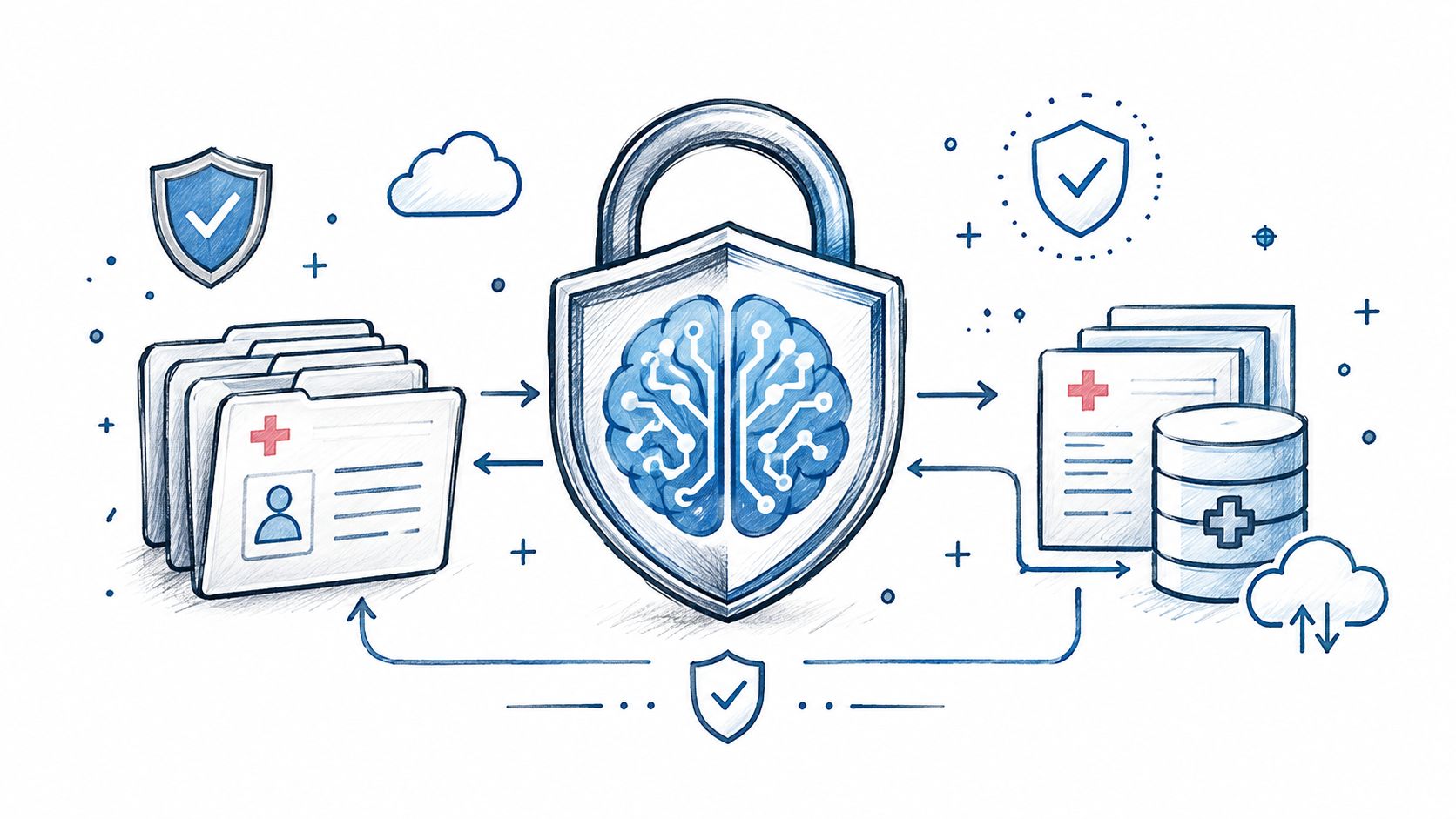
AI in Healthcare
HIPAA-Compliant AI: How to Use LLMs With PHI Safely
How to build HIPAA-compliant AI: when LLM providers need a BAA, data minimization, de-identification, audit controls and a reference architecture.
October 16, 2026Read more
Discover how applied AI for healthcare enterprises drives real-world value. Learn to build a data strategy, navigate ethics, and fast-track implementation.

The conversation around AI in medicine has moved past the theoretical. Today, applied AI for healthcare enterprises isn't some far-off goal; it's a practical toolkit for boosting operational performance and delivering better patient care. We've shifted from abstract models and research papers to scalable, real-world solutions that are expected to show a clear return on investment.
This practical focus is fundamentally changing how healthcare organizations operate. C-suite executives are no longer just consumers of technology—they're becoming AI strategists, weaving these tools into the very fabric of their business. This impacts everything from back-office administration to the front lines of patient diagnosis.
Getting this right is complex. It’s why many successful organizations work closely with an expert HealthTech engineering partner to sidestep common pitfalls and build momentum.

We're not talking about futuristic concepts anymore. This is about deploying proven technologies to fix today's problems. Healthcare providers are already using AI-powered systems to tackle persistent issues like staffing shortages, administrative backlogs, and other systemic inefficiencies. A big part of this involves making sense of vast amounts of data, which is a key part of understanding How AI BI Transforms Healthcare Analytics.
The global AI in healthcare market, valued at USD 18.0 billion in 2026, is projected to hit an incredible USD 80.7 billion by 2036. That's a powerful 16.2% compound annual growth rate, driven by the real-world application of AI in diagnostics, robotics, and workflow automation. If you're interested in the specifics, it's worth reviewing these AI in healthcare market projections.
For any healthcare leader, this signals a crucial mindset shift. The objective is no longer simply to "adopt" new tech. It's about integrating AI so deeply that it drives measurable improvements across both business metrics and patient outcomes. This requires a clear vision and a well-defined plan, which often starts with expert AI strategy consulting.
So, where do you start? Successful applied AI initiatives tend to focus on a few core areas where they can deliver the most significant, tangible value.
The table below summarizes these key pillars, outlining the primary business goals and a concrete example for each.
| AI Pillar | Primary Business Goal | Example Application |
|---|---|---|
| Operational Efficiency | Reduce overhead and redirect staff to patient-facing work. | Automating billing codes and claims processing with custom internal tooling. |
| Clinical Augmentation | Equip medical staff with smarter, faster decision-making tools. | Using AI to analyze medical images or developing complex SaMD solutions. |
| Patient Experience | Improve patient engagement, satisfaction, and outcomes. | Deploying AI-powered chatbots for scheduling and personalized post-visit follow-ups. |
Focusing on these strategic pillars helps move AI from isolated experiments to an integrated, enterprise-wide capability that drives real growth and improvement.
Enough with the theory. Let's dig into the proven, high-value real-world use cases where applied AI is already making a difference for healthcare enterprises. We'll look at how you can pinpoint the most promising initiatives, whether you’re focused on building internal tooling for efficiency or developing advanced SaMD solutions for patient care.
We're seeing a clear push toward using intelligent systems to solve very specific, pressing challenges. Just look at the recent digital brain health expansion in Canada—it’s a perfect example of organizations adopting AI not for the sake of technology, but to meet a tangible need.

It’s no secret that administrative complexity is a huge drain on healthcare. Some studies show that nearly 30% of all healthcare spending is eaten up by these activities. Applied AI offers a practical way out by automating the high-volume, repetitive work that burns out staff and slows everything down.
A great place to start is with claims management, using AI Automation as a Service. Instead of just speeding up one step, you can embed AI directly into the workflow to manage intake, validation, and adjudication, cutting down on manual work and accelerating the entire process.
The real win isn't just automating single tasks; it's about orchestrating the whole process. Think of a multi-agent AI system coordinating actions across departments—from pulling member records to validating information and applying plan-specific rules—all without a single person having to re-enter data or manually trigger the next step.
AI is becoming an invaluable partner for clinicians, helping them make faster, more informed decisions. One of the most mature applications is in diagnostic imaging. AI models can scan X-rays, CTs, and MRIs, flagging subtle abnormalities that even a trained human eye might overlook.
This isn't about replacing doctors. It's about giving them a powerful co-pilot. An AI can analyze thousands of images in minutes, automatically prioritizing the most urgent cases for a radiologist's review. This simple step can dramatically shrink turnaround times and get high-risk patients the attention they need, sooner. Other powerful tools can be found in our overview of Healthcare AI Services.
These kinds of enhancements are making a real impact in areas like:
Ultimately, these applications directly boost the quality of care and improve patient safety.
Today’s patients expect the same convenient, personalized service from their healthcare provider that they get everywhere else. Applied AI is finally making this a reality by powering tools that manage the patient experience from beginning to end.
AI-driven chatbots, for example, can handle appointment scheduling, answer common pre-visit questions, and send out reminders, which frees up your front-desk staff for more complex issues. After a visit, AI can send automated, personalized follow-ups to ensure patients stick to their care plans and medication schedules—a crucial step in managing chronic conditions and preventing costly readmissions.
By making sense of patient data, AI also helps create a more empathetic, tailored interaction. This could look like:
The influence of applied AI runs deep into R&D, especially in drug discovery and clinical trials. Finding a new drug candidate has traditionally been an incredibly long and expensive gamble, but AI is fundamentally changing that equation.
By analyzing massive biological and chemical datasets, AI models can predict how different compounds might interact with diseases, spotting promising candidates in a fraction of the time. This doesn't just speed up the R&D pipeline; it slashes the immense costs tied to failed experiments.
When it comes to clinical trials, AI helps optimize the study design, recruit the right patient groups more quickly, and even monitor participants remotely, making the entire process more efficient and data-rich.
Let's be honest: no major AI initiative gets off the ground without a rock-solid business case. Beyond the exciting possibilities for patient care, your CFO and board members want to see a clear, convincing path to financial return. So, how does implementing applied AI actually strengthen your organization's bottom line? It really comes down to two things: slashing significant costs and opening up new avenues for revenue.
The numbers here aren't just theoretical. Analysts expect AI-driven tools to slash healthcare costs by as much as USD 150 billion annually worldwide by 2026. This isn't a future dream; the returns are already here. We're seeing 57% of medtech firms reporting positive ROI from AI in medical imaging alone, and 46% of pharmaceutical companies are seeing returns from their AI-powered drug discovery efforts. It’s no surprise that 85% of healthcare leaders are planning to ramp up their AI spending. You can dig deeper into these healthcare AI market growth and key statistics to see the trend for yourself.
The easiest place to find immediate financial wins is in your operations. Administrative waste is a notorious black hole for healthcare budgets, and AI provides a direct, powerful solution.
Think about the sheer manpower tied up in manual data entry, claims processing, and scheduling. By bringing in something like AI Automation as a Service, you can automate these high-volume, repetitive jobs that are essential but don't require a human touch.
This isn't just about speed. It’s about strategically reassigning your most valuable asset—your people. When your skilled team isn't buried in paperwork, they can dedicate their time to complex, patient-focused work that improves care quality and directly drives revenue.
Here’s where you’ll see the savings almost immediately:
The financial upside of AI goes well beyond just cutting checks. Some of the most powerful gains come from improvements in clinical outcomes and how you use your existing resources—gains that are less direct but just as impactful.
Take patient readmissions, for example. Predictive models can flag patients who are at a high risk of returning to the hospital shortly after discharge. Armed with that insight, your care teams can provide proactive, personalized follow-up, preventing a costly and disruptive readmission.
The same principle applies to your physical assets. AI-powered scheduling can optimize the use of high-demand resources like operating rooms or MRI machines. You can increase patient throughput and generate more revenue from the equipment you already own, without spending millions on capital expansion.
Building a compelling business case starts by connecting these dots. The goal is to map each potential AI project to a specific, measurable financial outcome, whether it's a direct cost saving or an indirect revenue gain. A good AI strategy consulting tool can guide this process, helping you build a financial narrative that resonates with everyone from the C-suite to your frontline clinicians.
Getting AI right in a healthcare setting doesn't happen by accident. It's the result of a deliberate, well-thought-out plan. Without a clear roadmap, even the most promising AI projects can get bogged down by shifting goals, unexpected costs, or a simple lack of support from key departments. A solid plan is what separates a flashy tech demo from a solution that genuinely improves care and strengthens your bottom line.
The first step is always a deep discovery process. This is more than just a few brainstorming sessions; it involves a detailed AI requirements analysis to find the most impactful use cases that line up with your organization's core objectives. Bringing in an expert for AI strategy consulting at this early stage can make a huge difference, helping you pinpoint quick wins that build momentum for the bigger, long-term goals.
This isn't just about technology—it’s about creating real financial value. The right AI initiatives can directly cut operational costs, open up new revenue streams, and deliver a powerful return on investment.

As you can see, it becomes a self-reinforcing cycle. The initial savings you achieve can be reinvested into further innovation, driving sustained growth and an even better ROI over time.
To guide you through this process, we've broken it down into a phased roadmap. This table outlines the key activities and expected outcomes for each stage, offering a clear path from initial strategy to full-scale deployment.
| Phase | Key Activities | Primary Outcome |
|---|---|---|
| Phase 1: Strategy & Discovery | Conduct stakeholder workshops to identify pain points. Prioritize use cases based on impact and feasibility. Develop a detailed business case with financial modeling. | A prioritized list of AI initiatives backed by a solid business case and stakeholder consensus. |
| Phase 2: Data Readiness & Governance | Audit existing data sources for quality and accessibility. Establish a robust data governance framework. Cleanse, label, and structure data for pilot projects. | A secure, compliant, and well-organized data foundation ready to support AI model training and validation. |
| Phase 3: Pilot Program & Prototyping | Develop a Minimum Viable Product (MVP) for a top-priority use case. Test the model in a controlled, real-world setting. Collect feedback from end-users. | A validated prototype that proves the AI's value and a data-driven case for full-scale implementation. |
Each phase builds on the last, ensuring that your investment is de-risked and aligned with your strategic goals every step of the way.
The first phase is all about defining what success actually means for your organization. Instead of chasing the latest AI trend, you need to zero in on specific, high-value problems the technology can solve. Look for the operational bottlenecks, clinical inefficiencies, or administrative headaches that are holding you back.
Key activities here involve getting the right people in a room:
By the end of this phase, you should have a formal Custom AI Strategy report that outlines a handful of prioritized initiatives, each with a rock-solid business case.
It’s an old saying, but it’s true: an AI model is only as good as the data you feed it. Before a single line of code is written, you have to get your data house in order. This phase is often the most time-consuming part of the entire journey, but it's non-negotiable for success.
This means putting a strong data governance framework in place to handle privacy, security, and ethical rules. For most organizations, it also involves a massive effort to clean, standardize, and structure data that might be sitting in disconnected silos. This groundwork is the foundation of any effective custom healthcare software development project.
A common mistake is dramatically underestimating the work needed here. It's not unusual for up to 80% of an AI project’s timeline to be spent just on data preparation. Tackling this head-on will save you from major headaches and delays later.
With a clear strategy in place and clean data at your fingertips, you're ready to start building. The goal of the pilot phase is to test your concept on a small, manageable scale. You want to prove that the AI works and delivers real value before you ask for the budget to roll it out everywhere. A disciplined AI Product Development Workflow is your best friend here.
This pilot phase lets you:
A successful pilot gives you undeniable proof to win over skeptics and secure the buy-in needed for a full-scale deployment. It’s the final step in de-risking the project and showing everyone, from the C-suite to the clinic floor, how AI can deliver on its promise.
Let's be clear: in the world of healthcare, great AI isn't just about clever algorithms. When you're dealing with patient lives and sensitive data, building systems that are compliant, ethical, and fundamentally trustworthy is the real challenge. Getting data governance and the regulatory maze right isn't a "nice-to-have"—it's the absolute foundation for any successful applied AI for healthcare enterprises program.
This goes far beyond ticking off boxes on a compliance checklist. It requires a serious, enterprise-wide framework for data governance that spells out exactly how patient information is handled from collection to protection. This is the bedrock for HIPAA compliance, patient privacy, and frankly, for earning and keeping trust.
A culture of responsibility isn't an accident. It’s built intentionally on three interconnected principles that ensure your AI initiatives are both effective and trusted.
Rock-Solid Data Governance: Think of this as your internal rulebook. It must clearly define who gets to access data, why they need it, and what they're allowed to do with it. Without a strong governance policy, you're opening the door to data misuse, inconsistencies, and significant risk.
Practical AI Ethics: This is where we move past what's legally required and ask what's right. It means actively hunting for and rooting out algorithmic bias, designing for fairness in outcomes, and maintaining complete transparency in how your AI models operate.
Vigilant Regulatory Compliance: These are the non-negotiables. It’s not just about adhering to established laws like HIPAA; it's about staying ahead of evolving guidance from the FDA, especially for things like SaMD solutions and other AI-driven medical technologies.
One of the biggest ethical minefields in healthcare AI is algorithmic bias. If your model is trained on data that reflects historical inequities in care—and most historical data does—it won't just replicate those problems. It can make them worse, leading to poorer outcomes for already vulnerable populations. You have to commit to auditing your data and models for bias, not just once, but continuously.
Transparency is just as crucial. A doctor isn’t going to trust a "black box" recommendation, and they shouldn't have to. This is where Explainable AI (XAI) is so important; it provides clear, human-friendly reasoning behind a model's output. It's also vital to use purpose-built tools, like an AI-powered data extraction engine, that are designed from the ground up for secure, private data handling.
Look at the pharma and biotech sectors, which are projected to account for over 30% of the market revenue share in 2025 as AI continues to reshape drug discovery. This incredible progress relies on analyzing massive patient datasets, which only amplifies the data governance stakes. While 74% of pharma companies are already using AI, these global AI healthcare market findings show that data challenges and questions about ROI remain major hurdles, underscoring just how critical a solid ethical framework is.
Getting this right isn't just a defensive strategy for avoiding fines. When you build a reputation for responsible AI, you build deep trust with patients and empower your clinicians to use new tools with confidence. In the long run, that principled approach to innovation becomes your most powerful competitive advantage.
By making governance, ethics, and compliance central to your AI strategy from the very beginning, you ensure your solutions are not only powerful but also principled. It's a comprehensive approach that sits at the core of our Healthcare AI Services.
Knowing you need to bring AI into your healthcare system is one thing. Actually making it work—integrating it, scaling it, and seeing a real return—is another beast entirely. So many ambitious AI projects get stuck somewhere between a brilliant PowerPoint deck and a functioning solution that doctors and staff can actually use.
This is where most initiatives lose momentum. The real challenge isn't just having a good idea; it's bridging the gap between that vision and the complex reality of execution. To succeed, you need a partner who does more than just talk strategy. You need someone who can roll up their sleeves and help you build.
The road to successful AI adoption demands two very different skill sets: high-level strategic thinking and deep, hands-on technical expertise. It's rare to find both under one roof, which is why many organizations get bogged down. They have a roadmap but no one to build the engine. A true execution partner is there for the entire journey, from the initial "what if" conversation all the way to a full-scale deployment.
The smartest way to move forward is through quick, focused experiments. Instead of getting lost in months of theoretical planning, you identify a high-impact problem, build a small-scale pilot to prove it can be solved, and then put your resources behind what works.
This iterative approach takes the guesswork out of innovation and builds momentum. We bring both the strategic blueprint and the technical crew to bring it to life. This ensures your vision doesn't just stay on a whiteboard but becomes a tangible tool that generates real value. Following a disciplined AI Product Development Workflow is what separates successful projects from expensive failures.
By working with our expert team, you get direct access to professionals who have been in the healthcare trenches. We know the unique regulatory, data, and operational hurdles you face. Our job is to help translate your big-picture goals into practical, compliant, and scalable AI systems that deliver measurable improvements for your bottom line and your patients.
To get you moving quickly, we’ve developed a unique model to deliver a Custom AI Strategy report in just 24 hours. This isn't a generic, one-size-fits-all document. It's a concise, actionable plan built around your organization’s specific challenges, data, and opportunities. It’s designed to help you completely bypass the slow, expensive cycle of traditional consulting.
This report acts as the starting gun, giving you immediate clarity on where to focus first. From there, we shift from strategists to builders, providing the end-to-end technical execution you need to turn that plan into a working reality. This blend of speed, strategy, and hands-on building helps you:
The time for debating the potential of AI in healthcare is over. It’s time to start building, and we’re ready to help you do it.
Stepping into the world of applied AI for healthcare enterprises always brings up some tough, practical questions. We get it. Here are the answers to some of the most common things we hear from healthcare leaders who are ready to put AI to work.
Your first step isn't about the technology—it's about the strategy. Before you even think about vendors or algorithms, you need a clear-eyed look at your organization's biggest pain points.
Start by bringing everyone to the table: clinicians, administrators, IT, and finance. The goal is to find those high-impact, low-complexity "quick wins." Think about things like automating patient appointment reminders or handling the first pass on claims processing. These projects deliver an immediate, measurable return and build the confidence you need for bigger initiatives. A formal AI strategy consulting process is the fastest way to map these opportunities and build a roadmap that ensures your first project is a success.
Protecting patient data isn't just a best practice; it's a non-negotiable foundation for everything you do with AI. This requires a defense-in-depth approach.
First, you need rock-solid data governance policies that strictly define who can access data, when, and why. Second, you can use powerful techniques like data anonymization or even federated learning, a method where the AI model learns from your data without that data ever leaving the hospital's secure servers.
Finally, any third-party AI tools for business or partners you work with must be fully HIPAA compliant and have the security audits to prove it. As we explored in our AI adoption guide, you should also run regular privacy impact assessments to keep your defenses sharp as you introduce new AI functions.
Measuring the return on an AI investment goes far beyond just cutting costs. The key is to establish a balanced scorecard of metrics before you launch.
Your scorecard should track a few different kinds of value:
For an AI-powered diagnostic tool, for instance, you wouldn't just measure the time a radiologist saves. You’d also track its effect on patient length-of-stay and long-term outcomes. Having a clear measurement framework, often a core component of a Custom AI Strategy report, is how you prove the real value of your investment.
Absolutely. In fact, tackling clinician burnout is one of the most powerful applications of AI in a hospital setting. It works by automating the mundane, soul-crushing tasks that get in the way of patient care.
For example, "ambient clinical intelligence" can listen to and transcribe a patient visit in real time, draft notes, and summarize a patient's entire history for review. This is a game-changer.
By taking on the administrative burden that consumes so much of a clinician's day, well-designed internal tooling gives doctors and nurses their time back. It frees them to focus on patients, not paperwork. When done right, AI restores the human connection at the heart of medicine. If you need help building that strategy, our expert team is here to guide you.
Ready to build a smarter healthcare enterprise? Ekipa AI delivers a custom AI strategy report in just 24 hours, giving you a clear, actionable roadmap to accelerate your AI adoption. Get started today by visiting Ekipa AI.
How to build HIPAA-compliant AI: when LLM providers need a BAA, data minimization, de-identification, audit controls and a reference architecture.
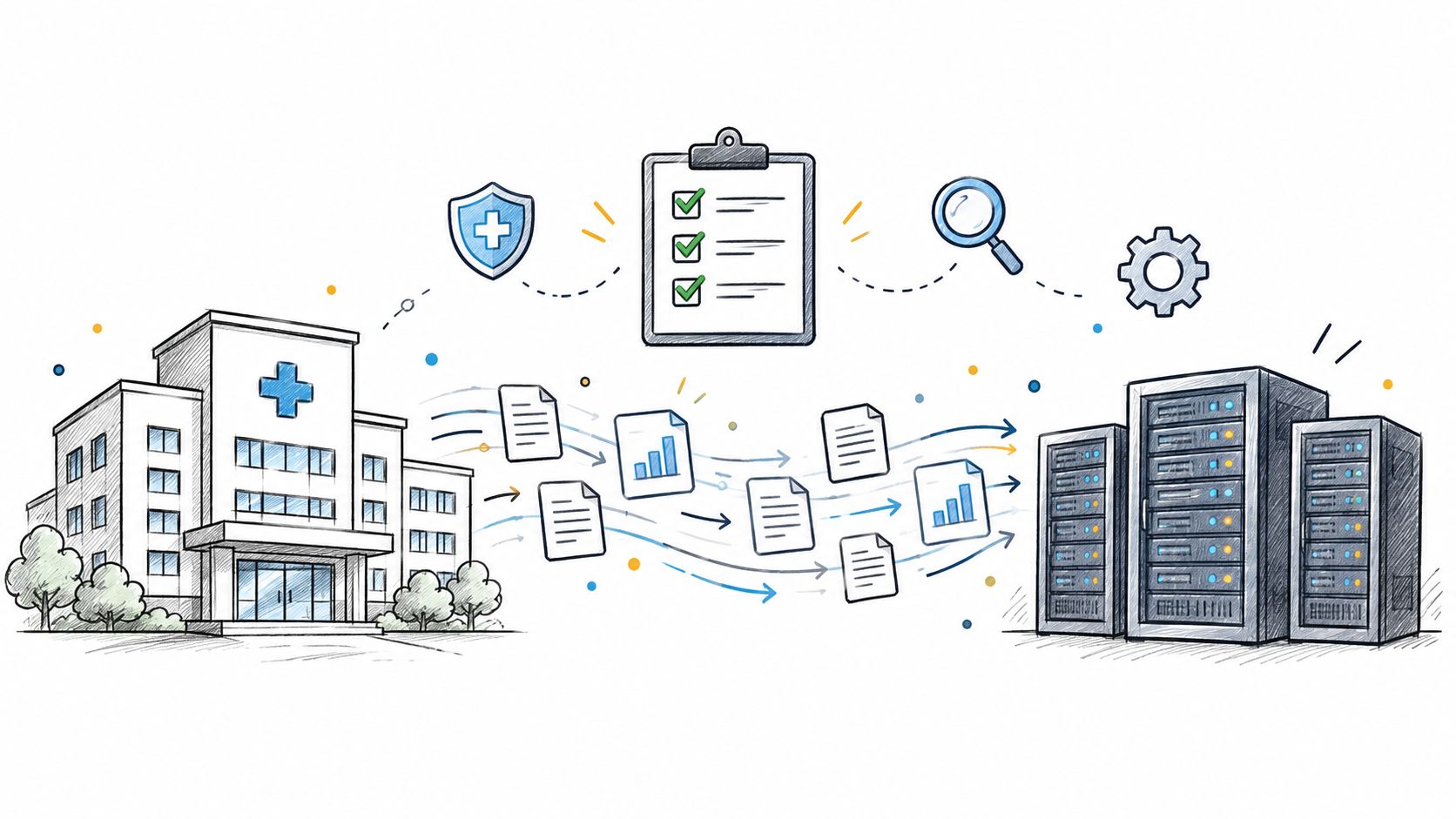
Practical data migration planning guide for healthcare teams. Scope, mapping, compliance, validation, cutover and rollback decisions explained end to end.
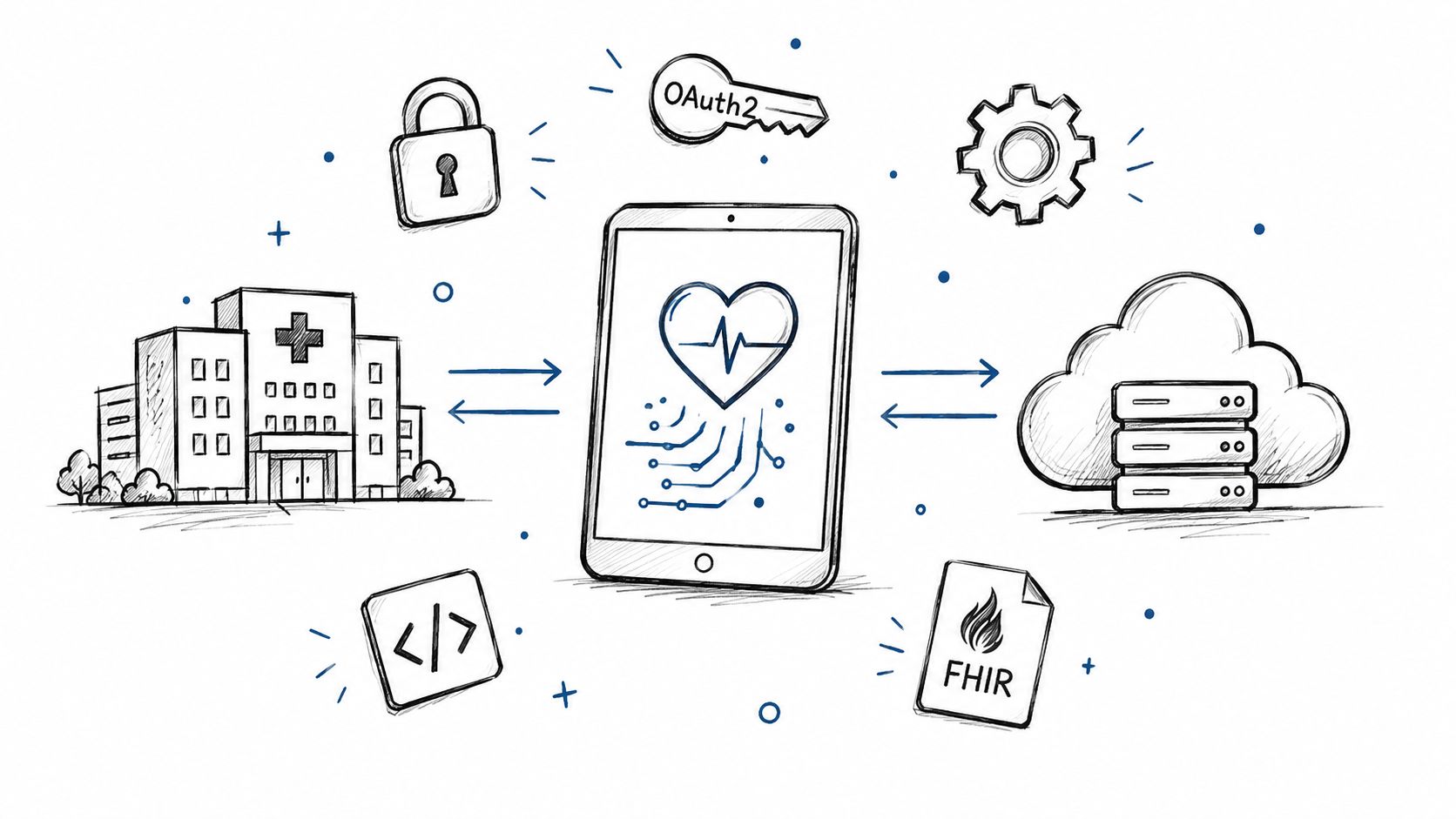
Smart on FHIR guide for healthtech engineers. Learn the OAuth 2.0 launch model, scope syntax, backend services, and US regulatory requirements.
Connect with our team to explore how AI expertise can transform your business.