AI in Healthcare
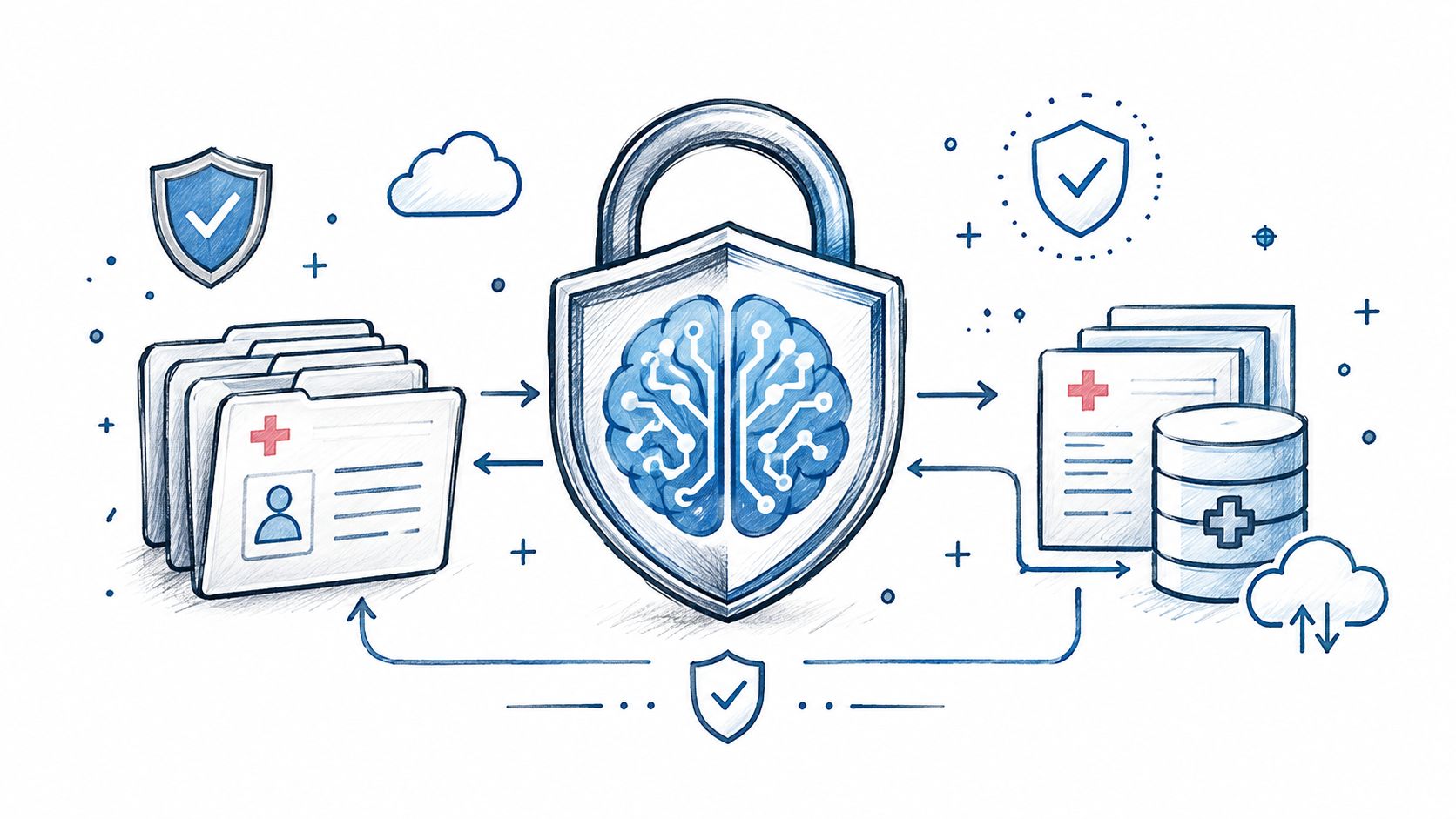
HIPAA-Compliant AI: How to Use LLMs With PHI Safely
How to build HIPAA-compliant AI: when LLM providers need a BAA, data minimization, de-identification, audit controls and a reference architecture.
October 16, 2026Read more
Navigate healthcare AI implementation challenges with practical strategies from data governance to clinician adoption and ROI.

Healthcare is on a collision course with a major staffing crisis, staring down a projected 10 million worker shortfall by 2030. AI is often presented as the silver bullet, but anyone who has been in the trenches knows it's not that simple. This guide cuts through the noise to get real about the challenges that keep promising AI pilots from ever making a real-world impact.
The potential for artificial intelligence to improve everything from diagnostic imaging to the mountain of administrative work is undeniable. Yet, for all the investment and excitement, a sobering 80% of healthcare AI projects never move beyond the pilot phase. This isn't just a statistic; it's a symptom of a massive gap between an idea's potential and the hard reality of implementation.
Understanding these roadblocks is the first step to building something that lasts and avoiding expensive dead ends. To see what a successful clinical application can look like, check out a real-world example like the AI Health Clinic project. Our goal here is to give you the strategic foresight to turn these common pitfalls into a clear path forward. For a deeper look at specific solutions, you can also explore our dedicated Healthcare AI Services.
Before diving deep, let's get a high-level view of the key challenges. The following table summarizes the most common barriers and their direct impact on healthcare organizations.
| Challenge Category | Primary Obstacle | Immediate Business Impact |
|---|---|---|
| Data | Fragmented, siloed, and low-quality data sources. | Inaccurate models, wasted development time, and compliance risks. |
| People & Culture | Clinician skepticism and resistance to workflow changes. | Low adoption rates, disrupted clinical operations, and project failure. |
| ROI & Cost | High upfront investment with an unclear or long-term return. | Difficulty securing budget, executive buy-in, and project scalability. |
| Compliance | Navigating complex regulations like HIPAA and proving clinical efficacy. | Legal exposure, delayed approvals, and erosion of patient trust. |
This table makes it clear: success in AI isn't just about having the best algorithm. It's about orchestrating a complex interplay of data, people, and processes.
The obstacles to scaling AI in healthcare aren't just technical; they are fundamentally human and systemic. They cluster around data, people, and the bottom line. This map visualizes how these challenges are interconnected.

As you can see, a successful strategy must address each of these areas, not just the technology itself. We're going to break down these core issues one by one, including:
By tackling these problems head-on, healthcare leaders can finally start moving innovations from the lab to the bedside, ensuring technology genuinely supports both patients and providers.
Let’s be honest: any discussion about AI in healthcare has to start with data. It’s the single biggest reason promising projects never get off the ground. Think of it this way—the most brilliant AI algorithm is useless if you feed it messy, incomplete, or contradictory information. It’s the classic “garbage in, garbage out” problem, but in healthcare, the stakes are infinitely higher.
This isn’t just a theoretical roadblock. The World Economic Forum has pointed out that healthcare innovators are constantly hitting a wall due to fragmented data, siloed systems, and limited access to the very information they need to build and train their models. The numbers tell the same story. While over $100 billion in venture capital has flooded into US digital health since 2010, a huge number of these AI initiatives stall out in the pilot phase.
Why? A recent NVIDIA survey gets right to the point, revealing that 39% of healthcare organizations see data-related issues as their number one challenge.

When an AI tool spits out a recommendation based on flawed data, clinicians see it immediately. They’re the ones who have to deal with the consequences, like an algorithm that flags a low-risk patient for an urgent follow-up because it was trained on inconsistent records. This doesn’t just create alert fatigue; it systematically erodes trust in the technology.
This lack of trust is a project killer. It's why so many expensive AI pilots never get fully adopted—the people on the front lines simply don't believe in the outputs they're seeing. The root causes are almost always the same:
The only way forward is to stop treating data infrastructure as an IT problem and start treating it as a core strategic asset. Before you can even think about algorithms, you have to get your data house in order. This means moving from dozens of fragmented data closets to a centralized, secure "data lake" or warehouse that can serve as a single source of truth.
To make that happen, you need a solid data governance framework. Governance isn't just about rules; it’s about creating a shared understanding of how to manage data responsibly. It defines who can access what, how information should be standardized, and what privacy protocols are non-negotiable. It’s what makes data not just available, but trustworthy.
The first step in any successful AI journey is not choosing an algorithm; it's conducting a thorough data readiness audit. You must understand the current state of your data before you can map a path to a future-ready infrastructure.
A practical approach starts with a detailed AI requirements analysis to pinpoint the exact data your AI model will need to function. Once you know your destination, you can map out the steps to clean, standardize, and consolidate your information. You can even find modern tools to help, like an AI-powered data extraction engine that automates much of the grunt work.
Without this foundational effort, even the most sophisticated healthcare software solutions are set up to fail. You're just building on sand.
You can have the most brilliant AI tool in the world, but it’s worthless if your clinicians won’t use it. We often get so caught up in perfecting the algorithms and data pipelines that we forget about the people. In reality, the human element is the single most common reason AI initiatives fail in healthcare. Technology is just one piece of the puzzle; the real work starts when you need to win over the hearts and minds of your staff.

This "people problem" isn't a small hurdle—it's one of the biggest healthcare AI implementation challenges we face. It’s a sobering fact, but a staggering 70% of AI pilots never scale up, and it's almost never because the technology glitched. They collapse because of clinician burnout, deep-seated resistance to change, and new tools that simply don't fit into existing workflows. Executives consistently underestimate the human side of digital projects, but it's the part that makes or breaks them. If keeping your clinical team on board is a priority, our HCP Engagement Co-pilot is designed to help.
The skepticism from clinicians isn't just stubbornness—it's earned. They're already overworked, buried in alert fatigue from other systems, and have every right to be cautious about trusting a "black box" algorithm with a patient's well-being. From their perspective, any new tool that messes with their routine often feels less like a helper and more like another burden.
This resistance usually comes down to a few core issues:
When the tools provided by the organization don't meet the needs of an overwhelmed staff, a dangerous trend called shadow AI starts to appear. This is what happens when clinicians, crushed by administrative loads and immense pressure, turn to unapproved, consumer-grade AI tools—like public chatbots—just to get through the day. Their goal is simply to cope, but in doing so, they unknowingly open up a massive can of worms for security and governance.
"Shadow AI is a direct symptom of a failed change management strategy. It signals that leadership has not provided the right tools or support, forcing staff to find their own solutions and exposing the organization to significant risk."
This uncontrolled use of external AI tools for business creates huge vulnerabilities. We're talking about potential HIPAA violations and the very real risk of sensitive patient data being fed into insecure public models. Industry experts warn that the surge in shadow AI, fueled by burnout and staff shortages, is sending organizations scrambling to build reactive governance policies after the fact.
The only way to get ahead of this is with a proactive, strategic approach to change management. This isn't optional; it's the only way to succeed. The goal is to make clinicians partners in the process from the very beginning, not just people you hand a finished product to.
Here are the essential steps to get it right:
An incredible AI tool that can predict patient deterioration is brilliant in a lab. But if it can't talk to the systems already running in a hospital, it’s practically useless. This is the integration puzzle, and it's one of the most common and frustrating hurdles in healthcare AI. I’ve seen countless projects show amazing potential in controlled tests, only to stumble in the real world because they couldn't plug into the existing clinical workflow.
Think of many legacy Electronic Health Record (EHR) systems as digital fortresses. They were engineered decades ago to store information securely, not to share it with new applications. They often lack the modern APIs that allow new tools to connect easily. The result? Clinicians are stuck toggling between screens or, even worse, manually re-entering data. This disjointed experience isn’t just annoying; it’s a primary reason why adoption fails.
At its heart, this is a problem of interoperability—or the lack thereof. Interoperability is simply the ability of different IT systems to communicate and exchange data in a way both can understand.
When an AI diagnostic model can't pull a patient's history directly from the EHR or push its findings back into their chart, its value plummets. Instead of acting like a helpful co-pilot, it becomes just another tedious task on a clinician's already packed schedule. This fundamental disconnect is a massive barrier to scaling any AI initiative. Success demands a clear strategy for building robust system integrations from the very beginning.
The goal is to make AI invisible. It should feel like a natural extension of the existing workflow, not a clunky add-on that creates more work for the people it's supposed to help.
The best way to get there is by focusing on flexible healthcare software solutions built with modern standards in mind, like FHIR (Fast Healthcare Interoperability Resources). FHIR essentially acts as a universal translator for health data, allowing different systems to finally speak the same language. For a closer look at the technical side, our AI Product Development Workflow provides a structured approach for building tools that are ready to integrate.
Solving the interoperability problem is far more than an IT project; it’s a strategic effort that requires everyone to be at the table. Bringing IT specialists and clinical staff into the conversation early—before you even select an AI tool—is non-negotiable. They are the only ones who truly understand the day-to-day workflows and the real-world technical limitations.
Here are a few practical steps to foster a more connected healthcare environment:
By treating integration as a core component of your AI strategy—not an afterthought—you can ensure your new tools are adopted, valued, and actually deliver on their promise to improve care.
In healthcare, there are no second chances. While other industries might tolerate a minor software bug, a glitch in a medical AI tool can have life-altering consequences. This reality elevates clinical validation and bias mitigation from a simple technical hurdle to an urgent patient safety imperative, making it one of the most high-stakes healthcare AI implementation challenges.
An algorithm that performs brilliantly in a controlled lab setting can fall apart when faced with the complexities of a diverse, real-world patient population. Technical accuracy alone just isn't enough. The tool has to prove its clinical value and safety, which means earning the trust of clinicians and regulators through rigorous, transparent validation—a process that goes far beyond what’s typical for standard enterprise software.

A huge hurdle is the infamous "black box" problem. Clinicians are, quite rightly, skeptical of tools that spit out recommendations without explaining their reasoning. After all, asking a doctor to trust a mysterious algorithm with a patient’s well-being is a recipe for low adoption and high risk.
This is where explainability becomes non-negotiable. The AI must be able to show its work, giving clinicians insight into the factors that led to a specific conclusion. This transparency not only builds confidence but also allows them to apply their own expert judgment to confirm or question the AI's output. A well-designed AI Product Development Workflow should bake explainability into the process from the very beginning.
Even with perfect explainability, another danger lurks in the data used to train the model: algorithmic bias. If an AI learns primarily from data belonging to one demographic, it can perform poorly—or even make dangerous mistakes—when applied to underrepresented groups.
For example, a diagnostic tool trained mostly on male patient data might completely miss the signs of a heart attack in women, whose symptoms often present differently. This doesn't just create a technical error; it actively worsens existing health disparities.
Algorithmic bias isn't just a technical flaw; it's a critical patient safety and equity issue. Mitigating it requires a conscious effort to build and validate AI on diverse, representative datasets, a process that starts with a detailed AI requirements analysis.
To meaningfully combat bias, healthcare organizations have to get proactive. This involves:
Getting an AI tool launched isn't the finish line; it’s the starting gun. Healthcare is constantly evolving. New treatments, changing disease patterns, and shifts in patient demographics can all cause a once-accurate model to slowly degrade over time.
This makes ongoing monitoring absolutely essential. Organizations must establish a robust framework to track the performance of their AI tools for business in real time. This is the only way to catch performance drift early and retrain models as needed to keep them safe and effective. Without this constant vigilance, even the most rigorously validated AI can quickly become a liability. Bringing in our expert team can provide the sustained oversight required to manage this long-term responsibility.
Let's be blunt: AI isn't cheap. Any new AI project needs serious investment, and hospital leaders are rightfully protective of their budgets. Getting them to sign off means building a business case that's crystal clear and compelling. The financial hurdles are often the most practical and immediate healthcare AI implementation challenges you'll face.
Simply pointing to the software's price tag won't cut it. A real business case digs into the total cost of ownership—everything from integration fees and infrastructure upgrades to the intensive staff training needed to make it all work. Without this complete financial picture, even the most promising ideas will die on the vine. You have to move past vague promises and show a measurable return on investment (ROI).
When we hear "ROI," we usually think about money coming in. But in a hospital setting, the most powerful returns aren't always found on a balance sheet. A much better approach is to look at both the hard ROI and what many of us call "value on investment" (VOI), which captures the critical human and operational gains.
To build a case that actually resonates, you need to track metrics that matter in the real, high-pressure world of healthcare. Think about benefits like these:
Framing the investment this way changes the entire conversation. It’s no longer just a cost center; it’s a strategic move toward a more sustainable and healthy organization. A formal Custom AI Strategy report is a great tool for pinpointing and quantifying these high-value opportunities for your specific hospital.
Instead of going to leadership with a proposal for a massive, system-wide overhaul, aim for smaller, more targeted wins first. Focus on AI tools for business that solve nagging administrative headaches. Automating tasks like prior authorizations, suggesting billing codes, or drafting initial reports delivers immediate, tangible value.
These early successes are your secret weapon for winning over skeptics and getting leadership excited. They provide concrete proof that the technology works and delivers a real benefit, which paves the way for bigger, more ambitious projects down the road. Many successful organizations begin their AI journey with foundational healthcare software solutions designed to tackle exactly this kind of low-hanging fruit.
"When I went to my board, I didn’t promise increased productivity or big dollar savings. I told them we had a workforce shortage, and the top reason was work-life balance. I told them we needed to reduce the stress of documentation, and it was going to cost us. But I knew it would pay off." - Felicia Jeffery, CEO of Gulf Coast Center
This people-first approach builds the trust you need for lasting change. As we've seen time and again, framing technology around the humans who use it is absolutely critical for a successful rollout.
For organizations that are hesitant to commit to a huge upfront capital expense, flexible payment models can make AI much more approachable. A service-based model like AI Automation as a Service is a great example. It allows you to pay for the outcomes you achieve, rather than buying and maintaining the entire tech stack yourself.
This approach dramatically lowers the initial financial barrier and shifts much of the risk from your shoulders to the provider's.
At the end of the day, a powerful business case is a mix of hard numbers and a human story that connects. By working with an AI strategy consulting partner, you can identify the most impactful uses for AI, calculate a realistic ROI, and build a plan that gets everyone—from the C-suite to the frontline clinicians—on board.
Alright, we've covered the many healthcare AI implementation challenges you're likely to face. Now, let’s get down to the practical side of things: how do you actually get this done? Moving from a great idea to a successful rollout isn't about finding a secret solution—it's about following a clear, proven path.
Think of this as your playbook, a step-by-step guide for turning those AI ambitions into a reality that genuinely helps your staff and patients. It’s built on experience, designed to help you navigate the obstacles and make sure your AI projects deliver real, tangible value from the start.
Before you even think about code or algorithms, think about people. Your first and most critical move is to bring the right minds to the table. A successful AI project absolutely requires a team with members from every corner of your organization: clinicians, IT specialists, data scientists, administrators, and your legal or compliance officers.
This diverse group isn't just for show. They provide the essential 360-degree view needed to properly evaluate potential tools, navigate the inevitable internal politics, and become the champions who drive the project forward.
You can't build a strong house on a shaky foundation. Before you go any further, you need a brutally honest look at what you’re working with. This involves a two-pronged audit: one for your data infrastructure and another for your current clinical workflows.
A detailed AI requirements analysis will quickly show you where the gaps are in your data quality and how accessible it really is. At the same time, a workflow audit helps you pinpoint the exact frustrations and bottlenecks where AI could make the biggest difference.
Don't try to solve every problem at once. That's a recipe for burnout and budget overruns. Instead, start by finding a few specific, high-impact areas where AI can score a quick and measurable win.
Your goal is to solve a real, nagging problem. Maybe that's cutting down the time your team spends on administrative paperwork or making the patient intake process smoother. Diving into a library of real-world use cases is a great way to get inspired and see what's possible.
A successful AI strategy prioritizes quick wins. By targeting administrative tasks with established AI tools for business, you can build momentum, demonstrate immediate value, and secure buy-in for more ambitious projects down the road.
This approach not only proves the concept but also builds the trust and organizational confidence you’ll need for the long haul.
Once you've picked your starting point, map out a phased implementation plan. For every single phase, you need to define clear, measurable Key Performance Indicators (KPIs).
What does success actually look like? Don’t just stick to technical jargon. Define it in terms of real-world improvements, like a 15% reduction in documentation time or a 10% increase in patient throughput. Following a well-defined AI Product Development Workflow brings structure and accountability to each stage, keeping everyone aligned on the end goal.
As we've said before, the technology is often the easiest part of the equation. Getting your people on board is where the real work begins. You need a proactive change management plan to win over a workforce that is often rightfully skeptical of new tech, as we explored in our AI adoption guide.
Involve your clinicians from the very beginning, be transparent about what you’re doing and why, and establish a strong governance framework to handle ethics, safety, and compliance right from day one.
For organizations that want hands-on support navigating this journey, our dedicated Healthcare AI Services are designed to accelerate every step of this roadmap. By partnering with our expert team, you can ensure your AI implementation is not only successful but also sustainable, turning potential challenges into lasting strategic advantages.
When we talk to healthcare leaders about AI, the same questions tend to pop up. Getting these projects off the ground is complex, so let’s clear up a few of the most common hurdles.
If I had to pick just one, it’s the data. Everything in AI hinges on data quality and accessibility. You can have the most brilliant algorithm in the world, but if you feed it messy, incomplete data, you’ll get useless results.
The root of the problem is that patient information is often fragmented and locked away in different EHR systems that don't talk to each other. On top of that, strict privacy rules like HIPAA and GDPR, combined with a lack of clear data governance, can stop a project in its tracks. That's why a thorough AI requirements analysis isn't just a good idea—it's the essential first step.
Getting clinicians on board comes down to two things: trust and genuine utility. No one wants another tool that adds clicks and complicates their day.
First, you have to involve them from day one. Bringing clinicians into the conversation during the AI Product Development Workflow ensures the solution actually solves a real-world problem they face, like cutting down on tedious administrative work. It's also critical to be transparent about how the AI reaches its conclusions. Giving them a safe, low-stakes environment to test and train with the tool is the best way to build confidence before you even think about a full-scale rollout.
This is the classic build-versus-buy dilemma, but for most hospitals and health systems, the answer is somewhere in the middle. Building a solution from the ground up is incredibly expensive and demands a very specific, and rare, type of talent.
On the other hand, buying an off-the-shelf AI product often leads to frustration when it doesn’t integrate properly with your existing internal tooling. We’ve found the most successful path is a hybrid approach: buy a proven, validated AI model, but then invest in customizing the integration. This ensures the tool fits perfectly into your team's established clinical workflows, which is key for driving adoption and seeing a real return on your investment. Our expert team can help you figure out the right balance for your specific needs.
Ready to turn these challenges into opportunities? Ekipa AI’s AI Strategy consulting tool can help you build a clear, actionable roadmap for successful AI implementation in your healthcare organization. To learn more about the people behind our success, meet our expert team.
How to build HIPAA-compliant AI: when LLM providers need a BAA, data minimization, de-identification, audit controls and a reference architecture.

Practical data migration planning guide for healthcare teams. Scope, mapping, compliance, validation, cutover and rollback decisions explained end to end.

Smart on FHIR guide for healthtech engineers. Learn the OAuth 2.0 launch model, scope syntax, backend services, and US regulatory requirements.
Connect with our team to explore how AI expertise can transform your business.