Healthcare leaders don’t need another list of AI possibilities. They need a way to ship automation that survives procurement, security review, clinician scrutiny, and budget pressure.
The market has already moved. Healthcare is deploying AI at 2.2x the broader economy rate, and in 2025 the most common applications are generative AI (71%), speech recognition (70%), and agentic AI (68%), with momentum centered on documentation and workflow automation, according to Menlo Ventures’ 2025 state of AI in healthcare. The primary question now isn’t whether to adopt AI. It’s whether your organization will do it through disconnected pilots or through a healthtech ai automation platform that can scale.
That distinction matters. Point solutions can produce a promising demo. Platforms change operating models. They give executives a way to connect workflow automation, governance, integration, and measurable business outcomes across clinical, operational, and financial domains.
In practice, most failures happen in execution. Teams buy a model, a scribe, or an RPA bot, then discover the hard part was never the model. It was workflow design, PHI controls, EHR integration, exception handling, and change management. That’s where the platform-first approach earns its keep.
Why AI Automation is No Longer Optional in Healthcare
Healthcare organizations are already deploying AI into production faster than many other sectors. The operational question for executives is no longer whether AI has potential. It is whether the organization can turn that potential into controlled, repeatable workflow improvement before labor pressure, reimbursement pressure, and clinician burnout force the issue.
The urgency is practical. Health systems are carrying too much manual coordination in processes that should be structured, timed, and auditable. Staff still move work through inboxes, spreadsheets, payer portals, and callback queues. Every handoff adds delay. Every exception creates rework. Every system switch increases the chance that staff miss a requirement, a deadline, or a billable action.
The real constraint is execution
Most AI projects in healthcare do not fail because the model is weak. They fail because the operating model around the model is weak. Teams can buy a promising documentation tool, coding assistant, or chatbot and still get no enterprise value if the workflow stops at draft output, lacks EHR integration, creates new review burden, or cannot pass compliance review.
That is why AI automation has become a board-level operations issue, not just an innovation program.
Revenue cycle shows the pattern clearly. Prior auth, eligibility, coding review, denial follow-up, and payment posting all involve repetitive judgment across fragmented systems. The value of automation comes from reducing touches across the full process, not from adding another screen with AI suggestions. For a grounded look at healthcare RCM and AI's role, medical billing is one of the clearest examples of where AI succeeds only when it is tied to orchestration and exception handling.
Practical rule: If staff still have to copy, paste, verify, re-enter, and route the work by hand, the process is not automated. It has only been partially assisted.
Why platform-first decisions win
The execution gap is where many healthcare AI initiatives stall. Leaders approve pilots. Teams prove a narrow use case. Then the effort slows down in security review, interface work, change management, and workflow redesign. That pattern is expensive because every new tool repeats the same integration and governance work.
A healthtech ai automation platform changes the economics of adoption. It gives teams a common way to connect systems, control PHI access, log actions, manage models, and route tasks between AI services and human reviewers. That shared foundation lowers the cost of the second use case, the third, and the tenth.
What healthcare requires is not more isolated intelligence. It needs reliable process execution.
For teams evaluating where AI can produce business value first, Healthcare AI Services for provider and payer operations can help frame the discussion around workflow fit, governance requirements, and implementation readiness instead of generic AI categories.
The organizations that get results treat AI automation as an operating system decision. The ones that struggle keep buying disconnected tools and call the pilot portfolio a strategy.
Decoding the Healthtech AI Automation Platform
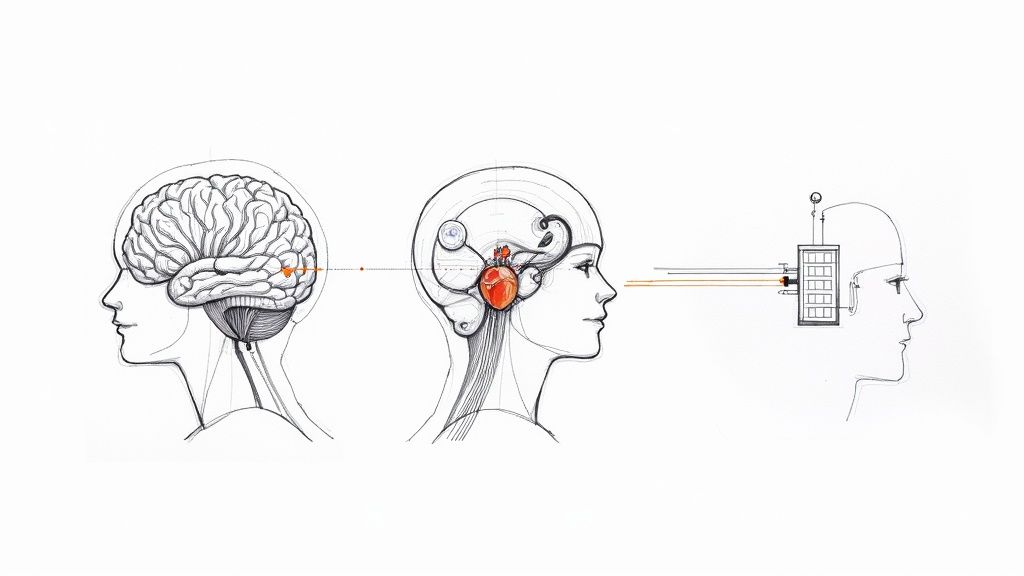
A healthtech ai automation platform is best understood as the hospital’s digital nervous system. It senses what’s happening across systems, interprets signals, decides what action should happen next, and routes work to the right human or software endpoint.
That’s very different from a standalone chatbot, a generic workflow engine, or a single RPA script. Those can solve narrow problems. A platform creates compounding value because every new workflow can reuse the same integration, security, orchestration, and governance layers.

The four layers that matter
Data ingestion and integration
This layer connects the messy reality of healthcare operations. EHR data, payer portals, call transcripts, scanned forms, scheduling systems, lab feeds, and document repositories all need to flow into a common operating context.
If this layer is weak, every downstream promise falls apart. Models can’t reason well over fragmented inputs, and automations fail when they hit missing fields, unstructured notes, or system mismatches.
AI-powered intelligence
This is the decision layer. It handles classification, summarization, extraction, prediction, and next-best-action logic. In healthcare, the useful question isn’t whether a model is advanced. It’s whether the model can support a specific workflow under real constraints.
For example, many executives first encounter healthcare automation through virtual care experiences. A simple primer on how virtual care works helps illustrate why intelligence has to sit behind triage, routing, scheduling, and patient communication rather than just inside a chat window.
Automation and orchestration
Actual work gets done on the platform. It doesn’t stop at generating an answer. It triggers tasks, applies business rules, routes exceptions, requests approvals, updates systems, and tracks state across a process.
Without orchestration, organizations end up with “smart outputs” that still depend on manual labor to create business value.
Secure and compliant environment
In healthcare, this isn’t a supporting feature. It’s part of the product. Identity controls, auditability, data segregation, encrypted storage and transmission, and policy-based access determine whether the platform can be used in production.
What a platform is not
A useful way to evaluate vendors is to ask what happens after the first successful demo.
A real platform is not:
- A single-purpose model wrapper that answers questions but doesn’t change process flow
- Basic RPA alone that clicks through systems without clinical context, governance, or resilient exception handling
- A loose bundle of AI tools that creates more vendor sprawl and inconsistent controls
What you want instead is an operational layer that supports multiple workflows on one governed foundation. That’s the logic behind AI Automation as a Service, where the emphasis is on shipping and managing workflow outcomes, not just provisioning models.
The fastest way to waste an AI budget is to buy tools by department before you’ve defined the shared architecture they all depend on.
High-Impact Use Cases Across the Healthcare Value Chain
AI programs usually stall when organizations start with a model demo instead of a workflow. The use cases that survive budget review and scale across departments share a different profile. They sit inside repetitive, rules-heavy, time-sensitive processes where delays create measurable cost, access issues, or staff burnout.

For most health systems, that means focusing on three lanes first: clinical operations, back-office operations, and revenue cycle. The execution gap shows up here fast. Teams can usually identify dozens of promising ideas, but only a small set can be implemented safely, integrated into existing systems, and governed without creating more manual cleanup work. A platform-first approach matters because the same controls, routing logic, and audit trail can support multiple workflows instead of forcing each department to build its own stack.
Clinical workflows
Clinical use cases deserve a higher bar than basic productivity claims. If the output affects chart quality, follow-up actions, or patient communication, the workflow has to be designed around review paths, exception handling, and role-based responsibility.
Speech-driven documentation is a good example. Used well, it reduces clerical load and shortens the time between encounter and completed note. Used poorly, it creates editing burden and trust problems. Examples of enhancing healthcare with Voice AI are useful because they show where speech tools fit into care delivery rather than treating voice as a standalone feature.
The strongest implementations usually target work such as:
- Documentation support: Turn conversations into structured summaries, draft notes, or coding suggestions for clinician review
- Clinical routing: Identify likely follow-up needs, missing documentation, or care coordination handoffs
- Patient communication: Handle common inbound requests, triage basic questions, and manage scheduling messages before staff intervention
A practical pattern is a clinic assistant that combines intake, messaging, and routing in one workflow. A focused tool such as Clinic AI Assistant can reduce front-desk and care-team load when the design keeps a human review path for edge cases and patient-specific judgment.
Operational workflows
Operations teams often deliver the first production wins because the workflows are easier to define, test, and measure. That matters for executive sponsorship. Early credibility usually comes from reducing backlog, shortening turnaround time, and cutting the amount of work that disappears into email, spreadsheets, and queue hopping.
Common targets include:
- Staff scheduling and coordination: Match demand, shift coverage, and follow-up tasks with fewer manual handoffs
- Referral and intake processing: Extract data from forms, validate required fields, and route cases to the right queue
- Internal service requests: Move IT, compliance, credentialing, and approval workflows through a consistent process
The trade-off is straightforward. These workflows look simpler than clinical use cases, but local exceptions are everywhere. A generic workflow tool often breaks on the details that are important, such as specialty-specific intake rules, approval thresholds, or exception routing by site. That is why many organizations get better results from internal tooling on a shared platform than from buying another point solution for each department.
Financial workflows and revenue cycle
Revenue cycle is usually where ROI becomes visible first. The work is repetitive, document-heavy, deadline-driven, and spread across EHRs, payer portals, coding queues, and human review steps. That combination makes it a strong candidate for automation, but only if the platform can manage end-to-end process state rather than generating partial outputs that staff still have to chase down.
Janus Health describes AI use in revenue cycle around core workflows such as medical coding, chart review, and reducing DNFB bottlenecks in its overview of AI for hospital revenue cycle management. The useful takeaway is not one vendor’s headline numbers. It is that revenue cycle automation works best when AI is tied to queue management, exception handling, and human validation inside the same operating layer.
Typical platform use cases include:
| Use case |
What the platform does |
Why it matters |
| Prior authorization workflows |
Extracts clinical and payer data, prepares submissions, tracks status, and routes exceptions |
Reduces manual follow-up and shortens approval cycles |
| Coding support |
Summarizes documentation, highlights missing elements, and prepares work for coder review |
Improves throughput while keeping human oversight |
| Denial and appeal workflows |
Categorizes denials, drafts response materials, and manages work queues |
Speeds recovery and standardizes execution |
| Scheduling optimization |
Identifies likely no-shows and triggers outreach or rebooking logic |
Protects capacity and improves access |
The broader lesson is execution discipline. A healthtech ai automation platform creates outsized value when these workflows share the same orchestration layer, integration pattern, and governance model. That is how organizations avoid the common failure mode of isolated pilots that never become an operating system for the business.
Navigating Compliance and Data Governance Requirements
Governance failures kill more healthcare AI programs than weak model performance. The teams that reach production treat compliance, access control, and auditability as design requirements from day one, not procurement paperwork after the fact.
That matters because the execution gap usually shows up here. A pilot can look impressive in a controlled demo while still failing security review, legal review, or operational sign-off once PHI, role-based access, and exception handling enter the picture. A healthtech ai automation platform only scales if governance is built into the operating layer.

What good governance looks like in practice
Compliance is a set of system behaviors.
In practical terms, the platform should support encrypted data in transit and at rest, role-based access down to workflow and user level, full audit trails for prompts and downstream actions, clear data residency and retention controls, and enforced human review for higher-risk decisions. HHS guidance on the HIPAA Security Rule reinforces the need for access controls, audit controls, integrity protections, and transmission security in systems that handle electronic protected health information, as outlined by the U.S. Department of Health and Human Services.
The hard part is not writing those requirements into a policy. The hard part is making them visible in the product. I look for whether approvals can be forced in the workflow, whether privileged actions are logged by default, and whether teams can separate development, testing, and production access without custom workarounds.
Why generic AI stacks fall short
General-purpose AI tools are useful for experimentation. They break down when a health system needs clear PHI boundaries, controlled integrations, retention rules, and evidence an auditor can inspect.
That is the difference between a tool and a platform. A tool can generate output. A platform governs who can trigger that output, what data can be used, where it is stored, how exceptions are routed, and what record remains after the action is taken.
Some organizations also need privacy-preserving architectures because data is spread across multiple systems, partners, or care settings. In those cases, approaches such as federated learning may reduce the need to centralize sensitive data, but they also add operational complexity. The trade-off is real. Privacy can improve, while implementation and model management become harder.
Governance is the control system that lets an organization move from pilot to production without creating preventable legal, security, or operational risk.
The vendor questions that reveal maturity
Vendor diligence should get very specific, very quickly.
Ask questions like:
- What is logged for each user interaction, model output, approval, override, and downstream system action?
- How does the platform separate PHI exposure by role, environment, workflow, and tenant?
- Where does data live during inference, storage, monitoring, and retraining, if retraining is part of the product?
- Which workflows support mandatory human review, and how is that control enforced technically?
- Can the vendor show these controls in the product, or are they describing services and future-state architecture?
External review can help pressure-test those answers, especially when the organization is assessing both software risk and AI governance risk. FDA guidance on software functions, clinical decision support, and risk-based oversight is also useful for teams drawing the line between administrative automation and higher-risk use cases, as described by the U.S. Food and Drug Administration.
Choosing Your Platform A Vendor Selection Framework
Platform selection decides whether AI automation becomes a repeatable operating capability or another isolated pilot. The execution gap usually shows up here. Leadership teams approve the use case, vendors show polished demos, and six months later the program stalls on integration work, workflow exceptions, or unclear ownership.
A stronger evaluation process tests production fit early. The question is not whether a vendor can generate a useful output. The question is whether the platform can support the way your organization runs.
What to screen for first
Start with three filters.
First, remove vendors that cannot show how their product works inside real healthcare workflows. Generic automation claims are not enough. Ask where the system hands work to staff, how exceptions are routed, and what happens when source data is incomplete or inconsistent.
Second, test implementation reality. Many products look strong in a sandbox and struggle once they touch EHR data, payer documents, legacy systems, and departmental work queues. Vendors should be able to explain integration methods, change management requirements, and the internal team you will need to stand up the first production workflow.
Third, make a deliberate build-versus-buy decision. Some organizations need a configurable platform that can support several use cases with shared controls and shared integrations. Others need customized software around a distinct care model, service line, or operational process. For teams evaluating custom development paths, the U.S. Department of Health and Human Services provides practical guidance on planning health IT projects and vendor relationships through HealthIT.gov.
Healthtech AI Platform Vendor Selection Criteria
| Evaluation Criterion |
What It Means |
Key Question to Ask |
| Clinical and operational fit |
The product reflects actual healthcare processes, handoffs, and exception paths |
Which healthcare workflows are live in production, and where is human review required? |
| Integration depth |
The platform connects to EHRs, portals, documents, and internal systems without fragile custom work |
How do you handle system changes, failed calls, and non-standard data formats? |
| Governance architecture |
Logging, access controls, approvals, and audit trails are built into the product |
What is logged by default, and how are review controls enforced in the workflow? |
| Workflow orchestration |
The system manages routing, state, and downstream actions across a process |
Can the platform complete the task flow, not just draft content or classify inputs? |
| Reusability across use cases |
New automations can reuse connectors, controls, and monitoring instead of starting from zero |
What can we carry forward from the first deployment to the next department? |
| Delivery model |
The vendor supports design, rollout, and optimization, not only software licensing |
Who is responsible for workflow redesign, testing, training, and post-launch tuning? |
| Proof of execution |
The vendor can discuss failures, edge cases, and remediation steps with specificity |
What deployment problems have delayed go-live, and how did you fix them? |
Product vendor versus engineering partner
This distinction affects speed and risk more than pricing does.
A software vendor typically sells licenses, templates, and a product roadmap. An engineering partner helps define workflow boundaries, data dependencies, operating ownership, and release sequencing. In healthcare, that difference matters because the hard part is rarely the model. The hard part is getting one workflow into production with the right controls, then repeating that success across the enterprise.
Teams that want durable ROI should favor a platform-first approach with enough flexibility to fit local workflows, but enough standardization to avoid rebuilding governance and integration patterns for each new use case. That is how organizations reduce implementation drag and avoid the failure pattern that hits many AI programs. They stop treating each project as a one-off and start building an execution system.
From Blueprint to Reality Your Implementation Roadmap
Around 80% of AI initiatives stall before they deliver scaled value. In healthcare, the pattern is familiar. Teams fund a pilot, prove a model can work, then get stuck on integration, workflow ownership, exception handling, and user adoption. The execution gap is the primary risk.
Recent reporting from Fierce Healthcare on healthtech implementation hurdles points to the same constraints operators see every day: data silos, clinician resistance, long onboarding cycles, and expensive custom integration work. Executives should treat implementation as an operating program, not a side experiment. A pilot is the first production release.
Phase 1. Strategy and discovery
Start with one workflow, one owner, and one measurable business problem.
Teams lose time when they frame the work as enterprise transformation instead of process redesign. A better approach is structured AI strategy consulting tied to a narrow use case with high volume, clear rules, and visible operational pain. Discovery should document the source systems, handoffs, exception paths, review requirements, and the point where a human must stay in control.
For teams that want a faster planning cycle, a Custom AI Strategy report can help force prioritization before engineering starts.
Phase 2. Pilot selection and design
Pilot selection determines whether the program earns trust or burns it.
Choose a workflow where the baseline is already understood and the output can be checked quickly by the business team. Good candidates usually share four traits:
- Operational pain is obvious: staff already feel the backlog, delay, or rework
- Volume is high enough to learn fast: the workflow runs often, so defects and gains appear early
- Success can be measured clearly: turnaround time, queue depth, throughput, denial recovery, or documentation quality
- Risk is contained: human review stays in place until the process proves stable
Avoid pilots that depend on unresolved ownership, undefined exception handling, or major legacy integration work nobody has scoped. Those projects consume budget before they generate confidence.
A pilot should prove the organization can run AI in production with controls, not just show that a model produces plausible output.
Phase 3. Rollout and integration
This phase usually decides whether the platform scales beyond one department.
The work is operational. Teams need environment controls, API design, observability, user training, release management, and a clear escalation path when outputs fail or inputs change. If those pieces are missing, the team starts firefighting instead of improving the workflow.
The common failure modes are predictable:
- Integration debt appears late. Core systems do not expose the data or events the workflow needs.
- Frontline users were excluded. Clinicians or operators reject outputs they did not help shape.
- Exception volume is higher than expected. The workflow handles standard cases but breaks under real production variability.
- No business owner is accountable. IT launches the system, but no operational leader manages adoption and performance.
A structured AI Product Development Workflow gives teams checkpoints for integration readiness, governance signoff, user acceptance, and cutover planning. That reduces the odds of a pilot that works in a demo and fails in production.
Phase 4. Scale and optimization
Scaling requires standardization with room for local variation.
Reuse the platform components that should not be rebuilt, such as security controls, logging, identity, orchestration, and monitoring. Adjust the parts that depend on department logic, specialty rules, staffing models, or approval thresholds. That balance matters. Too much standardization creates local workarounds. Too much customization turns every deployment into a new project.
This is also the point where governance needs to mature. Promote only the workflows that meet reliability targets, have stable ownership, and show repeatable value. Retune prompts, routing logic, review thresholds, and exception handling based on live performance, not workshop assumptions.
Ekipa AI is one option organizations can use for faster AI strategy definition and execution planning. The practical value is speed from use case selection to a delivery plan with fewer gaps between business intent and implementation steps.
Teams that need examples to compare candidate workflows can also review real-world use cases. That helps separate attractive demos from automations that can survive production constraints.
Measuring Success KPIs and Proving ROI
Nearly 80% of AI initiatives fail to reach scaled business impact because teams cannot prove operational value, sustain adoption, or move from pilot metrics to executive metrics. Healthcare feels that failure faster than other sectors. If a workflow does not improve cash flow, staff capacity, turnaround time, or quality, it will not survive budget review.
The execution gap shows up clearly here. Many teams can report model accuracy or workflow volume. Executive teams need a tighter scorecard that connects automation performance to financial and operational outcomes.
Start with a baseline before deployment. Measure the current process, then compare post-launch performance at 30, 60, and 90 days. Without that baseline, teams end up defending activity instead of proving impact.
Hard ROI
Hard ROI is the part that usually secures the second budget approval. It ties directly to labor efficiency, revenue capture, cost reduction, or capacity creation.
Track measures such as:
- Administrative throughput: Cases, tasks, or encounters processed per full-time employee
- Cycle time: Time from intake to prior auth decision, coding completion, scheduling confirmation, or claim resolution
- Rework rate: Cases sent back for correction, manual completion, or exception handling
- Cost per transaction: Unit cost for documentation, coding, intake, referral processing, or billing tasks
- Revenue performance: Changes in denial rates, days in accounts receivable, coding lag, cash collections, or billing completeness
These metrics matter because they show whether the platform is removing work or just relocating it to another team.
Strategic ROI
Strategic ROI is slower to show up, but it determines whether the platform scales across the enterprise or stalls after one use case.
Examples include:
- Clinician time returned: Reduction in repetitive administrative effort, especially documentation support, inbox triage, and message routing
- Patient access performance: Faster scheduling, intake completion, referral turnaround, or follow-up coordination
- Operational resilience: Ability to absorb volume growth without matching headcount growth
- Control and audit maturity: Fewer undocumented workarounds, clearer exception ownership, and better traceability for decisions and handoffs
I usually advise leaders to separate platform KPIs into three layers: automation performance, human intervention, and business outcome impact. That structure prevents a common reporting mistake. A workflow can have high utilization and still fail economically if override rates stay high or downstream teams spend more time fixing outputs.
A practical ROI review asks five questions:
- Did throughput improve?
- Did skilled staff spend less time on low-value work?
- Did quality hold or improve?
- Did the process create measurable financial benefit?
- Did risk stay controlled as volume increased?
If the answer to only one or two is yes, the organization has a pilot, not a repeatable operating capability.
That distinction matters. Platform-first adoption works when leaders measure reusable value, not isolated wins. The goal is not to show that one automation ran successfully. The goal is to prove that the organization can implement governed AI workflows repeatedly, with lower delivery risk and a clear path from strategy to scaled return.
Frequently Asked Questions
Can a legacy health system start with a healthtech ai automation platform?
Yes, but the starting point should be workflow selection, not enterprise-wide replacement. Legacy environments are manageable when the first use case has clear boundaries, known system dependencies, and a defined exception path. The mistake is trying to modernize the whole architecture in one move.
Should we start with one department or design for the whole enterprise?
Start with one workflow, but design with enterprise controls in mind. That means security, logging, access, and integration standards should be reusable even if the first deployment is narrow. Local pilot, shared foundation.
Where does generative AI actually fit inside the platform?
Generative AI is most useful when paired with orchestration. It can summarize notes, draft messages, extract structured data, and support staff decisions. On its own, it usually creates output. Inside a platform, it becomes part of a governed workflow that can route, escalate, and complete work.
How do we avoid clinician resistance?
Bring users into workflow design early. Don’t ask clinicians to “adopt AI.” Ask them to help remove specific friction from tasks they already dislike. Trust improves when staff can see what the system did, what it didn’t do, and when they remain in control of exceptions and approvals.
What’s the biggest mistake executives make?
They confuse a successful demo with implementation readiness. In healthcare, production readiness depends on governance, integration, exception handling, and operating ownership. The model is only one component.
How is this different from buying standalone AI tools for business?
Standalone AI tools for business can help with narrow tasks, but they usually don’t solve cross-system workflow execution in regulated environments. A platform approach is stronger when the core problem spans data ingestion, decision support, routing, and compliance.
When do we need formal requirements work?
Earlier than often realized. AI requirements analysis matters before vendor selection and before pilot scoping, because the organization needs agreement on workflow boundaries, human review points, integration needs, and measurable outcomes.
Do we need specialist expertise beyond our IT team?
Often, yes. Healthcare AI touches process redesign, security, regulation, and user adoption at the same time. That’s why many organizations combine internal IT and operations leaders with product, clinical, and compliance specialists. If you want to evaluate who should be in that room, review our expert team.
If you’re evaluating a healthtech ai automation platform, the fastest way to reduce risk is to get clear on workflow priority, governance requirements, integration reality, and ownership before you launch a pilot. Ekipa AI helps teams move from use case discovery to execution planning without the usual consulting drag, and you can review our expert team to see the kinds of capabilities that matter when strategy has to become shipped workflow, not another slide deck.