
AI in Healthcare
HIPAA-Compliant AI: How to Use LLMs With PHI Safely
How to build HIPAA-compliant AI: when LLM providers need a BAA, data minimization, de-identification, audit controls and a reference architecture.
October 16, 2026Read more
Discover how artificial intelligence for medical applications transforms patient care, diagnostics, and operations. Explore top use cases and practical steps.
What if we could spot diseases before the first symptom even appears? Or design treatments based on a person's unique genetic code? This isn't a scene from a sci-fi movie; it's the new reality that artificial intelligence for medical applications is building today, setting a completely new standard for patient care and how hospitals run.
Artificial intelligence is quickly becoming an essential partner for clinicians, hospital administrators, and medical researchers alike. This guide cuts through the hype to show you how AI is genuinely reshaping healthcare, from diagnostic tools that can spot details the human eye might miss to intelligent systems that untangle complex hospital workflows. Think of it as a practical roadmap to understanding and actually using the power of AI.
The adoption of AI in healthcare has exploded. The global market is on track to hit an incredible $431.05 billion by 2032. Industry analysis predicts that by 2025, a staggering 80% of hospitals worldwide will be using AI to improve patient outcomes.
This marks a huge shift—we’re moving past small, experimental pilots and into full-scale operational integration. This growth is all about meeting the demand for smarter treatment planning, reliable remote monitoring, and powerful diagnostic tools. The focus now is on creating unified systems, not just a collection of disconnected apps.
This rapid adoption isn't happening by accident. A few key factors are pushing AI into the mainstream of medical practice and building a smarter healthcare ecosystem.
As we push into this new territory, it's crucial to understand the technology that makes it all possible. The real magic happens behind the scenes, and modern data platforms are essential for unlocking GenAI capabilities with real-time data streaming. This is the infrastructure that powers the next wave of medical AI, allowing these tools to process information in the moment and deliver insights that can save lives.
While it’s easy to talk about the future potential of artificial intelligence for medical fields, the truth is its impact is already being felt in clinics and hospitals today. We've moved past the theoretical and into a reality where AI is a critical tool for improving patient outcomes. These applications aren’t sci-fi concepts; they are saving lives and reshaping how care is delivered right now.
This progress is fueling massive growth. The generative AI market in healthcare is expected to hit $3.3 billion in 2025 and is on track to explode to $39.8 billion by 2035. This boom is driven by practical tools like virtual nursing assistants, remote patient monitoring, and, most significantly, medical imaging and diagnostics—an area seeing some of the most profound breakthroughs. You can find more details in these AI in healthcare statistics.
Let's look at the key clinical areas where AI is already delivering significant value. Below is a quick summary of the top applications.
The table below breaks down some of the most established AI use cases in clinical work, highlighting what they do and why it matters.
| Application Area | Primary Function | Key Benefit |
|---|---|---|
| Medical Imaging | Identifies patterns and anomalies in scans (X-rays, MRIs, CTs) | Faster, more accurate detection of diseases like cancer; reduces diagnostic errors. |
| Personalized Medicine | Analyzes patient data (genomics, lifestyle) to predict treatment response | Tailors drug regimens and therapies to the individual, improving effectiveness. |
| Drug Discovery & R&D | Simulates molecular interactions and predicts protein structures | Radically speeds up the identification of new drug candidates and clinical trial design. |
| Predictive Analytics | Forecasts disease outbreaks, patient risk, and hospital admissions | Allows for proactive interventions and better resource management. |
Each of these areas represents a major step forward, moving healthcare from a reactive to a more proactive and precise model.
Medical imaging is one of the most mature and impactful applications of AI today. Radiologists and pathologists face the monumental task of spotting tiny, subtle abnormalities in incredibly complex scans—X-rays, MRIs, CTs, and tissue slides. It’s a high-stakes, high-volume job where precision is everything.
AI algorithms, especially deep learning models, are exceptionally good at this kind of pattern recognition. When trained on millions of anonymized images, these systems learn to spot potential signs of disease, like cancerous tumors or early markers of neurological disorders, often with a speed and accuracy that perfectly complements a human expert. For instance, an AI tool might flag a few suspicious areas on a mammogram for a radiologist to re-examine. It acts as a second set of eyes that never gets tired, helping prioritize urgent cases and cutting down on the risk of human error.
This isn't about replacing doctors. It's about augmenting them, giving them a powerful analytical assistant that can process immense amounts of visual data in seconds. This frees them up to focus their expertise on the nuances of diagnosis and patient care.
The era of one-size-fits-all medicine is fading, and AI is a huge reason why. Every patient is unique—a complex mix of genetics, lifestyle, and medical history. AI models can analyze this web of data to predict how an individual will likely respond to a specific therapy.
Take oncology, for example. An AI system can sift through the genomic data from a patient's tumor, cross-reference it with vast databases of clinical trial results, and help an oncologist pinpoint the most effective chemo regimen with the fewest side effects. This level of personalization used to be unthinkable, requiring countless hours of manual research. Now, it’s becoming a practical reality, leading directly to better outcomes and a higher quality of life for patients. These are some of the most compelling real-world use cases of AI in action.
Bringing a new drug to market is an incredibly long, expensive, and often frustrating process. It typically takes over a decade and costs billions, with a high chance of failure along the way. Artificial intelligence is changing this equation entirely by making research and development (R&D) faster, cheaper, and more precise.
AI models do this in a few key ways:
By streamlining these critical early stages, AI solutions from partners like Ekipa AI help pharmaceutical companies and research institutions get new, life-saving therapies to the people who need them, faster than ever before.
While clinical breakthroughs get all the headlines, the real, immediate impact of artificial intelligence for medical settings is often felt behind the scenes. Every patient visit, every procedure, is supported by a mountain of administrative and logistical work. When that work is inefficient, it drives up costs and burns out skilled professionals. AI is quickly becoming the most powerful tool we have to untangle this mess, automating the grunt work so humans can focus on what they do best: care.
This isn't just theory anymore—it's happening right now. A recent report from the American Medical Association (AMA) shows just how fast things are changing. In 2024, 66% of physicians in the U.S. were already using AI tools, a huge jump from just 38% in 2023. What were they using it for? Mostly, for fixing their workflows and automating tedious tasks. That tells you everything you need to know about where the immediate value is.
A shocking amount of a healthcare professional’s day is eaten up by paperwork: scheduling, billing, coding, and chasing down insurance claims. These tasks are critical, of course, but they’re also repetitive and time-consuming, pulling talented people away from patients.
Take something as basic as patient scheduling. AI-powered systems can now:
This same intelligence is being applied to the revenue cycle. AI algorithms can scan a doctor's notes to suggest the right billing codes, spot a likely claim denial before it's even submitted, and even automate the first steps of an appeal. It's not just about getting paid faster; it's about eliminating the costly human errors that plague manual billing.
When you offload these routine processes, you give your team the breathing room to handle complex patient issues, improve the overall experience, and fight the administrative burnout that is so rampant in the industry.
Beyond just tackling individual tasks, AI is starting to reshape entire operational flows. A hospital is a finely tuned machine, or at least it's supposed to be. Resources—from operating rooms to simple medical supplies—have to be managed perfectly. A single inefficiency can cascade into treatment delays, wasted money, and even patient safety issues. You can dive deeper into how this works in our guide on AI-powered workflow automation.
Here’s where you can see it in action:
This is the kind of smart, strategic thinking that makes a hospital not just more efficient, but more resilient and patient-focused.
Putting these operational AI tools in place delivers a return on investment you can see and measure. The financial wins are obvious—less administrative overhead, faster payments from insurers, and better use of expensive resources. For instance, a hospital might see its claim denial rates drop by 30% or its operating room usage climb by 15%.
But the ROI isn't just about money. When you free clinicians and staff from mind-numbing paperwork, job satisfaction goes way up. They can finally dedicate their time and energy to their actual mission: providing outstanding care. That powerful link between operational efficiency and the quality of care is the true sign of a smart AI strategy.
Bringing artificial intelligence into a medical setting can seem daunting. The key is to treat it not as a single, massive project but as a manageable journey broken down into logical phases. A clear roadmap is your best friend here, preventing you from chasing shiny objects and ensuring each step builds logically on the last. We can break this down into three core phases: Discovery, Pilot, and Scaling.
This is all about moving from understanding your organization’s unique challenges to the widespread, successful use of AI solutions. Following a deliberate path ensures your investment delivers real, measurable value—both for your bottom line and for your patients.
The first phase, Discovery, is arguably the most important. This isn't about buying the latest AI tool; it’s about looking inward to find the most pressing problems that AI can genuinely solve. The whole point is to find high-impact, achievable use cases that actually support your organization’s bigger goals.
It all starts with a deep dive, what we call an AI requirements analysis. You have to evaluate your current workflows, your data infrastructure, and your existing tech stack. This means asking some tough questions: Where are our biggest operational bottlenecks? Which repetitive administrative tasks are eating up our clinicians' valuable time? Where can AI give us the biggest lift in patient outcomes? The answers lay the groundwork for a solid, realistic plan.
Out of this analysis, a focused strategy emerges. This is where something like a Custom AI Strategy report becomes a game-changer. It takes your needs and translates them into a concrete action plan, pinpointing the specific AI tools for business that will get the job done right.
Once you’ve zeroed in on a promising use case, you don’t go all-in. You start with a small-scale, low-risk pilot project. Think of it as a test flight. A pilot gives you the chance to prove the concept in a controlled environment, gather real-world data, and build some internal excitement. A successful pilot is the best evidence you can have when asking stakeholders for the resources to expand.
A solid pilot project needs a few key ingredients:
The pilot is your scientific experiment. You’re testing a hypothesis with minimal risk before you commit to a much larger deployment.
This is a great illustration of how AI can transform healthcare operations from simply reactive to truly predictive.
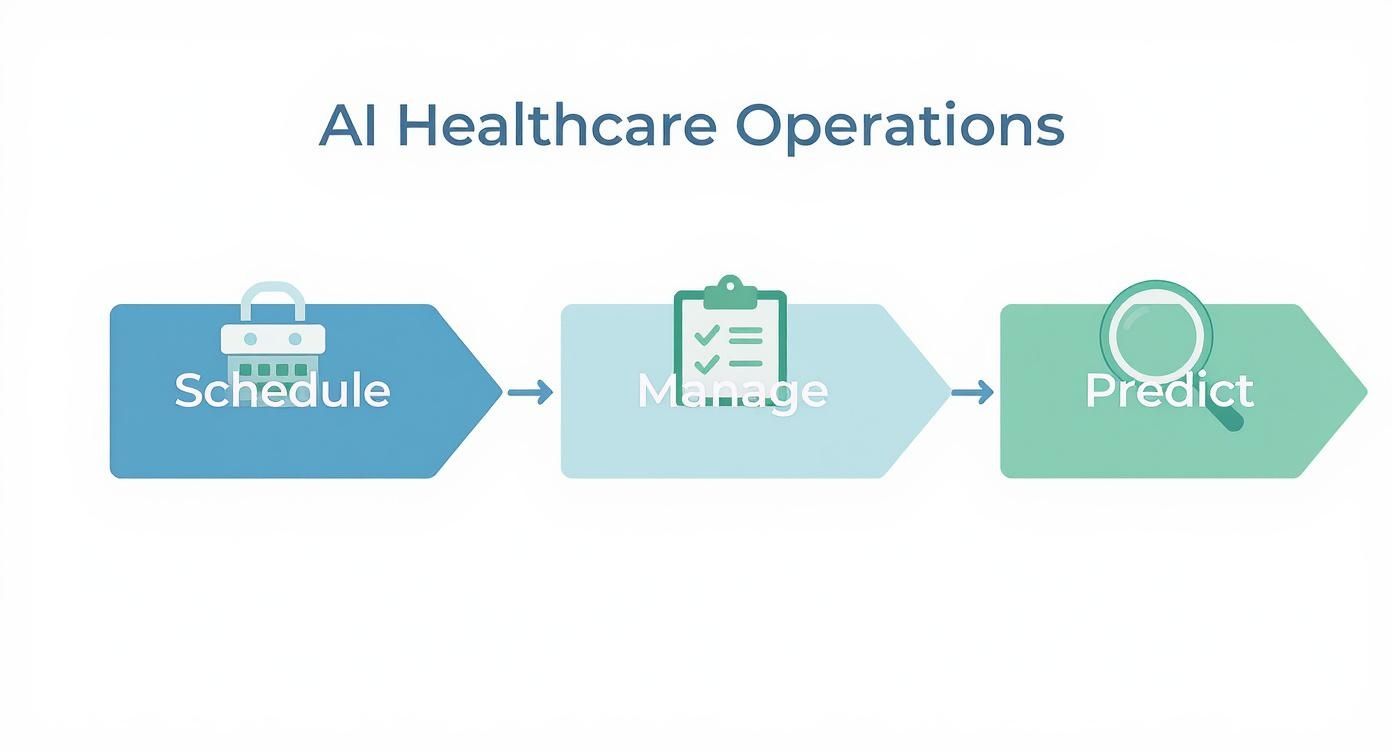
The image shows the evolution—moving beyond basic scheduling to proactively managing resources and, ultimately, predicting needs before they even arise. That's the goal.
With a successful pilot under your belt, it’s time for the final phase: Scaling. This is where you take everything you learned and roll it out across the wider organization. But scaling is so much more than a technical deployment. It demands careful planning around change management, staff training, and continuous performance monitoring.
A structured AI Product Development Workflow is absolutely critical here. It gives you a repeatable framework for taking a proven concept and turning it into a fully integrated, enterprise-ready solution. This process ensures the technology isn't just installed but is actually adopted by the people who need to use it every day. As any experienced leader knows, user training and clear communication are just as vital as the tech itself.
When you scale successfully, you stop treating AI as a one-off project. It becomes a permanent capability for continuous improvement. This means setting up feedback loops to constantly refine the models and workflows, ensuring they keep up with the ever-changing needs of your healthcare environment.
Ultimately, this three-phase roadmap—Discovery, Pilot, and Scaling—gives any healthcare organization a clear and repeatable process. It turns the complex ambition of adopting AI into a series of practical, achievable steps, guiding you from a smart strategy all the way to measurable, long-term impact.
For all the promise AI holds for healthcare, we have to be honest about the hurdles. Getting this right isn't just a matter of plugging in new software; it's a serious undertaking that involves grappling with tough ethical questions, complex regulations, and significant technical barriers.
Building genuine trust—with clinicians, patients, and regulators alike—is everything. If we can't do that, even the most brilliant algorithm is dead on arrival. We're talking about protecting incredibly sensitive patient data, proving our models are fair and unbiased, and building tools that doctors can actually depend on when the stakes are high. It's helpful to step back and consider some crucial questions for artificial intelligence from a broader perspective to make sure we're on the right track.
In healthcare, data privacy isn't just a feature; it's the foundation. We're dealing with Protected Health Information (PHI), which is guarded by ironclad regulations like HIPAA in the U.S. Any AI system that even touches this data needs to be built from the ground up with security and compliance as its absolute core.
This goes way beyond basic encryption. It's about a multi-layered defense:
This is where working with specialists in custom healthcare software development can make all the difference. They know how to embed these privacy-by-design principles right into the code from day one.
One of the biggest roadblocks to getting doctors on board with AI is the "black box" problem. Many of the most powerful AI models, especially in deep learning, can deliver stunningly accurate results but can't explain how they got there. That’s a non-starter for a clinician. How can a doctor confidently act on a recommendation if the logic behind it is a complete mystery?
This is why Explainable AI (XAI) is so critical. XAI isn't about dumbing down the model; it's about making it transparent.
Instead of just spitting out a diagnosis, an explainable model might highlight the exact pixels in a CT scan that it found suspicious or list the specific lab results that pushed its risk score into the red zone.
That transparency is the key to adoption. It lets doctors use their own expertise to verify the AI's reasoning, building the confidence they need to integrate these tools into their workflow.
Here’s a hard truth: if an AI is trained on biased data, it will produce biased results. It’s that simple. If a model meant to detect skin cancer is mostly trained on images of light-skinned patients, its accuracy will plummet for patients with darker skin. This isn't just a technical flaw; it's a massive risk that could easily widen existing health disparities.
Making sure our AI promotes health equity is a moral imperative. It takes deliberate effort and a clear strategy:
By facing these challenges head-on, we can build AI solutions that are not only powerful but also responsible, trustworthy, and fair. That’s how we move beyond the hype and unlock the real, sustainable value of AI in medicine.
You've seen what AI can do—from spotting diseases earlier to making a hospital run like clockwork. But turning that potential into a reality that benefits your patients and your bottom line? That’s the real challenge. It can feel like a huge undertaking, but you don’t have to go it alone.
This is exactly where having the right partner makes all the difference. A successful AI initiative is never just about the tech. It’s about weaving powerful AI solutions into your specific clinical and operational goals. Whether you’re just starting to explore what’s possible or you’re ready to scale up a pilot, a clear roadmap is what turns a good idea into a great investment.
Getting started on the right foot is everything. Our AI strategy consulting is designed to cut through the noise and find the most valuable opportunities waiting inside your organization. We’ll work alongside your team to pinpoint the exact problems AI can solve best, making sure every dollar and every hour is spent where it will make the biggest impact.
The goal is to turn knowledge into action. A plan built for your reality is what transforms the promise of AI into tangible wins—better patient outcomes and smoother operations—so you can move forward with total confidence.
This is about much more than just picking a vendor. It’s about creating a complete strategy that looks at your data, your infrastructure, and where you want to be in five years. We make sure every project is built on a rock-solid business case, setting you up for success that lasts.
Ready to map out your path? Let’s talk about how our expert team can help you build the future of healthcare, together.
The best starting point isn't technology—it's strategy. You need a clear, focused plan, which usually begins with an AI strategy consultation. The goal is to pinpoint the one or two most significant problems you're facing, whether that’s a clinical bottleneck or an operational headache, that AI is uniquely suited to solve.
From there, it's about digging into the details with a thorough AI requirements analysis. This helps you understand what you have (data, infrastructure) and what you'll need. Honestly, as we explored in our AI adoption guide, it's far better to launch a small, well-defined pilot project—like an AI-powered diagnostic imaging assistant or an automated scheduling tool—than to try and overhaul everything at once. Small wins build momentum.
This is non-negotiable, and it requires a defense-in-depth approach. At the most basic level, AI models should be trained on anonymized or de-identified data whenever possible. You also need rock-solid cybersecurity measures in place to protect the entire system.
Every tool you implement must be fully HIPAA compliant, without exception. This is why partnering with an expert in custom healthcare software development is so critical. They can bake privacy-by-design principles directly into the architecture, making compliance a foundational element, not just a box to check at the end.
Return on investment here isn’t just about the money; it’s measured in both financial gains and clinical improvements. On the financial side, you’ll see returns from greater efficiency—think lower administrative overhead from services like our AI Automation as a Service.
But the clinical ROI is where things get really compelling: better patient outcomes, faster and more accurate diagnoses, and a measurable reduction in clinician burnout. A smart, targeted project focused on a high-impact area can often deliver a positive return within 18-24 months by improving both the quality of care and how smoothly your facility runs.
If you want to understand how to structure your AI journey for the best possible return, let's talk. Our expert team can show you the way.
At Ekipa AI, we help you move from strategy to execution with confidence. Discover how our AI solutions can transform your healthcare organization. Get started with Ekipa AI today.
How to build HIPAA-compliant AI: when LLM providers need a BAA, data minimization, de-identification, audit controls and a reference architecture.

Practical data migration planning guide for healthcare teams. Scope, mapping, compliance, validation, cutover and rollback decisions explained end to end.

Smart on FHIR guide for healthtech engineers. Learn the OAuth 2.0 launch model, scope syntax, backend services, and US regulatory requirements.
Connect with our team to explore how AI expertise can transform your business.