
AI in Healthcare
HIPAA-Compliant AI: How to Use LLMs With PHI Safely
How to build HIPAA-compliant AI: when LLM providers need a BAA, data minimization, de-identification, audit controls and a reference architecture.
October 16, 2026Read more
Discover how artificial intelligence in predictive healthcare transforms patient outcomes with practical insights, key technologies, and implementation steps.
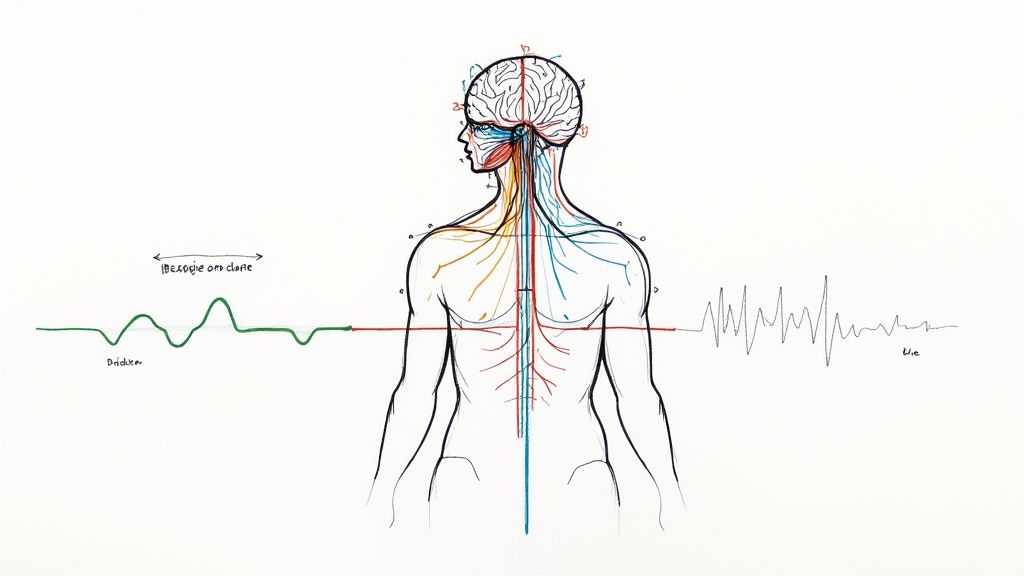
For decades, medicine has largely been a reactive practice. We wait for symptoms to appear, diagnose the problem, and then treat it. But what if we could see health crises coming before they happen? That's the promise of artificial intelligence in predictive healthcare.
This isn't just about tweaking existing processes; it’s a fundamental change in mindset from treating sickness to actively preserving wellness.
Think of it like a sophisticated weather forecast, but for your health. Instead of predicting rain, these systems predict the likelihood of a heart attack, the onset of sepsis, or a hospital readmission. They do this by sifting through massive amounts of data—electronic health records, lab results, genetic information, even data from a patient's smartwatch.
AI models are trained to spot the subtle, almost invisible patterns that a human might miss, signaling a potential health event on the horizon. This ability to look ahead allows clinicians to intervene earlier, often with simpler, more effective treatments.
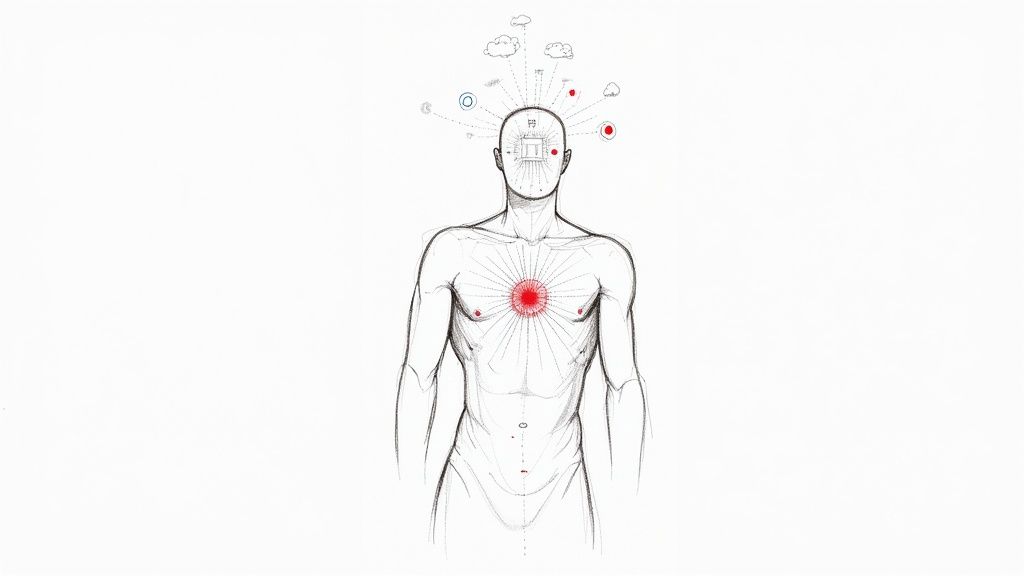
This proactive approach is driven by machine learning algorithms that get smarter and more accurate with every piece of data they analyze. The goals are straightforward: improve patient outcomes, make hospital operations more efficient, and bring down the unsustainable costs of care. We are seeing leading health systems embrace this change, turning dormant data into actionable, life-saving insights.
This isn't science fiction anymore. Predictive AI is rapidly moving into the mainstream of clinical practice.
A recent survey found that a remarkable 71% of U.S. hospitals now have predictive AI tools integrated directly into their electronic health record systems. That’s a significant jump from 66% just a year prior.
Drilling down, the numbers tell a powerful story:
This trend underscores a clear move toward proactive medicine, and it’s a core focus of our work in the AI healthcare sector. By automating the "signal-finding" in the noise of data, these tools free up doctors and nurses to focus on what they do best: caring for patients.
To get a better sense of where this technology is making waves, the table below summarizes the core areas where predictive AI is delivering the most value. It covers everything from spotting clinical risks to streamlining the entire hospital.
| Application Area | Primary Goal | Example Use Case |
|---|---|---|
| Clinical Predictions | Anticipate patient health events like sepsis or readmissions. | Real-time monitoring of vital signs to flag early indicators of decline. |
| Diagnostics | Speed up and improve the accuracy of medical diagnoses. | Triage of emergency room patients based on urgency predicted from initial data. |
| Operational Efficiency | Optimize hospital resources, staffing, and patient flow. | Forecasting patient admission rates to manage bed capacity effectively. |
| Population Health | Identify at-risk groups for targeted preventive care programs. | Analyzing community data to predict disease outbreaks or chronic illness hotspots. |
These applications represent the front lines of the AI-driven healthcare evolution, each one offering a pathway to a more efficient, effective, and patient-centered system. We'll explore these real-world use cases in greater detail in the sections that follow.
To really understand how artificial intelligence in predictive healthcare works, you need to look under the hood. These aren’t abstract, futuristic concepts anymore; they're real tools that make sense of complex medical data in ways we couldn't before. Think of them as a team of highly specialized digital assistants, each with a unique talent for seeing what’s coming next for a patient.
The engine driving everything is Machine Learning (ML). Picture a medical resident who can instantly review millions of patient charts, lab results, and treatment outcomes. ML does just that, learning from historical data to find subtle patterns that point to future events. This is the bedrock of our AI solutions.
Then there’s Natural Language Processing (NLP). A huge part of a patient's story is buried in unstructured text—a doctor's scribbled notes, a radiologist's report, or a discharge summary. NLP acts like a master translator, reading and interpreting this human language to pull out crucial details that standard data fields can’t capture.
Beyond those foundational technologies, we use specific modeling techniques to tackle very particular healthcare problems. Getting these right is the difference between a generic prediction and a life-saving insight, which is a core focus of any good AI strategy consulting engagement.
Survival Analysis Models: These are all about timing. They don't just predict if something will happen, but when. For example, they can calculate the odds of a patient being readmitted within 30, 60, or 90 days, helping care teams know exactly who needs a follow-up call.
Time-Series Analysis: This is a lifesaver for data that's constantly changing. Think of heart rate from a wearable, blood pressure readings in the ICU, or glucose levels from a continuous monitor. Time-series models are brilliant at spotting when a patient's vitals start trending in the wrong direction, often flagging a decline long before it becomes critical.
Federated Learning: Patient privacy is non-negotiable, and this is where federated learning comes in. Instead of gathering sensitive data into one central database—which is a huge security risk—this approach trains a shared AI model across multiple hospitals without the data ever leaving its home institution. It’s a way to build smarter, more accurate models collaboratively while keeping patient information locked down.
These tools have officially moved out of the lab and into the real world. In fact, 25% of U.S. hospitals are already using predictive models to analyze their data. When these powerful AI tools for business spot the faint signals of sepsis or respiratory failure hours before a human could, they give clinical teams the head start they need to save lives. You can read more about these and other crucial healthcare AI trends to see their impact.
By layering these technologies, we build a multi-dimensional picture of every patient. This isn’t about broad, one-size-fits-all predictions. It's about creating a personalized health forecast that allows for proactive, truly individualized care, which is the whole point of a well-designed AI Product Development Workflow.
When you put all these pieces together, you get a powerful engine for predictive health. It turns a sea of raw data into clear, actionable foresight, empowering clinicians to step in and prevent a bad outcome before it ever happens. Working with our expert team ensures these sophisticated tools are aimed squarely at solving your most pressing clinical and operational goals.
The real power of AI in healthcare isn't some far-off theory; it's happening right now at the patient’s bedside and within daily clinical workflows. When these tools are put to work correctly, they give clinicians a vital edge, helping them make faster, more accurate decisions. Let's move beyond the abstract and look at a few concrete examples where AI is already making a huge difference in patient outcomes.
We'll explore four areas where predictive models are solving some of healthcare's toughest challenges, showing what's possible when smart technology meets a specific, pressing clinical need.
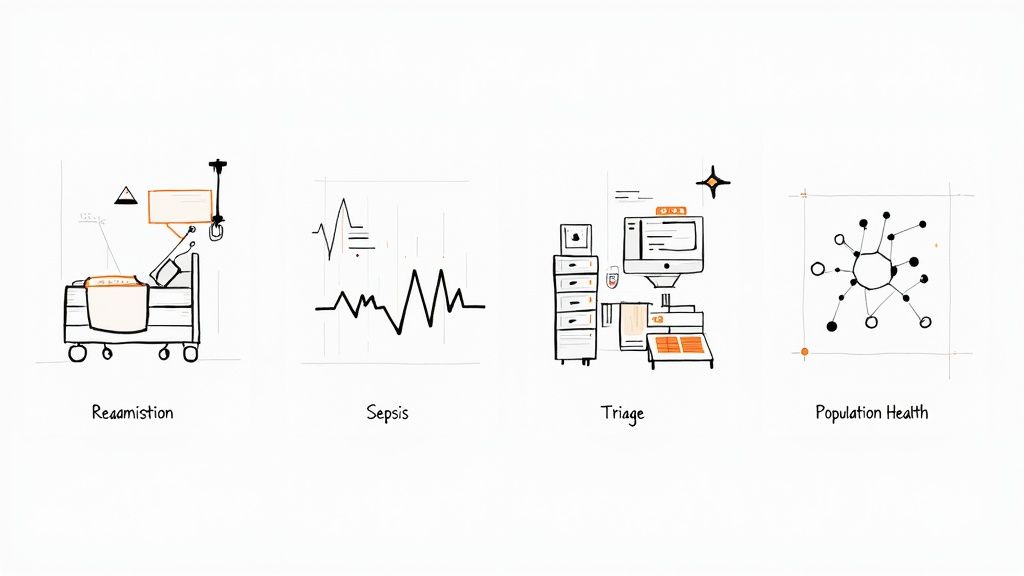
Picture this: a patient named Maria is discharged after a five-day stay for congestive heart failure. In the past, she would have left with a standard packet of instructions. But now, her care team has an invisible assistant. An AI model has crunched the numbers on her entire record—labs, medications, comorbidities, even notes from her physical therapy.
The model flags Maria with a high probability of readmission within 30 days. This isn't just a generic guess; it's a specific forecast based on what happened to thousands of patients with similar health journeys.
That one insight kicks off a whole new protocol:
By spotting the risk ahead of time, the health system can use targeted, low-cost support to keep Maria healthy at home. It’s a simple shift that prevents a costly, stressful return trip to the hospital.
Sepsis is a race against the clock. For every hour treatment is delayed, the risk of mortality skyrockets. The problem is that its early signs—a fever, a faster heart rate—are incredibly common and easy to overlook in a hectic ICU. This is exactly where AI shines, finding the quiet signal hidden in the noise.
Think of an ICU where an AI model is constantly watching the real-time data streams from every patient's bedside monitor. It's not just tracking one or two things; it's analyzing dozens of variables at once, from heart rate variability to tiny shifts in blood pressure.
Suddenly, the AI spots a pattern of subtle changes in one patient's data that strongly points to the early onset of sepsis. It sends an immediate, high-priority alert to the nursing station long before the patient’s condition visibly worsens. This gives the clinical team a critical head start to confirm the diagnosis and start life-saving treatment.
This isn't about replacing a doctor's expertise. It's about giving them a tireless "second set of eyes" that can process information on a scale no human ever could.
Emergency rooms are organized chaos. Making the right call quickly is everything. AI can help bring a data-driven order to that chaos by fine-tuning the triage process. When a new patient arrives, an AI system can instantly analyze their intake information—symptoms, vitals, their main complaint—and check it against a massive database of similar cases.
From that analysis, the AI can predict the patient's likely severity level and even suggest which conditions to investigate first. For example, it might flag a patient with what seems like mild chest pain as having a high probability of a cardiac event, bumping them to the front of the line for an EKG.
This approach ensures the sickest patients get seen first, resources go where they're needed most, and wait times are cut down for everyone. Tools like the Clinic AI Assistant are being built to handle these exact workflows, making patient intake smarter and faster.
Beyond helping one patient at a time, AI is a powerful tool for managing the health of entire communities. Health systems can use predictive models to sift through population-level data—like insurance claims, demographics, and social determinants of health—to pinpoint groups at high risk for chronic conditions.
For instance, an AI model could identify a specific zip code where residents have a high risk of developing type 2 diabetes. Armed with that knowledge, public health officials can launch targeted prevention campaigns right in that neighborhood, offering free health screenings or nutrition workshops. It represents a fundamental shift from treating people after they get sick to proactively keeping them well.
Think of building a predictive AI program like constructing a new, state-of-the-art hospital wing. You wouldn’t just start pouring concrete without a solid architectural plan and a deeply rooted foundation. In the world of artificial intelligence in predictive healthcare, that foundation is built on three critical pillars: Data, Infrastructure, and Governance.
Getting these three elements right from the very beginning isn't just a good idea—it's essential. If you skimp on any one of them, you risk building models that are inaccurate, wasting precious resources, or, in the worst-case scenario, causing patient harm. A thoughtful, deliberate approach here is what separates a successful AI initiative from a stalled project, as we explored in our AI adoption guide.
High-quality, diverse, and secure data is the lifeblood of any predictive model. It's the fuel for your AI engine. The better the fuel, the better the engine performs. This data flows in from countless sources, each one providing a unique piece of the patient's story.
Some of the most important data sources include:
But here’s the catch: just having a mountain of data isn't enough. It's almost always messy, unstructured, and locked away in different systems. This is why data preparation—the painstaking work of cleaning, standardizing, and integrating these varied sources—is one of the most vital steps in the entire process. Our AI-Powered Data Extraction Engine was built to solve this exact problem, transforming chaotic raw information into a clean, organized asset ready for analysis.
Once you have high-quality fuel, you need a powerful engine to make it useful. That’s where your technical infrastructure comes in. Training sophisticated AI models, particularly deep learning algorithms that analyze complex medical images, demands a level of computational power that most on-premise hospital servers just can't deliver.
This is precisely why cloud computing has become the go-to for predictive healthcare AI. Platforms from providers like AWS, Google Cloud, and Microsoft Azure offer the scalable horsepower you need for:
The final pillar, governance, provides the essential guardrails for your entire AI program. It's about making sure every single step you take is responsible, ethical, and fully compliant with regulations. In healthcare, where the stakes couldn’t be higher, this is absolutely non-negotiable.
Strong governance sets the rules of the road for several key areas:
Building this three-pillared foundation is a major undertaking, and the difficulty helps explain a stark reality in the industry. Recent research shows that while 86% of multi-hospital system affiliates are using predictive AI, only 37% of independent hospitals can say the same. This gap highlights just how crucial a deliberate strategy for data, infrastructure, and governance truly is. You can read the full research on closing the predictive AI gap in hospitals.
Before diving into an AI project, it's wise to take stock of your organization's readiness. This checklist can help you assess where you stand across the foundational pillars.
| Category | Key Requirement | Success Metric |
|---|---|---|
| Data | Access to clean, diverse, and representative datasets. | Data is centralized, standardized, and readily available for model training. |
| A clear data lineage and ownership process. | Every dataset has a documented owner and a clear history of transformations. | |
| Robust data extraction and preparation capabilities. | Time from data request to model-ready asset is minimized (e.g., days vs. weeks). | |
| Infrastructure | Scalable, secure, and HIPAA-compliant cloud environment. | Infrastructure can scale on-demand to support intensive model training. |
| Access to necessary computing resources (GPUs/TPUs). | Model training times are within acceptable project timelines. | |
| Tools for model deployment and integration (e.g., MLOps). | A clear, automated pathway exists to move models from validation to production. | |
| Governance | Established AI ethics committee or review board. | All AI projects are reviewed for fairness, bias, and patient safety. |
| Clear policies for data privacy and security. | Zero compliance breaches related to AI data handling. | |
| A formal process for model validation and monitoring. | Models are continuously monitored for performance degradation post-deployment. |
Taking the time to honestly evaluate your capabilities against this checklist will illuminate potential gaps and help you build a more realistic and successful implementation plan from day one.
Bringing artificial intelligence in predictive healthcare from a promising idea to a clinical reality demands a clear, disciplined plan. Without a solid roadmap, even the best projects can get bogged down in unexpected complexities. This phased approach breaks the journey into manageable stages, ensuring each step builds logically on the one before it.
Think of it as moving from a blueprint to a fully operational hospital wing. This roadmap turns the massive undertaking of AI adoption into a series of achievable milestones, guiding your organization from initial discovery all the way to full-scale deployment and a clear return on investment.
The journey doesn't start with algorithms or data lakes. It starts by answering a simple question: What problem are we trying to solve? This discovery phase is absolutely critical—a well-defined problem is already halfway to being solved. Focus on a specific, high-impact clinical or operational challenge where predictive insights could truly move the needle, like cutting sepsis mortality rates or preventing those costly patient readmissions.
During this stage, your team needs to nail down a few key things:
A thorough Custom AI Strategy report can dramatically speed up this phase. It creates a clear blueprint that connects the technical needs with your ultimate business goals, getting everyone on the same page from day one.
With a clear strategy in place, it's time to test your ideas in the real world—but on a small, controlled scale. A pilot project is your proof-of-concept. It lets you validate a predictive model with actual data without disrupting your hospital's day-to-day operations. This is your chance to experiment, learn, and fine-tune your approach in a low-risk setting.
The main goal here is to answer some fundamental questions. Does the model actually have predictive power? Can we reliably get the data it needs? What roadblocks might we hit when trying to integrate it? A successful pilot builds crucial momentum and gives you the hard evidence needed to get buy-in for a wider rollout.
Once a pilot model shows it has potential, it must pass through rigorous clinical validation. This step is non-negotiable. It's how you ensure the algorithm is not just accurate but also safe, fair, and effective for your patient population.
This process involves testing the model against historical data it has never seen before. Sometimes, it even means running the model silently in the background, comparing its predictions to what actually happened to see how it would have performed.
After clearing validation, the solution is ready for a scaled deployment. This means carefully weaving the AI tool into the clinical workflow—for example, as a smart alert inside the EHR. This is where services like our AI Automation as a Service can handle the heavy technical lifting, making sure the integration is seamless and secure.
This foundational process shows how data, infrastructure, and governance must work in harmony to support any AI implementation.
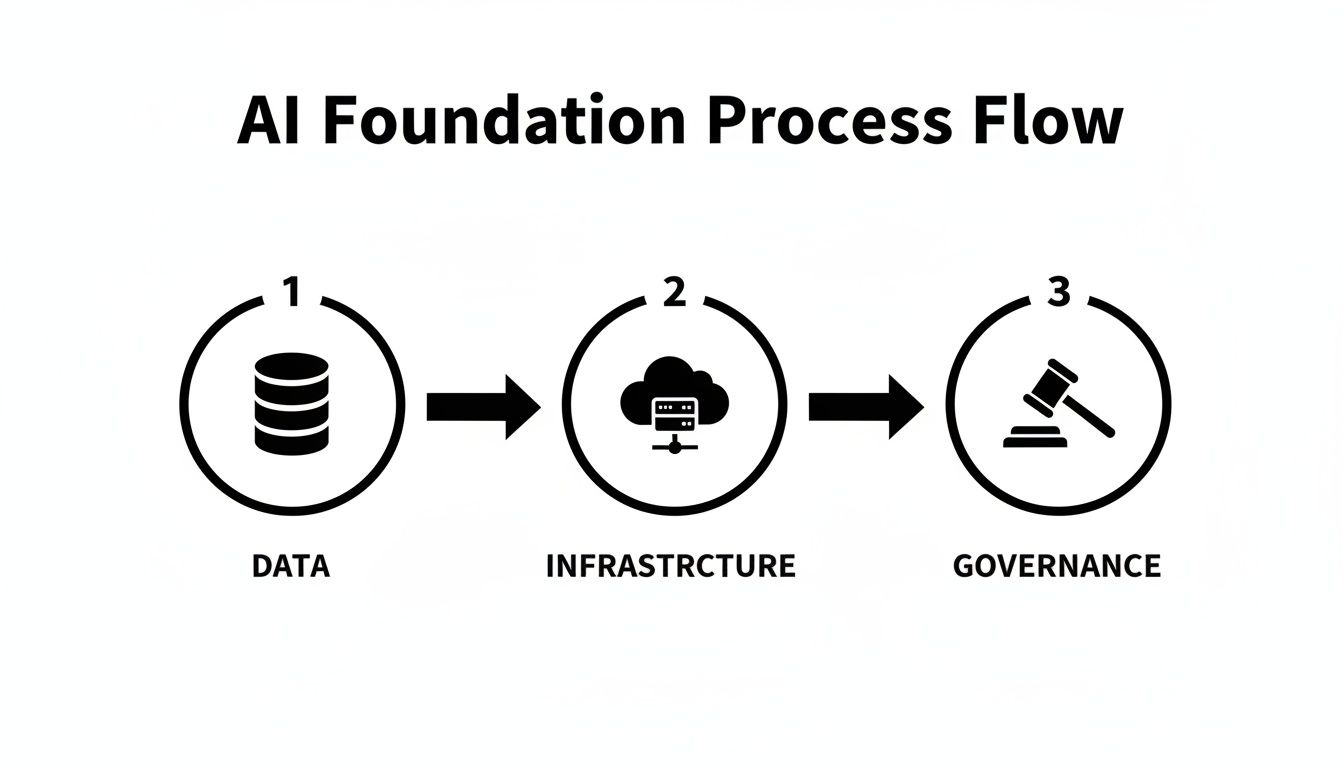
As the flow shows, you can't even think about deployment until you have a rock-solid foundation of data management, scalable infrastructure, and clear governance in place.
Launching an AI model isn't the finish line; it’s the start of an ongoing cycle. Healthcare is always changing. New treatments emerge, patient populations shift, and clinical guidelines are updated. All of these factors can cause a model’s performance to slowly degrade over time—a problem known as "model drift."
A predictive model is a living asset, not a one-time installation. It requires ongoing care and maintenance to remain effective and trustworthy.
To fight model drift, you need a robust monitoring system. This means tracking the model's accuracy and fairness in real time and setting up alerts for when it's time for a tune-up. This loop of monitoring, evaluating, and retraining with fresh data is what ensures your AI tool remains a valuable and trusted clinical partner for years to come.
Putting predictive AI to work in healthcare is about much more than just good data and slick algorithms. It means facing some significant hurdles head-on—regulatory, ethical, and operational. You have to navigate this landscape carefully to build trust and make sure these powerful tools actually help patients and clinicians.
Ignoring these challenges simply isn't an option. They need to be tackled with practical, well-thought-out strategies. This is where a clear AI strategy becomes your best friend, turning potential roadblocks into manageable steps.
Healthcare is, and should be, a heavily regulated field. Any AI solution you build has to be designed from the ground up to meet strict standards like HIPAA and, if you handle data from European citizens, GDPR. This gets very real, very fast. We're talking about robust data anonymization, rock-solid secure storage, and crystal-clear processes for how patient information is handled.
Keeping up with data protection rules is non-negotiable when you’re dealing with sensitive health records. For a deeper dive, resources like this guide on GDPR compliance for health data are invaluable. Beyond that, if your AI tool is considered a medical device, getting FDA clearance brings a whole new level of validation and documentation work.
This might be the most important challenge of all: ensuring fairness and stamping out algorithmic bias. Think about it—if an AI model is trained on data that reflects historical health disparities, it will not only learn those biases but can actually make them worse. The result? Poorer outcomes for already underrepresented groups.
The core ethical mission for AI in healthcare must be to close health equity gaps, not widen them. This takes a constant, deliberate effort to check for bias and make sure models work fairly for everyone.
The only way to fight this is with diverse, representative training data and regular bias audits. It's a key part of our AI requirements analysis process, where we focus on building fairness right into the model from the start. Working with specialists in custom healthcare software development can also bring in the deep expertise needed to handle these complex issues.
Here’s a hard truth: even the most accurate and ethical AI model is useless if clinicians don’t trust it or won’t use it. Doctors and nurses are often overworked and understandably skeptical of new tech. A "black box" algorithm that spits out recommendations without any explanation is almost guaranteed to be ignored.
Real success comes from bringing clinicians into the design of internal tooling from day one. When they feel like co-creators, the final product is far more likely to be intuitive, genuinely helpful, and fit neatly into their packed schedules. Getting past these adoption hurdles takes a mix of technical skill and a real-world understanding of how a hospital actually works—a balance our expert team works hard to strike.
Predictive AI in healthcare uses machine learning algorithms to analyze vast amounts of patient data—such as electronic health records, lab results, and real-time vitals—to forecast future health events. The goal is to identify patients at high risk for conditions like sepsis, hospital readmission, or cardiac arrest before symptoms become critical, enabling proactive medical intervention.
Traditional analytics is retrospective; it looks at past data to report on what has already happened (e.g., last quarter's readmission rates). Predictive AI is forward-looking; it uses historical data to generate a forecast about a future outcome for a specific individual. It answers the question, "What is likely to happen next?" rather than "What happened?"
While technical challenges exist, the biggest barrier is often cultural and operational. Earning the trust of clinicians is paramount. If AI tools are not intuitive, transparent (not a "black box"), and seamlessly integrated into their daily workflows, adoption will fail. Overcoming this requires involving doctors and nurses in the design and validation process from the very beginning.
This is a critical ethical challenge. To prevent AI from amplifying existing biases, you must:
The most impactful use cases currently include:
Ready to see how AI can create real value for your healthcare organization? The team at Ekipa AI specializes in helping leaders move from initial idea to measurable impact. Our AI Strategy consulting tool can map out a custom AI strategy for you in just 24 hours, showing you exactly where predictive healthcare can make the biggest difference. Our expert team is ready to help you navigate this journey.
How to build HIPAA-compliant AI: when LLM providers need a BAA, data minimization, de-identification, audit controls and a reference architecture.

Practical data migration planning guide for healthcare teams. Scope, mapping, compliance, validation, cutover and rollback decisions explained end to end.

Smart on FHIR guide for healthtech engineers. Learn the OAuth 2.0 launch model, scope syntax, backend services, and US regulatory requirements.
Connect with our team to explore how AI expertise can transform your business.