
AI in Healthcare
HIPAA-Compliant AI: How to Use LLMs With PHI Safely
How to build HIPAA-compliant AI: when LLM providers need a BAA, data minimization, de-identification, audit controls and a reference architecture.
October 16, 2026Read more
Autonomous AI systems in hospital operations boost efficiency. Leaders: explore use cases, ROI, implementation, & governance in this 2026 guide.
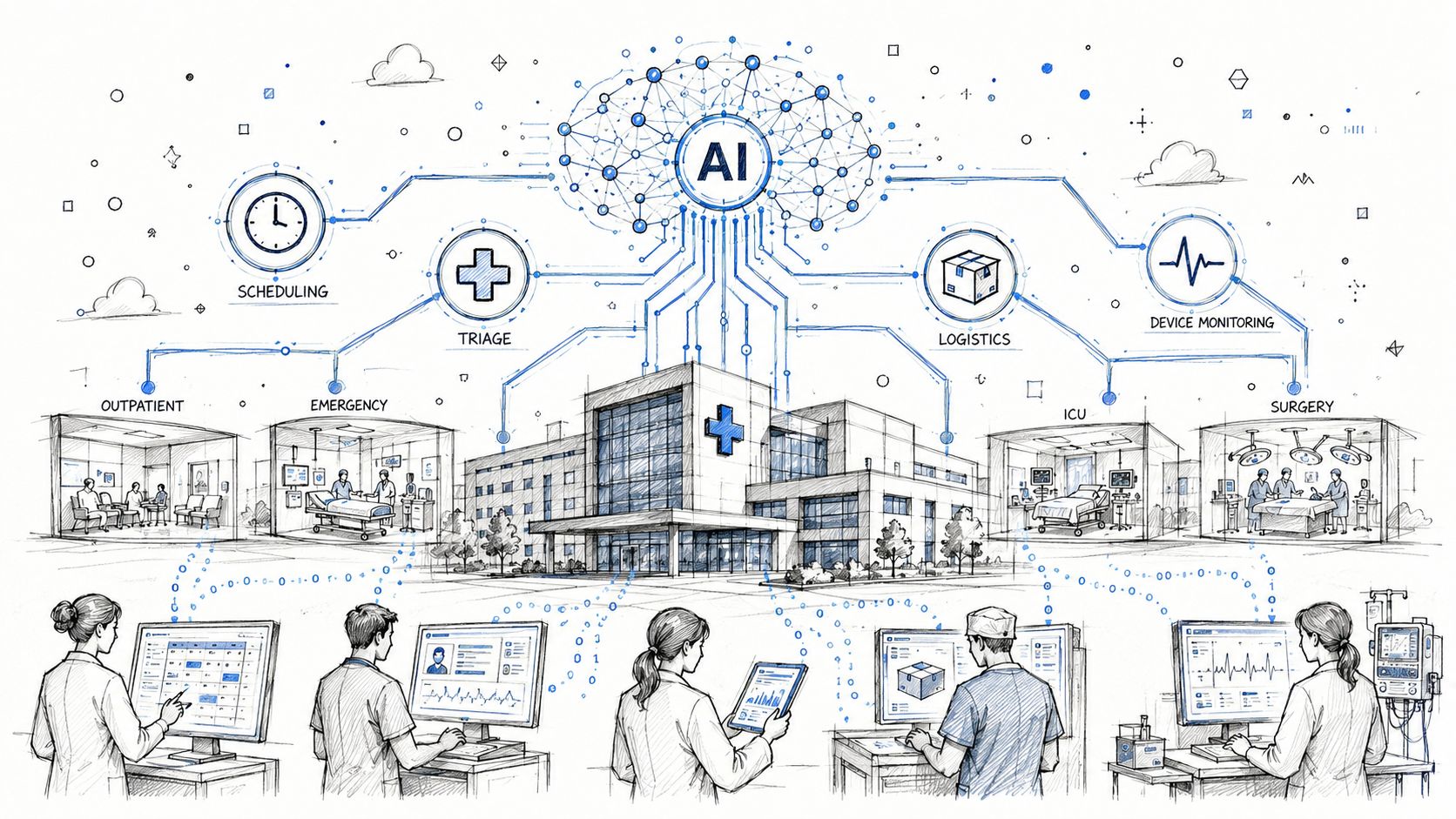
A 40% productivity gain is enough to change a board agenda. It shifts AI out of the innovation budget and into core operating strategy.
Hospitals have spent years evaluating AI as a clinical adviser. The bigger near-term opportunity is operational autonomy: systems that can route work, trigger follow-up tasks, coordinate departments, and execute defined actions inside approved guardrails. That is a different category of value. It affects patient access, labor capacity, throughput, and margin.
It also exposes a hard truth.
Autonomous AI acts like a chaos detector for hospital operations. If discharge workflows rely on undocumented workarounds, if staffing decisions depend on stale data, or if revenue cycle teams spend hours resolving preventable exceptions, an autonomous system will surface those weaknesses fast. In practice, that is why some deployments stall. The problem is rarely the model alone. The problem is the process around it.
Hospitals that get results treat autonomous AI systems in hospital operations as an operating model change with technology attached. They define where the system can act on its own, where human review stays in place, which exceptions require escalation, and how performance will be measured in financial and operational terms. That discipline is what turns autonomy from an interesting pilot into a scalable way to run parts of the hospital better.
A 40% productivity gain changes more than a pilot scorecard. It changes capital allocation, staffing assumptions, and how a board thinks about operating capacity.
For hospital leadership, the question is no longer whether AI can generate useful recommendations. The harder and more valuable question is where the organization is prepared to let software take action inside approved rules. That is the frontier. Autonomous AI does not stop at identifying a delay in discharge, a scheduling gap, or a preventable claim exception. It can trigger the next step, route the work, document the action, and escalate only when a case falls outside policy.
That shift matters because hospitals do not need another layer of alerts. They need fewer handoffs, fewer queues, and fewer avoidable delays between decision and execution.
As noted earlier, autonomous AI has already shown it can materially raise productivity in care delivery. Boards should read that result less as a clinical story and more as an operating signal. If a system can safely handle bounded work in one part of the enterprise, the same model can be applied to repetitive operational decisions across access, throughput, revenue cycle, and coordination.
The main board issue is not technical novelty. It is operational advantage.
A hospital with tight labor supply and rising cost pressure cannot rely on dashboards alone. Staff still have to interpret the signal, choose an action, and push it through multiple systems. Autonomous operations shorten that chain. In practical terms, that can mean faster bed assignment, cleaner prior auth follow-up, tighter referral routing, and quicker resolution of exceptions that would otherwise sit in a work queue until the next shift reviews them.
Outside healthcare, the same pattern is visible in operational environments that use AI to reduce manual coordination and speed up routine decisions. The Beyond Surplus AI impact analysis is useful here because it frames AI as an execution tool, not just an insight tool. Hospitals should apply that same discipline, with stricter governance and higher audit requirements.
Operational autonomy changes management work first.
Once software starts executing approved actions, supervisors spend less time assigning tasks and more time reviewing exceptions, refining thresholds, and checking whether the process itself is sound. That is where many hospitals hit the chaos detector problem. AI surfaces broken workflows quickly. If case managers rely on unofficial workarounds, if scheduling rules conflict across departments, or if denial management depends on tribal knowledge, an autonomous system will expose those gaps on day one.
That is useful, but it is not comfortable.
The right response is not enterprise-wide rollout. It is controlled deployment in workflows with three characteristics:
Good starting points usually include discharge task orchestration, intake preparation, claims exception handling, staffing adjustments within policy, and supply replenishment triggers. Poor starting points are workflows with unresolved policy disputes, fragmented ownership, or constant one-off exceptions that nobody has documented.
Board oversight should stay simple. Define where the system can act, where human approval remains in place, what must be logged, and which outcomes determine whether the program expands. Hospitals that treat autonomy as an operating model decision, not a software feature, are the ones that get measurable ROI without losing control.
Most hospitals already use automation. Many use predictive models. Far fewer use systems that qualify as autonomous.
That distinction gets blurred in vendor pitches, so it helps to use a plain operational test. If the system observes conditions, interprets them, selects a response, and triggers the action inside predefined boundaries, it's moving into autonomy.
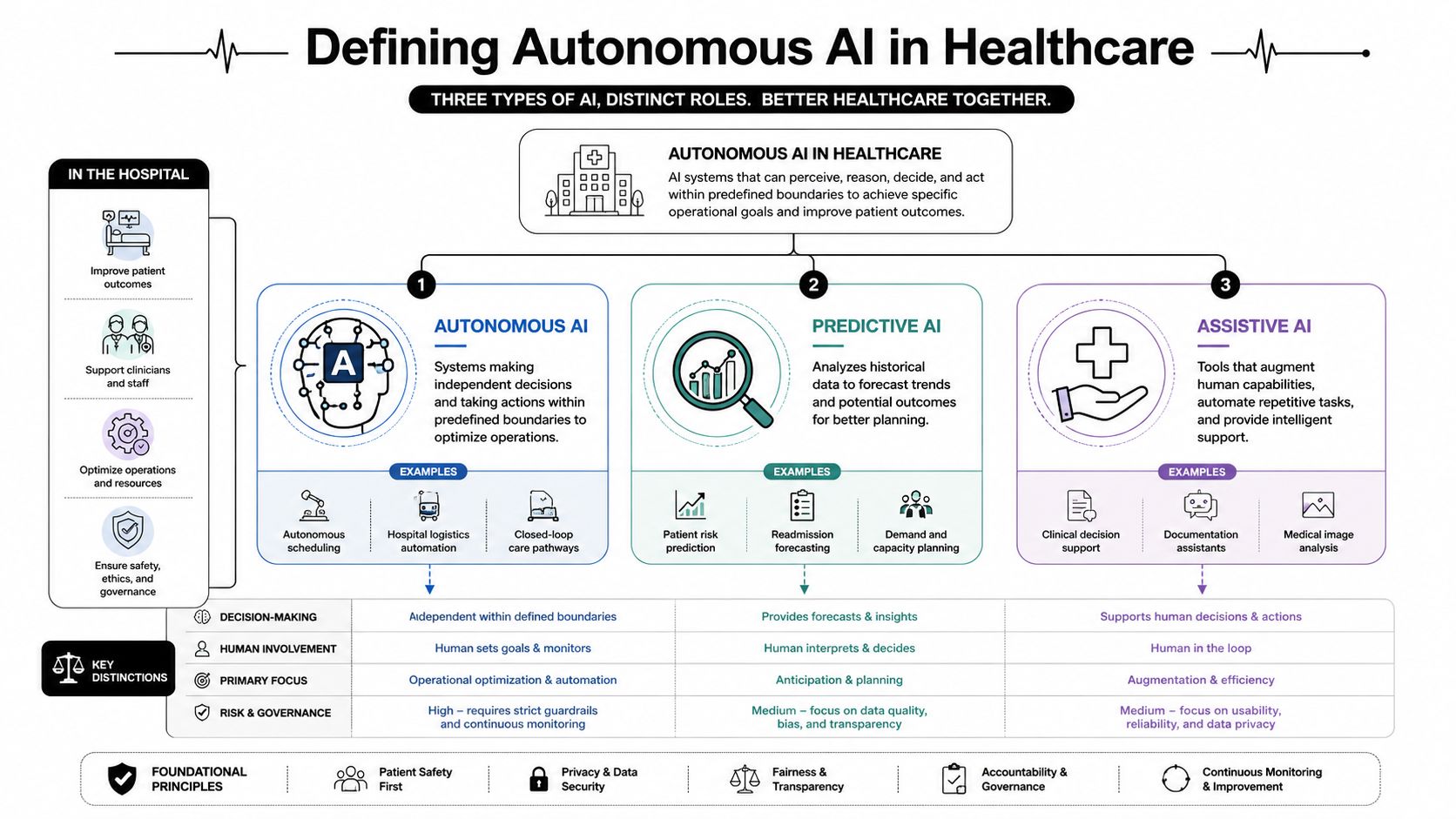
A practical way to think about it is assistive AI, predictive AI, and autonomous AI.
That last category is the one many hospitals are only beginning to define properly.
Autonomous healthcare agents continuously observe multi-source hospital data, interpret signals, make contextual decisions, and orchestrate workflows, enabling a shift from static automation to goal-driven, real-time operational control (LinkedIn analysis on autonomous healthcare agents).
The simplest way to explain the difference is this:
| AI type | What it does | Human role | Hospital example |
|---|---|---|---|
| Assistive | Supports a task | Human decides and acts | Chart pre-fill before a visit |
| Predictive | Forecasts likely events | Human reviews and responds | Demand forecast for admissions |
| Autonomous | Decides and triggers next steps | Human governs exceptions | Dynamic routing and workflow orchestration |
This is the difference between a GPS and a self-driving system. One recommends. The other executes.
Hospitals often think they're buying autonomy when they're really buying prediction plus alerts. That gap is where many AI programs stall.
In hospital operations, autonomy usually appears as bounded execution, not science fiction. The system doesn't “run the hospital.” It runs narrow but high-friction workflows that people currently manage through inboxes, spreadsheets, phone calls, and swivel-chair work between systems.
Examples include:
For leaders trying to place this shift in a broader business context, the Beyond Surplus AI impact analysis is useful because it looks at how AI changes operational decision-making, not just isolated productivity tasks.
The mistake is to define autonomy by the sophistication of the model. The better definition is operational. If the system can take action in production, under policy, with monitoring and escalation, it belongs in the autonomy discussion.
Hospitals don't need a dozen autonomous use cases at once. They need one that solves a painful operational problem with enough financial relevance to matter and enough control to govern well.
The strongest starting points tend to sit where workflows are repetitive, delays are visible, and decision logic can be bounded.
Patient flow is often the first domain where operational autonomy becomes tangible. Not because the workflows are simple, but because the waste is obvious. Delayed discharge, avoidable queue buildup, and fragmented triage decisions compound across the day.
Autonomous agents can coordinate multi-step workflows such as intake preparation, patient routing, triage prioritization, and discharge alignment with real-time readiness across departments. In practice, this means fewer manual handoffs and less waiting for someone to notice that the next operational step is already clear.
There are real examples of this broader operating pattern. Mount Sinai Health System cut emergency room wait times by 50% using AI models that predict admissions based on local events and weather patterns, while St. Luke's University Health Network reduced patient wait times by 40% and operational costs by 25% by aligning staffing levels with expected surges (Intuition Labs).
Hospital operations break down quickly when supplies, staff, rooms, and equipment aren't synchronized.
Predictive inventory management is one of the cleanest operational use cases because it links directly to cost, availability, and service continuity. AI-powered inventory systems can reduce medical supply costs by 15-20% and cut emergency shortages by 30%, while AI-driven predictive maintenance can identify breakdown risks before failure. Automated claims processing also reaches 95% accuracy with a 40% faster revenue cycle in the same body of evidence (PMC review on hospital operations AI).
A practical next step for operations teams evaluating equipment uptime is to assess tools like this predictive maintenance app, especially when maintenance delays are already affecting capacity planning.
Administrative friction is where many hospitals find the fastest path to autonomous action. Revenue cycle work is rules-heavy, exception-driven, and often expensive to scale with labor alone.
Autonomous agents are now used in 46% of health systems and hospitals specifically for revenue cycle management, where they handle simple insurance claims autonomously and leave complex cases to staff (Intelisys healthcare AI overview). That's not just an efficiency play. It changes staffing design by moving people from repetitive processing to exception resolution.
| Use Case | Primary Benefit | Potential ROI | Implementation Complexity |
|---|---|---|---|
| Patient flow orchestration | Shorter waits and smoother throughput | Strong when delays are visible and bed turnover is constrained | High, because it touches many departments |
| Predictive inventory management | Lower supply spend and fewer shortages | Strong where procurement volatility is costly | Moderate |
| Predictive maintenance | Better equipment uptime and fewer service disruptions | High when critical devices create downstream delays | Moderate |
| Revenue cycle automation | Faster claims handling and fewer manual touches | Strong where work queues are large and repetitive | Moderate |
| Intake and chart prep orchestration | Less admin burden before clinician interaction | Medium to strong, depending on workflow maturity | Low to moderate |
The common mistake is choosing the most impressive demo. The better choice is the use case with clear ownership, usable data, and a measurable operational pain point.
Hospitals rarely fail at AI because the model is weak. They fail because the surrounding architecture can't support reliable action.
Autonomous operations require a stack that can ingest data from fragmented systems, interpret what's happening in context, and trigger actions back into production workflows without creating more operational mess.
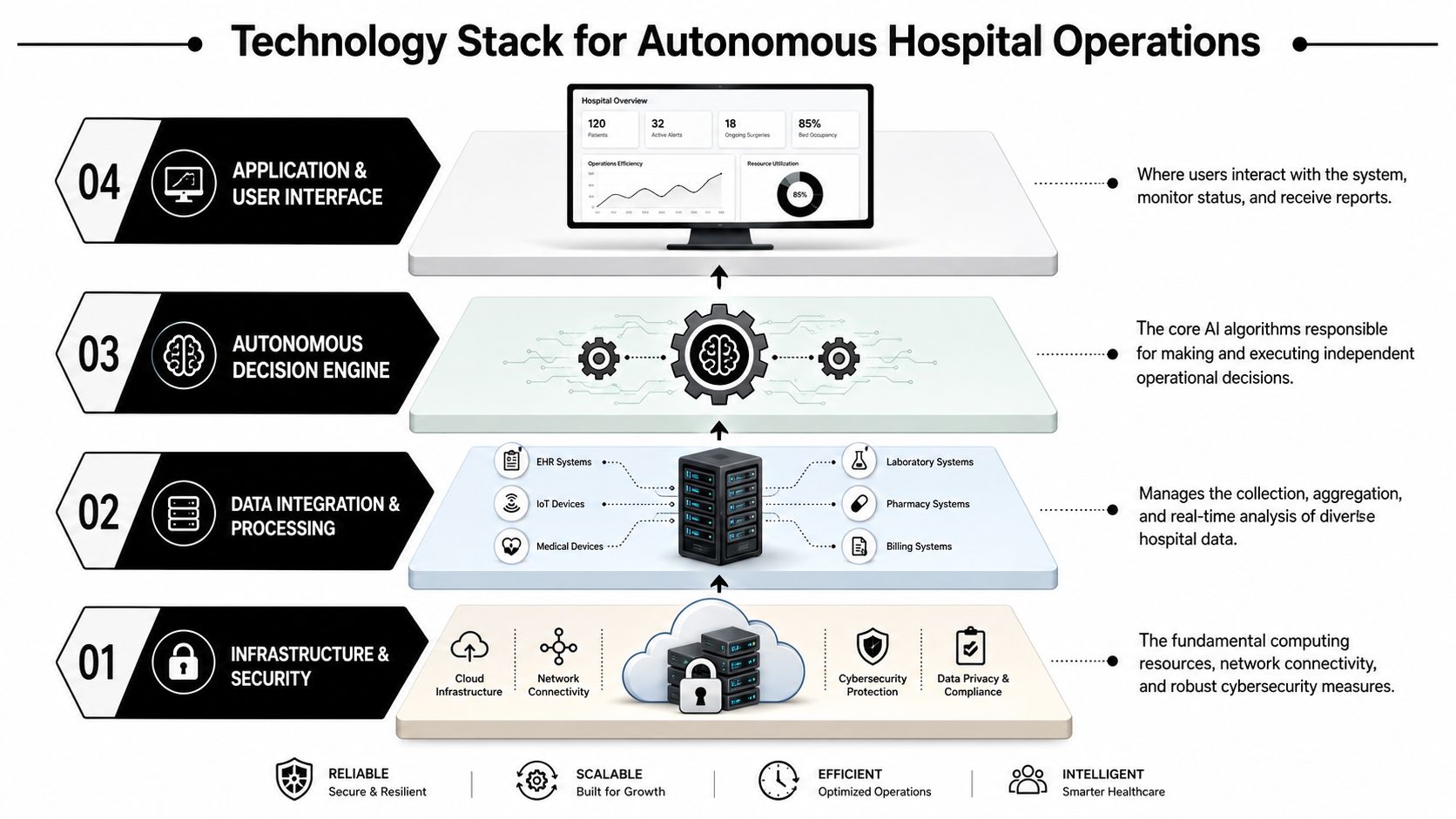
Most successful AI deployments begin by building a unified data foundation, then layering intelligence and automation across high-impact workflows. This “activate data” approach turns analytics into real-time operational guidance (Innovaccer on autonomous healthcare).
That principle sounds obvious, but it's where many hospital programs cut corners. They try to automate a process that still depends on inconsistent timestamps, missing status fields, duplicate patient events, or work queues maintained outside the system of record.
A practical architecture usually starts with these data streams:
Once the data layer is stable enough, the intelligence layer can do more than score risk. It can prioritize tasks, select actions, and trigger them under explicit rules.
That middle layer usually includes machine learning models, business rules, orchestration logic, and guardrails for confidence thresholds, exception routing, and fallback behavior. Hospitals often underestimate how much this layer depends on process design, not just data science.
Architecture rule: If a workflow doesn't have a clear owner, a stable source of truth, and an agreed exception path, it isn't ready for autonomy.
For teams dealing with unstructured inputs such as faxes, forms, or external documents, this AI-powered data extraction engine illustrates the kind of upstream capability that often has to be solved before downstream orchestration works.
Insight alone doesn't change operations. The action layer does. That's where APIs, workflow engines, robotic process automation, notification systems, and task-routing logic push decisions back into the hospital's daily work.
A strong action layer should be able to:
This is why autonomous AI systems in hospital operations are an integration challenge. The intelligence may be novel, but the hard work is making action reliable inside a high-stakes environment with legacy systems, compliance constraints, and nonstop operational variability.
Operational autonomy changes the hospital's risk profile because the system is no longer limited to recommendations. It can assign work, change timing, redirect resources, and shape who gets attention first. In a hospital, those are operational decisions with ethical weight.
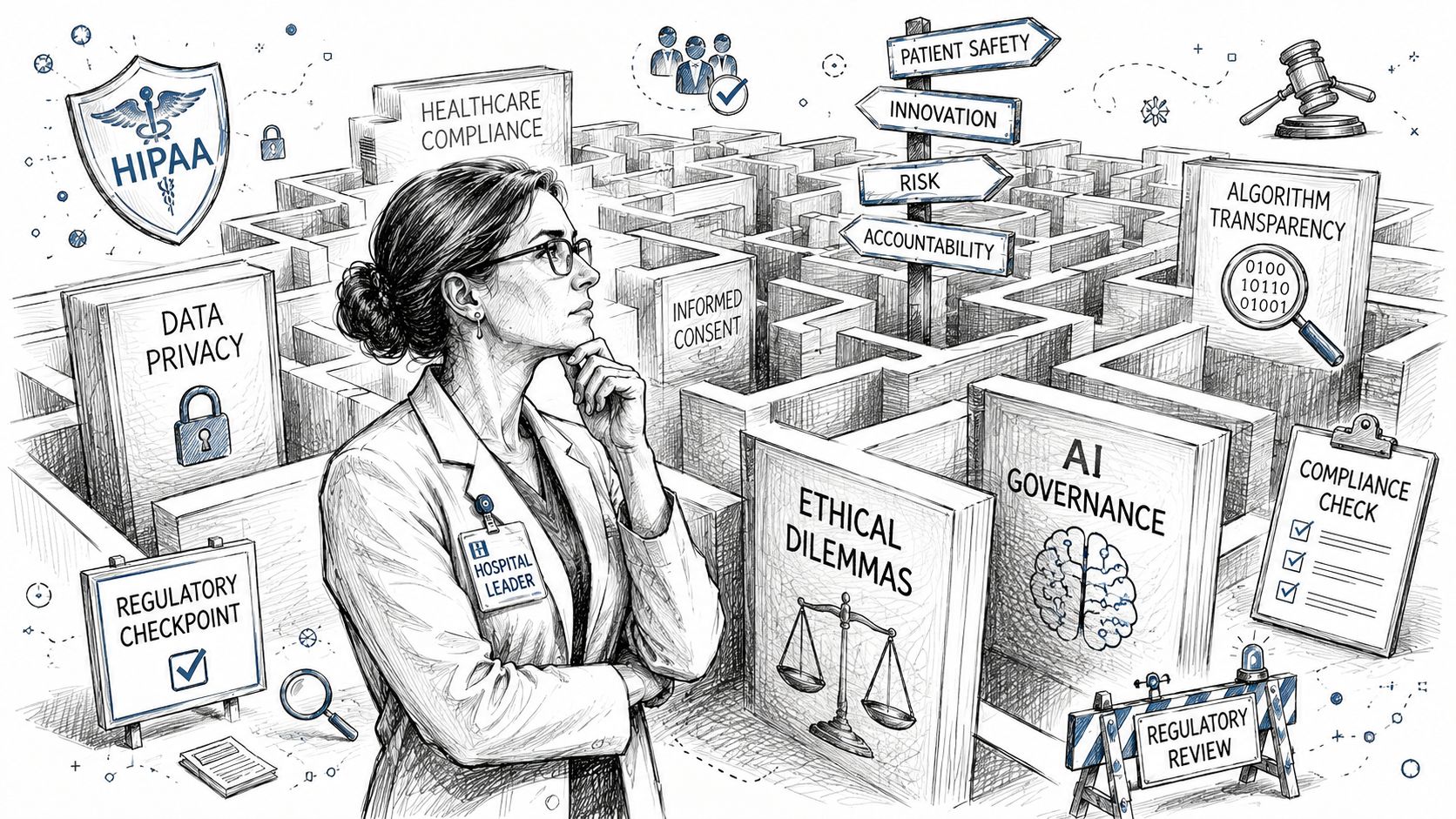
The practical question is not whether AI is “regulated.” The practical question is what level of autonomy the hospital is authorizing, in which workflow, with what fallback, and under whose authority. That framing keeps boards out of abstract AI debates and focused on accountable operating controls.
A useful framework for responsible AI in healthcare applies graded autonomy, classifying systems by risk factors such as the responsible agent, backup decision-maker, and care context (Scientific Reports).
Boards should use that logic at the workflow level. An AI agent that reorders supply tasks or routes denials for review presents one kind of risk. An agent that affects discharge sequencing, transfer prioritization, or access to time-sensitive services presents another. Treating both as “AI” is how governance gets sloppy.
I advise hospital leaders to approve autonomy in tiers:
| Autonomy level | Typical use | Oversight expectation |
|---|---|---|
| Low | Administrative routing, queue balancing, document classification | Post-action audit, sampled review, defined rollback |
| Medium | Cross-department coordination, prior auth follow-up, bed flow recommendations with action triggers | Human fallback, active performance monitoring, tighter change control |
| Higher | Actions that can influence patient access, timing, escalation, or safety-sensitive operations | Formal validation, named accountable owner, real-time oversight, restricted deployment scope |
Clinical AI ethics gets most of the attention. Operational autonomy creates a different failure mode. It can automate an unfair process with perfect consistency.
That is the chaos detector problem.
If intake delays are worse for patients with incomplete records, if interpreter needs are captured inconsistently, or if one service line gets faster manual escalation because staff know who to call, an autonomous system will expose those gaps immediately. In some cases it will amplify them. The fix is not a better model alone. The fix is process redesign, data cleanup, and a policy decision about what the system is allowed to do.
That is why fairness review should include workflow questions, not only model questions. Who gets routed faster. Who gets pushed into exception queues. Which cases require human confirmation. Which populations are more likely to be missing the data the system depends on.
Before a hospital expands beyond a pilot, leadership should require evidence in five areas:
In practice, I would add a sixth. Change discipline. Hospitals often validate the model once and underinvest in what happens after go-live, when policies shift, payer rules change, volumes spike, and frontline workarounds start to appear.
For organizations that need help translating these requirements into operational controls, validation steps, and release governance, implementation support for hospital AI programs is often more valuable than another standalone model demo.
Responsible autonomy is an operating model. It sets boundaries on what the system can do, who can override it, and how the hospital learns from failure before failure scales.
For leaders weighing the broader policy context, this expert analysis on health AI ethics is a useful read on trust, governance, and why deployment discipline matters as much as technical capability.
Hospitals that try to automate too much too early usually end up funding a cleanup project they did not plan for. The better path is narrower. Start with one operational workflow, one accountable owner, and a financial case tied to a measurable constraint such as discharge delay, prior authorization backlog, staffing coverage gaps, or denied claims rework.
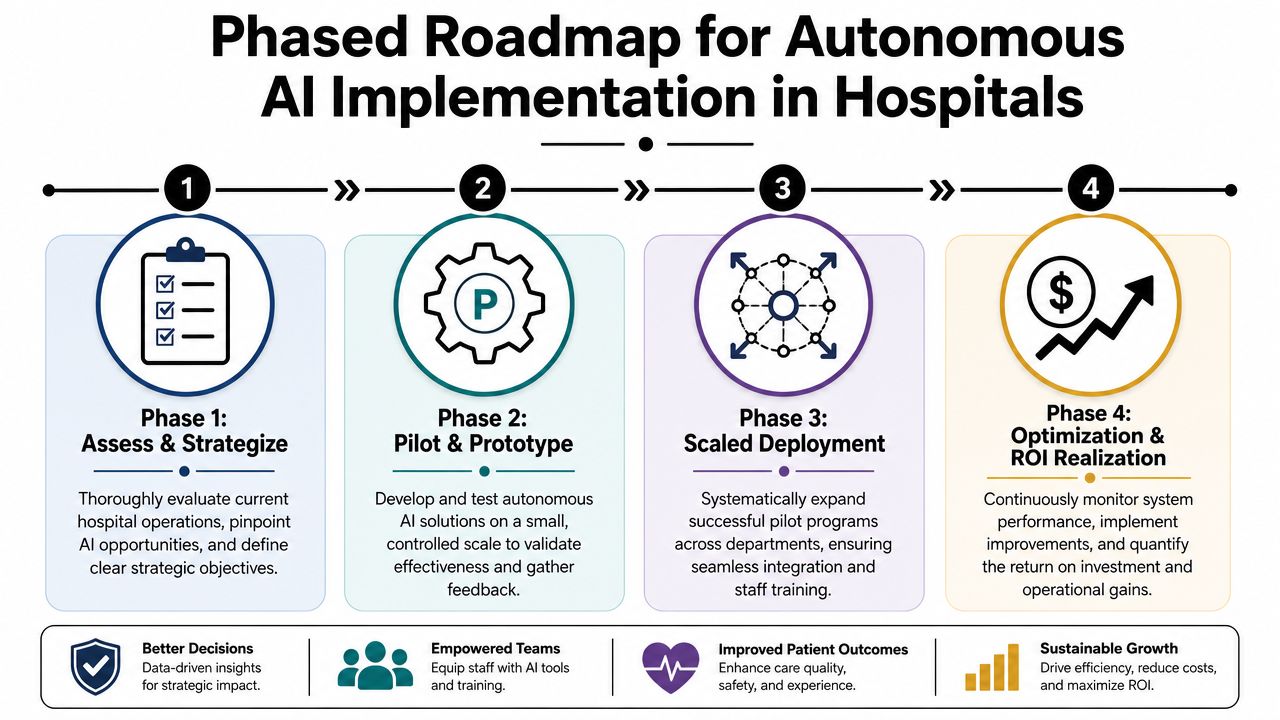
The first phase is not vendor selection. It is operational diagnosis.
Autonomous AI works best where work is high-volume, rules-based enough to delegate, and painful enough that leadership will act on what the system exposes. That last point matters. In hospitals, AI often reveals broken handoffs, inconsistent status codes, and exception paths that exist only in staff memory. If the organization is unwilling to fix those issues, autonomy will stall.
A useful assessment should answer five questions:
The output should be a prioritized use case, a workflow map, a data-readiness view, a risk classification, and an ROI hypothesis the board can scrutinize. That is how teams avoid confusing interest in AI with readiness for autonomy.
A pilot should test whether the hospital can let the system do real work under defined guardrails. Pick one workflow. Set clear boundaries for what the AI can execute on its own, what requires review, and what must always stay with staff.
The strongest pilots usually share a few characteristics:
The separation of operational autonomy from decision support becomes evident. A dashboard can suggest. An autonomous system routes, schedules, escalates, documents, or triggers next steps inside the workflow. That difference is exactly why pilot design must focus on accountability and operational fit, not model accuracy alone.
Once the pilot proves it can run safely and improve throughput, expansion should follow a standard build model. Hospitals that scale successfully do not reinvent integration, approval logic, monitoring, and release controls for every new use case.
They standardize three layers early:
This is also the point where many health systems discover they need execution support, not another strategy deck. If internal teams are stretched across EHR priorities, cybersecurity reviews, and departmental change requests, outside help with hospital AI implementation support can speed deployment without weakening controls.
Finance committees do not fund autonomy because the technology is interesting. They fund it when the value shows up in labor redeployment, faster throughput, fewer avoidable delays, reduced leakage, and less management time spent chasing status across departments.
Measure ROI at three levels.
As noted earlier, published results in healthcare and adjacent operational settings show that meaningful productivity gains are possible when AI is embedded into live workflows rather than used as a passive assistant. Boards should treat those outcomes as directional, not as a promise. The right target is not a headline number. It is a credible, local business case built from current baseline performance, known constraints, and realistic adoption rates.
One final point matters for ROI. Autonomous AI does not just reduce effort. It redistributes attention. The return often comes from giving managers and frontline teams fewer exceptions to chase manually, while exposing the process failures that were already draining margin and slowing care. That is why the best roadmap is phased, measured, and tied to operational redesign from the start.
Hospitals usually discover their operating model is less standardized than leadership believed the moment an autonomous system starts acting across departments.
That is the chaos detector effect. AI does not create the disorder. It exposes work that was already being held together by local habits, side spreadsheets, hallway escalations, and tribal knowledge. Once the system starts routing tasks, assigning next steps, or clearing routine exceptions on its own, hidden variation becomes visible fast.
Healthcare Finance News captured this dynamic well in its reporting on hospital AI adoption, describing how AI surfaces fragmented data and broken workflows that leaders then have to address (Healthcare Finance News).
Boards should treat that moment as a management signal, not a failed deployment. In practice, the first value from operational autonomy is often diagnostic. The system shows where the hospital cannot run consistently at scale.
I see three governance failures show up again and again:
These issues matter because autonomous AI is not just another analytics layer. It is taking action inside the operation. If governance is weak, the hospital gets faster visibility into the same old confusion. If governance is sound, the hospital gets a practical path to standardization.
The governance model should be cross-functional and specific. A steering group with operations, IT, compliance, security, data leadership, finance, and clinical representation where relevant is usually the right starting point. That group needs authority, not just advisory status. It should approve where autonomy is allowed, define escalation thresholds, review exceptions, and stop deployments that are creating operational risk without measurable value.
Good governance also runs on operating routines, not a quarterly committee calendar. Effective teams maintain decision logs, review overrides, inspect failed handoffs, and compare system behavior against actual policy. They do not look only at model accuracy. They look at whether the workflow is running with fewer delays, fewer touches, and fewer preventable escalations.
The trade-off is evident: Tighter controls slow rollout. Loose controls speed rollout but increase rework, override rates, and trust issues. In a hospital, that trade-off should be made deliberately, workflow by workflow, based on operational risk and recoverability.
Mature organizations handle the chaos detector effect by fixing the process the AI just exposed. They standardize status definitions. They assign a true workflow owner. They write down exception rules. They decide which edge cases stay with people and which can be absorbed into the autonomous flow after review.
That discipline is what separates a real operating model from pilot theater. The question is not whether the AI completed a task in a test environment. The question is whether the hospital became easier to run, easier to audit, and easier to improve once the system was put in charge of part of the work.
Automation executes a fixed sequence. Autonomous AI manages work within approved limits and adjusts based on current conditions.
In hospital operations, that difference matters. A basic automation can move every prior authorization request into the same queue. An autonomous system can assess completeness, prioritize by payer rules and turnaround risk, route standard cases, and send uncertain ones to staff with the right context attached. The value is not only speed. It is fewer handoffs, fewer stalled items, and less manager intervention.
Usually, no.
They shift labor toward higher-value work. Teams spend less time chasing status, rekeying data, and manually triaging queues. They spend more time handling exceptions, resolving edge cases, monitoring performance, and improving the underlying process. Hospitals that plan for that shift early tend to get better adoption because managers can explain how roles change, not just announce a new tool.
Start where operational friction is already visible to leadership and painful to frontline teams. Good candidates include referral intake, prior authorization coordination, discharge workflow management, supply replenishment, and revenue cycle work queues.
Do not start with the biggest possible enterprise ambition. Start with one workflow that has a clear owner, enough transaction volume to matter, and an escalation path that staff already understand. That gives the organization a way to prove control before it tries to scale autonomy across departments.
Readiness comes down to four practical tests:
If one of those elements is missing, the hospital may still proceed, but it should treat the work as process redesign first and AI deployment second.
Boards should ask a tougher question than “How many hours will this save?” The better question is “Does this make the hospital easier to run at scale?”
That means looking at throughput, delay reduction, fewer missed handoffs, lower rework, improved capacity use, better service levels, and stronger operational visibility. Labor savings may show up, but in many hospitals the first gains come from reduced friction, faster cycle times, and fewer costly exceptions. The best cases improve margin and resilience at the same time.
Process ambiguity usually breaks before the model does.
One department defines a case as complete, another says it is pending, and a third works from a spreadsheet no one mentioned during design. Autonomous AI tends to reveal those inconsistencies quickly. That is why it acts as a chaos detector. The lesson is not that autonomy failed. The lesson is that the hospital found a broken operating rule that was already hurting performance.
Run a focused operating review on one target workflow. Map the current path, document every exception, identify the systems involved, and decide exactly which actions the AI can take without human approval.
Then set three numbers before launch: the current cycle time, the current exception rate, and the current staff touch count. If leadership cannot agree on the workflow boundaries, the owner, and the success metrics, the organization is not ready for autonomous execution yet.
How to build HIPAA-compliant AI: when LLM providers need a BAA, data minimization, de-identification, audit controls and a reference architecture.

Practical data migration planning guide for healthcare teams. Scope, mapping, compliance, validation, cutover and rollback decisions explained end to end.

Smart on FHIR guide for healthtech engineers. Learn the OAuth 2.0 launch model, scope syntax, backend services, and US regulatory requirements.
Connect with our team to explore how AI expertise can transform your business.