
AI in Healthcare
HIPAA-Compliant AI: How to Use LLMs With PHI Safely
How to build HIPAA-compliant AI: when LLM providers need a BAA, data minimization, de-identification, audit controls and a reference architecture.
October 16, 2026Read more
Bias in AI often originates from flawed processes, not just models. Learn how organizations can address data, design, and workflow issues to ensure fair and reliable AI.
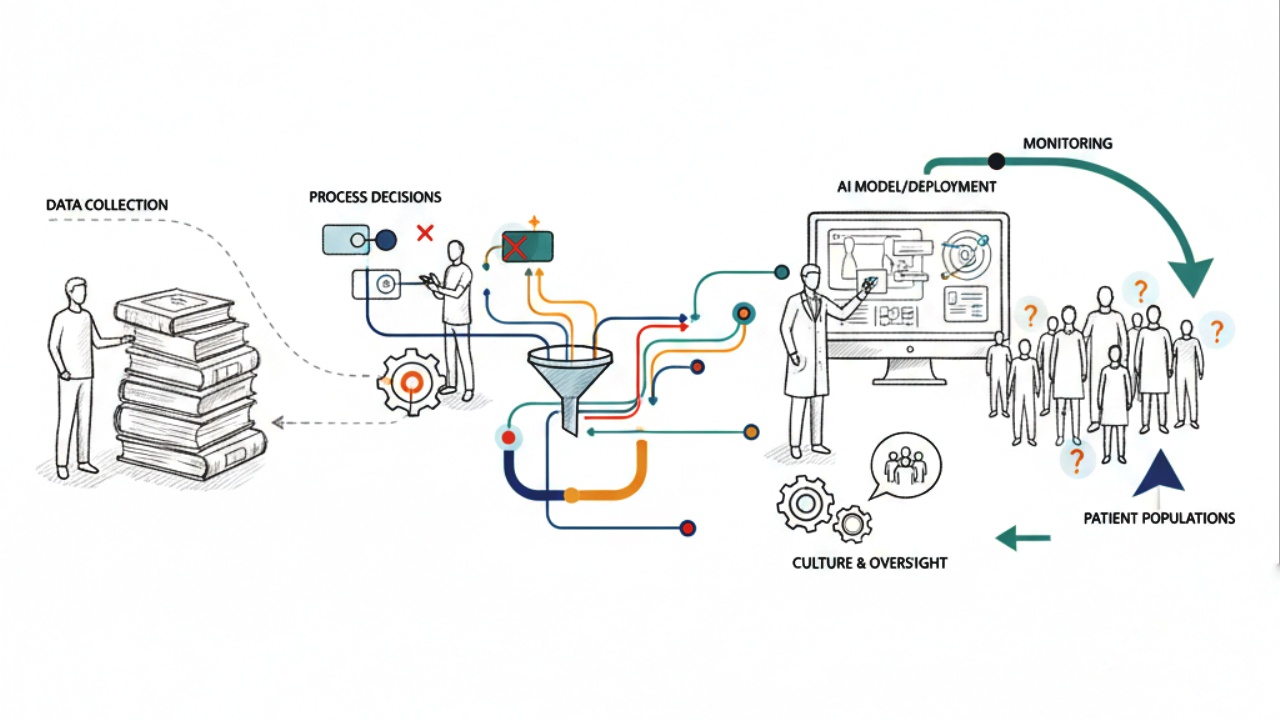
People often view artificial intelligence as a perfectly fair judge. However, the results it produces can quietly reflect the same unfairness found in our society. This issue becomes clear when we examine AI bias in healthcare systems. Here, unbalanced results carry real weight for people's lives. The important point to remember is that this bias does not simply appear from the algorithm. It is planted much earlier, long before anyone trains a model. Recognizing where bias enters the development stages is the first step toward creating reliable and equitable AI solutions.
Bias often takes root at the very beginning, when we gather data. The information we collect, including historical medical records, patient surveys, and clinical trial results, can reflect long-standing systemic inequalities. Sometimes, entire groups of people are not fully represented in these records.
This lack of balance quietly guides the AI’s learning. Imagine training a model primarily with information from a single community. Its predictions for people from other backgrounds may become unreliable. This example illustrates why any team providing healthcare AI services must analyze the composition of their data thoroughly before proceeding.

Bias is also shaped by the choices made as an AI system is built. The selection of certain data features, the exclusion of others, or the emphasis on specific performance goals steers how the model learns. Choices about which patient groups to focus on or which health outcomes to track form a core part of any AI strategy consulting process. These decisions hold significant power in determining the system's fairness and dependability. Understanding this development phase means that an AI implementation partner can build systems that are not only precise but also just.
After an AI solution goes live, continuous oversight is non-negotiable. Real-world patient populations can differ significantly from the data used for training, creating new disparities. Tracking performance across patient groups helps find problems early. Frameworks such as an AI maturity model and an AI readiness assessment provide a structured method to examine ongoing bias risks, enabling prompt corrective actions.
Beyond technical steps, organizational culture and governance play a major role in either preventing or permitting bias. Teams that prioritize diverse viewpoints and establish clear feedback processes while preparing a custom. Involving experts from multiple disciplines gives confidence that the outputs from an AI system meet both ethical guidelines and practical needs across healthcare operations.
Beyond technical steps, organizational culture and oversight serve as critical components of the process. Teams that bring together diverse perspectives and maintain clear feedback channels position themselves to recognize sources of bias much earlier. A structured approach with an AI implementation partner, supported by resources like a custom AI strategy report or an AI readiness assessment, can methodically reveal biases hidden within the process itself.
Labeling datasets involves human judgment, which is always subjective. The people who annotate data classify patient symptoms, treatment responses, or health outcomes based on their own prior experience, personal assumptions, or cultural norms. These early judgments form a foundation that shapes each subsequent stage of the AI process. When human bias enters the labeling stage, the predictions from the AI can reflect those same biases, creating disparities that seem deeply ingrained in the system. This becomes especially clear in sensitive AI use cases, where the resulting decisions directly shape patient care and treatment pathways.
After deployment, a focus limited to the model overlooks where bias truly begins. The process itself requires continuous evaluation. This means regularly updating data, reviewing how information is labeled, and checking the workflows that surround the technology. Using structured frameworks, such as an AI maturity model, or creating a clear AI adoption roadmap, makes corrections at the process level possible before issues become embedded in the system's outputs. This continued attention is necessary to reduce AI bias in healthcare systems and preserve fair, accurate results.
Every step that happens before a model is built forms the true origin of bias. This includes data collection, how information is labeled, which features are selected, and the strategic choices that guide development. Models do not invent unfair results on their own. They echo the assumptions and decisions already built into the process. Addressing bias requires a view of the entire AI lifecycle, with a focus on process integrity rather than just changing algorithms. When organizations redesign and audit their process, they hold the ability to meaningfully reduce gaps in the outcomes their AI produces.
Bias within AI bias in healthcare systems finds its source not in the model, but in the process people create. Identifying and addressing this bias during stages like data collection, labeling, and system design is what leads to fair and trustworthy results. Integrating reliable AI solutions with structured planning, as outlined in a clear AI adoption roadmap, and consistent monitoring frameworks can stop bias from becoming established.
For guidance on evaluating and improving these processes to build ethical and reliable systems, contact us today.
AI bias in healthcare systems originates in the process, data collection, labeling, and system design, not in the model itself.
Healthcare AI services can ensure fair outcomes by auditing data, reviewing AI use cases, and applying structured processes throughout.
An AI implementation partner helps integrate AI Solutions while monitoring workflows and labeling practices to minimize bias in healthcare systems.
A custom AI strategy report identifies gaps in data, processes, and oversight, providing actionable guidance to reduce AI bias in healthcare systems.
Regular updates, workflow reviews, and adherence to an AI adoption roadmap ensure ongoing oversight and reduce bias during deployment.
How to build HIPAA-compliant AI: when LLM providers need a BAA, data minimization, de-identification, audit controls and a reference architecture.

Practical data migration planning guide for healthcare teams. Scope, mapping, compliance, validation, cutover and rollback decisions explained end to end.

Smart on FHIR guide for healthtech engineers. Learn the OAuth 2.0 launch model, scope syntax, backend services, and US regulatory requirements.
Connect with our team to explore how AI expertise can transform your business.