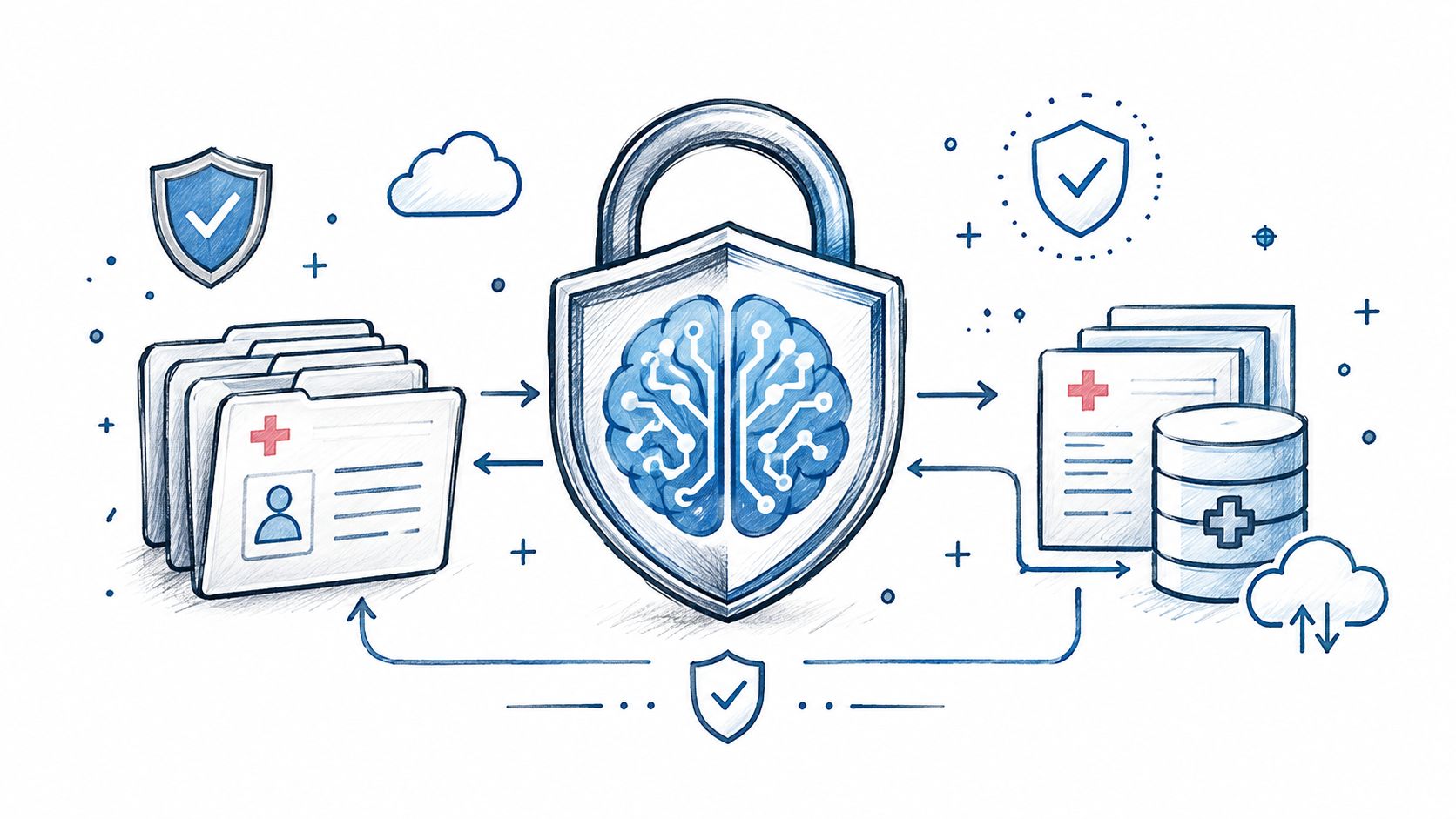
AI in Healthcare
HIPAA-Compliant AI: How to Use LLMs With PHI Safely
How to build HIPAA-compliant AI: when LLM providers need a BAA, data minimization, de-identification, audit controls and a reference architecture.
October 16, 2026Read more
Deploying AI in healthcare comes with challenges like data privacy, integration issues, and regulatory compliance. Learn key problems and practical solutions to ensure successful AI adoption in clinical environments.

Artificial intelligence is steadily expanding across hospitals, clinics, and diagnostic networks, offering advanced pattern recognition, faster data analysis, and insights driven by clinical data. This growth draws attention to healthcare AI challenges as organisations work toward accurate and scalable clinical intelligence systems. Healthcare systems adopt smart tools for diagnosis, patient monitoring, and predictive analytics due to higher patient volumes, more complex data, and the need for quicker clinical decisions. Yet a clear gap exists between expectations and actual deployment outcomes, with many projects facing delays, budget overruns, and workflow disruptions during early adoption. This situation leads to a deeper look at why deployment remains difficult in clinical settings.
Healthcare systems run through many connected departments like emergency care, diagnostics, pharmacy, surgery, and long-term treatment planning. Each department follows its own workflow, documentation method, and clinical focus, which creates a highly complex setting for any new technology. When AI gets introduced, it must adjust to all these variations at once while keeping patient data and clinical processes consistent. This structural complexity adds directly to healthcare AI challenges, because integration demands alignment across systems that were never built to work together in a single digital framework.
Medical decisions carry high risk since they directly affect patient safety, recovery results, and treatment accuracy. Even a small mistake in a prediction or suggestion can lead to serious clinical problems. For this reason, AI systems must achieve a very high level of accuracy and reliability before they can be used in real clinical settings. Along with precision, trust from healthcare professionals is essential, as they depend on AI outputs during sensitive decisions. Strict rules for data privacy and regulatory standards add another layer of difficulty. These combined demands explain why AI deployment issues that healthcare teams face are deeply tied to accuracy, trust, and regulatory alignment, not just the technology itself.
Medical data lives in many forms, such as scanned reports, lab records, image files, and handwritten notes. This scattered layout makes it hard to interpret data uniformly or train models effectively. Hospitals often run separate data systems across different departments, which leads to broken information flow. Gaps in standardisation reduce consistency across datasets.
A sound strategy calls for structured data pipelines, uniform formats, and interoperable systems that link clinical sources across departments. A healthtech engineering partner plays a central role in building structured data frameworks that lower fragmentation and improve data quality for AI systems.

Healthcare data holds highly sensitive personal details, clinical histories, diagnostic reports, and treatment records. Protecting this information remains a top priority across all digital healthcare systems. At the same time, AI systems depend on large datasets to learn patterns and produce accurate results. This creates a constant tension between safeguarding patient privacy and driving innovation, which stands as one of the key healthcare AI challenges faced during deployment. Many healthcare AI services now focus on building privacy-preserving models that balance data access with strong protection measures.
Health records carry very personal information such as medical conditions, prescriptions, and past treatments. Even a small leak of this data can harm patient trust and breach confidentiality. Due to this sensitivity, strict access controls and secure storage systems are needed at every stage of AI development and use.
Healthcare organisations must follow strict rules that define how patient data can be gathered, stored, and handled. These regulations differ by region and need ongoing attention to avoid violations. Compliance adds layers of complexity to AI implementation because every system must meet legal standards before going live.
Concerns about unauthorised access or improper use of medical data create hesitation among patients and healthcare providers. This fear slows down data sharing, which directly affects AI model training and how well the system performs. Strong governance structures, secure encryption methods, and controlled data access help lower these risks and build greater confidence in AI systems. Many SaMD solutions are now designed with built-in privacy controls and data governance features to address these concerns directly.
Clinical decision systems need very high accuracy, because even small errors can change treatment paths. Model bias and limited training data reduce how reliably the system predicts outcomes. Real clinical settings introduce unexpected variations that differ from training conditions. This gap affects how well the system performs once deployed.
Ongoing model refinement, clinical validation cycles, and human review frameworks help lower these risks. AI deployment issues in healthcare often occur when validation steps remain unfinished before the system goes live. A well-structured custom AI strategy report can help organisations plan validation phases and set clear accuracy benchmarks before full deployment.
Healthcare organisations still depend on older systems built long before modern AI technologies existed. These systems often struggle to connect with advanced AI platforms, which creates gaps in how data moves and how systems communicate with each other. As a result, bringing AI into daily clinical work becomes slow and technically difficult, adding to healthcare AI challenges across hospitals and care networks.
Older hospital software was designed for record keeping and basic tasks, not for smart data processing. They lack the flexibility needed to support machine learning models and real-time analysis, which limits AI adoption in clinical settings.
Electronic Health Records and Electronic Medical Records often run in separate systems that do not share data smoothly with AI tools. This lack of interoperability reduces data access and affects how well AI-driven insights perform.
Bringing AI into existing clinical workflows can cause operational changes that require healthcare staff to adjust. Worries about process disruption often slow down adoption until systems are properly aligned with daily clinical routines.
Healthcare professionals often react with caution when AI systems enter clinical settings. This response stems from concerns about changing workflows, shifting responsibilities, and how reliable automated suggestions really are. Such resistance is one of the common AI deployment issues that healthcare organisations face during early adoption phases. Building trust becomes essential for successful adoption because clinicians depend on accurate and explainable outputs when making patient care decisions.
Many healthcare workers worry that AI may reduce the need for human involvement in clinical roles. This concern creates hesitation during early adoption stages, even when AI is designed to assist rather than replace medical professionals.
Clinicians depend on proven medical judgment, so they may question AI-generated suggestions if the system logic is unclear. Limited transparency in decision-making reduces confidence in using AI outputs during critical care situations.
Introducing AI systems requires healthcare staff to adapt to new interfaces and workflows. In high-pressure environments, learning new tools takes time and structured guidance, which can delay smooth adoption.
Adopting AI in healthcare demands careful financial planning because of system setup, upgrades, and ongoing maintenance needs. Many hospitals review costs thoroughly before committing to large-scale implementation.
High implementation and maintenance costs: AI systems require advanced software installation and regular updates, which drive up total spending.
Infrastructure and training expenses: Hospitals invest in upgraded systems and staff training before AI tools can be used effectively.
ROI uncertainty for hospitals: Clear financial returns take time to appear, which causes hesitation in early adoption decisions.
Healthcare innovation moves quickly, but regulatory reviews follow structured and detailed evaluation steps. Approval rules differ across regions, which adds complexity for global or multi-location deployment plans. Regulatory AI healthcare frameworks shape system design from early stages by aligning clinical safety, documentation standards, and approval readiness.
Successful adoption requires alignment between clinical knowledge, data systems, and technology design. Small-scale pilot projects provide practical learning before large expansion. Ongoing monitoring of model performance, clinical feedback, and workflow integration creates steady improvement cycles.
AI integration problems often occur when clinical systems and AI platforms are not properly aligned during deployment. These issues become less frequent when early planning includes system compatibility checks, clear data flow design, and close coordination between technical teams and healthcare professionals.
Healthcare systems continue to adopt intelligent technologies for diagnostics, patient monitoring, and operational planning. The range of healthcare AI challenges reflects both technical and clinical difficulties that need structured solutions.
Well-balanced adoption strategies, clinical validation, and responsible system design guide successful implementation across institutions. Organisations gain clarity through careful planning, data alignment, and regulatory readiness. Contact us for guidance on structured AI adoption strategies and implementation planning.
The key healthcare AI challenges include data fragmentation, lack of interoperability, and strict clinical validation needs. A healthtech engineering partner helps reduce these AI deployment issues in healthcare by improving system design and planning.
Regulatory AI healthcare rules slow down deployment due to safety, privacy, and approval checks. Strong healthcare AI services ensure compliance and reduce legal and operational risks.
AI integration problems happen due to legacy systems, poor interoperability, and disconnected workflows. Using SaMD solutions helps connect systems smoothly and reduce integration gaps.
A clear custom AI strategy report helps identify risks and plan a structured rollout. With expert healthtech engineering partner support, organizations can reduce AI deployment issues in healthcare effectively.
Healthcare AI services improve data flow, accuracy, and system performance. They address healthcare AI challenges by enabling scalable solutions and reducing AI integration problems across clinical systems.
How to build HIPAA-compliant AI: when LLM providers need a BAA, data minimization, de-identification, audit controls and a reference architecture.

Practical data migration planning guide for healthcare teams. Scope, mapping, compliance, validation, cutover and rollback decisions explained end to end.

Smart on FHIR guide for healthtech engineers. Learn the OAuth 2.0 launch model, scope syntax, backend services, and US regulatory requirements.
Connect with our team to explore how AI expertise can transform your business.