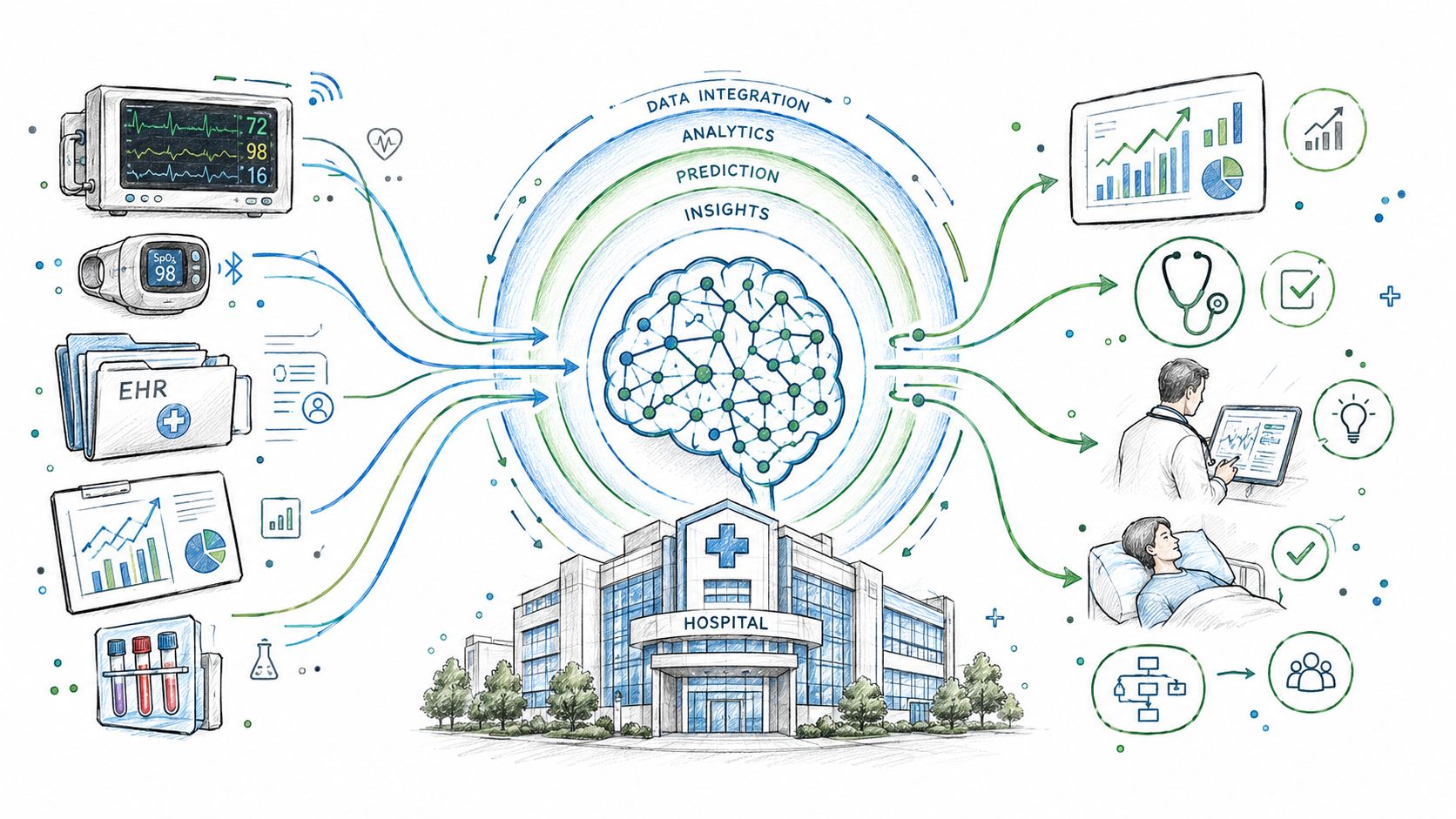
AI in Healthcare
AI Healthcare Analytics Explained: A Practical Guide
Learn what AI healthcare analytics is, how it creates business value, and what it takes to implement it across EHR systems, compliance, and ROI.
September 16, 2026Read more
Learn how deep learning in healthcare powers imaging, EHR and SaMD solutions, from model types to deployment, compliance and ROI for leaders.

A radiologist opens a scan, a bedside team waits on rounds, and an operations lead is still trying to figure out why yesterday's alerts landed too late. Deep learning in healthcare matters in that gap between signal and action, where a model can help spot patterns in images, vitals, or notes before a human can manually cross-check everything. The hard part isn't just whether the model looks smart in a benchmark, it's whether it fits the clinical workflow, clears the compliance path, and stays reliable after it leaves the lab.
For business and technical leaders, that shift changes the question from “Can AI do this?” to “Where does it create durable value without creating new risk?” The best use cases usually combine clear data, a narrow decision point, and a workflow where faster or more consistent decisions matter. That's the lens Ekipa AI uses as a healthtech engineering partner, from use case definition to deployment, especially when teams need help separating promising ideas from expensive distractions.
The clearest opportunities often sit inside imaging, predictive risk, documentation, and decision support, but every one of those paths has trade-offs. A model can be technically strong and still fail if it doesn't connect cleanly to the EHR, if governance is missing, or if the clinical team doesn't trust the output. For teams exploring Healthcare AI Services or checking real-world use cases, the useful starting point is not the model family, it's the workflow.
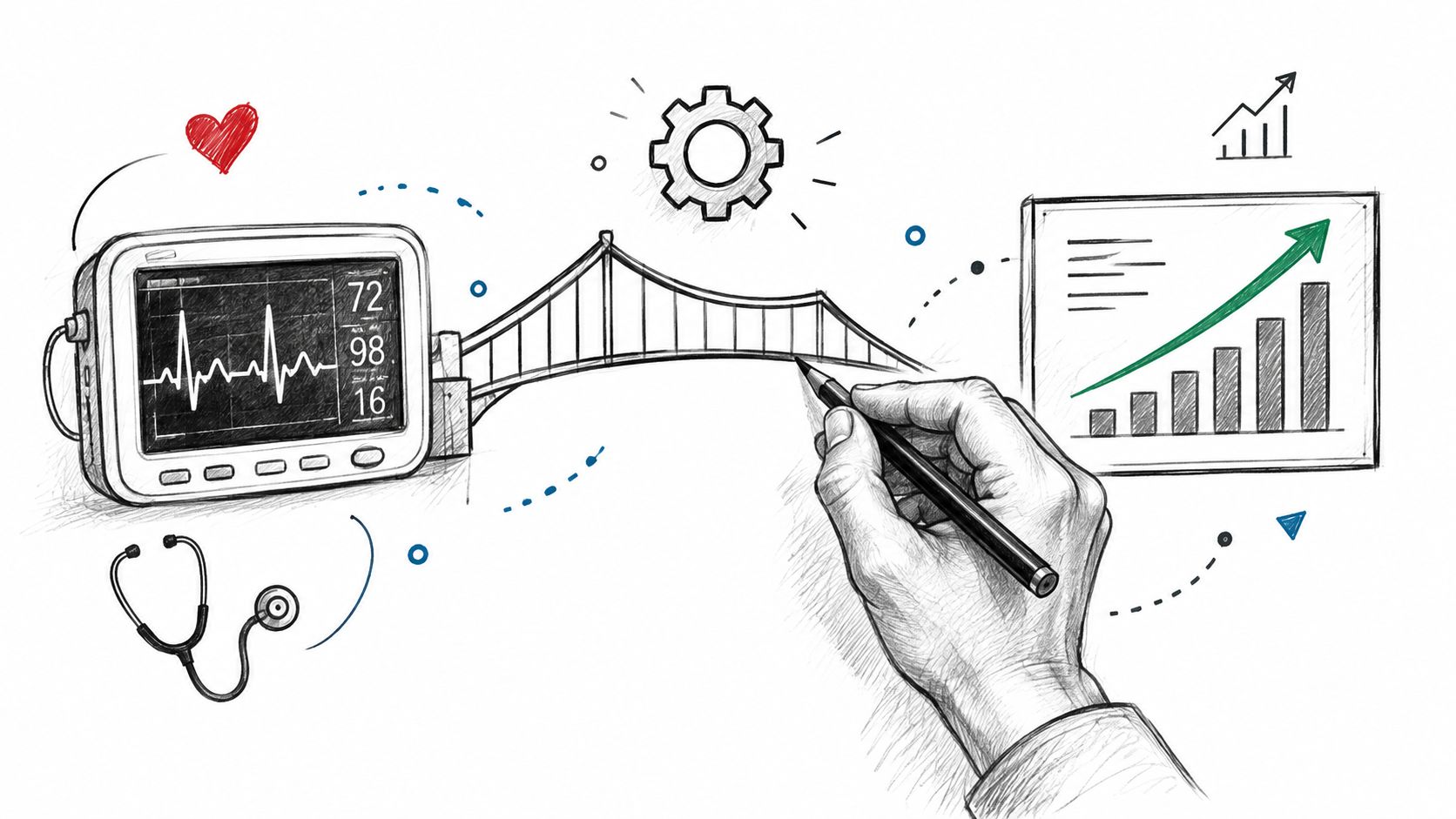
A hospital doesn't feel like a lab. It feels like a chain of small, urgent decisions, a scan to read, a note to reconcile, a risk to flag, a discharge to approve. Deep learning in healthcare earns attention when it helps those decisions happen faster or more consistently without forcing staff to leave the tools they already use.
That's why leaders should think about it as a product and workflow problem first, not a model shopping exercise. A strong imaging model that never reaches the reading workflow is just a demo, while a modest model that lands inside the right EHR screen can change daily operations. The difference is implementation, not hype.
Practical rule: if the output doesn't change a real decision, it's not a healthcare product yet.
The opportunity is real, but so is the evidence standard. A 2019 systematic review and meta-analysis of 69 studies found pooled sensitivity of 87.0% and pooled specificity of 92.5% for deep learning models in medical imaging, compared with 86.4% sensitivity and 90.5% specificity for health-care professionals in the same subset of 14 head-to-head studies. The same review also showed very wide performance ranges across the broader evidence base, with sensitivity from 9.7% to 100.0% and specificity from 38.9% to 100.0%, which is a strong reminder that validation and deployment context matter as much as headline scores. That turning point is captured in the review itself, which frames carefully selected and externally validated models as clinically credible decision support (The Lancet Digital Health review30123-2/fulltext)).
By 2021, the research base had grown to 279 studies, with especially strong results in ophthalmology, respiratory imaging, and breast imaging, while still warning that heterogeneity and method variation can overstate practical utility (Nature review). For leaders, that means the field is mature enough to plan around, but not mature enough to trust blindly.
If your team is mapping where to start, the best first pass is usually to define the decision, the data source, and the integration point before anyone debates architectures. That's also where a Custom AI Strategy report or AI strategy consulting conversation helps, because the bottleneck is usually not the model, it's the handoff into care delivery. For a broader view of how teams move from interest to execution, the framing in our AI adoption guide aligns with this same product-first logic.
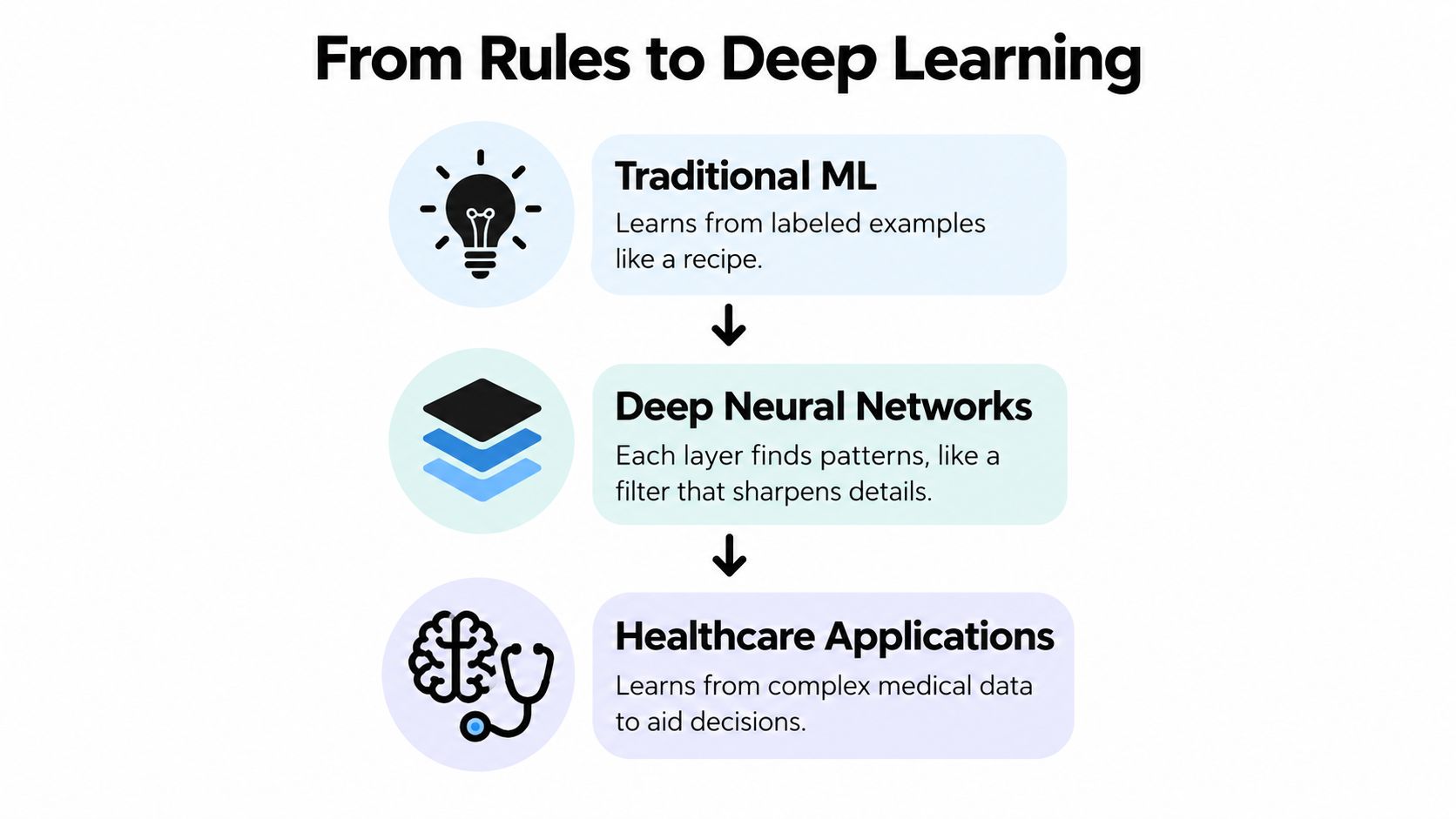
Traditional machine learning usually starts with human-made features. Deep learning starts with raw data and learns its own internal hierarchy, which is why it works so well on images, waveforms, and clinical text. Think of it less like a spreadsheet model and more like a stack of filters, each layer sharpening a different part of the signal.
A rules-based system says, “If X and Y happen, then raise the flag.” A traditional model may learn from labeled examples, but still depends on hand-picked inputs. A deep network can look at the whole pattern, then learn which details matter at each level, from edges and textures in images to rhythm changes in time-series data.
That's useful in healthcare because clinical data is messy in exactly the ways deep learning handles well. Scans have subtle visual cues, notes contain context, and ICU data changes minute by minute. These are not problems that fit clean yes-or-no rules very well.
Deep learning is strongest when the input is complex, the pattern is subtle, and the outcome depends on combining many small clues.
This is also why data volume and label quality matter so much. If the examples are inconsistent, the model learns inconsistency. If the labels reflect local practice rather than a durable clinical standard, the model may look accurate in one hospital and fail in another. That's why leaders should treat training data as a product asset, not just a technical input.
A useful distinction for non-technical teams is this. Traditional ML helps when the problem is narrow and the features are already known. Deep learning helps when the useful features are hidden inside the data itself, which is often the case in radiology, pathology, ophthalmology, and sequence-heavy monitoring.
For product teams comparing options, AI tools for business can help frame the broader automation context, while our expert team can pressure-test whether a problem belongs in a rules engine, a traditional model, or a deep network. If you've been following the topics in our AI adoption guide, the common thread is simple, use the smallest model that can solve the problem reliably enough for the workflow.
The model family should follow the data shape, not the other way around. When a team starts with architecture instead of the problem, they often end up with an elegant system that's awkward to use. A cleaner approach is to match the model to the kind of evidence clinicians already trust.
| Model Family | Best For | Healthcare Example | Key Limitation |
|---|---|---|---|
| CNNs | Images and spatial patterns | Radiology, pathology, retinal imaging | Need strong image labeling and local validation |
| RNNs and transformers | Time-series, notes, and sequence data | ICU vitals, clinical text, longitudinal risk scoring | Can be harder to govern and explain |
| Autoencoders and generative approaches | Anomaly detection, compression, synthesis | Outlier detection, synthetic augmentation, data completion | Risk of bias amplification or unrealistic outputs |
CNNs are usually the first stop for image-heavy use cases because they're built to pick up spatial patterns. That matters in radiology and pathology, where tiny visual differences can change the clinical interpretation. These models shine when the question is, “Does this scan contain a pattern we've seen before?”
RNNs and transformers fit better when time and context matter. ICU signals, narrative notes, and multi-visit records aren't static. They're sequences, and sequence-aware models can learn how earlier changes affect later risk. That's why these architectures often show up in monitoring and clinical text work.
Autoencoders and generative models sit in a different bucket. They're useful when the system needs to spot something unusual, compress complex inputs, or create synthetic examples for testing. They can be powerful, but they also deserve more scrutiny because synthetic content can carry hidden bias or distort anatomy if governance is weak.
For teams that need to connect architecture to delivery, SaMD solutions and AI Product Development Workflow are where the technical choice becomes operational. If the model is going to support a regulated clinical function, start the AI requirements analysis early, before the team commits to a path that's expensive to unwind later.
The strongest healthcare AI use cases usually sit where pattern recognition is repetitive, expensive, or time-sensitive. Imaging gets the most attention because the signal is visual and the outputs are easy to test, but the value often appears when the model output changes who gets reviewed first, what gets escalated, or which tasks are automated.
A benchmark on the MIMIC-III ICU dataset found that deep learning models outperformed traditional clinical predictors across mortality prediction, length-of-stay estimation, and ICD-9 code grouping, with the strongest gains when models used raw multivariate time-series instead of hand-crafted features (MIMIC-III benchmark). That matters because raw sequences can preserve deterioration patterns that summary scores miss, which is one reason ICU risk models keep showing up in operational discussions.
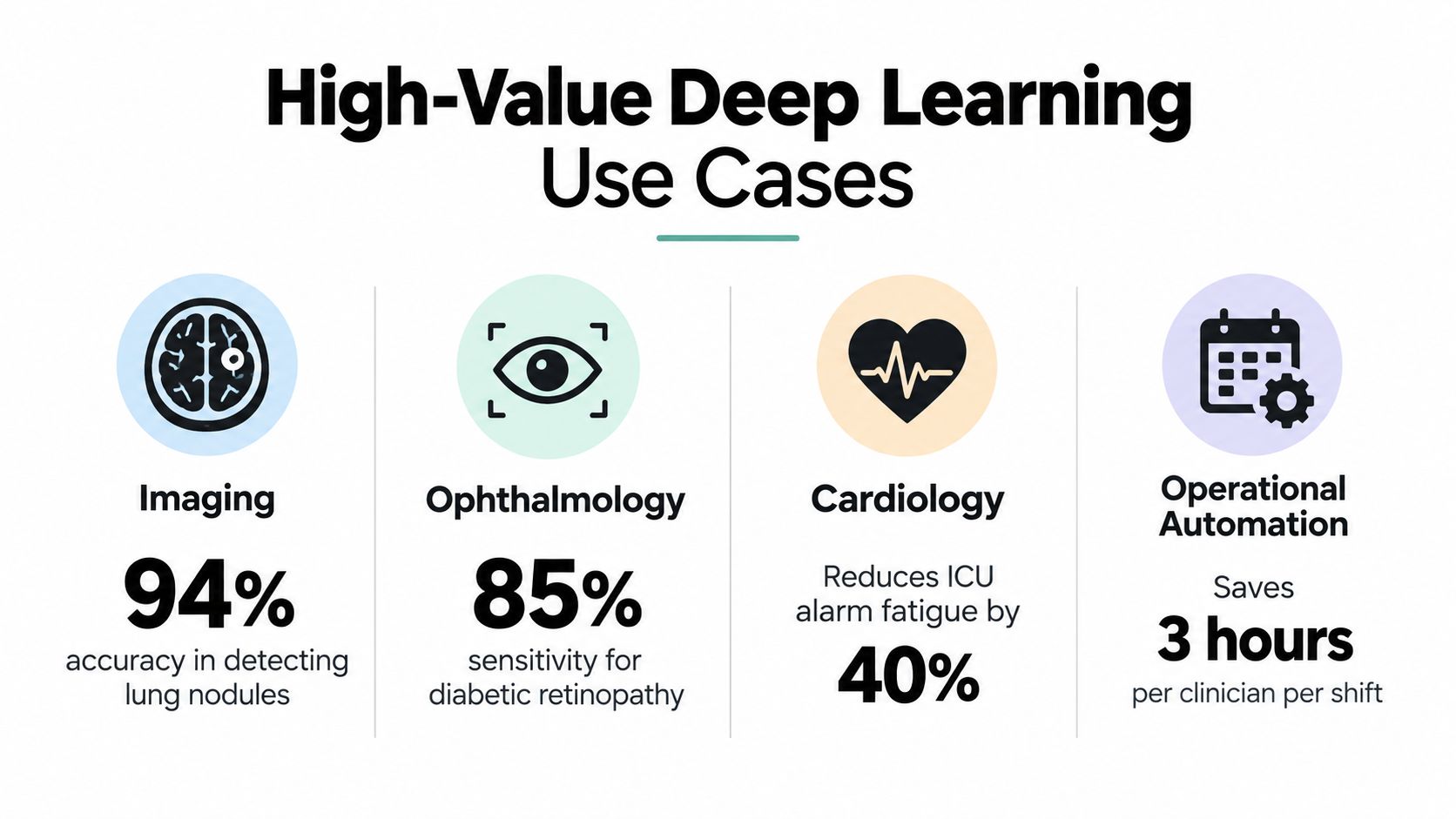
The common mistake is to pick a use case because it sounds advanced. The better filter is whether the data is available, the workflow is clear, and the intervention point is measurable. If the answer to any of those is fuzzy, ROI will be hard to prove even if the model performs well in isolation.
Teams building toward AI Automation as a Service or internal tooling should think in terms of task replacement or task augmentation, not just accuracy. And when the work extends into systems and interfaces, custom healthcare software development can matter as much as the model itself. For a deeper list of problem patterns, the real-world use cases page is a practical place to compare fit before committing engineering time.
A model can't save a messy pipeline. If the data isn't reliable, joined correctly, and available where clinicians work, the deployment will feel disconnected no matter how good the underlying network is. That's why data design comes before training, and why EHR integration is part of the product, not a later add-on.
For temporal problems like ICU deterioration, raw multivariate time-series can outperform hand-crafted summaries, because the model sees the sequence of changes instead of just the final averages (MIMIC-III benchmark). That doesn't mean every problem needs raw feeds, but it does mean teams should think carefully before flattening everything into a spreadsheet. The signal you remove during feature engineering is often the signal clinicians care about most.
A practical pipeline usually starts with three layers. First, sourcing and labeling the data. Second, moving it through FHIR and HL7 integration paths so the model can receive and return useful outputs. Third, embedding the result inside the clinical workflow so alerts, summaries, or extracted fields appear where people already work.
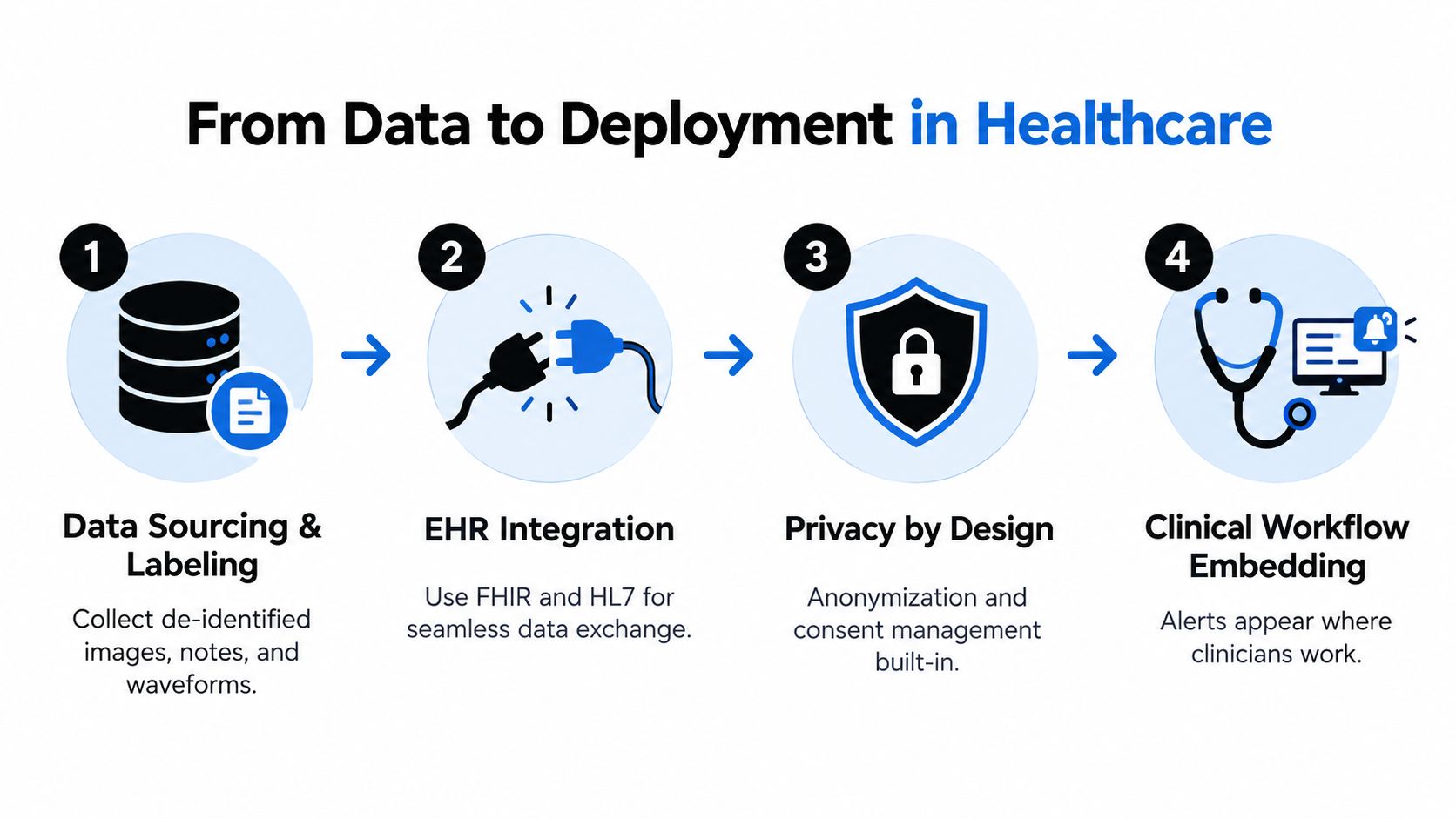
Privacy by design has to sit inside that same pipeline. De-identification, access control, consent handling, and auditability aren't legal decorations, they're engineering constraints. If the team can't explain what data is stored, who can see it, and how outputs are logged, the system isn't ready for clinical use.
Engineering rule: if the data path isn't documented end to end, the model isn't production-ready.
For operating teams, a good companion resource is the healthcare data analytics guide, because the analytics layer and the AI layer often fail for the same reason, weak data stewardship. When leaders need a structured plan for governance and pipeline design, AI strategy consulting and a regulatory compliance partner can help align the technical architecture with privacy and medical-device expectations.
If you're building extraction or normalization into that flow, Ekipa AI's AI-powered data extraction engine is one example of how unstructured records can be turned into structured inputs before the modeling work begins.
A model that looks good in testing can still fail in the ward. That's why validation has to go beyond a single accuracy number and include external testing, workflow fit, auditability, and error behavior after launch. The question is not whether the model works once, it's whether it keeps working under clinical pressure.
The evidence base points to the same caution. A 2026 Frontiers review says supervised deep learning can be clinically useful on narrow imaging tasks only after local validation, and that synthetic-data approaches may amplify hidden bias or produce anatomically incorrect images. It also says LLM-based clinical decision support is not supported for routine autonomous use and must remain under strict human supervision (Frontiers review). That's a clear signal for buyers and operators, human-in-the-loop design isn't optional in clinician-facing systems.
A 2026 review on real-world deployment found that adoption and appropriateness were the most frequently evaluated outcomes, while implementation cost was assessed in only one study and sustainability in none (real-world implementation review). That gap matters because a model that is clinically interesting but financially and operationally fragile won't survive procurement.
Explainability is no longer a side note either. A 2026 systematic review synthesized evidence from 70 peer-reviewed studies published between 2017 and 2025, which shows the field has moved well past the “just trust the model” era (FDA explainable AI page). For regulated projects, the AI Product Development Workflow should include governance checkpoints from the start, not just a final test gate.
If the model is heading toward a regulated clinical function, the SaMD solutions path should be considered early. That keeps the team focused on evidence, labeling, version control, and post-market monitoring before the system creates avoidable risk.
A regional hospital group may start with a narrow retinal screening pilot in two clinics, then validate the model on a third site's data before wider rollout. That kind of sequence works because it tests the full path, from image capture to referral, instead of treating deep learning as a lab exercise. If the workflow still forces staff to switch systems or chase unclear outputs, the pilot has exposed a product gap, not just a model gap.
The strongest implementations usually follow the same rhythm, discover the use case, define the data and workflow, pilot in a narrow setting, validate externally, then scale only after the operational story is solid. A team that tries to cover everything at once often ends up with a pilot that never leaves the lab. A narrower scope makes it easier to prove value and spot integration issues early.
That roadmap should begin with AI requirements analysis. Decide whether the use case belongs in imaging, extraction, prediction, or automation, then map the regulatory path before engineering starts. From there, a small pilot can show whether the model improves a real handoff, reduces manual work, or helps staff prioritize cases more clearly.
A practical ROI lens combines time saved, risk reduced, and workflow consistency improved. The endpoint should be defined in operational terms, not technical ones. If clinicians still need to leave their core system to use the model, the product design is not finished.
For teams comparing build options, Healthcare AI Services, AI Product Development Workflow, and our expert team can help move from concept to pilot without skipping governance. If the work includes compliance-heavy productization, a regulatory compliance partner keeps the implementation grounded.
FAQ
How do I know whether deep learning is the right fit?
If the data is complex, the pattern is subtle, and the decision repeats often, it is a strong candidate. If the workflow is unstable or the labels are weak, start with data cleanup and process cleanup first.
What's the biggest implementation mistake?
Treating model accuracy as the finish line. In healthcare, the finish line is a safe, trusted workflow with monitoring and clear accountability.
Should we build or buy?
Buy when the workflow is standard, such as off-the-shelf diabetic retinopathy screening. Build when your EHR integration, governance, and clinical workflow are custom enough that a vendor product would need heavy rework.
If you want to compare strategy, implementation, and compliance paths for a healthcare AI initiative, start with the Ekipa AI team. They work on use case definition, EHR integration, clinical software, AI adoption, and compliance engineering, which is where most deep learning projects either succeed or stall.
Learn what AI healthcare analytics is, how it creates business value, and what it takes to implement it across EHR systems, compliance, and ROI.

Learn how predictive AI in healthcare works, where it delivers value, and how to deploy it safely inside real clinical workflows with a clear roadmap.

Explore machine learning healthcare applications from diagnosis to operations, with ROI, architecture, EHR integration and compliance roadmap for leaders.
Connect with our team to explore how AI expertise can transform your business.