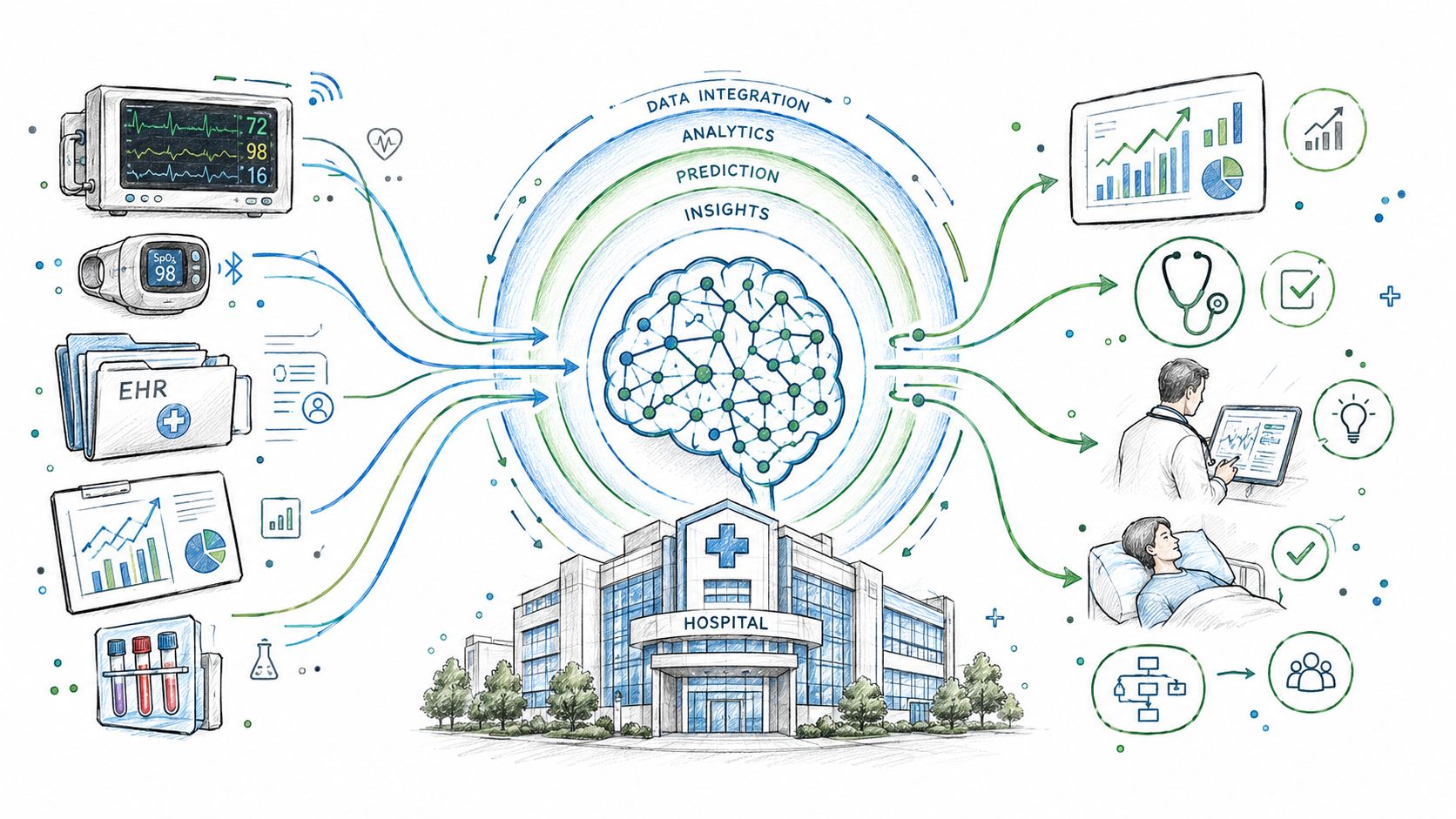
You're probably living in the gap between a promising AI pilot and the moment clinicians will trust it. The dashboard looks clean, the demo went well, and the next step is supposed to be deployment, but the real work starts when the model has to live inside the EHR, survive governance review, and fit a workflow that already runs hot.
AI Healthcare Analytics is the discipline of turning fragmented clinical, operational, and financial data into models that are validated, governable, and tied to a real workflow change. The market backdrop helps explain why this matters now, the OECD notes the worldwide AI health care market was USD 11 billion in 2020 and is projected to grow 16x by 2030, while another estimate places AI in healthcare at USD 36.67 billion in 2025 with a forecast of USD 505.59 billion by 2033 at a 38.90% CAGR from 2026 to 2033 (OECD report). That scale is why analytics programs are moving from experimentation to procurement strategy, especially in North America, which held more than 54% of the market in one estimate (OECD report).
For healthtech leaders, the hard lesson is that a good proof-of-concept is not the same as a deployable system. If the model can't be validated on your population, embedded into your EHR, and monitored after launch, it stays a science project. That's why teams who want to handle AI change well in healthcare IT usually focus on integration discipline first, not model novelty.
A practical healthtech engineering partner such as Healthcare AI Services can help turn that gap into an implementation plan, but only if the work starts with data reality, not vendor promises.
Why AI Healthcare Analytics Matters to Your Business
A healthtech director usually feels the pressure in a familiar way. A sepsis model looks strong in a notebook, the pilot gets applause, then the rollout slows because nurses don't trust the alerts, the data team can't reconcile feeds, and compliance wants a second review. The problem isn't that AI failed, it's that the organization tried to buy insight without building the operating conditions for it.
At business level, AI Healthcare Analytics is about measurable workflow change, not abstract intelligence. It pulls together clinical notes, claims, device data, and operational signals, then turns them into decisions that affect readmissions, denials, documentation burden, and capacity planning. That matters because AI adoption is already broad, 85% of healthcare organizations had adopted or were exploring AI by the end of 2024, up from 72% at the start of that year, but only 18% were ready to deploy AI in care delivery (Knowi summary).
Why pilots stall
Disconnected pilots often optimize for one metric in a narrow environment. They look good on a retrospective dataset, then stumble when the EHR data are messy, the patient mix changes, or the team has to explain every decision to clinicians and auditors. That is why the organizations that move past pilots tend to treat analytics as part of the clinical operating model, not as a bolt-on dashboard.
Practical rule: if a model cannot survive governance, integration, and workflow review, it is not ready for clinical use.
The business case has shifted because healthcare now needs systems that can absorb large volumes of unstructured data and reduce the burden on scarce staff. A useful way to think about it is simple, the organization pays for analytics once in software and repeatedly in trust, integration, and maintenance. The teams that win are the ones that budget for all three.
As we explored in our AI adoption guide, the hardest part is rarely interest, it's turning interest into a repeatable deployment pattern. That's why custom healthcare software development often has to sit alongside analytics work when the goal is to change how care teams operate.
How AI Healthcare Analytics Works Under the Hood
Think of the stack like a hospital operations pipeline. Signals start at the bedside, pass through identity and terminology layers, get scored by models, then surface back into a place where a clinician can act without leaving their workflow. If any layer breaks, the model may still look accurate in a lab but fail in production.
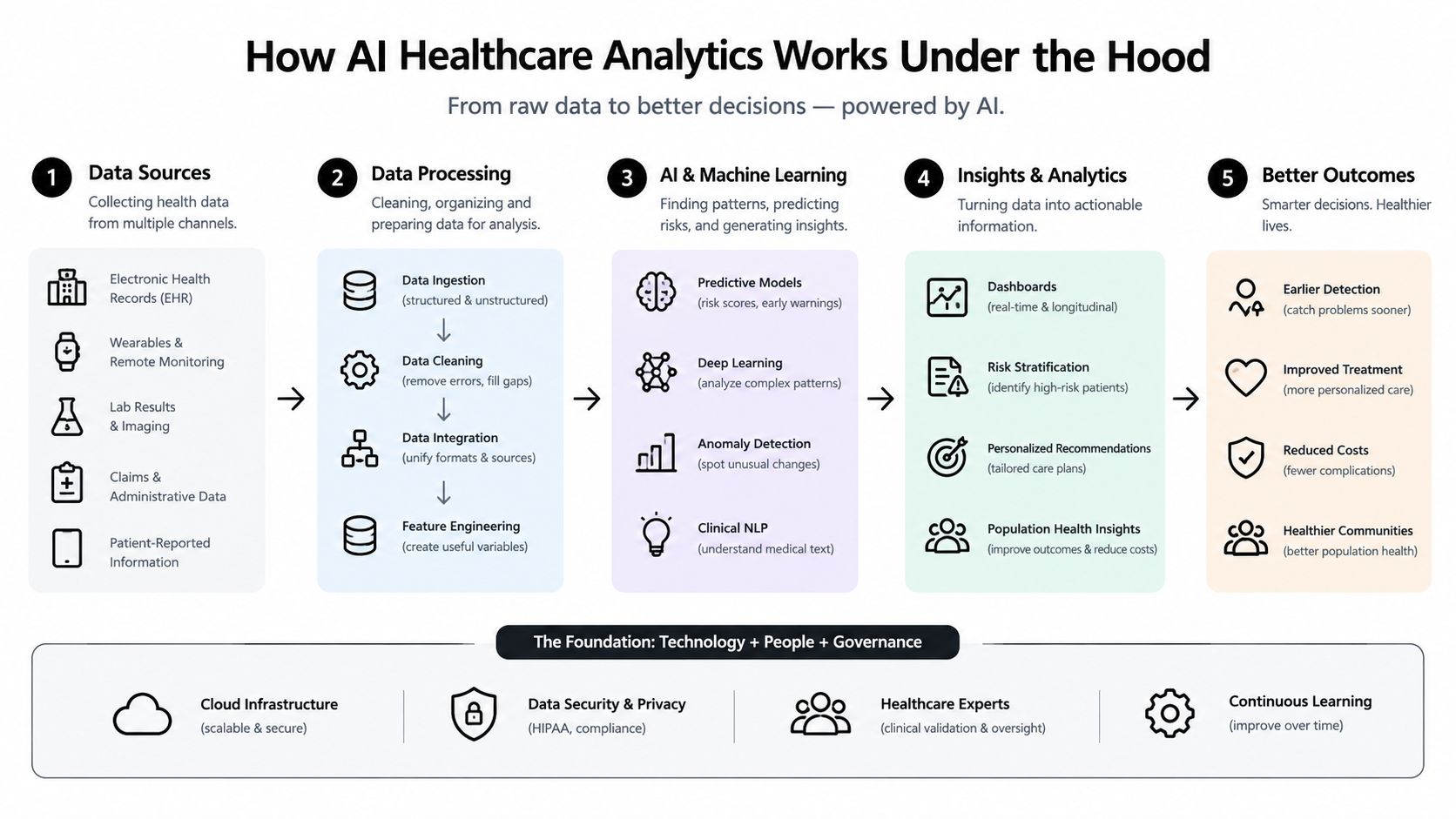
The pipeline from raw data to decision
The first layer is ingestion. Hospitals and payers move data through HL7 feeds, FHIR resources, claims files, device streams, and free-text notes. The second layer is harmonization, where terminology mapping and identity resolution make sure the analytics layer sees one patient, one encounter, and one record lineage instead of a pile of duplicates.
Data quality is not a cleanup task at the end. It's the condition that determines whether the model can be trusted at all.
The modeling tier is where descriptive, predictive, and prescriptive analytics diverge. Classical machine learning is often enough for tabular risk scoring, deep learning is stronger when the input includes imaging or waveform patterns, and large language models are useful when the problem is documentation, summarization, or information retrieval. The important point is that model class should follow the data and workflow, not hype.
What production readiness really means
The decision layer matters just as much as the model. Scores should appear in the EHR, order workflow, or care management queue, not in a separate tool that clinicians have to remember to open. Monitoring closes the loop, drift, fairness, latency, and outcome feedback need to run continuously so the model doesn't degrade.
A useful comparison is this, a highly accurate model with poor latency or weak auditability still fails production. That's why leaders should ask about integration path and monitoring design at the same time they ask about AUROC. The architecture has to support both technical performance and clinical accountability.
Connecting Analytics to EHR Systems and Clinical Data
Most integration friction isn't about whether the model runs, it's about how it gets inside the hospital's system of record without breaking everything around it. Epic, Cerner, and Meditech each have their own operating realities, and analytics teams usually need a layered connection strategy instead of a single “plug-in” promise.
The layers that matter
Structured data typically come through FHIR APIs, while HL7v2 still carries many of the real-time feeds that hospitals depend on. Imaging and waveform data usually need custom pipelines because not everything clinically important maps cleanly into FHIR yet. On top of that, identity resolution decides whether analytics can tie events to the right patient, encounter, provider, and location.
Here's the practical rule, if patient identity is weak, model outputs become unreliable fast. If provider mapping is weak, workflow routing breaks. If encounter timing is weak, the model may score data too late to matter.
| EHR Integration Patterns Compared |
Best For |
Latency |
Effort |
| FHIR apps |
Embedded clinician-facing tools |
Low to moderate |
Moderate |
| HL7v2 feeds |
Real-time operational ingestion |
Low |
Moderate |
| Bulk export |
Population analytics and reporting |
Higher |
Lower upfront |
| Custom pipelines |
Imaging, waveforms, legacy edge cases |
Variable |
High |
Where most projects slow down
The integration layer is usually SMART on FHIR apps for embedded UI, CDS Hooks for point-of-care recommendations, and bulk data export for population-scale analytics. But the contract and governance work can take longer than the coding. Single sign-on, identity provider setup, security review, and access scoping often decide whether the model reaches a clinician this quarter or waits in a sandbox.
That's also where AI strategy consulting becomes practical rather than abstract. Teams need help deciding what should be embedded, what should be batch processed, and what should stay outside the workflow until governance catches up.
Real Use Cases and the Metrics They Move
The best healthcare analytics programs don't chase “AI” as a category, they chase a workflow problem with a measurable endpoint. A deterioration model that never changes nurse behavior is a science exercise. A denial model that reduces rework in revenue cycle is a business asset.
Clinical, operational, and administrative examples
Clinical use cases usually start with inpatient deterioration, sepsis early warning, readmission risk, or imaging triage. These systems often rely on gradient-boosted trees for structured data or transformer-based NLP for notes, and they need validation on sensitivity, false-alert rate, and calibration before anyone trusts them in a live unit. The question is not just whether the model predicts well, it's whether it changes response time and downstream care.
Operational use cases tend to focus on ED boarding, OR throughput, bed forecasting, and ambient documentation burden. These models are judged by how they affect length of stay, cases per day, or clinician time reclaimed. Administrative analytics is different again, denial prevention, prior authorization automation, and risk-adjusted coding accuracy usually map to clean claim quality, overturn rate, and faster billing action.
A useful validation mindset is to ask whether the model holds up on the exact workflow where it will be used. That means held-out sites, not just held-out dates, and data inputs that match the actual system, claims, notes, events, or images, depending on the use case.
| Use Case |
Domain |
Primary Metrics |
Validation Evidence |
| Inpatient deterioration |
Clinical |
Sensitivity, false-alert rate |
External site testing, clinician review |
| Sepsis early warning |
Clinical |
Time to intervention, calibration |
Retrospective plus shadow-mode review |
| Readmission risk |
Clinical |
Risk stratification quality |
Held-out site validation |
| Imaging triage |
Clinical |
Priority accuracy, turnaround time |
Radiology workflow testing |
| ED boarding |
Operational |
Length of stay, queue impact |
Operations pilot with live data |
| OR throughput |
Operational |
Cases per day, schedule adherence |
Historical back-testing and pilot |
| Ambient documentation support |
Operational |
Clinician time reclaimed |
Usage review and chart audit |
| Denial prevention |
Administrative |
Clean claim rate, denial overturn rate |
Payer-rule testing and claims review |
| Prior authorization automation |
Administrative |
Cycle time, staff effort |
End-to-end workflow validation |
| Risk-adjusted coding |
Administrative |
Coding accuracy, RAF alignment |
Chart-level audit and sample replay |
For a concrete adjacent example, the logic behind LLM cost optimization examples is similar, measure the model against the actual operating cost it changes, not the demo output it produces.
Compliance, Governance, and Bias in Healthcare AI
Healthcare analytics gets risky when teams treat compliance as a document package instead of an architecture decision. A model that influences diagnosis, treatment, or prevention can fall under the FDA's device framework, and the agency says software intended to diagnose, treat, cure, mitigate, or prevent disease is regulated as a medical device, with AI/ML-based software handled through the SaMD framework (FDA discussion paper).
SaMD and change control
The regulatory question isn't only whether a model is regulated, it's also how it changes over time. The FDA's AI/ML SaMD Action Plan called out five priorities, including a predetermined change control plan, good machine learning practices, patient-centered transparency, evaluation methods, and real-world performance monitoring (FDA Action Plan). The practical implication is that learning systems need a governance path before they reach production, not after.
For product teams, a regulatory compliance partner can help map the evidence trail, but the engineering team still has to wire controls into the pipeline itself.
Bias, privacy, and auditability
Bias checks need to happen on subgroup performance, calibration across race, sex, and socioeconomic strata, and drift after deployment. A recent study reported that generative AI models may recommend different treatments for the same condition based solely on socioeconomic and demographic background, which makes fairness monitoring a live operational issue, not a theoretical one (ScienceDaily summary of the study). HIPAA adds another layer, because de-identification limits, BAA scope, and cross-entity deployment can all create gaps if teams assume one clean transfer solves everything.
Compliance-by-design works when model cards, access controls, validation gates, and audit trails are part of the release process, not separate paperwork.
A strong reference point for teams building this way is SaMD solutions, especially when the analytics product may cross into regulated software territory. Governance isn't a blocker to scaling, it's what keeps scaling from becoming a liability.
An Implementation Roadmap for Analytics Programs
Strong programs don't begin with model selection. They begin with a tightly defined problem statement, a baseline metric, and a decision owner who will use the output. If those three pieces are fuzzy, the project usually drifts into a generic AI initiative with no clear finish line.
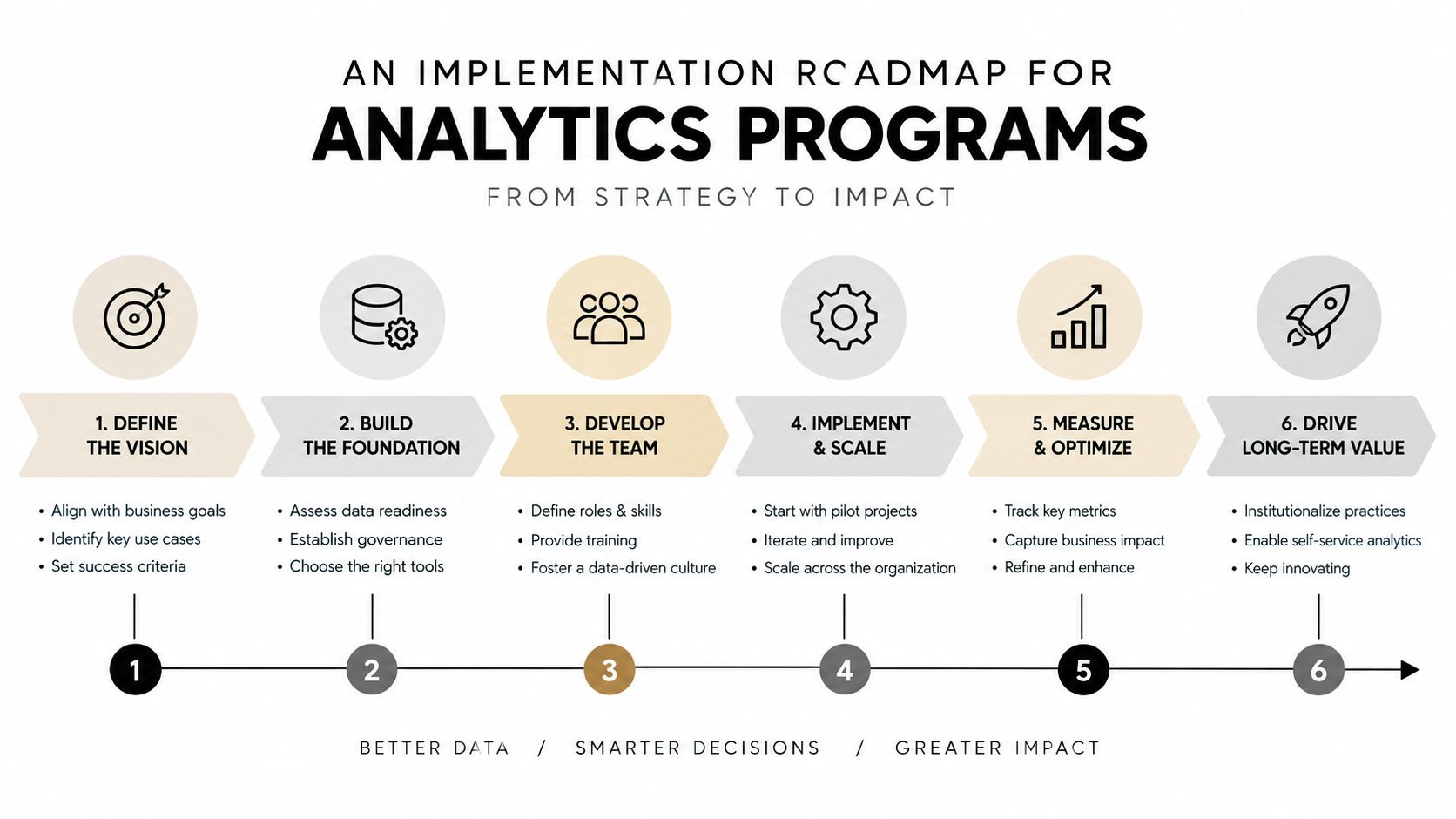
A sequence that survives contact with reality
The first phase is problem framing. Define the clinical or operational pain point in one sentence, then anchor it to a baseline and a target outcome. The second phase is data readiness, because most failures trace back to data quality, label quality, and integration gaps, not the model architecture itself.
The third phase is prototyping with off-the-shelf baselines before custom builds. That gives the team a benchmark for whether complexity is buying value. The fourth phase is shadow mode, where the system runs alongside the current workflow so you can compare model output with real operations before any live change.
Scale only after the control plane is real
The fifth phase is controlled deployment. Monitoring, retraining triggers, rollback paths, and access controls need to be explicit before anyone flips the switch. The sixth phase is reuse, because once one use case works, the ingestion patterns, validation gates, and governance templates should carry into the next.
If the team can't explain the exit criteria for each phase, the project isn't ready to scale.
That's where AI Product Development Workflow becomes useful as an operational model, because analytics delivery is a sequence of engineering decisions, not a one-off build. The programs that scale well treat each use case as a reusable component of the next one.
Choosing the Right Vendor or Engineering Partner
A serious buyer should not be impressed by polished demos alone. The true test is whether the partner can validate on your population, connect to your environment without months of middleware work, and stay accountable after go-live when the model starts interacting with real users and messy data.
Questions that separate partners from resellers
A credible partner should explain how they validate against your population, not just their reference dataset. They should be able to describe how they handle HL7v2, FHIR R4, and legacy EHR quirks, and they should show how bias monitoring continues after deployment instead of stopping at launch. If they can't talk clearly about data residency or feature pipelines, they're probably selling a wrapper, not an engineered system.
A good evaluation process also demands proof of external validation, named references with similar data maturity, and a sandbox using de-identified data before contract signature. Contracts should be tied to measurable model performance and reporting commitments, not just seats or generic subscription terms.
| Evaluation Criterion |
What Credible Partners Show |
Red Flags to Watch |
| Population validation |
Testing on your data and workflow |
Only vendor benchmark results |
| Integration depth |
Clear plan for HL7v2, FHIR, legacy systems |
“Works with everything” claims |
| Governance support |
Bias, audit, and monitoring commitments |
Compliance treated as an add-on |
| Data transparency |
Clear residency and pipeline explanations |
Vague data handling language |
| Commercial structure |
Performance-linked accountability |
Seat-license-only pricing |
If you want one more comparison point, AI tools for business are only useful when the implementation path is clear. For healthcare analytics, that path has to include validation, governance, and workflow ownership from day one.
Measuring ROI and Scaling What Works
Healthcare analytics ROI is rarely one number. It compounds across clinical, operational, and financial layers, and each layer needs its own baseline before anyone can credibly claim impact. A readmission project, a denials project, and a documentation project don't share the same measurement logic, even if they use similar tooling.
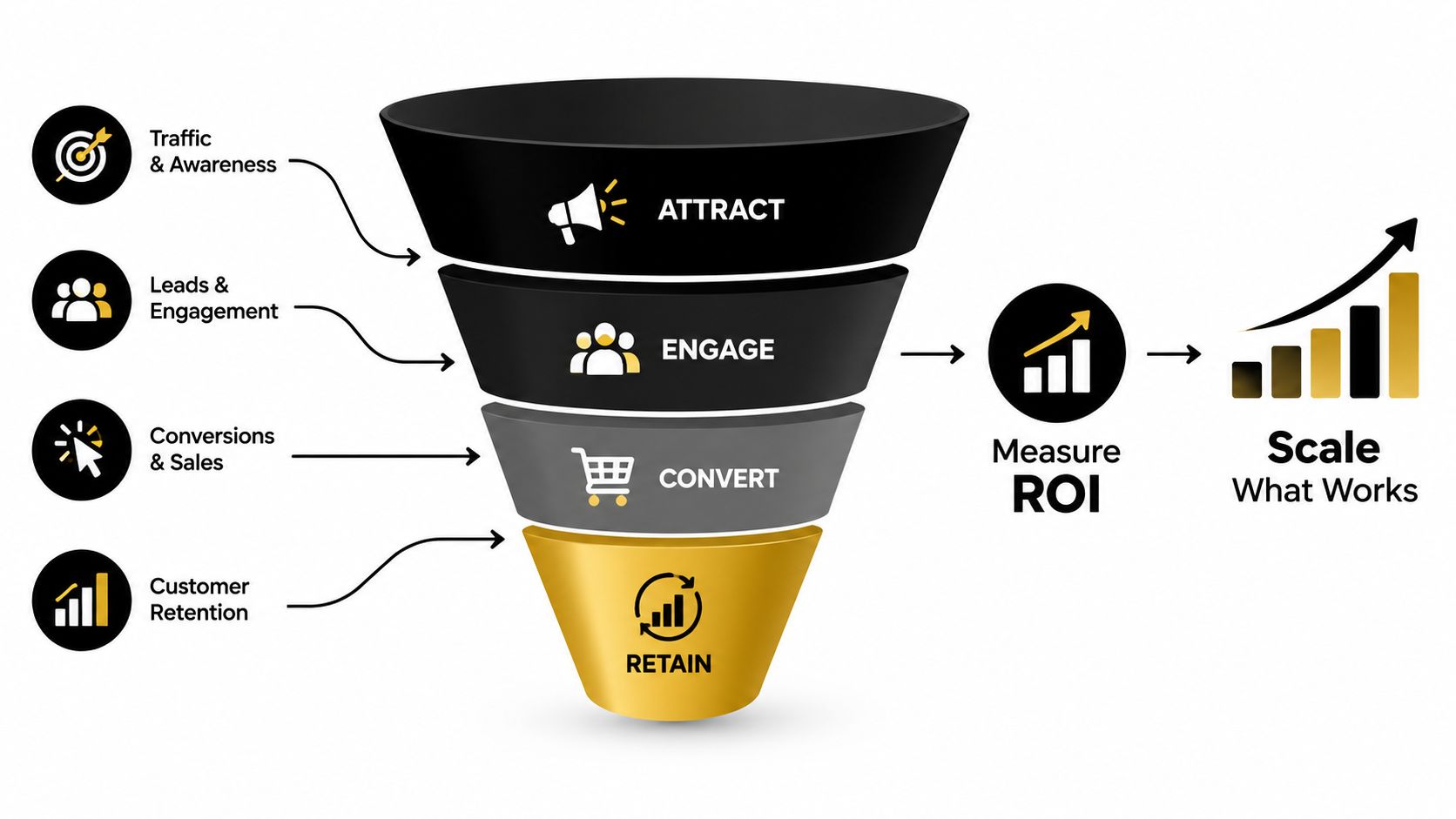
What to measure first
Start by fixing the baseline for the use case. If the model targets readmissions, the baseline has to be readmission behavior before the intervention. If it targets claims, the baseline has to be denial rates and adjudication workflow. If it targets clinician burden, the baseline has to be staff time per case, not general satisfaction alone.
Soft ROI matters too. Clinician fatigue, reduced rework, and smoother handoffs are real outcomes even when they don't show up immediately on a balance sheet. The strongest programs review fairness metrics, drift, and realized savings on a regular cadence, because a model that saves money while degrading subgroup performance is not a win.
How scaling actually works
The best scaling pattern is reuse. Once data pipelines, validation logic, monitoring patterns, and governance approvals exist for one use case, the second and third deployments move faster because the control plane already exists. That's why mature teams think in platforms, not isolated experiments.
If you're ready to move from experimentation to a production-grade analytics program, Ekipa AI helps healthcare teams scope use cases, design EHR-connected workflows, and build the governance and integration layer that pilots usually miss. Visit Ekipa AI to review your use case, compare build versus buy options, and start planning a deployment that clinicians can use.