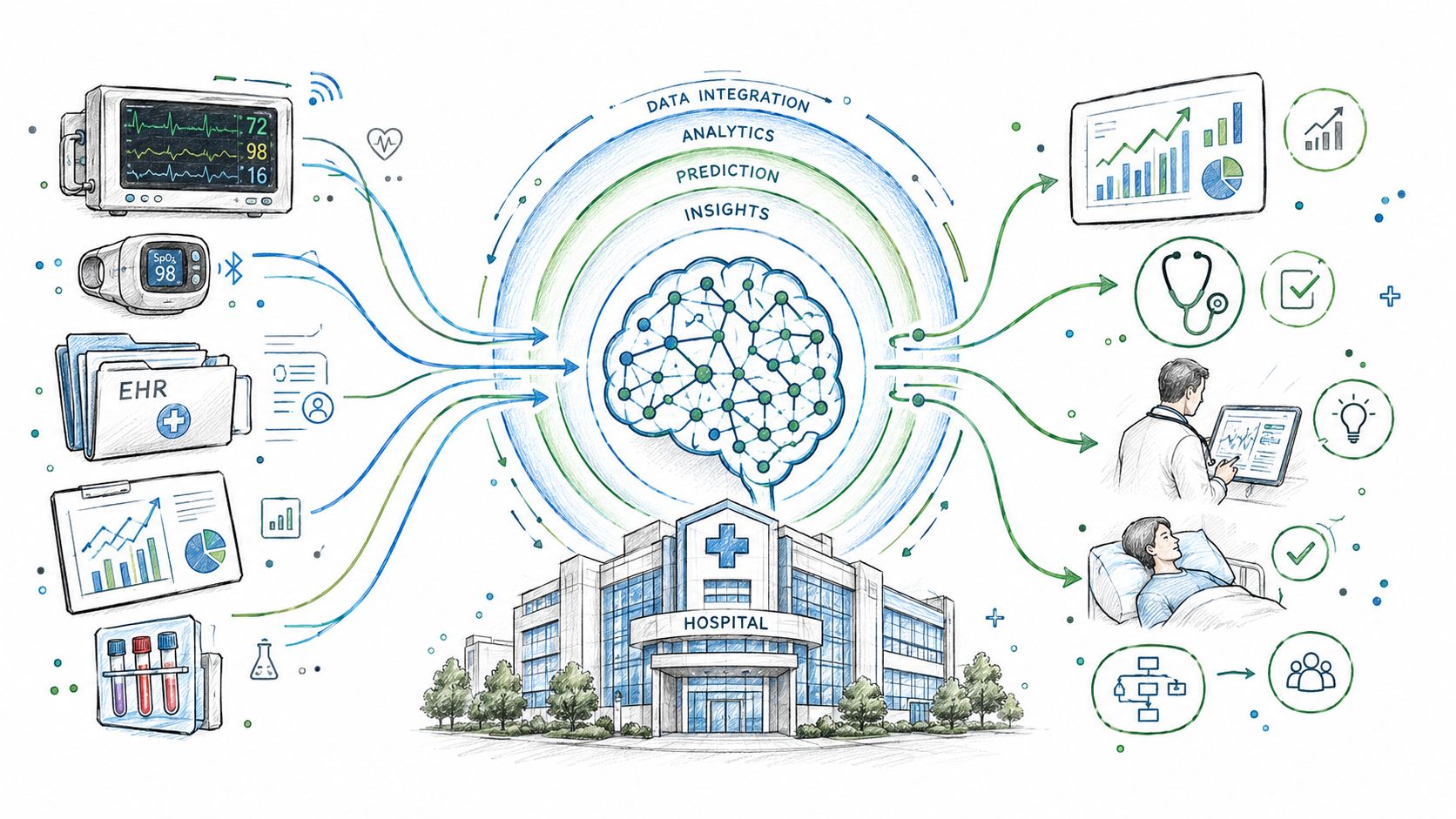
AI in Healthcare
AI Healthcare Analytics Explained: A Practical Guide
Learn what AI healthcare analytics is, how it creates business value, and what it takes to implement it across EHR systems, compliance, and ROI.
September 16, 2026Read more
A practical roadmap for building AI-powered healthcare systems, covering architecture, EHR integration, compliance, MLOps, vendor selection, and ROI

Most advice about AI-powered healthcare systems starts in the wrong place. Teams obsess over the model, then act surprised when the tool never reaches routine clinical use because nobody planned for workflow fit, integration debt, or governance. That's how pilot theater happens, a promising demo, a good-looking slide deck, and then a system that clinicians don't trust, compliance can't bless, and operations can't sustain.
The core question isn't whether a model can score well in isolation. It's whether the organization can absorb it into care delivery, prove it behaves safely, and keep it working after the first release. That's an operating-model problem, not a model-only problem, and it's where most healthcare AI programs falter.
Buying a clinical model does not mean you have deployed AI-powered healthcare systems. It means you have one component, while the harder work, fitting it into real care workflows, still has to be done. Market growth is real, but spend does not create dependable clinical use by itself.
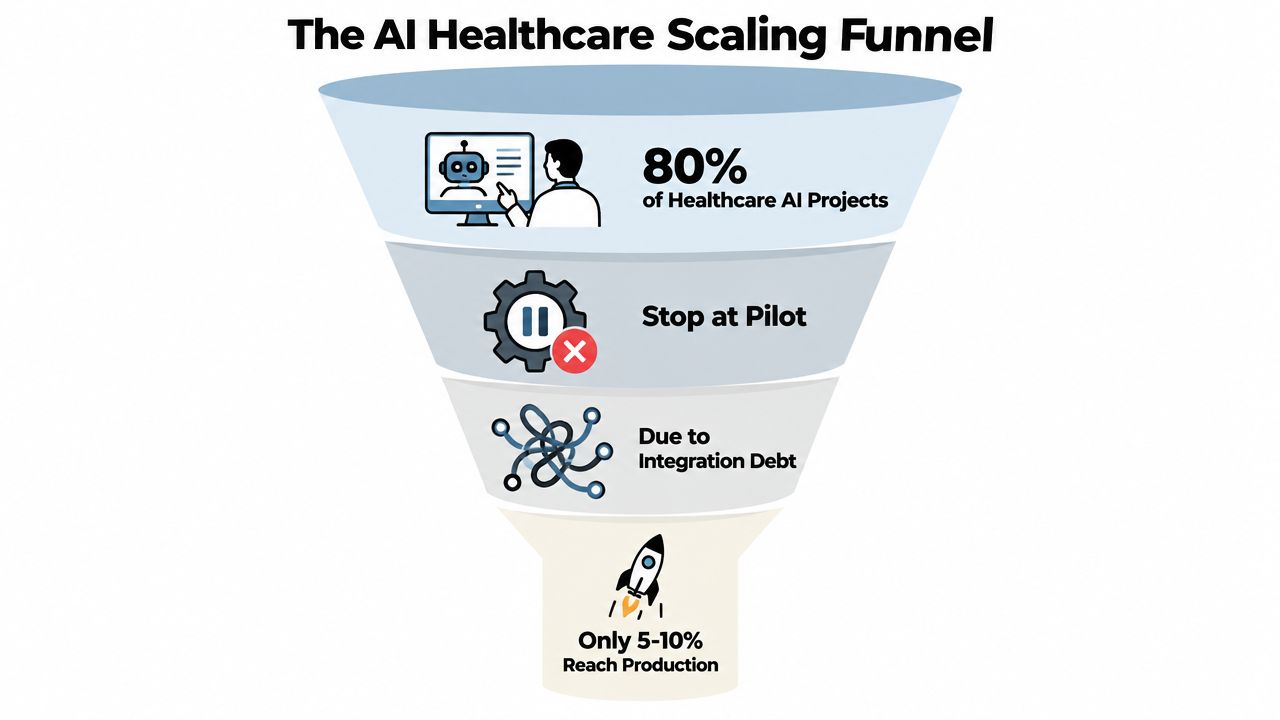
The pattern is predictable. A team trains a model, the demo looks strong, a pilot starts in one department, and then the project slows because identity, audit logging, EHR integration, and clinical ownership were never designed together. By the time the workflow reaches production, clinicians need fast answers, clear accountability, and minimal disruption, while the system often only looks good in controlled testing.
Practical rule: if a model cannot survive EHR latency, access controls, and human override in the same workflow, it is not ready for clinical deployment.
The usual problems are operational, not theoretical. Teams undercount integration work, leave FDA software classification for a late legal review, and measure success by model accuracy instead of clinical throughput, documentation burden, or safer decisions. The AI deployment pitfalls guide makes the same point from an operations angle, failures appear where tooling meets reality, not where the slide deck says the system should work.
The useful frame is implementation readiness. AI strategy consulting only helps when it is tied to workflow design, release criteria, and ownership across product, engineering, compliance, and clinical leadership. If you are trying to move beyond experiments, start with implementation support such as an healthtech engineering partner, not another proof of concept.
A healthcare AI stack has to act like a clinical system, not a generic app. The useful way to design it is as three layers, data ingestion, model processing, and clinical action, with each layer tied to a different reliability risk. The first layer pulls from HL7v2 streams, FHIR APIs, DICOM archives, and device telemetry, then normalizes the data before any model sees it.
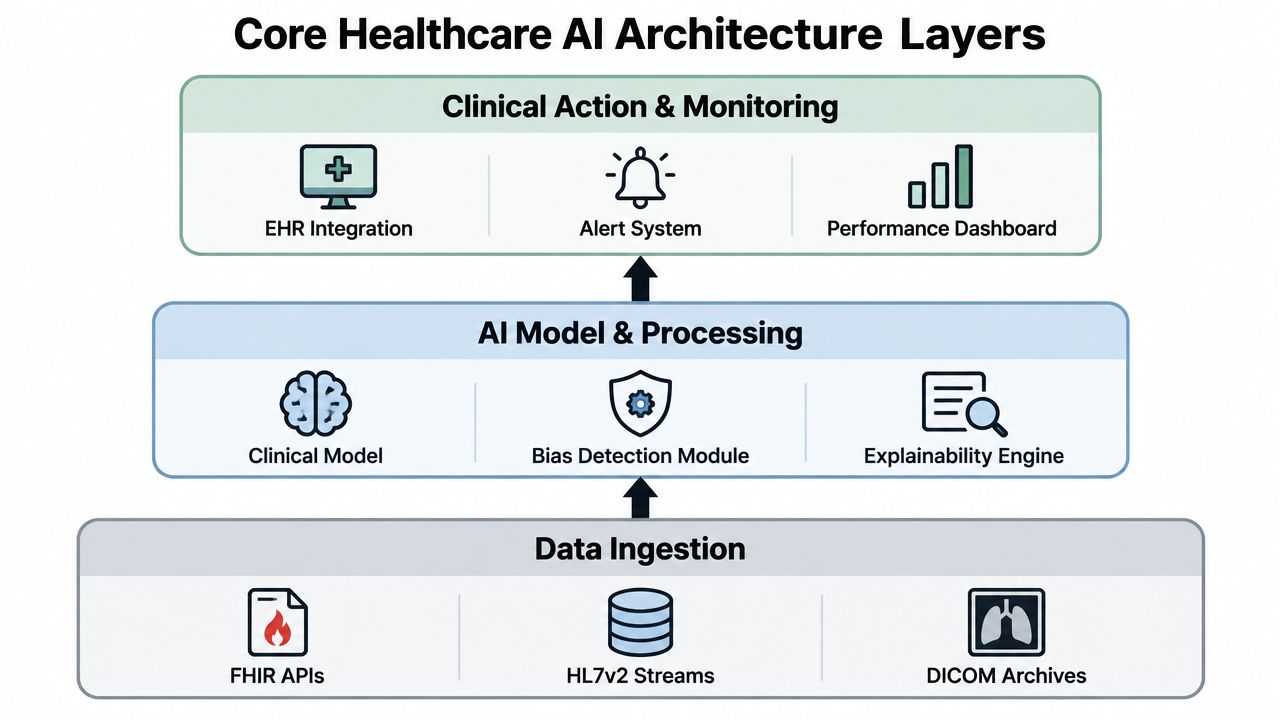
A clinical data lake or warehouse usually sits behind ingestion, with PHI segregation and access controls that match hospital policy. The model layer runs in batch or in real time, depending on the use case. Batch inference fits risk panels and cohort scoring. Bedside decision support needs lower-latency serving and tighter timeout control. The last layer is what clinicians use, either an embedded UI inside the EHR or an adjacent workflow surface that keeps people out of swivel-chair work.
The fragile part is the dependency chain. Identity has to move from EHR SSO into the inference gateway, the request needs authentication and audit logging, and the result has to be traceable back to the model version, input state, and patient record at the moment of inference. If any of that is missing, support teams cannot explain a recommendation, compliance cannot audit it, and clinicians stop trusting the output.
Architecture choices also change how fast a program can ship and how much it can absorb operationally. Edge or on-prem placement can reduce latency and make residency constraints easier to handle, while cloud serving can speed iteration and centralize governance. The right answer depends on uptime needs, data residency, and whether the workflow is urgent enough that network instability matters.
For teams formalizing this stack, our AI delivery framework should define the handoffs between data engineering, model serving, and clinical review before build starts. That contract is what keeps recommendations attributable and supportable.
EHR integration is the hardest technical problem in most healthcare AI programs, not because FHIR exists, but because healthcare systems don't agree on identity, timing, or workflow. A model can only be as reliable as the source data that feeds it, and in production that means dealing with mixed interfaces, incomplete notes, legacy feeds, and rate limits that don't show up in demos. That's why many teams start with custom healthcare software development patterns that acknowledge the integration burden instead of pretending it's incidental.
Vendor-native FHIR R4 or R5 APIs are the cleanest path when the source system exposes the fields you need. SMART on FHIR helps when the tool must launch inside the clinical context of the EHR, while bulk export works better for cohorting, retrospective scoring, or downstream analytics. Legacy bridges through HL7v2 or custom interfaces still matter because a lot of real healthcare data lives outside modern APIs.
The failure modes are blunt:
Operational insight: the safest integration layer is the one that fails loudly in staging, not silently in front of clinicians.
A staging environment with test patient records should be mandatory before any live rollout. Contracted read scopes need to be negotiated early, because a tool that only sees partial data can look accurate while missing the very detail that changes the clinical decision. A reference data quality dashboard should track completeness, timeliness, and drift across each source system, so the team knows whether the input is stable before the model output ever reaches a user.
If your program also needs extraction from messy chart data, an AI-powered data extraction engine can help, but only if the underlying clinical mapping and access model are already sound. Without that, extraction just accelerates bad data.
| Integration Pattern | Best Fit | Main Production Risk |
|---|---|---|
| Vendor-native FHIR API | Structured data, modern EHR environments | Missing fields or rate limits |
| SMART on FHIR launch | In-workflow clinical tools | Context loss across sessions |
| HL7v2 bridge | Legacy hospital interfaces | Mapping complexity and message variability |
| Bulk export | Cohorting and retrospective analytics | Not suitable for real-time decisions |
| Custom interface | Niche workflow or device integration | Maintenance burden and support risk |
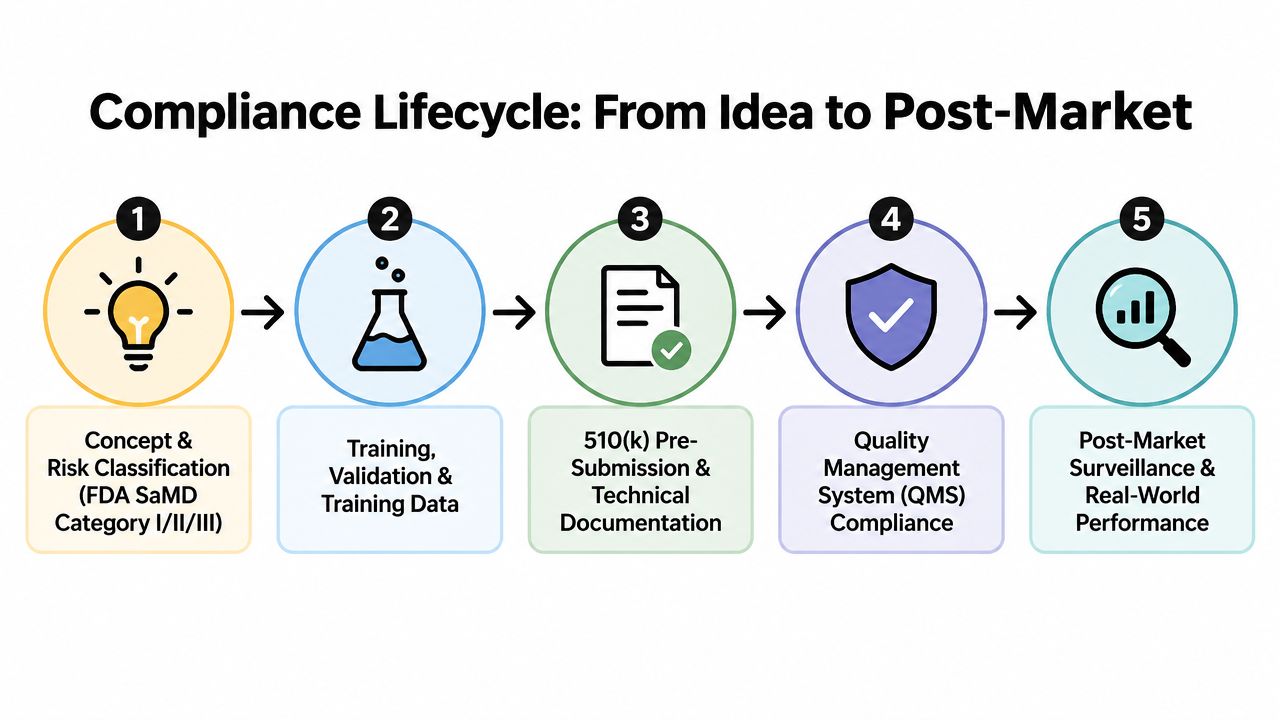
Compliance in healthcare AI isn't a gate at the end of a project. It's a lifecycle discipline that affects how you design, document, test, release, and monitor the system from day one. The FDA's draft guidance for AI-enabled device software functions frames these products through a lifecycle-management lens, not as static software (FDA), and the same risk-based mindset shows up in how software as a medical device is classified and reviewed (Congressional Research Service).
The engineering team needs to produce more than a model card. The file set should include the intended use statement, performance envelope, subgroup behavior, human-in-the-loop rationale, and the exact trigger conditions that move output from recommendation to review. For a regulated system, change control matters just as much as training, versioning and re-validation triggers should be explicit, and release approval should happen in a governance forum with clinical, compliance, and engineering owners in the room.
Data handling rules shape the whole stack. HIPAA and GDPR don't just affect storage, they influence logging, identity propagation, and whether cross-border inference is even allowed in a specific setup. That means the audit trail can't be an afterthought, and the security model can't rely on generic application patterns that ignore PHI.
The same lifecycle logic applies to human review.
A human-in-the-loop policy only counts if you can prove who reviewed what, when they overrode it, and whether the override path actually worked.
For EU deployments, the technical file and post-market surveillance posture need to be planned alongside the product, not after the first customer signs. If the system's role changes, the governance process has to catch that shift before it becomes a labeling or evidence problem. Ekipa AI's SaMD solutions and regulatory compliance partner links are relevant here only because the engineering and regulatory tracks have to stay synchronized, not because compliance can be outsourced after launch.
The fastest way to ship a broken clinical model is to trust one dataset and one evaluation split. Healthcare data is full of class imbalance, site-of-care bias, and label leakage, and those issues don't show up until the model lands in a different hospital, a different specialty, or a different documentation culture. A sepsis model trained at one ICU can look strong in development and still fail at another because the underlying patterns of care aren't the same.
Internal holdout sets catch basic overfitting, but they rarely prove the model will survive workflow drift. Temporal validation is better because it forces the model to face later data, including code changes and documentation changes that happen after the training cut-off. Prospective silent trials go further, because the model runs in the background and you can compare its outputs with clinician decisions before it's allowed to influence care.
Subgroup performance belongs in the release gate, not the appendix. Age, sex, ethnicity, and comorbidity strata can all behave differently, and calibration drift matters as much as raw accuracy because a well-ranked but miscalibrated recommendation still misleads clinicians. Teams that skip this step often discover the problem after deployment, when support tickets and override rates start rising.
A useful benchmark mindset is also showing up in the research ecosystem. Stanford's MedAgentBench evaluates models inside a simulated EHR workflow, not just on medical vignettes, and HealthBench was built with 262 physicians across 60 countries and 5,000 realistic health conversations (Stanford HAI). That shift matters because workflow-level behavior is different from question-answer accuracy, and clinical deployment depends on the full chain, retrieval, action selection, and downstream safety checks.
Shadow mode is where many teams first see the truth. The model runs behind the EHR, doesn't act, and its recommendations are compared with what clinicians did and what happened next. That setup exposes bad assumptions in label logic, alert timing, and the handoff between data freshness and clinical usefulness.
Field note: if shadow mode produces a flood of exceptions, the model isn't “chatty,” the surrounding data contract is broken.
Runtime architecture matters once the model moves past testing. Stable internal APIs, identity propagation, and hospital-network inference usually improve reliability, while monitoring has to cover input drift, prediction drift, calibration drift, latency, and override rates. Rollback should be real, with canary releases, traffic shadowing, and a kill switch the clinical owner can use when something changes upstream.
A validation program should separate these layers clearly:
| Validation Layer | What It Catches | Typical Duration |
|---|---|---|
| Internal holdout | Basic fit and leakage | Short |
| Temporal validation | Time-based drift | Moderate |
| Subgroup review | Uneven behavior across cohorts | Moderate |
| Silent trial | Workflow mismatch | Longer |
| Canary release | Production instability | Short to moderate |
Build versus buy is a maturity decision, not a philosophy test. If your team does not have enough ML, data engineering, clinical informatics, and MLOps capacity, building from scratch usually slows delivery and adds maintenance risk. If speed matters most, a configured platform or a vertical vendor can fit, but only when the workflow, evidence, and integration model match your environment.
The market is already showing strong adoption pressure. Analysts have estimated the AI in healthcare market at USD 18.1 billion in 2025 and forecast growth to USD 222.9 billion by 2033, and a 2026 survey reported that 75% of U.S. health systems were using or planning to use at least one AI application, while only 18% were ready to deploy AI in direct care delivery (Healthcare in Europe). The gap points to readiness, not interest, as the key bottleneck.
A build path gives you maximum control, but you own retraining, monitoring, validation, and release governance for the full lifecycle. A horizontal platform reduces setup time and can standardize orchestration, yet your team still has to design the workflow, connect the data, and prove clinical value. A vertical vendor may bring regulated product experience, but you still need visibility into the clinical logic, evidence, and model lifecycle.
Ask direct questions during diligence. Review audit logs, retraining rights, data residency, clinical evidence quality, monitoring commitments, and exit clauses. If a vendor cannot show how the product behaves after updates, or will not state who owns the model lifecycle, you are buying risk, not capability.
Ekipa AI's AI strategy consulting is relevant only if you need help turning those choices into a roadmap, and its AI Automation as a Service, internal tooling, and Healthcare AI Services offerings map to different parts of that stack. The question is whether your team needs strategic design, implementation support, or integration execution before any vendor commitment is made.
| Dimension | Build from Scratch | Configure a Platform | Buy a Vertical Vendor |
|---|---|---|---|
| Control | Highest | Moderate | Lowest |
| Speed | Slowest | Faster | Fastest |
| Compliance burden | Highest | Shared | Vendor-heavy, but still yours to oversee |
| Integration cost | Highest | Moderate | Moderate to high |
| Long-term ownership | Highest | Moderate | Lower operational lift, but lock-in risk |
A practical decision rule is straightforward. Build only when the workflow is strategic and your internal team can own the whole lifecycle. Configure when you need speed without giving up too much control. Buy when the use case is narrow, regulated, and the vendor can prove real production support.
What does a first production system usually cost?
It depends on scope, integration depth, and compliance burden, so there isn't a reliable one-size-fits-all number to quote. The main cost buckets are data engineering, model development, EHR integration, validation, security, and long-term MLOps, and those costs rise quickly when the workflow touches multiple systems or regulated decision points.
How long does it take to go live?
A pilot can move quickly, but a clinically deployed system usually takes longer because it has to clear validation, security review, procurement, and governance. If the model needs EHR integration and human review, expect the schedule to be driven by coordination work as much as by engineering.
Why do good evaluation results fail in production?
Because production changes the surrounding system. Monitoring, workflow fit, exception handling, and governance often get treated as afterthoughts, and then the model drifts, the data feed breaks, or clinicians stop trusting the output.
Who should be on the team?
At minimum, you need product, clinical informatics, ML, data engineering, security, compliance, and a named clinical owner. If the use case is regulated, involve governance early, not after the model is already integrated.
When should an AI governance committee be formed?
Before the first model goes live. Waiting until after deployment usually means the committee only exists to react to problems instead of shaping the release criteria and oversight model.
If you need a team that can shape the operating model, handle EHR integration, and build the governance layer with the product layer, start with our expert team and then move into a scoped engagement.
Ekipa AI helps healthtech teams turn AI plans into deployed clinical workflows, from integration design and implementation support to governance-ready delivery. If you're building AI-powered healthcare systems and need a partner that understands EHRs, regulated software, and production reliability, visit Ekipa AI and talk through your use case with the team.
Learn what AI healthcare analytics is, how it creates business value, and what it takes to implement it across EHR systems, compliance, and ROI.

Learn how predictive AI in healthcare works, where it delivers value, and how to deploy it safely inside real clinical workflows with a clear roadmap.

Learn how deep learning in healthcare powers imaging, EHR and SaMD solutions, from model types to deployment, compliance and ROI for leaders.
Connect with our team to explore how AI expertise can transform your business.