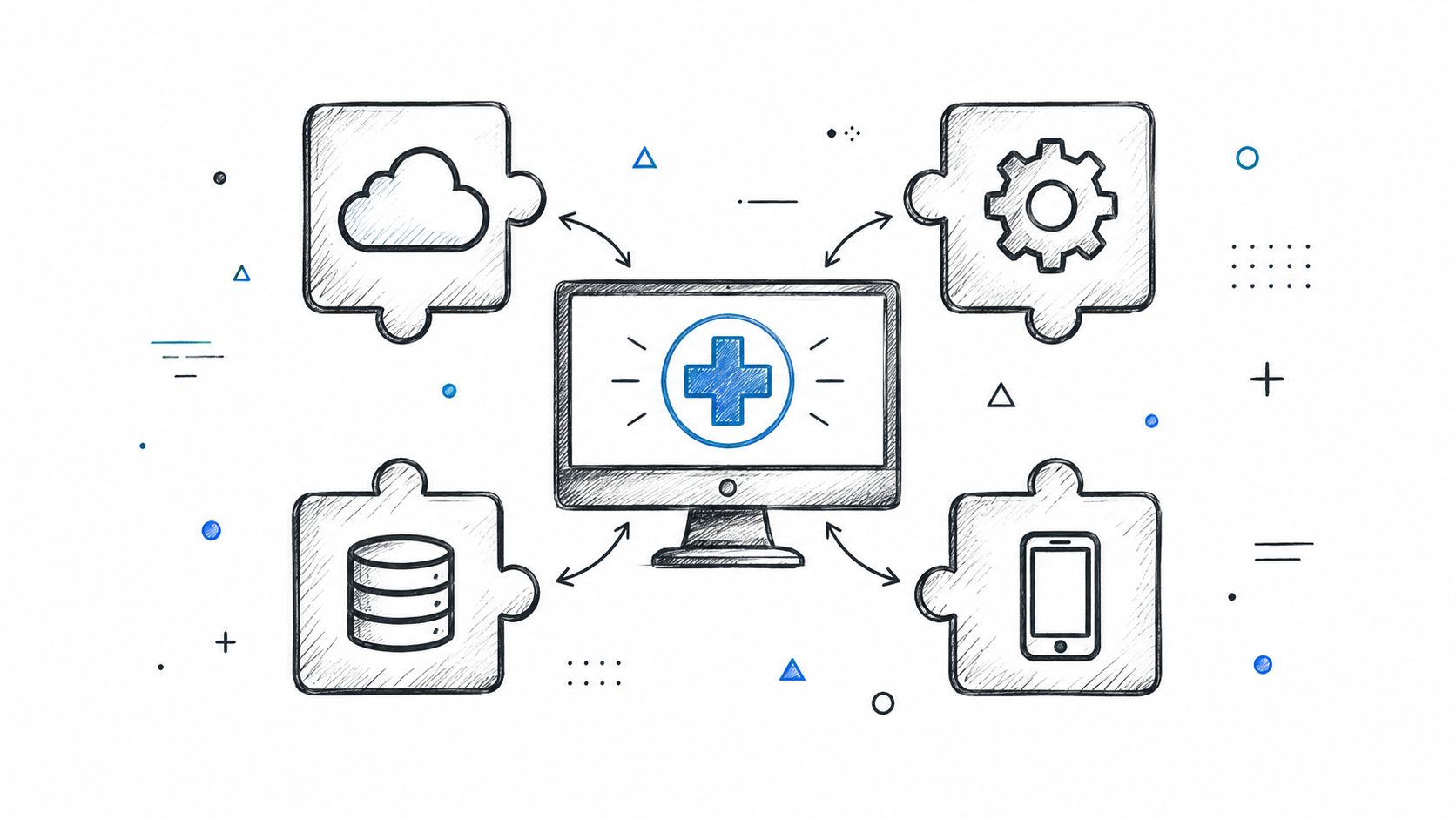
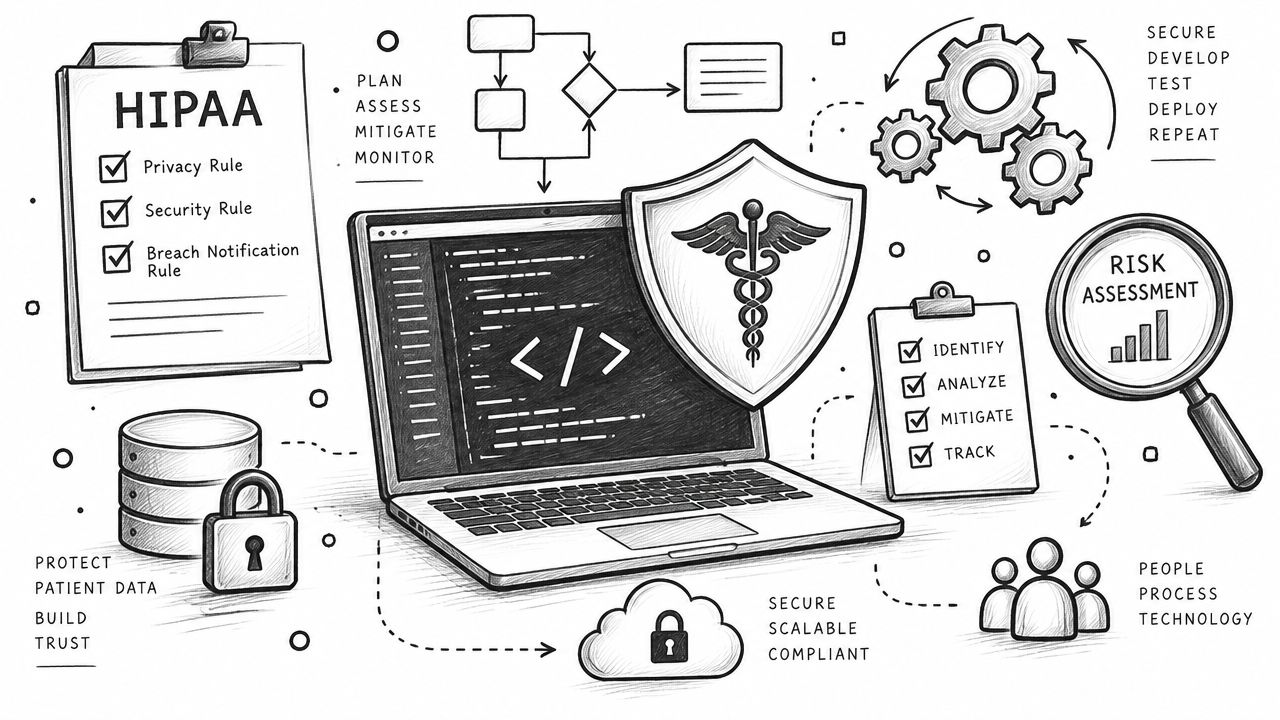
Your product team needs EHR connectivity, but the first decision isn't which vendor has the longest feature list. It's whether you need a managed network API, a FHIR data platform, an integration engine, or a partner to design and operate a custom architecture. Those options solve different problems, and choosing the wrong layer can leave your developers maintaining brittle mappings, your clinicians reviewing unusable data, or your compliance team carrying responsibilities nobody assigned.
The right choice depends on data scope, source systems, standards, deployment model, governance, monitoring, and internal interoperability expertise. Hospital-to-hospital record retrieval has different requirements from writing an AI-generated note back into an EHR. A payer aggregating claims data needs a different foundation from a digital health company connecting medical devices and clinical applications.
This guide compares EHR integration software by the integration problem it solves, not by a generic checklist. It covers practical use cases, limitations, implementation questions, and buyer criteria across network access, shared longitudinal records, FHIR infrastructure, enterprise interface engines, and custom delivery partnerships. Teams building AI-enabled clinical products can also review Healthcare AI Services and explore real-world use cases for examples of where integration becomes part of the product rather than a side project.
1. Healthcare and HealthTech Engineering, AI in Healthcare
Ekipa is a service engagement, so the first question is whether your team has the budget and decision capacity to run a joint delivery, not whether the vendor can reach an EHR. This model suits projects where connectivity is one part of a larger clinical product and requires ongoing collaboration on scope, governance, and operations. Healthcare AI Services describes that healthcare engineering focus.
The engagement can cover discovery, use-case definition, solution design, EHR and clinical-system integration, deployment, and enablement. That breadth is useful when an integration affects clinical decisions, medical devices, imaging, or AI-generated outputs. It also means the buyer must provide timely clinical, technical, and compliance decisions rather than treating delivery as a connector purchase.
The technical scope includes HL7, FHIR, DICOM, SNOMED CT, and LOINC. These standards address both message transport and clinical meaning across different systems. Delivery can also account for HIPAA and GDPR-aligned requirements, although the buyer remains responsible for its own risk assessment, contracts, controls, and operating procedures.
Where this option works best
Use this route when a product must connect EHRs with imaging systems, devices, AI services, or internal applications. It fits teams with a defined clinical problem that need help converting it into a deployable product and operating model.
Key strengths include:
- Standards-first interoperability: Experience with HL7, FHIR, DICOM, SNOMED CT, and LOINC supports exchange across heterogeneous clinical environments.
- End-to-end delivery: One partner can coordinate discovery, design, integration, deployment, and enablement, reducing handoffs between specialists.
- AI and product engineering: The work can extend from a proof of concept to operating AI within a clinical workflow.
- Compliance-minded implementation: HIPAA and GDPR-aligned practices can expose governance gaps before deployment, rather than after the interface is built.
The main constraint is customization. Legacy EHR environments may extend timelines, limit write-back, or require compromises in workflow design. A service partner also needs sustained access to product owners, clinicians, security staff, and integration teams.
Practical rule: Choose a delivery partner when the difficult task is making the complete clinical workflow reliable, not simply reaching an EHR.
Ekipa may also be relevant to organizations assessing SaMD solutions, AI strategy consulting, or a Custom AI Strategy report alongside their integration architecture.
2. Redox for Managed EHR Connectivity
Redox is designed for teams that want to connect to multiple healthcare organizations without building every interface themselves. It places a managed interoperability layer between a digital health product and systems such as Epic, Cerner, and athenahealth, exposing normalized data through FHIR and Redox JSON.
The practical value is abstraction. Redox handles mapping, translation, routing, orchestration, and monitoring so the product team can work against a more consistent interface. Its Platform API and operational dashboards support configuration, logs, and integration management, while in-flight enrichment helps route or augment messages during processing.
Redox also supports AI and agent integrations through its Redox MCP server. Its HITRUST certification and mature security program can help enterprise buyers structure vendor review, although certification doesn't remove the need to assess the specific data flows and responsibilities in the contract.
The trade-off for product teams
Redox can reduce custom interface work and shorten the path to a first production connection. Developer documentation and operational tooling are useful when the buyer needs both implementation support and visibility after launch.
The limitations appear in commercial and deployment coordination. Pricing is bespoke and may increase with scale or transaction volume. Even with Redox in the architecture, every connected health system still has its own security review, testing process, participation requirements, and go-live schedule.
Redox is a good choice when network reach and operational abstraction matter more than owning the entire integration stack. It's less suitable when a health system wants deep control over every transformation, data store, and deployment detail.
Choose Redox when: You need managed connectivity to multiple US healthcare organizations and want routing, normalization, and monitoring in one platform.
Buyers should ask how custom mappings are versioned, who owns production incident response, how write-back workflows are tested, and which charges apply to additional facilities or transaction volume. Those answers reveal more than the presence of a unified API.
Visit Redox to review its interoperability platform and integration model.
3. Particle Health for Nationwide Clinical Data Access
Particle Health addresses a different problem from an integration engine. It provides a nationwide clinical data API for retrieving and integrating clinical documents, medications, ADT events, and other records through major health information networks, including Carequality and CommonWell. Pharmacy and PBM connections extend the dataset for medication-related workflows.
The platform is useful when a product needs a longitudinal view assembled from external sources, rather than a direct interface to one health system. Intake, risk stratification, care coordination, and clinical data enrichment are natural examples. RESTful FHIR and C-CDA APIs provide structured and document-based access paths, while patient and data-retrieval endpoints support application workflows.
A no-code interface can help business or operations teams inspect data access before developers complete a full integration. That's valuable during discovery, but it shouldn't substitute for production validation. The product still needs clear rules for patient matching, source precedence, document classification, and downstream use.
What buyers should validate
Particle can be a fast way to augment locally held EHR data with records from broader networks. Its developer documentation and examples support teams that want to move quickly from an integration concept to an API-based workflow.
The main risk is variability. Coverage and payload quality differ by source, and the returned data may require governance before it's safe to use in a clinical or operational decision. A product team should define how it handles duplicates, conflicting medications, missing timestamps, and documents that need human review.
Pricing isn't public and is generally sales-led and contract-based. That makes a realistic proof of value important before committing to a broad rollout.
Ask for representative data, not a polished demo: Your evaluation should include incomplete records, mixed formats, duplicates, and patients with sparse external histories.
Explore Particle Health when the core requirement is external clinical record retrieval across networks rather than deep ownership of interface infrastructure.
4. 1upHealth for FHIR-First Data Programs
A payer building a member-facing clinical application may need more than access to one EHR. It may need to ingest clinical and claims data, preserve source context, apply a consistent model, and support repeated queries across products. 1upHealth targets that FHIR-first data program.
Its platform connects payers, providers, and healthtech products with EHRs and CMS-mandated APIs. It also provides a managed FHIR data store and cloud infrastructure, giving teams a place to ingest, store, query, and govern data after initial retrieval.
That distinction affects architecture. A network API mainly supplies records to an application. A FHIR data platform supports durable access to clinical and claims data, patient-level analytics, and workflows spanning multiple sources. Developer-focused documentation and FHIR-native APIs can reduce implementation friction, while cloud deployment and HITRUST-certified infrastructure may support enterprise security reviews.
The platform does not remove the harder modeling decisions. Sources can represent the same clinical concept through different profiles, extensions, coding systems, optional fields, and update behavior. Before ingestion, buyers should define a canonical model, reconciliation rules, and the level of source fidelity the product must retain.
Those choices affect clinical confidence. Storing every source representation without governance can leave developers unsure what a resource means. Excessive normalization can discard relevant context or make provenance difficult to trace. Claims and clinical data also require clear handling for versioning, corrections, and bulk operations.
1upHealth fits organizations building a FHIR-native product or enterprise data program, especially where reusable workflows matter. A narrow, one-off connection may be easier to implement through a managed network provider or direct API.
Best fit: Payers, providers, and vendors building reusable FHIR workflows.
Main strength: A developer-oriented foundation for clinical and claims data.
Main caution: Reconciliation, provenance, and governance remain buyer responsibilities.
Pricing is not public and is oriented toward enterprise contracts. During diligence, test representative clinical and claims resources, source provenance, bulk workflows, version handling, and migration options if the surrounding architecture changes.
Review 1upHealth when the program needs a FHIR-first foundation rather than a single connection.
5. Health Gorilla for Governed Nationwide Exchange
A healthtech product may need records from multiple organizations while meeting formal exchange and governance requirements. Health Gorilla addresses that problem through a regulated exchange network. It is designated as a TEFCA QHIN and California QHIO, and supports query-based record retrieval, laboratory orders and results, plus ADT and other event subscriptions.
Those designations support an enterprise compliance strategy, but they do not remove implementation work. Teams still need onboarding, patient and provider attribution, permitted-use policies, and operating procedures for each exchange workflow. Delivery time depends on the participating organizations and the use case.
Health Gorilla's APIs cover clinical records, laboratories, and event notifications. Its documented transaction and subscription commercial model also gives buyers a clearer basis for forecasting exchange activity than an entirely opaque pricing approach.
Where Health Gorilla fits
Choose Health Gorilla when nationwide exchange, regulatory posture, and transaction visibility drive the decision. A private transformation layer for internally controlled HL7 and FHIR messages may be a better fit for organizations that do not need external network access.
Query responses can include heterogeneous document formats, so the surrounding product still needs normalization, document classification, patient matching, provenance tracking, and a review experience. At scale, narrative documents can create additional extraction work. An AI-powered data extraction engine may complement the exchange by turning relevant document content into usable data, while preserving appropriate source context.
Evaluate the operational workflow rather than only the API:
- Attribution: How are patients and providers matched, enrolled, and maintained?
- Results: Which document formats arrive, and how are they classified and indexed?
- Commercials: Which activities generate transaction charges or subscription costs?
- Recovery: How are incomplete, delayed, or rejected queries surfaced and retried?
Visit Health Gorilla when governed external exchange matters as much as technical API access.
6. Zus Health for Shared Longitudinal Patient Data
Zus Health focuses on the shared patient record problem. Its Zus Aggregated Profile, or ZAP, assembles continuously refreshed longitudinal patient data from networks and partners. Applications can access that profile through FHIR and GraphQL APIs, embeddable components, and direct EHR integrations.
This model is useful for care delivery and digital health products that need an up-to-date patient context without repeatedly reconstructing it from every source. Patient enrollment and subscription workflows support event-based refreshes for data such as labs and ADT events. Document upload and association help teams add information that doesn't originate from a connected network.
Why the shared record model matters
A conventional point-to-point integration often answers a narrow question, such as whether a lab result can be sent to an EHR. Zus is aimed at a broader question: how does an application maintain a usable patient profile as new external events arrive?
That can reduce application complexity, but it moves important decisions into data-sharing governance. Organizations must define who can access the aggregated profile, what consent and enrollment mean in each workflow, how source data is displayed, and when a refreshed record is considered authoritative.
Pricing is sales-led and requires budgeting for network subscription costs at patient scale. Buyers should model not only initial enrollment, but also ongoing refresh behavior and the operational consequences of retaining or displaying external documents.
The strongest longitudinal-data platform is still weak if clinicians can't tell which source supplied a fact and when that fact was last updated.
Zus is a good fit for care coordination, longitudinal navigation, and digital health workflows that need API, UI, and direct EHR integration options in the same architecture.
Explore Zus Health for a shared patient data approach.
7. Smile Digital Health for FHIR Infrastructure
A health system consolidating feeds from several EHRs may need more than a connector. Smile Digital Health's Smile Omni provides FHIR-native infrastructure, including a FHIR server, repository, standards tooling, and quality or compliance modules. It suits organizations building a reusable data foundation rather than a single-purpose exchange.
Smile's work maintaining HAPI FHIR and contributing to HL7 working groups supports a standards-focused implementation approach. Health systems, payers, and vendors can use the platform for ingestion, transformation, validation, analytics, and large-scale deployment, instead of exposing only a narrow group of endpoints.
The platform can include ingestion and transformation layers, quality and compliance functions, cloud marketplace availability, and partner enablement. Deployment options help buyers balance cloud adoption with data residency, performance requirements, and existing enterprise infrastructure.
The implementation trade-off
Smile fits teams prepared to own a FHIR-centered operating model. Architects gain control over resource handling and platform design, while the organization takes responsibility for profiles, validation, terminology, transformation pipelines, and ongoing governance. Those tasks usually require dedicated FHIR expertise and clear ownership before production launch.
A small product retrieving a limited dataset through a managed network may find the platform heavier than necessary. The case is stronger when the roadmap includes multiple sources, reusable APIs, analytics, quality programs, or a long-lived enterprise repository.
Evaluate the operating model as carefully as the feature set:
- Standards depth: HAPI FHIR experience and a broad FHIR tooling ecosystem.
- Deployment choice: Options for cloud and enterprise environments.
- Budget planning: Enterprise-specific pricing and implementation services require early planning.
- Governance: Teams must assign responsibility for FHIR validation, terminology, profiles, and platform operations.
Review Smile Digital Health when FHIR infrastructure is itself a core product or enterprise capability.
8. Rhapsody for Enterprise Interface Operations
Rhapsody, together with Corepoint and Rhapsody Integration Engines, is built for organizations that need an established healthcare integration engine. It supports HL7 v2, FHIR, X12, REST, SOAP, and custom workflows, with visual interface development, mapping, translation, monitoring, and transformation.
This is the right category when the organization already operates a substantial interface estate or must connect systems that don't expose convenient modern APIs. Hospitals and vendors often need to manage ADT messages, lab results, orders, billing transactions, documents, and custom feeds in one controlled environment.
Rhapsody is available on premises and in the cloud, including cloud marketplace options such as Corepoint as a Service. Training, certification, and implementation resources can help organizations create a repeatable operating model instead of relying on one interface specialist who understands every channel.
The key limitation
Rhapsody is primarily an integration engine, not a turnkey nationwide network connection. Buyers still need interface analysts, message mapping skills, testing processes, monitoring ownership, and a plan for managing downstream system changes.
Its enterprise reputation and reliability are advantages for organizations that value controlled operations. The trade-off is the platform's depth. A team expecting a simple, self-service API may find the implementation model heavier than necessary.
Operational test: Don't ask only whether Rhapsody can transform a message. Ask who will monitor queues, approve mapping changes, handle retries, and investigate clinical data discrepancies at two in the morning.
Pricing varies by deployment and organization size and isn't publicly listed. Visit Rhapsody when your primary problem is enterprise interface management across legacy and modern protocols.
9. NextGen Mirth Connect for Familiar Interface Teams
NextGen Connect, formerly known widely as Mirth Connect, is a channel-based integration engine for HL7 v2, FHIR, X12, DICOM, and custom protocols. It provides routing, transformation, scripting, and connectors familiar to many healthcare interface teams.
Its historical advantage has been familiarity. Organizations with existing Mirth expertise can often understand channel patterns, scripts, and routing logic without adopting a completely different integration framework. The large user community and extensive documentation also make troubleshooting easier than it would be with an unfamiliar proprietary tool.
The licensing model is now a central procurement question. The open-source line is frozen at version 4.5.2, while newer 4.6 and later releases require commercial licensing, as described in the product plan. That changes the total-cost calculation for teams that previously treated Mirth as a low-cost open-source backbone.
Evaluate the version and support posture
The commercial product provides tiered support and enterprise extensions. That may be the sensible route for organizations that need current fixes, vendor accountability, or support for production-critical interfaces. Teams that remain on the older open-source line need to assess maintenance, security, and operational ownership carefully.
NextGen Connect works well when the buyer has interface expertise and wants flexible channel control. It doesn't automatically provide nationwide network access, semantic governance, or a ready-made patient data model.
A migration, modernization, or implementation program may also require a broader AI Product Development Workflow, especially when the engine must support a new clinical product rather than only existing interfaces.
Review NextGen Connect and compare licensing, support, deployment, and upgrade responsibilities against the team's actual operational capacity.
10. InterSystems IRIS for Health and Health Connect
InterSystems IRIS for Health combines an integration engine, enterprise FHIR repository, and transformation services in one healthcare data platform. It supports HL7 v2, C-CDA, X12, and FHIR, making it suitable for organizations that need to unify integration, storage, and analytics rather than operate separate products for each layer.
The platform supports managed cloud services, on-premises deployment, and hybrid models. That flexibility can help large providers and vendors accommodate existing infrastructure, data residency requirements, performance constraints, and staged modernization. Its reference material and enterprise tooling are designed for complex environments where integration is a strategic capability.
A platform decision, not just an interface decision
IRIS for Health makes the most sense when the organization wants a high-performance healthcare data backbone with integration and storage closely connected. It can reduce architectural fragmentation, but the platform's breadth creates a steeper learning curve and a higher initial investment.
Teams should assign ownership for FHIR modeling, message transformation, environment management, monitoring, and release governance. A platform this flexible can support many patterns, but that flexibility won't create a coherent architecture without standards and operating rules.
InterSystems is less likely to be the right answer for a small product that only needs one managed EHR connection. It's more appropriate for health systems, large vendors, and enterprises that expect ongoing interoperability programs across clinical, administrative, and analytical workflows.
Pricing is enterprise-oriented and quote-based. Explore InterSystems IRIS for Health when integration, enterprise data management, and analytics need to live on a shared foundation.
Top 10 EHR Integration Platforms, Feature Comparison
| Solution |
Core capabilities |
Target audience |
Unique selling points |
Integration & compliance |
Pricing / procurement |
| Ekipa AI, Healthcare & HealthTech Engineering |
End‑to‑end engineering: discovery → design → EHR/infrastructure → deployment; AI productization |
Digital health teams, startups, clinical software product teams |
Partnership model; domain + engineering pedigree; compliance‑first delivery |
HL7/FHIR/DICOM/SNOMED/LOINC expertise; HIPAA/GDPR‑aligned builds; EHR integrations |
Project‑based services; bespoke engagement and timelines |
| Redox |
Unified API (FHIR & Redox JSON), normalization, routing, orchestration, monitoring |
Digital health vendors needing fast EHR connectivity |
Abstracts per‑site EHR work; strong tooling/observability; HITRUST |
Connectors for major EHRs (Epic, Cerner, athena); mature security program; site coordination required |
Bespoke pricing; scales with transactions/volume |
| Particle Health |
Nationwide clinical data API (Carequality/CommonWell), meds/PBM data, FHIR & C‑CDA |
Apps needing longitudinal records for intake, risk & care coordination |
Single API for nationwide queries; pharmacy/PBM access; developer friendly |
FHIR & C‑CDA endpoints; variable coverage/payload quality; governance needed |
Sales‑led contracts; pricing not public |
| 1upHealth |
FHIR‑native APIs, managed FHIR store, clinical + claims aggregation, CMS API support |
Payers, providers, healthtech building on FHIR and CMS integrations |
FHIR‑first developer experience; payer/CMS alignment; HITRUST |
FHIR‑centric platform; certified/cloud infra; requires data modeling/governance |
Enterprise contracts; sales‑led pricing |
| Health Gorilla |
TEFCA QHIN connectivity, record retrieval, labs, ADT/event subscriptions |
Enterprises and vendors needing compliant nationwide exchange |
QHIN/QHIO designations; documented transaction/subscription model |
TEFCA connectivity; onboarding and attribution steps; heterogeneous formats require normalization |
Transaction/subscription pricing model (documented) |
| Zus Health |
Continuously refreshed patient profiles (ZAP), FHIR & GraphQL APIs, embeddables |
Apps needing up‑to‑date longitudinal patient profiles |
Event‑based refresh; embeddable UI components; multiple ingestion paths |
Enrollment/subscription model; data sharing/governance considerations |
Sales‑led subscriptions; patient‑scale budgeting |
| Smile Digital Health |
Enterprise FHIR server (HAPI FHIR), ingestion, transformation, quality/compliance modules |
Health systems, payers, large vendors building FHIR backbones |
Deep standards pedigree; HAPI FHIR maintainer; tooling ecosystem |
Enterprise FHIR tooling; compliance/quality modules; cloud marketplace options |
Enterprise‑specific pricing; strategic investment |
| Rhapsody (Corepoint) |
Integration engine suite: visual mapping, monitoring, HL7 v2/FHIR/X12 support |
Hospitals, HIEs, vendors needing proven interface engines |
Longstanding reliability; Best‑in‑KLAS heritage; training/certification |
On‑prem/cloud delivery; broad protocol support; requires interface expertise |
Quote‑based enterprise pricing |
| NextGen Mirth Connect |
Channel routing, transformation, scripting; connectors for HL7/FHIR/X12/DICOM |
HIEs, hospitals, interface teams familiar with Mirth |
Large community and knowledge base; familiar tooling patterns |
Widely deployed as interface backbone; newer releases moved to commercial licensing |
Historically low TCO for open versions; newer commercial licensing |
| InterSystems IRIS for Health (Health Connect) |
Integrated engine + enterprise FHIR repository + transformation and analytics |
Large providers and vendors seeking a unified data platform |
High performance; unifies integration, storage and analytics; proven at scale |
Supports HL7 v2/C‑CDA/X12/FHIR; managed/cloud/on‑prem options |
Enterprise quote‑based pricing; higher initial investment |
Turn the Shortlist Into a Safe Integration Plan
A shortlist becomes useful only when it connects to a defined workflow. Start by specifying the data the product must read, write, subscribe to, or transform. Separate clinical documents from discrete resources, operational events from transactional messages, and one-time retrieval from continuously refreshed data. An AI scribe writing an approved note into an EHR has a different risk profile from a care coordination product assembling external records.
Next, map the source-system constraints. Identify the EHRs, laboratory systems, imaging platforms, pharmacy connections, HIEs, and internal applications involved. Record which standards each source supports, which vendor-specific rules apply, whether write-back is available, and what patient, provider, consent, and attribution workflows must happen before data can move.
Interoperability adoption is broad, but usability still creates friction. In a national survey of 2,088 physicians, 70% were at least somewhat satisfied with access to outside information, yet only 23% said it was very easy to use, and just 8% said it was very easy to use information from different EHR systems. Only 11% were very satisfied with their ability to electronically access all 10 outside-information types measured, according to the physician interoperability survey. Buyers should treat those findings as a warning against equating connectivity with workflow success.
Validate the architecture, not the demo
The market has moved toward standards-based APIs, but hybrid integration remains normal. A national survey found that 73% of companies had current or previous production use of a standards-based EHR API, while 57% used both standards-based and proprietary APIs, as reported in the JAMIA survey of standards-based EHR API use.
Your evaluation should therefore test the actual mix of FHIR, proprietary APIs, HL7 v2, C-CDA, X12, and custom workflows. FHIR availability alone isn't proof of production readiness. The CAQH 2025 FHIR report describes organizations facing technical complexity, operational hurdles, and inconsistent vendor support during implementation. The same report notes that 79% of countries have a national implementation guide, but only 20% say it's widely used. Those findings reinforce the need to assess governance, enforcement, and workflow integration rather than accepting “FHIR-enabled” as a complete answer.
A safe procurement sequence looks like this:
- Define required workflows: Document retrieval, write-back, lab exchange, ADT subscriptions, medication data, analytics, and user approval steps.
- Map standards constraints: Identify FHIR versions, profiles, legacy HL7 or CDA dependencies, proprietary APIs, terminology requirements, and source-specific exceptions.
- Assess coverage or engine capability: Confirm network participation, facility coverage, message support, transformation depth, and deployment options.
- Assign governance responsibilities: Clarify ownership for consent, identity matching, provenance, data retention, access control, terminology, and incident response.
- Estimate the full operating effort: Include implementation, testing, monitoring, mapping updates, vendor coordination, security reviews, and maintenance.
- Test failure recovery: Simulate rejected messages, duplicate records, delayed events, unavailable endpoints, partial queries, and incorrect mappings before signing.
A typical healthcare API stack combines OAuth 2.0 for authorization, OpenID Connect for authentication, HL7 FHIR for the data model and API, JSON for payloads, and SMART App Launch for launching applications inside an EHR, as outlined in the SMART on FHIR workshop materials. SMART on FHIR can restrict an application to specific data types and launch contexts instead of granting access to the entire chart, according to this SMART on FHIR integration overview. That least-privilege approach is valuable, but the buyer still needs to verify scopes, consent, logging, and clinician review.
Security architecture belongs in the design from the beginning. Healthcare APIs moving protected health information need strong authentication and secure transport. An EHR API security guide recommends OAuth 2.0 rather than basic username and password authentication and HTTPS/TLS for REST-based FHIR traffic. These controls are necessary, but they're only part of the operating model. Contracts, access reviews, environment separation, audit trails, breach response, and data minimization also need named owners.
The most important buying distinction is between connectivity and clinical reliability. A network vendor may provide access to records, but your team still has to decide how clinicians see the data. An integration engine may transform HL7, but it won't define the right reconciliation rule for conflicting medications. A FHIR repository may store resources, but it won't automatically produce a longitudinal view that clinicians trust.
Teams that need broader product delivery can evaluate custom healthcare software development, involve a regulatory compliance partner, and speak with our expert team about architecture, workflow, and implementation responsibilities. The best purchase is the one that leaves no ambiguity about who makes the integration work after the contract is signed.
Frequently asked questions
What's the difference between an integration engine and an EHR API platform?
An integration engine manages interfaces, routing, transformation, queues, monitoring, and protocols such as HL7 v2, FHIR, X12, or custom formats. An EHR API platform usually abstracts connectivity to one or more EHRs and exposes application-friendly endpoints. Some platforms combine both capabilities, but buyers should verify whether they're purchasing network access, transformation infrastructure, data storage, or all three.
When do we need FHIR infrastructure?
You need dedicated FHIR infrastructure when your product must ingest, store, validate, query, transform, and reuse FHIR data across multiple workflows or sources. A managed EHR API may be enough for a narrow integration. A FHIR server or data platform becomes more valuable when you need a durable canonical model, longitudinal records, analytics, profile validation, or controlled APIs for internal and external consumers.
How should we evaluate data normalization?
Test normalization with real, messy samples rather than idealized payloads. Review patient identity, terminology, timestamps, provenance, duplicate resources, missing fields, conflicting values, document classification, and source-specific extensions. Ask whether the vendor preserves the original source representation, exposes transformation logic, supports versioned mappings, and provides a way to audit how a normalized value was produced.
What implementation work remains after selecting a vendor?
You'll still need workflow design, source-system coordination, security and compliance review, identity and consent decisions, data mapping, terminology governance, testing, user acceptance, monitoring, incident response, and ongoing maintenance. Write-back workflows also need clinical validation and approval rules. Selecting software reduces one part of the project. It doesn't replace the engineering and operational work required to make data dependable.
Should we choose one platform for every integration problem?
Usually not. A healthtech company may use a network API for external record retrieval, a FHIR platform for its internal data layer, and an integration engine for legacy hospital interfaces. A delivery partner can help govern the boundaries between those components. The best architecture is usually the smallest combination that meets the workflow, security, deployment, and maintenance requirements without creating unnecessary duplication.
Ekipa AI helps digital health teams design and build secure EHR integrations, clinical software, AI-enabled workflows, and compliance-minded healthcare products. If you need to move from vendor selection to a production-ready architecture, visit Ekipa AI to discuss the data flows, standards, and delivery model your product requires.