AI in Healthcare
Intelligent Healthcare Systems Explained for Leaders
What are intelligent healthcare systems? Explore architecture, EHR integration, AI use cases, ROI, risks and how to build compliant systems.
September 21, 2026Read more
Discover how smart healthcare technology transforms patient care, reduces costs, and improves outcomes. Learn about IoT, AI, EHR integrations

Smart healthcare technology is growing from USD 188.86 billion in 2024 to USD 385.28 billion by 2030, a 12.51% CAGR that signals a shift from pilots to core infrastructure. That kind of growth matters because hospitals and health systems are buying operational capability, not just software.
The category now sits inside the everyday mechanics of care delivery. It connects devices, EHRs, analytics, telehealth, and automation into one working layer that affects how teams monitor patients, move data, and make decisions.
A smart hospital isn't defined by one flashy product. It's defined by how well connected devices, software, and workflows behave as a system, which is why the market's move from USD 188.86 billion in 2024 to USD 385.28 billion by 2030 matters operationally as much as financially (Grand View Research). The money is flowing into infrastructure that changes how care gets delivered, documented, and coordinated.
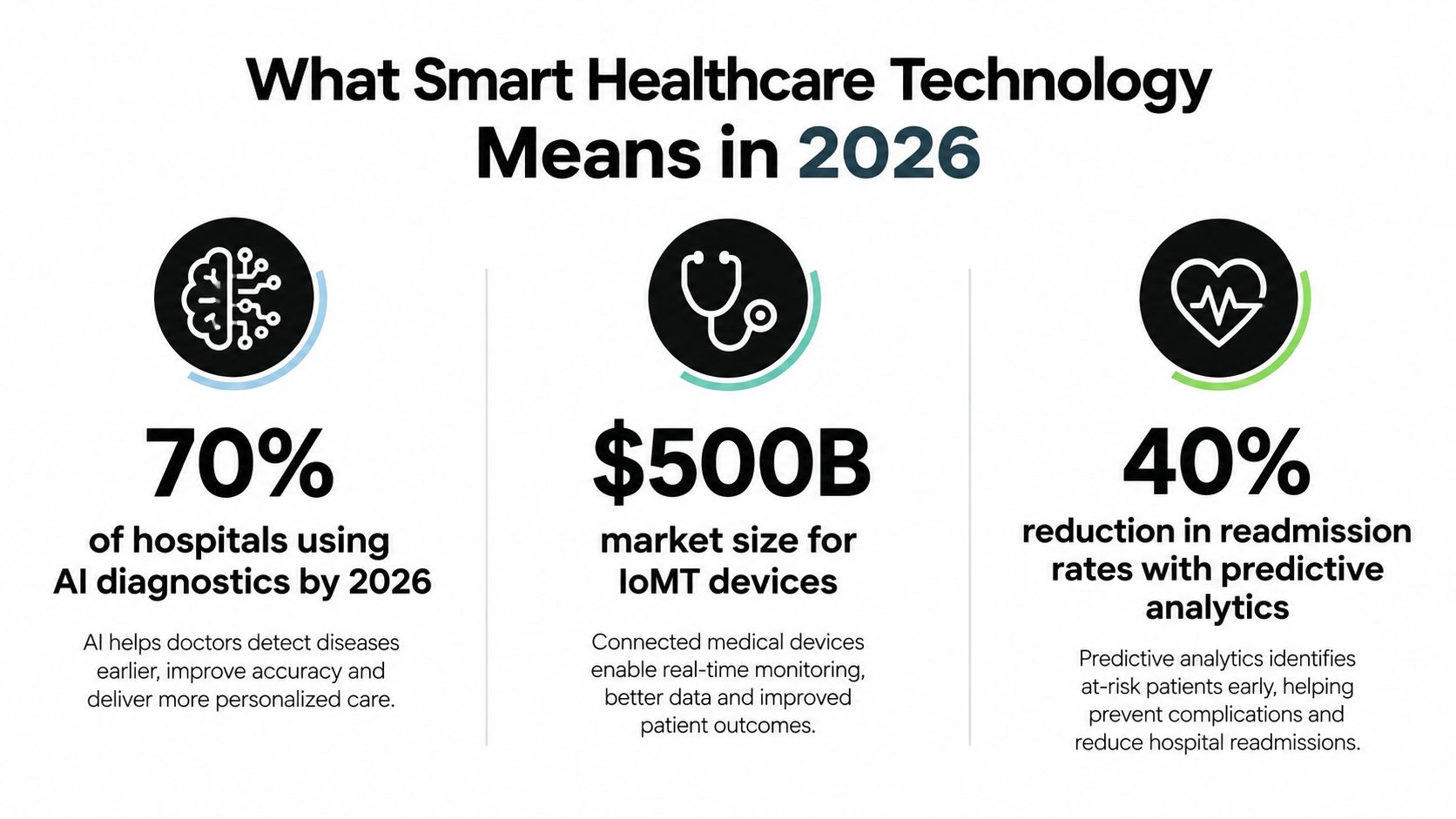
In practice, smart healthcare technology is the stack that makes care more connected and more responsive. It includes medical devices that generate data, software that organizes that data, and analytics that turn it into actions clinicians can use. The value shows up when a wearable, a chart, and a decision rule all work together instead of sitting in separate silos.
That's why the category belongs in the same conversation as core hospital infrastructure. A connected monitor without a workflow to escalate findings is just another data source. A dashboard without chart integration becomes a parallel record, and parallel records create work instead of reducing it.
The size of the market tells you the buyer base is already broad. Executives aren't evaluating whether smart healthcare is real anymore, they're deciding which layer to modernize first, device, workflow, analytics, or integration. For a practical point of entry, many teams start by mapping smart healthcare use cases against their current care pathways and then align implementation partners around the highest-friction process.
A useful reference point is the healthcare practice area on Healthcare AI Services, where the focus is on the systems that make digital care operational rather than theoretical.
Practical rule: if a smart healthcare tool doesn't change a workflow, it hasn't earned its place in production.
Smart healthcare systems only work when the stack is built to hand off cleanly from one layer to the next. Devices generate the signal, software classifies it, the data model makes it clinically usable, and infrastructure keeps the whole flow secure, available, and auditable. If any layer is poorly defined, the result is more alert noise, more manual reconciliation, and more work for the care team.
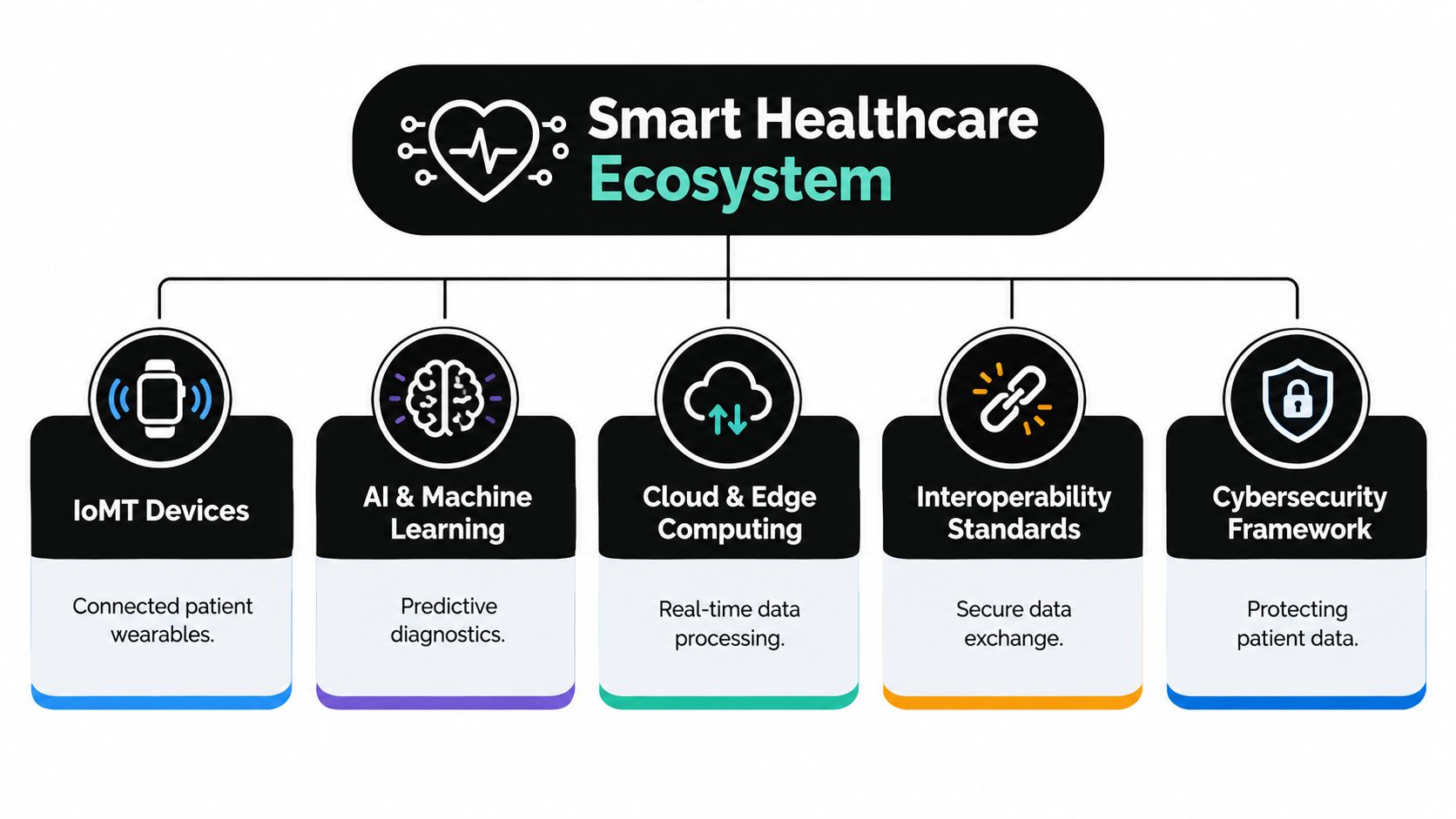
IoMT devices are the front line. They capture vitals, movement, imaging signals, or other patient data, then send it into systems that can track trends and flag exceptions. The practical question is not whether the device collects data, but whether the care model defines who sees it, how fast, and what action follows when a threshold is crossed.
AI and machine learning should support triage, not create a second decision layer that clinicians have to interpret from scratch. In production, that usually means pattern detection, prioritization, or prediction tied to a narrow operational question. A useful model returns a clear result that fits the workflow, for example a risk flag inside a nurse dashboard or a routing suggestion in a command center queue.
EHR integration is the point where a smart system becomes part of care delivery. In the United States, certified EHR adoption reached 96% among non-federal acute care hospitals and 78% among office-based physicians, while predictive AI use inside hospital EHRs reached 71% in 2024 (Institute of Internet Economics). The center of gravity has moved into the chart, which raises the bar for integration quality.
A practical example is FHIR R4 Patient resource mapping. If demographics, identifiers, and encounter context are not mapped cleanly into the patient resource, downstream apps end up with partial records and duplicate workflows. HL7 v2 feeds, SMART on FHIR apps, and direct EHR writeback all solve different problems, so the integration pattern has to match the clinical use case rather than the vendor demo.
Telehealth extends the care model beyond the hospital, cloud and edge infrastructure decide where processing happens, and interoperability standards determine whether data moves cleanly or gets trapped in custom interfaces. Security controls matter because every new endpoint expands the attack surface, which means identity, audit logging, and access rules have to be designed with the workflow, not added after go-live.
A smart healthcare stack fails fast when the data model is fragmented. Teams usually spend more time reconciling systems than using them.
For teams evaluating build options, healthtech engineering partner support often makes the difference between a prototype and a usable system. The test is whether the partner can work through integration constraints, compliance requirements, and clinical workflow fit without turning the project into a long pilot.
Leadership teams don't fund smart healthcare because the technology is interesting. They fund it when it reduces avoidable utilization, improves patient flow, or lowers the burden on scarce staff. The strongest cases are built on operational outcomes first, then clinical outcomes, because that's how CFOs and COOs evaluate risk.
A 2024 systematic review found that remote patient monitoring interventions produced a 9.6% mean decrease in hospitalisation and a 1.043-day mean reduction in hospital length of stay (Nature). Those are the kinds of results that move the conversation from gadget spending to capacity management.
The business case usually lands in four places. Operational efficiency improves when clinicians spend less time chasing data. Cost containment improves when admissions, readmissions, and unnecessary visits fall. Revenue protection improves when care teams can manage patients outside the hospital more reliably. Patient experience improves when the system feels coordinated instead of fragmented.
That said, the ROI isn't automatic. The value depends on who gets the alerts, how fast they're acted on, and whether the organization has the staffing to absorb new signals. A monitoring program that sends data into a dead-end inbox creates more labor, not less.
A strong business case includes a baseline, a clear clinical target, and a workflow owner. It also includes a cutoff for what counts as success, because not every metric should be expected to move at once. If you want to tie technology to enterprise value, focus on measures that executives already track, then link them to the specific care pathway the system changes.
Practical rule: a smart healthcare investment should reduce at least one recurring bottleneck, otherwise it's just digitization with a higher invoice.
The same logic applies when teams assess AI tools for business in healthcare settings. The tool has to fit the operating model, not the other way around.
The hardest architecture choice is usually not the model, it's the handoff between systems. Cloud-native designs, edge processing, and hybrid setups each solve different problems, and the wrong choice creates delay, cost, or compliance friction that shows up long after go-live.
Cloud-native architecture works well when scale matters more than immediacy. It centralizes data processing, simplifies updates, and usually supports broader analytics and model management. It's a good fit for batch reporting, population-level insight, and workflows that can tolerate normal network latency.
Edge architecture is different. It pushes processing closer to the device or care setting, which matters when response time is part of the clinical requirement. Surgical navigation, alarm escalation, and time-sensitive monitoring need local decision support because a few seconds of delay can change the usefulness of the system.
| Architecture Model | Latency Performance | Data Privacy & Compliance | Infrastructure Cost | Best Use Cases |
|---|---|---|---|---|
| Cloud-native | Good for non-urgent workflows, slower than local processing | Centralized controls can simplify governance, but data movement must still be managed carefully | Usually lower upfront complexity, easier to scale | Analytics, reporting, coordination, population programs |
| Edge computing | Better for real-time response and local failover | Keeps more processing near the source, which can help with sensitive use cases | More complex to deploy and support at the point of care | Monitoring, alerting, surgical support, critical care |
API-first integration is cleaner when vendors support it well. Middleware works better when the environment is messy and legacy systems won't cooperate. FHIR helps standardize exchange, but standards alone don't solve data quality, identity matching, or workflow alignment.
The most underrated issue is provenance. Teams want one version of the truth, but smart healthcare data often comes from charts, devices, self-reports, and operational systems at once. That's why Custom AI Strategy report work often begins with a data map before anyone talks about model selection.
Smart healthcare technology sits inside a regulated environment where “move fast” can't mean “skip controls.” Compliance isn't a wrapper added at the end, it has to be built into architecture, documentation, testing, and operational oversight from the start.

The European Union AI Act entered into force on 1 August 2024, and healthcare-related AI systems classified as high-risk have to meet requirements for risk mitigation, high-quality datasets, clear user information, and human oversight (European Commission). That changes how teams design, test, and document the system before it reaches patients.
The FDA has also updated the path for AI-enabled software. Its final guidance in December 2024 on predetermined change control plans gives manufacturers a mechanism for certain post-clearance updates without restarting the full cycle, which matters when models evolve after deployment. If your deployment includes device software, this isn't a side issue, it shapes the maintenance plan.
A workable compliance program usually includes three disciplines. First, define the intended use tightly so the system doesn't drift into unreviewed territory. Second, maintain evidence of how the model behaves and who reviewed it. Third, assign human oversight to the part of the workflow where judgment still matters.
For organizations building or buying AI-enabled device software, a regulatory compliance partner can help interpret obligations, but the engineering team still has to design for them. The best systems are built so auditability, version control, and data access review are part of the product, not an afterthought.
If you can't explain how the system changed, who approved it, and what data it used, you're not ready for regulated deployment.
Teams looking at SaMD solutions should also ask how the vendor handles model updates, validation artifacts, and post-market monitoring. Those details determine whether compliance is manageable or constantly reactive.
Most smart healthcare failures aren't technical failures. They're adoption failures caused by workflow friction, unclear ownership, and training that stops at the login screen. A team can buy strong software and still end up with a system clinicians avoid.
A 2026 health AI survey found workflow integration was the top barrier cited by 72% of respondents, ahead of unclear leadership direction at 68% and limited staff capacity or training at 61% (Dimesociety). That tracks with what implementation teams see in the field. The technology often works well enough, but it doesn't slot into the day-to-day rhythm of care.
The first phase should map the current state in plain language. Who enters the data, who reviews it, who acts on it, and what happens when no one is available? If those answers are fuzzy, the pilot will be fuzzy too.
A workable rollout usually begins with a narrow pilot, then expands after the team proves the workflow holds under real conditions. Training should be role-specific, since clinicians, administrators, and operations staff need different instructions. Feedback loops matter because the first version of a process is rarely the final one.
Here's the important part, a successful implementation measures behavior, not just access. Login counts don't tell you whether the tool reduced steps, cut delays, or changed decisions. If adoption is low, the problem may be design, not resistance.
For teams that need automation around intake, routing, or document handling, internal tooling and AI Automation as a Service can help, but only after the workflow is defined clearly enough to automate. If the process is unstable, automation just makes the instability faster.
The best smart healthcare use cases are narrow enough to measure and important enough to matter. Broad platform promises are usually weak, but specific applications can produce clear clinical and operational value when the workflow is designed correctly.
Remote patient monitoring has the strongest evidence when the use case is specific. The 2024 review found lower hospitalisation and shorter stays, which is why chronic disease management gets so much attention in enterprise planning. The pattern is consistent, if the system detects change early and routes it to the right clinician fast enough, it can reduce avoidable utilization.
FDA clearance also shows where the market is maturing. Records show active approval across multiple specialties in 2024, including the X-Guide Surgical Navigation System cleared on 02/21/2024, EpiMonitor on 02/15/2024, and Philips ultrasound systems and QOCA image Smart RT Contouring System on 02/13/2024 (FDA). That matters because regulatory clearance gives leadership teams a more concrete basis for vendor evaluation.
Not every digital monitoring program delivers the same result. A prior randomized-trial meta-analysis found no statistically significant improvement across broad biometrics such as BMI, weight, waist circumference, body fat percentage, systolic blood pressure, or diastolic blood pressure. The practical lesson is simple, condition-specific design wins.
One good example is the way teams use workflow automation to clean up incoming patient data before it reaches clinicians. A useful reference is improve patient data workflows with AI, which illustrates how downstream operations improve when the intake and routing layer is designed properly.
For teams exploring real-world use cases or a clinic AI assistant, the question isn't whether the category is promising. It's whether the use case has a clear owner, a measurable threshold, and a workflow that can absorb the output without adding friction.
A smart healthcare program can fail long before the model is built. The usual failure point is the partner selection process, where a general software team is asked to solve a regulated, integration-heavy operational problem without enough healthcare depth.
Ask whether the team has shipped systems that connected to EHRs, not just demos. Ask for a recent 510(k) submission artifact, a FHIR integration log, and a post-market monitoring runbook from the last deployment. Ask how they document data lineage, audit trails, and model version changes. Ask what standards they support, and what happens when source data is incomplete, delayed, or inconsistent.
A credible partner should also explain how they handle change management after go-live. If they treat deployment as the finish line, they are thinking like a software vendor, not a healthcare operator. In regulated health tech, ongoing tuning is part of the product lifecycle.
Red flags are vague compliance language, generic case studies, and no clear answer on interoperability. They also show up when a team talks only about the model and never about the clinical workflow it has to fit into.
Green flags are more concrete. They show up as a deployment method you can inspect, familiarity with regulated environments, and a clear answer on what support looks like after launch. They also show up when a partner can discuss the trade-offs between speed, safety, and maintainability without overselling any one of them.
If you are comparing vendors, start with the basics:
A practical partner should also be able to point to our expert team and explain who handles architecture, compliance, and delivery. That level of clarity is usually a better signal than a polished pitch deck.
If you are evaluating an healthtech engineering partner, ask the same operational questions. The test is whether the team can handle the messy middle between concept and adoption, because that is where most smart healthcare programs succeed or stall.
What are intelligent healthcare systems? Explore architecture, EHR integration, AI use cases, ROI, risks and how to build compliant systems.

Master AI-driven healthcare with this guide. Explore clinical use cases, regulatory requirements, vendor selection, and a practical roadmap for safe deployment.
Learn what AI healthcare software is, where it delivers ROI, and how leaders evaluate vendors, integrations, regulation, and rollout in 2026.
Connect with our team to explore how AI expertise can transform your business.