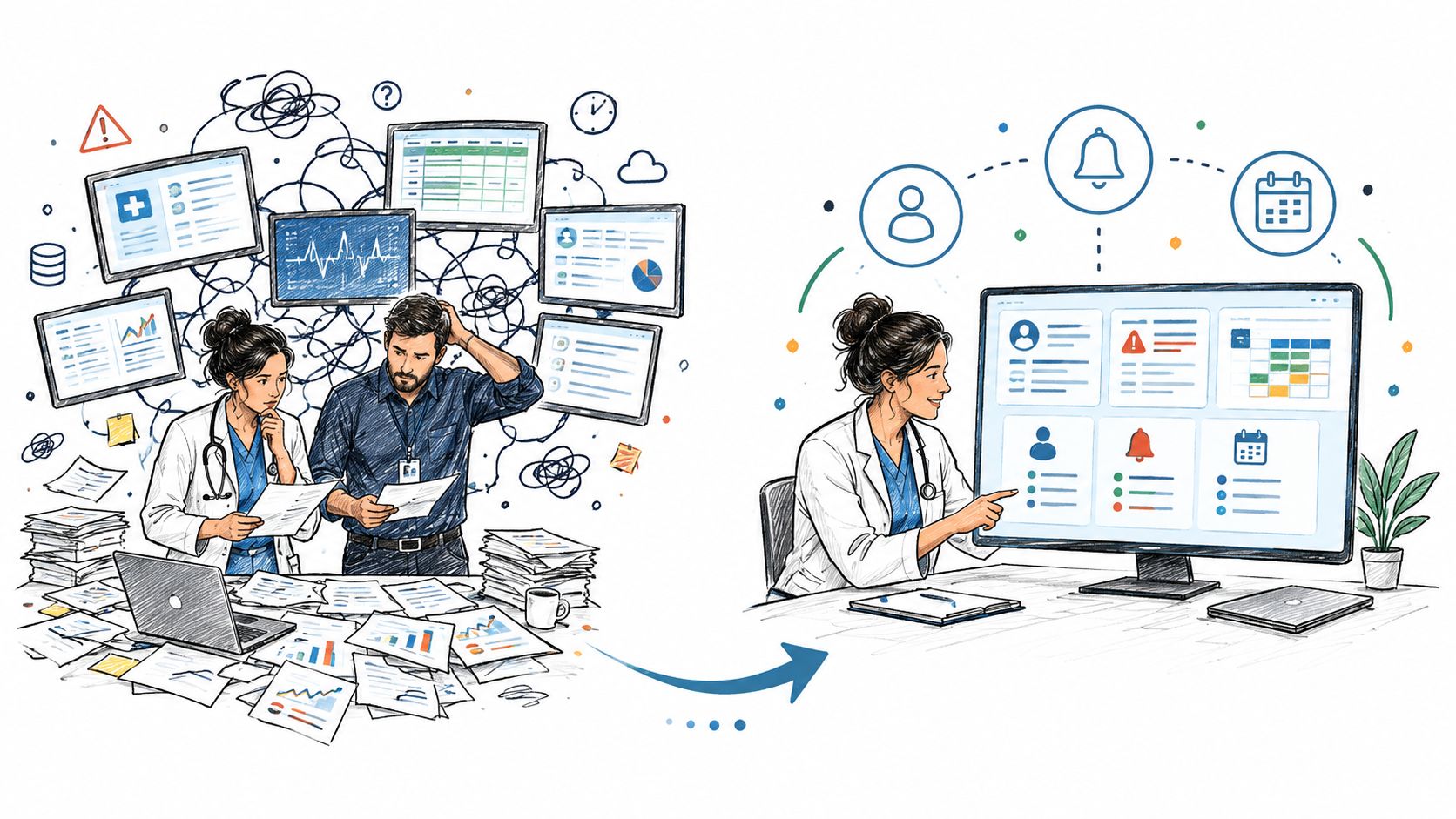
A clinician opens the morning list and sees three different truths about the same patient. The EHR has one medication record. A lab portal has another. A remote monitoring dashboard shows a worsening trend, but nobody has pulled it into the visit workflow. Down the hall, an operations lead is juggling staffing gaps, prior authorizations, and discharge delays with reports that arrive too late to change today's schedule.
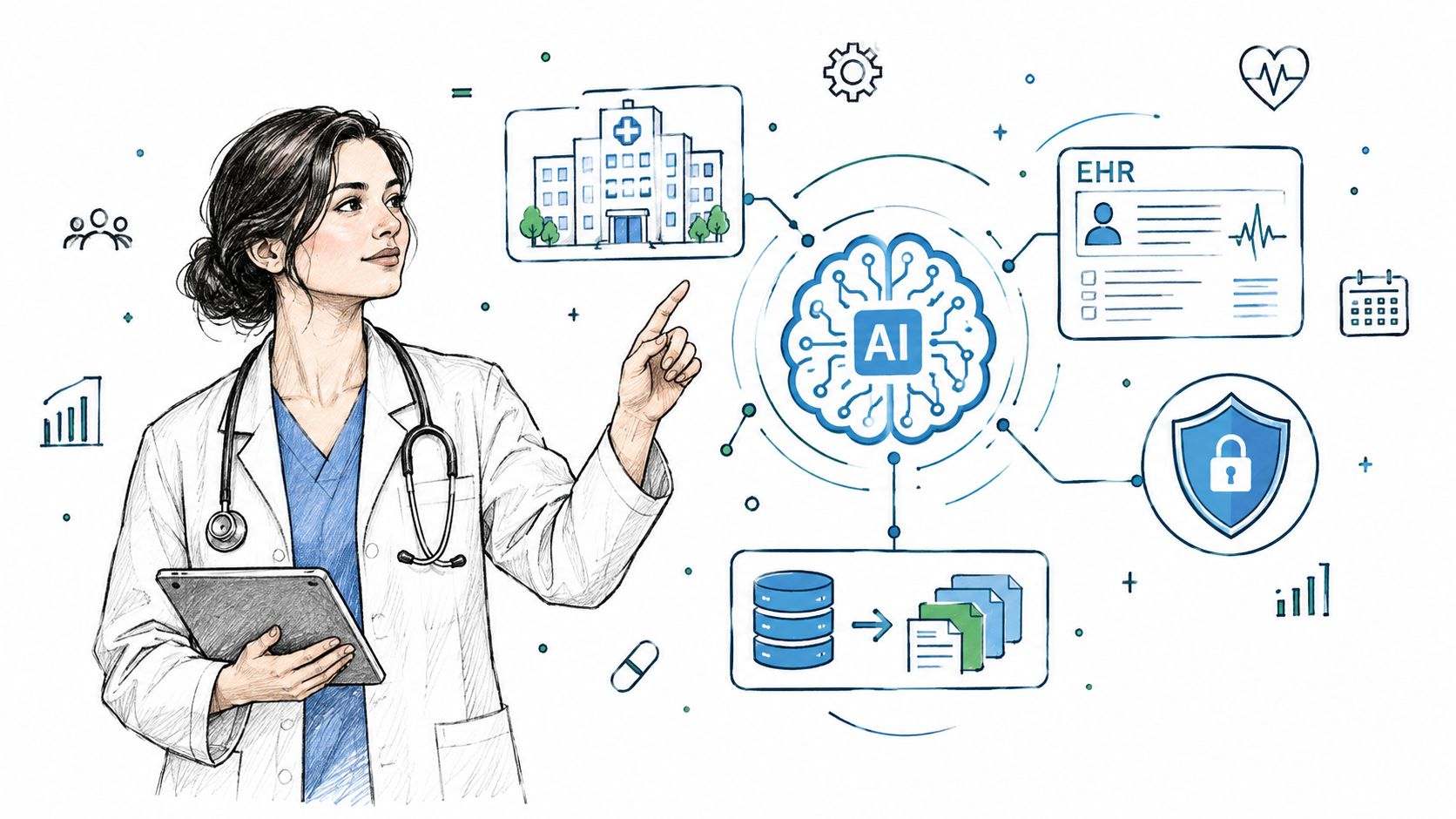
An intelligent healthcare system doesn't fix that by adding one more dashboard. It changes how data moves, how decisions surface, and how teams act inside the workflow they already use. Instead of asking staff to hunt across systems, it pulls the right context into the right screen, at the right moment, with clear human review.
That matters now because intelligent healthcare is no longer a fringe experiment. One 2026 industry summary places hospitals and clinics at 42.44% of global AI-in-healthcare revenue, which tells you where adoption is landing first: frontline delivery settings, not innovation labs (Fortune Business Insights).
Introduction to Intelligent Healthcare in Practice
Hospitals and clinics account for 42.44% of global AI-in-healthcare revenue, according to Fortune Business Insights. That concentration matters for one reason. Healthcare leaders are no longer buying AI as a lab experiment. They are trying to fit it into live clinical operations, billing workflows, staffing constraints, and regulated data environments.
At 8:15 a.m., that reality shows up in small failures. A nurse checks one portal for imaging, another for lab trends, and a secure message thread for worsening vitals. The clinical question is straightforward. The operational setup is not.
By 8:17 a.m., the gap is visible. It is not "having AI" versus "not having AI." It is whether the organization can pull the right data into the EHR workflow, apply logic that fits the clinical context, and present an action a human can review without leaving the visit.
Why leaders should care now
For CEOs and CTOs, the central decision is architectural and operational before it is algorithmic. A model may perform well in testing, but ROI depends on less glamorous questions: Can it read from the EHR without brittle custom interfaces? Does it use standards such as HL7 or FHIR cleanly enough to survive upgrades? Can compliance teams audit what it recommended, when, and on what basis? Can frontline teams act on it inside the systems they already use?
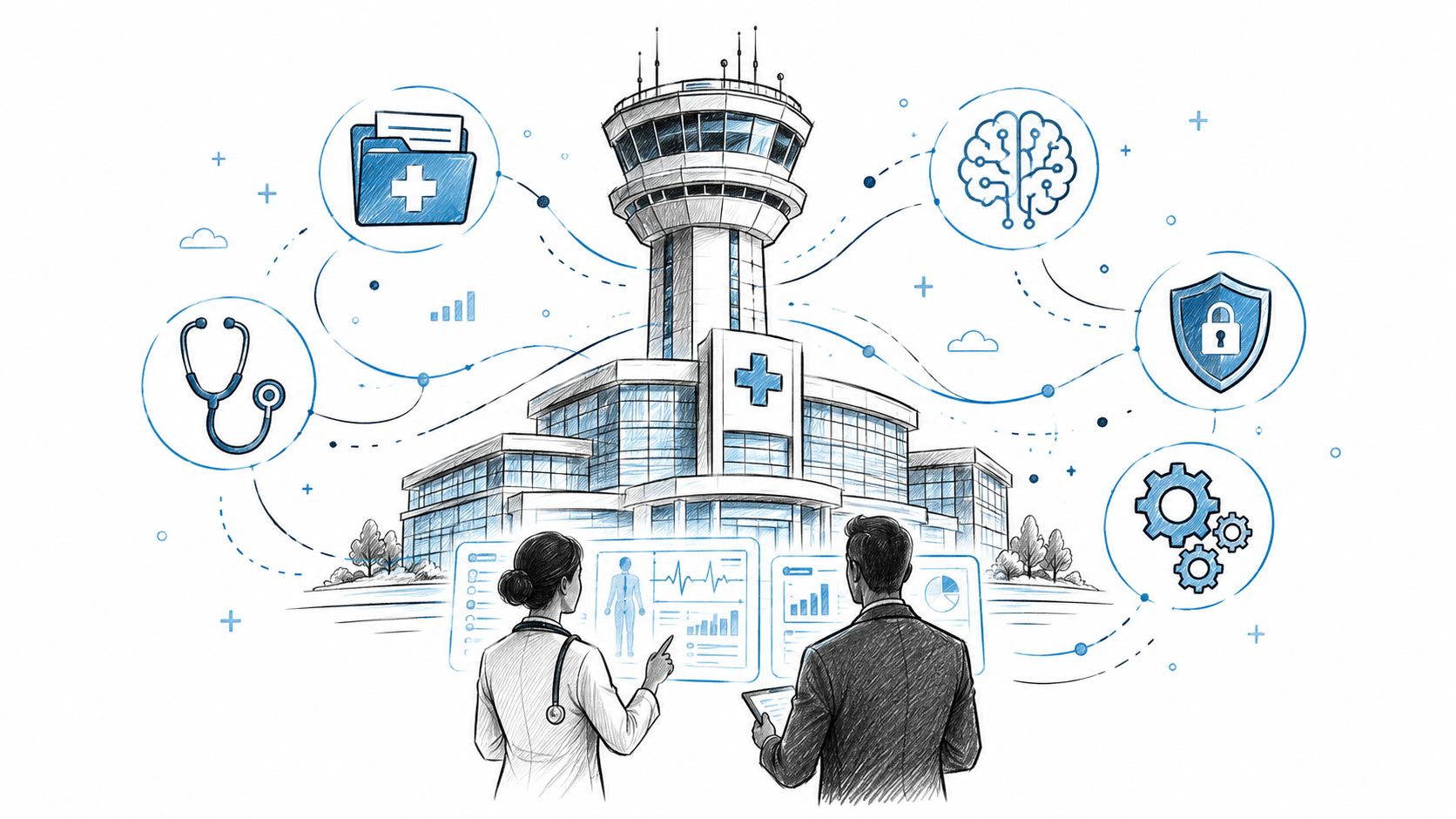
A useful analogy is airport operations. The value does not come from one radar screen by itself. It comes from how radar, routing, scheduling, and control tower procedures work together under clear rules. Intelligent healthcare works the same way. Data, models, workflow triggers, interoperability layers, and governance have to operate as one system or the result is another isolated tool.
That is why many healthcare AI projects stall after the demo. Integration work expands. Data definitions conflict across source systems. Alerts arrive in the wrong screen. Monitoring is weak after go-live, so drift and workflow workarounds go unnoticed.
If you are assessing options as a buyer, builder, or operator, review any healthcare AI services for clinical workflow integration and governance with the same scrutiny you would apply to an EHR rollout or revenue cycle platform. In practice, the long-term winners are usually the organizations that set up interoperability, human oversight, and lifecycle monitoring early, not the ones that start with the flashiest model.
What Intelligent Healthcare Systems Really Are
Hospitals already run on dozens of software systems, devices, and handoffs. The hard part is rarely producing one more prediction. The hard part is getting the right signal into the right workflow, with enough context and oversight that people can act on it.
That is the difference between a tool and a system.
An EHR records what happened. A point AI application detects one pattern, such as readmission risk or missing documentation. An intelligent healthcare system coordinates data, decision logic, model output, and human review across the care process. Airport operations are a useful comparison. Radar alone does not run an airport. The value comes from how radar, routing, scheduling, and tower procedures work together under clear rules. Healthcare works the same way.
Core definition: Intelligent healthcare systems combine clinical data, workflow logic, AI models, interoperability standards, and human oversight so teams can make better decisions inside care delivery, not outside it.
The phrase "intelligent system" often creates confusion because buyers picture the model first. In practice, intelligence comes from orchestration. The system has to gather the right inputs, interpret them in clinical context, deliver a recommendation or action at the right moment, and keep a record of what happened. If one link breaks, the value drops quickly.
A strong model in the wrong place still fails. If a deterioration alert appears in a separate portal after rounds are complete, it may be technically accurate and operationally irrelevant. If a recommendation cannot be traced to the source data and model version, compliance and clinical leadership will slow or stop adoption.
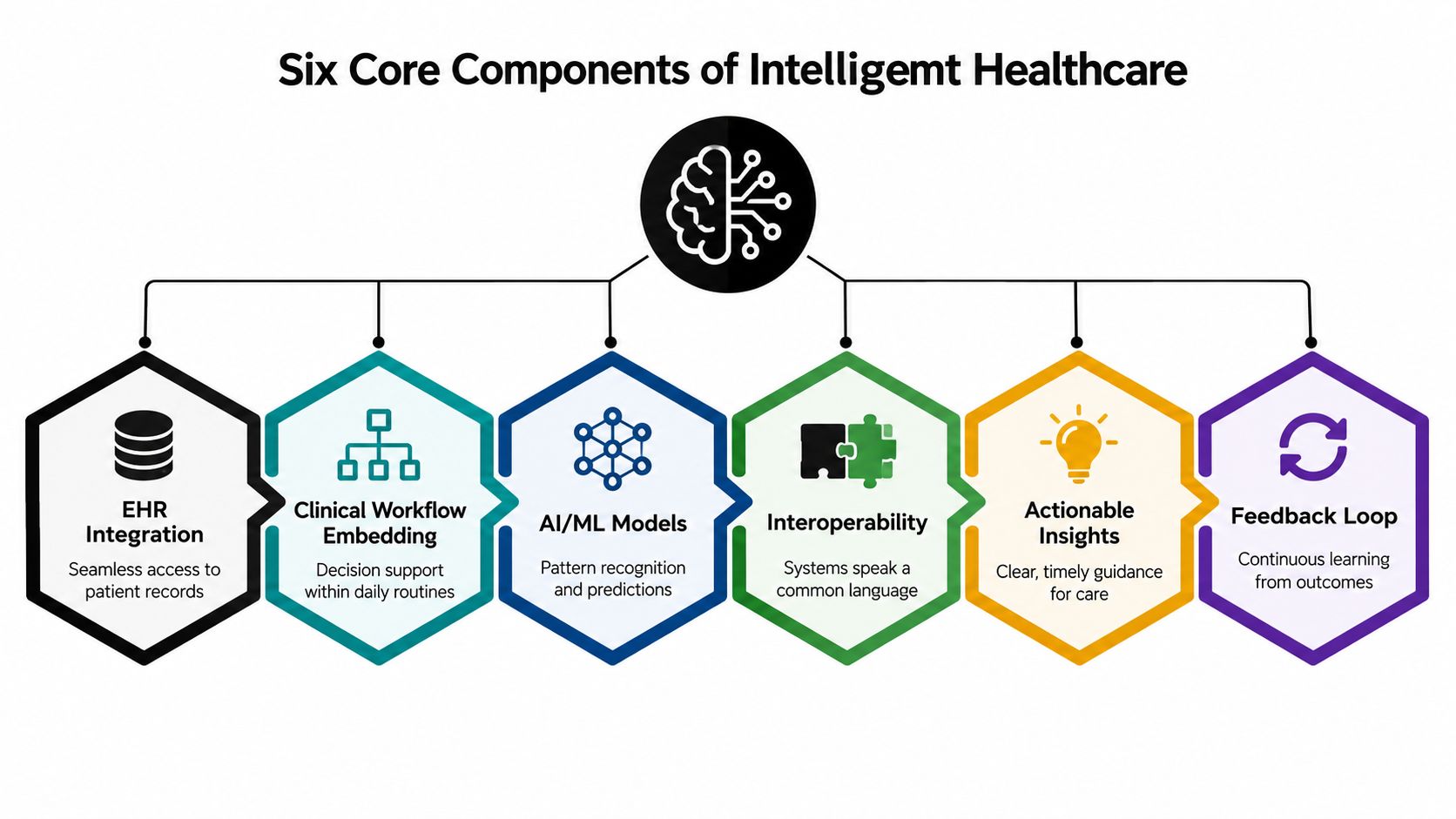
A practical way to evaluate whether you are looking at a true intelligent healthcare system is to ask three questions:
- Workflow test: Does it appear inside the tools clinicians, care managers, or operations teams already use?
- Action test: Does it support a next step, such as triage, documentation, routing, or follow-up, instead of producing insight alone?
- Governance test: Can your team review which model version ran, what inputs it used, and how performance is tracked after deployment?
Many products pass only one of these tests. They may be useful, but they are still features or point tools.
Organizations often need both. A health system might use a lightweight AI assistant for narrow administrative work and a larger intelligent system for care coordination or utilization management. The mistake is treating every AI feature as a strategic platform investment.
The intelligence is not only in the model. It is in the orchestration around the model.
Leaders who understand that tend to budget differently. They spend less time asking only about model accuracy and more time asking how the system fits EHR workflows, which interoperability approach it requires, who owns monitoring, and how exceptions are handled after go live. That is usually where ROI is won or lost.
Core Components That Make Systems Intelligent
Most failures in intelligent healthcare systems don't come from weak algorithms alone. They come from missing parts in the delivery stack.
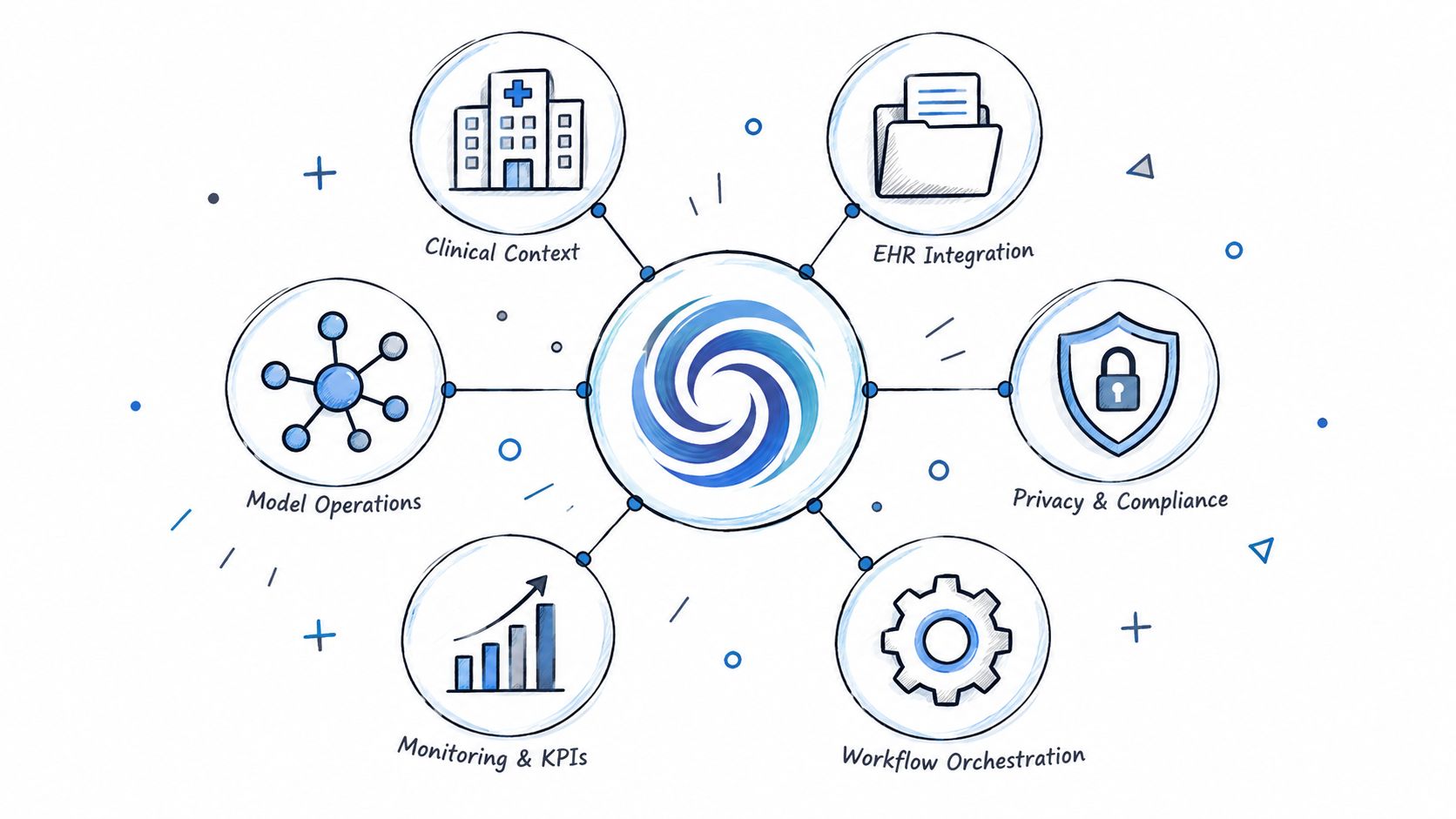
The six parts that have to work together
-
EHR integration
If the system can't read patient context from the EHR and write back useful outputs, clinicians end up copying information by hand. That kills speed and trust.
-
Clinical workflow embedding
Recommendations need to appear at the point of care. A prompt that arrives after the encounter is analytically interesting and operationally useless.
-
AI and ML models
The model still matters. It may classify images, summarize notes, flag deterioration risk, or extract structured fields. But in production, the model is one component in a larger machine.
-
Interoperability layer
Healthcare systems speak through standards and interfaces. The U.S. Health IT infrastructure notes that HL7 Version 2, HL7 C-CDA, and HL7 FHIR remain core for data exchange, and that AI applications commonly consume or generate demographics, encounters, problems, observations, medications, and procedures through FHIR resources and implementation guides such as US Core profiles (HealthAI Global Landscape Report).
-
Security and privacy controls
Access control, audit trails, and data minimization aren't side tasks. They shape architecture from day one.
-
Compliance engineering
If the product qualifies as medical software, the build path changes. Teams working on SaMD solutions have to design for documentation, traceability, validation, and change control much earlier than general software teams usually expect.
What breaks when one part is missing
A few common failure modes show up repeatedly:
- No integration: Staff export CSVs and re-upload them elsewhere. The "intelligence" depends on manual labor.
- No workflow embedding: Teams get alerts in email or a side portal, so the signal arrives detached from the clinical moment.
- No standards strategy: The product works in one environment and becomes brittle in the next because data contracts weren't normalized.
- No compliance layer: Engineering ships fast, then gets blocked when buyers ask for clinical safety evidence and audit history.
A good example is document-heavy intake. A capable AI-powered data extraction engine can structure forms, referrals, or scanned records, but it only becomes useful when those fields map cleanly into downstream workflows and validation logic.
If you're thinking through automation around front-desk communication or triage support, this overview of how virtual assistant AI works in healthcare is useful because it shows how conversational layers fit into larger care operations rather than standing alone.
Build versus bolt-on
Some organizations can extend existing platforms with strong internal tooling. Others need deeper custom healthcare software development because their workflows, integration environment, or regulatory posture won't fit an off-the-shelf product.
The point isn't to custom-build everything. It's to identify which parts are strategic enough that you can't afford architectural shortcuts.
Architecture Patterns and Interoperability Choices
Health systems rarely struggle because they picked the wrong model first. They struggle because the model sits outside the record, outside the workflow, or outside a governance process that can keep it safe and useful over time.
Architecture choice decides whether intelligence shows up at the point of care or in a disconnected side system. A good way to frame it is simple. The model is the engine. The architecture is the road network, traffic rules, and maintenance plan. If those pieces are weak, even an accurate model creates friction.
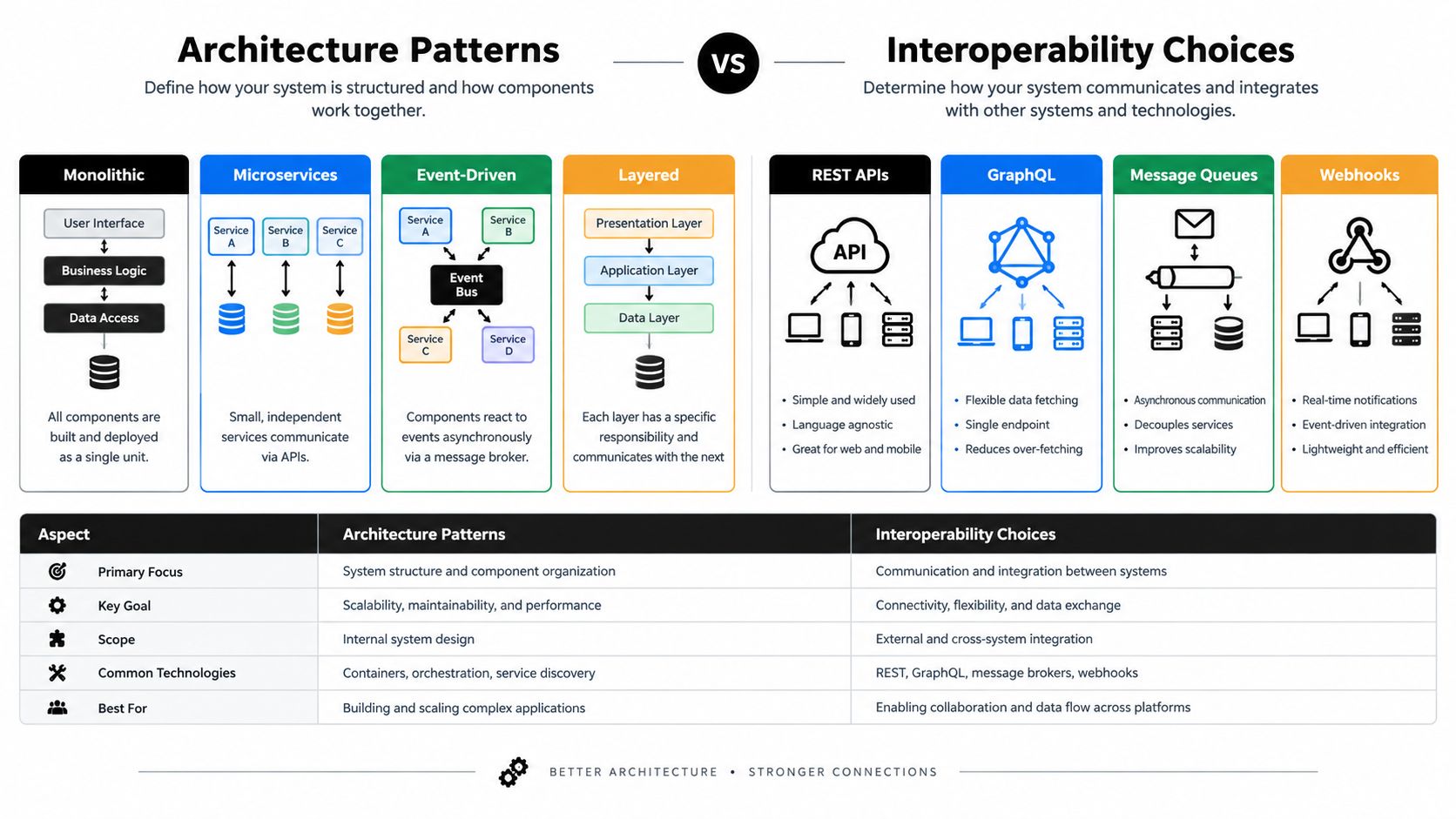
Three common architecture patterns
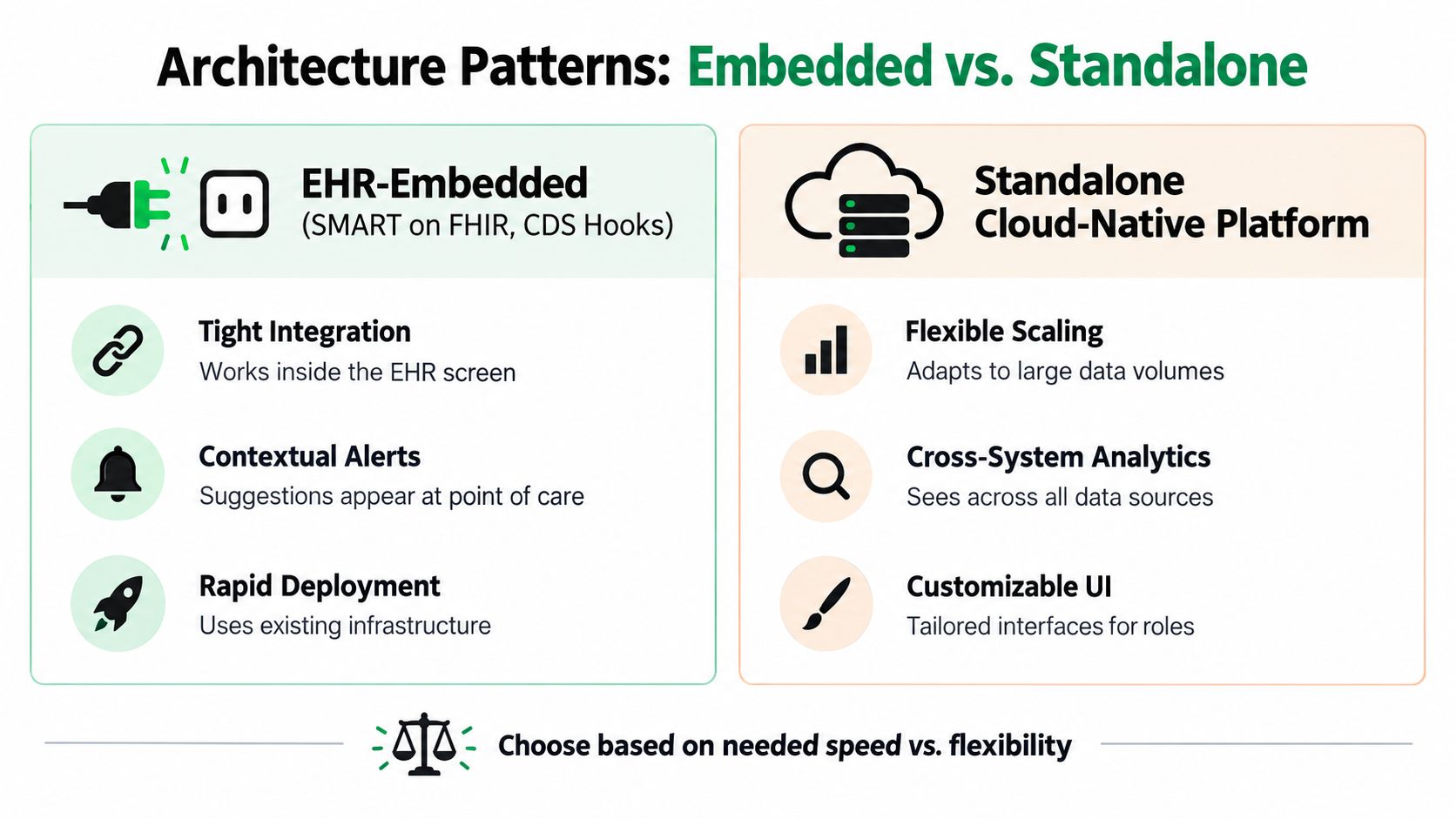
The first pattern is EHR-embedded decision support. Here, the intelligence runs inside or very close to the electronic health record using standards such as SMART on FHIR and CDS Hooks. That matters because clinicians do not want to swivel between systems during chart review or order entry. A review of AI-based clinical decision support systems points to data variability and programming complexity as recurring interoperability problems, which is why standard interfaces matter so much for adoption and workflow fit (systematic review on AI-based clinical decision support systems).
The second pattern is a standalone cloud-native platform. This works well when the product needs to combine signals across facilities, support its own operational workspace, or coordinate activity that extends beyond a single EHR. The trade-off is clear. You gain flexibility and broader data reach, but you must work harder to bring recommendations back into the clinical moment.
The third pattern is a hybrid edge-cloud model. This setup keeps some processing or integrations close to the source system while using cloud services for orchestration, heavier analytics, and lifecycle monitoring. Hospitals often end up here when they need both local workflow precision and centralized oversight.
Choosing an Architecture Pattern for Intelligent Healthcare
| Architecture Pattern |
Best For |
Trade-off to Manage |
| EHR-embedded |
Point-of-care alerts, order guidance, contextual decision support |
Dependence on EHR limits, release cycles, and vendor-specific implementation details |
| Standalone cloud-native |
Cross-facility analytics, care coordination, operational command layers |
Weaker workflow fit unless write-back, task routing, and context sharing are designed well |
| Hybrid edge-cloud |
Mixed clinical and operational workloads, phased modernization |
More components to govern, monitor, and support across environments |
The decision criteria that matter
CEOs and CTOs should evaluate four design questions before they commit to a pattern.
- Workflow proximity: If a recommendation must appear during order entry, medication review, or triage, embedded delivery usually works best.
- Data spread: If value depends on claims, labs, imaging, device feeds, and scheduling data together, standalone or hybrid designs usually handle that breadth better.
- Latency tolerance: Bedside support has very different timing requirements from weekly capacity planning or risk scoring.
- Integration maturity: A team without clear interface ownership, version control, and testing discipline should be careful with highly distributed architectures.
One rule helps cut through the noise. Choose the pattern that fits the decision point, not the demo.
That is also where interoperability standards stop being a compliance checkbox and start acting like economic infrastructure. FHIR, HL7 interfaces, terminology mapping, identity resolution, and audit trails determine whether a system can survive expansion to a second hospital, a second EHR, or a stricter buyer review. Real ROI comes from getting intelligence into care delivery with traceability and operational control, then monitoring it as clinical workflows, source data, and model behavior change over time.
Teams planning AI product development should define architecture choices alongside governance, alert routing, fallback behavior, and monitoring expectations early. The same applies to requirements analysis. Data contracts, user roles, write-back rules, and human review points need to be explicit before deployment, not patched in after adoption stalls.
Real World Use Cases and Measurable ROI
Healthcare buyers do not fund intelligent systems because a model scores well in a lab. They fund them when they remove minutes from high-cost decisions, reduce avoidable handoffs, and fit the systems staff already use every hour of the day.
That is why hospitals and clinics often see value first. Repeated decisions happen there at scale, inside tightly constrained workflows, with real consequences for delay. As noted earlier, market adoption data points in the same direction. The practical lesson for CEOs and CTOs is simple. Start where workflow friction is expensive and measurable.
Where value usually appears first
A useful way to evaluate use cases is to follow the decision, not the model. In healthcare, intelligence behaves less like a standalone product and more like a routing layer for attention. It decides what should be seen, by whom, and how fast.
Common starting points include:
- Clinical decision support: Deliver patient-specific prompts during chart review, medication reconciliation, or escalation decisions, inside the workflow where the clinician is already working.
- Imaging and triage workflows: Prioritize review queues, route studies to the right specialist, or flag cases that need earlier attention.
- Remote monitoring: Convert device feeds and patient-reported signals into outreach tasks, follow-up actions, or escalation paths that care teams can manage.
- Care coordination: Combine records, referrals, discharge information, and outreach signals so transitions do not depend on manual chasing across disconnected systems.
- Operational automation: Structure intake documents, assist prior authorization steps, and reduce repetitive administrative work that consumes staff time without improving care.
These categories matter because they produce ROI through operations first. Better prediction alone rarely changes economics. A prompt that arrives too late, lands in the wrong inbox, or cannot write back to the record behaves like a missed opportunity, even if the model itself is accurate.
How leaders should measure ROI
The strongest ROI cases use three layers of evidence. Clinical usefulness, workflow adoption, and operating impact.
Start with behavior change. Did a clinician act on the recommendation? Did staff complete the task with fewer clicks, fewer calls, or fewer workarounds? Then check timing. Did the insight appear early enough to change care or only early enough to document it? Finally, measure system-level effects such as turnaround time, queue length, denial rework, follow-up completion, or avoidable escalation.
One simple rule helps. Tie each use case to one decision, one workflow, and one owner.
That discipline prevents a common mistake. Teams approve an AI project based on broad promises, then struggle to prove value because no one defined the operational metric the system was supposed to move. In practice, ROI usually comes from very specific improvements: fewer chart review delays, faster imaging reads, better referral closure, or less manual intake processing.
This is also why governance shows up in ROI, not only in compliance reviews. If terminology mapping is inconsistent, patient identity resolution is weak, or EHR write-back rules are unclear, adoption drops. Staff lose trust. Exceptions pile up. The system starts creating a second workflow instead of improving the first one.
One area worth watching is neurocognitive and behavioral support, where digital intervention models are becoming more visible in care delivery. This example of AI-powered cognitive therapy showcased is useful because it shows a broader point. Healthcare AI creates value when it improves the delivery experience for patients and clinicians, not only when it produces a prediction in the background.
For product and platform teams, the question is rarely "Where can we add AI?" A better question is "Which decision, in which workflow, with which data contract, will produce measurable operating gain?" That framing leads to better use-case selection and more believable ROI.
Implementation Roadmap From Data to Deployment
Many healthcare AI projects fail before deployment for a simple reason. The team builds a model before it defines the data contract, workflow trigger, and operating owner.
A better roadmap works like hospital plumbing. The model is only one fixture. Value depends on whether data arrives in the right format, whether the output reaches the right screen at the right moment, and whether someone is responsible when the system behaves unexpectedly.
Start with data readiness and governance. Identify which records the system will use, where those records originate, how patient identity is resolved across sources, and which fields are reliable enough for production use. In healthcare, a smaller dataset with clear provenance usually beats a larger one with weak normalization, unclear terminology mapping, or inconsistent timestamps.
Next, define the integration contract before model work expands. Specify the APIs, HL7 feeds, FHIR resources, documents, and event triggers involved. Decide which platform is the source of truth and which system is allowed to write back. This is the point where many teams discover that the hard part is not prediction quality. It is getting the recommendation into the EHR workflow without creating a second inbox or extra reconciliation work. If leadership needs a planning framework, a structured AI product development workflow for healthcare implementation can help turn assumptions into named interfaces, owners, and release criteria.
Then move into model development and validation. The World Health Organization's framework for AI-based medical devices separates training, validation, and evaluation, and extends responsibility into deployment and post-market surveillance because real clinical conditions differ from development settings (WHO guidance on AI-based medical devices).
After validation, choose the deployment model. Some systems belong inside the EHR session. Others work better as a background service, a separate operational console, or a hybrid pattern. The right choice depends on who acts on the output, how quickly they need it, and whether the recommendation must become part of the legal clinical record.
Then add governance features as product features, not policy documents sitting outside the system:
- Audit logging: Record what output was shown, when it appeared, what data it used, and which model version produced it.
- Versioning: Track changes to prompts, models, thresholds, terminology mappings, and interface logic.
- Human review paths: Let clinicians and operators override, annotate, defer, or escalate recommendations without leaving their normal workflow.
- Monitoring: Watch for drift, interface failures, delayed data feeds, unusual override rates, and other signs that the system is no longer behaving as designed.
The last step is operational handoff. Production readiness means runbooks, support ownership, retraining criteria, downtime procedures, incident response, and a release process that treats workflow changes as seriously as model changes.
That is how intelligent healthcare systems get from pilot to routine use. The work is joining data, workflow, interoperability, and governance into one operating system that clinicians can trust.
Risks Evaluation and Choosing the Right Partner
The biggest misconception in healthcare AI is that accuracy equals safety. It doesn't.
A model can score well in testing and still cause harm if it appears at the wrong time, uses incomplete data, or nudges users without enough context. That's why intelligent healthcare systems need evaluation across safety, adoption, and governance, not just predictive performance.
The risk lenses leaders should use
In the U.S. regulatory context, software classification matters early. The FDA framework defines software as a medical device, or SaMD, as software intended for one or more medical purposes without being part of a hardware medical device, a distinction reiterated in a June 2026 Congressional Research Service summary discussed in this SaMD whitepaper. That classification affects how you document, validate, and maintain the product.
In Europe, the bar is broader. The EU AI Act treats AI-based clinical decision support systems as high-risk, requiring risk management, data governance, technical documentation, audit logging, transparency, human oversight, postmarket monitoring, quality management, conformity assessment, and EU registration, while MyHealth@EU adds cross-border interoperability expectations (JMIR analysis of the EU AI Act and MyHealth@EU).
For NHS entry, suppliers face a concrete operational gate. DTAC is the baseline framework for digital health technologies entering the NHS, and it covers clinical safety, data protection, technical assurance, interoperability, and usability/accessibility (Digital Health on DTAC and NHS frameworks).
What to ask a potential partner
Use partner evaluation questions that reveal delivery maturity:
- Can they integrate with clinical systems? Ask about EHR workflows, interface standards, and structured data contracts.
- Can they handle regulated change? Ask how they manage versioning, validation evidence, and traceability.
- Can they support operations after launch? Ask who monitors drift, alert quality, and user behavior.
- Can they work across your ecosystem? Many organizations also need adjacent infrastructure support, and practical references such as this overview of Canadian healthcare IT solutions can help frame the broader operational environment.
For some teams, a focused builder like Ekipa AI fits when the need is integration-heavy delivery across workflow automation, EHR connectivity, and product implementation. For others, the right move is pairing engineering with a specialized regulatory compliance partner so compliance work isn't bolted on late.
The best evaluation signal isn't a polished demo. It's whether the team can explain failure modes clearly, show how governance lives in the product, and work with clinicians, operators, and security reviewers at the same table. You can also review our expert team to see the kind of cross-functional capability this work typically requires.
If you're evaluating intelligent healthcare systems, Ekipa AI helps turn the idea into a buildable plan and a production-ready delivery path. That includes workflow design, EHR integration, AI implementation, and the governance layers that make healthcare systems usable. Visit Ekipa AI to explore how that support fits your product roadmap.