Most hospital AI projects don't die because the model missed a benchmark. They die because a clinician can't trust the output, the EHR can't accept the result, or nobody can explain what happens when the system changes overnight. If you're evaluating an AI healthcare platform right now, that's the right question to ask first, because the failure is usually operational, not mathematical.
The market already reflects that shift. One 2026 industry estimate valued the global AI-in-healthcare market at about USD 36.67 billion in 2025 and projected USD 505.59 billion by 2033, with a 38.9% CAGR from 2026 to 2033 (Grand View Research). That scale means buyers aren't shopping for novelty anymore. They're buying systems that can survive hospital workflows, compliance reviews, and integration politics.
What an AI Healthcare Platform Actually Is
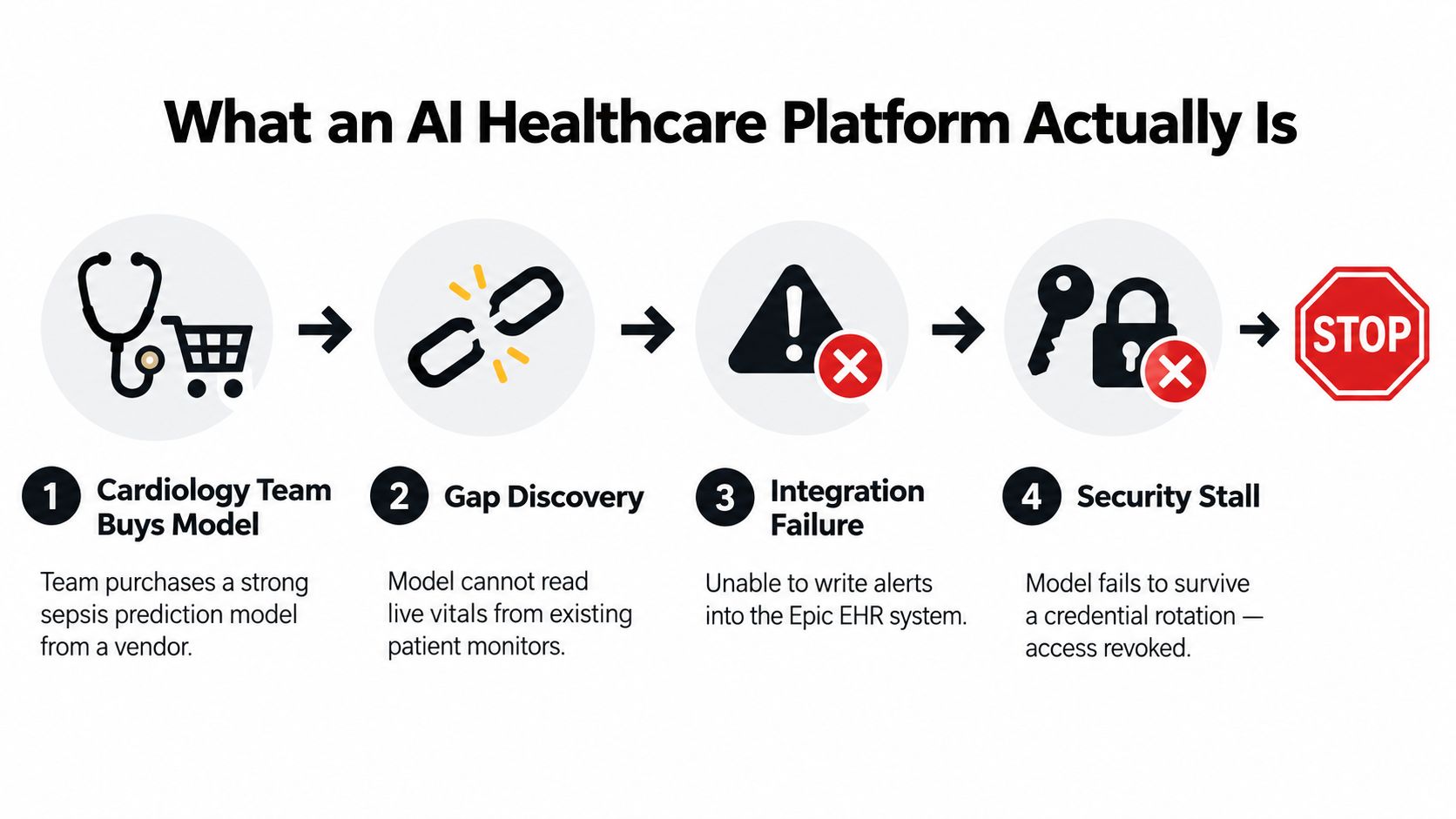
A cardiology team can buy a strong sepsis prediction model and still get nowhere. If it can't read live vitals, write alerts into Epic, or survive a credential rotation, the model is just a demo with a nice slide deck. That's the difference between a model and an AI healthcare platform. One predicts. The other operates inside the hospital.
The production layer is the product
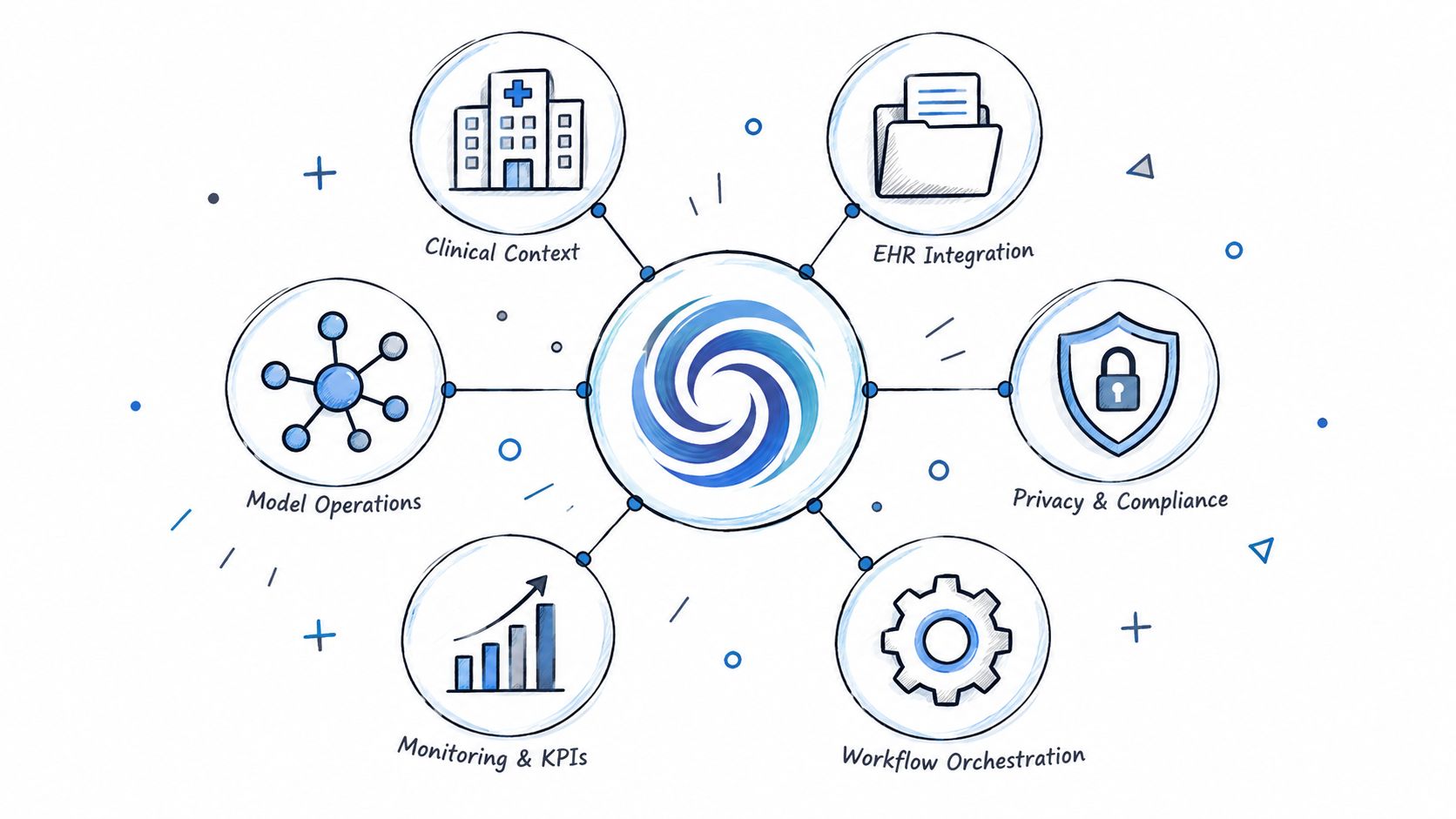
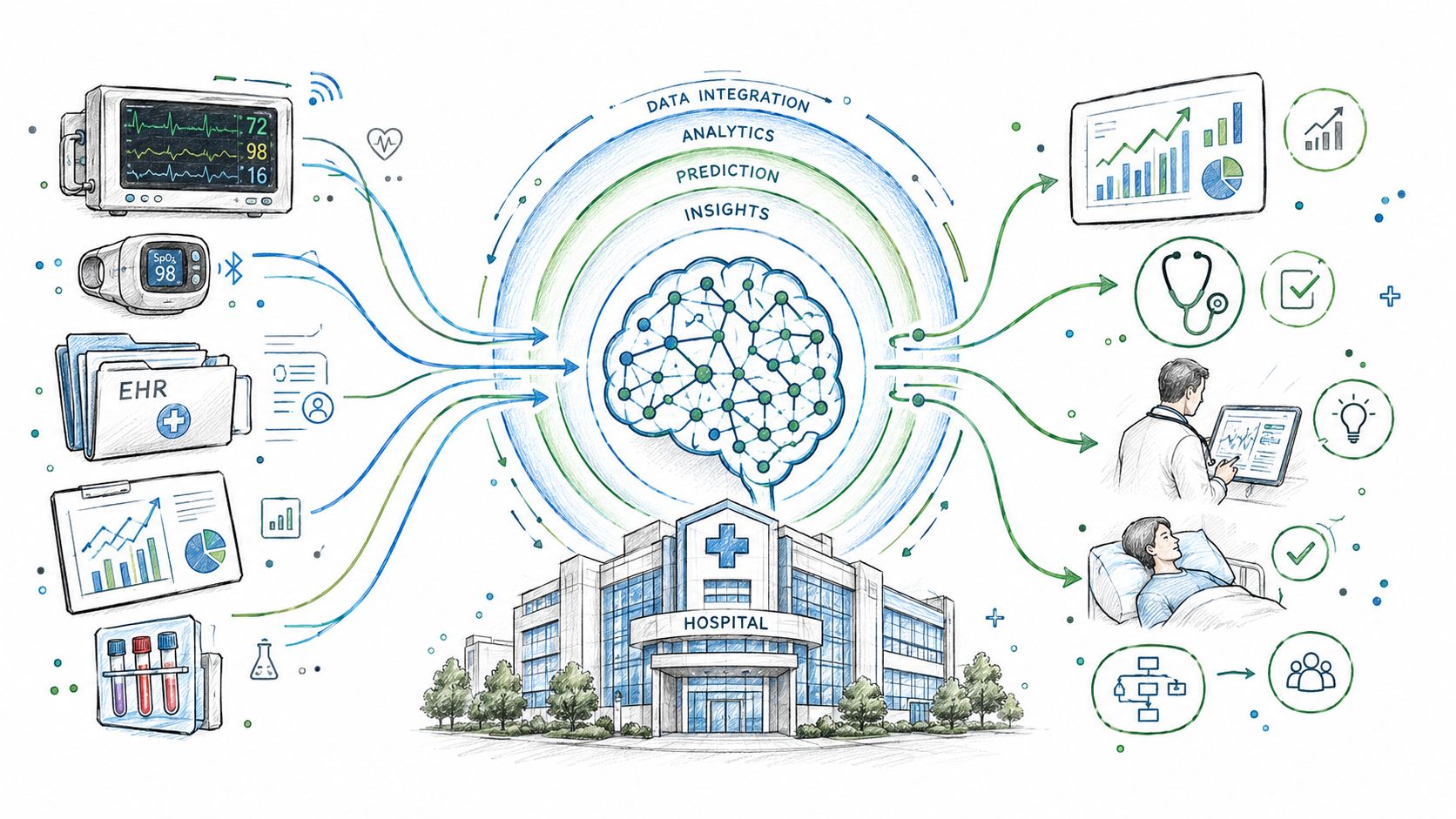
An AI healthcare platform is the software layer that turns isolated models into clinical systems. It includes integration plumbing, inference orchestration, identity checks, audit logging, monitoring, governance, and a user experience clinicians can use in the middle of care. Without that layer, a model sits outside the workflow and gets ignored, even if it performs well in a lab.
The cleanest way to see it is through an EHR-integrated workflow. An ambient scribe listens to the encounter, converts the conversation into structured data, and passes normalized fields through FHIR R4 resources such as Observation, Condition, and ServiceRequest. The model service then produces a draft note, a triage suggestion, or a structured alert, and the platform writes that output back into the chart.
Practical rule: if the AI can't read, route, and write back with the same identity and consent context the EHR expects, it isn't production software.
FHIR matters because it cuts out a lot of custom parsing. HL7 FHIR R4 exposes demographics, observations, medications, and care-plan data as structured REST resources, so the platform can connect to EHR workflows without building a separate adapter for every vendor (Moweb). That's why the question isn't “does the model work?” It's “can the system move cleanly from ingestion to inference to write-back without breaking security or workflow?”
The broader market has already moved in this direction. The FDA's authorization base for AI/ML-enabled medical devices grew from fewer than 50 in 2016 to more than 1,000 by early 2026, with 2025 setting a record of roughly 258 to 295 authorizations (Med Device Guide). The first standalone AI diagnostic device, IDx-DR, was authorized in 2017, and the FDA established its Digital Health Center of Excellence in 2020, which tells you the category has become durable rather than experimental. A platform strategy only makes sense in that environment.
For health systems evaluating vendors, a useful working definition is simple. If the product can't integrate, govern, monitor, and explain itself in clinical context, it's not a platform. It's an algorithm with packaging. For buyers looking for a healthtech engineering partner, that distinction is where serious evaluation starts, not where it ends. See how that maps to Healthcare AI Services when the goal is deployment, not just prototyping.
The Six Capability Layers Every Platform Needs
A weak AI healthcare platform usually doesn't fail in one dramatic place. It leaks across several layers until no one trusts it. If you want a sane procurement conversation, break the system into six capability layers and test each one separately.
What each layer does
| Layer |
Plain-English Meaning |
Typical Failure When Weak |
| Data integration |
Pulls data from EHR, HL7v2, FHIR, DICOM, and claims systems |
The model sees partial, stale, or inconsistent inputs |
| Identity and consent management |
Knows who the user is and what the patient allowed |
A deployment gets blocked or used outside policy |
| Model serving and routing |
Chooses the right model and sends the right task to it |
Requests time out, or the wrong model handles the wrong case |
| Clinical workflow and UX |
Puts output where clinicians already work |
Staff ignore the tool because it adds friction |
| Observability and drift monitoring |
Tracks latency, errors, and model decay |
Accuracy slips quietly until a serious incident |
| Governance and audit |
Records what happened, when, and why |
No one can investigate, defend, or roll back the decision |
These layers matter because the blast radius is real. If consent metadata is wrong, the deployment may fail without notice. If drift monitoring is weak, a model can decay for months before anyone notices. If audit trails are missing, the post-incident review turns into guesswork. The problem is usually not that the model is bad. It's that the platform around it was never designed for hospital reality.
Where buyers get it wrong
Hospitals often over-focus on model metrics and under-focus on system behavior. That's backward. A platform with decent predictions but poor integration will underperform a simpler tool that lands cleanly in the workflow. The operating question is whether the platform can sustain clinical use when data sources change, users rotate, and security policies tighten.
If you need a related framing for connected devices and data movement, the strategic guide to medical IoT is useful because it shows the same integration problem from the device side. The architecture lesson is the same. Production depends on dependable inputs, reliable routing, and traceable outputs.
A strong platform should also support AI strategy consulting that starts with capability gaps, not flashy demos. If a vendor can't show how these six layers work together, move on.
Compliance and Regulation as Architecture, Not Afterthought
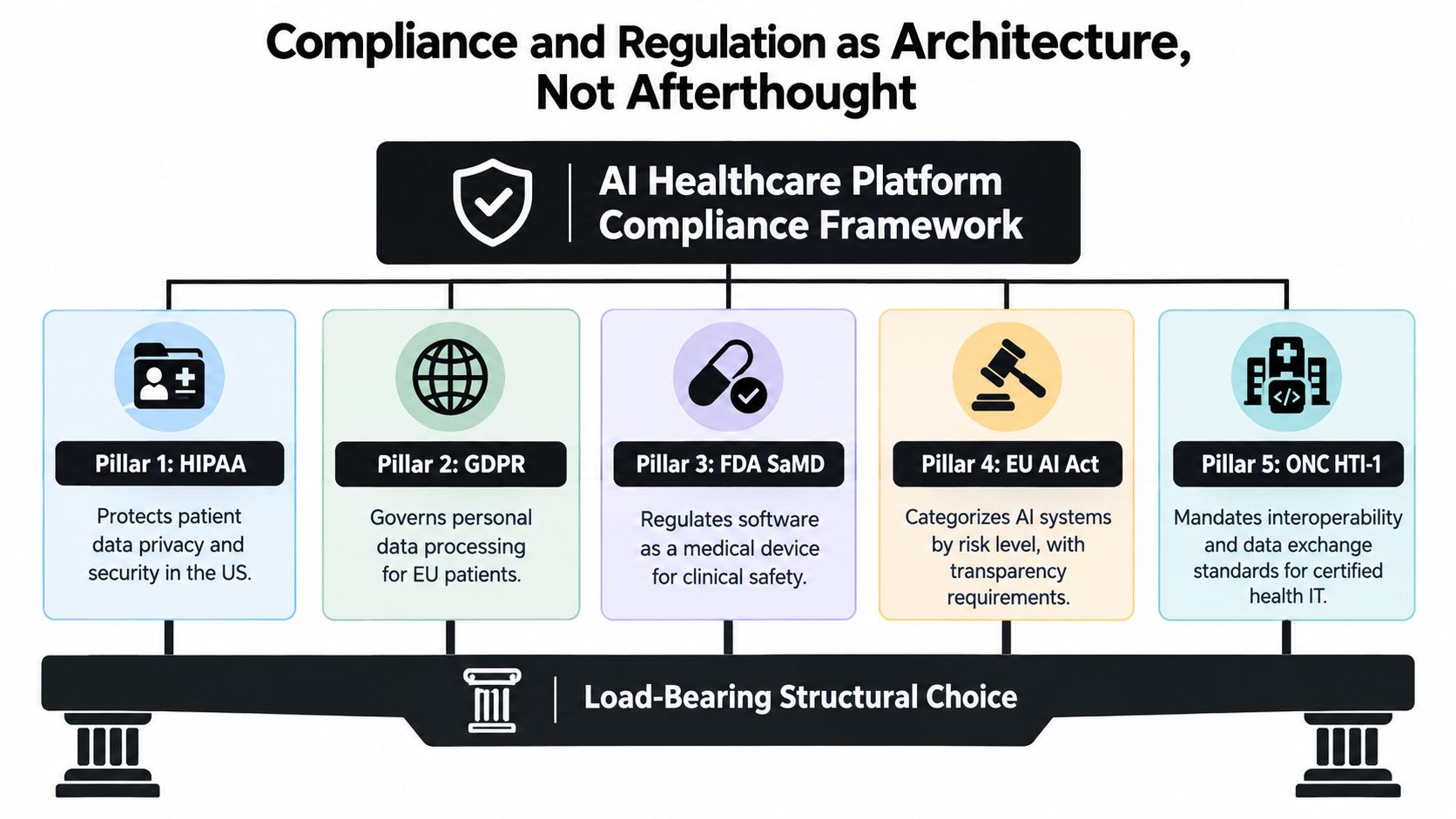
Compliance belongs in the platform design, not in a late-stage review. In healthcare, the data flow, access controls, and audit model have to be decided before the first deployment. If you build first and ask legal later, you have already chosen the wrong architecture.
Under U.S. interoperability rules, certified EHRs must support FHIR R4 APIs, and predictive decision-support tools delivered through certified EHRs must disclose source attributes like funding source, training-data characteristics, validation methodology, and performance metrics at the point of care (Healthcare AI Insights). Provenance and explainability cannot sit in a separate compliance binder. They have to live in the inference path.
What architecture has to carry
The FDA says it published draft guidance for AI-enabled device software functions on January 6, 2025, which reflects a lifecycle view of AI products rather than one-off software releases (FDA). That matters because model updates, prompt changes, and retraining all change how the system behaves. A retrospective audit is useless if the platform keeps changing under clinical users.
A platform that will survive production needs these pieces:
- Patient-level consent checks before data is used or surfaced.
- Signed model artifacts so deployed versions are traceable.
- Immutable audit logs for every meaningful action.
- Policy-as-code gates so updates cannot slip through unmanaged.
- Continuous control validation when the model, data, or workflow changes.
When compliance is bolted on late, teams end up with undocumented feature stores, unmonitored third-party endpoints, and consent flows that nobody can prove are correct.
The operational cost is higher than executives expect. If point-of-care disclosure has to happen inside the EHR, the platform must expose provenance where clinicians already work. If write-back actions need review, the approval path has to exist in the workflow, not in a separate dashboard. That is why the regulatory posture should shape the data flow, not the other way around.
For teams comparing build options, the strategic guide to medical IoT shows the same integration problem from the device side. For regulated clinical decision-making, SaMD solutions is the right framing. A custom healthcare software development approach can work too, but only if compliance engineering is built in from the start.
Real-World Use Cases That Are Actually Scaling
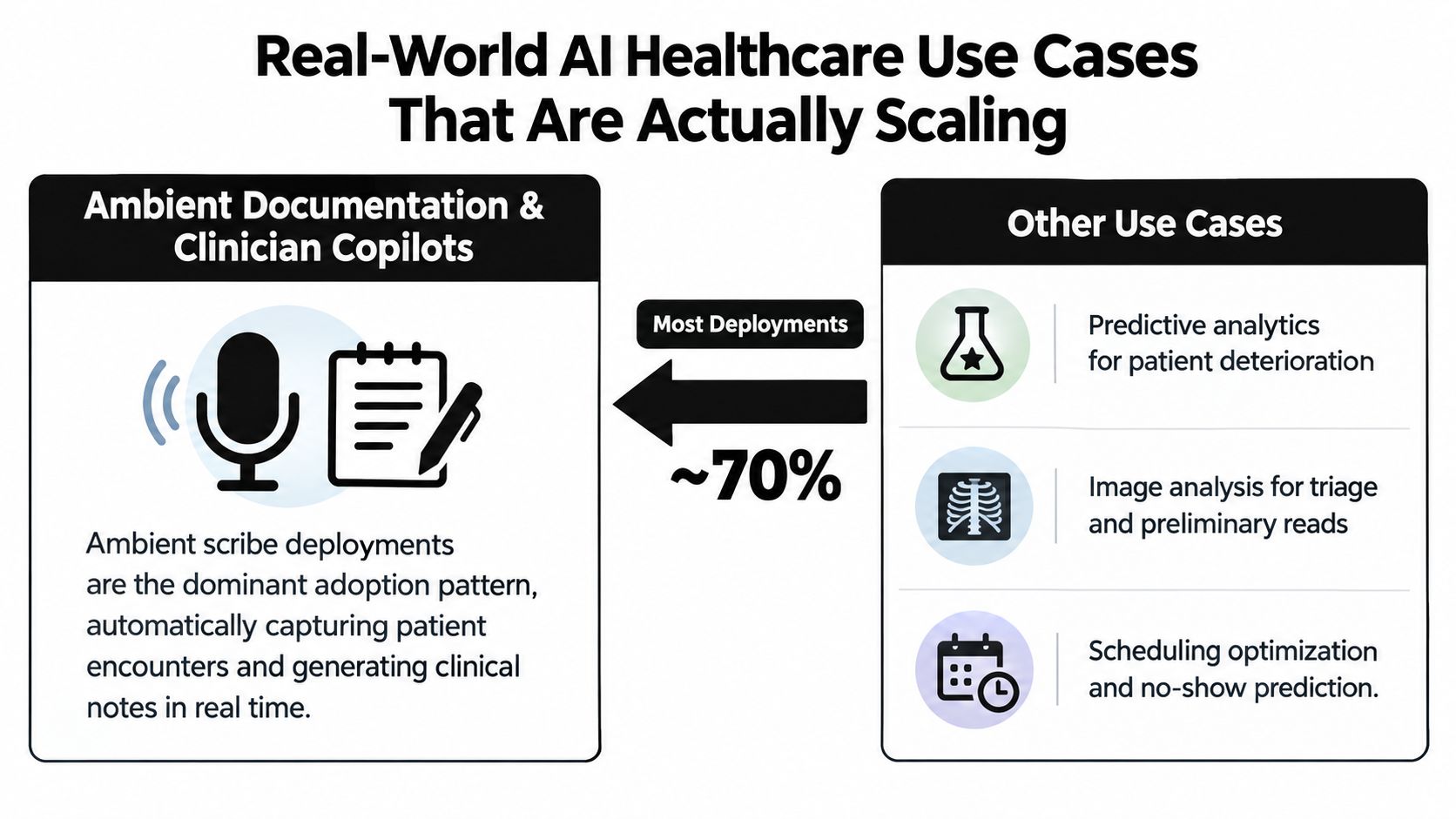
The most common scaled use case is still ambient documentation. A 2025 peer-reviewed survey found that Ambient Notes was the only use case with 100% of respondents reporting adoption activity, and 53% reported a high degree of success for clinical documentation AI (PMC). KLAS then reported in 2026 that ambient speech was the most widely adopted clinical AI use case, with 79% of organizations using it and positive ROI being reported alongside adoption (TechTarget). That's where the market has gone first for a reason.
Where value shows up first
Ambient documentation and clinician copilots usually deliver the clearest early value because they fit naturally into existing encounters. They reduce note burden, improve chart completeness, and keep the clinician inside the patient conversation longer. That's why they tend to reach production before broader predictive programs.
Other use cases are scaling too, but each has different integration demands:
- AI-assisted triage and intake works best when the platform can ingest symptoms, prior history, and acuity signals quickly. It usually needs lighter write-back than note generation, but it still needs reliable data intake.
- Radiology and pathology assistance depends on PACS and reporting workflows. It's strongest when the platform can support image review without forcing radiologists into another disconnected interface.
- Coding, prior authorization, and revenue cycle automation can work well when the platform has structured chart access and billing context. These use cases live or die on back-office accuracy and process fit.
The operational outcomes buyers care about are plain. Documentation tools aim to shorten encounter closeout and reduce after-hours charting. Triage tools aim to move the right patient to the right queue sooner. Imaging assistance aims to improve throughput and reading efficiency. Revenue cycle automation aims to reduce documentation gaps and administrative rework.
The key distinction is integration depth. Ambient documentation and coding tools usually need deep EHR coupling. Some intake or back-office workflows can survive with lighter integration at first, then deepen over time. That's the procurement filter. If a platform can't show where it needs tight integration and where it can start lean, it doesn't understand hospital operations.
A Practical Roadmap From Pilot to Production
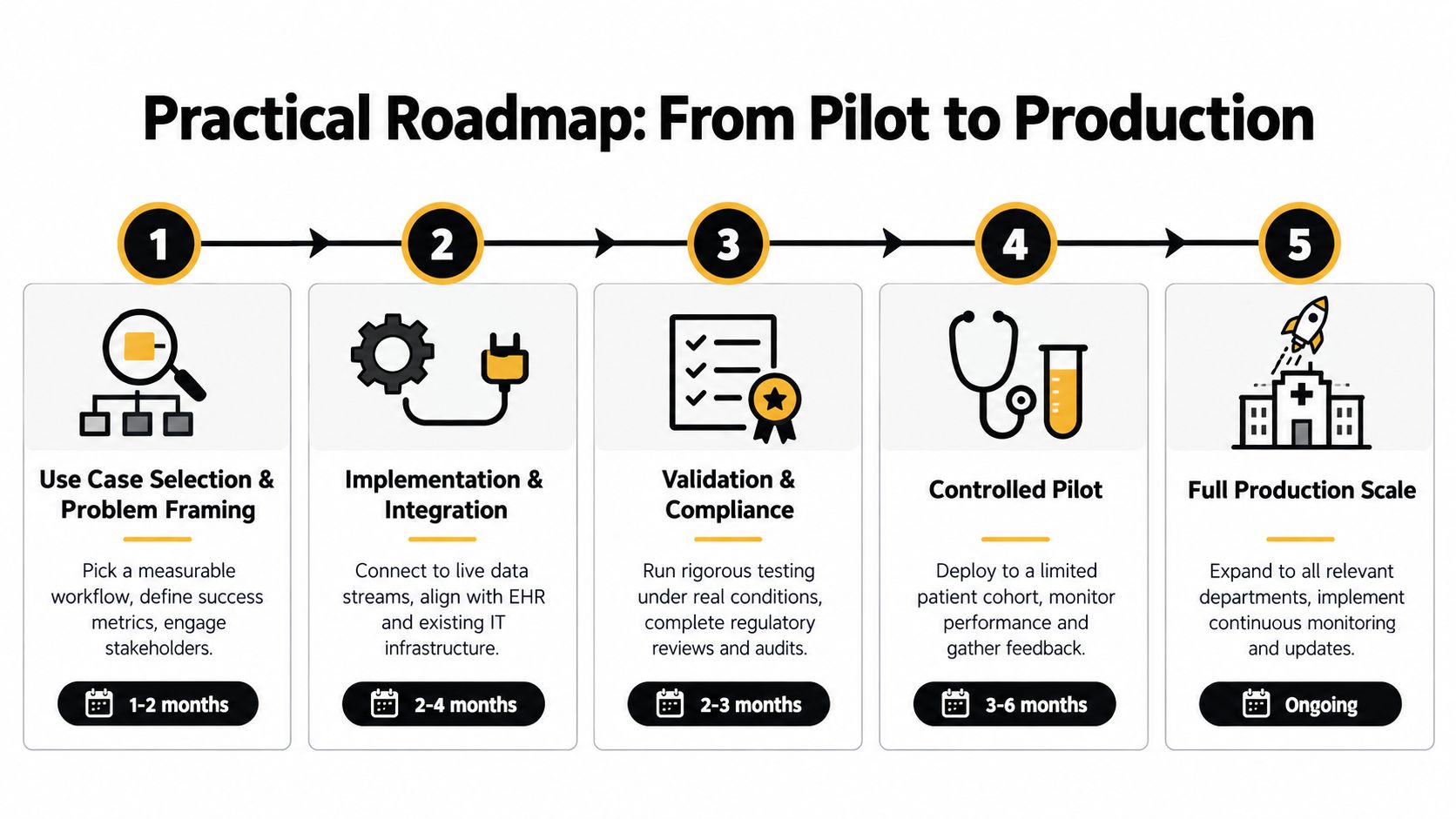
A health system does not get to production by chasing “AI transformation.” It starts with one workflow that is painful, visible, and owned by a clinical leader who wants it fixed. That is the only sane entry point.
Move in phases, not fantasies
- Use case selection and problem framing. Pick one workflow with measurable friction and a clear owner. Start from the operational problem, not a model in search of a problem. Teams usually fail here because they choose a use case because it looks impressive, not because it changes care or operations.
- Data and integration readiness. Confirm EHR access through FHIR, verify consent and de-identification paths, and stand up ingestion before model work starts. If the integration audit is skipped, the project stalls after the demo.
- Controlled pilot. Put the tool behind a feature flag, keep human review in the loop, and compare it with a defined control cohort. Without a control group, nobody can tell whether the platform helped or just added noise.
- Production hardening. Add monitoring, drift detection, fallback logic, rollback, and incident logging. Many teams discover at this stage that they built a prototype, not a system.
- Scale out. Replicate to more sites, specialties, and use cases only after the first deployment is stable. If reliability is weak, expansion just multiplies failure.
Treat the work like an engineering program, not a lab exercise. A Custom AI Strategy report helps define the first use case and the data prerequisites, while AI Automation as a Service fits once the workflow has been validated and needs operationalization. For teams that need structure across the build, an AI delivery framework keeps the work organized from pilot through handoff.
If your team needs help on the execution layer, the AI Product Development Workflow should be used as a delivery discipline, not a buzzword. Pilot to production is a loop. Retraining, drift, and new use cases keep showing up.
The Operational Reality Most Platforms Are Not Built For
A platform can look solid during a pilot and still break in the first year of production. That's not a rare failure mode. It's the norm when teams treat deployment as the finish line.
Model drift is the obvious culprit. Imaging models can degrade after scanner firmware changes. Triage models can behave differently when patient mix shifts. Documentation models can drift when clinicians change how they speak or chart. None of that shows up if you only look at launch-week performance.
Fragmented systems make the problem worse. A model that depends on three upstream feeds can fail the moment one feed drops a field or changes a format. The hospital then sees partial outputs, delayed responses, or no response at all. At that point, clinical users stop believing the system and route around it.
Operational rule: if nobody can say who gets paged, who rolls back, and what evidence gets logged after an incident, the platform is not production-ready.
Governance gaps are the hardest part. When something goes wrong, the data science team points to IT, IT points to the vendor, and the EHR team says the workflow was never theirs to own. That split accountability is exactly how systems survive a pilot and die later. The better question for buyers isn't whether the demo looked good. It's whether the platform can explain itself after a bad day.
If you're choosing a partner for internal tooling or clinician-facing systems, ask three blunt questions. How is drift detected, who gets paged at 2 a.m., and what does the rollback path look like. If those answers are fuzzy, the platform will be fuzzy in production too.
Choosing the Right Engineering Partner
Hiring for an AI healthcare platform is not the same as hiring a generic software shop. You're choosing who will carry integration risk, compliance pressure, and reliability work while the clinical team keeps ownership of the use case. That's a real operating decision, not a procurement formality.
Build, buy, or partner
| Dimension |
Build In-House |
Vendor Platform |
Healthtech Partner |
| Control |
Highest |
Lowest |
High, with shared execution |
| Speed |
Slowest ramp |
Fastest start |
Moderate, with better fit |
| Domain priors |
Depends on your team |
Fixed by vendor roadmap |
Strong across healthcare delivery |
| Integration ownership |
Fully yours |
Mostly vendor-defined |
Shared, with deep EHR focus |
| Long-term dependence |
Low if you staff well |
High lock-in risk |
Lower if knowledge transfer is real |
In-house gives you control, but it also gives you the slowest ramp and the most hiring burden. A vendor platform can be fast, but you inherit someone else's data model and roadmap priorities. A specialist partner sits between those extremes and can own clinical integration, MLOps, and compliance scaffolding while your team owns product decisions.
A good regulatory compliance partner also matters when the platform touches SaMD workflows or point-of-care disclosure. The right external team should make your internal team stronger, not dependent. In practice, that means they document what they build, transfer the know-how, and stay honest about what they don't own.
If you're evaluating AI tools for business, make sure the vendor or partner can show how it handles FHIR depth, production reliability, and regulatory documentation. Those are the selection criteria. Everything else is presentation.
Measuring ROI and the KPIs That Matter
ROI for an AI healthcare platform should be measured against the workflow it was built to change, not against model accuracy in isolation. Executives get misled when they ask the wrong questions. Accuracy can look great while operations stay flat.
Start with three clinical outcomes, three operational outcomes, and three platform-health indicators. That mix keeps the conversation grounded in actual use.
The KPIs that belong on the dashboard
For clinical impact, track time-to-decision, documentation closure rate, ambient scribe adoption, and clinician-reported cognitive load. For operations, measure imaging turnaround, triage-to-contact time, denial rate, and scheduled appointments kept. For platform health, watch inference latency, drift alerts, integration uptime, and incident mean time to detect and resolve.
Governance needs its own metrics too. Log audit-trail completeness, consent verification rate, and near-miss events. If those numbers are weak, the platform may be useful but not defensible. That's a bad trade in healthcare.
If a metric doesn't move after a quarter, the issue is usually integration depth or workflow fit, not model quality.
A useful operating rule is simple. Review the dashboard monthly, not annually, and tie every number to a platform layer or governance risk. That's how leaders avoid vanity reporting. It also makes budget conversations more honest, because hidden costs show up fast when the workflow doesn't stick.
A good first-quarter plan looks like this:
- Days 1 to 30: Audit one high-friction workflow and inventory the data sources behind it.
- Days 31 to 60: Run a contained pilot with clear KPIs and governance guardrails.
- Days 61 to 90: Decide whether to build, buy, or partner based on integration depth, compliance posture, and operational survivability.
Executives also ask private questions they won't always say out loud. How long before ROI appears, what hidden costs blow up the budget, whether off-the-shelf foundation models are safe for clinical use, how liability works when the model is wrong, and what separates a platform that survives year three from one that gets decommissioned. The answer to every one of those is the same. Pick the system that can explain its outputs, survive workflow change, and keep operating when the first shiny version is obsolete.
If you want a team that works at that layer, our expert team builds healthcare products, integrations, and AI systems with that production mindset. You can also review the broader delivery model in our AI requirements analysis approach before you commit to a roadmap.
Ekipa AI helps healthtech teams move from idea to shipped clinical software, including EHR integrations, AI workflow design, and production-ready healthcare systems. If you need an AI healthcare platform that can survive real hospital use, start with Ekipa AI and talk to the people who build for deployment, compliance, and operational fit.