AI in Healthcare
HIPAA-Compliant AI: How to Use LLMs With PHI Safely
How to build HIPAA-compliant AI: when LLM providers need a BAA, data minimization, de-identification, audit controls and a reference architecture.
October 16, 2026Read more
Unlock the power of enterprise clinical intelligence. Our 2026 guide covers business value, architecture, use cases, and an implementation roadmap to drive ROI.

Healthcare leaders don’t need another dashboard. They need an intelligence layer that helps teams act faster, coordinate better, and avoid making high-stakes decisions from fragmented data.
That’s why enterprise clinical intelligence matters now. It sits between raw clinical data and operational action. Done well, it connects EHR events, lab data, documentation, utilization patterns, and workflow signals into something leadership, clinicians, and operations teams can use.
The urgency is real. Healthcare organizations are deploying domain-specific AI tools at a pace that outstrips the broader enterprise. But adoption alone doesn’t create value. In practice, the difference between a useful clinical intelligence engine and an expensive pilot usually comes down to two neglected foundations: data maturity and governance discipline.
Healthcare has reached the point where retrospective reporting isn’t enough. Monthly scorecards and delayed utilization reviews don’t help when bed capacity is tightening today, when coding gaps affect reimbursement this week, or when care teams need better context during the encounter.
That’s why enterprise clinical intelligence is better understood as an operating capability, not a software category. It brings together clinical, financial, and operational signals so teams can move from hindsight to coordinated action.
The market shift is no longer theoretical. 22% of healthcare organizations had implemented domain-specific AI tools as of 2025, a 7x increase over 2024, while fewer than one in 10 companies in the broader enterprise had implemented AI, according to Menlo Ventures’ healthcare AI analysis.
In real organizations, this shows up in practical ways:
A mature enterprise clinical intelligence program also changes how an organization buys and builds technology. Instead of adding isolated point tools, teams start asking whether each capability strengthens the shared data and decision layer across the enterprise.
That’s the right framing for 2026. Enterprise clinical intelligence isn’t another digital transformation label. It’s the mechanism health systems use to make their data operational. Organizations that need help connecting strategy, architecture, and workflow execution usually benefit from working with a Healthcare AI Services team that understands both health IT constraints and clinical operations.
Enterprise clinical intelligence becomes valuable when it changes decisions inside existing workflows, not when it produces impressive demos outside them.
The business case for enterprise clinical intelligence gets stronger when you stop describing features and start mapping capabilities to executive metrics.
Leaders rarely fund “better analytics” on its own. They fund lower administrative burden, cleaner throughput, more reliable quality performance, and tighter financial execution.

Organizations implementing ECI strategies can reduce administrative costs by 30% while improving clinical outcomes by 15-20% across key quality indicators, and 90% of C-suite healthcare executives expect digital technology adoption to accelerate in 2025, based on Blue Prism’s healthcare AI statistics summary.
In most boardrooms, the first question is simple. Where does the ROI show up?
For enterprise clinical intelligence, the clearest financial gains usually come from documentation quality, coding support, denial prevention, and less manual administrative work. These are attractive starting points because they tie directly to cost and margin pressure while avoiding the highest-risk clinical deployment scenarios.
That doesn’t mean finance should dominate the roadmap. It means finance often funds the foundation.
A technically sound ECI platform still fails if frontline teams experience it as extra work.
The best programs improve how work moves across the enterprise. They help bed managers see constraints earlier. They help service line leaders understand resource friction. They help care teams spend less time hunting for information across separate systems.
Operational KPIs usually matter because they’re visible quickly. Teams can tell whether patient flow is smoother, whether handoffs are cleaner, and whether documentation burden is shrinking.
Clinical quality is where the ambition gets bigger and the tolerance for error gets smaller. Many organizations overreach here. They try to jump from fragmented data to advanced clinical decision support before they’ve established reliable integration, validation, or model oversight. A better sequence is to earn trust with workflow-adjacent intelligence first, then expand into higher-stakes clinical use cases as governance and data confidence improve.
Here’s a practical mapping for executive teams.
| ECI Application | Business Value Driver | Primary KPIs |
|---|---|---|
| Clinical documentation assistance | Less administrative workload, better record completeness | Administrative cost, documentation turnaround, clinician time saved |
| Revenue cycle intelligence | Cleaner coding, fewer downstream revenue leaks | Denial trends, coding accuracy, reimbursement performance |
| Patient flow forecasting | Better capacity planning and throughput | Length of stay, bed utilization, transfer delays |
| Risk stratification | Earlier intervention planning | Readmissions, care management follow-up, complication trends |
| Operational command dashboards | Shared visibility across departments | Throughput, escalation time, resource utilization |
| Population health intelligence | Better targeting of proactive outreach | Gap closure, intervention prioritization, quality measure performance |
Practical rule: If you can’t name the workflow owner, the baseline KPI, and the action triggered by the insight, the use case isn’t ready for investment.
A good KPI set also avoids one common mistake. Don’t measure the model in isolation. Measure the chain from signal to action to outcome. Precision matters, but operational adoption matters just as much.
Most enterprise clinical intelligence programs don’t break because the model is weak. They break because the data underneath the model isn’t reliable, current, normalized, or usable across systems.
That’s the hard truth many vendors downplay. Many enterprise efforts fail because they operate within siloed legacy systems that limit data liquidity, and even advanced AI models falter in production without strong data foundations, as discussed in F1000Research’s analysis of healthcare AI implementation barriers.

A strong ECI stack starts with one question. Can you move the right data, at the right latency, into a form that supports trustworthy operational or clinical action?
If the answer is unclear, don’t start with model procurement. Start with a data maturity audit.
That audit should look at:
Some teams also review foundational storage choices at this stage. If you’re comparing infrastructure patterns, this overview of best open source database options is a useful reference for thinking through trade-offs in performance, flexibility, and maintenance before locking into a broader architecture.
A workable enterprise clinical intelligence stack usually has four layers.
Most of the effort resides here.
You need a clinical data lake or lakehouse that can ingest both structured and unstructured information. That includes EHR records, lab values, encounter notes, scheduling data, claims signals, and operational logs. If your platform can’t preserve raw fidelity while also supporting normalized downstream use, your analytics layer will be brittle from the start.
FHIR matters here because it gives you a practical route to interoperability, but standards alone won’t save a messy environment. Teams still need mapping logic, terminology management, and governance around source-of-truth decisions.
This layer handles APIs, event streams, connectors, ETL or ELT pipelines, and workflow orchestration.
In healthcare, this layer often becomes a central battleground. One system updates in near real time. Another exports overnight. A third uses custom data structures that were never intended for enterprise analytics. Your integration strategy has to absorb those realities without creating a maintenance nightmare.
For document-heavy environments, tools like an AI requirements analysis process paired with extraction services such as AI tools for business can help teams turn forms, faxes, scanned records, and narrative documents into usable structured inputs. That’s often a prerequisite for payer workflows, prior auth operations, and utilization management intelligence.
In this layer, analytics, rules, and machine learning operate.
Not every use case needs a large language model. Many early wins come from simpler risk logic, forecasting methods, queue prioritization, and workflow-aware prediction. The right design often combines deterministic rules for compliance-sensitive steps with ML models where pattern recognition adds value.
Dashboards alone are insufficient.
The experience layer should deliver insights inside the workflow where people already work. That may be the EHR, an operational command center, a coding work queue, or a care manager worklist. If users have to leave their workflow to find the insight, adoption usually drops.
Ask these questions before approving the build:
If the answer is no to any of those, the architecture isn’t ready.
The fastest way to waste an AI budget in healthcare is to automate on top of unresolved data fragmentation.
The most convincing enterprise clinical intelligence programs don’t start with abstract transformation goals. They start with one painful workflow, one reliable data path, and one decision that can be improved.
That’s why the best use cases are easy to explain in operational terms. They reduce friction, surface missed context, or help staff act sooner.

One of the clearest examples comes from knowledge graph and model-augmented clinical intelligence. Google Cloud’s MedLM, used in a Clinical Intelligence Engine, achieved superior performance in evaluation by capturing 90%+ of ground-truth clinical elements while reducing errors in workflows, according to Google Cloud’s description of the MedLM-based clinical intelligence engine.
That matters because recommendation quality in healthcare isn’t just about generating likely answers. It’s about reducing omitted context and lowering the chance that relevant medications, labs, procedures, or diagnoses are missed.
Ambient documentation is often discussed as a clinician productivity tool. In practice, its value can extend much further when the structured output feeds enterprise analytics.
Once symptoms, medications, labs, and encounter details are exported into an analytics environment, health systems can analyze patterns across visits. Teams can look for workflow bottlenecks, identify signals associated with deterioration, and understand why some encounters consistently run longer or generate more downstream utilization than others.
That’s the difference between a point solution and enterprise clinical intelligence. One improves note creation. The other turns encounter data into an operational asset.
Operational use cases tend to earn trust quickly because the feedback loop is shorter.
When a platform forecasts demand, flags bottlenecks, and gives service line leaders a shared view of constraints, teams can manage bed turnover, OR flow, infusion scheduling, and discharge coordination with better timing. These use cases often succeed because the required action is obvious. Escalate a staffing issue. Adjust scheduling. Prioritize a transfer. Rebalance workload.
Use cases tend to move fastest when they meet three conditions:
If a use case doesn’t meet those tests, it may still be valuable. It just probably shouldn’t be first.
For leaders looking for comparable patterns, reviewing real-world use cases can help separate deployable ideas from innovation theater.
Good ECI use cases don’t just predict. They change what a clinician, manager, or operations lead does next.
Most failed healthcare AI programs share a pattern. The organization moved quickly on tooling and slowly on accountability.
That’s backwards. A critical blindspot for enterprise buyers is the governance gap, because few organizations have formal AI oversight bodies or established principles for ethical use and validation, and ECI success depends less on the AI model itself and more on governance maturity and regulatory readiness, as noted in Union Healthcare Insight’s discussion of healthcare AI governance gaps.

Before any pilot starts, create a cross-functional oversight group. It should include clinical leadership, operations, compliance, security, data, and product or engineering ownership.
The group’s job isn’t to slow the work down. It’s to decide what “safe and useful” means before deployment pressure takes over.
At this phase, define:
Teams should also determine here whether they need lightweight operational intelligence, regulated SaMD solutions, or a hybrid model. That distinction affects validation burden, documentation, and deployment controls from day one.
The pilot should be narrow enough to control and important enough to matter.
A weak pilot is broad, politically motivated, and disconnected from daily operational pain. A strong pilot has a clear workflow owner, a baseline metric, a training plan, and a rollback procedure.
Good pilot questions include:
This phase should also include shadow-mode testing where appropriate. If the system would have recommended an action, compare it against what teams did before making the output operational.
Once one use case proves value, the temptation is to launch five more. Resist that.
Scale works when teams productize the shared components. That means reusable integration patterns, common terminology handling, standard monitoring, and governance checkpoints that don’t need to be reinvented for every project.
Organizations also need strong internal tooling to manage model versioning, auditability, exception review, and user feedback. Without that layer, scaling usually depends on a few experts manually holding the system together.
The mature state isn’t “set and forget.” It’s recurring review.
Use a standing operating rhythm that checks output quality, user adoption, edge cases, policy changes, and drift in workflow performance. Teams that treat governance as a one-time approval step usually discover problems late.
Build the oversight council before the pilot. If you wait until something goes wrong, governance becomes a cleanup function instead of a design function.
This is also where a disciplined AI Product Development Workflow matters. Healthcare AI delivery needs product management, validation, security, workflow design, and change management to move together. If those tracks split apart, the implementation will feel complete on paper and fragile in production.
Choosing a partner for enterprise clinical intelligence is less about vendor breadth and more about whether they can help you build a durable operating capability.
A tool vendor may solve one narrow problem. That can be useful. But enterprise clinical intelligence usually requires a partner who understands interoperability, health system workflows, data governance, and implementation sequencing.
Some criteria matter more than polished demos.
For delivery-heavy programs, experience in custom healthcare software development can also matter, especially when the work involves workflow integration rather than standalone analytics.
Many teams buy software before they’ve aligned on use case sequencing, readiness, or ownership. That’s usually where timelines slip and ROI becomes hard to prove.
A better approach starts with AI strategy consulting and prioritization. That can include a readiness review, use case scoring, governance design, and architecture planning before procurement expands. For example, a Custom AI Strategy report can help an organization identify which workflows are suitable for near-term deployment and which ones need more data preparation first.
Ekipa AI is one option in this category. It focuses on AI opportunity discovery, prioritization, and execution support for teams that want to move from concept to implementation with clearer scoping and delivery structure.
You should also ask partners how they support implementation after strategy work is done. Planning without deployment support creates another handoff risk. That’s why teams often prefer a partner that can stay involved through validation and buildout using an AI Product Development Workflow.
It’s the combination of data integration, analytics, workflow design, and governance that turns fragmented healthcare data into usable operational and clinical insight. The important point is action. If no one changes what they do because of the insight, it isn’t functioning as enterprise clinical intelligence.
Start with a workflow that already has visible pain, reachable data, and a clear owner. Documentation, patient flow, and revenue-cycle-adjacent intelligence often make better first deployments than high-autonomy clinical decision support.
Three things. Teams underestimate data cleanup, overestimate what a pilot proves, and delay governance until late in the process. Those mistakes create rework and weaken trust.
No. Many successful programs begin with integration, rules, forecasting, and workflow analytics. More advanced models should be added where they improve a clearly defined decision and where the organization can validate and monitor them responsibly.
Measure the full chain. Look at whether the insight was delivered, whether staff used it, whether action changed, and whether the business or clinical KPI moved. Model performance on its own is not enough.
Ownership should be shared, but not vague. Clinical, operations, data, security, and compliance leaders all need defined responsibilities. If accountability is dispersed without named decision-makers, the program will stall.
If you’re working through those decisions now, it helps to review them with our expert team.
Enterprise clinical intelligence works when strategy, data, governance, and implementation move together. If you’re evaluating priorities, architecture, or rollout sequencing, Ekipa AI can help you assess use cases, shape the implementation path, and connect planning to execution.
How to build HIPAA-compliant AI: when LLM providers need a BAA, data minimization, de-identification, audit controls and a reference architecture.
Practical data migration planning guide for healthcare teams. Scope, mapping, compliance, validation, cutover and rollback decisions explained end to end.
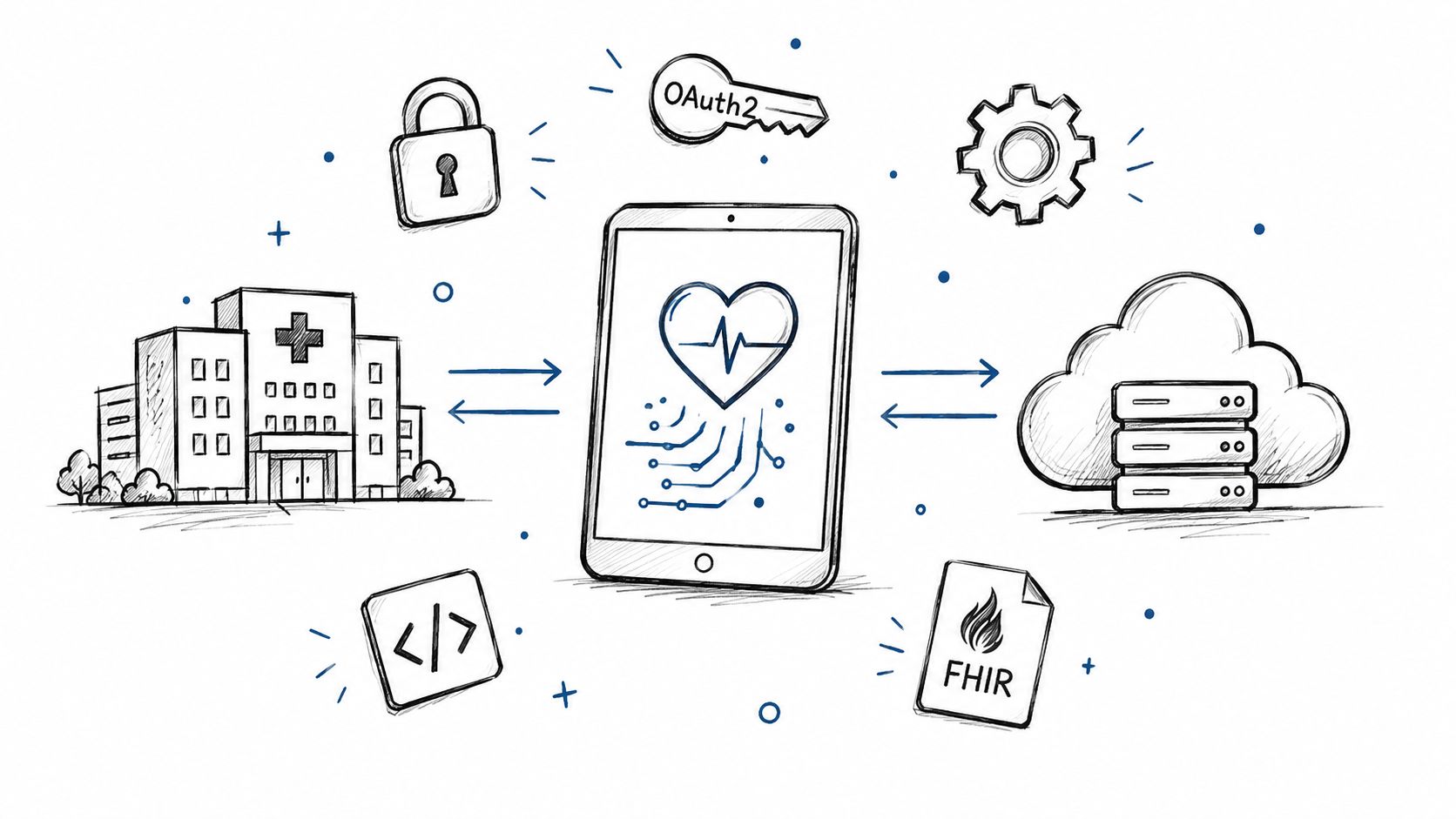
Smart on FHIR guide for healthtech engineers. Learn the OAuth 2.0 launch model, scope syntax, backend services, and US regulatory requirements.
Connect with our team to explore how AI expertise can transform your business.