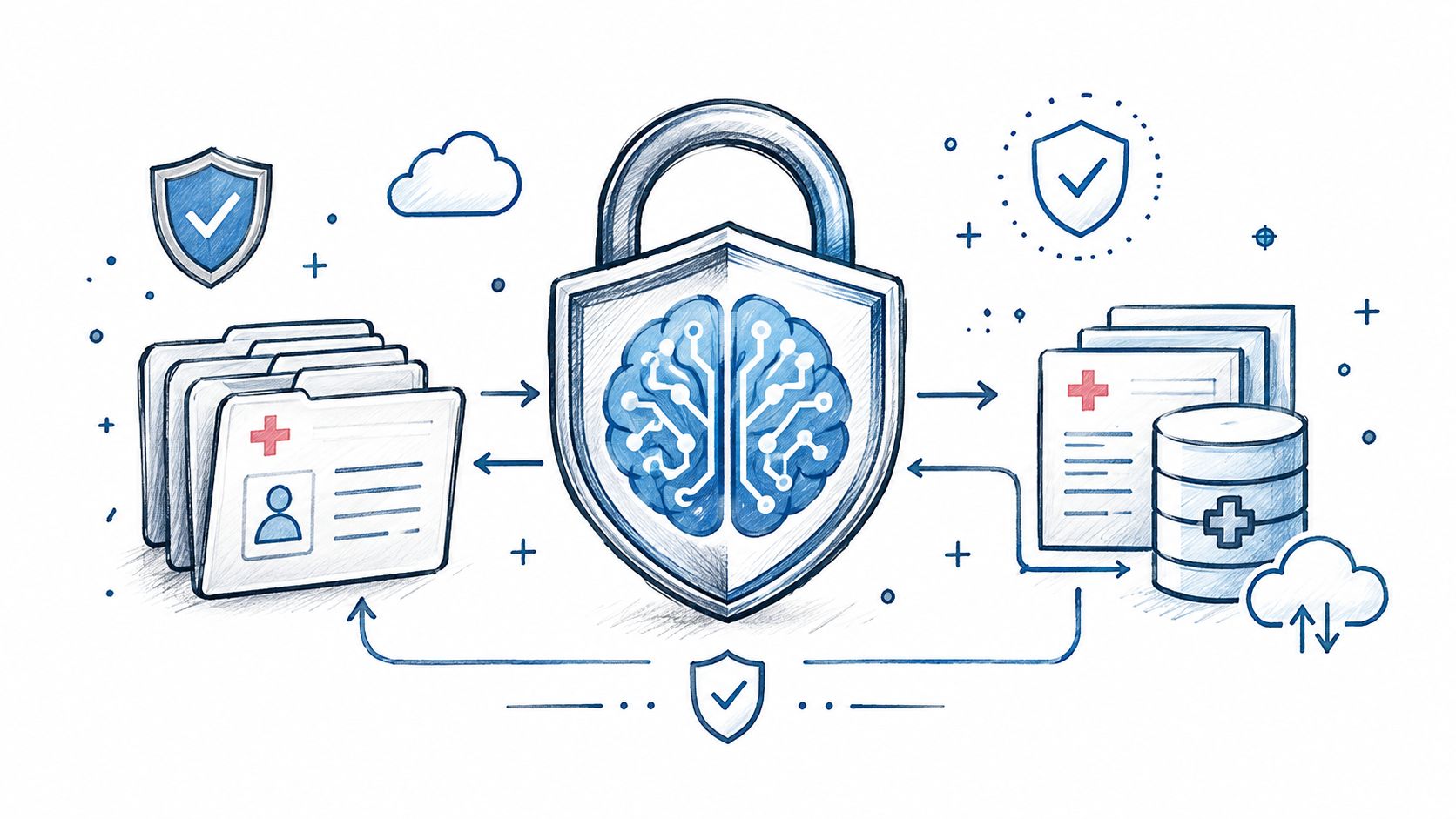
AI in Healthcare
HIPAA-Compliant AI: How to Use LLMs With PHI Safely
How to build HIPAA-compliant AI: when LLM providers need a BAA, data minimization, de-identification, audit controls and a reference architecture.
October 16, 2026Read more
Unlock the power of healthcare systems intelligence. This guide explains core components, KPIs, use cases, and a roadmap for execs to drive real business value.

The market signal is hard to ignore. The global AI in healthcare market is projected to exceed $120 billion by 2028 with a 36.4% CAGR, and over 60% of healthcare executives see AI driving the most innovation in the next five years, according to Strategic Market Research.
That growth matters, but the bigger shift is operational. Healthcare organizations aren’t just digitizing records anymore. They’re trying to build systems that can detect risk early, guide decisions inside workflows, and trigger action before a problem becomes a cost, a delay, or a clinical event.
That’s what healthcare systems intelligence is about. Not more dashboards. Not another analytics project. It’s the move from static reporting to an operating model where data, predictive models, workflows, and governance work together.
For a hospital CTO, this changes the question. The issue isn’t whether the organization has data. It almost certainly does. The issue is whether that data can support timely decisions across clinical operations, revenue cycle, staffing, quality, and patient experience. If it can’t, the organization is still collecting signals without creating intelligence.
Hospitals have spent years building reporting capability, yet many still struggle to act early enough to change outcomes. Length of stay, denial rates, staffing gaps, readmissions, and throughput metrics are visible in most organizations. The problem is timing. Retrospective reporting shows where performance broke down after the cost, delay, or clinical risk has already materialized.
Healthcare systems intelligence shifts that model from review to intervention. It combines integrated data, predictive models, decision logic, and workflow execution so teams can act while there is still a meaningful window to improve the result. In practice, that means identifying inpatient deterioration sooner, flagging outpatient risk before avoidable utilization rises, or detecting pressure in bed flow before it affects the ED, perioperative schedule, and discharge planning.
This marks a shift from observation to intervention.
A dashboard explains past performance. An intelligent system supports a decision in time to affect clinical, operational, or financial performance.
The difference shows up in the questions the system can answer:
Leadership teams often overlook this distinction. They fund data platforms and reporting layers, then expect measurable gains in throughput, margin, quality, or patient experience. Those gains usually do not appear unless intelligence is embedded inside the workflow where clinicians, operators, and revenue cycle teams already work.
Healthcare systems intelligence becomes strategic when clinical, operational, and financial leaders can act on the same signal within the same operating window.
That is also why this should be treated as a strategic transformation initiative rather than a narrow IT implementation. The technical work matters, but so do ownership, governance, adoption, KPI design, and frontline process changes. Organizations that need outside support often use specialized healthcare AI services for providers and health systems to connect architecture and model decisions to business priorities such as avoidable utilization, labor efficiency, denial reduction, and care quality.
Healthcare systems intelligence works like a hospital’s central nervous system, but the business value comes from architecture choices, not analogy alone. The system has to sense, interpret, decide, act, and learn across clinical, operational, and financial domains. If one layer is weak, the whole model underperforms.
For leadership teams, this is a maturity question as much as a technical one. Early-stage organizations collect and standardize data. More advanced organizations connect that data to workflow, accountability, and measurable KPIs. The same logic shows up in broader decision intelligence and business growth. Better decisions create value only when they arrive fast enough, in the right context, with a clear owner.

Health systems rarely have a data shortage. They have a coordination problem.
Clinical signals sit in the EHR, imaging, labs, and device feeds. Operational signals sit in staffing, bed management, transport, and scheduling systems. Financial signals sit in claims, coding, authorizations, and denials platforms. An intelligent system brings those sources together in a form that supports live decisions, not just retrospective reporting.
Key design priorities include:
Many programs stall at this stage. Leaders approve a data platform, but not the hard work of mapping identifiers, resolving latency, and assigning data ownership. Without that discipline, model performance degrades quickly in production.
Interoperability determines the timeliness and placement of predictive insight. A model has little value if the signal arrives after rounds, outside the care management queue, or in a dashboard no one opens during the operating day.
Standards such as HL7 and FHIR matter, but workflow fit matters just as much. Hospitals need data exchange that supports the actual point of decision, whether that is inside the EHR, a transfer center workflow, a staffing console, or a revenue cycle work queue.
In practice, broad platforms that claim to solve everything often fail because local workflow, data quality, and accountability vary by service line, site, and use case.
Analytics is the reasoning layer. It turns raw signals into risk, prioritization, and recommended action.
The highest-value models are usually specific. Deterioration risk, discharge readiness, preventable readmission, no-show likelihood, denial risk, and staffing pressure are all useful because each ties to a real operating decision and a measurable KPI. That focus also makes governance easier. Leaders can test whether the model changes throughput, quality, labor efficiency, or cash performance instead of debating abstract accuracy scores.
The trade-off is speed versus precision. An advanced model may benchmark well in validation, but a simpler model that updates faster and fits the workflow often creates more value.
Prediction does not improve performance on its own. The organization needs explicit decision logic.
That usually includes:
This is also where business leaders should look for maturity. If a system generates scores without triggering operational response, the organization has analytics capability, not systems intelligence.
The final component is closed-loop learning. Outcomes have to flow back into the system so models, thresholds, and workflows improve over time.
That means tracking more than model accuracy. Teams should measure alert acceptance, intervention timing, override rates, downstream outcomes, and whether the action improved the KPI it was meant to influence. In my experience, this is the difference between pilots that produce interest and programs that survive budget review.
Practical rule: If the system cannot learn from outcomes and operational response, it is still advanced reporting, not intelligence.
Hospital leaders don’t fund architecture for architecture’s sake. They fund outcomes. If healthcare systems intelligence doesn’t improve operating performance, quality, or margin, it won’t survive budget scrutiny.
The strongest business case comes from linking each intelligence capability to a KPI a C-suite team already tracks.

A hospital can’t manage throughput well if bed demand, staffing pressure, and discharge readiness are all handled separately. Systems intelligence helps by connecting those signals and supporting earlier operational decisions.
That usually affects metrics such as:
Clinical value appears when models support intervention early enough to matter. That’s why high-performing systems focus on specific decisions with clear owners.
Examples include:
When those signals are operationalized, the impact can be material. In U.S. hospitals, 65% employ AI-assisted predictive models, especially for inpatient trajectory prediction (92%) and high-risk outpatient identification (79%), with associated 15% to 20% reductions in hospital readmissions, according to Master of Code’s healthcare AI statistics roundup.
Finance leaders usually care less about AI as a category and more about whether it reduces avoidable labor, leakage, denials, and missed reimbursement opportunities.
Healthcare systems intelligence can support that by improving:
| Business concern | Intelligence contribution | KPI lens |
|---|---|---|
| Revenue cycle friction | Better signal quality before claims move downstream | Denial trends, coding accuracy, cash timing |
| Administrative burden | Automation of repetitive review and routing tasks | Staff time allocation, queue volume |
| Utilization waste | Earlier identification of preventable events | Readmissions, avoidable use, variation |
A practical option for some organizations is to pair predictive models with AI Automation as a Service so decision support and administrative execution are designed together instead of as separate programs.
The fastest way to understand healthcare systems intelligence is to look at where it changes work on a normal Tuesday. Not in a lab. Inside active operations.
A command center receives census projections, discharge-risk signals, and staffing constraints. The goal isn’t a prettier dashboard. The goal is to help bed management, nursing leadership, and operations teams act earlier.
When that system works, leaders can rebalance staff, protect discharge pathways, and reduce preventable bottlenecks before they spill into the ED or procedural areas.
A clinician opens a chart and sees more than history. The system flags a meaningful risk, provides context, and does it at a moment when the care team can still intervene.
Organizations often combine local workflow design with tools like SaMD solutions, particularly when decision support moves closer to regulated clinical functionality.
The best clinical intelligence is quiet, targeted, and accountable. If every patient looks urgent, the system has failed.
Some teams also extend this into patient communication and triage layers through products such as a Clinic AI Assistant, where the point isn’t novelty. It’s better routing, clearer intake, and more consistent patient engagement.
A health system identifies a group of patients whose utilization pattern suggests rising risk. The useful move isn’t sending generic outreach. It’s ranking who needs contact first, what kind of intervention is appropriate, and which care pathway can absorb the work.
That changes care management from broad outreach to selective intervention.
Another common use case sits far from the bedside but matters just as much. Clinical notes, coding logic, authorization workflows, and denial patterns all produce signals.
When intelligence is applied well, teams can catch documentation gaps earlier, route work more intelligently, and reduce back-end cleanup. When it’s applied badly, they create extra review layers that burden already stretched revenue and clinical teams.
Across this value chain, the pattern is consistent. Intelligence pays off when it improves a specific operational decision with a named owner. It underperforms when it’s deployed as a generic enterprise AI program with no hard connection to workflow.
Most organizations don’t move from fragmented data to adaptive systems in one jump. They mature in stages. The useful question for a CTO isn’t whether the hospital has “started AI.” It’s whether the current operating model can support prediction, action, and learning reliably.
Some organizations are still highly reactive. Data exists, but it’s siloed, delayed, and used mainly for retrospective reporting.
Others have integrated data but still stop at dashboards. They can explain what happened, yet they can’t reliably shape what happens next.
The next stages are where healthcare systems intelligence becomes operational:
| Maturity Level | Key Characteristic | Primary Question Answered | Example Technology |
|---|---|---|---|
| Level 1 Siloed and Reactive | Disconnected systems and manual reporting | What happened in each silo | Departmental reports, spreadsheets |
| Level 2 Integrated and Descriptive | Shared data foundation and standardized dashboards | What happened across the enterprise | Data warehouse, BI dashboards |
| Level 3 Predictive and Proactive | Forecasting and risk stratification support earlier intervention | What is likely to happen | ML risk models, real-time monitoring |
| Level 4 Prescriptive and Automated | System recommends actions and automates repeatable tasks | What should we do now | Workflow engines, rules orchestration, automation |
| Level 5 Adaptive and Autonomous | Closed-loop learning continuously tunes decisions | How should the system improve itself | Learning systems, continuous model monitoring |
A simple diagnostic usually exposes the truth faster than strategy language.
Ask these questions:
If the answer to most of those is no, the organization probably isn’t beyond Level 2, even if it has several AI pilots.
Maturity is not the number of models you’ve built. It’s the number of decisions you’ve improved safely and repeatedly.
Advancing from one level to the next often requires operating model changes as much as technical work. That’s where AI strategy consulting tends to matter. The bottleneck is usually prioritization, workflow fit, governance, and executive alignment, not access to algorithms.
A phased implementation path is most effective because hospitals punish unfocused rollouts. Teams that push ahead without aligned governance, workflow ownership, data readiness, and clinician trust usually end up with an expensive pilot and no durable operating change.

Prioritize business problems with clear value paths over speculative model ideas.
For a hospital CTO, that usually means selecting a problem where the KPI, workflow owner, and financial impact are already visible. Readmissions, discharge delays, denial risk, staffing instability, and care management prioritization are stronger entry points than broad mandates to "use AI" somewhere in the enterprise. The test is simple. If the executive team cannot explain how the signal will change a decision, the use case is not ready.
The foundation phase usually includes:
This phase is where many programs either gain traction or drift. Leaders often underestimate how much value depends on operational design rather than model accuracy alone.
Focus on a single, high-impact pilot to prove value before attempting to scale.
The right pilot has clear operational relevance, manageable integration scope, and a user group that has both the authority and the willingness to act on the output. Build the smallest version that can influence a real decision in production. Then measure four things closely: adoption, intervention timing, alert burden, and business impact.
A disciplined AI Product Development Workflow helps teams move from prototype logic to governed deployment. That matters because healthcare organizations rarely fail at building a model. They fail at embedding it into a workflow people will use consistently under real operating pressure.
Effective scaling involves building reusable components rather than copying a model into new departments.
In practice, that means standardizing the parts that create repeatability across use cases:
Ekipa AI can support this stage by helping teams structure priority use cases and connect strategy decisions to implementation work. The practical benefit is tighter alignment between executive intent, technical delivery, and measurable business outcomes.
The most common failure is weak operating design. A model may identify risk accurately, but if no one owns the intervention, no KPI changes.
Security and trust issues also surface early. Procurement, compliance, and IT leaders often ask for evidence that a vendor can handle protected data, access controls, and audit expectations at the level a hospital requires. SOC 2 for Healthcare Companies is a useful reference during that review process.
Other recurring problems are straightforward and costly:
If clinicians have to leave their workflow, interpret the signal on their own, and decide who acts next, adoption drops quickly.
The opportunity cost of standing still is becoming harder to ignore. Research discussed in this NIH-hosted analysis of AI underuse in clinical decision support highlights a meaningful gap between independent and system-affiliated hospitals, with independents at 31% to 37% adoption versus 81% to 86% for system-affiliated organizations, implying substantial foregone efficiency in areas where predictive AI can support 15% to 25% efficiency gains.
For executives, that changes the framing. The risk isn’t only failed experimentation. It’s underuse in decision areas where better intelligence is already feasible.
Start with an honest maturity assessment. Don’t ask whether the organization has data science activity. Ask whether it can move from signal to intervention in a governed way.
Then build a working coalition across clinical leadership, operations, IT, compliance, and finance. Healthcare systems intelligence fails when one group owns the model but another group absorbs the workflow burden.
Security and trust should be addressed early as well. For leaders evaluating vendor readiness and governance expectations, this overview of SOC 2 for Healthcare Companies is a practical reference point alongside internal security review.
Finally, decide what to build internally and what to accelerate through partners. Modern custom healthcare software development and integration work can be complex, especially when predictive workflows touch regulated, clinical, and operational systems at once.
If leadership wants to move quickly without turning the effort into a sprawling internal science project, our expert team is one place to start the conversation.
It’s an operating model that connects data, predictive analytics, workflow logic, and action. The goal is to help a healthcare organization respond earlier and more consistently, not just report after the fact.
Business intelligence is mostly descriptive. It explains what happened. Healthcare systems intelligence adds prediction, decision support, automation, and feedback so teams can influence outcomes while care and operations are still in motion.
Start with one use case where the KPI is clear and the workflow owner is obvious. Good candidates are usually tied to readmissions, throughput, staffing, denial risk, or high-risk patient prioritization.
No. Many teams make better progress by proving value in one workflow, then reusing what worked. The platform should support the use case. The use case shouldn’t be bent to justify the platform.
Three things matter most:
Keep clinicians and operators in the loop. Train teams on when to trust the signal, when to challenge it, and how outcomes feed back into the system. The point is augmentation, not blind delegation.
If you’re evaluating options, compare use case libraries, delivery models, and implementation depth. Ekipa’s real-world use cases, AI tools for business, and broader role as a HealthTech engineering partner can help frame what’s realistic for your current maturity level.
If you’re ready to turn fragmented healthcare data into a governed, predictive operating system, Ekipa AI can help you assess use cases, define the roadmap, and move from strategy to execution with the right clinical, technical, and operational structure.
How to build HIPAA-compliant AI: when LLM providers need a BAA, data minimization, de-identification, audit controls and a reference architecture.
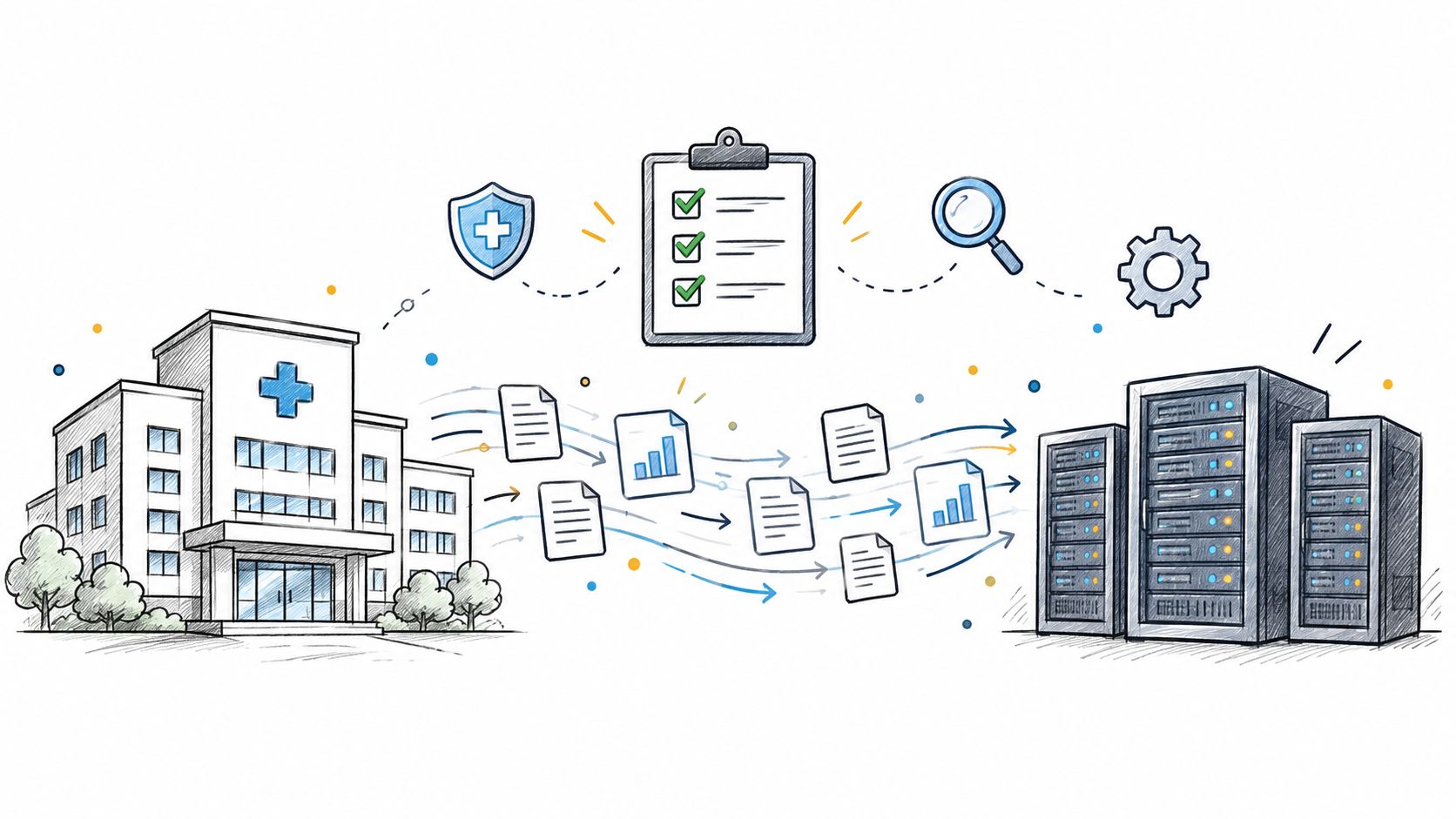
Practical data migration planning guide for healthcare teams. Scope, mapping, compliance, validation, cutover and rollback decisions explained end to end.
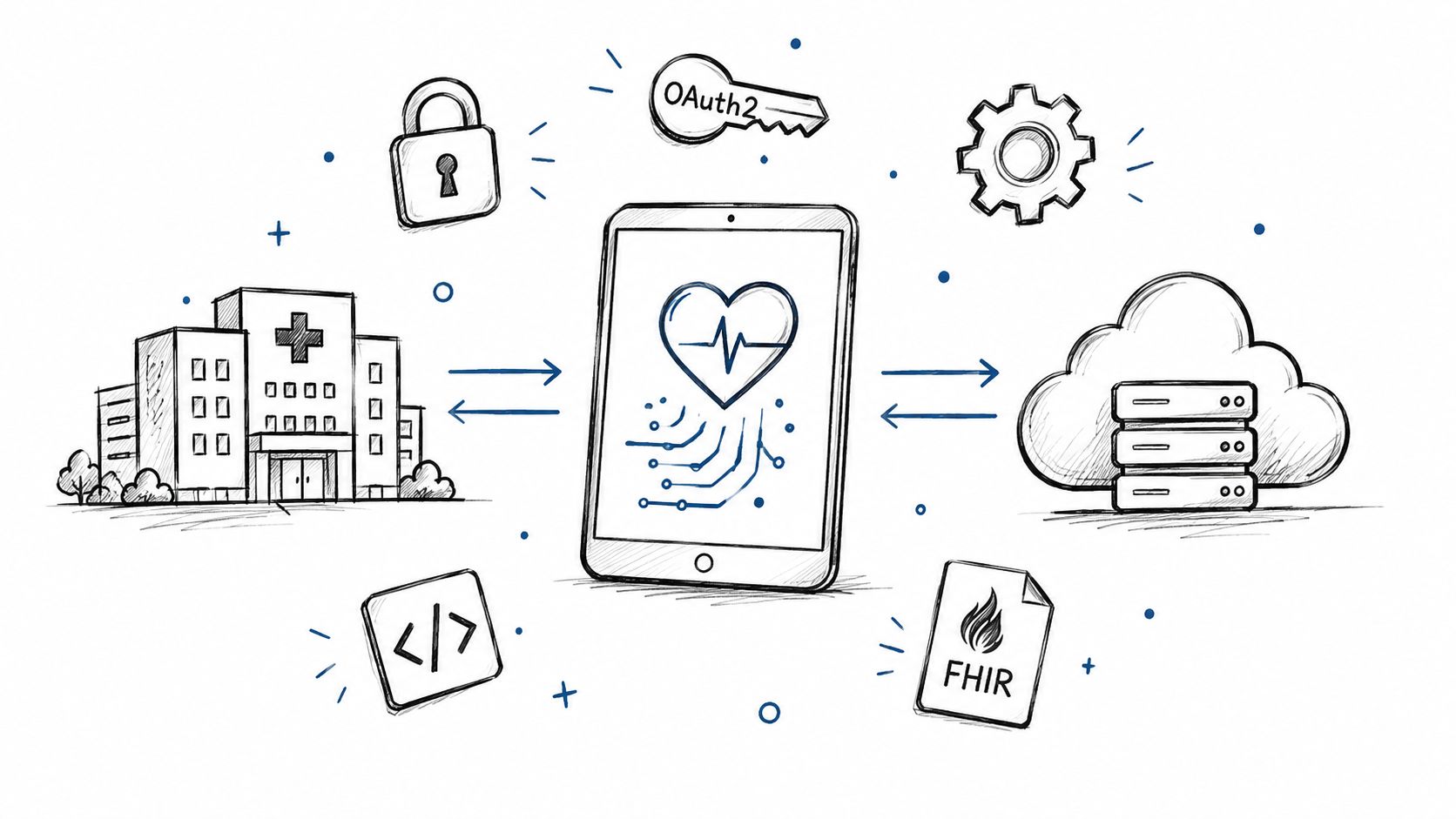
Smart on FHIR guide for healthtech engineers. Learn the OAuth 2.0 launch model, scope syntax, backend services, and US regulatory requirements.
Connect with our team to explore how AI expertise can transform your business.