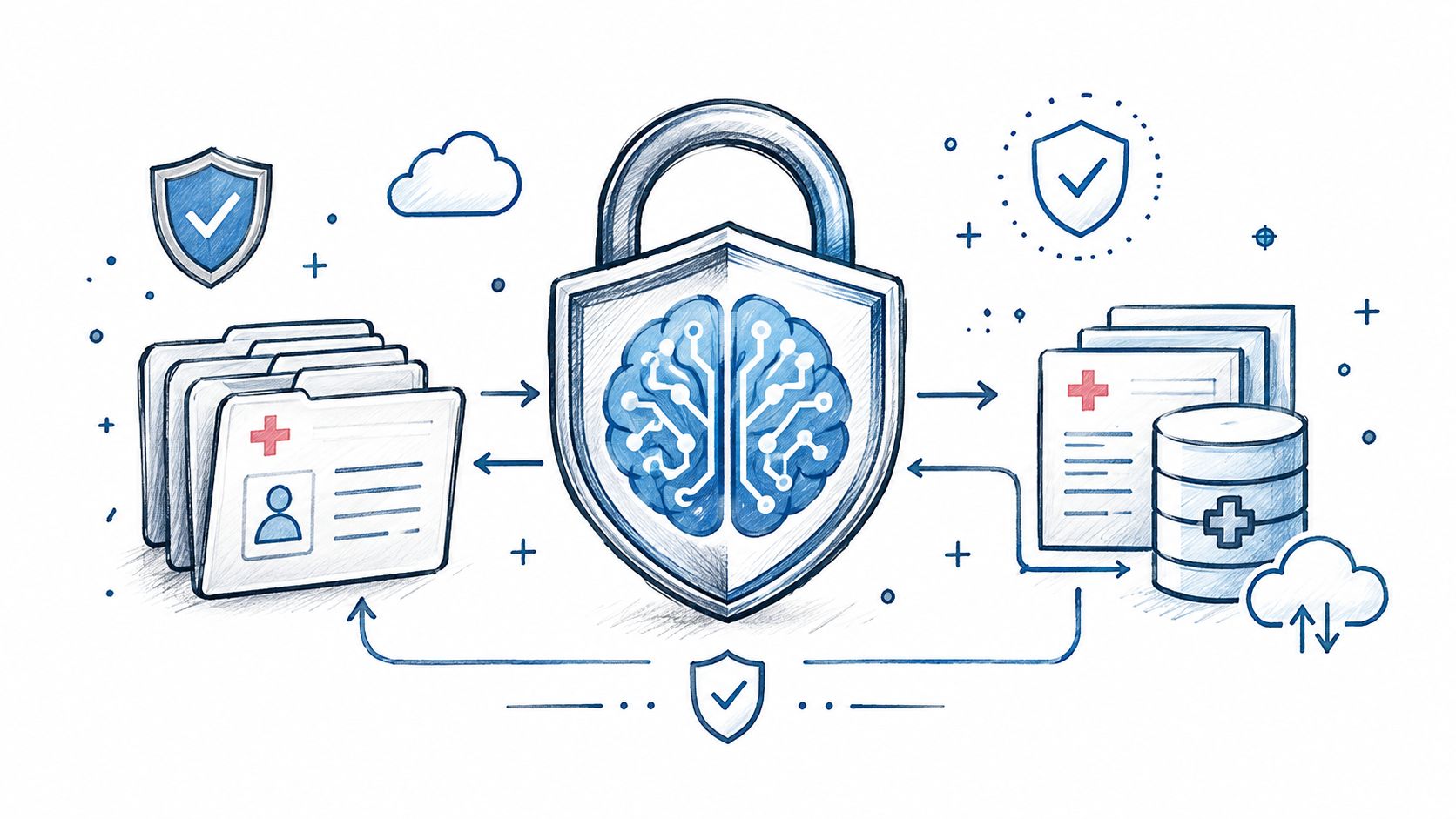
AI in Healthcare
HIPAA-Compliant AI: How to Use LLMs With PHI Safely
How to build HIPAA-compliant AI: when LLM providers need a BAA, data minimization, de-identification, audit controls and a reference architecture.
October 16, 2026Read more
Unlock the true potential of enterprise-grade healthcare AI. A CEO's guide to architecture, compliance, ROI, and vendor selection for transformative results.

Let's start with a simple comparison. Think about the difference between a personal finance app on your phone and the core software that keeps a global bank running. While both handle money, only one is engineered to manage millions of transactions with airtight security, navigate a maze of regulations, and run with near-perfect reliability.
That’s the exact distinction between a standard AI tool and true enterprise-grade healthcare AI.

While a consumer wellness app might track your steps, an enterprise-grade AI solution is built to plug directly into a hospital’s incredibly complex ecosystem. These aren't experimental side projects; they are powerful systems designed for high-stakes environments where they might predict sepsis risk, streamline operating room schedules, or support a clinician's diagnostic process. They become part of the very fabric of care delivery.
The market growth tells the same story, showing a clear shift from small pilot programs to permanent, mission-critical infrastructure. Projections show the global AI in healthcare market soaring from $39 billion in 2025 to over $500 billion by 2032. This isn't just hype; it’s driven by the real-world ROI health systems are seeing from these serious deployments.
So, what truly elevates an AI solution to "enterprise-grade"? It isn't just a single feature but a combination of non-negotiable attributes that ensure safety, reliability, and tangible business value. The table below outlines these core pillars.
| Characteristic | Description | Business Implication |
|---|---|---|
| Scalability & Reliability | The system must perform flawlessly for thousands of users and across massive datasets without any lag or degradation in performance. | Supports system-wide adoption without crashing or slowing down critical operations. Protects against costly downtime. |
| Security & Compliance | Built with ironclad security protocols and guaranteed adherence to regulations like HIPAA and GDPR to protect sensitive patient information. | Mitigates the enormous financial and reputational risks associated with data breaches. Ensures legal and regulatory adherence. |
| Seamless Integration | The AI must connect smoothly with existing Electronic Health Records (EHRs) and clinical workflows, augmenting them rather than disrupting them. | Drives user adoption by making the tool a natural part of a clinician's day. Avoids creating new data silos or workflow friction. |
| Clinical Validation | The models are rigorously and continuously tested against clinical gold standards to prove their safety, accuracy, and effectiveness in real-world scenarios. | Builds trust with clinicians and patients. Ensures the AI provides genuinely helpful, safe, and reliable outputs that improve care. |
Ultimately, these characteristics are what separate a promising concept from a deployable, trustworthy asset. They are the foundation of any serious AI strategy in healthcare.
Understanding these requirements is the first step for any decision-maker. It’s about moving beyond the algorithm and focusing on the entire system's resilience and its fit within the organization. Exploring real-world use cases, like Jpa Health's approach to AI-powered healthcare communications, can provide a practical look at these principles in action.
Our Healthcare AI Services are designed from the ground up to meet these demanding standards, delivering solutions that are ready for the complex realities of modern health systems.
When we talk about enterprise AI in healthcare, we’re not just talking about a clever algorithm. We’re talking about the plumbing—the technical foundation that has to be rock-solid to support AI across an entire, complex health system. This isn't about running an experiment on a single laptop; it's about engineering a resilient, secure, and scalable engine that can be trusted with clinical decisions.
The first major decision you'll face is your architecture. For most health systems, a hybrid cloud model hits the sweet spot. It allows you to keep your most sensitive patient data secure on-premise while tapping into the massive processing power of the public cloud for the heavy lifting of model training. This gives you tight control without sacrificing the computational muscle needed for serious AI development.
Privacy can't be an afterthought here. It has to be baked in from day one. That’s why techniques like federated learning are becoming so important. This approach allows a model to learn from data across different hospitals or clinics without that data ever leaving its secure home. The model trains locally, and only the mathematical insights—not the raw data—are shared. This ensures patient privacy is protected by design.
Every AI model is hungry for data, but it's incredibly picky. The pipelines that feed your models are responsible for pulling in huge volumes of data from everywhere—EHRs, lab systems, imaging archives—and then cleaning, structuring, and validating it. If your data pipeline is flawed, you'll fall victim to the "garbage in, garbage out" principle, and even the most sophisticated model will fail.
This is where Machine Learning Operations (MLOps) becomes the heart of your technical strategy.
MLOps is to AI what DevOps is to software development. It’s the set of practices that automates and manages the entire lifecycle of a machine learning model, turning a one-off science project into a reliable, continuously improving system.
Without a strong MLOps framework, your AI models will inevitably degrade. This performance decay happens as real-world data and patient populations shift over time, making your model less accurate. MLOps is the engine that keeps your models sharp by automating the critical, ongoing work.
Think of it as the system that handles:
Frankly, the biggest technical headache is often getting these new AI systems to talk to your existing, and often aging, hospital infrastructure. A powerful AI tool is useless if it's trapped in a silo. It has to connect seamlessly with the EHRs and clinical workflows your care teams already use every day. Our experience with the AI Product Development Workflow confirms that true success hinges on having expertise in both modern AI and the messy reality of healthcare IT.
Building this complex, resilient system is what separates a genuine AI strategy from wishful thinking. It requires a partner who knows how to bridge the gap between cutting-edge technology and the practical demands of a clinical environment. By getting this technical blueprint right, you build a foundation for AI that is not only powerful but also sustainable, secure, and ready to grow with you.
When it comes to enterprise AI in healthcare, compliance isn't just a box to check. It's the very foundation of patient trust and a critical shield against massive business risk. If you're going to navigate the regulatory maze of HIPAA in the U.S. and GDPR in Europe, you need a plan. And that plan has to be baked in from day one.
A solid data governance framework is the bedrock of it all. This means setting up crystal-clear rules for how Protected Health Information (PHI) is handled—from collection and storage to its use in AI models and final auditing. Think of it as establishing an unbreakable chain of custody for every piece of patient data your system touches.
This starts with appointing data stewards, the people directly responsible for data quality and protection. It also means putting strict, role-based access controls in place so only authorized staff can interact with sensitive information. Without these guardrails, even the most powerful AI is a liability waiting to happen.
The technical blueprint below shows how these pieces fit together to create a secure, compliant architecture.

This setup shows how components like a hybrid cloud, federated learning, and MLOps are not just IT jargon; they are essential tools for building a system that respects privacy while delivering powerful insights.
To build an AI program that's both defensible and trustworthy, there are a few non-negotiables. These are the core elements you absolutely must have to operate safely in healthcare's highly regulated world.
Getting this right isn't about being reactive; it's about being proactive. It shifts governance from a burden to a genuine competitive advantage.
The explosion of enterprise AI has put compliance and auditability directly under the microscope. The U.S. healthcare AI market is on track to hit $22.7 billion by 2026, with some analysts projecting the global market could exceed $1 trillion by 2034.
This growth is driven by serious investment. U.S. health organizations recently spent $1.4 billion on AI in a single year, nearly tripling the prior year’s spend and causing a 7x spike in the use of specialized AI tools. This incredible momentum highlights just how urgent the need for scalable, compliant solutions has become.
A strong data governance framework transforms compliance from a reactive, check-the-box exercise into a proactive strategy that underpins patient safety, builds trust, and secures the organization’s future.
As you work through this complex regulatory environment, it's vital to have a clear strategy. For a closer look at these challenges, we recommend exploring these insights on mastering compliance & risk management in the AI era. Preparing for audits and putting these strict controls in place shows a real commitment to ethical AI—something that resonates with regulators and patients alike, making your solutions truly enterprise-ready.
The tech world’s old mantra, “move fast and break things,” is a non-starter in healthcare. It's actually a recipe for disaster. When a patient’s well-being is on the line, there’s simply no margin for error. That’s why enterprise-grade healthcare AI is built on a foundation of clinical validation, rigorous risk management, and unwavering ethical principles. These aren't just nice-to-haves; they are non-negotiable.

Before an AI model ever touches a real patient workflow, it has to prove its worth through exhaustive validation. This isn't just about showing it can process data. It's about benchmarking its performance against the "clinical gold standard"—the diagnostic methods and best practices trusted by top human experts. Without this evidence, an AI tool is nothing more than an interesting but unproven algorithm.
This process generates the hard evidence required for regulatory clearance, but the work doesn't stop there. True enterprise-grade validation is a continuous loop, ensuring the model stays safe, accurate, and effective long after it's been deployed.
One of the most significant dangers with AI in healthcare is algorithmic bias. Think about it: if a model learns from data that mostly represents a single demographic, its accuracy can plummet when it encounters patients from underrepresented groups. It could even produce actively harmful recommendations. A truly enterprise-ready system is designed from the ground up to deliver equitable care for everyone.
Getting this right requires a proactive, multi-pronged strategy:
This focus on fairness isn't just about ethics—it's a fundamental part of clinical safety and risk management. Building trust with clinicians and patients starts by proving your technology works for all patients, not just a select few.
Even the most sophisticated AI shouldn't make high-stakes clinical calls on its own. The "human-in-the-loop" model is an essential safety design that keeps a qualified clinician in the driver's seat. In this framework, AI acts as a powerful co-pilot, surfacing insights and flagging potential issues, but the final judgment always rests with the human expert.
Beyond the technical safeguards, your organization needs to establish its own ethical charter. This document becomes your North Star, clearly defining your commitments to:
When you're looking at potential vendors, you have to go deep on their validation studies and their strategies for handling bias. Scrutinizing their real-world results is how you connect governance directly to patient safety and build the trust needed for long-term success. For instance, you can see how this works with tools like Diagnoo for medical diagnoses, where AI supports rather than replaces clinical expertise.
So, you’ve made a significant investment in enterprise-grade healthcare AI. How do you actually prove it's working? To get beyond vague promises, you need a clear way to measure your return on investment (ROI). That means picking the right Key Performance Indicators (KPIs) that track both the nuts-and-bolts operational gains and the critical improvements in patient care.
For anyone managing the business side of a health system, the initial focus is almost always on financial and workflow metrics. Proving ROI here is about drawing a straight line from the AI solution to tangible cost savings and smoother processes. It's about showing the technology is helping the hospital run more efficiently.
Your operational KPIs need to tell a simple "before and after" story. The idea is to show exactly how AI is chipping away at the administrative grind and improving patient flow across your facilities.
Think about tracking metrics like:
These are the kinds of hard numbers that justify the investment in powerful healthcare software solutions. They translate directly to a healthier bottom line and the ability to serve more patients.
Of course, efficiency is only half the story. The real purpose of AI in healthcare is to improve patient care. To measure the clinical ROI, you need a different set of KPIs—ones that focus on safety, accuracy, and better health outcomes. This is where you prove the AI isn't just fast, but genuinely effective.
A balanced scorecard is the best way to think about this. You can't just look at financial gains. You have to put them alongside improvements in clinical quality, patient experience, and clinician satisfaction to see the full picture of the AI's impact.
Key clinical KPIs to measure include:
When you bring both the operational and clinical metrics together, you create a powerful story for stakeholders. You can show that your AI initiative is not only a smart financial move but is also delivering on the fundamental mission of providing better, safer care for your patients.
As we explored in our AI adoption guide, this all starts with a clear strategy. Our Custom AI Strategy report is built to help organizations define and track these critical KPIs right from the start, making sure every project is set up for measurable success.
Picking a vendor for an enterprise healthcare AI project is one of the most consequential decisions you'll make. This isn’t just about buying software. You’re choosing a long-term partner to help you navigate a maze of technical, clinical, and regulatory hurdles.
The right partner can be a powerful accelerator. The wrong one? A fast track to stalled projects, compliance nightmares, and a whole lot of wasted money. You have to cut through the marketing noise and find someone who truly gets healthcare.
To do this, you need a structured way to evaluate potential partners. It's about finding proof of real-world success, not just slick presentations and technical promises. Look for a team that has deep technical skills, of course, but also an authentic understanding of the clinical environment.
Here are the non-negotiable criteria you should be assessing:
The healthcare AI market is crowded and competitive. You've got tech giants like Microsoft, Google (DeepMind), AWS, and NVIDIA competing with specialized health-tech firms.
This market is exploding, projected to jump from $22.18 billion in 2025 to $719.7 billion by 2034. That intense competition is actually great news for health systems—it forces vendors to focus on what really matters: clinical utility, safety, bias mitigation, and seamless EHR integration. You can read more on the AI in healthcare market outlook at Research and Markets.
Choosing a partner is about more than just technology; it’s about finding an organization that shares your commitment to patient safety, clinical rigor, and ethical responsibility. Their approach to mitigating bias and ensuring transparency is as important as their algorithm's accuracy.
The table below provides a snapshot of some of the major players, helping you understand their core strengths and how they might fit into your strategy.
This table evaluates leading vendors in the enterprise healthcare AI space based on criteria crucial for enterprise adoption, such as integration capabilities, regulatory focus, and primary use cases.
| Vendor | Primary Focus/Strengths | EHR Integration Capabilities | Regulatory/Compliance Focus |
|---|---|---|---|
| Microsoft | Cloud infrastructure (Azure), broad AI services, and productivity tools. Strong focus on generative AI for administrative and clinical documentation tasks. | Extensive partner ecosystem; deep integrations with Epic via Nuance DAX. | Strong enterprise-grade security and compliance frameworks (HIPAA BAA). |
| Advanced AI/ML research (DeepMind), large-scale data analytics (BigQuery), and generative models (Med-PaLM 2). | Growing partnerships; API-first approach for integration with various EHRs and data platforms. | Focus on secure, compliant cloud infrastructure; developing specific healthcare data engines. | |
| NVIDIA | High-performance computing hardware (GPUs) and software frameworks (Clara) for medical imaging, genomics, and drug discovery. | Primarily provides the "engine" for partners and health systems to build on; less direct EHR integration. | Provides tools and frameworks that are built to be compliant within a partner's secure environment. |
| Oracle Cerner | Deeply embedded in clinical workflows with its own EHR. AI is focused on augmenting existing clinical and operational systems. | Native integration with Cerner Millennium EHR. Interoperability with other systems is a stated goal. | Core focus on clinical data regulations (HIPAA); deep experience with health data management. |
Ultimately, you need to decide what kind of partner you need. Are you looking for a massive platform provider, or a more hands-on strategic guide who can take you from an idea to a fully implemented solution?
At Ekipa, we act as that strategic partner. Our services range from high-level AI strategy consulting to full-cycle AI Automation as a Service. For unique clinical challenges, we also collaborate with trusted firms that offer custom healthcare software development. We also build practical tools like the HCP Engagement Co-pilot to directly support your teams.
Your end goal is to find a partner who helps you build and deploy healthcare AI that is not only powerful but also safe, compliant, and woven directly into the fabric of your organization.
As you consider bringing AI into your healthcare system, it’s natural to have some big questions. Let's tackle a few of the most common ones we hear from leaders and decision-makers just like you.
Everyone wants to jump straight to the exciting technology, but the real first step is taking a step back to focus on strategy. Before looking at specific AI tools for business, your organization needs a clear and unified vision for what you want to achieve.
We always recommend starting with a dedicated AI strategy consulting tool. The goal is to pinpoint the highest-impact use cases that genuinely align with your core objectives. Are you trying to slash administrative costs, accelerate diagnostic turnaround times, or smooth out patient flow? Knowing this upfront is critical. This process also involves a thorough AI requirements analysis to map out your data resources, current IT infrastructure, and compliance responsibilities. To make this tangible, we help teams produce a Custom AI Strategy report that prioritizes projects by potential ROI, giving you a solid foundation to build upon.
That's one of the most important questions, as poor integration is a deal-breaker. True enterprise-grade AI should feel invisible, and seamless integration with systems like Epic or Cerner needs to be a non-negotiable part of your vendor selection.
The goal is to embed AI into the clinician's existing workflow, not force them to switch between multiple systems. For example, AI-powered diagnostic insights should appear directly within the patient's record.
Think of it this way: the AI should come to the clinician, not the other way around. Whether you are building internal tooling or choosing an outside partner, always prioritize platforms built on interoperability standards. Our Healthcare AI Services are designed to deliver solutions that feel like a natural extension of the healthcare software solutions your team already relies on every day.
This is a valid concern, and the answer involves a proactive, layered approach—it isn't something you can bolt on at the end. For patient privacy, strict adherence to a well-defined data governance framework that meets HIPAA and GDPR standards is the baseline. This often means using advanced techniques like data anonymization or even federated learning, where the model trains on local data without the data ever leaving the hospital's servers.
Tackling AI bias starts with the data itself. You must ensure your training datasets are a fair and accurate representation of your actual patient population. When evaluating vendors, don't be shy about asking for proof—demand transparency on how they test for and reduce bias in their models.
Finally, for high-stakes clinical decisions, always implement a "human-in-the-loop" protocol. This gives clinicians the final say, allowing them to review and, if necessary, override an AI recommendation. Building trust is all about maintaining transparency and control, and our expert team at Ekipa specializes in helping organizations establish these essential ethical and safety guardrails from day one.
How to build HIPAA-compliant AI: when LLM providers need a BAA, data minimization, de-identification, audit controls and a reference architecture.
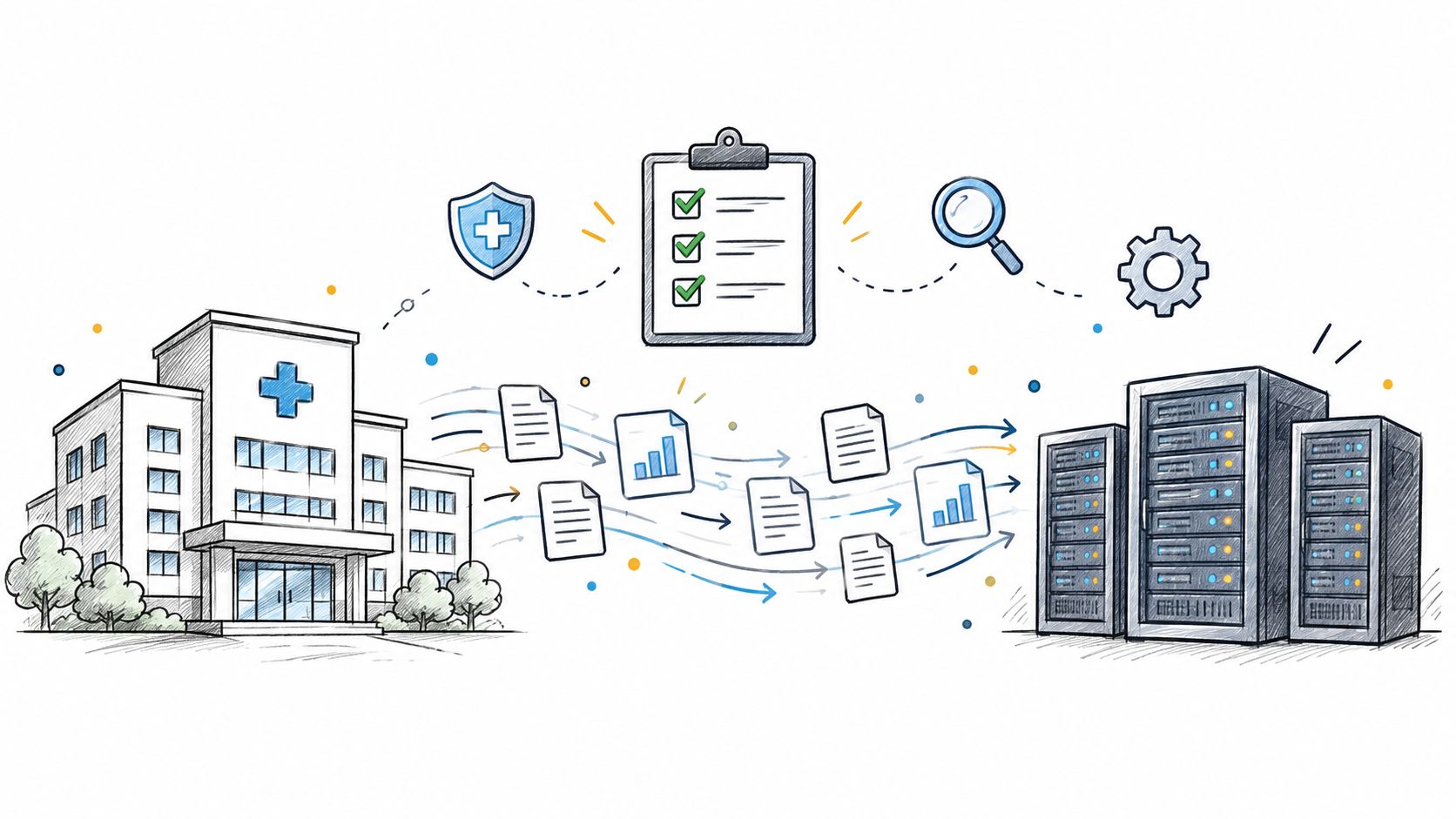
Practical data migration planning guide for healthcare teams. Scope, mapping, compliance, validation, cutover and rollback decisions explained end to end.
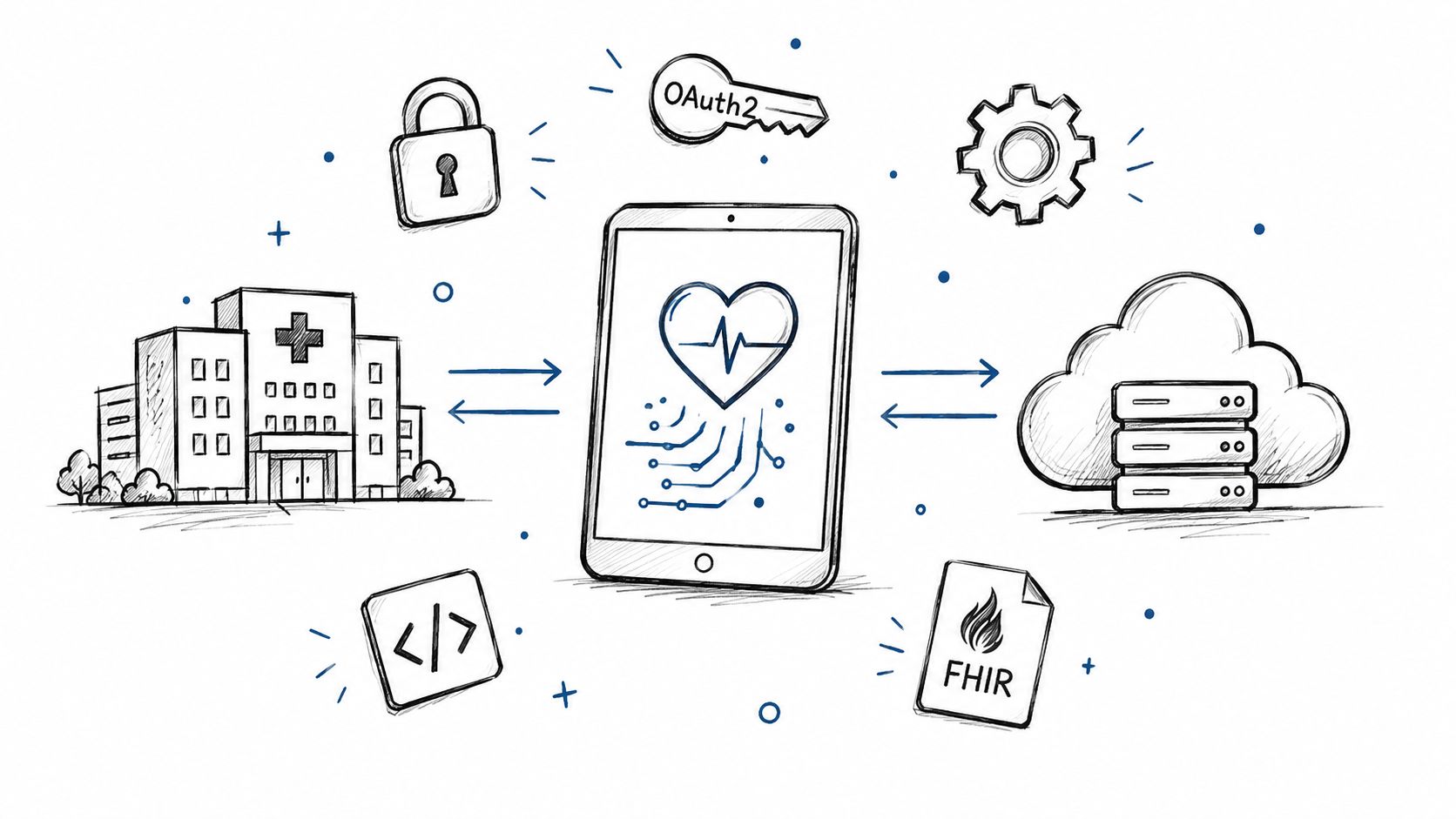
Smart on FHIR guide for healthtech engineers. Learn the OAuth 2.0 launch model, scope syntax, backend services, and US regulatory requirements.
Connect with our team to explore how AI expertise can transform your business.