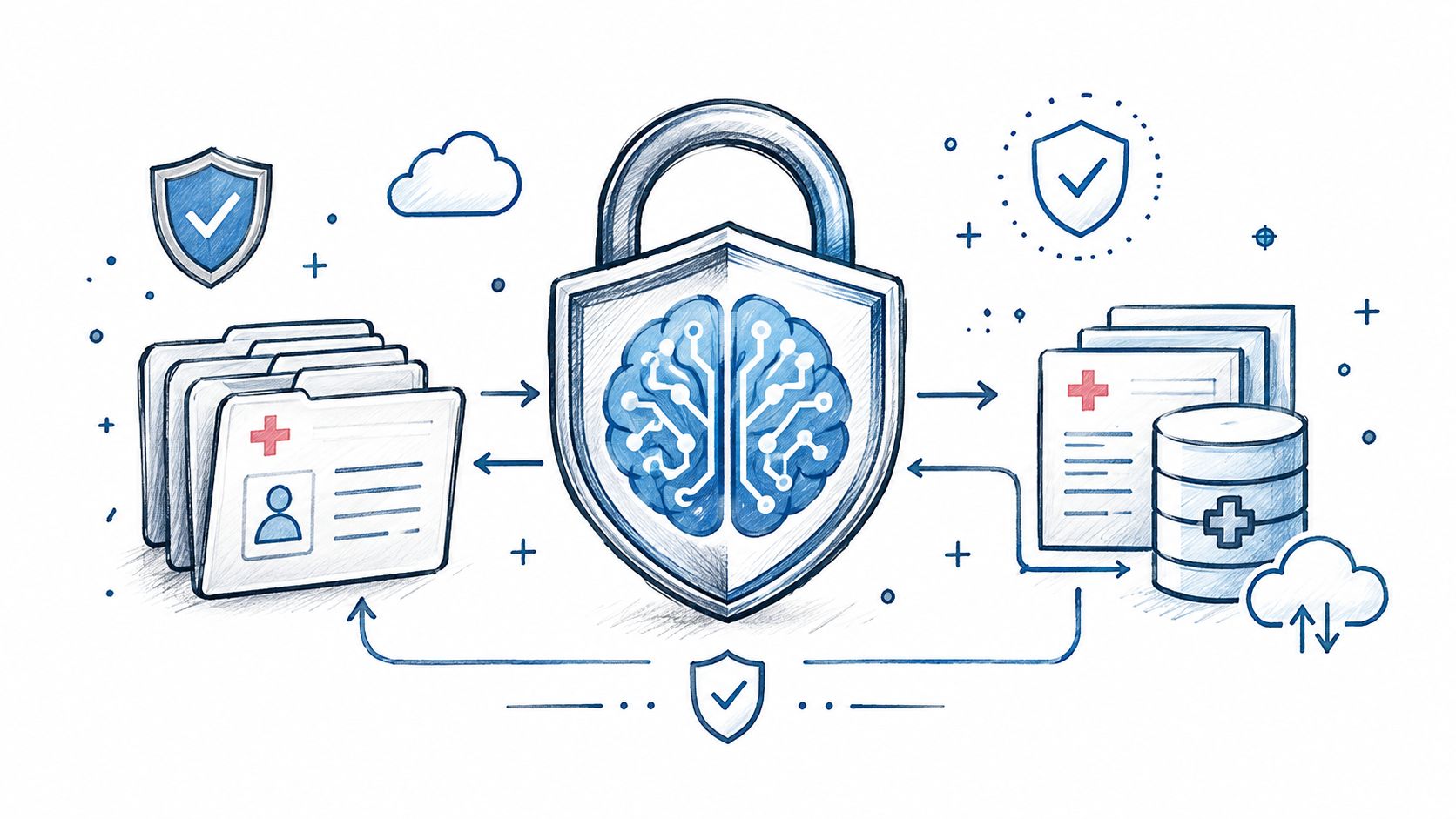
AI in Healthcare
HIPAA-Compliant AI: How to Use LLMs With PHI Safely
How to build HIPAA-compliant AI: when LLM providers need a BAA, data minimization, de-identification, audit controls and a reference architecture.
October 16, 2026Read more
Discover how healthcare decision intelligence platforms transform operations and patient care. Learn to build a business case and implement these AI systems.

Think of your most experienced physician. Now, imagine they could instantly recall every patient chart, every clinical trial, and every operational report ever written in your health system. That’s the core idea behind healthcare decision intelligence (DI) platforms. These aren't just another analytics tool; they act as a strategic co-pilot for clinicians and administrators, diagnosing problems and recommending specific actions to take.
For years, healthcare has relied on traditional business intelligence (BI), which is a lot like driving using only your rearview mirror. It’s great at telling you what already happened—last quarter’s patient volumes or historical readmission rates.
Decision intelligence, on the other hand, is like a GPS with live traffic updates. It not only shows you where you are but predicts what's ahead and suggests the best routes to your destination. The goal isn't to replace your experts, but to supercharge their abilities, cutting through the noise so they can focus on high-value patient care and strategic decisions.
This fundamental shift—from looking backward to actively guiding future actions—is what makes a DI platform so different. It’s about weaving together massive, disconnected datasets from EHRs, billing systems, real-time monitors, and even genomic data to provide clear, actionable guidance.
At its core, a DI platform continuously works to answer four critical questions:
It’s that final question that truly sets DI apart. A traditional dashboard might flag a spike in patient wait times, but a DI platform will suggest specific scheduling changes or staffing adjustments to fix it. Of course, making this all work requires a robust technical foundation, which is why specialized IT services for health care services are so critical for successful implementation.
To understand this distinction better, let's compare these two approaches side-by-side.
This table contrasts the capabilities of modern decision intelligence platforms with those of traditional BI tools to clarify their distinct value propositions in a healthcare context.
| Capability | Traditional Business Intelligence (BI) | Healthcare Decision Intelligence (DI) |
|---|---|---|
| Primary Focus | Historical Reporting (What happened?) | Forward-Looking Guidance (What should we do?) |
| Output | Dashboards, static reports, and data visualizations. | Actionable recommendations, simulations, and outcome predictions. |
| Analytics Scope | Descriptive and some diagnostic analytics. | Descriptive, diagnostic, predictive, and prescriptive analytics. |
| User Interaction | Passive. Users interpret data to find insights. | Interactive. Users collaborate with the system to evaluate options. |
| Decision Process | Human-driven. Relies entirely on user expertise to connect data to action. | Augmented. The system recommends actions and models their impact. |
| Example | A report showing a 15% increase in patient readmissions last quarter. | Identifying at-risk patients before discharge and recommending a specific follow-up care plan to prevent readmission. |
As you can see, DI doesn't just present information; it synthesizes it into a recommended course of action, turning data into decisions.
A decision intelligence platform acts as a strategic co-pilot for hospital leaders and clinicians. It analyzes vast, complex datasets to not only diagnose problems but also recommend specific actions and predict their outcomes.
This capability is quickly moving from a "nice-to-have" to a necessity. The AI in healthcare market, valued at USD 18.0 billion in 2023, is projected to soar to USD 80.7 billion by 2036—a 16.2% compound annual growth rate (CAGR). This explosive growth isn't just hype; it's a direct response to urgent needs like staffing shortages and operational bottlenecks, where AI-powered tools are proving their worth.
Most healthcare organizations are drowning in data but starving for wisdom. DI platforms are engineered to fix this. By unifying information that was once trapped in separate silos, these systems create a holistic view of both clinical performance and operational health.
However, just buying the technology isn't enough. The first step is partnering with a HealthTech engineering partner that understands the intersection of healthcare and technology. This ensures the platform is built to tackle your organization's specific goals, whether that’s improving patient outcomes, lowering costs, or boosting staff morale. For a closer look at what this involves, our guide on specialized Healthcare AI Services breaks it down further. This is how a powerful tool becomes a lasting strategic advantage.
To really get what makes a decision intelligence platform so powerful in healthcare, you have to look under the hood. The best way to think about it is as your organization's central nervous system—it’s built to sense what's happening, process it, and trigger a coordinated response. This all happens across three core layers that work in concert.
It all starts with the Data Integration Layer. This is the system’s eyes and ears, constantly pulling in information from every corner of your healthcare environment. We're talking about a massive amount of structured and unstructured data from dozens of sources that, until now, probably didn't talk to each other.
This includes information from:
Once the data is collected, it’s fed into the Analytics & AI Engine—the brain of the whole operation. This is where raw, messy data gets turned into clear, strategic insight. Sophisticated machine learning models get to work on this constant stream of information, running the full gamut of analytics from describing what happened to prescribing the next best action.
Building this analytical core is where having deep expertise in Healthcare AI Services is non-negotiable. The engine has to be designed for seamless interoperability and rock-solid security, plus it needs to be able to scale as your organization grows. Its entire job is to turn a flood of data into intelligence you can actually use.
The final piece of the puzzle is the Visualization & Action Layer. Think of this as the hands and voice of the system. It translates complex analytics into intuitive outputs that people can act on immediately. For an executive, that might be an interactive dashboard showing real-time KPIs or modeling different financial scenarios.
For a clinician on the floor, it could be a simple alert on their phone warning that a patient’s condition is deteriorating. This layer can also kick off automated actions, like alerting a sepsis response team or automatically reordering critical supplies because the system predicts a shortage. The goal is always the same: get the right insight to the right person at the right time.
This flow chart gives you a simple, high-level look at how raw data becomes a real-world action.

As you can see, it’s a journey from data ingestion, through the analytical engine, and out the other side as a concrete, intelligent action.
The platform’s architecture isn’t just about showing you data. It's designed to create a closed-loop system where insights directly drive measurable improvements in both clinical and operational outcomes.
The market for these systems is growing incredibly fast. Healthcare analytics is projected to jump from USD 55.99 billion in 2026 to USD 217.59 billion by 2033—that's a compound annual growth rate of 21.4%. The software itself is expected to represent 46.6% of this market, showing just how critical it is to the whole equation.
Here’s a key detail for leaders: despite the buzz around cloud computing, on-premises deployment still dominates, capturing an estimated 57.8% of the market. This preference is driven by strict data governance and security needs inherent to healthcare. These figures tell us that a successful platform has to balance advanced software with a secure, controllable infrastructure. Your choice of deployment—cloud, on-prem, or hybrid—is a major strategic decision that will depend entirely on your organization’s unique compliance and security posture.
Theory is one thing; results are another. This is where a decision intelligence (DI) platform proves its real-world value, moving beyond abstract concepts to deliver tangible outcomes that reshape both patient care and hospital management. These applications aren't futuristic pipe dreams—they are practical solutions being put to work today. The real-world use cases speak for themselves.

In a clinical setting, these platforms are saving lives by driving predictive alerts. A great example is sepsis detection. By constantly analyzing subtle shifts in vital signs and lab results from the EMR, the system can flag high-risk patients hours earlier than a human team realistically could. That early warning gives clinicians a critical head start.
But it's not just about alerts. DI makes truly personalized treatment possible. By analyzing a patient’s specific genomic data, clinical history, and even lifestyle factors, the platform can suggest therapies that have the highest probability of success for that individual. This is where custom SaMD solutions can play a significant role. We're finally moving past one-size-fits-all medicine.
The impact on the operational side is just as significant. Think about an emergency department that automatically adjusts its staffing schedule based on a reliable forecast of incoming patients—a forecast that considers community health trends, local events, and even the weather. That’s operational decision intelligence in action.
The same goes for the supply chain. Instead of scrambling to react to stockouts, the system can predict demand for critical supplies like PPE or specific medications. It then triggers orders well before a shortage ever occurs, ensuring resources are always where they need to be.
Other crucial operational wins include:
These use cases are flourishing in a digital health market that's booming, projected to hit over $300 billion in 2026. Much of that growth comes from AI-powered tools. A key driver is the explosion of connected devices, which are expected to generate 50% of all digital health data by 2026. At the same time, cloud-based solutions now make up 58% of deployments, showing just how important scalable and accessible platforms have become. These trends are directly shaping the AI tools for business, as you can see in our guide on the Clinic AI Assistant.
Decision intelligence platforms thrive by integrating these multi-source data streams—from IoT devices to cloud systems—and turning them into actionable insights that align with modern healthcare's investment priorities and regulatory demands.
This ability to weave together diverse data is what gives a DI platform its power. It connects clinical actions to operational efficiency, creating a smarter, more responsive healthcare system from top to bottom.
Let's be honest, for any major investment in a hospital, the conversation always starts with the numbers. Before you can even get into the "how," you have to nail down the "why." When it comes to a healthcare decision intelligence platform, that means moving past the cool features and showing how its capabilities solve your most critical challenges.
The case you build has to be grounded in tangible, measurable value. You need to connect the dots from the platform’s insights to the financial metrics your CFO and board care about. We’re not talking about vague benefits; we’re talking about hard numbers that directly impact your hospital's financial health.
Often, these gains are unlocked through focused AI Automation as a Service. This is where the platform’s recommendations are automatically translated into actions, ensuring great ideas don’t just sit in a report but actually drive immediate results without needing someone to manually push a button.
The core of your financial argument for a DI platform is simple: it helps you use resources smarter and cut out waste. The best way to track this is by focusing on a few key performance indicators (KPIs) that tell a clear story.
You can calculate a direct ROI by tracking improvements in areas like:
These are the kinds of measurable wins that form the backbone of a solid financial case.
But the numbers only tell half the story. The value of decision intelligence goes way beyond the balance sheet. Some of the most powerful benefits are the ones you feel—the qualitative improvements that create a stronger, more resilient hospital. These "soft" benefits are just as crucial and should be front and center in your pitch.
A DI platform doesn't just make a hospital more profitable; it makes it a better, safer place for patients to receive care and for staff to work. This dual impact on quality and culture is often the most compelling part of the business case.
Think about the impact on:
Building a truly persuasive business case is all about tying these specific outcomes—both financial and cultural—to your organization's big-picture goals. This is a core part of what effective AI strategy consulting does: making sure every technology investment delivers real, meaningful results for your patients, your staff, and your bottom line.
Bringing a healthcare decision intelligence platform into your organization isn't a flip-of-the-switch project; it's a carefully managed journey. To get it right and see a real return on your investment without causing chaos, you need a clear, phased roadmap. This is how you get from initial idea to a fully integrated, value-generating system.
It all begins with a solid foundation of strategy and discovery. Before you ever look at a single piece of software, you have to do the hard work of defining what success actually looks like for your hospital. You can't hit a target you can't see.
This first phase is about aligning any technology investment with your hospital's most critical needs. Don't start with the tech and look for a problem to solve. Instead, identify your biggest operational and clinical headaches and then see how a DI platform can provide the cure. A comprehensive AI requirements analysis is essential here.
This is where you zero in on what truly matters.
With clear goals in hand, you can now start looking for the right partner and prove the solution works on a small scale. Not all vendors are the same—you need one with a deep understanding of healthcare and a platform that plays well with your existing IT infrastructure. When they give you a demo, make them show you how their platform addresses your specific use cases.
Once you’ve found a promising partner, launch a focused Proof of Concept (PoC). This is your chance to test the technology in a controlled environment, proving its value quickly and with minimal risk. A successful PoC is your best tool for building momentum and getting the buy-in needed for a wider rollout.
After your PoC proves successful, it's time to expand. This is the delicate phase where you start connecting the DI platform to your core systems—EHRs, billing software, and lab information systems. This complex integration work is best managed with a clear AI Product Development Workflow.
Whatever you do, avoid a "big bang" implementation where everything goes live at once. That approach is a recipe for disaster. Instead, roll out the platform one department or one use case at a time. This method minimizes disruption, allows you to collect valuable user feedback, and makes it much easier to squash bugs as they pop up. If your needs are highly specialized, you might find that off-the-shelf solutions don't quite fit, making custom healthcare software development a more practical long-term option.
The final phase is all about making this new way of working stick. You need to weave the platform into the very fabric of your hospital's daily operations. This boils down to three ongoing activities:
To help guide you through this process, here is a simple checklist that breaks down each phase into actionable steps.
| Phase | Key Actions | Critical Success Factors |
|---|---|---|
| 1. Strategy & Discovery | - Convene stakeholder workshops. - Identify & prioritize 3-5 use cases. - Define measurable KPIs (e.g., reduce wait times by 20%). |
- Executive sponsorship and buy-in. - Clear alignment between DI goals and business strategy. |
| 2. Vendor Selection & PoC | - Issue RFPs to shortlisted vendors. - Conduct use-case-specific demos. - Run a 90-day PoC on one high-impact problem. |
- Strong vendor healthcare expertise. - A successful PoC that demonstrates tangible value. |
| 3. Phased Rollout | - Develop a detailed integration plan (EHR, LIS, etc.). - Deploy to the first department or use case. - Gather user feedback and iterate. |
- A "quick win" from the initial rollout to build momentum. - Robust data integration without disrupting workflows. |
| 4. Governance & Scaling | - Establish a data governance committee. - Develop a comprehensive user training program. - Create a roadmap for enterprise-wide expansion. |
- Strong user adoption and positive feedback. - Continuous monitoring and refinement of AI models. |
Following a structured roadmap like this ensures you are building a lasting capability, not just implementing another piece of software.
Adopting decision intelligence is a strategic transformation. A methodical, phased approach ensures the technology is not only implemented correctly but is also embraced by your teams, driving lasting improvements in patient care and operational efficiency.
Bringing a powerful tool like a healthcare decision intelligence platform into a clinical setting isn't just a technical project; it's a massive responsibility. You have to get the ethical and practical sides right from day one. The absolute starting point, the foundation for everything else, is ironclad data security and total HIPAA compliance. This isn't just about ticking boxes—it's about protecting patients and maintaining trust.
With patient data in the mix, knowing how to approach securing your AI systems is non-negotiable. This means putting robust encryption, strict access controls, and constant monitoring in place to shield against any potential breach or misuse.

But security is only one piece of the puzzle. A more hidden danger is algorithmic bias. AI models learn from the data we give them, and if that historical data contains biases or reflects existing health disparities, the AI will learn those same biases. Worse, it could make them even more pronounced.
Tackling bias isn't a one-and-done task. It demands a deliberate, ongoing effort that starts with curating diverse and representative data for training. From there, you have to constantly audit your models to catch and correct any skewed results. The goal is to build a system that actively improves health equity, not one that accidentally makes things worse.
Then there's the "black box" problem. Doctors and nurses are trained to understand the reasoning behind a diagnosis or treatment plan. They won't—and shouldn't—blindly follow recommendations from a machine they can't understand. This is exactly why explainable AI (XAI) is so critical.
Explainable AI pulls back the curtain on a model’s decision-making process. It translates the complex math into a clear rationale, showing clinicians the "why" behind a suggestion. This transparency is the key to building the trust needed for real-world adoption.
Finally, never underestimate the human side of introducing new technology. You can have the best platform in the world, but if your clinical teams don't get on board, it will gather dust. Change management isn't an afterthought; it’s central to success.
This means you need to get a few things right:
Getting through these challenges is where partnering with an experienced team can make all the difference. Building the right governance and ethical frameworks for these sophisticated AI tools is complex, but it ensures your move into decision intelligence is both successful and responsible.
There's no single price tag. The cost of a healthcare decision intelligence platform can range from a predictable monthly subscription for a ready-made solution to a larger, project-based investment for a custom-built system. Factors like the scale of your deployment and the number of data sources you need to integrate will shape the final cost. A good approach is to start with a focused Proof of Concept (PoC) to prove ROI before committing to an enterprise-wide rollout.
A pilot project targeting a specific issue, like optimizing OR schedules or reducing no-shows, can start delivering value in as little as 3 to 6 months. A full, enterprise-wide implementation is a longer journey, typically taking 12 to 18 months, depending on your existing IT infrastructure and data quality. The key, as we explored in our AI adoption guide, is a phased rollout.
You don't need to hire a large team of data scientists. While you'll rely on your technology partner for heavy lifting, you should cultivate "data translators" internally—people who can connect clinical challenges with data-driven solutions. The goal is to improve general data literacy and change management skills across the organization. For end-users like clinicians, the platform should be intuitive and require minimal technical expertise.
Trust is built through a combination of technology and governance. Technologically, look for platforms that offer explainable AI (XAI), which makes the AI's reasoning transparent. Instead of a "black box" answer, it shows why a recommendation was made. On the governance side, establish a multidisciplinary AI committee with clinicians, data experts, and ethicists to ensure models are fair, accurate, and aligned with your hospital's ethical standards.
For a deeper conversation about building a responsible and effective AI strategy with our AI Strategy consulting tool, feel free to connect with our expert team.
How to build HIPAA-compliant AI: when LLM providers need a BAA, data minimization, de-identification, audit controls and a reference architecture.
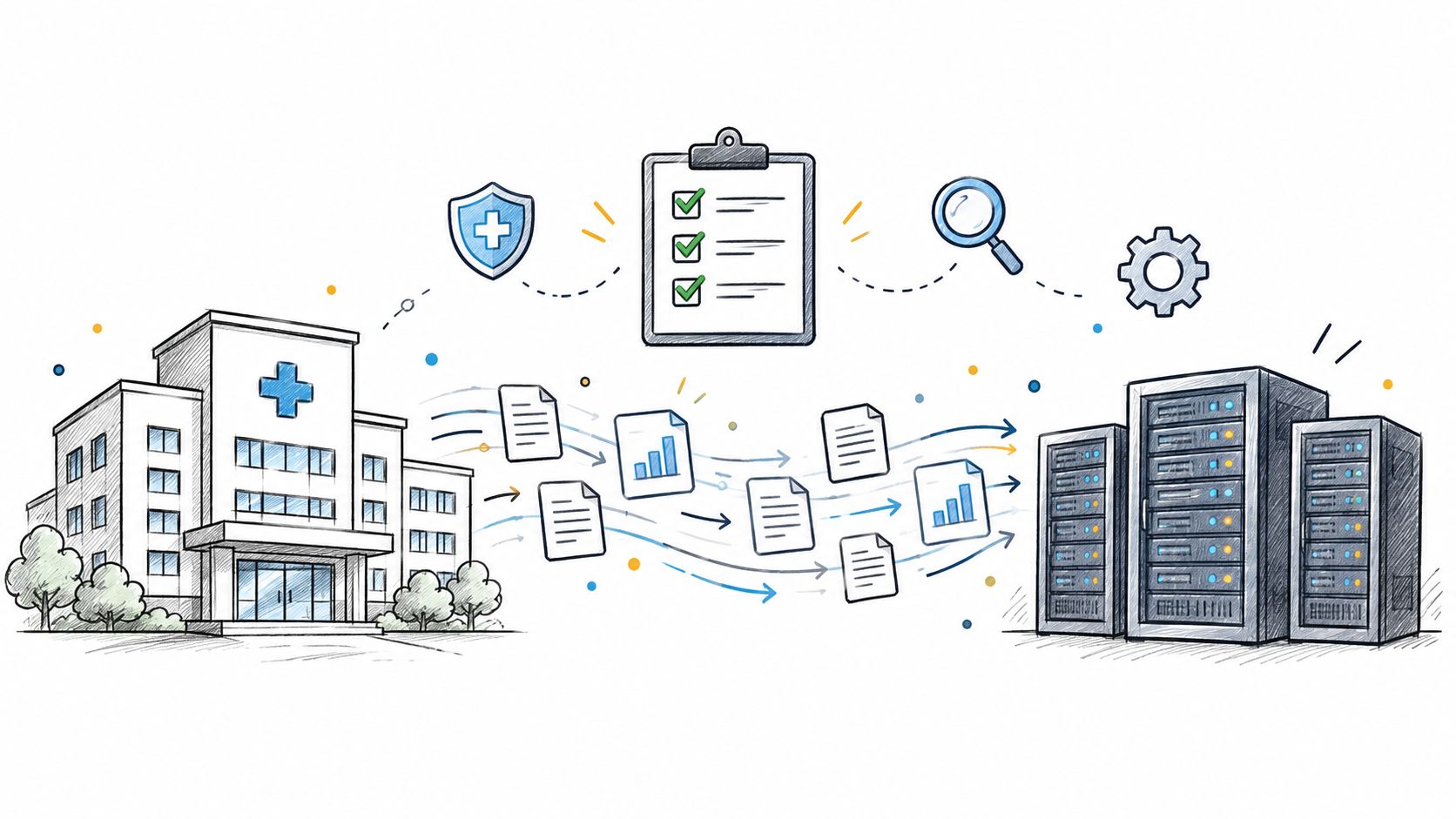
Practical data migration planning guide for healthcare teams. Scope, mapping, compliance, validation, cutover and rollback decisions explained end to end.
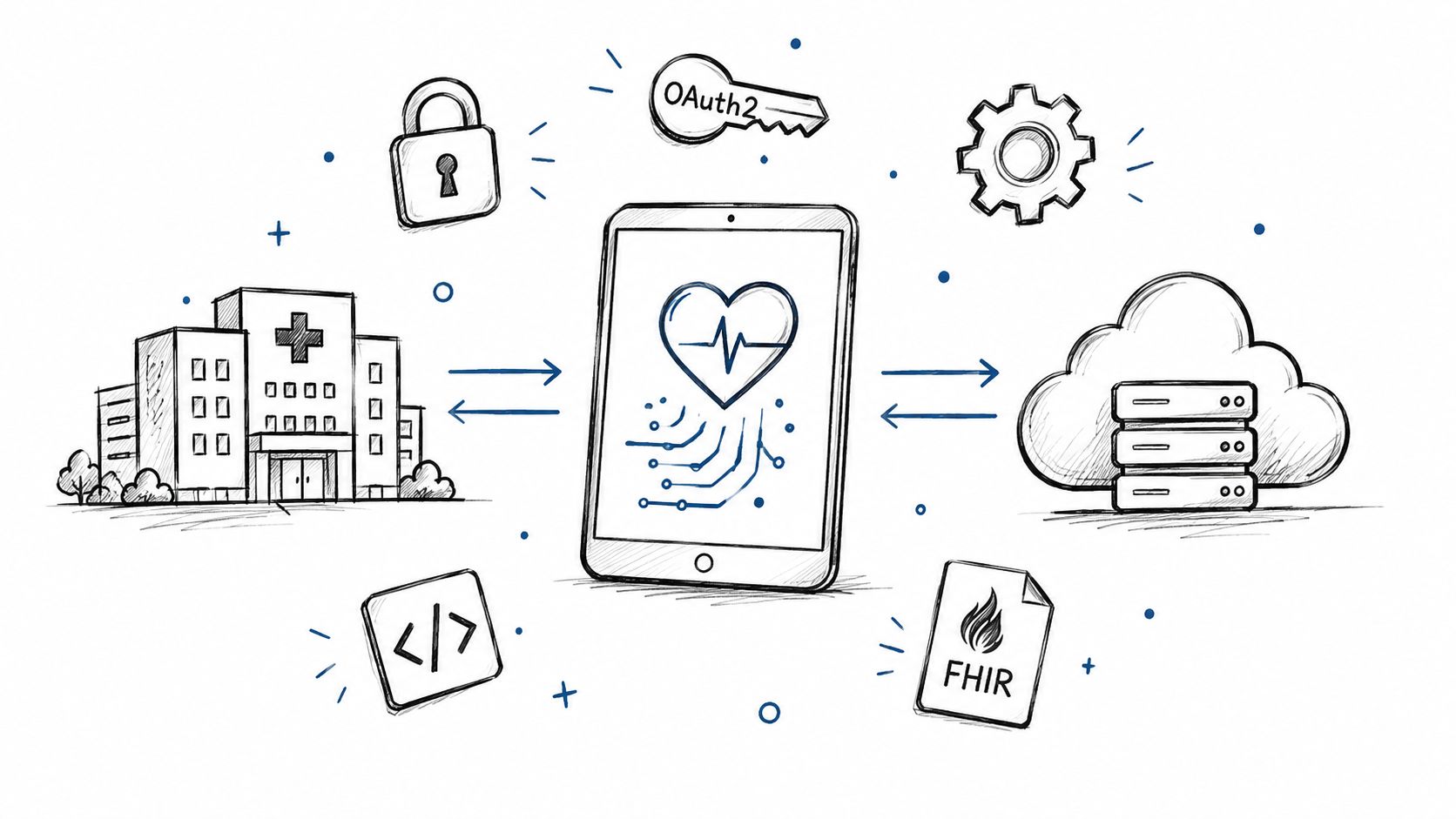
Smart on FHIR guide for healthtech engineers. Learn the OAuth 2.0 launch model, scope syntax, backend services, and US regulatory requirements.
Connect with our team to explore how AI expertise can transform your business.