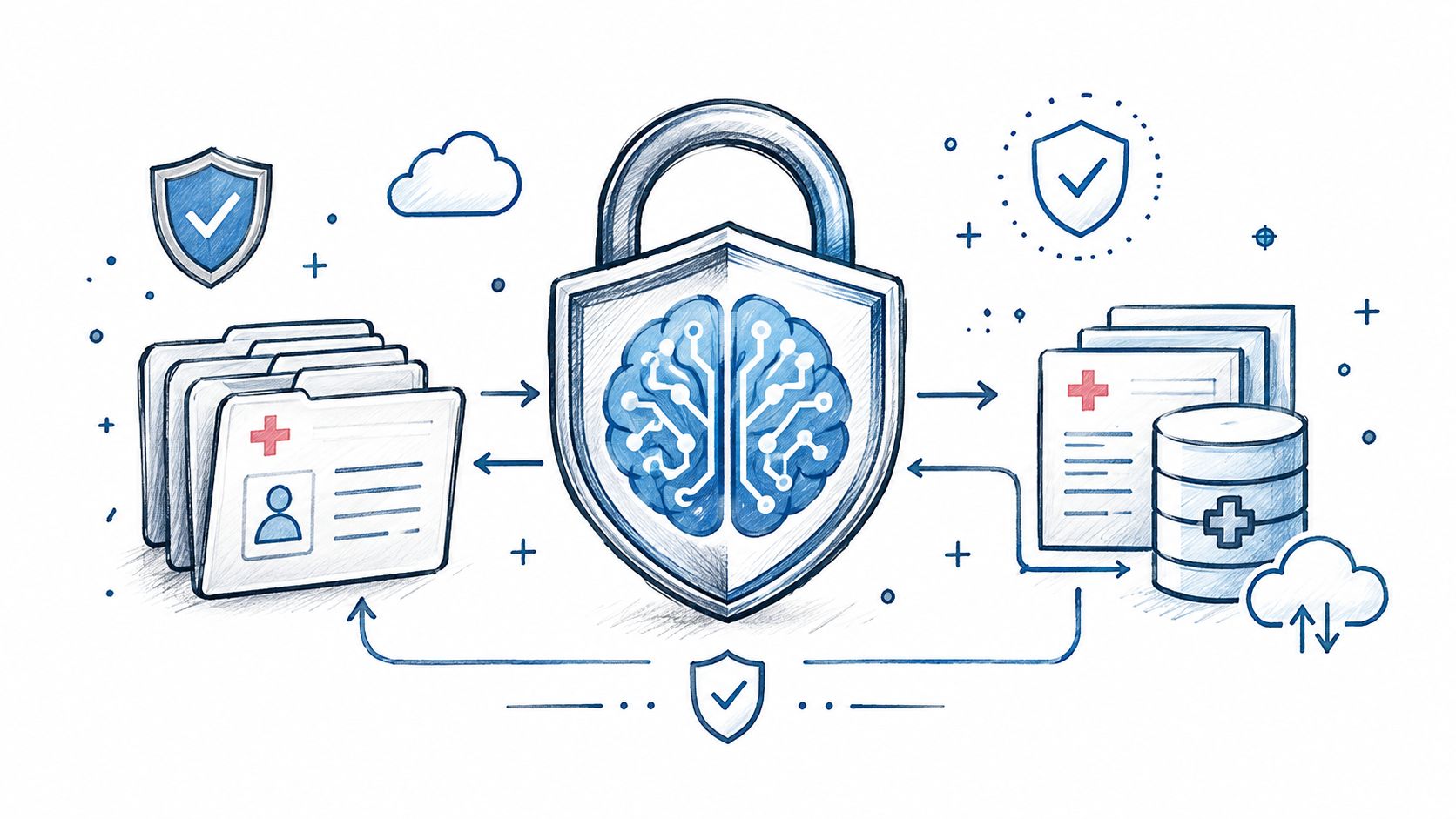
AI in Healthcare
HIPAA-Compliant AI: How to Use LLMs With PHI Safely
How to build HIPAA-compliant AI: when LLM providers need a BAA, data minimization, de-identification, audit controls and a reference architecture.
October 16, 2026Read more
Implement enterprise-grade healthcare AI platforms in 2026. Explore core capabilities, architecture, use cases, vendor selection, ROI, & executive roadmap.

A hospital CIO usually doesn't get to “start AI” with a clean slate. They get three pilots, two vendor promises, one department that loves the new tool, and a security team that's asking who can see patient data, where it lives, and what happens when the model changes next month. This underscores the demands placed on enterprise-grade healthcare AI platforms, they're not just software purchases, they're the layer that keeps clinical work, operations, governance, and data movement from turning into disconnected experiments.
The shift is already visible in health systems. A February 2026 survey of 120 health systems found 75% had deployed at least one AI solution, up from 59% a year earlier, which signals a move from pilots to enterprise deployments (survey data). For healthcare leaders, that means the question is no longer whether AI belongs in the stack. Rather, the question is whether the platform can integrate across the hospital, support oversight, and stay useful after the first wave of excitement fades. Ekipa AI's Healthcare AI Services fit into that strategy work when teams need a practical partner for scoping, integration planning, and deployment thinking.
A common pattern in healthcare is simple. A department buys one AI tool for documentation, another team trials a chatbot, and operations later discovers that neither system speaks cleanly to the EHR, the billing stack, or the governance process. Each pilot feels promising in isolation, but the organization ends up carrying technical debt, duplicated workflows, and compliance uncertainty.
That's why enterprise-grade healthcare AI platforms matter. They're built for hospital-wide integration, not just a single team's convenience. The platform has to fit the way a health system already works, meaning shared identity, governed data use, interoperability, and a path to scale beyond one enthusiastic department.
Practical rule: if a tool can't explain how it handles workflow ownership, access control, and performance oversight after go-live, it isn't really enterprise-ready.
The market is moving in that direction fast. Mordor Intelligence estimated the AI in enterprise healthcare platforms market at USD 5.22 billion in 2025 and projected USD 29.51 billion by 2031, with a 34.48% CAGR from 2026 to 2031 (market estimate). That kind of growth usually means buyers are trying to solve operational problems, not just test novelty. It also means the winners will be the platforms that can hold up under real governance and real workload.
A useful way to think about this is as the difference between a clinic app and a hospital utility. A clinic app can be valuable to one team. A hospital utility has to stay on, connect cleanly, and support many users without creating new risk.

Think of a hospital operations floor. Every department has its own job, but the whole place only works when records are accurate, handoffs are clean, and someone is watching for problems before they become incidents. Enterprise-grade healthcare AI platforms work the same way. They don't just generate outputs, they manage how those outputs fit into governed clinical and administrative work.
Data governance is the records desk of the platform. It decides who can access what, which data is allowed into which workflow, and whether the system can support safe, auditable use. For healthcare buyers, that matters because AI in this setting isn't dealing with generic text, it's dealing with PHI, regulated workflows, and system boundaries.
Interoperability is the handoff between departments. A useful platform should connect cleanly to existing EHRs, practice management systems, and adjacent tools rather than asking clinicians to swivel between windows and rekey information. Buyer guidance specifically recommends checking support for HL7 FHIR and a deep library of existing EHR and PM integrations (buyer's guide).
Ekipa AI's own AI strategy consulting can sit at this planning layer when teams need help turning those abstract requirements into a shortlist of real deployment constraints.
Healthcare workflows don't stay still. That's why static validation is never enough on its own. Clinical AI guidance calls for continuous feedback loops that capture clinician disagreement, measure usefulness, and trend performance over time (clinical AI platform guidance).
That feedback loop matters because a model that looks fine in testing can still behave awkwardly in practice if nurses work differently on nights, if a department changes triage rules, or if clinicians disagree with its recommendations. In other words, the platform has to learn from use, not just from launch-day approval.
Practical rule: if the platform can't tell you where clinician disagreement is happening, it's operating blind.
For buyers, that means the platform isn't only a model wrapper. It's an operating layer that connects governance, workflow, and performance review into one system.

Architecture choice shapes everything downstream. A small, tightly controlled environment can sometimes use a simpler stack, while an IDN with multiple hospitals and uneven data maturity usually needs more modularity. Ekipa AI's AI Product Development Workflow is useful here because architecture decisions and delivery decisions can't really be separated in healthcare.
At minimum, the platform needs to bring data in, normalize it, protect it, and keep models usable as conditions change. That's where data ingestion, interoperability, ML lifecycle management, security, and scalability become core evaluation pillars. They're not abstract features, they're the mechanics that decide whether the system survives contact with daily hospital work.
Healthcare's regulatory maturity also matters here. U.S. FDA-cleared or approved AI/ML-enabled medical devices reached 1,250 by May 2025, which shows that governed clinical AI is now part of normal product development rather than an edge case (FDA device count). That makes platform design more important, not less, because regulated tooling needs traceability from the start.
A Centralized Hub Architecture works like a command center. Data and control flow through one core layer, which can be helpful when an organization wants tighter governance and simpler oversight. A Distributed Mesh Architecture is closer to a network of connected departments, each with more autonomy but still following shared rules.
The right choice depends on how fragmented the health system already is. A uniform environment may do well with a hub. A multi-site IDN with different local systems may need the flexibility of a mesh so integrations don't become bottlenecks. The important part is that the architecture supports controlled change, not accidental sprawl.
Practical rule: choose the architecture your governance team can actually operate, not the one that looks neat in a demo.
This is also where platform engineering starts to matter. Ekipa AI's internal tooling work can support the operational side of the stack when teams need visibility into requests, approvals, or workflow state. For larger organizations, that layer often becomes the difference between a tool that is technically deployed and a platform that can be governed at scale.
If you're trying to map vendors to your environment, the key is to look for clean API design, workflow visibility, and a deployment model that doesn't force every team into the same operating pattern.
The strongest enterprise use cases usually start where the workflow is repetitive, costly, and easy to measure. That's why hospitals often begin with documentation support, call handling, intake assistance, or workflow automation before they touch anything that affects high-stakes clinical judgment.
In emergency care, AI documentation support can reduce the burden of writing while the clinician is still focused on the patient. The value isn't magic output, it's fewer interruptions and less mental switching between conversation and charting.
Predictive analytics for deterioration usually works best when it stays inside a governed clinical workflow. The platform has to surface risk in a way that fits existing escalation paths, not as a noisy alert that creates extra work for nurses.
Prior authorization is a different kind of pain point. It's administrative, but it affects patient access and staff time directly. Therefore, workflow automation can help teams move requests through a predictable sequence rather than hand-carrying each step.
Revenue cycle work is another strong fit, especially when teams need to reduce repetitive back-and-forth across billing and claims. For readers comparing practical operations support, a resource on optimize medical practice billing shows how adjacent automation thinking is also being applied outside core clinical documentation.
The point is that use cases should be selected for workflow fit, not hype. A platform that works well in scheduling may fail in clinical triage if the guardrails are weak. A platform that shines in billing may not belong near bedside decision support.
Ekipa AI's real-world use cases page can help teams translate those categories into concrete opportunities, especially when leaders are still deciding which workflow is worth operationalizing first. That step matters because the right first use case usually has enough volume to matter and enough structure to be governed.
Enterprise buyers should also ask a simple question. Does this use case reduce friction for staff without creating a second system of record? If the answer is no, adoption often stalls even if the model itself is impressive.
Choosing a vendor is less about the glossy demo and more about what happens when the platform meets hospital reality. The evaluation should cover integration depth, governance maturity, operating cost, and proof that the vendor has dealt with organizations similar to yours.
| Criteria | Key Questions |
|---|---|
| Scalability | Can the platform support multiple sites, service lines, and growing workflow volume without re-architecture? |
| EHR Integration Depth | Does it connect meaningfully to the systems you actually run, or only to one narrow workflow? |
| Interoperability Standards Support | Does it support HL7 FHIR and other standards your IT team already uses? |
| Total Cost of Ownership | What happens after go-live, and what staffing, infrastructure, and support costs continue? |
| Governance Infrastructure | Can it support approvals, auditability, access control, and workflow oversight? |
| Customer References | Has it worked in organizations that resemble your scale and complexity? |
A useful buyer move is to request the vendor's integration library and ask which connectors are maintained versus custom-built. You should also ask how PHI is handled, whether they offer BAAs, and how training data is controlled. Enterprise healthcare offerings are described as HIPAA-ready when they pair model controls with data-retention settings, BAAs, and healthcare-oriented connectors or agent skills (HIPAA-ready enterprise use).
Ask for the last mile, not just the architecture diagram. If a vendor can't explain how clinicians, compliance, and operations will actually use the system on Monday morning, the fit probably isn't there.
For teams that need a structured planning artifact, Ekipa AI's Custom AI Strategy report can support internal decision-making, while a separate regulatory compliance partner may be useful when a deployment needs specialized oversight. If you're considering broader platform categories, AI tools for business can help teams compare solution types before narrowing to a final stack.

Many AI buyers obsess over model quality and underestimate the operating bill. That's a mistake. The hard part isn't only getting a system to work once, it's keeping it reliable, secure, and affordable after it enters production. Mordor Intelligence notes that healthcare payers are the fastest-growing users, with a 36.88% CAGR, which makes post-launch economics a central issue rather than a side note (market report).
The first risk is PHI leakage. For regulated workflows, a practical baseline is to separate the model layer from PHI handling and restrict training on customer data unless explicitly permitted, because healthcare platforms are described as HIPAA-ready only when those controls sit in place (enterprise healthcare limits).
The second risk is drift. A model that works on day one can degrade as workflows change, users adapt, or data sources shift. That's why formal validation and continuous monitoring matter after launch, not just before it.
The third risk is inequitable performance. Healthcare AI content often talks about governance in the abstract, but safety-net systems and multi-site organizations need infrastructure and training that reflect uneven resources, not ideal conditions. A recent CHCF discussion emphasizes equitable infrastructure and dedicated funding for underserved communities, while a systematic review in PMC highlights persistent concerns around bias, privacy, regulation, and inclusion (CHCF discussion).
ROI in healthcare AI is broader than accuracy. It includes staff time, workflow reliability, avoided rework, and the cost of sustaining the system. If the platform reduces one manual task but requires constant custom maintenance, the business case weakens quickly.
That's why operational layers matter. Ekipa AI's AI Automation as a Service can be relevant when teams want to explore automation without turning every workflow into a long internal rebuild. On the other hand, buyers should still budget for data unification, workflow redesign, and the people who keep the system monitored after launch.
For teams looking at adjacent operational support, a resource on how managed IT helps healthcare clinics reinforces a similar point, good technology still needs a support model around it. That idea applies directly to healthcare AI. The platform is only one line item. The operating model is the rest.
Practical rule: calculate ROI over the life of the platform, not just the pilot window. If you ignore post-go-live staffing and monitoring, the spreadsheet will lie to you.

Leaders usually don't need more theory. They need a sequence that can survive budget review, security review, and clinical review. A phased plan works because it forces the organization to prove value before it expands complexity.
Start by identifying the workflows that are painful, repetitive, and measurable. That's where AI requirements analysis matters most, because you need to know which systems the platform must touch, who owns the process, and what success looks like before anyone buys software.
During the pilot, keep the scope narrow. One department, one workflow, one clear set of governance checkpoints. If the pilot is successful, its value should be visible in how much smoother the workflow feels, not in how many features the vendor showed in a demo.
Scaling is where many programs slow down. This is the moment to connect the pilot to broader workflows, formalize ownership, and decide whether the platform can stretch across additional sites. Ekipa AI's custom healthcare software development capabilities may be relevant when the platform needs deeper product work around the edge of the AI layer.
The final phase is optimization. That means monitoring outcomes, improving the workflow, and deciding where the platform should expand next. Ekipa AI's AI Product Development Workflow and internal tooling support can be useful at this stage, especially when teams need workflow controls, internal visibility, or support for long-term iteration.
A healthy roadmap usually ends where the organization can maintain the system without heroics. If every enhancement requires an emergency project, the platform isn't mature yet.
Enterprise-grade healthcare AI platforms succeed when they do three things at once. They connect to real hospital systems, they stay governable under clinical and regulatory pressure, and they remain affordable to operate after launch. The hard part isn't choosing a model. It's choosing an operating system for AI that can survive healthcare's complexity.
If your team is evaluating where to start, focus on the use case, the governance model, and the support structure around the platform. Ekipa AI's AI tools for business, SaMD solutions, and our expert team can help you pressure-test the strategy, architecture, and delivery path before you commit. Strong platforms are built with cross-functional judgment, not just technical ambition.
If you're planning an enterprise AI initiative, connect with Ekipa AI and speak with our expert team about strategy, implementation, and governance for your healthcare workflow.
How to build HIPAA-compliant AI: when LLM providers need a BAA, data minimization, de-identification, audit controls and a reference architecture.
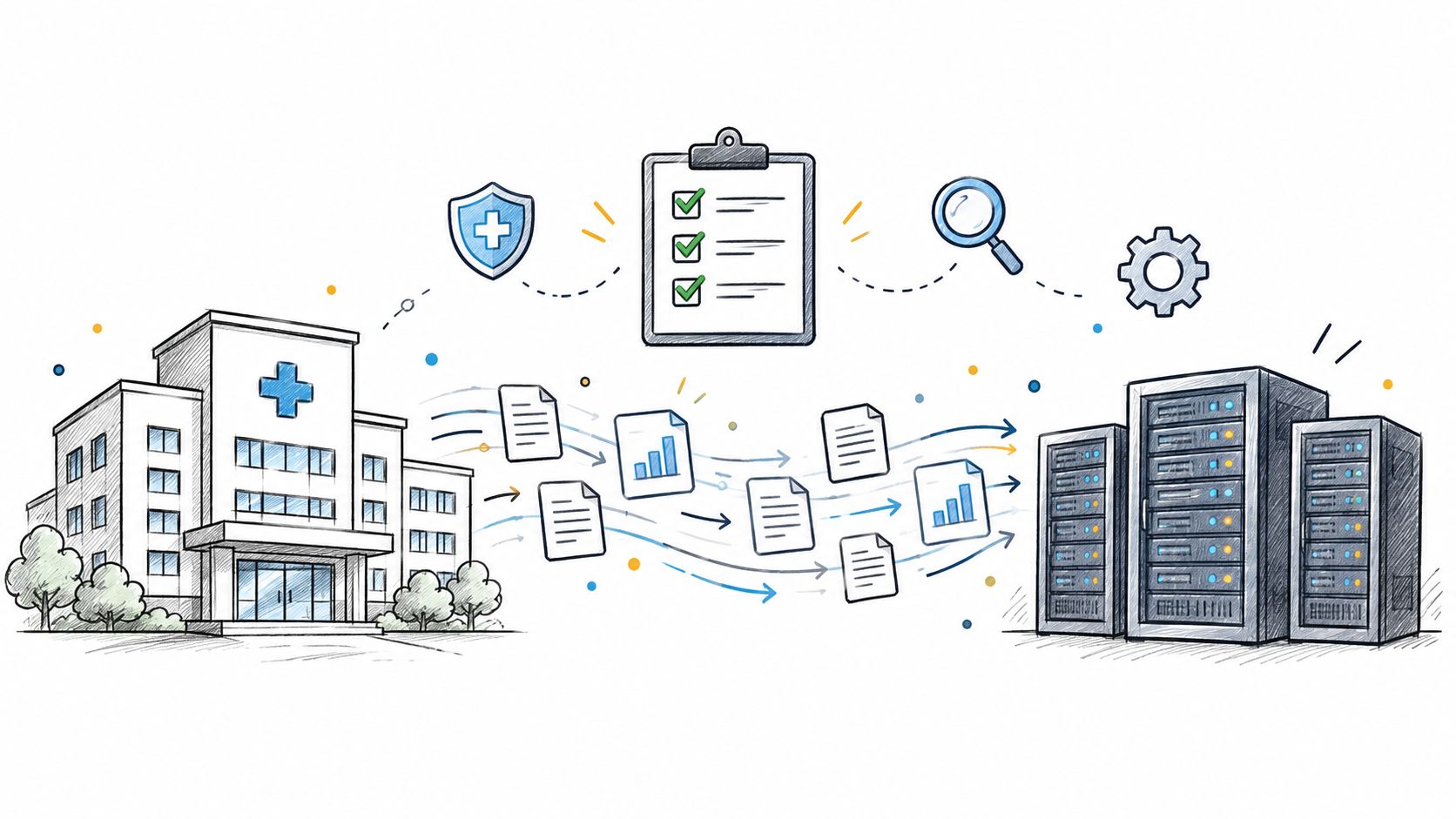
Practical data migration planning guide for healthcare teams. Scope, mapping, compliance, validation, cutover and rollback decisions explained end to end.
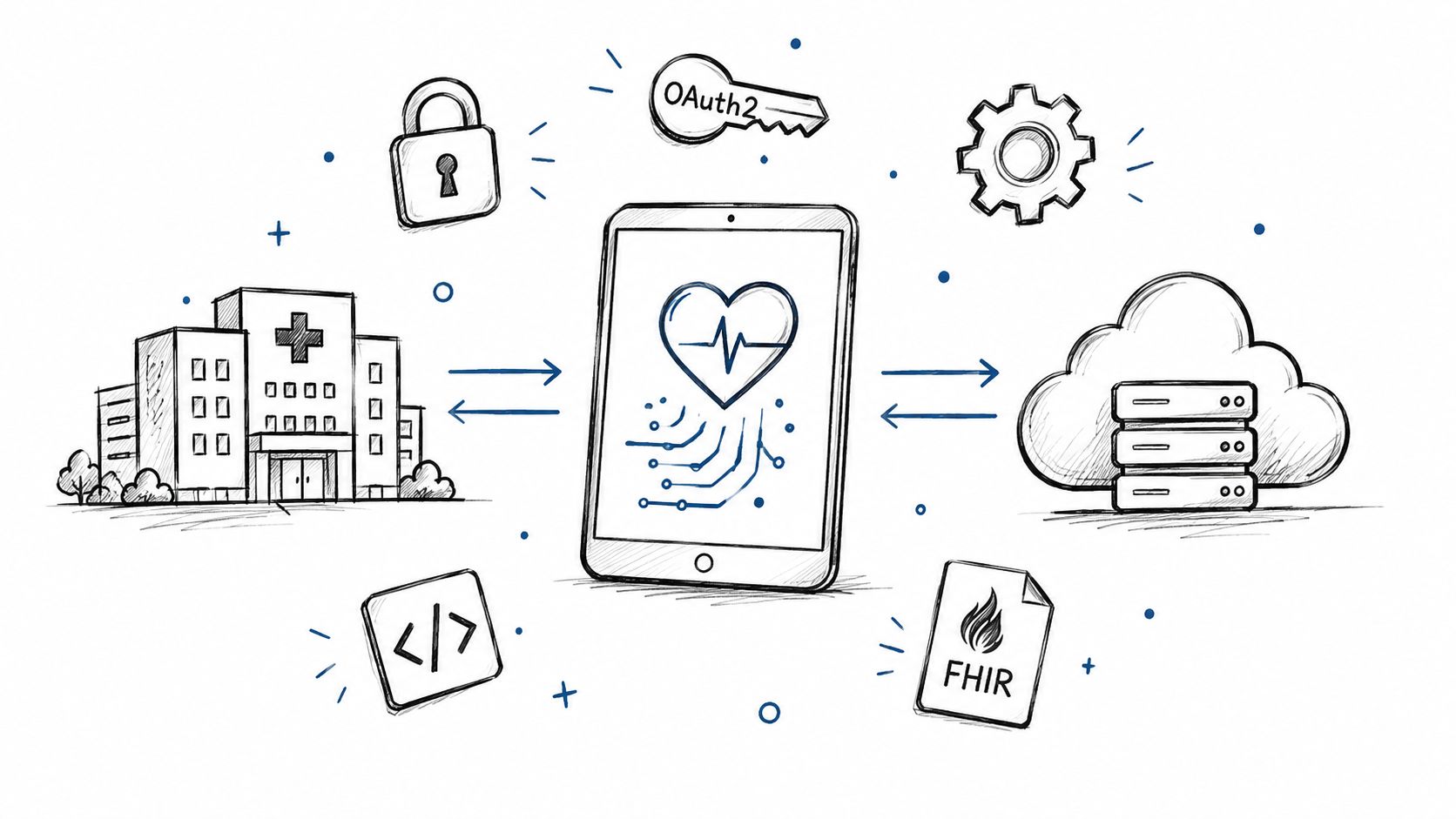
Smart on FHIR guide for healthtech engineers. Learn the OAuth 2.0 launch model, scope syntax, backend services, and US regulatory requirements.
Connect with our team to explore how AI expertise can transform your business.