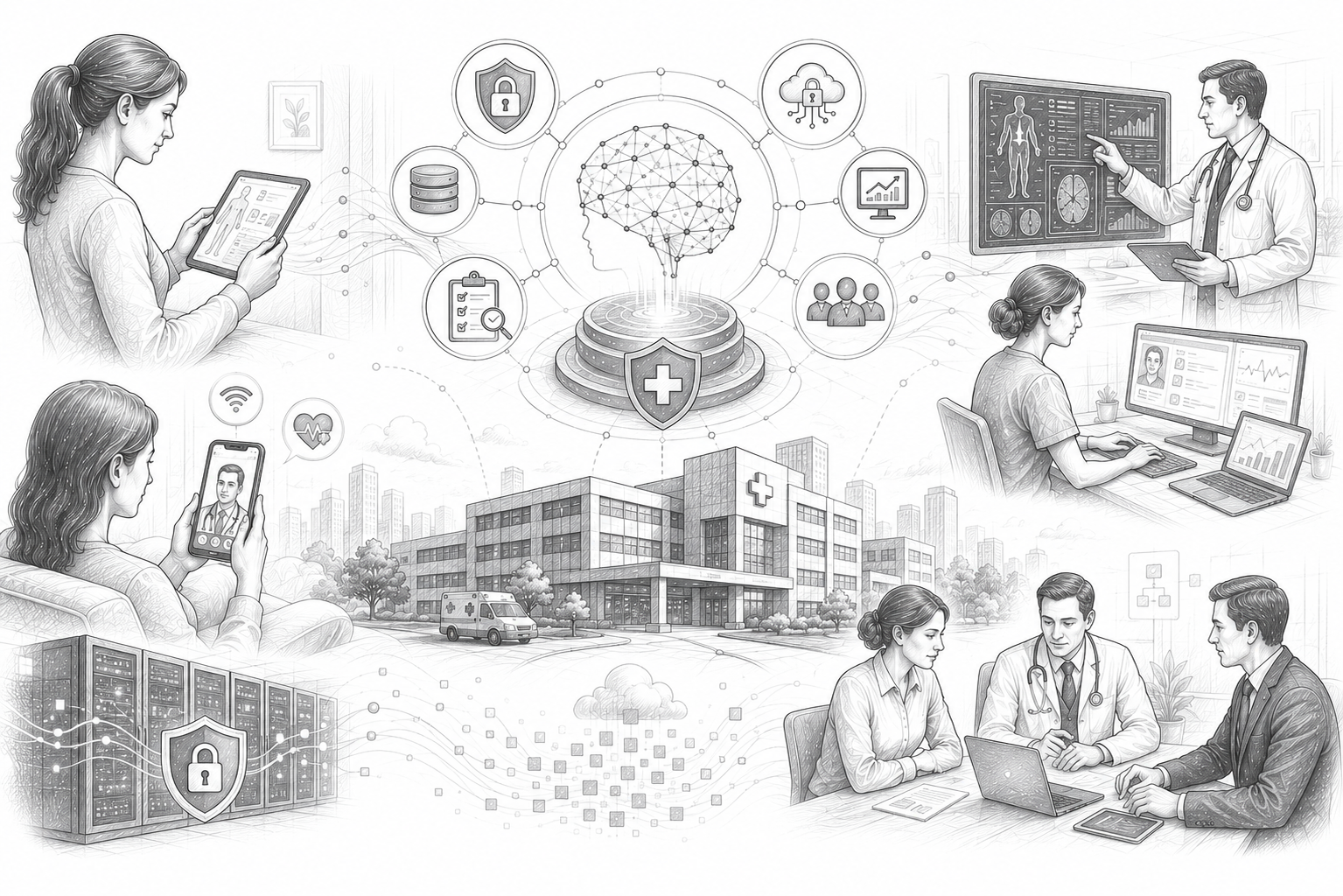
It’s a staggering paradox: healthcare is responsible for a massive 30% of the world's data, yet an almost unbelievable 97% of it sits idle. This valuable information is trapped, locked away in dozens of disconnected systems, rendering it almost useless for improving care or operations.
Enterprise Health Data Platforms (EHDPs) are built to solve this exact problem. Think of an EHDP as the central nervous system for a modern health organization—a smart, unified hub designed to connect every piece of fragmented data into a single, reliable source of truth.
The New Backbone of Modern Healthcare
For years, healthcare organizations have treated data as a simple byproduct of their daily work. Information was captured during a patient visit or a lab test and then filed away. This created a messy web of data silos, with electronic health records (EHRs), billing systems, imaging archives, and lab results all living in their own separate worlds. Trying to build a complete picture of a patient or the organization's health from this jumble is next to impossible.
An enterprise health data platform flips that entire model on its head. It’s not another dusty data warehouse; it's a dynamic, living system that actively pulls in data from every corner of your ecosystem. It then translates those disparate signals into clear, actionable insights. This is more critical than ever, especially with the explosion of data coming from the Internet of Things in Medical (IoMT), which makes a centralized platform non-negotiable.
An enterprise health data platform isn’t just about collecting data; it’s about activating it. By creating a single source of truth, it becomes the launchpad for advanced analytics, operational efficiency, and ultimately, better patient care.
This unified approach is what powers modern Healthcare AI Services. It’s no surprise that the healthcare analytics market is booming, with projections showing it could hit $64 billion by 2025. Organizations are finally realizing the immense value locked inside their patient data and are racing to build the infrastructure needed to unleash it.
Shifting From Silos to Synergy
The move from traditional, siloed systems to an integrated enterprise platform is a fundamental strategic shift. It’s the difference between having a library of disconnected books and having a fully indexed, searchable, and intelligent digital database. This is where the real work begins—and where an organization’s data finally becomes its most valuable asset.
This table highlights the core differences between the old way and the new.
| Characteristic |
Traditional Data Systems (Silos) |
Enterprise Health Data Platform (EHDP) |
| Data Scope |
Fragmented; focused on specific departments (e.g., EHR, billing) |
Holistic; ingests data from all sources (clinical, financial, operational, IoT) |
| Data State |
Raw, inconsistent, and often duplicated across systems |
Cleaned, normalized, and standardized into a single source of truth |
| Patient View |
Incomplete; a snapshot from one system at a time |
Comprehensive 360-degree view of the entire patient journey |
| Accessibility |
Difficult to access; requires manual queries and data blending |
Easily accessible via APIs for analytics, AI/ML, and applications |
| Purpose |
Primarily for record-keeping and archival |
Designed for active use—powering real-time insights and predictions |
As you can see, the EHDP is built for action. The data isn't just stored; it's curated and made ready for advanced applications from the moment it arrives. This is the groundwork that separates industry leaders from everyone else. It’s the essential foundation for building intelligent systems that can predict patient risks, optimize hospital resources, and deliver truly personalized care at scale.
Understanding the Core Architecture
To really get what an enterprise health data platform does, you have to look under the hood. It’s not just one piece of software; it’s more like a sophisticated digital engine made of several interconnected parts. Each part has a very specific job, and together, they turn the chaotic flood of health information into a clean, intelligent, and accessible resource.
The whole process starts with what sounds like a simple first step: getting all the data into the system. In healthcare, that's where the first major hurdle appears.
Data Ingestion: The Great Unifier
Data ingestion is the platform's front door. It’s responsible for pulling in information from an incredible variety of sources. Think about it: you've got structured data like lab results from a Laboratory Information Management System (LIMS), but you also have unstructured, free-text doctor’s notes sitting in an EHR. On top of that, you have data coming from billing systems, pharmacy records, and even real-time streams from patient wearables.
This first stage has to be incredibly flexible, ready to handle everything from secure file transfers to direct API calls. If your ingestion layer isn't up to the task, your most valuable data stays locked away in its original silo. The goal of a unified patient view is dead on arrival.
This diagram illustrates how a central platform acts as a brain, integrating all these different inputs.

As you can see, the platform becomes the central nervous system for creating a complete patient picture. But once the raw data is in, the real work of making it truly useful begins.
Storage and Normalization: Creating Order from Chaos
Let's be honest: raw healthcare data is a mess. One hospital might log a diagnosis as "High Blood Pressure," while another across town uses the clinical term "Hypertension." A single patient can easily have different ID numbers in the EHR, the lab system, and the billing department.
This is where data normalization becomes absolutely critical. The platform applies sophisticated rules to wrangle this chaos into order. It will:
- Standardize medical terms and billing codes.
- De-duplicate patient records to create a single, reliable master patient index.
- Cleanse the data by flagging errors and filling in gaps where possible.
Only after this cleanup is the data moved into a secure, scalable data lake or cloud warehouse. Now, it’s in a consistent state, ready for analysis. This step is the foundation for any serious AI Product Development Workflow, because clean, reliable data is the only fuel that works for machine learning.
Terminology Services: The Universal Translator
To make sure everyone is speaking the same clinical language, these platforms use terminology services. These are specialized tools that manage and map thousands of medical vocabularies. They act as a universal translator, ensuring that a concept like "myocardial infarction" is understood the same way whether it came from a doctor's note, a billing code, or an imaging report.
Think of terminology services as the Rosetta Stone for your health data. They translate thousands of disparate medical terms into a single, standardized language, making large-scale analytics and interoperability possible.
Some of the key standards managed by these services include:
- SNOMED CT for clinical terms
- LOINC for lab tests and observations
- RxNorm for medications
By enforcing a common vocabulary, these services make the data truly interoperable and clinically meaningful. This is a non-negotiable component in both our approach to custom healthcare software development and our broader healthcare software solutions.
APIs: The Secure Gateway for Innovation
So, the data is in, it's clean, and it's speaking a common language. How do people and applications actually use it? The answer is Application Programming Interfaces (APIs).
APIs are secure gateways that let other applications request and receive data from the platform without ever compromising the core system's security. This is what unlocks innovation.
A research team could use an API to query anonymized patient data for a clinical trial. An AI application could tap into real-time data streams to predict sepsis risk. Even your own internal tooling can be plugged in, giving your teams direct access to powerful insights. APIs make the data actionable, turning the platform from a static database into a dynamic engine for discovery. Our AI strategy consulting can help you build a roadmap for putting these APIs to work.
Protecting Patient Data with Robust Governance
In healthcare, patient data isn't just a string of ones and zeros. It represents a deeply personal story and a bond of trust between an individual and their care provider. For any enterprise health data platform, protecting that trust isn't a feature—it’s the absolute bedrock of the entire system.
Security, compliance, and governance aren't just checkboxes to tick. While many see regulations like the Health Insurance Portability and Accountability Act (HIPAA) or certifications like HITRUST as obstacles, it's better to view them as a clear roadmap. They give us the structure needed to safeguard protected health information (PHI) and build a system that patients and providers can truly rely on.

This framework is brought to life through specific technical safeguards. Think of these as the digital locks, alarms, and security guards that must be designed into the platform from the very beginning.
The On-Premises vs. Cloud Security Debate
One of the first major decisions you'll face is where your data will actually live. The choice between on-premises servers and a cloud-based environment has huge implications for security, control, and of course, cost. And while the cloud is certainly growing, many healthcare leaders are still rightfully cautious.
The data backs up this hesitation. Even with a major push to the cloud, on-premises solutions are still expected to hold a 57.8% market share in healthcare analytics through 2026. This isn't just stubbornness; it’s a direct response to skyrocketing data breach costs, which are projected to hit an average of $7.42 million by 2025 after impacting 289 million records in 2024.
An on-premises platform gives an organization direct, physical control over its data, which many leaders see as the ultimate security guarantee. A cloud platform offers immense scalability and lower upfront costs but requires placing trust in a third-party vendor’s security protocols.
Neither option is automatically right or wrong, but they come with very different responsibilities. On-prem demands a skilled in-house team to manage everything from physical access to security patches. A cloud strategy, on the other hand, hinges on rigorous vendor vetting and airtight contracts.
Essential Technical Safeguards
No matter which path you choose, every trustworthy enterprise health data platform must be built with a multi-layered security strategy. These are the non-negotiable components that protect patient data from being exposed or misused.
- End-to-End Encryption: Data has to be unreadable both when it's sitting in a database (at rest) and when it's moving between systems (in transit). This is your primary defense; even if data is intercepted, it remains gibberish.
- Role-Based Access Control (RBAC): Not everyone on the team needs access to everything. RBAC works on the principle of least privilege, ensuring a clinician can see patient charts while a billing specialist can only access financial data.
- Comprehensive Audit Trails: Every single action taken on the data must be logged. This creates a transparent, unchangeable record of who accessed what, when they did it, and what actions they took—a critical tool for compliance and investigating any incidents.
Building Trust with Strong Data Governance
Technical security is only half the battle. Just as important is the discipline of data governance. This is the complete set of policies, standards, and processes that dictate how data is managed and protected across your organization. It answers the tough questions, like:
- Who is the official owner of this dataset?
- What are our quality standards for this data to be considered "good"?
- What are the ethical rules for using this data in our analytics and AI models?
Think of strong data governance as the foundation for reliable analytics. If you can't trust your data, you can't trust the insights you get from it. As you navigate the complexities of securing patient data, understanding regulations like HIPAA is essential. For a closer look at managing sensitive information during platform transitions, you can find valuable insights on HIPAA SharePoint Migration. This governance ensures every tool and analysis you build operates on a foundation of quality and trust.
How AI Turns a Data Platform into an Intelligence Engine
An enterprise health data platform’s real value isn't just in neatly organizing data—it's in preparing that data to think. Once you have a clean, standardized, and accessible foundation, the platform becomes a launchpad for artificial intelligence. This is where you make the leap from reacting to health events to proactively predicting them. It's the moment your unified data strategy truly comes alive.
Think of it this way: high-quality data is the fuel for any machine learning model. Without it, your AI initiatives will sputter and fail, producing biased or unreliable results. With a solid EHDP in place, however, healthcare organizations can finally tap into the advanced analytics that define modern, data-driven medicine.

This powerful combination is attracting massive investment. The big data analytics market in healthcare is on track to hit $113.65 billion by 2030, a surge driven by the explosion of data from EHRs and connected health devices. Hospitals and health systems are aggressively adopting cloud and AI to shift away from costly acute care and toward preventive models. For a closer look at the numbers, you can read the full research on big data analytics in healthcare.
Unlocking Predictive Power
Predictive analytics is arguably one of the most exciting applications of AI in a clinical setting. By sifting through enormous historical datasets, machine learning models can spot faint patterns that signal future health problems, giving care teams a chance to step in before a patient’s condition worsens.
Here are a few ways an EHDP makes this possible:
- Spotting At-Risk Patients: Models can flag individuals who show a high probability of developing chronic conditions like diabetes or heart failure, triggering early and often life-saving interventions.
- Preventing Hospital Readmissions: By understanding the common factors that lead to readmission, hospitals can create targeted follow-up plans for their most vulnerable patients, improving outcomes and trimming costs.
- Forecasting Sepsis Risk: AI can analyze real-time data streams from patient monitors to detect the earliest signs of sepsis, a deadly condition where every hour counts.
This fundamental shift toward proactive care is a core principle behind our Healthcare AI Services. It’s about using data to get ahead of problems, not just respond to them.
"AI does not create enterprise value on its own. Strong data foundations, regulatory maturity, workflow integration, and trust do."
This statement gets to the heart of why an EHDP is so essential. The platform delivers the trustworthy data foundation needed for AI to succeed—not just in a lab, but in the complex reality of a clinical workflow.
Turning Unstructured Notes into Actionable Insights
A staggering amount of crucial clinical information—up to 80%—is trapped in unstructured formats. We're talking about physician’s notes, discharge summaries, and pathology reports. Natural Language Processing (NLP) is the key that finally unlocks this treasure trove of data.
An NLP engine can effectively read and interpret this free-form text, pulling out critical details like diagnoses, symptoms, and medications that are often missing from structured data fields. This is a game-changer for everything from accelerating clinical research to streamlining daily operations. Our approach to NLP is a central part of many of the AI tools for business we help build. To see exactly how this works, check out our deep dive on the AI-powered data extraction engine.
Enhancing Diagnostics with Computer Vision
Finally, computer vision models are completely changing the field of medical imaging. Trained on millions of scans, these AI systems can analyze X-rays, CT scans, and MRIs to spot abnormalities with an accuracy that can meet or even surpass human experts.
This technology doesn't replace radiologists. Instead, it acts as a powerful assistant, helping to prioritize the most urgent cases and flagging subtle findings that a busy clinician might otherwise miss.
By bringing these powerful AI applications together, an enterprise health data platform becomes a true engine for innovation. It helps reduce clinician burnout by automating tedious tasks, sharpens diagnostic accuracy, and gives providers the tools they need to deliver truly personalized, proactive care.
Driving Real-World Impact and ROI
All this talk about architecture and data models is great, but leaders always ask the same critical question: What’s the return on this investment? An enterprise health data platform isn't just another piece of tech. It’s a foundational shift that pays for itself through better patient outcomes, reduced costs, and smoother operations.
The real magic happens when clean, unified data becomes the bedrock of every decision. Health systems can finally stop just reacting to problems and start building proactive programs that deliver tangible results. This is where the upfront work on a solid data infrastructure truly begins to pay off.
Powering Proactive Population Health
One of the first places you’ll see a real difference is in population health management. By bringing together data from EHRs, claims systems, and even social determinants of health, organizations get a clear, live picture of their entire patient community. This allows them to spot high-risk groups and step in before a minor health issue becomes a major one.
For example, a health system can use its unified data to:
- Slash Hospital Readmissions: Find patients who are likely to be readmitted and deploy targeted support, like follow-up calls or home health visits, to keep them recovering safely at home.
- Manage Chronic Conditions: Keep an eye on patients with conditions like diabetes or hypertension, automatically flagging anyone who isn't on track and alerting care managers to reach out.
- Close Gaps in Care: Identify patients who are behind on preventive screenings, such as mammograms or colonoscopies, and send them personalized, automated reminders.
The University of Pittsburgh Medical Center (UPMC) put this into practice. By using a centralized platform to analyze patient data, they cut readmissions for heart failure patients by an incredible 40%. This is a perfect example of how good data translates directly into better health and massive cost savings.
Optimizing Clinical and Operational Workflows
Beyond patient-facing programs, these platforms deliver huge returns by untangling the complex workflows that keep a hospital running. Administrative bloat and operational snags are massive cost drivers in healthcare, and a single source of truth is the best tool for spotting and fixing them.
This is particularly true for complex functions like clinical trials and revenue cycle management. Diving into real-world use cases shows how data turns these areas from cost centers into strategic advantages. Imagine researchers needing to find eligible patients for a new trial. Instead of digging through siloed records for months, they can query a unified database and get a list of candidates in minutes.
The same principle transforms the revenue cycle. Predictive models built on the platform can forecast claim denials before they're even submitted, giving billing teams a chance to fix errors on the spot. The result is faster payments, less administrative headache, and a much healthier bottom line. This ability to create targeted tools is a core strength of custom healthcare software development, which turns raw data into a real-world business asset.
Ultimately, an enterprise health data platform proves its worth by helping create a smarter, more efficient, and forward-thinking healthcare system. The ROI isn't just about the dollars you save; it's about the lives you improve. That dual return makes it one of the most important strategic moves a healthcare organization can make.
Your Path to a Successful Implementation
So, you’re ready to build an enterprise health data platform. The key to getting it right isn't a massive, "big bang" launch. It's a deliberate, phased journey that starts with a clear vision and ends with real, measurable results. This roadmap is for leaders who want to build modern data infrastructure the smart way—avoiding the common and costly mistakes.
The work begins long before you even think about vendors. It all starts with strategy. The first step is to develop a Custom AI Strategy report that nails down your core objectives and the specific business problems you're trying to solve. From there, you can conduct a thorough AI requirements analysis to make sure the technology you build is a perfect match for your clinical and operational needs.
Setting Your Strategic Foundation
One of the biggest pitfalls is jumping straight to the technology without a solid "why." Your initial strategy has to answer some tough questions. Are you aiming to lower hospital readmission rates? Make clinical trial recruitment more efficient? Or get a better handle on your revenue cycle? Focusing on these high-value targets ensures the platform delivers a tangible return on investment right from the start.
This kind of strategic clarity is what gets you executive sponsorship and, just as important, buy-in from your clinicians. When doctors and nurses see how the platform will actually fix their daily frustrations, they go from being skeptical observers to your biggest supporters. This foundational work de-risks the entire project, a process our AI strategy consulting is built to accelerate.
A Phased Roadmap to Success
Once your strategy is set, you can shift to a structured, phased implementation. This approach lets you show value quickly, learn as you go, and build momentum. As we explored in our AI adoption guide, starting small with a focused pilot is a proven path to success.
-
Phase 1: Pilot and Proof of Concept (Months 1-6): Choose one high-impact use case. Bring in a limited number of data sources and build out a small-scale model to prove the concept works and delivers value. A detailed AI Product Development Workflow is absolutely essential here.
-
Phase 2: Expansion and Integration (Months 7-18): Building on the pilot's success, start connecting more data sources—think lab systems, billing software, and even custom internal tooling. Grow the platform to support two or three additional use cases.
-
Phase 3: Enterprise-Wide Rollout (Months 19+): Now you're ready to scale the platform across the entire organization. At this stage, you can bring in advanced capabilities like AI Automation as a Service to maximize efficiency and find new ways to innovate.
Common Pitfall to Avoid: A mistake we see all the time is underestimating the sheer complexity of data migration. Moving decades of historical data out of legacy systems isn't a simple copy-and-paste. It demands meticulous planning, data cleansing, and validation to make sure the data is trustworthy in its new home.
Building powerful enterprise health data platforms isn't the multi-year ordeal it used to be. With the right strategy, a phased approach, and an experienced partner, you can establish an agile, intelligent data foundation faster and more cost-effectively than ever. To see how we can guide you through every step, get in touch with our expert team today.
Frequently Asked Questions
Still have questions about enterprise health data platforms? Let's tackle some of the most common ones we hear from healthcare leaders.
What Is the Difference Between an EHR and an Enterprise Health Data Platform?
It's a great question, and the distinction is crucial. Your Electronic Health Record (EHR) is fundamentally a system of record, like a highly detailed digital filing cabinet for an individual patient. It's fantastic for capturing clinical notes, orders, and results during a visit.
An enterprise health data platform, on the other hand, is a system of insight. It doesn't replace your EHRs; it connects them. It pulls in data from all your different systems—multiple EHRs, lab systems, pharmacy benefits managers, billing software, even patient wearables—and weaves it all together into a single, reliable source of truth for your entire organization.
Can Smaller Clinics or Hospitals Benefit from an EHDP?
It’s a common misconception that these platforms are only for massive health systems. While the scale is different, the core problems are the same. A smaller specialty clinic can get immense value from unifying its data to better manage high-risk patient populations or automate quality reporting.
The trick is to scale the approach to the size of your organization and goals, not the other way around. You don't need a massive, multi-year project to get started. Our expertise in AI strategy consulting is geared toward finding that "just right" starting point.
How Long Does EHDP Implementation Take?
That really depends on the scope. We’ve seen focused, high-impact pilot projects go live in as little as 6-9 months. A full, wall-to-wall enterprise rollout is naturally a bigger undertaking, often ranging from 18 to 36 months.
The key to a faster return on investment isn't cutting corners; it's starting with a rock-solid plan. Our Custom AI Strategy report is designed to do just that—define a clear, phased roadmap so you start seeing value much sooner.
Who Needs to Be Involved in an EHDP Implementation?
Putting one of these platforms in place truly takes a village. You can't just hand it off to the IT department. A successful project always brings together a cross-functional team.
You’ll need:
- IT and data architects to build the technical foundation.
- Clinical leaders and physicians to ensure the data is accurate and the workflows make sense in practice.
- Compliance and security officers to oversee data governance and patient privacy.
- Operational and financial leaders to connect the data back to business goals.
Bringing an experienced partner like our expert team into the mix helps orchestrate all these moving parts, keeping everyone aligned and the project on track.